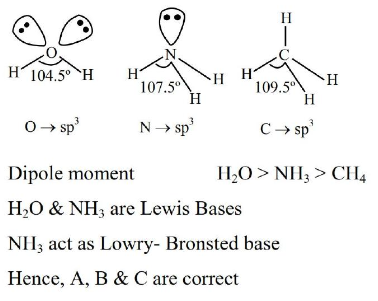
Which of the following statement is true with respect to $\mathrm{H}_{2} \mathrm{O}, \mathrm{NH}_{3}$ and $\mathrm{CH}_{4}$ ? A. The central atoms of all the molecules are $\mathrm{sp}^{3}$ hybridized. B. The $\mathrm{H}-\mathrm{O}-\mathrm{H}, \mathrm{H}-\mathrm{N}-\mathrm{H}$ and $\mathrm{H}-\mathrm{C}-\mathrm{H}$ angles in the above molecules are $104.5^{\circ}, 107.5^{\circ}$ and $109.5^{\circ}$ respectively. C. The increasing order of dipole moment is $\mathrm{CH}_{4}<\mathrm{NH}_{3}<\mathrm{H}_{2} \mathrm{O}$. D. Both $\mathrm{H}_{2} \mathrm{O}$ and $\mathrm{NH}_{3}$ are Lewis acids and $\mathrm{CH}_{4}$ is a Lewis base E. A solution of $\mathrm{NH}_{3}$ in $\mathrm{H}_{2} \mathrm{O}$ is basic. In this solution $\mathrm{NH}_{3}$ and $\mathrm{H}_{2} \mathrm{O}$ act as Lowry-Bronsted acid and base respectively. Choose the correct answer from the options given below :
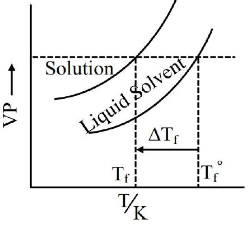
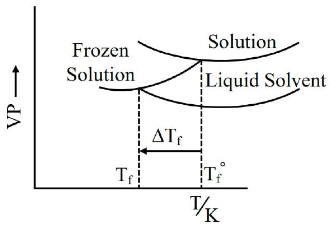
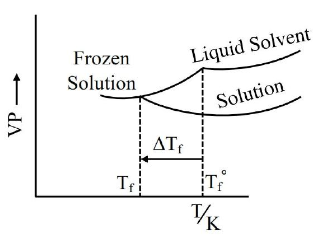
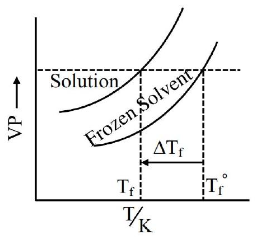
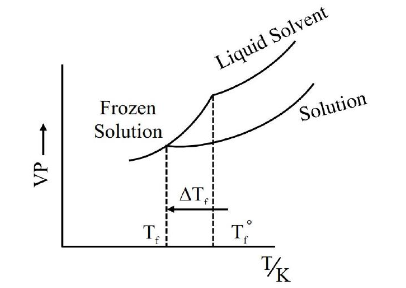
Consider the given plots of vapour pressure (VP) vs temperature (T/K) Which amongst the following options is correct graphical representation showing $\Delta \mathrm{T}_{\mathrm{f}}$, depression in the freezing point of solvent in a solution?
A
B
✓
D
Answer
Correct option: C.
(C) Sol. On adding non-volatile solute in a solvent, the freezing point of solution decreases. $\mathrm{T}_{\mathrm{f}}<\mathrm{T}_{\mathrm{f}}^{0}$ F.P. of solution < F.P. of pure solvent Also V.P. of solution decreases on adding nonvolatile solute in a solvent.
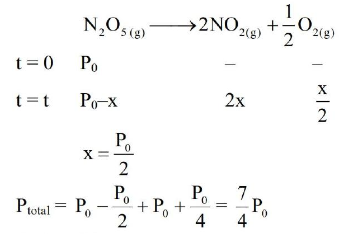
For a reaction, $\mathrm{N}_{2} \mathrm{O}_{5(\mathrm{~g})} \rightarrow 2 \mathrm{NO}_{2(\mathrm{~g})}+\frac{1}{2} \mathrm{O}_{2(\mathrm{~g})}$ in a constant volume container, no products were present initially. The final pressure of the system when $50 \%$ of reaction gets completed is
The large difference between the melting and boiling points of oxygen and sulphur may be explained on the basis of
A
Atomic size
✓
Atomicity
C
Electronegativity
D
Electron gain enthalpy
Answer
Correct option: B.
Atomicity
(B) Sol. Oxygen exists as $\mathrm{O}_{2}($ Atomicity $=2)$ Sulphur exists as $\mathrm{S}_{8}($ Atomicity $=8)$ Hence, Melting point & Boiling point of sulphur are significantly large compared to oxygen.
Preparation of potassium permanganate from $\mathrm{MnO}_{2}$ involves two step process in which the $1^{\text {st }}$ step is a reaction with KOH and $\mathrm{KNO}_{3}$ to produce
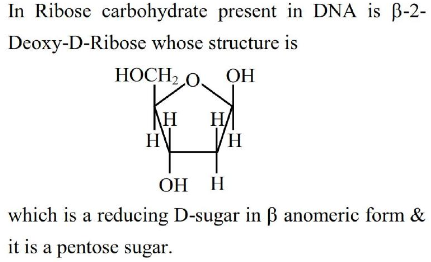
The carbohydrates "Ribose" present in DNA, is A. A pentose sugar B. present in pyranose from C. in "D" configuration D. a reducing sugar, when free E. in $\alpha$-anomeric form Choose the correct answer from the options given below :
Which of the following Statements are NOT true about the periodic table? A. The properties of elements are function of atomic weights. B. The properties of elements are function of atomic numbers. C. Elements having similar outer electronic configuration are arranged in same period. D. An element's location reflects the quantum numbers of the last filled orbital. E. The number of elements in a period is same as the number of atomic orbitals available in energy level that is being filled. Choose the correct answer from the options given below:
✓
A, C and E Only
B
D and E Only
C
A and E Only
D
B, C and E Only
Answer
Correct option: A.
A, C and E Only
(A)
Sol. Properties of elements are periodic function of their atomic number. Elements having similar outer electronic configuration are arranged in same group. Number of elements in a period is not equal to number of atomic orbitals available in energy level that is being filled. Hence, A, C & E are incorrect
Given below are two statements I and II. Statement I : Dumas method is used for estimation of "Nitrogen" in an organic compound. Statement II : Dumas method involves the formation of ammonium sulphate by heating the organic compound with conc $\mathrm{H}_{2} \mathrm{SO}_{4}$. In the light of the above statements, choose the correct answer from the options given below
A
Both Statement I and Statement II are true
B
Statement I is false but Statement II is true
C
Both Statement I and Statement II are false
✓
Statement I is true but Statement II is false
Answer
Correct option: D.
Statement I is true but Statement II is false
(D) Sol. In Dumas method nitrogen present in organic compound is converted into $\mathrm{N}_{2}$ gas whose volumetric analysis gives the percentage of nitrogen atom in the organic compound.
Let us consider an endothermic reaction which is non-spontaneous at the freezing point of water. However, the reaction is spontaneous at boiling point of water. Choose the correct option.
✓
Both $\Delta \mathrm{H}$ and $\Delta \mathrm{S}$ are (+ve)
B
$\Delta \mathrm{H}$ is $(-\mathrm{ve})$ but $\Delta \mathrm{S}$ is $(+\mathrm{ve})$
C
$\Delta \mathrm{H}$ is $(+\mathrm{ve})$ but $\Delta \mathrm{S}$ is $(-\mathrm{ve})$
D
Both $\Delta \mathrm{H}$ and $\Delta \mathrm{S}$ are ( -ve )
Answer
Correct option: A.
Both $\Delta \mathrm{H}$ and $\Delta \mathrm{S}$ are (+ve)
(A) Sol. Reaction is spontaneous at relatively high temperature and non-spontaneous at low temperature $\Delta \mathrm{G}=\Delta \mathrm{H}-\mathrm{T} \Delta \mathrm{S}$ It is only possible when $\Delta \mathrm{H}$ and $\Delta \mathrm{S}$ both are positive.
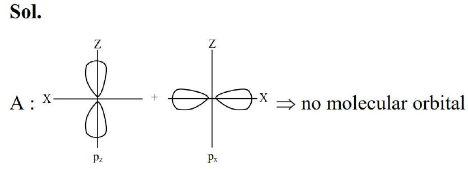
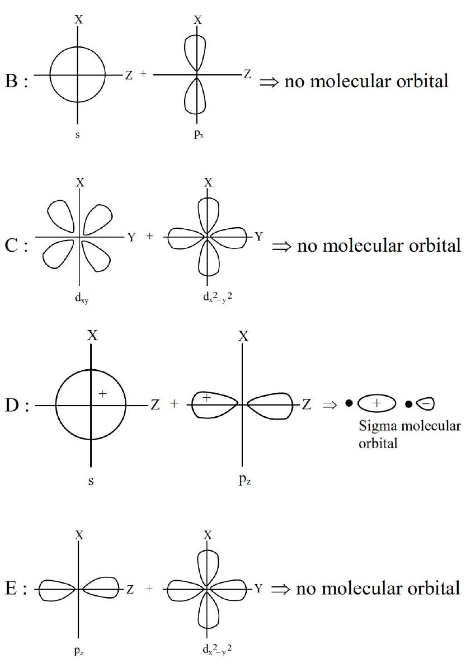
Which of the following linear combination of atomic orbitals will lead to formation of molecular orbitals in homonuclear diatomic molecules [internuclear axis in z-direction] ? A. $2 p_{z}$ and $2 p_{x}$ B. 2 s and $2 \mathrm{p}_{\mathrm{x}}$ C. $3 d_{x y}$ and $3 d_{x^{2}-y^{2}}$ D. 2 s and $2 \mathrm{p}_{z}$ E. $2 p_{z}$ and $3 d_{x^{2}-y^{2}}$
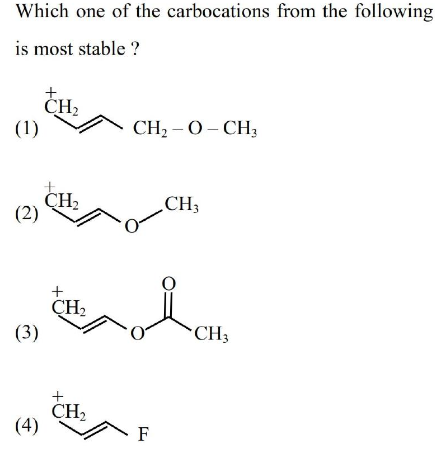
(B) Sol. Carbocation intermediate is stabilised by $+\mathrm{I},+\mathrm{M}$ & hyperconjugation effect. Since in option 2 carbocation is in conjugation with stronger +M group $-\mathrm{OCH}_{3}$ hence it will be most stable.
One mole of the octahedral complex compound $\mathrm{Co}\left(\mathrm{NH}_{3}\right)_{5} \mathrm{Cl}_{3}$ gives 3 moles of ions on dissolution in water. One mole of the same complex reacts with excess of $\mathrm{AgNO}_{3}$ solution to yield two moles of $\mathrm{AgCl}_{(\mathrm{s})}$. The structure of the complex is :
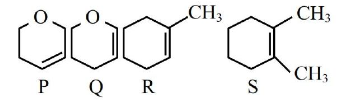
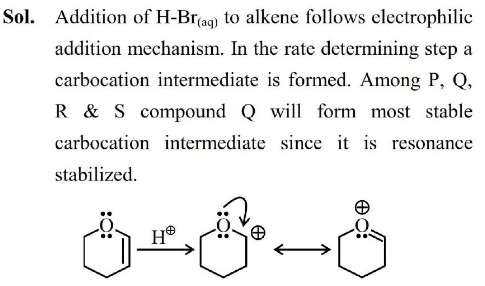
Following are the four molecules "P", "Q", "R" and "S". Which one among the four molecules will react with $\mathrm{H}-\mathrm{Br}(\mathrm{aq})$ at the fastest rate ?
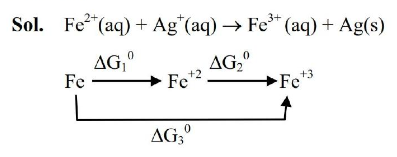
For the given cell $ \mathrm{Fe}^{2+}(\mathrm{eq})+\mathrm{Ag}^{+}(\mathrm{aq}) \rightarrow \mathrm{Fe}^{3+}(\mathrm{aq})+\mathrm{Ag}(\mathrm{~s}) $ The standard cell potential of the above reaction is Given : $\mathrm{Ag}^{+}+\mathrm{e}^{-} \rightarrow \mathrm{Ag}$ $\mathrm{E}^{0}=\mathrm{xV}$ $\mathrm{Fe}^{2+}+2 \mathrm{e}^{-} \rightarrow \mathrm{Fe}$ $\mathrm{E}^{0}=\mathrm{yV}$ $\mathrm{Fe}^{3+}+3 \mathrm{e}^{-} \rightarrow \mathrm{Fe}$ $\mathrm{E}^{0}=\mathrm{zV}$