MCQ 14 Marks
If the system of equations
$2 \mathrm{x}-\mathrm{y}+\mathrm{z}=4$
$5 x+\lambda y+3 z=12$
$100 \mathrm{x}-47 \mathrm{y}+\mu \mathrm{z}=212$,
has infinitely many solutions, then $\mu-2 \lambda$ is equal to
Answer(D)
Sol. $\Delta=0 \Rightarrow\left|\begin{array}{ccc}2 & -1 & 1 \\ 5 & \lambda & 3 \\ 100 & -47 & \mu\end{array}\right|=0$
$2(\lambda \mu+141)+(5 \mu-300)-235-100 \lambda=0$
$\Delta_{3}=0 \Rightarrow\left|\begin{array}{ccc}2 & -1 & 4 \\ 5 & \lambda & 12 \\ 100 & -47 & 212\end{array}\right|=0$
$6 \lambda=-12 \Rightarrow \lambda=-2$
Put $\lambda=2$ in (1)
$2(-2 \mu+141)+5 \mu-300-235+200=0$
$\mu=53$
$\therefore 57$
View full question & answer→MCQ 24 Marks
Let the lines $3 x-4 y-=0,8 x-11 y-33=0$, and $2 x-3 y+\lambda=0$ be concurrent. If the image of the point $(1,2)$ in the line $2 \mathrm{x}-3 \mathrm{y}+\lambda=0$ is $\left(\frac{57}{13}, \frac{-40}{13}\right)$, then $|\alpha \lambda|$ is equal to :
Answer(B)
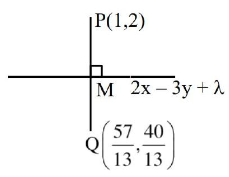
$\because \mathrm{PM}=\mathrm{QM}$
So, $M\left(\frac{\frac{57}{13}+1}{2}, \frac{\frac{-40}{13}+2}{2}\right)$
$=\left(\frac{35}{13}, \frac{-7}{13}\right)$
$\because \mathrm{M}$ lies on the time
$
2 x-3 y+\lambda=0
$
$
2\left(\frac{35}{13}\right)-3\left(\frac{-7}{13}\right)+\lambda=0
$
$
\lambda=-\frac{70}{13}+\frac{21}{13}
$
$
=\frac{-91}{13}=-7
$
$
\left|\begin{array}{ccc}
3 & -4 & -\alpha \\
8 & -11 & -33 \\
2 & 3 & \lambda
\end{array}\right|=0
$
$
\Rightarrow 3(-11 \lambda-99)+4(8 \lambda+66)-\alpha(-24+22)=0
$
$
\Rightarrow 33 \lambda-297+32 \lambda+264+24 \alpha-22 \alpha=0
$
$\Rightarrow-\lambda+2 \alpha-33=0\qquad\ldots(1)$
$\therefore \lambda=-7$
$-(-7)+2 \alpha-33=0$
$2 \alpha=26$
$\alpha=13$
$\therefore|\alpha \lambda|=|13 \times(-7)|$
$=91$ View full question & answer→MCQ 34 Marks
Let the line passing through the points $(-1,2,1)$ and parallel to the line $\frac{x-1}{2}=\frac{y+1}{3}=\frac{z}{4}$ intersect the line $\frac{x+2}{3}=\frac{y-3}{2}=\frac{z-4}{1}$ at the point $P$. Then the distance of P from the point $\mathrm{Q}(4,-5,1)$ is :
- A
- B
- C
$5 \sqrt{6}$
- ✓
$5 \sqrt{5}$
AnswerCorrect option: D. $5 \sqrt{5}$
(D)
Sol. Equation of line through point $(-1,2,1)$ is $\rightarrow$
$\Rightarrow \frac{x+1}{2}=\frac{y-2}{3}=\frac{z-1}{4}-$
(2) $=\lambda$
So, $\left[\begin{array}{l}x=2 \lambda-1 \\ y=3 \lambda+2 \\ z=4 \lambda+1\end{array}\right.$
By $(1) \rightarrow \frac{x+2}{3}=\frac{y-3}{2}=\frac{z-4}{1}=\mu($ Let $)$
So, $\left[\begin{array}{l}x=3 \mu-2 \\ y=2 \mu+3 \\ z=\mu+4\end{array}\right.$
For intersection point ' P '
$\mathrm{x}=2 \lambda-1=3 \mu-2$
$y=3 \lambda+2=2 \mu+3 \quad\left[\begin{array}{l}\lambda=1 \\ \mu=1\end{array}\right]$
$z=4 \lambda+1=\mu+4$
So, point $\mathrm{P}(\mathrm{x}, \mathrm{y}, \mathrm{z})=(1,5,5)$
\& $\mathrm{Q}(4,-5,1)$
$\therefore \mathrm{PQ}=\sqrt{9+100+16}$
$=\sqrt{125}=5 \sqrt{5}$ View full question & answer→MCQ 44 Marks
The product of all the rational roots of the equation $\left(x^{2}-9 x+11\right)^{2}-(x-4)(x-5)=3$, is equal to :
Answer(A)
Sol. $\left(x^{2}-9 x+11\right)^{2}-\left(x^{2}-9 x+20\right)=3$
Let
$\Rightarrow \mathrm{x}^{2}-9 \mathrm{x}=\mathrm{t}$
$\Rightarrow \mathrm{t}^{2}+22 \mathrm{t}+121-\mathrm{t}-20-3=0$
$\Rightarrow \mathrm{t}^{2}+21 \mathrm{t}+98=0$
$\Rightarrow(\mathrm{t}+14)(\mathrm{t}+7)=0$
$\Rightarrow \mathrm{t}=-7,-14$
So, $\quad x^{2}-9 x=-7,-14$
$x^{2}-9 x+7=0 \quad$ or $\quad x^{2}-9 x+14=0$
$\mathrm{x}=\frac{9 \pm \sqrt{81-4(7)}}{2 \times 1} \quad \mathrm{x}=\frac{9 \pm \sqrt{81-4(14)}}{2}$
$=\frac{9 \pm \sqrt{53}}{2} \quad=\frac{9 \pm 5}{2}$
Product of all rational roots $=7 \times 2=14$
View full question & answer→MCQ 54 Marks
For some $n \neq 10$, let the coefficients of the $5^{\text {th }}, 6^{\text {th }}$ and $7^{\text {th }}$ terms in the binomial expansion of $(1+x)^{n+4}$ be in A.P. Then the largest coefficient in the expansion of $(1+x)^{n+4}$ is :
Answer(B)
Sol. $(1+x)^{n+4}$
${ }^{n+4} \mathrm{C}_{4},{ }^{\mathrm{n}+4} \mathrm{C}_{5},{ }^{\mathrm{n}+4} \mathrm{C}_{6}, \rightarrow$ A.P.
$\Rightarrow 2 \times{ }^{n+4} C_{5}={ }^{n+4} C_{4}+{ }^{n+4} C_{6}$
$\Rightarrow 4 \times{ }^{n+4} C_{5}=\left({ }^{n+4} C_{4}+{ }^{n+4} C_{5}\right)+\left({ }^{n+4} C_{5}+{ }^{n+4} C_{6}\right)$
$\Rightarrow 4 \times{ }^{n+4} \mathrm{C}_{5}={ }^{\mathrm{n}+5} \mathrm{C}_{5}+{ }^{\mathrm{n}+5} \mathrm{C}_{6}$
$\Rightarrow 4 \times \frac{(\mathrm{n}+4)!}{5!.(\mathrm{n}-1)!}=\frac{(\mathrm{n}+6)!}{6!\cdot \mathrm{n}!}$
$\Rightarrow 4=\frac{(\mathrm{n}+6)(\mathrm{n}+5)}{6 \mathrm{n}}$
$\Rightarrow \mathrm{n}^{2}+11 \mathrm{n}+30=24 \mathrm{n}$
$\Rightarrow \mathrm{n}^{2}-13 \mathrm{n}+30=0$
$\Rightarrow \mathrm{n}=3,10$ (rejected)
$\because \mathrm{n} \neq 10$
$\therefore$ Largest binomial coefficient in expansion of
$(1+\mathrm{x})^{7}$
$(\because \mathrm{n}+4=7)$
is coeff. of middle term
$\Rightarrow{ }^{7} \mathrm{C}_{4}={ }^{7} \mathrm{C}_{3}=35$
N.T.A.
View full question & answer→MCQ 64 Marks
Let circle $C$ be the image of $x^{2}+y^{2}-2 x+4 y-4=0$ in the line $2 x-3 y+5=0$ and $A$ be the point on $C$ such that OA is parallel to $x$-axis and $A$ lies on the right hand side of the centre $O$ of $C$. If $B(\alpha, \beta)$, with $\beta<4$, lies on $C$ such that the length of the arc AB is $(1 / 6)^{\text {th }}$ of the perimeter of C , then $\beta-\sqrt{3} \alpha$ is equal to
- A
- B
$3+\sqrt{3}$
- C
$4-\sqrt{3}$
- ✓
Answer(D)
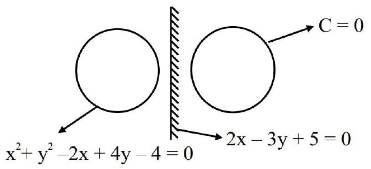
Centre (1, -2), $\mathrm{r}=3$
Reflection of $(1,-2)$ about $2 x-3 y+5=0$
$\frac{x-1}{2}=\frac{y+2}{-3}=\frac{-2(2+6+5)}{13}=-2$
$x=-3, y=4$
Equation of circle ' $C$ '
$C:(x+3)^{2}+(y-4)^{2}=9$
A.T.Q.
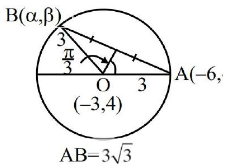
$\ell(\operatorname{arcAB})=\frac{1}{6} \times 2 \pi r$
$\mathrm{r} \theta=\frac{1}{6} \times 2 \pi \mathrm{r}$
$\theta=\frac{\pi}{3}$
$(\alpha+6)^{2}+(\beta-4)^{2}=27$
$\frac{(\alpha+3)^{2} \pm(\beta-4)^{2}=9}{(\alpha+6)^{2}-(\alpha+3)^{2}=18}$
$\Rightarrow 6 \alpha=-9$
$\Rightarrow \alpha=\frac{-3}{2}, \beta=\left(4-\frac{3 \sqrt{3}}{2}\right)$
$\therefore \beta-\sqrt{3} \alpha$
$\left(4-\frac{3 \sqrt{3}}{2}\right)+\frac{3 \sqrt{3}}{2}$
$=4$ View full question & answer→MCQ 74 Marks
For a statistical data $x_{1}, x_{2}, \ldots, x_{10}$ of 10 values, a student obtained the mean as 5.5 and $\sum_{i=1}^{10} \mathrm{x}_{\mathrm{i}}^{2}=371$. He later found that he had noted two values in the data incorrectly as 4 and 5 , instead of the correct values 6 and 8 , respectively. The variance of the corrected data is
Answer(A)
Sol. Mean $\bar{x}=5.5$
$
\begin{aligned}
= & \sum_{\mathrm{i}=1}^{10} \mathrm{x}_{\mathrm{i}}=5.5 \times 10=55 \\
= & \sum_{\mathrm{i}=1}^{10} \mathrm{x}_{\mathrm{i}}^{2}=371 \\
& \left(\sum \mathrm{x}_{\mathrm{i}}\right)_{\text {new }}=55-(4+5)+(6+8)=60 \\
& \left(\sum \mathrm{x}_{\mathrm{i}}\right)_{\text {new }}=371-\left(4^{2}+5^{2}\right)+\left(6^{2}+8^{2}\right)=430
\end{aligned}
$
Variance $\sigma^{2}=\frac{\sum \mathrm{x}_{\mathrm{i}}^{2}}{10}-\left(\frac{\sum \mathrm{x}_{\mathrm{i}}}{10}\right)^{2}$
$\sigma^{2}=\frac{430}{10}-\left(\frac{60}{10}\right)^{2}$
$\sigma^{2}=43-36$
$\sigma^{2}=7$
View full question & answer→MCQ 84 Marks
The area of the region $\left\{(x, y): x^{2}+4 x+2 \leq y \leq|x+2|\right\}$ is equal to
AnswerCorrect option: C. $20 / 3$
(C)
Sol. $\quad x^{2}+4 x+2 \leq y \leq|x+2|$
The area bounded between
$y=x^{2}+4 x+2=(x+2)^{2}-2$
and $y=|x+2|$ is same as
area bounded between $y=x^{2}-2$ and $y=|x|$
For P.O.I $|x|^{2}-2=|x|$
$\Rightarrow|\mathrm{x}|=2 \Rightarrow \mathrm{x}= \pm 2$
$\therefore$ Required area $=-\int_{-2}^{2}\left(\mathrm{x}^{2}-2\right) \mathrm{dx}+\int_{-2}^{2}|\mathrm{x}| \mathrm{dx}$
$=-2 \int_{0}^{2}\left(x^{2}-2\right) d x+2 \int_{0}^{2} x \cdot d x$
$=-2\left[\frac{x^{3}}{3}-2 x\right]_{0}^{2}+2\left[\frac{x^{2}}{2}\right]_{0}^{2}$
$=--2\left[\frac{8}{3}-4\right]+2\left[\frac{4}{2}\right]$
$=-2 \times\left(\frac{-4}{3}\right)+4$
$=\frac{20}{3}$
View full question & answer→MCQ 94 Marks
Consider the region
$R=\left\{(x, y): x \leq y \leq 9-\frac{11}{3} x^{2}, x \geq 0\right\}$. The area, of the largest rectangle of sides parallel to the coordinate axes and inscribed in $R$, is :
- A
$\frac{625}{111}$
- B
$\frac{730}{119}$
- ✓
$\frac{567}{121}$
- D
$\frac{821}{123}$
AnswerCorrect option: C. $\frac{567}{121}$
(C)
Sol. t. $\left(9-\frac{11 \mathrm{t}^{2}}{3}-\mathrm{t}\right)$
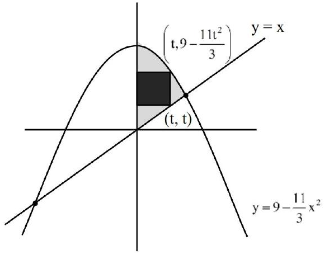
$A=9 t-t^{2}-\frac{11}{3} t^{3}$
$\frac{\mathrm{dA}}{\mathrm{dt}}=9-2 \mathrm{t}-11 \mathrm{t}^{2}$
$\Rightarrow 11 \mathrm{t}^{2}+2 \mathrm{t}-9=0$
$11 \mathrm{t}^{2}+11 \mathrm{t}-9 \mathrm{t}-9=0$
$\mathrm{t}=-1 \& \mathrm{t}=\frac{9}{11}$
$\therefore \frac{\mathrm{dA}}{\mathrm{dt}}= $
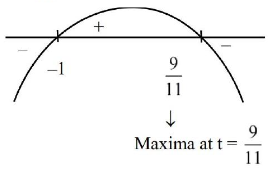
$\therefore$ largest area $=\frac{9}{11}\left(9-\frac{11}{3}, \frac{81}{121}-\frac{9}{11}\right)$
$=\frac{9}{11} \cdot \frac{63}{11}=\frac{567}{121}$ View full question & answer→MCQ 104 Marks
A and B alternately throw a pair of dice. A wins if he throws a sum of 5 before $B$ throws a sum of 8 , and B wins if he throws a sum of 8 before A throws a sum of 5 . The probability, that $A$ wins if A makes the first throw, is
- A
$\frac{9}{17}$
- ✓
$\frac{9}{19}$
- C
$\frac{8}{17}$
- D
$\frac{8}{19}$
AnswerCorrect option: B. $\frac{9}{19}$
(B)
Sol. $\mathrm{p}\left(\mathrm{S}_{5}\right)=\frac{1}{9}$
$p\left(S_{5}\right)=\frac{5}{36}$
required prob $=\frac{1}{9}+\frac{8}{9} \cdot \frac{31}{36} \cdot \frac{1}{9}+\left(\frac{8}{9} \cdot \frac{31}{36}\right)^{2} \cdot \frac{1}{9}+\ldots \infty$ $=\frac{\frac{1}{9}}{1-\frac{62}{81}}=\frac{9}{19}$
View full question & answer→MCQ 114 Marks
Let the product of the focal distances of the point $\left(\sqrt{3}, \frac{1}{2}\right)$ on the ellipse $\frac{\mathrm{x}^{2}}{\mathrm{a}^{2}}+\frac{\mathrm{y}^{2}}{\mathrm{~b}^{2}}=1,(\mathrm{a}>\mathrm{b})$, be $\frac{7}{4}$.
Then the absolute difference of the eccentricities of two such ellipses is
- A
$\frac{3-2 \sqrt{2}}{3 \sqrt{2}}$
- B
$\frac{1-\sqrt{3}}{\sqrt{2}}$
- ✓
$\frac{3-2 \sqrt{2}}{2 \sqrt{3}}$
- D
$\frac{1-2 \sqrt{2}}{\sqrt{3}}$
AnswerCorrect option: C. $\frac{3-2 \sqrt{2}}{2 \sqrt{3}}$
(C)
Sol. Product of focal distances $=\left(a+e x_{1}\right)\left(a-e x_{1}\right)$
$=a^{2}-e^{2} x_{1}^{2}=a^{2}-e^{2}(3)$
$=\mathrm{a}^{2}-3 \mathrm{e}^{2}=\frac{7}{4} \Rightarrow \mathrm{a}^{2}=\frac{7}{4}+3 \mathrm{e}^{2}$
$\Rightarrow 4 \mathrm{a}^{2}=7+12 \mathrm{e}^{2}$
$\&\left(\sqrt{3}, \frac{1}{2}\right)$ lines on $\frac{\mathrm{x}^{2}}{\mathrm{a}^{2}}+\frac{\mathrm{y}^{2}}{\mathrm{~b}^{2}}=1$
$\therefore \frac{3}{\mathrm{a}^{2}}+\frac{1}{4 \mathrm{~b}^{2}}=1$
$\frac{3}{\mathrm{a}^{2}}+\frac{1}{4\left(\mathrm{a}^{2}\right)\left(1-\mathrm{e}^{2}\right)}=1$
$12\left(1-\mathrm{e}^{2}\right)+1=4 \mathrm{a}^{2}\left(1-\mathrm{e}^{2}\right)$
$13-12 \mathrm{e}^{2}=\left(7+12 \mathrm{e}^{2}\right)\left(1-\mathrm{e}^{2}\right)$
$\Rightarrow 13-12 \mathrm{e}^{2}=7-7 \mathrm{e}^{2}+12 \mathrm{e}^{2}-12 \mathrm{e}^{4}$
$\Rightarrow 12 \mathrm{e}^{4}-17 \mathrm{e}^{2}+6=0$
$\therefore \mathrm{e}^{2}=\frac{17 \pm \sqrt{289-288}}{24}=\frac{17 \pm 1}{24}=\frac{3}{4} \& \frac{2}{3}$
$\therefore \mathrm{e}=\frac{\sqrt{3}}{2} \& \sqrt{\frac{2}{3}}$
$\therefore$ difference $==\frac{\sqrt{3}}{2}-\sqrt{\frac{2}{3}}=\frac{3-2 \sqrt{2}}{2 \sqrt{3}}$
View full question & answer→MCQ 124 Marks
Let $y=y(x)$ be the solution of the differential equation $\left(x y-5 x^{2} \sqrt{1+x^{2}}\right) d x+\left(1+x^{2}\right) d y=0$, $y(0)=0$. Then $y(\sqrt{3})$ is equal to
- ✓
$\frac{5 \sqrt{3}}{2}$
- B
$\sqrt{\frac{14}{3}}$
- C
$2 \sqrt{2}$
- D
$\sqrt{\frac{15}{2}}$
AnswerCorrect option: A. $\frac{5 \sqrt{3}}{2}$
(A)
Sol. $\left(1+x^{2}\right) \frac{d y}{d x}+x y=5 x^{1} \sqrt{1+x^{2}}$
$\frac{d y}{d x}+\frac{x y}{1+x^{2}}=\frac{5 x^{2}}{\sqrt{1+x^{2}}}$
$\therefore$ I.F. $=\mathrm{e}^{\int \frac{\mathrm{x}}{1+\mathrm{x}^{2}} \mathrm{dx}}=\mathrm{e}^{\frac{\ln \left(1+\mathrm{x}^{2}\right)}{2}}=\sqrt{1+\mathrm{x}^{2}}$
$\therefore \mathrm{y} \sqrt{1+\mathrm{x}^{2}}=\int \frac{5 \mathrm{x}^{2}}{\sqrt{1+\mathrm{x}^{2}}} \cdot \sqrt{1+\mathrm{x}^{2}} \mathrm{dx}$
$\therefore \mathrm{y} \sqrt{1+\mathrm{x}^{2}}=\int \frac{5 \mathrm{x}^{2}}{\sqrt{1+\mathrm{x}^{2}}} \cdot \sqrt{1+\mathrm{x}^{2}} \mathrm{dx}$
$y \sqrt{1+x^{2}}=\frac{5 x^{3}}{3}+C$
$\because y(0)=0 \Rightarrow 0=0+C \Rightarrow C=0$
$\therefore \mathrm{y}=\frac{5 \mathrm{x}^{3}}{3 \sqrt{1+\mathrm{x}^{2}}}$
$y(\sqrt{3})=\frac{15 \sqrt{3}}{32}=\frac{5 \sqrt{3}}{2}$
View full question & answer→MCQ 134 Marks
Let in a $\triangle A B C$, the length of the side $A C$ be 6 , the vertex $B$ be $(1,2,3)$ and the vertices $A, C$ lie on the line $\frac{x-6}{3}=\frac{y-7}{2}=\frac{z-7}{-2}$. Then the area (in sq. units) of $\triangle \mathrm{ABC}$ is
Answer(B)
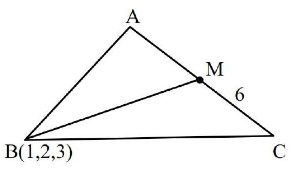
Let $\mathrm{M}(3 \lambda+6,2 \lambda+7,-2 \lambda+7)$
$
\overrightarrow{\mathrm{BM}}=(3 \lambda+5) \hat{\mathrm{i}}+(2 \lambda+5) \hat{\mathrm{j}}+(-2 \lambda+4) \hat{\mathrm{k}}
$
$\overrightarrow{\mathrm{AC}} \cdot \overrightarrow{\mathrm{BM}}=0=3(3 \lambda+5)+2(2 \lambda+5)-2(-2 \lambda+4)$
$\overrightarrow{\mathrm{BM}}=2 \hat{\mathrm{i}}+3 \hat{\mathrm{j}}+6 \hat{\mathrm{k}}$
$|\overrightarrow{\mathrm{BM}}|=7$
Area $=\frac{1}{2} \times 6 \times 7=21$ View full question & answer→MCQ 144 Marks
$\lim _{x \rightarrow 0} \operatorname{cosec} x\left(\sqrt{2 \cos ^{2} x+3 \cos x}-\sqrt{\cos ^{2} x+\sin x+4}\right)$ is
- A
$0$
- B
$\frac{1}{2 \sqrt{5}}$
- C
$\frac{1}{\sqrt{15}}$
- ✓
$-\frac{1}{2 \sqrt{5}}$
AnswerCorrect option: D. $-\frac{1}{2 \sqrt{5}}$
(D)
$\lim _{x \rightarrow 0} \operatorname{cosec} x \sqrt{2 \cos ^{2} x+3 \cos x}-\sqrt{\cos ^{2} x+\sin x+4}$
$
\lim _{x \rightarrow 0} \frac{\operatorname{cosec} x\left(\cos ^{2} x+3 \cos x-\sin x-4\right)}{\left(\sqrt{2 \cos ^{2} x+3 \cos x}+\sqrt{\cos ^{2} x+\sin x+4}\right)}
$
$
\lim _{x \rightarrow 0} \frac{1}{\sin x} \frac{\left(\cos ^{2} x+3 \cos x-4\right)-\sin x}{\left(\sqrt{2 \cos ^{2} x+3 \cos x}+\sqrt{\cos ^{2} x+\sin x+4}\right)}
$
$
\lim _{x \rightarrow 0} \frac{(\cos x+4)(\cos x-1)-\sin x}{\sin x\left(\sqrt{2 \cos ^{2} x+3 \cos x}+\sqrt{\cos ^{2} x+\sin x+4}\right)}
$
$
\lim _{x \rightarrow 0} \frac{-2 \sin ^{2} \frac{x}{2}(\cos x+4)-2 \sin \frac{x}{2} \cos \frac{x}{2}}{2 \sin \frac{x}{2} \cos \frac{x}{2}\left(\sqrt{2 \cos ^{2} x+3 \cos x}+\sqrt{\cos ^{2} x+\sin x+4}\right)}
$
$
\lim _{x \rightarrow 0} \frac{-\left(\sin \frac{x}{2}(\cos x+4)+\cos \frac{x}{2}\right)}{\cos \frac{x}{2}\left(\sqrt{2 \cos ^{2} x+3 \cos x}+\sqrt{\cos ^{2} x+\sin x+4}\right)}
$
$
-\frac{1}{2 \sqrt{5}}
$
View full question & answer→MCQ 154 Marks
If $\alpha$ and $\beta$ are the roots of the equation $2 z^{2}-3 z-2 i=0$, where $i=\sqrt{-1}$, then 16. $\operatorname{Re}\left(\frac{\alpha^{19}+\beta^{19}+\alpha^{11}+\beta^{11}}{\alpha^{15}+\beta^{15}}\right) \cdot \operatorname{Im}\left(\frac{\alpha^{19}+\beta^{19}+\alpha^{11}+\beta^{11}}{\alpha^{15}+\beta^{15}}\right)$ is equal to
Answer(D)
Sol. $2 z^{2}-32-2 i=0$
$
\begin{aligned}
& 2\left(z-\frac{i}{z}\right)=3 \\
& \alpha-\frac{i}{\alpha}=\frac{3}{2} \\
& \Rightarrow \alpha^{2}-\frac{1}{\alpha^{2}}-2 i=\frac{9}{4} \\
& \Rightarrow \alpha^{2}-\frac{1}{\alpha^{2}}-2 i=\frac{9}{4} \\
& \Rightarrow \frac{9}{4}+2 i=\alpha^{2}-\frac{1}{\alpha^{2}} \\
& \Rightarrow \frac{81}{16}-4+9 i=\alpha^{4}+\frac{1}{\alpha^{4}}-2 \\
& \Rightarrow \frac{49}{16}+9 i=\alpha^{4}+\frac{1}{\alpha^{4}}
\end{aligned}
$
Similarly
$
\begin{aligned}
& \Rightarrow \frac{49}{16}+9 \mathrm{i}=\beta^{4}+\frac{1}{\beta^{4}} \\
& \Rightarrow \frac{\alpha^{19}+\beta^{19}+\alpha^{11}+\beta^{11}}{\alpha^{15}+\beta^{15}}=\frac{\alpha^{15}\left(\alpha^{4}+\frac{1}{\alpha^{4}}\right)+\beta^{15}\left(\beta^{4}+\frac{1}{\beta^{4}}\right)}{\alpha^{15}+\beta^{15}} \\
& =\frac{\left(\alpha^{15}+\beta^{15}\right)\left(\frac{49}{16}+9 i\right)}{\left(\alpha^{15}+\beta^{15}\right)}
\end{aligned}
$
$
\text { Real }=\frac{49}{16}
$
$
\operatorname{Im}=9
$
View full question & answer→MCQ 164 Marks
Let $f(x)=\frac{2^{x+2}+16}{2^{2 x+1}+2^{x+4}+32}$. Then the value of $8\left(\mathrm{f}\left(\frac{1}{15}\right)+\mathrm{f}\left(\frac{2}{15}\right)+\ldots+\mathrm{f}\left(\frac{59}{15}\right)\right)$ is equal to
Answer(A)
Sol. $f(x)=\frac{42^{x}+16}{2.2^{2 x}+16.2^{x}+32}$
$
\begin{aligned}
& f(x)=\frac{2\left(2^{x}+4\right)}{2^{2 x}+8.2^{x}+16} \\
& f(x)=\frac{2}{2^{x}+4} \\
& f(4-x)=\frac{2^{x}}{2\left(2^{x}+4\right)} \\
& f(x)+f(4-x)=\frac{1}{2}
\end{aligned}
$
So, $\quad \mathrm{f}\left(\frac{1}{15}\right)+\mathrm{f}\left(\frac{59}{15}\right)=\frac{1}{2}
$
$
\begin{aligned}
& \text { Similarly }=f\left(\frac{29}{15}\right)+f\left(\frac{31}{15}\right)=\frac{1}{2} \\
& f\left(\frac{30}{15}\right)=f(2)=\frac{2}{2^{2}+4}=\frac{2}{8}=\frac{1}{4} \\
& \Rightarrow 8\left(29 \times \frac{1}{2}+\frac{1}{4}\right)
\end{aligned}
$
View full question & answer→MCQ 174 Marks
Let $\mathrm{S}_{\mathrm{n}}=\frac{1}{2}+\frac{1}{6}+\frac{1}{12}+\frac{1}{20}+\ldots$ upto n terms. If the sum of the first six terms of an A.P. with first term ${ }^{-} \mathrm{p}$ and common difference p is $\sqrt{2026 \mathrm{~S}_{2025}}$, then the absolute difference between $20^{\text {th }}$ and $15^{\text {th }}$ terms of the A.P. is
Answer(A)
Sol. $\quad \mathrm{Sn}=\frac{1}{2}+\frac{1}{6}+\frac{1}{12}+\frac{1}{20} \quad \ldots \mathrm{~N}$ terms
$
\begin{aligned}
& \mathrm{S}_{2025}=\sum_{\mathrm{n}=1}^{2025} \frac{1}{\mathrm{n}(\mathrm{n}+1)}=\sum_{\mathrm{n}=1}^{2025}\left(\frac{1}{\mathrm{n}}-\frac{1}{\mathrm{n}+1}\right) \\
& \quad=\left(\frac{1}{1}-\frac{1}{2}\right)+\left(\frac{1}{2}-\frac{1}{3}\right) \quad \cdots \cdots\left(\frac{1}{2025}-\frac{1}{2026}\right)
\end{aligned}
$
$
\begin{aligned}
& =\frac{2025}{2026} \\
& \sqrt{2026 . S_{2025}}=\sqrt{2025}=45 \\
& \text { Given : } \frac{6}{2}[-2 \mathrm{p}+(6-1) \mathrm{p}]=45 \\
& 9 \mathrm{p}=45 \\
& \mathrm{p}=5 \\
& \left|\mathrm{~A}_{20}-\mathrm{A}_{15}\right|=|-5+19 \times 5|-[-5+14 \times 5] \\
& =|90-65| \\
& =25
\end{aligned}
$
View full question & answer→MCQ 184 Marks
Let $\mathrm{f}: \mathbb{R}-\{0\} \rightarrow \mathbb{R}$ be a function such that $f(x)-6 f\left(\frac{1}{x}\right)=\frac{35}{3 x}-\frac{5}{2}$. If the $\lim _{x \rightarrow 0}\left(\frac{1}{\alpha x}+f(x)\right)=\beta$; $\alpha, \beta \in \mathbb{R}$, then $\alpha+2 \beta$ is equal to
Answer(C)
Sol. $F(x)-6 f(1 / x)=\frac{35}{3 x}-\frac{5}{2}.....(1)$
Replace $\mathrm{x} \rightarrow \frac{1}{\mathrm{x}}$
$F(1 / x)-6(x)=\frac{35 x}{3}-\frac{5}{2}....(2)$
Using (1) & (2)
$f(x)=-2 x-\frac{1}{3 x}+\frac{1}{2}$
$B=\lim _{x \rightarrow 0}\left(\frac{1}{\alpha x}+f(x)\right)$
$=\lim _{x \rightarrow 0}\left(\frac{1}{\alpha \mathrm{x}}-2 \mathrm{x}-\frac{1}{3 \mathrm{x}}+\frac{1}{2}\right)$
$\alpha=3, \quad B=1 / 2$
So, $\alpha+2 \mathrm{~B}=3+1=4$
View full question & answer→MCQ 194 Marks
In $I(m, n)=\int_{0}^{1} x^{m-1}(1-x)^{n-1} d x, m, n>0$, then
$\mathrm{I}(9,14)+\mathrm{I}(10,13)$ is
- A
$I(9,1)$
- B
$\mathrm{I}(19,27)$
- C
$I(1,13)$
- ✓
$I(9,13)$
AnswerCorrect option: D. $I(9,13)$
(D)
Sol. $I(m, m)=\int_{0}^{1} x^{m-1}(1-x)^{n-1} d x$
Let $x=\sin ^{2} \theta \quad d x=2 \sin \theta \cos \theta d \theta$
$\mathrm{I}(\mathrm{m}, \mathrm{n})=2 \int_{0}^{\pi / 2}(\sin \theta)^{2 \mathrm{~m}-1}(\cos \theta)^{2 \mathrm{n}-1} \mathrm{~d} \theta$
$I(9,14)+I(10,13)=2 \int_{0}^{\pi / 2}(\sin \theta)^{17}(\cos \theta)^{27} d \theta$
$+2 \int_{0}^{\pi / 2}(\sin \theta)^{19}(\cos \theta)^{25} d \theta$
$=2 \int_{0}^{\pi / 2}(\sin \theta)^{17}(\cos \theta)^{25} \mathrm{~d} \theta$
$=\mathrm{I}(9,13)$
View full question & answer→MCQ 204 Marks
Let $\overrightarrow{\mathrm{a}}=\hat{\mathrm{i}}+2 \hat{\mathrm{j}}+3 \hat{\mathrm{k}}, \overrightarrow{\mathrm{b}}=3 \hat{\mathrm{i}}+\hat{\mathrm{j}}-\hat{\mathrm{k}}$ and $\overrightarrow{\mathrm{c}}$ be three vectors such that $\vec{c}$ is coplanar with $\vec{a}$ and $\vec{b}$. If the vector $\vec{c}$ is perpendicular to $\vec{b}$ and $\vec{a} \cdot \vec{c}=5$, then $|\vec{c}|$ is equal to
- A
$\frac{1}{3 \sqrt{2}}$
- B
- C
- ✓
$\sqrt{\frac{11}{6}}$
AnswerCorrect option: D. $\sqrt{\frac{11}{6}}$
(D)
Sol. $\quad \overrightarrow{\mathrm{c}}=\lambda(\overrightarrow{\mathrm{b}} \times(\overrightarrow{\mathrm{a}} \times \overrightarrow{\mathrm{b}}))$
$=\lambda((\vec{b} \cdot \vec{b}) \vec{a}-(\vec{a} \cdot \vec{b}) \vec{b})$
$=\lambda(11 \overrightarrow{\mathrm{a}}-2 \overrightarrow{\mathrm{~b}})=\lambda(11 \mathrm{i}+22 \mathrm{j}+33 \mathrm{k}-6 \mathrm{i}-2 \mathrm{j}+2 \mathrm{k})$
$=\lambda(5 \mathrm{i}+20 \mathrm{j}+35 \mathrm{k})$
$=5 \lambda(5 \mathrm{i}+4 \mathrm{j}+7 \mathrm{k})$
$=$ Given $\vec{c} \cdot \vec{a}=5$
$=5 \lambda(1+8+21)=5=\lambda=\frac{1}{30}$
$\Rightarrow \overrightarrow{\mathrm{c}}=\frac{1}{6}(\mathrm{i}+4 \mathrm{j}+7 \mathrm{k})$
$|\overrightarrow{\mathrm{c}}|=\frac{\sqrt{1+16+49}}{6}=\sqrt{\frac{11}{6}}$
View full question & answer→