MCQ 14 Marks
An ideal gas goes from an initial state to final state. During the process, the pressure of gas increases linearly with temperature.
A. The work done by gas during the process is zero.
B. The heat added to gas is different from change in its internal energy.
C. The volume of the gas is increased.
D. The internal energy of the gas is increased.
E. The process is isochoric (constant volume process)
Choose the correct answer from the options given below :-
Answer(B)
Sol. Given that
$\mathrm{P}=\mathrm{kT}$
$\frac{\mathrm{P}}{\mathrm{T}}=$ constant
$\therefore$ Volume is constant or isochoric process.
$\therefore \mathrm{W}_{\mathrm{D}}=0$
$\therefore \mathrm{Q}=\Delta \mathrm{U}$
Also temperature increases hence internal energy increases.
View full question & answer→MCQ 24 Marks
A force $\mathrm{F}=\alpha+\beta \mathrm{x}^{2}$ acts on an object in the x -direction. The work done by the force is 5 J when the object is displaced by 1 m . If the constant $\alpha=1 \mathrm{~N}$ then $\beta$ will be
- A
$15 \mathrm{~N} / \mathrm{m}^{2}$
- B
$10 \mathrm{~N} / \mathrm{m}^{2}$
- ✓
$12 \mathrm{~N} / \mathrm{m}^{2}$
- D
$8 \mathrm{~N} / \mathrm{m}^{2}$
AnswerCorrect option: C. $12 \mathrm{~N} / \mathrm{m}^{2}$
(C)
Sol. $F=\alpha+\beta x^{2}$
Work done $=\int F d x$
$5=\int\left(\alpha+\beta x^{2}\right) d x$
$5=\alpha x+\left.\frac{\beta x^{3}}{3}\right|_{0} ^{1}$
$5=\alpha+\frac{\beta}{3}[\alpha=1]$
$4=\frac{\beta}{3} \Rightarrow \beta=12 \mathrm{~N} / \mathrm{m}^{2}$
View full question & answer→MCQ 34 Marks
A parallel plate capacitor was made with two rectangular plates, each with a length of $l=3 \mathrm{~cm}$ and breath of $b=1 \mathrm{~cm}$. The distance between the plates is $3 \mu \mathrm{~m}$. Out of the following, which are the ways to increase the capacitance by a factor of 10 ?
A. $l=30 \mathrm{~cm}, \mathrm{~b}=1 \mathrm{~cm}, \mathrm{~d}=1 \mu \mathrm{~m}$
B. $l=3 \mathrm{~cm}, \mathrm{~b}=1 \mathrm{~cm}, \mathrm{~d}=30 \mu \mathrm{~m}$
C. $l=6 \mathrm{~cm}, \mathrm{~b}=5 \mathrm{~cm}, \mathrm{~d}=3 \mu \mathrm{~m}$
D. $l=1 \mathrm{~cm}, \mathrm{~b}=1 \mathrm{~cm}, \mathrm{~d}=10 \mu \mathrm{~m}$
E. $l=5 \mathrm{~cm}, \mathrm{~b}=2 \mathrm{~cm}, \mathrm{~d}=1 \mu \mathrm{~m}$
Choose the correct answer from the options given below :
Answer(A)
Sol. $\mathrm{C}=\frac{\mathrm{A} \in_{0}}{\mathrm{~d}}$
A : plate area
d : distance between the plates.
Capacitance initial
$=\frac{\in_{0} \ell \mathbf{b}}{d}=\in_{0}$ units
Option ' C ' $\quad \ell=6 \mathrm{~cm}$
$
\begin{aligned}
& \mathrm{b}=5 \mathrm{~cm} \\
& \mathrm{~d}=3 \mathrm{~cm}
\end{aligned}
$
Capacitance $=10 \in_{0}$ units
Option 'E' $\quad \ell=5 \mathrm{~cm}$
$
\begin{aligned}
& \mathrm{b}=2 \mathrm{~cm} \\
& \mathrm{~d}=1 \mathrm{~cm}
\end{aligned}
$
Capacitance $=10 \in_{0}$ units
$\therefore$
View full question & answer→MCQ 44 Marks
An electron of mass ' $m$ ' with an initial velocity $\overrightarrow{\mathrm{v}}=\mathrm{v}_{0} \hat{\mathrm{i}}\left(\mathrm{v}_{0}>0\right) \quad$ enters an electric field $\overrightarrow{\mathrm{E}}=-\mathrm{E}_{0} \hat{\mathrm{k}}$. If the initial de Broglie wavelength is $\lambda_{0}$, the value after time $t$ would be :-
- ✓
$\frac{\lambda_{0}}{\sqrt{1+\frac{\mathrm{e}^{2} \mathrm{E}_{0}^{2} \mathrm{t}^{2}}{\mathrm{~m}^{2} \mathrm{v}_{0}^{2}}}}$
- B
$\frac{\lambda_{0}}{\sqrt{1-\frac{\mathrm{e}^{2} \mathrm{E}_{0}^{2} \mathrm{t}^{2}}{\mathrm{~m}^{2} \mathrm{v}_{0}^{2}}}}$
- C
$\lambda_{0}$
- D
$\lambda_{0} \sqrt{1+\frac{e^{2} E_{0}^{2} t^{2}}{m^{2} v_{0}^{2}}}$
AnswerCorrect option: A. $\frac{\lambda_{0}}{\sqrt{1+\frac{\mathrm{e}^{2} \mathrm{E}_{0}^{2} \mathrm{t}^{2}}{\mathrm{~m}^{2} \mathrm{v}_{0}^{2}}}}$
(A)
Sol. $\overrightarrow{\mathrm{v}}=\mathrm{v}_{0} \hat{\mathrm{i}}-\frac{\mathrm{E}_{0} \mathrm{e}}{\mathrm{m}} \mathrm{t} \hat{\mathrm{k}}$
$|\overrightarrow{\mathrm{v}}|=\sqrt{\mathrm{v}_{0}^{2}+\frac{\mathrm{E}_{0}^{2} \mathrm{e}^{2} \mathrm{t}^{2}}{\mathrm{~m}^{2}}}$
$\lambda_{0}=\frac{\mathrm{h}}{\mathrm{mv}_{0}}$
$\lambda^{\prime}=\frac{h}{\mathrm{mv}_{0} \sqrt{1+\frac{\mathrm{E}_{0}^{2} \mathrm{e}^{2} \mathrm{t}^{2}}{\mathrm{v}_{0}^{2} \mathrm{~m}^{2}}}}$
$\lambda^{\prime}=\frac{\lambda_{0}}{\sqrt{1+\frac{\mathrm{E}_{0}^{2} \mathrm{e}^{2} \mathrm{t}^{2}}{\mathrm{v}_{0}^{2} \mathrm{~m}^{2}}}}$
View full question & answer→MCQ 54 Marks
An alternating current is given by
$I=I_{A} \sin \omega t+I_{B} \cos \omega t$.
The r.m.s. current will be :-
- A
$\sqrt{I_{A}^{2}+I_{B}^{2}}$
- B
$\frac{\sqrt{I_{A}^{2}+I_{B}^{2}}}{2}$
- ✓
$\sqrt{\frac{\mathrm{I}_{\mathrm{A}}^{2}+\mathrm{I}_{\mathrm{B}}^{2}}{2}}$
- D
$\frac{\left|I_{A}+I_{B}\right|}{\sqrt{2}}$
AnswerCorrect option: C. $\sqrt{\frac{\mathrm{I}_{\mathrm{A}}^{2}+\mathrm{I}_{\mathrm{B}}^{2}}{2}}$
(C)
Sol. $i_{\text {rms }}=\sqrt{\frac{\int I^{2} d t}{\int d t}}$
$\sqrt{\frac{I_{A}^{2}+I_{B}^{2}}{2}}=i_{\text {rms }}$
View full question & answer→MCQ 64 Marks
A plano-convex lens having radius of curvature of first surface 2 cm exhibits focal length of $f_{1}$ in air. Another plano-convex lens with first surface radius of curvature 3 cm has focal length of $f_{2}$ when it is immersed in a liquid of refractive index 1.2. If both the lenses are made of same glass of refractive index 1.5 , the ratio of $f_{1}$ and $f_{2}$ will be :-
- A
$3: 5$
- ✓
$1: 3$
- C
$1: 2$
- D
$2: 3$
AnswerCorrect option: B. $1: 3$
(B)
Sol. $\frac{1}{f_{1}}=(1.5-1)\left[\frac{1}{2}-0\right] \Rightarrow f_{1}=4 \mathrm{~cm}$
$\frac{1}{\mathrm{f}_{2}}=\left(\frac{1.5}{1.2}-1\right)\left(\frac{1}{3}-0\right)$
$\frac{1}{\mathrm{f}_{2}}=\frac{0.3}{1.2} \times \frac{1}{3}$
$\mathrm{f}_{2}=12$
$\mathrm{f}_{1}: \mathrm{f}_{2}=4: 12=1: 3$
View full question & answer→MCQ 74 Marks
A satellite is launched into a circular orbit of radius ' R ' around the earth. A second statellite is launched into an orbit of radius 1.03 R . The time period of revolution of the second satellite is larger than the first one approximately by :-
- A
$3 \%$
- ✓
$4.5 \%$
- C
$9 \%$
- D
$2.5 \%$
AnswerCorrect option: B. $4.5 \%$
(B)
Sol. $\quad \mathrm{T}^{2}=\mathrm{KR}^{3}$
$
\begin{aligned}
& \frac{2 \Delta \mathrm{~T}}{\mathrm{~T}}=\frac{3 \Delta \mathrm{R}}{\mathrm{R}} \\
& \frac{2 \Delta \mathrm{~T}}{\mathrm{~T}}=\frac{3 \times 0.03 \mathrm{R}}{\mathrm{R}} \\
& \frac{\Delta \mathrm{~T}}{\mathrm{~T}}=\frac{3 \times 0.03}{2} \times 100=4.5 \%
\end{aligned}
$
View full question & answer→MCQ 84 Marks
A particle is executing simple harmonic motion with time period 2 s and amplitude 1 cm . If D and d are the total distance and displacement covered by the particle in 12.5 s , then $\frac{\mathrm{D}}{\mathrm{d}}$ is :-
- A
$\frac{15}{4}$
- B
- C
- D
$\frac{16}{5}$
View full question & answer→MCQ 94 Marks
A thin plano convex lens made of glass of refractive index 1.5 is immersed in a liquid of refractive index 1.2 . When the plane side of the lens is silver coated for complete reflection, the lens immersed in the liquid behaves like a concave mirror of focal length 0.2 m . The radius of curvature of the curved surface of the lens is :-
Answer(B)
Sol.
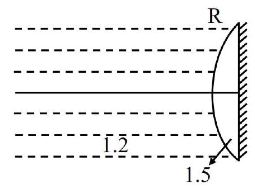
$\frac{1.5}{\mathrm{v}}=\frac{1.5-1.2}{\mathrm{R}}$
$\mathrm{v}=\frac{1.5 \mathrm{R}}{0.3}=5 \mathrm{R}$
$\frac{1.2}{f}-\frac{1.5}{5 R}=\frac{1.2-1.5}{-R}$
$\frac{1.2}{\mathrm{f}}=\frac{0.3}{\mathrm{R}} \times 2 \Rightarrow \mathrm{f}=2 \mathrm{R} \Rightarrow \mathrm{R}=0.1$ View full question & answer→MCQ 104 Marks
A uniform solid cylinder of mass ' $m$ ' and radius ' $r$ ' rolls along an inclined rough plane of inclination $45^{\circ}$. If it starts to roll from rest from the top of the plane then the linear acceleration of the cylinder axis will be :-
AnswerCorrect option: C. $\frac{\sqrt{2} g}{3}$
(C)
Sol. $\mathrm{a}=\frac{\mathrm{g} \sin \theta}{1+\frac{\mathrm{I}}{\mathrm{mR}^{2}}}$
$a=\frac{\frac{\mathrm{g}}{\sqrt{2}}}{1+\frac{1}{2}}=\frac{2 \frac{\mathrm{~g}}{\sqrt{2}}}{3}=\frac{\sqrt{2} \mathrm{~g}}{3}$
View full question & answer→MCQ 114 Marks
A car of mass ' $m$ ' moves on a banked road having radius ' $r$ ' and banking angle $\theta$. To avoid slipping from banked road, the maximum permissible speed of the car is $v_{0}$. The coefficient of friction $\mu$ between the wheels of the car and the banked road is :-
- A
$\mu=\frac{v_{0}^{2}+r g \tan \theta}{\operatorname{rg}-v_{0}^{2} \tan \theta}$
- B
$\mu=\frac{v_{0}^{2}+r g \tan \theta}{r g+v_{0}^{2} \tan \theta}$
- C
$\mu=\frac{v_{0}^{2}-r g \tan \theta}{r g+v_{0}^{2} \tan \theta}$
- D
$\mu=\frac{v_{0}^{2}-r g \tan \theta}{\operatorname{rg}-v_{0}^{2} \tan \theta}$
Answer
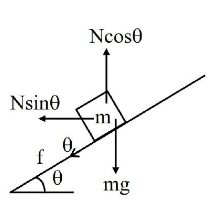
$\mathrm{N} \sin \theta+\mathrm{f} \cos \theta=\frac{\mathrm{mv}^{2}}{\mathrm{R}}$
$\mathrm{N} \cos \theta-\mathrm{f} \sin \theta=\mathrm{mg}$
$\frac{\sin \theta+\mu \cos \theta}{\cos \theta-\mu \sin \theta}=\frac{v^{2}}{R g}$
$R g \tan \theta+\mu R g=v^{2}-v^{2} \mu \tan \theta$
$\mu=\frac{\mathrm{v}^{2}-\mathrm{Rg} \tan \theta}{\mathrm{Rg}+\mathrm{v}^{2} \tan \theta}$ View full question & answer→MCQ 124 Marks
The Young's double slit interference experiment is performed using light consisting of 480 nm and 600 nm wavelengths to form interference patterns. The least number of the bright fringes of 480 nm light that are required for the first coincidence with the bright fringes formed by 600 nm light is :-
Answer(D)
Sol. $\frac{n_{1} \lambda_{1} D}{d}=\frac{n_{2} \lambda_{2} D}{d}$
n $480=m 600$
$\mathrm{n}_{\text {min }}=5$
View full question & answer→MCQ 134 Marks
An object of mass ' $m$ ' is projected from origin in a vertical xy plane at an angle $45^{\circ}$ with the x -axis with an initial velocity $\mathrm{v}_{0}$. The magnitude and direction of the angular momentum of the object with respect to origin, when it reaches at the maximum height, will be [ g is acceleration due to gravity]
- A
$\frac{m v_{0}^{3}}{2 \sqrt{2} g}$ along negative $z$-axis
- B
$\frac{m v_{0}^{3}}{2 \sqrt{2} g}$ along positive $z$-axis
- C
$\frac{m v_{0}^{3}}{4 \sqrt{2} g}$ along positive $z$-axis
- ✓
$\frac{m v_{0}^{3}}{4 \sqrt{2} g}$ along negative $z$-axis
AnswerCorrect option: D. $\frac{m v_{0}^{3}}{4 \sqrt{2} g}$ along negative $z$-axis
(D)
Sol.
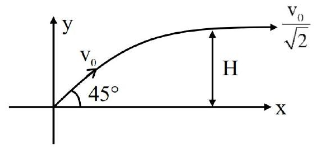
$\mathrm{H}=\frac{\left(\frac{\mathrm{v}_{0}}{\sqrt{2}}\right)^{2}}{2 \mathrm{~g}}=\frac{\mathrm{v}_{0}^{2}}{4 \mathrm{~g}}$
$\mathrm{L}=\mathrm{mvh}$
$\mathrm{L}=\mathrm{m} \frac{\mathrm{v}_{0}}{\sqrt{2}} \frac{\mathrm{v}_{0}^{2}}{4 \mathrm{~g}}$ View full question & answer→MCQ 144 Marks
The amount of work done to break a big water drop of radius ' R ' into 27 small drops of equal radius is 10 J . The work done required to break the same big drop into 64 small drops of equal radius will be :-
Answer(A)
Sol. $\mathrm{W}=\Delta \mathrm{U}=\mathrm{S} \Delta \mathrm{A}$
One drop to n drop
$\frac{4}{3} \lambda \mathrm{R}^{3}=\mathrm{n} \frac{4}{3} \lambda \mathrm{r}^{3}$
$r=\frac{R}{n^{\frac{1}{3}}}$
So $W=S\left(n 4 \pi r^{2}-4 \pi R^{2}\right)$
$=S 4 \pi R^{2}\left(n^{\frac{1}{3}}-1\right)$
For on drop to 27 drops
$\mathrm{W}=\mathrm{S} 4 \pi \mathrm{R}^{2}\left(27^{\frac{1}{3}}-1\right)=10......(i)$
For one drop to 64 drops
$W^{\prime}=S 4 \pi R^{2}\left(64^{\frac{1}{3}}-1\right) \ldots$ (ii)
(ii)/(i)
$\frac{\mathrm{W}^{\prime}}{\mathrm{W}}=\frac{4-1}{3-1}=\frac{3}{2}$
$\mathrm{W}^{\prime}=\frac{3}{2} \mathrm{~W}=155$
View full question & answer→MCQ 154 Marks
Consider the following statements :
A. The junction area of solar cell is made very narrow compared to a photo diode.
B. Solar cells are not connected with any external bias.
C. LED is made of lightly doped p-n junction.
D. Increase of forward current results in continuous increase of LED light intensity.
E. LEDs have to be connected in forward bias for emission of light.
MCQ 164 Marks
During the transition of electron from state A to state C of a Bohr atom, the wavelength of emitted radiation is 2000 Å and it becomes 6000 Å when the electron jumps from state B to state C. Then the wavelength of the radiation emitted during the transition of electrons from state A to state B is :-
Answer(A)
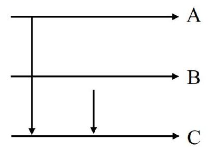
$
\begin{array}{l}
E_{A}-E_{C}=\frac{h c}{2000 Å} \ldots . . \text { (i) } \\
\text { and } E_{B}-E_{C}=\frac{h c}{6000 Å} \ldots . \text { (ii) } \\
\text { Now } E_{A}-E_{B}=\left(E_{A}-E_{C}\right)-\left(E_{B}-E_{C}\right) \\
\frac{hc}{\lambda_{AB}}=\frac{h c}{2000}-\frac{h c}{6000} \\
\frac{1}{\lambda_{A B}}=\frac{1}{3000 Å} \\
\lambda_{A B}=3000 Å
\end{array}
$ View full question & answer→MCQ 174 Marks
For an experimental expression $\mathrm{y}=\frac{32.3 \times 1125}{27.4}$, where all the digits are significant. Then to report the value of $y$ we should write :-
- A
$y=1326.2$
- B
$y=1326.19$
- C
$y=1326.186$
- ✓
$y=1330$
AnswerCorrect option: D. $y=1330$
(D)
Sol. $\mathrm{y}=\frac{32.3 \times 1125}{27.4}=1326.186$
Last significant digits are 3 in operands so results should rounded off to 3 digits.
$\therefore \mathrm{y}=1330$
View full question & answer→MCQ 184 Marks
An air bubble of radius 0.1 cm lies at a depth of 20 cm below the free surface of a liquid of density $1000 \mathrm{~kg} / \mathrm{m}^{3}$. If the pressure inside the bubble is $2100 \mathrm{~N} / \mathrm{m}^{2}$ greater than the atmospheric pressure, then the surface tension of the liquid in SI unit is (use $\mathrm{g}=10 \mathrm{~m} / \mathrm{s}^{2}$ )
Answer(D)
Sol. T is surface tension
$P$ in air bubble $=P_{0}+\rho g h+\frac{2 T}{R}$
$P_{i n}-P_{0}=\rho g h+\frac{2 T}{R}=2100$
$\frac{2 \mathrm{~T}}{\mathrm{R}}=2100-\rho \mathrm{gh}$
$\mathrm{T}=\frac{\mathrm{R}}{2}\left(2100-10^{3} \times 10 \times 0.2\right)$
$=\frac{1}{20}(2100-2000) \times 10^{-2}$
$=0.05$
View full question & answer→MCQ 194 Marks
What is the relative decrease in focal length of a lens for an increase in optical power by 0.1 D from 2.5 D? ['D' stands for dioptre]
Answer(A)
Sol. When $\mathrm{P}=2.5 \mathrm{D}$
$
\mathrm{F}=\frac{1}{\mathrm{P}}=\frac{1}{2.5}
$
When $\mathrm{P}^{\prime}=2.6 \mathrm{D}$
$\mathrm{F}^{\prime}=\frac{1}{\mathrm{P}^{\prime}}=\frac{1}{2.6}$
Relative decrease in focal length
$
\frac{\mathrm{F}-\mathrm{F}^{\prime}}{\mathrm{F}}=\frac{\frac{2}{5}-\frac{5}{13}}{\frac{2}{5}}=1-\frac{25}{26}=\frac{1}{26}=0.04
$
View full question & answer→MCQ 204 Marks
Consider a parallel plate capacitor of area A (of each plate) and separation 'd' between the plates. If $E$ is the electric field and $\varepsilon_{0}$ is the permittivity of free space between the plates, then potential energy stored in the capacitor is :-
- ✓
$\frac{1}{2} \varepsilon_{0} \mathrm{E}^{2} \mathrm{Ad}$
- B
$\frac{3}{4} \varepsilon_{0} \mathrm{E}^{2} \mathrm{Ad}$
- C
$\frac{1}{4} \varepsilon_{0} \mathrm{E}^{2} \mathrm{Ad}$
- D
$\varepsilon_{0} \mathrm{E}^{2} \mathrm{Ad}$
AnswerCorrect option: A. $\frac{1}{2} \varepsilon_{0} \mathrm{E}^{2} \mathrm{Ad}$
(A)
Sol. $\frac{U}{V}=\frac{1}{2} \in_{0} E^{2}$
$\mathrm{U}=\frac{1}{2} \in_{0} E^{2} \mathrm{~V}$
$=\frac{1}{2} \in_{0} \mathrm{E}^{2}(\mathrm{Ad})$
View full question & answer→