Questions

SECTION - B [MATHS - NUMERIC]

Take a timed test

5 questions · self-marked practice — reveal the answer and mark yourself.

Question 14 Marks
If $\int \frac{2 x^{2}+5 x+9}{\sqrt{x^{2}+x+1}} d x=x \sqrt{x^{2}+x+1}+\alpha \sqrt{x^{2}+x+1}+$ $\beta \log _{e}\left|x+\frac{1}{2}+\sqrt{x^{2}+x+1}\right|+C$, where $C$ is the constant of integration, then $\alpha+2 \beta$ is equal to ____________ .
Answer
(16)
Sol. $2 x^{2}+5 x+9=A\left(x^{2}+x+1\right)+B(2 x+1)+C$
$
\begin{aligned}
& A=2 \quad B=\frac{3}{2} \quad C=\frac{11}{2} \\
& 2 \int \sqrt{x^{2}+x+1} d x+\frac{3}{2} \int \frac{2 x+1}{\sqrt{x^{2}+x+1}} d x+\frac{11}{2} \int \frac{d x}{\sqrt{x^{2}+x+1}} \\
& 2 \int \sqrt{\left(x+\frac{1}{2}\right)^{2}+\left(\frac{\sqrt{3}}{2}\right)^{2}} d x+3 \sqrt{x^{2}+x+1}+\frac{11}{2} \int \frac{d x}{\sqrt{\left(x+\frac{1}{2}\right)^{2}+\left(\frac{\sqrt{3}}{2}\right)^{2}}} \\
& 2\left(\frac{x+\frac{1}{2}}{2} \sqrt{x^{2}+x+1}+\frac{3}{8} \ln \left(x+\frac{1}{2}+\sqrt{x^{2}+x+1}\right)\right)+3 \sqrt{x^{2}+x+1} \\
& +\frac{11}{2} \ln \left(x+\frac{1}{2}+\sqrt{x^{2}+x+1}\right)+C \\
& \alpha=\frac{7}{2} \quad \beta=\frac{25}{4} \\
& \alpha+2 \beta=16
\end{aligned}
$
View full question & answer
Question 24 Marks
Let $\mathrm{H}_{1}: \frac{\mathrm{x}^{2}}{\mathrm{a}^{2}}-\frac{y^{2}}{\mathrm{~b}^{2}}=1$ and $\mathrm{H}_{2}:-\frac{\mathrm{x}^{2}}{\mathrm{~A}^{2}}+\frac{\mathrm{y}^{2}}{\mathrm{~B}^{2}}=1$ be two hyperbolas having length of latus rectums $15 \sqrt{2}$ and $12 \sqrt{5}$ respectively. Let their eccentricities be $e_{1}=\sqrt{\frac{5}{2}}$ and $e_{2}$ respectively. If the product of the lengths of their transverse axes is $100 \sqrt{10}$, then $25 \mathrm{e}_{2}^{2}$ is equal to ____________ .
Answer
(55)
Sol. $\frac{2 \mathrm{~b}^{2}}{\mathrm{a}}=15 \sqrt{2}$
$1+\frac{\mathrm{b}^{2}}{\mathrm{a}^{2}}=\frac{5}{2}$
$\mathrm{a}=5 \sqrt{2}$
$b=5 \sqrt{3}$
$\frac{2 \mathrm{~A}^{2}}{\mathrm{~B}}=12 \sqrt{5}$
$2 \mathrm{a} .2 \mathrm{~B}=100 \sqrt{10}$
$2.5 \sqrt{2} .2 \mathrm{~B}=100 \sqrt{10}$
$B=5 \sqrt{5}$
$A=5 \sqrt{6}$
$\mathrm{e}_{2}^{2}=1+\frac{\mathrm{A}^{2}}{\mathrm{~B}^{2}}$
$=1+\frac{150}{125}$
$\mathrm{e}_{2}^{2}=1+\frac{30}{25}$
$25 \mathrm{e}_{2}^{2}=55$
View full question & answer
Question 34 Marks
Let $y=y(x)$ be the solution of the differential equation $2 \cos x \frac{d y}{d x}=\sin 2 x-4 y \sin x, x \in\left(0, \frac{\pi}{2}\right)$. If $y\left(\frac{\pi}{3}\right)=0$, then $y^{\prime}\left(\frac{\pi}{4}\right)+y\left(\frac{\pi}{4}\right)$ is equal to ____________ .
Answer
(1)
Sol. $\frac{d y}{d x}+2 y \tan x=\sin x$
I.F. $=\mathrm{e}^{2 \int \tan \mathrm{dx} x}=\sec ^{2} \mathrm{x}$
$y \sec ^{2} x=\int \frac{\sin x}{\cos ^{2} x} d x$
$=\int \tan \mathrm{x} \sec \mathrm{x} d \mathrm{x}$
$=\sec x+C$
$C=-2$
$y=\cos x-2 \cos ^{2} x$
$y\left(\frac{\pi}{4}\right)=\frac{1}{\sqrt{2}}-1$
$y^{\prime}=-\sin x+4 \cos x \sin x$
$y^{\prime}\left(\frac{\pi}{4}\right)=-\frac{1}{\sqrt{2}}+2$
$y^{\prime}\left(\frac{\pi}{4}\right)+y\left(\frac{\pi}{4}\right)=1$
View full question & answer
Question 44 Marks
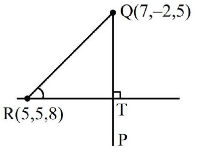
Let $P$ be the image of the point $Q(7,-2,5)$ in the line $L: \frac{x-1}{2}=\frac{y+1}{3}=\frac{z}{4}$ and $R(5, p, q)$ be a point on L . Then the square of the area of $\triangle \mathrm{PQR}$ is ____________ .
Answer
(957)
Image
Let $\mathrm{R}(2 \lambda+1,3 \lambda-1,4 \lambda)$
$2 \lambda+1=5$
$\lambda=2$
$\mathrm{R}(5,5,8)$
let $\mathrm{T}(2 \lambda+1,3 \lambda-1,4 \lambda)$
$\overrightarrow{\mathrm{QT}}=(2 \lambda-6) \hat{\mathrm{i}}+(3 \lambda+1) \hat{\mathrm{j}}+(4 \lambda-5) \hat{\mathrm{k}}$
$\overrightarrow{\mathrm{b}}=2 \hat{\mathrm{i}}+3 \hat{\mathrm{j}}+4 \hat{\mathrm{k}}$
$\overrightarrow{\mathrm{QT}} \cdot \overrightarrow{\mathrm{b}}=0$
$4 \lambda-12+9 \lambda+3+16 \lambda-20=0$
$\lambda=1$
$\mathrm{T}(3,2,4)$
$\mathrm{QT}=\sqrt{33} \quad \mathrm{RT}=\sqrt{29}$
$(\text { area of } \Delta \mathrm{PQR})^{2}=\left(\frac{1}{2} \sqrt{29} \cdot 2 \sqrt{33}\right)^{2}$
= 957
View full question & answer
Question 54 Marks
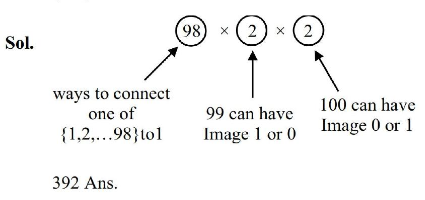
Number of functions $f:\{1,2, \ldots, 100\} \rightarrow\{0,1\}$, that assign 1 to exactly one of the positive integers less than or equal to 98 , is equal to ____________ .
Answer
(392)
Image
View full question & answer