Questions

SECTION - A [CHEMISTY - MCQ]

Take a timed test

20 questions · self-marked practice — reveal the answer and mark yourself.

MCQ 14 Marks
Identify the inorganic sulphides that are yellow in colour :
(A) $\left(\mathrm{NH}_{4}\right)_{2} \mathrm{~S}$
(B) PbS
(C) CuS
(D) $\mathrm{As}_{2} \mathrm{~S}_{3}$
(E) $\mathrm{As}_{2} \mathrm{~S}_{5}$
Choose the correct answer from the options given below:
  • A
    (A) and (C) only
  • B
    (A), (D) and (E) only
  • C
    (A) and (B) only
  • D
    (D) and (E) only
Answer
D,
NTA
B
$\mathrm{As}_{2} \mathrm{~S}_{3}$ and $\mathrm{As}_{2} \mathrm{~S}_{5}$ are yellow colour sulphides, $\left(\mathrm{NH}_{4}\right)_{2} \mathrm{~S}$ is colourless, PbS is black, CuS is black in colour
View full question & answer
MCQ 34 Marks
Identify correct statements :
(A) Primary amines do not give diazonium salts when treated with $\mathrm{NaNO}_{2}$ in acidc condition.
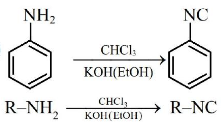
(B) Aliphatic and aromatic primary amines on heating wth $\mathrm{CHCl}_{3}$ and ethanolic KOH form carbylamines.
(C) Secondary and tertiary amines also give carbylamine test.
(D) Benzenesulfonyl chloride is known as Hinsberg's reagent.
(E) Tertiary amines reacts with benzenesulfonyl chloride very easily.
Choose the correct answer from the options given below :
  • A
    (B) and (D) only
  • B
    (A) and (B) only
  • C
    (D) and (E) only
  • D
    (B) and (C) only
View full question & answer
MCQ 44 Marks
Assume a living cell with $0.9 \%(\omega / \omega)$ of glucose solution (aqueous). This cell is immersed in another solution having equal mole fraction of glucose and water.
(Consider the data upto first decimal place only)The cell will :
  • A
    shrink since soluton is $0.5 \%(\omega / \omega)$
  • B
    shrink since solution is $0.45 \%(\omega / \omega)$ as a result of association of glucose molecules (due to hydrogen bonding)
  • C
    swell up since solution is $1 \%(\omega / \omega)$
  • D
    Show no change in volume since solution is $0.9 \%(\omega / \omega)$
Answer
(BONUS)NTA
D.
Living cell $=0.9 \mathrm{gm}$ in 100 gm of solution
$\% \mathrm{w} / \mathrm{w}=0.9$
Solution is have equal moles of glucose and
water $=0.5$
Weight of solution $=0.5 \times 180+0.5 \times 18=99 \mathrm{gm}$
$\% \mathrm{w} / \mathrm{w} \simeq 90 \%$
Concentrated solution
$=$ Cell will shrink.
View full question & answer
MCQ 54 Marks
Which of the following is/are not correct with respect to energy of atomic orbitals of hydrogen atom?
(A) 1 s $<2$ p $<3$ d $<4$ s
(B) $1 \mathrm{~s}<2 \mathrm{~s}=2 \mathrm{p}<3 \mathrm{~s}=3 \mathrm{p}$
(C) 1 s $<2$ s $<2$ p $<3$ s $<3$ p
(D) 1 s $<2$ s $<4$ s $<3\mathrm{~d}$
Choose the correct answer from the options given below:
  • A
    (B) and (D) only
  • B
    (A) and (C) only
  • C
    (C) and (D) only
  • D
    (A) and (B) only
Answer
C.
For single electron species energy only depends on
' n ' (principal quantum number)
So energy of $2 \mathrm{~s}=2 \mathrm{p}$
and energy of $3 \mathrm{~d}<4 \mathrm{~s}$
View full question & answer
MCQ 64 Marks
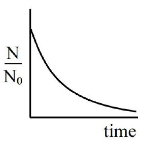
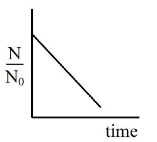
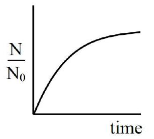
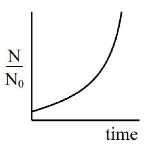
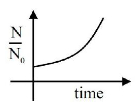
For bacterial growth in a cell culture, growth law is very similar to the law of radioactive decay.
Which of the following graphs is most suitable to represent bacterial colony growth ?
  • A
    Image
  • B
    Image
  • C
    Image
  • D
    Image
Answer
D.
Because no. of bacteria initial $=\mathrm{N}_{0}$
and No. of bacteria at any time $t=N$
Since bacterial growth is given as
$\mathrm{N}=\mathrm{N}_{0} \mathrm{e}^{\mathrm{Kt}}$
Where $\mathrm{K}=$ growth constant for bacterial growth
Image
View full question & answer
MCQ 74 Marks
Given below are two statements :
Statement (I): According to the Law of Octaves, the elements were arranged in the increasing order of their atomic number.
Statement (II) : Meyer observed a periodically repeated pattern upon plotting physical properties of certain elements against their respective atomic numbers.
In the light of the above statements, choose the correct answer from the options given below :
  • A
    Statement I is false but Statement II is true
  • B
    Both Statement I and Statement II are true
  • C
    Statement I is true but Statement II is false
  • D
    Both Statement I and Statement II are false
Answer
D.
Law of octaves was arranged in the increasing order of their atomic weight.
Lothar Meyer plotted the physical properties such as atomic volume, melting point and boiling point against atomic weight.
View full question & answer
MCQ 84 Marks
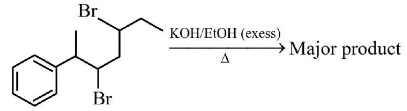
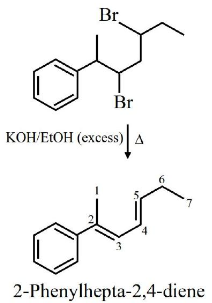
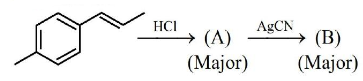
The major product of the following reaction is :
Image
  • A
    6-Phenylhepta-2,4-diene
  • B
    2-Phenylhepta-2,5-diene
  • C
    6-Phenylhepta-3,5-diene
  • D
    2-Phenylhepta-2,4-diene
Answer
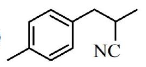
D.
Image
View full question & answer
MCQ 94 Marks
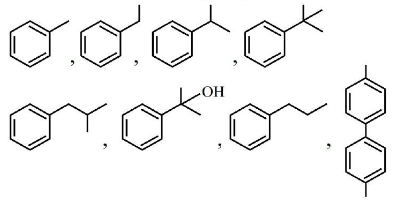
The total number of compounds from below when treated with hot $\mathrm{KMnO}_{4}$ giving benzoic acid is :
Image
  • A
    3
  • B
    4
  • C
    6
  • D
    5
Answer
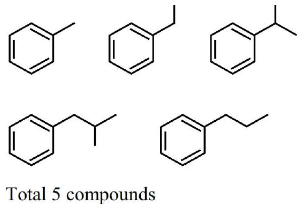
D.
Compounds having at least $1-\mathrm{H}$ will react with $\mathrm{KMnO}_{4}$ and give benzoic acid.
Image
View full question & answer
MCQ 104 Marks
Match List-I with List-II.
List-I
(Complex)}
List-II
(Hybridisation of central metal ion)
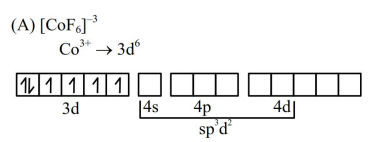
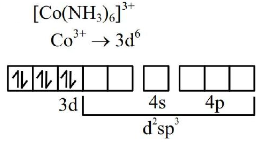
(A) $\left[\mathrm{CoF}_{6}\right]^{3-}$(I) $ d^2 sp ^3$
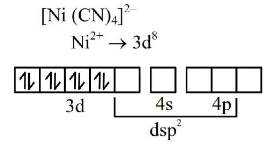
(B) $\left[\mathrm{NiCl}_{4}\right]^{2}$(II) $sp ^3$
(C) $\left[\mathrm{Co}\left(\mathrm{NH}_{3}\right)_{6}\right]^{3+}$(III) $ sp ^3 d^2$
(D) $\left[\mathrm{Ni}(\mathrm{CN})_{4}\right]^{2-}$(IV) $dsp ^2$

Choose the correct answer from the options given
  • A
    (A)-(I), (B)-(IV), (C)-(III), (D)-(II)
  • B
    (A)-(III), (B)-(II), (C)-(I), (D)-(IV)
  • C
    (A)-(I), (B)-(II), (C)-(III), (D)-(IV)
  • D
    (A)-(III), (B)-(IV), (C)-(I), (D)-(II)
Answer
View full question & answer
MCQ 114 Marks
Concentrated nitric acid is labelled as $75 \%$ by mass. The volume in mL of the solution which contains 30 g of nitric acid is _______________ .
Given : Density of nitric acid solution is $1.25 \mathrm{~g} / \mathrm{mL}$
  • A
    45
  • B
    55
  • C
    32
  • D
    40
Answer
C.
$\% \mathrm{w} / \mathrm{w}$ of $\mathrm{HNO}_{3}=75 \%$
means 100 gm of solution containing 75 g of
$\mathrm{HNO}_{3}$
$\&\left(\frac{\mathrm{gm}}{\mathrm{m}_{1}}\right)_{\text {solution }}=1.25=\frac{100 \mathrm{gm}}{\mathrm{V}}$
$\mathrm{V}_{\mathrm{ml}}$ of 100 gm solution $=\frac{100}{1.25} \mathrm{ml}$
$\because 75$ gm of $\mathrm{HNO}_{3}$ present in $\frac{100}{1.25} \mathrm{ml}$ solution
$\therefore 30 \mathrm{gm}$ of $\mathrm{HNO}_{3}$ present in
$\frac{100}{1.25 \times 75} \times 30=32 \mathrm{ml} \text { solution }$
View full question & answer
MCQ 134 Marks
Image
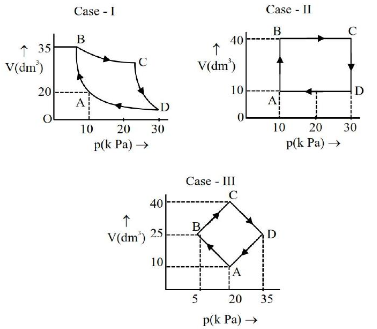
An ideal gas undergoes a cyclic transformation starting from the point A and coming back to the same point by tracing the path $\mathrm{A} \rightarrow \mathrm{B} \rightarrow \mathrm{C} \rightarrow \mathrm{D} \rightarrow \mathrm{A}$ as shown in the three cases above.
Choose the correct option regarding $\Delta \mathrm{U}$.
  • A
    $\Delta \mathrm{U}($ Case-III $)>\Delta \mathrm{U}($ Case-II $)>\Delta \mathrm{U}($ Case-I $)$
  • B
    $\Delta \mathrm{U}($ Case-I) $>\Delta \mathrm{U}($ Case-II $)>\Delta \mathrm{U}$ (Case-III)
  • C
    $\Delta U($ Case-I) $>\Delta U($ Case-III $)>\Delta U($ Case-II $)$
  • D
    $\Delta \mathrm{U}($ Case-I $)=\Delta \mathrm{U}($ Case-II $)=\Delta \mathrm{U}($ Case-III $)$
Answer
D.
As internal energy ' $U$ ' is a state function, its cyclic integral must be zero in a cyclic process
$\therefore \Delta \mathrm{U}$ case (I) $=\Delta \mathrm{U}$ case (II) $=\Delta \mathrm{U}$ case (III)
View full question & answer
MCQ 144 Marks
Identify correct conversion during acidic hydrolysis from the following :
(A) starch gives galactose.
(B) cane sugar gives equal amount of glucose and fructose.
(C) milk sugar gives glucose and galactose.
(D) amylopectin gives glucose and fructose.
(E) amylose gives only glucose.
  • A
    (C), (D) and (E) only
  • B
    (A), (B) and (C) only
  • C
    (B), (C) and (E) only
  • D
    (B), (C) and (D) only
Answer
C.
(A) Starch $\xrightarrow{\mathrm{H}^{+} / \mathrm{H}_{2} \mathrm{O}}$ Glucose
(B) Cane sugar $\xrightarrow{\mathrm{H}^{+} / \mathrm{H}_{2} \mathrm{O}}$ glucose + fructose
$\quad$ (Sucrose)$\quad$$\quad$$\quad$$\quad$$\quad$ $50 \% \quad\quad 50 \%$
(C) Milk sugar $\xrightarrow{\mathrm{H}^{+} / \mathrm{H}_{2} \mathrm{O}}$ glucose + galactose
$\quad$ (Lactose)
(D) Amylopectin $\xrightarrow{\mathrm{H}^{+} / \mathrm{H}_{2} \mathrm{O}}$ Glucose
(E) Amylose $\xrightarrow{\mathrm{H}^{+} / \mathrm{H}_{2} \mathrm{O}}$ Glucose
So, correct options are B, C and E only
View full question & answer
MCQ 154 Marks
The purification method based on the following physical transformation is :
$\underset{(\mathrm{X})}{\text { Solid }} \xrightarrow{\text { Heat }} \underset{(\mathrm{X})}{\text { Vapour }} \xrightarrow{\text { Cool }} \underset{(\mathrm{X})}{\text { Solid }}$
  • A
    Sublimation
  • B
    Distillation
  • C
    Crystallization
  • D
    Extraction
Answer
A.
Theory base
View full question & answer
MCQ 164 Marks
Arrange the following in increasing order of solubility product :
$\mathrm{Ca}(\mathrm{OH})_{2}, \mathrm{AgBr}, \mathrm{PbS}, \mathrm{HgS}$
  • A
    $\mathrm{PbS}<\mathrm{HgS}<\mathrm{Ca}(\mathrm{OH})_{2}<\mathrm{AgBr}$
  • B
    $\mathrm{HgS}<\mathrm{PbS}<\mathrm{AgBr}<\mathrm{Ca}(\mathrm{OH})_{2}$
  • C
    $\mathrm{Ca}(\mathrm{OH})_{2}<\mathrm{AgBr}<\mathrm{HgS}<\mathrm{PbS}$
  • D
    $\mathrm{HgS}<\mathrm{AgBr}<\mathrm{PbS}<\mathrm{Ca}(\mathrm{OH})_{2}$
Answer
B.
Based on the Ksp values and salt analysis cation identification, we can say that order of Ksp value is:
$\mathrm{HgS}<\mathrm{PbS}<\mathrm{AgBr}<\mathrm{Ca}(\mathrm{OH})_{2}$
Ksp values
$\mathrm{HgS} \rightarrow 4 \times 10^{-53}$
$\mathrm{PbS} \rightarrow 8 \times 10^{-28}$
$\mathrm{AgBr} \rightarrow 5 \times 10^{-13}$
$\mathrm{Ca}(\mathrm{OH})_{2} \rightarrow 5.5 \times 10^{-6}$
View full question & answer
MCQ 174 Marks
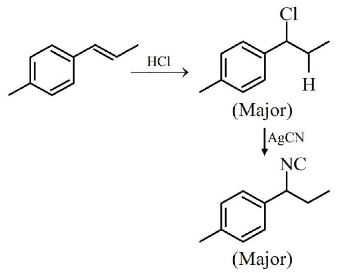
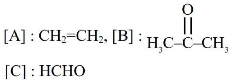
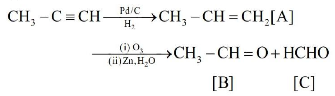
Identify product $[\mathrm{A}],[\mathrm{B}]$ and $[\mathrm{C}]$ in the following reaction sequence :
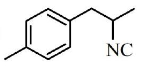
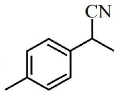
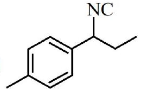
Image
  • A


    Image
  • B


    Image
  • C


    Image
  • D


    Image
Answer
A.
Image
View full question & answer
MCQ 184 Marks
Match List-I with List-II
List-I
(Saccharides)
List-II
(Glycosidic-linkages found)
(A) Sucrose(I) $\alpha$ 1-4
(B) Maltose(II) $\alpha 1-4$ and $\alpha 1-6$
(C) Lactose(III) $\alpha 1-\beta 2$
(D) Amylopectin(IV) $\beta 1-4$

Choose the correct answer from the options given below :
  • A
    (A)-(III), (B)-(I), (C)-(IV), (D)-(II)
  • B
    (A)-(IV), (B)-(II), (C)-(I), (D)-(III)
  • C
    (A)-(II), (B)-(IV), (C)-(III), (D)-(I)
  • D
    (A)-(I), (B)-(II), (C)-(III), (D)-(IV)
Answer
A.
(A) Sucrose $\rightarrow \alpha_{1}-\beta_{2}$ Glycosidic linkage
(B) Maltose $\rightarrow \alpha$ 1-4 Glycosidic linkage
(C) Lactose $\rightarrow \beta$ 1-4 Glycosidic linkage
(D) Amylopectin $\rightarrow \alpha$ 1-4 and $\alpha$ 1-6
Glycosidic linkage
A-III, B-I, C-IV, D-II
View full question & answer
MCQ 194 Marks
The amphoteric oxide among $\mathrm{V}_{2} \mathrm{O}_{3}, \mathrm{~V}_{2} \mathrm{O}_{4}$ and $\mathrm{V}_{2} \mathrm{O}_{5}$ upon reaction with alkali leads to formation of an oxide anion. The oxidation state of V in the oxide anion is :
  • A
    +3
  • B
    +7
  • C
    +5
  • D
    +4
Answer
C.
$\mathrm{V}_{2} \mathrm{O}_{5}+$ alkali $\rightarrow \mathrm{VO}_{4}^{3-}$
In $\mathrm{VO}_{4}^{3-}$ ion, vanadium is in +5 oxidation state
View full question & answer
MCQ 204 Marks
consider the elementary reaction $\mathrm{A}(\mathrm{g})+\mathrm{B}(\mathrm{g}) \rightarrow \mathrm{C}(\mathrm{g})+\mathrm{D}(\mathrm{g})$ If the volume of reaction mixture is suddenly reduced to $\frac{1}{3}$ of its initial volume, the reaction rate will become ' $x$ ' times of the original reaction rate. The value of $x$ is :
  • A
    $\frac{1}{9}$
  • B
    9
  • C
    $\frac{1}{3}$
  • D
    3
Answer
B.
$\mathrm{R}_{1}=\mathrm{K}[\mathrm{A}]^{1}[\mathrm{~B}]^{1}$
$\mathrm{R}_{1}=\mathrm{K}\left[\frac{\mathrm{n}_{\mathrm{A}}}{\mathrm{V}}\right]^{1}\left[\frac{\mathrm{n}_{\mathrm{B}}}{\mathrm{V}}\right]^{1}$
$\mathrm{R}_{2}=\mathrm{K}\left[\frac{3 \mathrm{n}_{\mathrm{A}}}{\mathrm{V}}\right]^{1}\left[\frac{3 \mathrm{n}_{\mathrm{B}}}{\mathrm{V}}\right]^{1}$
$\mathrm{R}_{2}=9 \mathrm{R}_{1}$
View full question & answer