Questions

SECTION - B [MATHS - NUMERIC]

Take a timed test

5 questions · self-marked practice — reveal the answer and mark yourself.

Question 14 Marks
If $y=y(x)$ is the solution of the differential equation,$\sqrt{4-x^{2}} \frac{d y}{d x}=\left(\left(\sin ^{-1}\left(\frac{x}{2}\right)\right)^{2}-y\right) \sin ^{-1}\left(\frac{x}{2}\right)$,$-2 \leq x \leq 2, y(2)=\left(\frac{\pi^{2}-8}{4}\right)$, then $\mathrm{y}^{2}(0)$ is equal to _______________ .
Answer
4
$\frac{d y}{d x}+\frac{\left(\sin ^{-1} \frac{x}{2}\right)}{\sqrt{4-x^{2}}} y-\frac{\left(\sin ^{-3} \frac{x}{2}\right)^{3}}{\sqrt{4-x^{2}}}$
$y e^{\frac{\left(\sin ^{-1} \frac{x}{2}\right)^{2}}{2}}=\int \frac{\left(\sin ^{-3} \frac{x}{2}\right)^{3}}{4-x^{2}} e^{\frac{\left(\sin ^{-1} \frac{x}{2}\right)^{2}}{2}} d x$
$y=\left(\sin ^{-1} \frac{x}{2}\right)^{2}-2+c . e^{\frac{-\left(\sin ^{-1} \frac{x}{2}\right)^{2}}{2}}$
$y(2)=\frac{\pi^{2}}{4}-2 \Rightarrow c=0$
$y(0)=-2$
View full question & answer
Question 24 Marks
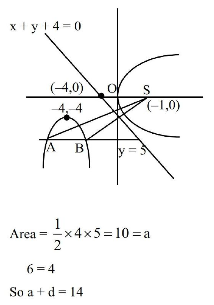
Let A and B be the two points of intersection of the line $y+5=0$ and the mirror image of the parabola $y^{2}=4 x$ with respect to the line $x+y+4=0$. If $d$ denotes the distance between A and B , and a denotes the area of $\triangle \mathrm{SAB}$, where S is the focus of the parabola $y^{2}=4 x$, then the vlaue of $(a+d)$ is _______________ .
Answer
14
Image
View full question & answer
Question 34 Marks
The interior angles of a polygon with n sides, are in an A.P. with common difference $6^{\circ}$. If the largest interior angle of the polygon is $219^{\circ}$, then n is equal to _______________ .
Answer
20
$\frac{\mathrm{n}}{2}(2 \mathrm{a}+(\mathrm{n}-1) 6)=(\mathrm{n}-2) .180^{\circ}$
$\mathrm{an}+3 \mathrm{n}^{2}-3 \mathrm{n}=(\mathrm{n}-2) \cdot 180^{\circ}\ldots(1)$
Now according to question
$a+(n-1) 6^{\circ}=219^{\circ}$
$\Rightarrow \mathrm{a}=225^{\circ}-6 \mathrm{n}^{\circ}\\\ldots(2)$
Putting value of a from equation (2) in (1)
We get
$\left(225 n-6 n^{2}\right)+3 n^{2}-3 n=180 n-360$
$\Rightarrow 2 \mathrm{n}^{2}-42 \mathrm{n}-360=0$
$\Rightarrow \mathrm{n} 2-14 \mathrm{n}-120=0$
$\mathrm{n}=20,-6($ rejected $)$
View full question & answer
Question 44 Marks
Let $f(\mathrm{x})=\lim _{\mathrm{n} \rightarrow \infty} \sum_{\mathrm{r}=0}^{\mathrm{n}}\left(\frac{\tan \left(\mathrm{x} / 2^{\mathrm{r}+1}\right)+\tan ^{3}\left(\mathrm{x} / 2^{\mathrm{r}+1}\right)}{1-\tan ^{2}\left(\mathrm{x} / 2^{\mathrm{r}+1}\right)}\right)$. Then $\lim _{x \rightarrow 0} \frac{\mathrm{e}^{\mathrm{x}}-\mathrm{e}^{f(\mathrm{x})}}{(\mathrm{x}-f(\mathrm{x}))}$ is equal to _______________ .
Answer
1
$f(x)=\lim _{n \rightarrow \infty} \sum_{r=0}^{n}\left(\tan \frac{x}{2^{r}}-\tan\frac{x}{2^{r+1}}\right)=\tan x$$\lim _{x \rightarrow 0}\left(\frac{e^{x}-e^{\tan x}}{x-\tan x}\right)=\lim _{x \rightarrow 0} e^{\tan x} \frac{\left(e^{x-\tan x}-1\right)}{(x-\tan x)}$
$=1$
View full question & answer
Question 54 Marks
The number of natural numbers, between 212 and 999 , such that the sum of their digits is 15 , is _______________ .
Answer
64
Image
Let $\mathrm{x}=2 \Rightarrow \mathrm{y}+\mathrm{z}=13$
$(4,9),(5,8),(6,7),(7,6),(8,5),(9,4), \rightarrow 6$
Let $\mathrm{x}=3 \rightarrow \mathrm{y}+\mathrm{z}=12$
$(3,9),(4,8)$,$\ldots$,$(9,3) \rightarrow 7$
Let $\mathrm{x}=4 \rightarrow \mathrm{y}+\mathrm{z}=11$
$(2,9),(3,8)$, $\ldots$, $(9,1) \rightarrow 9$
Let $\mathrm{x}=5 \rightarrow \mathrm{y}+\mathrm{z}=10$
$(1,9),(2,8)$, $\ldots$,$(9,1) \rightarrow 10$
Let $\mathrm{x}=6 \rightarrow \mathrm{y}+\mathrm{z}=9$
$(0,9),(1,8)$, $\ldots$,$(9,0) \rightarrow 9$
Let $\mathrm{x}=7 \rightarrow \mathrm{y}+\mathrm{z}=8$
$(0,9),(1,7)$,$\ldots$,$(8,0) \rightarrow 9$
Let $\mathrm{x}=8 \rightarrow \mathrm{y}+\mathrm{z}=7$
$(0,7),(1,6)$, $\ldots,(7,0) \rightarrow 8$
Let $x=9 \rightarrow y+z=6$
$(0,6),(1,5)$,$\ldots$,$(6,0) \rightarrow 7$
Total $=6=7+8+9+10+9+8+7=64$
View full question & answer