Questions

SECTION - B [CHEMISTY - NUMERIC]

Take a timed test

5 questions · self-marked practice — reveal the answer and mark yourself.

Question 14 Marks
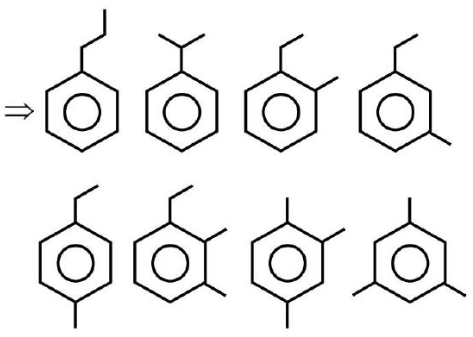
The total number of structural isomers possible for the substituted benzene derivatives with the molecular formula $\mathrm{C}_{9} \mathrm{H}_{12}$ is __________ .
Answer
8
$\mathrm{MF}=\mathrm{C}_{9} \mathrm{H}_{12}$
Image
View full question & answer
Question 24 Marks
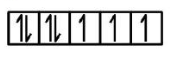
Among, $\mathrm{Sc}, \mathrm{Mn}, \mathrm{Co}$ and Cu, identify the element with highest enthalpy of atomisation. The spin only magnetic moment value of that element in its +2 oxidation state is __________ BM (in nearest integer).
Answer
4
ScMnCoCu
Enthalpy of Atomisation (kJ/mole)326281425339
Highest Co
$Co ^{-2}=( Ar ) 3 d^7$
Image
$\begin{array}{l} n =3 \\ \mu=\sqrt{15}=3.87\end{array}$
Nearest integer $=4$
View full question & answer
Question 34 Marks
A sample of n-octane (1.14 g) was completely burnt in excess of oxygen in a bomb calorimeter, whose heat capacity is $5 \mathrm{~kJ} \mathrm{~K}^{-1}$. As a result of combustion reaction, the temperature of the calorimeter is increased by 5 K . The magnitude of the heat of combustion of octane at constant volume is __________ $\mathrm{kJ} \mathrm{mol}^{-1}$ (nearest integer).
Answer
2500
Mole of octane $=\frac{1.14}{114}=0.01 \mathrm{~mole}$
Heat evolved $=\mathrm{C} \times \Delta \mathrm{T}$
$=5 \times 5 \mathrm{~kJ}$
$=25 \mathrm{~kJ}$
$\therefore$ Magnitude of Heat of combustion $=\frac{25}{0.01}=2500$
$\mathrm{kJ} /$ mole
View full question & answer
Question 44 Marks
Image
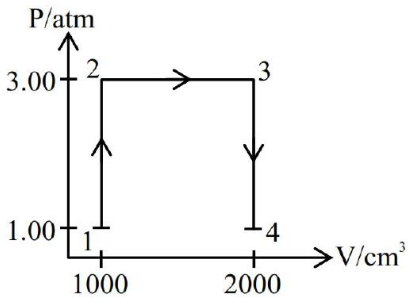
A perfect gas ( 0.1 mol ) having $\overline{\mathrm{C}}_{\mathrm{v}}=1.50 \mathrm{R}$ (independent of temperature) undergoes the above transformation from point 1 to point 4 . If each step is reversible, the total work done (w) while going from point 1 to point 4 is $(-)$ __________ J (nearest integer)
[Given : $\mathrm{R}=0.082 \mathrm{~L} \mathrm{~atm} \mathrm{~K}^{-1} \mathrm{~mol}^{-1}$ ]
Answer
304
$\quad W_{1 \rightarrow 2}=0$
$\mathrm{W}_{2 \rightarrow 3}=-\mathrm{P} \Delta \mathrm{V}$
$=-3[2-1]$
$=-3 \mathrm{~atm}-\ell$
$\mathrm{W}_{3 \rightarrow 4}=0$
Total work done
$=-3 \mathrm{~atm}-\ell$
$=-3 \times 101.3$ Joule
$=-304$ Joule
View full question & answer
Question 54 Marks
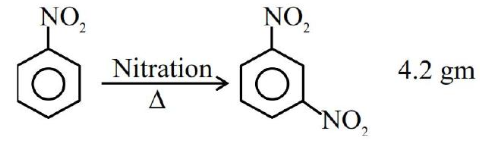
X g of nitrobenzene on nitration gave 4.2 g of m - dinitrobenzene.
X = __________ g. (nearest integer)
[Given : molar mass (in $\mathrm{g} \mathrm{mol}^{-1}$ ) $\mathrm{C}: 12, \mathrm{H}: 1$, $\mathrm{O}: 16, \mathrm{~N}: 14]$
Answer
3
Image
$\begin{array}{ll} C _6 H _5 NO _2 & MF = C _6 H _4 N_2 O _4 \\ MW =123 & MW =168 \\ & \therefore \frac{4.2}{168}=0.025 mol\end{array}$
$\because$ required gm of nitro benzene
$=123 \times 0.025$
$=3.075$
$\therefore$ Nearest integer is 3
View full question & answer