Questions

SECTION - B [MATHS - NUMERIC]

Take a timed test

5 questions · self-marked practice — reveal the answer and mark yourself.

Question 14 Marks
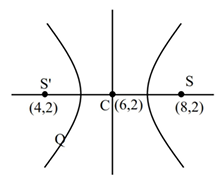
If the equation of the hyperbola with foci $(4,2)$ and $(8,2)$ is $3 x^{2}-y^{2}-\alpha x+\beta y+\gamma=0$, then $\alpha+\beta+\gamma$ is equal to __________ .
Answer
141
Image
Equation of hyperbola is
$\frac{(x-6)^{2}}{a^{2}}-\frac{(y-2)^{2}}{4-a^{2}}=1$
$\Rightarrow\left(4-a^{2}\right)(x-6)^{2}-a^{2}(y-2)^{2}=a^{2}\left(4-a^{2}\right)$
comparing with $3 x^{2}-y^{2}-\alpha x+\beta y+\gamma=0$, we get
$\mathrm{a}^{2}=1$ and $\alpha=36, \beta=4$ and $\gamma=101$
$\therefore \alpha+\beta+\gamma=141$
View full question & answer
Question 24 Marks
Let $\overrightarrow{\mathrm{a}}=\hat{\mathrm{i}}+2 \hat{\mathrm{j}}+\hat{\mathrm{k}}, \overrightarrow{\mathrm{b}}=3 \hat{\mathrm{i}}-3 \hat{\mathrm{j}}+3 \hat{\mathrm{k}}$, $\overrightarrow{\mathrm{c}}=2 \hat{\mathrm{i}}-\hat{\mathrm{j}}+2 \hat{\mathrm{k}}$ and $\overrightarrow{\mathrm{d}}$ be a vector such that $\overrightarrow{\mathrm{b}} \times \overrightarrow{\mathrm{d}}=\overrightarrow{\mathrm{c}} \times \overrightarrow{\mathrm{d}}$ and $\overrightarrow{\mathrm{a}} \cdot \overrightarrow{\mathrm{d}}=4$. Then $|(\overrightarrow{\mathrm{a}} \times \overrightarrow{\mathrm{d}})|^{2}$ is equal to __________ .
Answer
128
$\overrightarrow{\mathrm{b}} \times \overrightarrow{\mathrm{d}}=\overrightarrow{\mathrm{c}} \times \overrightarrow{\mathrm{d}}$-and $\overrightarrow{\mathrm{a}} \cdot \overrightarrow{\mathrm{d}}=4$
$\Rightarrow \overrightarrow{\mathrm{d}}=\lambda(\overrightarrow{\mathrm{b}}-\overrightarrow{\mathrm{c}})=\lambda(\hat{\mathrm{i}}-2 \hat{\mathrm{j}}+\hat{\mathrm{k}})$
$\because \vec{a} \cdot \vec{d}=4 \Rightarrow \lambda=-2$
Also. $|\overrightarrow{\mathrm{a}} \times \overrightarrow{\mathrm{d}}|^{2}+|\overrightarrow{\mathrm{a}} \cdot \overrightarrow{\mathrm{d}}|^{2}=|\overrightarrow{\mathrm{a}}|^{2}|\overrightarrow{\mathrm{~d}}|^{2}$
$\Rightarrow|\overrightarrow{\mathrm{a}} \times \overrightarrow{\mathrm{d}}|^{2}=6 \times 4 \times 6-16=128$
View full question & answer
Question 34 Marks
If $\operatorname{Lim}_{x \rightarrow 0}\left(\frac{\tan x}{x}\right)^{\frac{1}{x^{2}}}=p$, then $96 \log _{e} p$ is equal to __________.
Answer
32
$P=\lim _{x \rightarrow 0}\left(\frac{\tan x}{x}\right)^{\frac{1}{x^{2}}}$
$\Rightarrow \mathrm{P}=\mathrm{e}^{\lim _{\mathrm{x} \rightarrow 0}\left(\frac{\tan \mathrm{x}-\mathrm{x}}{\mathrm{x}^{3}}\right)}$
$=\mathrm{e}^{\lim _{x \rightarrow 0} \frac{\left(x+\frac{x^{3}}{3}+\frac{2 x^{5}}{15}+\ldots . . x\right)}{x^{3}}}$
$=e^{1 / 3}$
$\therefore 96 \log _{\mathrm{e}}{ }^{\mathrm{p}}=96 \times \frac{1}{3}=32$
View full question & answer
Question 44 Marks
Let $\left(1+x+x^{2}\right)^{10}=a_{0}+a_{1} x+a_{2} x^{2}+\ldots .+a_{20} x^{20}$. If
$\left(a_{1}+a_{3}+a_{5}+\ldots .+a_{19}\right)-11 \mathrm{a}_{2}=121 \mathrm{k}$, then k is equal to __________ .
Answer
239
$\left(1+x+x^{2}\right)^{10}=a_{0}+a_{1} x+a_{2} x^{2}+\ldots .+a_{20} x^{20}$
$
\begin{array}{l}
\therefore 3^{10}=a_0+a_1+a_2+\ldots+a_{20} & & ....(i)\\
1=a_0-a_1+a_2 \ldots . .+a_{20} & & ....(ii)
\end{array}
$
(i) - (ii) $\Rightarrow a_{1}+a_{3}+\ldots .+a_{19}=\frac{3^{10}-1}{2}=29524$
Also $\{1+\mathrm{x} (1 + \mathrm{x})\}^{10}=1$$+{ }^{10} C _1 x (1+ x )+{ }^{10} C _2 x ^2(1+ x )^2+\ldots $
$\therefore \mathrm{a}_{2}={ }^{10} \mathrm{C}_{1}+{ }^{10} \mathrm{C}_{2}=55$
$\therefore \frac{\left(\mathrm{a}_{1}+\mathrm{a}_{3}+\ldots+\mathrm{a}_{19}\right)-11 \mathrm{a}_{2}}{121}=239$
View full question & answer
Question 54 Marks
Let $I$ be the identity matrix of order $3 \times 3$ and for the matrix $\mathrm{A}=\left[\begin{array}{ccc}\lambda & 2 & 3 \\ 4 & 5 & 6 \\ 7 & -1 & 2\end{array}\right],|\mathrm{A}|=-1$. Let B be the inverse of the matrix $\operatorname{adj}\left(\mathrm{A} \operatorname{adj}\left(\mathrm{A}^{2}\right)\right)$. Then $|(\lambda B+1)|$ is equal to __________.
Answer
38
$|A|=\left|\begin{array}{ccc}\lambda & 2 & 3 \\ 4 & 5 & 6 \\ 7 & -1 & 2\end{array}\right|=-1$
$\lambda(16)-2(-34)+3(-39)=-1$
$16 \lambda=48 \Rightarrow \lambda=3$
$\mathrm{B}^{-1}=\operatorname{adj}\left(\mathrm{A} \cdot \operatorname{adj}\left(\mathrm{A}^{2}\right)\right)$
Let $\mathrm{C}=\mathrm{A} \cdot \operatorname{adj}\left(\mathrm{A}^{2}\right)$
$A C=A^{2} \operatorname{adj}\left(A^{2}\right)=|A|^{2} \cdot I=I \Rightarrow C=A^{-1}$
Now $\mathrm{B}^{-1}=\operatorname{adj}\left(\mathrm{A}^{-1}\right)=\mathrm{B}=\operatorname{adj}(\mathrm{A})$
Now $\lambda \mathrm{B}+\mathrm{I} \Rightarrow 3 \mathrm{~B}+\mathrm{I}$
Let $\mathrm{P}=3 \mathrm{~B}+\mathrm{I}$
P $=3 \operatorname{adj}(\mathrm{~A})+\mathrm{I}$
$\mathrm{AP}=3 \operatorname{Aadj}(\mathrm{~A})+\mathrm{A}$
$\mathrm{AP}=3|\mathrm{~A}| \cdot \mathrm{I}+\mathrm{A}$
$\mathrm{AP}=\mathrm{A}-3 \mathrm{I}$
$|\mathrm{AP}|=|\mathrm{A}-3 \mathrm{I}|$
$|\mathrm{A}| .|\mathrm{P}|=\left|\begin{array}{ccc}0 & 2 & 3 \\ 4 & 2 & 6 \\ 7 & -1 & -1\end{array}\right|=38$
$|\mathrm{P}|=-38$
View full question & answer