Questions

SECTION - A [CHEMISTY - MCQ]

Take a timed test

20 questions · 14 auto-graded MCQ + 6 self-marked written.

MCQ 14 Marks
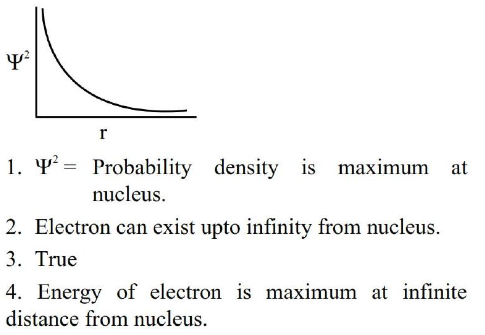
Which one of the following about an electron occupying the 1s orbital in a hydrogen atom is incorrect? (Bohr's radius is represented by $\mathrm{a}_{0}$)
  • A
    The probability density of finding the electron is maximum at the nucleus
  • B
    The electron can be found at a distance $2 a_{0}$ from the nucleus
  • C
    The 1 s orbital is spherically symmetrical
  • D
    The total energy of the electron is maximum when it is at a distance $\mathrm{a}_{0}$ from the nucleus
Answer
The total energy of the electron is maximum when it is at a distance $\mathrm{a}_{0}$ from the nucleus
Image
View full question & answer
MCQ 24 Marks
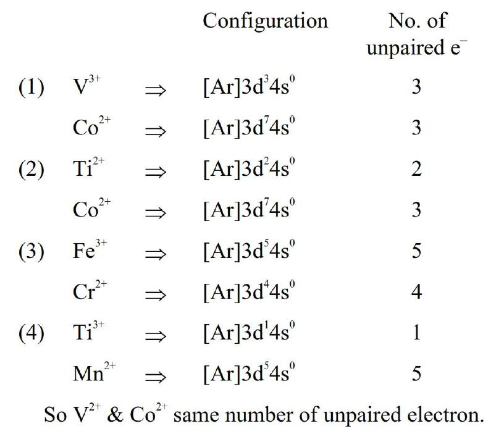
Pair of transition metal ions having the same number of unpaired electrons is :
  • $V ^{2+}, Co ^{2+}$
  • B
    $Ti ^{2+}, Co ^{2+}$
  • C
    $Fe ^{3+}, Cr ^{2+}$
  • D
    $Ti ^{3+}, Mn ^{2+}$
Answer
Correct option: A.
$V ^{2+}, Co ^{2+}$
(A) $V ^{2+}, Co ^{2+}$
Image
View full question & answer
MCQ 34 Marks
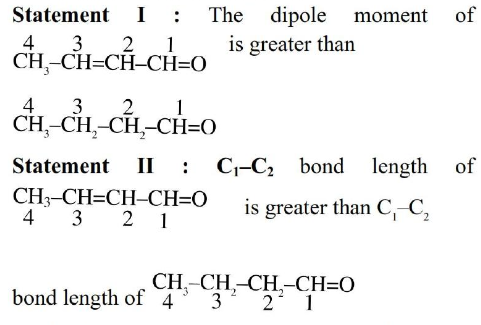
Given below are two statements.
Image
In the light of the above statements, choose the correct answer from the options given below :
  • A
    Statement I is false but Statement II is true
  • B
    Both Statement I and Statement II are false
  • Statement I is true but Statement II is false
  • D
    Both Statement I and Statement II are true
Answer
Correct option: C.
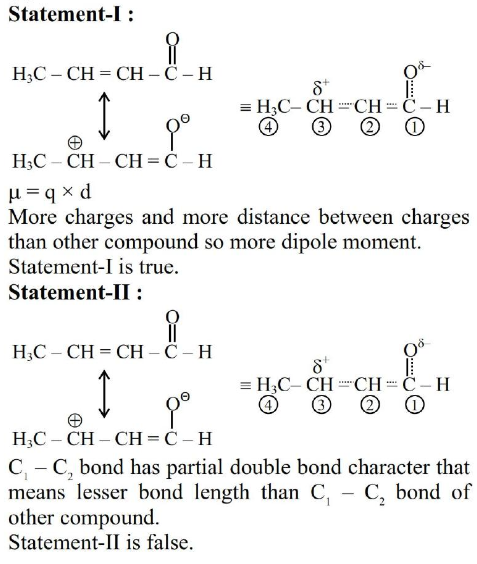
Statement I is true but Statement II is false
(C) Statement I is true but Statement II is false
Image
View full question & answer
MCQ 54 Marks
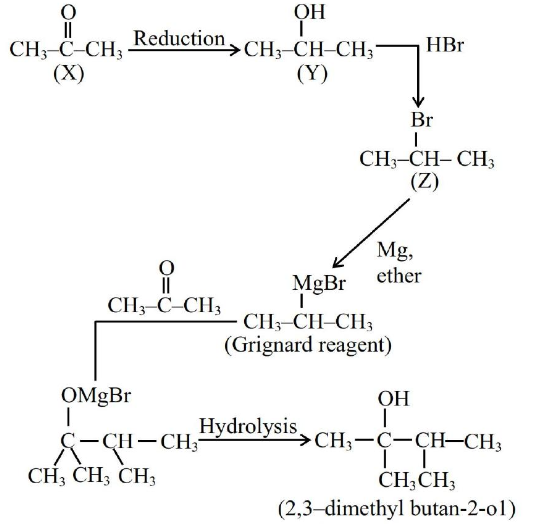
An organic compound (X) with molecular formula $\mathrm{C}_{3} \mathrm{H}_{6} \mathrm{O}$ is not readily oxidised. On reduction it gives $\left(\mathrm{C}_{3} \mathrm{H}_{8} \mathrm{O}(\mathrm{Y})\right.$ which reacts with HBr to give a bromide ( Z ) which is converted to Grignard reagent. This Grinard reagent on reaction with (X) followed by hydrolysis give 2,3-dimethylbutan-2-ol. Compounds (X), (Y) and (Z) respectively are :
  • A
    $\mathrm{CH}_{3} \mathrm{COCH}_{3}, \mathrm{CH}_{3} \mathrm{CH}_{2} \mathrm{CH}_{2} \mathrm{OH}, \mathrm{CH}_{3} \mathrm{CH}(\mathrm{Br}) \mathrm{CH}_{3}$
  • $\mathrm{CH}_{3} \mathrm{COCH}_{3}, \mathrm{CH}_{3} \mathrm{CH}(\mathrm{OH}) \mathrm{CH}_{3}, \mathrm{CH}_{3} \mathrm{CH}(\mathrm{Br}) \mathrm{CH}_{3}$
  • C
    $\mathrm{CH}_{3} \mathrm{CH}_{2} \mathrm{CHO}, \mathrm{CH}_{3} \mathrm{CH}_{2} \mathrm{CH}_{2} \mathrm{OH}, \mathrm{CH}_{3} \mathrm{CH}_{2} \mathrm{CH}_{2} \mathrm{Br}$
  • D
    $\mathrm{CH}_{3} \mathrm{CH}_{2} \mathrm{CHO}, \mathrm{CH}_{3} \mathrm{CH}=\mathrm{CH}_{2}, \mathrm{CH}_{3} \mathrm{CH}(\mathrm{Br}) \mathrm{CH}_{3}$
Answer
Correct option: B.
$\mathrm{CH}_{3} \mathrm{COCH}_{3}, \mathrm{CH}_{3} \mathrm{CH}(\mathrm{OH}) \mathrm{CH}_{3}, \mathrm{CH}_{3} \mathrm{CH}(\mathrm{Br}) \mathrm{CH}_{3}$
(B) $\mathrm{CH}_{3} \mathrm{COCH}_{3}, \mathrm{CH}_{3} \mathrm{CH}(\mathrm{OH}) \mathrm{CH}_{3}, \mathrm{CH}_{3} \mathrm{CH}(\mathrm{Br}) \mathrm{CH}_{3}$
Image
View full question & answer
MCQ 64 Marks
Given below are the pairs of group 13 elements showing their relation in terms of atomic radius.
$(\mathrm{B}<\mathrm{Al}),(\mathrm{Al}<\mathrm{Ga}),(\mathrm{Ga}<\mathrm{In})$ and $(\mathrm{In}<\mathrm{Tl})$
Identify the elements present in the incorrect pair and in that pair find out the element (X) that has higher ionic radius $\left(\mathrm{M}^{3+}\right)$ that the other one. The atomic number of the element $(\mathrm{X})$ is
  • 31
  • B
    49
  • C
    13
  • D
    81
Answer
Correct option: A.
31
(A) 31
Size order
$\mathrm{Al}>\mathrm{Ga}$
$\mathrm{Al}^{3+}<\mathrm{Ga}^{3+}$
Atomic number of Ga is 31
View full question & answer
Question 74 Marks
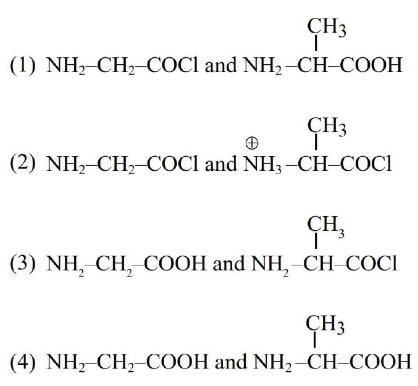
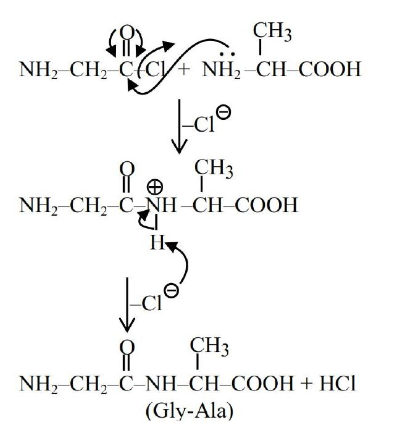
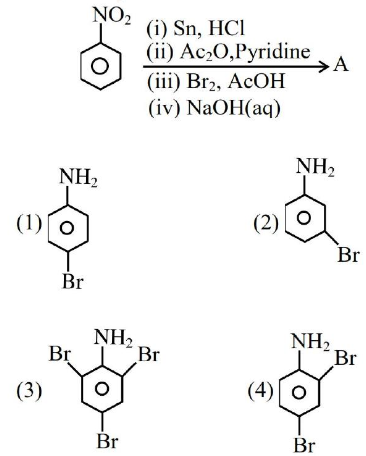
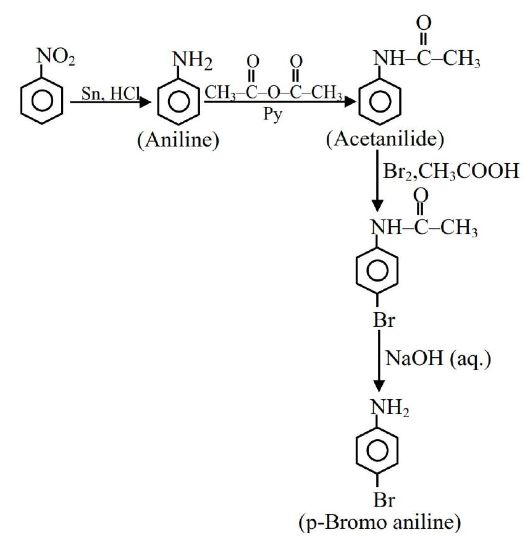
Identify the pair of reactants that upon reaction, with elimination of HCl will give rise to the dipeptide Gly-Ala.
Image
Answer
(A)
Image
View full question & answer
Question 84 Marks
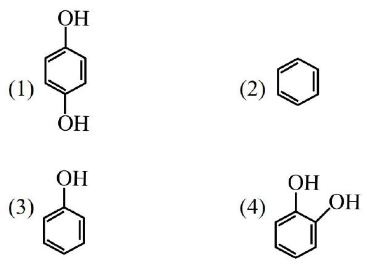
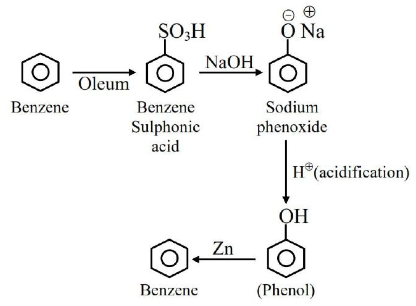
Benzene is treated with oleum to produce compound (X) which when further heated with molten sodium hydroxide followed by acidification produces compound (Y).The compound Y is treated with zinc metal to produce compound $(\mathrm{Z})$. Identify the structure of compound $(\mathrm{Z})$ from the following option.
Image
Answer
(B)
Image
View full question & answer
MCQ 94 Marks
Given below are two statements :
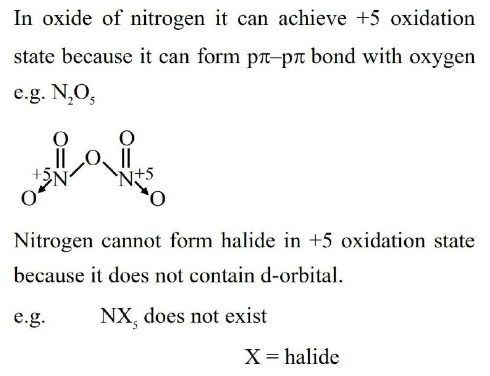
Statement I : Nitrogen forms oxides with +1 to +5 oxidation states due to the formation of $\mathrm{p} \underline{\underline{\pi}}-\mathrm{p} \pi$ bond with oxygen.
Statement II : Nitrogen does not form halides with +5 oxidation state due to the absence of d-orbital in it.
In the light of given statements, choose the correct answer from the options given below.
  • A
    Statement I is true but Statement II is false
  • B
    Both Statement I and Statement II are false
  • C
    Statement I is false but Statement II is true
  • Both Statement I and Statement II are true
Answer
Correct option: D.
Both Statement I and Statement II are true
(D) Both Statement I and Statement II are true
Image
View full question & answer
MCQ 104 Marks
On charging the lead storage battery, the oxidation state of lead changes from $x_{1}$ to $y_{1}$ at the anode and from $x_{2}$ to $y_{2}$ at the cathode. The values of $x_{1}, y_{1}, x_{2}, y_{2}$ are respectively :
  • A
    $+4,+2,0,+2$
  • $+2,0,+2,+4$
  • C
    $0,+2,+4,+2$
  • D
    $+2,0,0,+4$
Answer
Correct option: B.
$+2,0,+2,+4$
(B) $+2,0,+2,+4$
For charging of lead storage battery cell reaction is $2 \mathrm{PbSO}_{4}(\mathrm{s})+2 \mathrm{H}_{2} \mathrm{O}(\mathrm{l}) \rightarrow \mathrm{Pb}(\mathrm{s})+\mathrm{PbO}_{2}(\mathrm{s})+2 \mathrm{H}_{2} \mathrm{SO}_{4}(\mathrm{aq})$ At anode $\mathrm{PbSO}_{4}$ reduced back to Pb and at cathode $\mathrm{PbSO}_{4}$ oxidised back to $\mathrm{PbO}_{2}$.
$\begin{array}{ll}\because & x_1=+2, y_1=0 \\ & x_2=+2, y_2=4\end{array}$
View full question & answer
MCQ 124 Marks
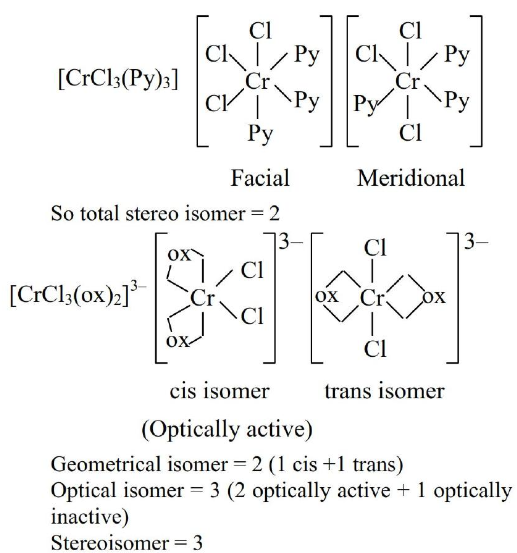
Number of stereoisomers possible for the complexes, $\left[\mathrm{CrCl}_{3}(\mathrm{py})_{3}\right]$ and $\left[\mathrm{CrCl}_{2}(\mathrm{ox})_{2}\right]^{3-}$ are respectively
(py = pyridine, ox = oxalate)
  • A
    $3~ \& ~3$
  • B
    $2~ \& ~2$
  • $2~ \& ~3$
  • D
    $1~ \& ~2$
Answer
Correct option: C.
$2~ \& ~3$
(C) $2 \& 3$
Image
View full question & answer
MCQ 134 Marks
Rate law for a reaction between $A$ and $B$ is given by
$\mathrm{R}=\mathrm{k}[\mathrm{A}]^{\mathrm{n}}[\mathrm{B}]^{\mathrm{m}}$
If concentration of A is doubled and concentration of $B$ is halved from their initial value, the ratio of new rate of reaction to the initial rate of reaction $\left(\frac{r_{2}}{r_{1}}\right)$ is
  • $2^{(n-m)}$
  • B
    $(\mathrm{n}-\mathrm{m})$
  • C
    $(m+n)$
  • D
    $\frac{1}{2^{m+n}}$
Answer
Correct option: A.
$2^{(n-m)}$
(A) $2^{(n-m)}$
$r_{1}=k[A]^{n}[B]^{m}$
Now A is doubled $\& \mathrm{~B}$ is halved in concentration
$\Rightarrow \mathrm{r}_{2}=\mathrm{k} 2^{\mathrm{n}}[\mathrm{A}]^{\mathrm{n}} \cdot \frac{[\mathrm{B}]^{\mathrm{m}}}{2^{\mathrm{m}}}$
Now $\frac{r_{2}}{r_{1}}=2^{(n-m)}$
View full question & answer
MCQ 144 Marks
For $\mathrm{A}_{2}+\mathrm{B}_{2} \rightleftharpoons 2 \mathrm{AB}$
$\mathrm{E}_{\mathrm{a}}$ for forward and backward reaction are 180 and $200 \mathrm{~kJ} \mathrm{~mol}^{-1}$ respectively
If catalyst lowers $\mathrm{E}_{\mathrm{a}}$ for both reaction by $100 \mathrm{~kJ} \mathrm{~mol}^{-1}$.
Which of the following statement is correct?
  • Catalyst does not alter the Gibbs energy change of a reaction.
  • B
    Catalyst can cause non-spontaneous reactions to occur.
  • C
    The enthalpy change for the reaction is $+20 \mathrm{~kJ} \mathrm{~mol}^{-1}$.
  • D
    The enthalpy change for the catalysed reaction is different from that of uncatalysed reaction.
Answer
Correct option: A.
Catalyst does not alter the Gibbs energy change of a reaction.
(A) Catalyst does not alter the Gibbs energy change of a reaction.
$\mathrm{A}_{2}+\quad \mathrm{B}_{2} \rightleftharpoons 2 \mathrm{AB}$
$\mathrm{E}_{\mathrm{f}}=180 \mathrm{~kJ} \mathrm{~mol}^{-1}$
$\mathrm{E}_{\mathrm{b}}=200 \mathrm{~kJ} \mathrm{~mol}^{-1}$
$\Delta \mathrm{H}=\mathrm{E}_{\mathrm{f}}-\mathrm{E}_{\mathrm{b}}=-20 \mathrm{~kJ} \mathrm{~mol}^{-1}$
In presence of catalyst :
$\mathrm{E}_{\mathrm{f}}=180-100=80 \mathrm{~kJ} \mathrm{~mol}^{-1}$
$\mathrm{E}_{\mathrm{b}}=200-100=100 \mathrm{~kJ} \mathrm{~mol}^{-1}$
Catalyst does not change $\Delta \mathrm{H}$ or $\Delta \mathrm{G}$ of a reaction.
View full question & answer
MCQ 154 Marks
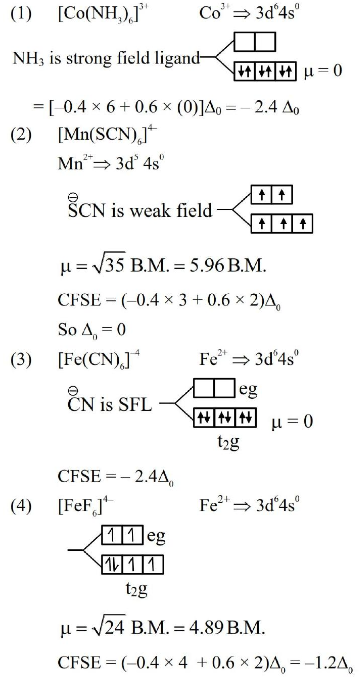
Which one of the following complexes will have $\Delta_{0}=0$ and $\mu=5.96$ B.M.?
  • A
    $\left[\mathrm{Fe}(\mathrm{CN})_{6}\right]^{+}$
  • B
    $\left[\mathrm{CO}\left(\mathrm{NH}_{3}\right)_{6}\right]^{3+}$
  • C
    $\left[\mathrm{FeF}_{6}\right]^{4}$
  • $\left[\mathrm{Mn}(\mathrm{SCN})_{6}\right]^{4}$
Answer
Correct option: D.
$\left[\mathrm{Mn}(\mathrm{SCN})_{6}\right]^{4}$
(D) $\left[\mathrm{Mn}(\mathrm{SCN})_{6}\right]^{4}$
Image
View full question & answer
MCQ 164 Marks
One mole of an ideal gas expands isothermally and reversibly from $10 \mathrm{dm}^{3}$ to $20 \mathrm{dm}^{3}$ at $300 \mathrm{~K} . \Delta \mathrm{U}$, q and work done in the process respectively are :
Given : $\mathrm{R}=8.3 \mathrm{JK}^{-1}$ and $\mathrm{mol}^{-1}$
In $10=2.3$
$\log 2=0.30$
$\log 3=0.48$
  • A
    $0,21.84 \mathrm{~kJ},-1.26 \mathrm{~kJ}$
  • B
    $0,-17.18 \mathrm{~kJ}, 1.718 \mathrm{~J}$
  • C
    $0,21.84 \mathrm{~kJ}, 21,84 \mathrm{~kJ}$
  • $0,178 \mathrm{~kJ},-1.718 \mathrm{~kJ}$
Answer
Correct option: D.
$0,178 \mathrm{~kJ},-1.718 \mathrm{~kJ}$
(D) $0,178 \mathrm{~kJ},-1.718 \mathrm{~kJ}$
$(10 \mathrm{L}, 300 \mathrm{~K}) \xrightarrow{\mathrm{n}=1}(20 \mathrm{L}, 300 \mathrm{K})$
$-\mathrm{q}=\mathrm{w}=-\mathrm{nRT} \ln \frac{\mathrm{V}_{2}}{\mathrm{~V}_{1}}$
$=-8.3 \times 300 \times \ln \left(\frac{20}{10}\right)$
$=-1.718 \mathrm{~kJ}$
$\Rightarrow \mathrm{q}=1.718 \mathrm{~kJ}$
$\mathrm{w}=-1.718 \mathrm{~kJ}$
$\Delta \mathrm{U}=0(\because \Delta \mathrm{~T}=0)$
View full question & answer
Question 174 Marks
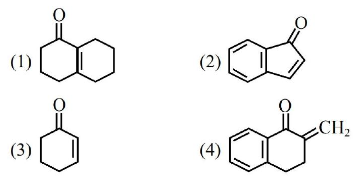
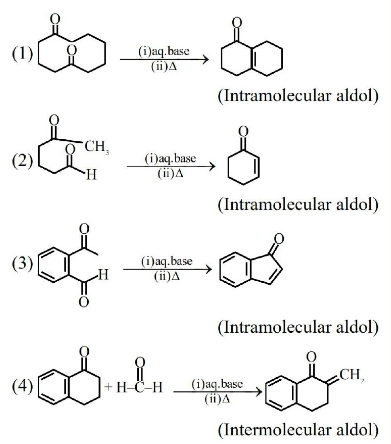
Aldol condensation is a popular and classical method to prepare $\alpha, \beta$-unsaturated carbonyl compounds. This reaction can be both intermolecular and intramolecular. Predict which one of the following is not a product of intramolecular aldol condensation?
Image
Answer
(D)
Image
View full question & answer
MCQ 184 Marks
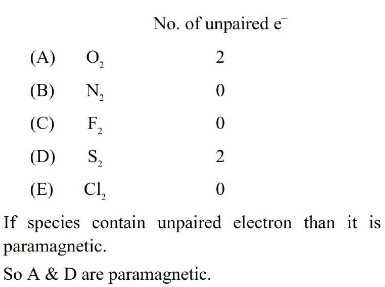
Which of the following molecules(s) show/s paramagnetic behavior?
(A) $\mathrm{O}_{2}$
(B) $\mathrm{N}_{2}$
(C) $\mathrm{F}_{2}$
(D) $\mathrm{S}_{2}$
(E) $\mathrm{Cl}_{2}$
Choose the correct answer from the options given below :
  • A
    B only
  • B
    A & C only
  • C
    A & E only
  • A & D only
Answer
Correct option: D.
A & D only
(D) A & D only
Image
View full question & answer
MCQ 194 Marks
Let us consider a reversible reaction at temperature, T.
In this reaction, both $\Delta \mathrm{H}$ and $\Delta \mathrm{S}$ were observed to have positive values. If the equilibrium temperature is Te , then the reaction becomes spontaneous at :
  • A
    $\mathrm{T}=\mathrm{Te}$
  • B
    $\mathrm{Te}>\mathrm{T}$
  • $\mathrm{T}>\mathrm{Te}$
  • D
    $\mathrm{Te}=5 \mathrm{~T}$
Answer
Correct option: C.
$\mathrm{T}>\mathrm{Te}$
(C) $\mathrm{T}>\mathrm{Te}$
For reaction to be spontaneous according to $2^{\text {nd}}$ law:
$\Delta \mathrm{G}<0$
$\Rightarrow \Delta \mathrm{H}-\mathrm{T} \Delta \mathrm{S}<0$
$\Rightarrow \mathrm{T}>\left(\frac{\Delta \mathrm{H}}{\Delta \mathrm{S}}\right)=\mathrm{T}_{\mathrm{e}}$
$\Rightarrow \mathrm{T}>\mathrm{T}_{\mathrm{e}}$
View full question & answer
MCQ 204 Marks
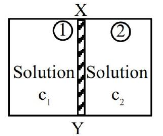
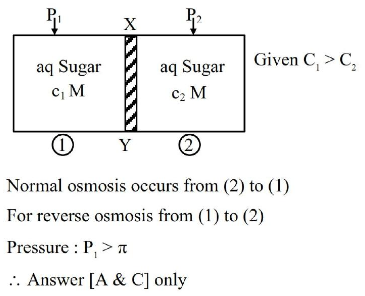
$X Y$ is the membrane / partition between two chambers 1 and 2 containing sugar solutions of concentration $\mathrm{c}_{1}$ and $\mathrm{c}_{2}\left(\mathrm{c}_{1}>\mathrm{c}_{2}\right) \mathrm{mol}~ \mathrm{L}{ }^{-1}$. For the reverse osmosis to take place identify the correct condition
(Here $p_{1}$ and $p_{2}$ are pressures applied on chamber 1 and 2)
Image
(A) Membrane/Partition ; Cellophane, $\mathrm{p}_{1}>\pi$
(B) Membrane/Partition ; Porous. $\mathrm{p}_{2}>\pi$
(C) Membrane/Partition ; Parchment paper, $\mathrm{p}_{1}>\pi$
(D) Membrane/Partition : Cellophane, $\mathrm{p}_{2}>\pi$
Choose the correct answer from the option given below :
  • A
    B and D only
  • B
    A and D only
  • A and C only
  • D
    C only
Answer
Correct option: C.
A and C only
(C) A and C only
Image
View full question & answer