MCQ 14 Marks
Let the mean and the standard deviation of the observation $2,3,3,4,5,7$, a, b be 4 and $\sqrt{2}$ respectively. Then the mean deviation about the mode of these observations is :
- ✓
- B
$\frac{3}{4}$
- C
- D
$\frac{1}{2}$
Answer(A) 1
$\frac{24+a+b}{8}=4 $
$a+b=8 $
$2=\frac{4+1+1+0+1+9+(a-4)^2+(b-4)^2}{8} $
$16=48+a^2+b^2-8 a-8 b $
$a^2+b^2=32 $
$32=2 a b $
$a b=16 $
$a=4$ $b=4 $
$\text { mode }=4 $
$\text { mean deviation }=\frac{2+1+1+0+1+3+0+0}{8}=1$
View full question & answer→MCQ 24 Marks
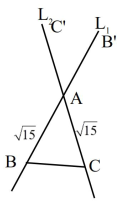
Let A be the point of intersection of the lines $L_1: \frac{x-7}{1}=\frac{y-5}{0}=\frac{z-3}{-1}$ and $L_2: \frac{x-1}{3}=\frac{y+3}{4}=\frac{z+7}{5}$. Let B and C be the point on the lines $L _1$ and $L _2$ respectively such that $AB = AC =\sqrt{15}$. Then the square of the area of the triangle ABC is :
View full question & answer→MCQ 34 Marks
Let $f(x)+2 f\left(\frac{1}{x}\right)=x^2+5$ and $2 g(x)-3 g\left(\frac{1}{2}\right)=x, x>0$. If $\alpha=\int_1^2 f(x) d x$, and $\beta=\int_1^2 g(x) d x$, then the value of $9 \alpha+\beta$ is :
Answer(D) 11
$f(x)+2 f\left(\frac{1}{x}\right)=x^2+5 $
$f\left(\frac{1}{x}\right)+2 f(x)=\frac{1}{x^2}+5 $
$f(x)=\frac{2}{3 x^2}-\frac{x^2}{3}+\frac{5}{3} $
$\alpha=\int_1^2\left(\frac{2}{3 x^2}-\frac{x^2}{3}+\frac{5}{3}\right) d x $
$\left(-\frac{2}{3 x}-\frac{x^3}{9}+\frac{5 x}{3}\right)_1^2 $
$-\frac{1}{3}-\frac{8}{9}+\frac{10}{3}+\frac{2}{3}+\frac{1}{9}-\frac{5}{3} $
$\alpha=2-\frac{7}{9}=\frac{11}{9} $
$2 g(x)-3 g\left(\frac{1}{2}\right)=x $
$g\left(\frac{1}{2}\right)=-\frac{1}{2} $
$g(x)=\frac{x}{2}-\frac{3}{4} $
$\beta=\int_1^2\left(\frac{x}{2}-\frac{3}{4}\right) d x $
$\left(\frac{x^2}{4}-\frac{3 x}{4}\right)_1^2=1-\frac{3}{2}-\frac{1}{4}+\frac{3}{4}=0 $
$9 \alpha+\beta=11$
View full question & answer→MCQ 44 Marks
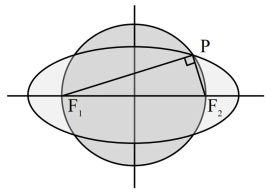
The centre of a circle $C$ is at the centre of the ellipse $E: \frac{x^2}{a^2}+\frac{y^2}{b^2}=1, a>b$. Let $C$ pass through the foci $F_1$ and $F_2$ of $E$ such that the circle $C$ and the ellipse $E$ intersect at four points. Let P be one of these four points. If the area of the triangle $PF _1 F_2$ is 30 and the length of the major axis of E is 17 , then the distance between the foci of $E$ is :
View full question & answer→MCQ 54 Marks
If a curve $y=y(x)$ passes through the point $\left(1, \frac{\pi}{2}\right)$ and satisfies the differential equation $\left(7 x^4 \cot y-e^x \operatorname{cosec} y\right) \frac{d x}{d y}=x^5, x \geq 1$, then at $x=2$, the value of cosy is:
- A
$\frac{2 e^2-e}{64}$
- B
$\frac{2 e^2+e}{64}$
- ✓
$\frac{2 e ^2- e }{128}$
- D
$\frac{2 e^2+e}{128}$
AnswerCorrect option: C. $\frac{2 e ^2- e }{128}$
(C) $\frac{2 e ^2- e }{128}$
$\frac{d y}{d x}=\frac{7 \cot y}{x}-\frac{e^x \operatorname{cosec} y}{x^5} $
$\frac{d y}{d x}=\frac{7 \cot y}{\sin y \cdot x}-\frac{e^x}{\sin y x^5} $
$\sin y \frac{d y}{d x}-\cos y \cdot \frac{7}{x}=\frac{-e^x}{x^5} $
$\operatorname{let}-\cos y=t $
$\sin y \frac{d y}{d x}=\frac{d t}{d x}$
$\frac{d t}{d x}+\frac{7 t}{x}=\frac{-e^x}{x^5} $
$\text { I.F. }=x^7 $
$\text { t. } x^7=-\int x^2 e^x d x $
$\cos y$ $x^7=x^2 e^x-2 \int x^x d x $
$\cos y$ $x^7=x^2 e^x-2 x e^x+2 e^x+c $
$x=1, y=\frac{\pi}{2}, c=-e $
$\cos y=\frac{2 e^2-e}{128}$
View full question & answer→MCQ 64 Marks
Consider two sets A and B , each containing three numbers in A.P. Let the sum and the product of the elements of A be 36 and p respectively and the sum and the product of the elements of B be 36 and q respectively. Let d and D be the common differences of AP's in A and B respectively such that $D=d+3, d>0$. If $\frac{p+q}{p-q}=\frac{19}{5}$, then $p-q$ is equal to
Answer(D) 540
$\text {Let}$ $A(a-d, a, a+d) B(b-D, b, b+D) $
$\quad a=12 \quad\quad\quad\quad\quad\quad b=12 $
$p=12\left(144-d^2\right)$
$q=12\left(144-D^2\right) $
$\frac{p+q}{p-q}=\frac{19}{5}$
$\frac{p}{q}=\frac{24}{14}=\frac{12}{7} $
$\frac{144-d^2}{144-\left(d^2+6 d+9\right)}=\frac{12}{7} $
$1008-7 d^2=-12 d^2-72 d+1620 $
$5 d^2+72 d-612=0 $
$d=6 $
$D=9$
$p - q =12\left( D ^2- d ^3\right) $
$=12(81-36) $
$=12(45) $
$=540$
View full question & answer→MCQ 74 Marks
Let for two distinct values of $p$ the lines $y=x+p$ touch the ellipse E : $\frac{x^2}{4^2}+\frac{y^2}{3^2}=1$ at the points A and B. Let the line $y = x$ intersect $E$ at the points $C$ and $D$. Then the area of the quadrilateral $A B C D$ is equal to
Answer(B) 24
Point of contact are $\left(\frac{\mp a ^2 m}{\sqrt{ a ^2 m^2+ b ^2}}, \frac{ \pm b ^2}{\sqrt{ a ^2 m^2+ b ^2}}\right)$
$A \left(\frac{-16}{5}, \frac{9}{5}\right) B \left(\frac{16}{5}, \frac{-9}{5}\right)$
Point D is $\left(\frac{12}{5}, \frac{12}{5}\right)$
Area of $ABD =\frac{1}{2}\left|\begin{array}{ccc}-\frac{16}{5} & \frac{9}{5} & 1 \\ \frac{16}{5} & \frac{-9}{5} & 1 \\ \frac{12}{5} & \frac{12}{5} & 1\end{array}\right|$
$=12$
Area of ABCD is $=24$
View full question & answer→MCQ 84 Marks
If $1^2 \cdot\left({ }^{15} C_1\right)+2^2 \cdot\left({ }^{15} C_2\right)+3^2 \cdot\left({ }^{15} C_3\right)+\ldots .+15^2 \cdot\left({ }^{15} C_{15}\right)=$ $2^{ m } \cdot 3^{ n } \cdot 5^{ k }$,
where $m , n , k \in N$, then $m + n + k$ is equal to :-
Answer(A) 19
$\sum_{ r =1}^{15} r ^2\left({ }^{15} C _{ r }\right) \Rightarrow 15 \sum_{ r =1}^{15} r ^{14} C _{ r -1} $
$15 \sum_{ r =1}^{15}( r -1+1){ }^{14} C _{ r -1} $
$15 \cdot 14 \sum_{ r =1}^{15}{ }^{13} C _{ r -2}+15 \sum_{ r =1}^{14} C _{ r -1} $
$15 \cdot 14 \cdot 2^{13}+15 \cdot 2^{14} $
$3^1 \cdot 2^{13}(70+10) $
$3^1 \cdot 2^{13} \cdot 80 $
$3^1 \cdot 5^1 \cdot 2^{17} $
$m=17 \quad n =1 \quad k =1$
View full question & answer→MCQ 94 Marks
If the sum of the first 20 terms of the series
$
\frac{4.1}{4+3.1^2+1^4}+\frac{4.2}{4+3.2^2+2^4}+\frac{4.3}{4+3.3^2+3^4}+\frac{4.4}{4+3.4^2+4^4}+\ldots
$
is $\frac{ m }{ n }$, where m and n are coprime, then $m + n$ is equal to :-
Answer(C) 421
$\sum_{ r =1}^{20} \frac{4 r }{4+3 r ^2+ r ^4} $
$\sum_{ r =1}^{20} \frac{4 r }{\left( r ^2+ r +2\right)\left( r ^2- r +2\right)} $
$2 \sum_{ r =1}^{20}\left(\frac{1}{ r ^2- r +2}-\frac{1}{ r ^2+ r +2}\right) $
$2\left(\frac{1}{2}-\frac{1}{4}\right) $
$\frac{1}{4}-\frac{1}{8} $
$\frac{1}{8}-\frac{1}{14} $
$\left(\frac{1}{382}-\frac{1}{422}\right) $
$=2\left(\frac{1}{2}-\frac{1}{422}\right) $
$=\frac{420}{422} $
$=\frac{210}{211}$
View full question & answer→MCQ 104 Marks
Let the matrix $A=\left[\begin{array}{lll}1 & 0 & 0 \\ 1 & 0 & 1 \\ 0 & 1 & 0\end{array}\right]$ satisfy $A^n=A^{n-2}+A^2-I$ for $n \geq 3$. Then the sum of all the elements of $A ^{50}$ is :-
Answer(A) 53
$ A ^{50}= A ^{48}+ A ^2- I $
$= A ^{46}+2\left(A^2- I \right) $
$= A ^{44}+3\left(A^2- I \right) $
$= A ^2+24\left(A^2- I \right) $
$=25 A^2-24 I $
$=25\left[\begin{array}{lll}1 & 0 & 0 \\ 1 & 1 & 0 \\ 1 & 0 & 1\end{array}\right] -24\left[\begin{array}{lll}1 & 0 & 0 \\ 0 & 1 & 0 \\ 0 & 0 & 1\end{array}\right] $
$=\left[\begin{array}{ccc}1 & 0 & 0 \\ 25 & 1 & 0 \\ 25 & 0 & 1\end{array}\right] $
$\text { Sum }=53$
View full question & answer→MCQ 114 Marks
Let the sum of the focal distances of the point $P (4,3)$ on the hyperbola $H : \frac{ x ^2}{ a ^2}-\frac{ y ^2}{b^2}=1$ be $8 \sqrt{\frac{5}{3}}$. If for H, the length of the latus rectum is $l$ and the product of the focal distances of the point P is m , then $9 l^2+6 m$ is equal to :-
Answer(C) 185
$e x+a+e x-a=8 \sqrt{\frac{5}{3}} $
$2 e$ $\times$ $=8 \sqrt{\frac{5}{3}} $
$2 e \times 4=8 \sqrt{\frac{5}{3}}$
$e=\sqrt{\frac{5}{3}} $
$b^2=a^2\left(\left(\frac{\sqrt{5}}{3}\right)^2-1\right) $
$b^2=\frac{2}{3} a^2 $
$\frac{16}{a^2}-\frac{9}{b^2}=1 $
$\text { and } b^2=\frac{2}{3} a^2 $
$\Rightarrow a^2=\frac{5}{2}$ $b^2=\frac{5}{3}$
Now,
$\ell=\frac{2 b^2}{a} $
$\ell^2=\frac{4 b^4}{a^2} $
$9 \ell^2=36 \times \frac{25}{9 \times 5} \times 2$
$9 \ell^2=40 $
$m=( ex + a )( ex - a ) $
$m = e ^2 x ^2- a ^2 $
$=\frac{5}{3} \times 16-\frac{5}{2}=\frac{145}{6} $
$=6 m=145 $
$9 \ell^2+6 m $
$40+145=185$
View full question & answer→MCQ 124 Marks
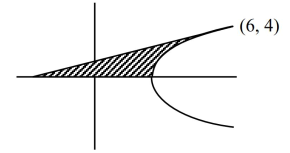
A line passing through the point $A (-2,0)$, touches the parabola $P : y ^2= x -2$ at the point B in the first quadrant. The area, of the region bounded by the line AB , parabola P and the x -axis, is :-
- A
$\frac{7}{3}$
- B
- C
$\frac{8}{3}$
- D
View full question & answer→MCQ 134 Marks
Let the domains of the functions $f(x)=\log _4 \log _3 \log _7\left(8-\log _2\left(x^2+4 x+5\right)\right)$ and $g(x)=\sin ^{-1}\left(\frac{7 x+10}{x-2}\right)$ be $(\alpha, \beta)$ and $[\gamma, \delta]$, respectively. Then $\alpha^2+\beta^2+\gamma^2+\delta^2$ is equal to :-
Answer(A) 15
$\log _3\left(\log _7\left(8-\log _2\left(x^2+4 x +5\right)\right)\right)>0 $
$\log _2\left( x ^2+4 x +5\right)<1 $
$x ^2+4 x +3<0 $
$\Rightarrow x \in(-3,-1) $
$-1 \leq \frac{7 x +10}{ x -2} \leq 1 $
$\Rightarrow x \in[-2,-1] $
$\alpha=-3, \beta=-1, \gamma=-2, \delta=-1 $
$\alpha^2+\beta^2+\gamma^2+\delta^2=15$
View full question & answer→MCQ 144 Marks
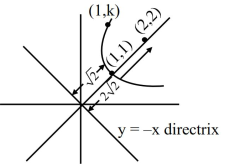
The axis of a parabola is the line $y = x$ and its vertex and focus are in the first quadrant at distances $\sqrt{2}$ and $2 \sqrt{2}$ units from the origin, respectively. If the point $(1, k)$ lies on the parabola, then a possible value of $k$ is :-
View full question & answer→MCQ 154 Marks
Let the values of p, for which the shortest distance between the lines $\frac{x+1}{3}=\frac{y}{4}=\frac{z}{5}$ and $\overrightarrow{ r }=( p \hat{ i }+2 \hat{ j }+\hat{ k })+\lambda(2 \hat{ i }+3 \hat{ j }+4 \hat{ k })$ is $\frac{1}{\sqrt{6}}$, be a, b, $( a < b )$. Then the length of the latus rectum of the ellipse $\frac{x^2}{a^2}+\frac{y^2}{b^2}=1$ is :-
- A
- B
$\frac{3}{2}$
- ✓
$\frac{2}{3}$
- D
AnswerCorrect option: C. $\frac{2}{3}$
(C) $\frac{2}{3}$
$\text { shortest distance }=\frac{|(\overline{a}-\overline{b})| \cdot(\overline{p} \times \overline{q})}{|\overline{p} \times \overline{q}|}$
where
$\overline{a}=-\hat{i}+0 \hat{j}+0 \hat{k}$
$\quad$$\quad$$\quad$$>\overline{ a }-\overline{ b }=(-1- p ) \hat{ i }-2 \hat{ j }-\hat{ k }$
$\overline{ b }= p \hat{ i }+2 \hat{ j }+\hat{ k } $
$\overline{ p }=3 \hat{ i }+4 \hat{ j }+5 \hat{ k } $
$\overline{ q }=2 \hat{ i }+3 \hat{ j }+4 \hat{ k } $
$\frac{1}{16}=\frac{|-1- p +4-1|}{\sqrt{6}} $
$|- p +2|=1 $
$p =3 \quad \& \quad q =1 $
$\frac{ x ^2}{1^2}+\frac{ y ^2}{3^3}=1$
$L \cdot R =\frac{2 a ^2}{b}=\frac{2 \times 1}{3}=\frac{2}{3}$
View full question & answer→MCQ 164 Marks
Let the product of $\omega_1=(8+i) \sin \theta+(7+4 i) \cos \theta$ and $\omega_2=(1+8 i ) \sin \theta+(4+7 i ) \cos \theta$ be $\alpha+ i \beta$, $i =\sqrt{-1}$. Let p and q be the maximum and the minimum values of $\alpha+\beta$ respectively.
Answer(B) 130
$\omega_1=(8 \sin \theta+7 \cos \theta)+i(\sin \theta+4 \cos \theta) $
$\omega_2=(\sin \theta+4 \cos \theta)+i(8 \sin \theta+7 \cos \theta) $
$\omega_1 \omega_2=8 \sin ^2 \theta+7 \sin \theta \cos \theta+32 \sin \theta \cos \theta+$
$28 \cos ^2 \theta-8 \sin ^2 \theta-32 \sin \theta \cos \theta-7 \sin \theta \cos \theta$
$-28 \cos ^2 \theta+i\left(\sin ^2 \theta+4 \sin \theta \cos \theta+4 \sin \theta \cos \theta\right.$
$+16 \cos ^2 \theta+64 \sin ^2 \theta+56 \sin \theta \cos \theta+56 \sin \theta \left.\cos \theta+49 \cos ^2 \theta\right) $
$\omega_1 \omega_2=0+i\left(65 \sin ^2 \theta+120 \sin \theta \cos \theta+65 \cos ^2 \theta\right) $
$\alpha+\beta=65+60 \sin 2 q$
$\alpha+\left.\beta\right|_{\max }=125 $
$\alpha+\left.\beta\right|_{\min }=5 $
$\text { Ans. }=125+5=130$
View full question & answer→MCQ 174 Marks
Let $A=\{-3,-2,-1,0,1,2,3\}$ and R be a relation on A defined by $x R y$ if and only if $2 x-y \in\{0,1\}$. Let $l$ be the number of elements in R. Let m and n be the minimum number of elements required to be added in R to make it reflexive and symmetric relations, respectively. Then $l+ m$ $n$ is equal to :-
Answer(B) 17
$2 x-y=0 $
$\{0,0\}\{-1,-2\}\{1,2\} $
$2 x-y=1 $
$\{0,-1\}\{1,1\}\{2,3\}\{-1,-3\}$
Total $(0,0)$ $(-1,-2),$ $(1,2)$ $(0,-1),$ $(1,1)$ $(2,3)$ $(-1,-3)$
Reflexive $m =5 \quad \&$ $\ell=7$
Symm. $\quad n =5 \quad \ell+ m + n =17$
View full question & answer→MCQ 184 Marks
The sum of the infinite series $\cot ^{-1}\left(\frac{7}{4}\right)+\cot ^{-1}\left(\frac{19}{4}\right)+\cot ^{-1}\left(\frac{39}{4}\right)+\cot ^{-1}\left(\frac{67}{4}\right)+\ldots$ is :-
- A
$\frac{\pi}{2}+\tan ^{-1}\left(\frac{1}{2}\right)$
- B
$\frac{\pi}{2}-\cot ^{-1}\left(\frac{1}{2}\right)$
- C
$\frac{\pi}{2}+\cot ^{-1}\left(\frac{1}{2}\right)$
- ✓
$\frac{\pi}{2}-\tan ^{-1}\left(\frac{1}{2}\right)$
AnswerCorrect option: D. $\frac{\pi}{2}-\tan ^{-1}\left(\frac{1}{2}\right)$
(D) $\frac{\pi}{2}-\tan ^{-1}\left(\frac{1}{2}\right)$
$T _{ n }=\tan ^{-1}\left(\frac{4}{4 n ^2+3}\right) $
$T _{ n }=\tan ^{-1}\left(\frac{\left( n +\frac{1}{2}\right)-\left( n -\frac{1}{2}\right)}{1+\left( n +\frac{1}{2}\right)\left( n -\frac{1}{2}\right)}\right) $
$T _{ n }=\tan ^{-1}\left( n +\frac{1}{2}\right)-\tan ^{-1}\left( n -\frac{1}{2}\right) $
$T _1+ T _2+\ldots .+ T _{ n }=\tan ^{-1}\left( n +\frac{1}{2}\right)-\tan ^{-1}\left(\frac{1}{2}\right) $
$S _{\infty}=\frac{\pi}{2}-\tan ^{-1}\left(\frac{1}{2}\right)$
View full question & answer→MCQ 194 Marks
Let f be a differentiable function on $R$ such that $f (2)$ $1$, $f^{\prime}(2)=4$. Let $\lim _{x \rightarrow 0}(f(2+x))^{3 / x}=e^\alpha$. Then the number of times the curve $y=4 x^3-4 x^2-4(\alpha-7) x-\alpha$ meets x-axis is :-
Answer(A) 2
$\lim _{x \rightarrow 0}(f(2+x))^{\frac{3}{x}} $
$e^{\lim _{x \rightarrow 0}} \frac{(f(2+x)-1)3}{x} $
$e^{3 f^\prime(2)}=(e)^{12}=(e)^a \Rightarrow a=12 $
$y=4 x^3-4 x^2-4(a-7) x-a $
$y=4 x^3-4 x^2-20 x-12 $
$\text { roots } x=-1,-1,3$
View full question & answer→MCQ 204 Marks
Let $a >0$. If the function $f ( x )=6 x ^3-45 ax ^2+108 a ^2 x +1$ attains its local maximum and minimum values at the points $x_1$ and $x_2$ respectively such that $x_1 x_2=54$, then $a + x _1+ x _2$ is equal to :-
Answer(B) 18
$f^{\prime}(x)=18 x^2-90 a x+108 a^2=0 $
$x=2 a$ $\&$ $x=3 a $
$x_1=2 a \quad x_2=3 a $
$x_1 x_2=54 $
$6 a^2=54 $
$a=3 $
$a+x_1+x_2 $
$3+2 \times 3+3 \times 3=18$
View full question & answer→