Questions

SECTION - B [MATHS - NUMERIC]

Take a timed test

5 questions · self-marked practice — reveal the answer and mark yourself.

Question 14 Marks
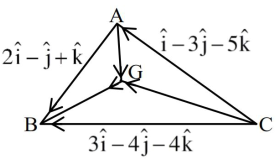
Let the three sides of a triangle $A B C$ be given by the vectors $2 \hat{i}-\hat{j}+\hat{k}, \quad \hat{i}-3 \hat{j}-5 \hat{k}$ and $3 \hat{i}-4 \hat{j}-4 \hat{k}$. Let $G$ be the centroid of the triangle ABC . Then $6\left(|\overrightarrow{ AG }|^2+|\overrightarrow{ BG }|^2+|\overrightarrow{ CG }|^2\right)$ is equal to __________
View full question & answer
Question 24 Marks
Let m and $n ,( m < n )$ be two 2-digit numbers. Then the total numbers of pairs $(m, n)$, such that $\operatorname{gcd}(m, n)=6$, is $\qquad$
Answer
64
Let $m =6 a , n =6 b$
$m < n \Rightarrow a < b$
where $a$ $\&$ $b$ are co-prime numbers
also since $m $ $\&$ $ n$ are 2 digit nos, so
$10 \leq m \leq 99$ $\&$ $10 \leq n \leq 99$
i.e. $2 \leq a \leq 16$ $ \&$ $2 \leq b \leq 16$
$(\because a$ is integer$)$
Now
$2 \leq a < b \leq 16$ $\& \quad a$ $\&$ $b$ are co-prime
$\therefore \text { if } $
$a=2, b=3,5,7,9,11,13,15 $
$a=3, b=4,5,7,8,10,11,13,14,16 $
$a=4, b=5,7,9,11,13,15 $
$a=5, b=6,7,8,9,11,12,13,14,16 $
$a=6, b=7,11,13 $
$a=7, b=8,9,10,11,12,13,15,16 $
$a=8, b=9,11,13,15 $
$a=9, b=10,11,13,14,16 $
$a=10, b=11,13 $
$a=11, b=12,13,14,15,16 $
$a=12, b=13 $
$a=13, b=14,15,16 $
$a=14, b=15 $
$a=15, b=16 $
$64 \text { ordered pairs }$
View full question & answer
Question 34 Marks
A card from a pack of 52 cards is lost. From the remaining 51 cards, n cards are drawn and are found to be spades. If the probability of the lost card to be a spade is $\frac{11}{50}$, the n is equal to
Answer
2
n cards are drawn & are found all spade, thus
remaining spades $=13-x$
remaining total cards $=52- x$
Now given that $P ($ lost card is spade $)=\frac{11}{50}$
i.e. $\frac{{ }^{13-n} C_1}{{ }^{52-n} C_1}=\frac{11}{50}$
$50(13- n )=11(52- n )$
$39 n =78$
$n =2$
View full question & answer
Question 44 Marks
$
\begin{array}{l}
\text { If } \int \frac{\left(\sqrt{1+x^2}+x\right)^{10}}{\left(\sqrt{1+x^2}-x\right)^9} d x= \\
\frac{1}{m}\left(\left(\sqrt{1+x^2}+x\right)^n\left(n \sqrt{1+x^2}-x\right)\right)+C \text { where } C
\end{array}
$
is the constant of integration and $m , n \in N$, then $m + n$ is equal to
Answer
379
rationalise
$\Rightarrow \int \frac{\left(\sqrt{1+x^2}+x\right)^{10}}{\left(\sqrt{1+x^2}-x\right)^9} \times \frac{\left(\sqrt{1+x^2}+x\right)^9}{\left(\sqrt{1+x^2}+x\right)^9} d x $
$\Rightarrow \int \frac{\left(\sqrt{1+x^2}+x\right)^{19}}{1} d x$
Put $\sqrt{1+ x ^2}+ x = t$
$\left(\frac{x}{\sqrt{1+x^2}}+1\right) dx=dt$
$dx=\frac{dt}{t} \sqrt{1+x^2}$
Now as $\sqrt{1+ x ^2}+ x = t$
$\text { so } \sqrt{1+x^2}-x=\frac{1}{t} $
$\therefore \sqrt{1+x^2}=\frac{1}{2}\left(t+\frac{1}{t}\right)$
Thus $I=\int t^{19} \cdot \frac{ dt }{ t } \cdot \frac{1}{2}\left( t +\frac{1}{ t }\right)$
$\Rightarrow \frac{1}{2} \int\left(t^{19}+t^{17}\right) dt $
$=\frac{1}{2}\left(\frac{t^{20}}{20}+\frac{t^{18}}{18}\right)+C $
$=\frac{t^{19}}{360}\left[9 t+\frac{10}{t}\right]+C $
$=\frac{t^{19}}{360}\left[9\left(t+\frac{1}{t}\right)+\frac{1}{t}\right]+C $
$\Rightarrow \frac{\left(\sqrt{1+x^2}+x\right)^{19}}{360}\left[9\left(2 \sqrt{1+x^2}\right)+\left(\sqrt{1+x^2}-x\right)\right]+C $
$\Rightarrow \frac{\left(\sqrt{1+x^2}+x\right)^{19}}{360}\left[19 \sqrt{1+x^2}-x\right]+C $
$\therefore m=360, n=19 $
$\therefore m+n=379$
View full question & answer
Question 54 Marks
If $\alpha$ is a root of the equation $x^2+x+1=0$ and $\sum_{ k =1}^{ n }\left(\alpha^{ k }+\frac{1}{\alpha^{ k }}\right)^2=20$, then n is equal to _________
Answer
11
$\alpha=\omega $
$\therefore\left(\omega^k+\frac{1}{\omega^k}\right)^2=\omega^{2 k}+\frac{1}{\omega^{2 k}}+2 $
$=\omega^{2 k}+\omega^k+2 \quad \because \omega^{3 k}=1$
$\therefore \sum_{k=1}^{n}\left(\omega^{2 k}+\omega^{k}+2\right)=20 $
$\Rightarrow\left(\omega^2+\omega^4+\omega^6+\ldots+\omega^{2n}\right)+\left(\omega+\omega^2+\omega^3+\ldots+\right.\left.\omega^{n}\right)+2 n=20$
Now if $n =3 m, \quad m \in I$
Then $0+0+2 n =20 \Rightarrow n =10$ (not satisfy)
if $n =3 m+1$, then
$\omega^2+\omega+2 n=20$
$-1+2 n =20 \Rightarrow n =\frac{21}{2}$ (not possible)
$\text { if } n =3 m+2 $
$\left(\omega^8+\omega^{10}\right)+\left(\omega^4+\omega^5\right)+2 n =20$$\Rightarrow\left(\omega^2+\omega\right)+\left(\omega+\omega^2\right)+2 n =20 $
$2 n =22 $
$ n =11 \text { satisfy } n =3 m+2 $
$\therefore n =11$
View full question & answer