MCQ 14 Marks
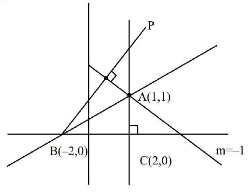
Let $A B C$ be the triangle such that the equations of lines $A B$ and $A C$ be $3 y-x=2$ and $x+y=2$, respectively, and the points $B$ and $C$ lie on $x$-axis. If $P$ is the orthocentre of the triangle $A B C$, then the area of the triangle PBC is equal to
View full question & answer→MCQ 24 Marks
Let the angle $\theta, 0<\theta<\frac{\pi}{2}$ between two unit vectors $\hat{a}$ and $\hat{b}$ be $\sin ^{-1}\left(\frac{\sqrt{65}}{9}\right)$. If the vector $\vec{c}=3 \hat{a}+6 \hat{b}+9(\hat{a} \times \hat{b}), \quad$ then the value of $9(\vec{c} \cdot \hat{a})-3(\vec{c} \cdot \hat{b})$ is
AnswerC. 29
$\overrightarrow{\mathrm{c}}=3 \vec{a}+6 \vec{b}+9(\vec{a} \times \vec{b})$
$\sin ^{-1}\left(\frac{\sqrt{65}}{9}\right) \Rightarrow \sin \theta=\frac{\sqrt{65}}{9} \Rightarrow \cos \theta=\frac{4}{9}$
$\vec{c} \cdot \vec{a}=3|\vec{a}|^{2}+6 \vec{a} \cdot \vec{b}=3+\frac{6.4}{9}=\frac{51}{9}$
$\vec{c} \cdot \vec{a}=3 \vec{a} \cdot \vec{b}+6|\vec{b}|^{2}=\frac{3.4}{9}+6=\frac{22}{3}$
$\therefore 9(\vec{c} \cdot \vec{a})-3(\vec{c} \cdot \vec{b})=51-22=29$
View full question & answer→MCQ 34 Marks
Let the line L pass through $(1,1,1)$ and intersect the lines $\frac{x-1}{2}=\frac{y+1}{3}=\frac{z-1}{4}$ and $\frac{x-3}{1}=\frac{y-4}{2}=\frac{z}{1}$ . Then, which of the following points lies on the line L?
- A
$(4,22,7)$
- B
$(5,4,3)$
- C
$(10,-29,-50)$
- D
$(7,15,13)$
AnswerD. $(7,15,13)$
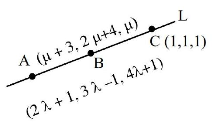
Dr's of $\mathrm{AC} \Rightarrow 2 \lambda, 3 \lambda-2,4 \lambda$
Dr's of $\mathrm{BC} \Rightarrow \mu+2,2 \mu+3, \mu-1$
$\Rightarrow \frac{\mu+2}{2 \lambda}=\frac{2 \mu+3}{3 \lambda-2}=\frac{\mu-1}{4 \lambda}$
$\Rightarrow 2(\mu+2)=\mu-1 \Rightarrow \mu=-5$
$\Rightarrow$ Dr's of $\mathrm{BC} \Rightarrow 3,7,6$
$\Rightarrow$ equation of $L \Rightarrow \frac{x-1}{3}=\frac{y-1}{7}=\frac{z-1}{6}$
$(7,15,13)$ satisfies. View full question & answer→MCQ 44 Marks
Let the system of equations :
$2 x+3 y+5 z=9$,
$7 x+3 y-2 z=8$,
$12 x+3 y-(4+\lambda) z=16-\mu$,
have infinitely many solutions. Then the radius of the circle centred at $(\lambda, \mu)$ and touching the line $4 \mathrm{x}=3 \mathrm{y}$ is
- A
$\frac{17}{5}$
- B
$\frac{7}{5}$
- C
- D
$\frac{21}{5}$
AnswerB. $\frac{7}{5}$
$\left|\begin{array}{ccc}2 & 3 & 5 \\ 7 & 3 & -2 \\ 12 & 3 & -(\lambda+4)\end{array}\right|=0$
$\Rightarrow 12(-21)-3(-39)-(\lambda+4)(-15)=0$
$\Rightarrow-252+117+15(1+4)=0$
$\Rightarrow 15 \lambda+177-252=0$
$\Rightarrow 15 \lambda-75=0 \Rightarrow \lambda=5$
$\left|\begin{array}{ccc}9 & 3 & 5 \\ 8 & 3 & -2 \\ 16-\mu & 3 & -9\end{array}\right|=0 \Rightarrow\left|\begin{array}{ccc}1 & 0 & 7 \\ \mu-8 & 0 & 7 \\ 16-\mu & 3 & -9\end{array}\right|=0$
$\Rightarrow 7-7(\mu-8)=0 \Rightarrow 1-(\mu-8)=0 \Rightarrow \mu=9$
$\Rightarrow$ centre of circle $(5,9)$
radius $=$ length of $\perp$ from centre $(5,9)=$ $\left|\frac{20-27}{5}\right|=\frac{7}{5}$
View full question & answer→MCQ 54 Marks
If the area of the region bounded by the curves $y=4-\frac{x^{2}}{4}$ and $y=\frac{x-4}{2}$ is equal to $\alpha$, then $6 \alpha$ equals
AnswerA. 250
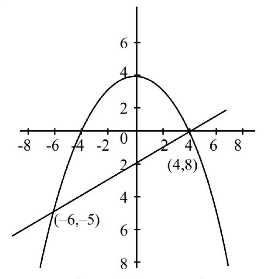
Area $=\int_{-6}^{4}\left\{\left(4-\frac{x^{2}}{4}\right)-\left(\frac{x-4}{2}\right)\right\} d x$
$=\int_{-6}^{4}\left\{-\frac{x^{2}}{4}-\frac{x-6}{2}\right\} d x$
$\alpha=-\frac{x^{3}}{12}-\frac{x^{2}}{4}+\left.6 x\right|_{-6} ^{4}=\frac{125}{3}$
$\therefore 6 \alpha=250$ View full question & answer→MCQ 64 Marks
Let $A$ be a $3 \times 3$ matrix such that $|\operatorname{adj}(\operatorname{adj}(\operatorname{adj} \mathrm{A}))|=81$. If
$\mathrm{S}=\left\{\mathrm{n} \in \mathbb{Z}:(|\operatorname{adj}(\operatorname{adj} A)|)^{\frac{(n-1)^{2}}{2}}=|A|^{\left(3 n^{2}-5 n-4\right)}\right\}$, then $\sum_{n \in S}\left|A^{\left(n^{2}+n\right)}\right|$ is equal to
AnswerD. 732
$|\operatorname{adj}(\operatorname{adj})(\operatorname{adj} A)|=81$
$\Rightarrow|\operatorname{adj} \mathrm{A}|^{4}=81$
$\Rightarrow|\operatorname{adj} \mathrm{A}|=3$
$\Rightarrow|A|^{2}=3$
$\Rightarrow|A|=\sqrt{3}$
$\left(|A|^{4}\right)^{\frac{(n-1)^{2}}{2}}=|A|^{3n^{2}-5 n-4}$
$\Rightarrow 2(\mathrm{n}-1)^{2}=3 \mathrm{n}^{2}-5 \mathrm{n}-4$
$\Rightarrow 2 \mathrm{n}^{2}-4 \mathrm{n}+2=3 \mathrm{n}^{2}-5 \mathrm{n}-4$
$\Rightarrow \mathrm{n}^{2}-\mathrm{n}-6=0$
$\Rightarrow(\mathrm{n}-3)(\mathrm{n}+2)=0$
$\Rightarrow \mathrm{n}=3,-2$
$\sum_{\mathrm{n} \in \mathrm{S}}\left|\mathrm{A}^{\mathrm{n}^{2}+\mathrm{n}}\right|$
$=\left|A^{2}\right|+\left|A^{12}\right|$
$=3+36=3+729=732$
View full question & answer→MCQ 74 Marks
Let the set of all values of $p \in \mathbb{R}$, for which both the roots of the equation $x^{2}-(p+2) x+(2 p+9)=0$ are negative real numbers, be the interval $(\alpha, \beta]$. Then $\beta-2 \alpha$ is equal to
AnswerC. 5
Using location of roots :
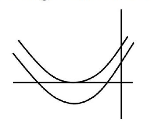
(i) $\mathrm{D} \geq 0$
(ii) $\frac{-\mathrm{b}}{2 \mathrm{a}}<0$
(iii) a. $\mathrm{f}(0)>0$
$(p+2)^{2}-4(2 p+9) \geq 0$
$(\mathrm{p}+4)(\mathrm{p}-8) \geq 0 \quad \mathrm{p}+2<0 \quad 2 \mathrm{p}+9>0$
Intersection $\mathrm{p} \in\left(-\frac{9}{2},-4\right]$
$\therefore \beta-2 \alpha=-4+9=5$ View full question & answer→MCQ 84 Marks
Let $\mathrm{x}_{1}, \mathrm{x}_{2}, \mathrm{x}_{3}, \mathrm{x}_{4}$ be in a geometric progression. If $2,7,9,5$ are subtracted respectively from $x_{1}, x_{2}, x_{3}$, $x_{4}$ then the resulting numbers are in an arithmetic progression. Then the value of $\frac{1}{24}\left(x_{1} x_{2} x_{3} x_{4}\right)$ is :
AnswerD. 216
$\mathrm{x}_{1}, \mathrm{x}_{2}, \mathrm{x}_{3}, \mathrm{x}_{4} \rightarrow$ G.P.
Let $\mathrm{a}, \mathrm{ar}, \mathrm{ar}^{2}, \mathrm{ar}^{3} \rightarrow$ G.P.
Now $a-2$, $a r-7, a^{2}-9, a r^{3}-5 \rightarrow$ A.P.
$\begin{array}{l}2(a r-7)=a-2+a r^2-9 \ldots . \text { (i) } \\ 2\left(ar^2-9\right)=a r-7+a r^3-5 \ldots \text { (ii) }\end{array}$
Solving $\mathrm{r}=2, \mathrm{a}=-3$
$\therefore$ Product $=\mathrm{x}_{1}, \mathrm{x}_{2}, \mathrm{x}_{3}, \mathrm{x}_{4}=\mathrm{a}^{4} \mathrm{r}^{6}=81 \times 64$
View full question & answer→MCQ 94 Marks
The mean and standard deviation of 100 observations are 40 and 5.1, respectively, By mistake one observation is taken as 50 instead of 40. If the correct mean and the correct standard deviation are $\mu$ and $\sigma$ respectively, then $10(\mu+\sigma)$ is equal to
AnswerD. 449
Actual means $=\mu=\frac{100(40)-50+40}{100}$
$\mu=40-\frac{1}{10}=39.9$
Incorrect variance
$(5.1)^2=\frac{\sum x_i^2}{100}-(\overline{ x })^2 $
$\sum x _{ i }^2=100 \times\left(40^2\right)+100(5.1)^2 $
$\sum x _{ i }^2=16 \times 10^4+(5.1)^2 \times 100=162601 $
$\sigma^2=\frac{\sum x _{ i }^2-50^2+40^2}{100}-(\mu)^2 $
$\sigma^2=1617.01-(39.9)^2=25 $
$\sigma=5 $
$10(\mu+\sigma)=10(39.9+5) $
$=10 \times 44.9=449$
View full question & answer→MCQ 104 Marks
Among the statements
(S1) : The set $\left\{\mathrm{z} \in \mathbb{C}-\{-\mathrm{i}\}:|\mathrm{z}|=1\right.$ and $\frac{\mathrm{z}-\mathrm{i}}{\mathrm{z}+\mathrm{i}}$ is purely real} contains exactly two elements, and
(S2) : The set $\left\{\mathrm{z} \in \mathbb{C}-\{-1\}:|z|=1\right.$ and $\frac{\mathrm{z}-1}{\mathrm{z}+1}$ is purely imaginary} contains infinitely many elements.
AnswerC. only (S2) is correct
$\mathrm{S}_{1}:|\mathrm{z}|=1, \frac{\mathrm{z}-\mathrm{i}}{\mathrm{z}+\mathrm{i}}=\frac{\overline{\mathrm{z}}+\mathrm{i}}{\overline{\mathrm{z}}-\mathrm{i}}$
$\Rightarrow(\mathrm{z}-\mathrm{i})(\overline{\mathrm{z}}-\mathrm{i})=(\mathrm{z}+\mathrm{i})(\overline{\mathrm{z}}+\mathrm{i})$
$|\mathrm{z}|^{2}-\mathrm{i}(\mathrm{z}+\overline{\mathrm{z}})-1=|\mathrm{z}|^{2}+\mathrm{i}(\mathrm{z}+\overline{\mathrm{z}})-1$
$\mathrm{i}(\mathrm{z}+\overline{\mathrm{z}})=0$
$\mathrm{z}+\overline{\mathrm{z}}=2 \cos \theta=0 \Rightarrow \cos \theta=0$
$\mathrm{z}=0+0 \mathrm{i},|\mathrm{z}| \neq 1$
$\mathrm{S}_{1}: \frac{\mathrm{z}-1}{\mathrm{z}+1}+\frac{\overline{\mathrm{z}}-1}{\overline{\mathrm{Z}}+1}=0$
$(z-1)(\bar{z}+1)+(z+1)(\bar{z}-1)=0$
$\Rightarrow|z|^{2}+(\mathrm{z}-\overline{\mathrm{z}})-1+|\mathrm{z}|^{2}+(\mathrm{z}-\overline{\mathrm{z}})-1=0$
$|z|^{2}=1$
View full question & answer→MCQ 114 Marks
The integral $\int_{0}^{\pi} \frac{(x+3) \sin x}{1+3 \cos ^{2} x} d x$ is equal to :
- A
$\frac{\pi}{\sqrt{3}}(\pi+1)$
- B
$\frac{\pi}{\sqrt{3}}(\pi+2)$
- C
$\frac{\pi}{3 \sqrt{3}}(\pi+6)$
- D
$\frac{\pi}{2 \sqrt{3}}(\pi+4)$
AnswerC. $\frac{\pi}{3 \sqrt{3}}(\pi+6)$
$I=\int_{0}^{\pi} \frac{(x+3) \sin x}{1+3 \cos ^{2} x} d x$
$I=\int_{0}^{\pi} \frac{(\pi-x+3) \sin x}{\left(1+3 \cos ^{2} x\right)} d x$
$2 I=\int_{0}^{\pi} \frac{(\pi+6) \sin x \cdot d x}{\left(1+3 \cos ^{2} x\right)}=2 \int_{0}^{\pi / 2} \frac{(\pi+6) \sin x}{\left(1+3 \cos ^{2} x\right)}$
$I=\int_{0}^{\pi / 2} \frac{(\pi+6) \sin x \cdot d x}{\left(1+3 \cos ^{2} x\right)}=\frac{\pi}{3 \sqrt{3}}(\pi+6)$
$\sqrt{3} \cos x=t$
$\sqrt{3} \sin x=d t$
View full question & answer→MCQ 124 Marks
Let $\mathrm{C}_{1}$ be the circle in the third quadrant of radius 3, that touches both coordinate axes. Let $\mathrm{C}_{2}$ be the circle with centre $(1,3)$ that touches $\mathrm{C}_{1}$ externally at the point $(\alpha, \beta)$. If $(\beta-\alpha)^{2}=\frac{m}{n}, \operatorname{gcd}(m, n)=1$, then $\mathrm{m}+\mathrm{n}$ is equal to :
AnswerC. 22
$\mathrm{C}_{1}:(\mathrm{x}+3)^{2}+(\mathrm{y}+3)^{2}=3^{2}$
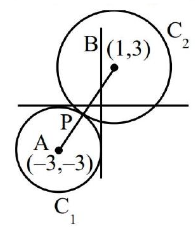
Let $\mathrm{C}_{1}$ and $\mathrm{C}_{2}$ has centres
$\mathrm{A}(-3,-3)$ and $\mathrm{B}(1,3)$
$\mathrm{AB}=\sqrt{16+36}=2 \sqrt{13}$
$r_{1}=3$ and $r_{2}=2 \sqrt{13}-3$
$P(\alpha, \beta), \alpha=\frac{r_{1}(1)+r_{2}(-3)}{r_{1}+r_{2}}, \beta=\frac{r_{1}(3)+r_{2}(-3)}{r_{1}+r_{2}}$
$\alpha=\frac{3-3(2 \sqrt{13}-3)}{2 \sqrt{13}}, \beta=\frac{18-6 \sqrt{13}}{2 \sqrt{13}}$,
$(\beta-\alpha)^{2}=\left(\frac{6}{2 \sqrt{13}}\right)^{2}$
$(\beta-\alpha)^{2}=\left(\frac{6}{2 \sqrt{13}}\right)^{2}, m+n=22$ View full question & answer→MCQ 134 Marks
If for $\theta \in\left[-\frac{\pi}{3}, 0\right]$, the points $(x, y)=\left(3 \tan \left(\theta+\frac{\pi}{3}\right), 2 \tan \left(\theta+\frac{\pi}{6}\right)\right)$ lie on
$x y+\alpha x+\beta y+\gamma=0$, then $\alpha^{2}+\beta^{2}+\gamma^{2}$ is equal to :
AnswerD. 75
$\mathrm{x}=3\left(\frac{\tan \theta+\sqrt{3}}{1-\sqrt{3} \tan \theta}\right)$
$\mathrm{x}-\sqrt{3} \tan \theta=3 \tan \theta+3 \sqrt{3}$
$\tan \theta=\frac{x-3 \sqrt{3}}{3+\sqrt{3} x} \ldots$ (1)
$\begin{array}{l}2\left(\frac{\tan \theta+\frac{1}{\sqrt{3}}}{1-\frac{\tan \theta}{\sqrt{3}}}-y\right) \\ 2(\sqrt{3} \tan \theta+1)=y(\sqrt{3}-\tan \theta) \ldots(2)\end{array}$
using (1) and (2)
$2\left(\frac{x-3 \sqrt{3}}{\sqrt{3}+x}+1\right)=y\left(\sqrt{3}-\frac{(x-3 \sqrt{3})}{\sqrt{3}(\sqrt{3}+x)}\right)$
$2 \sqrt{3}(x-3 \sqrt{3}+x+\sqrt{3})=y(3(\sqrt{3}+x)-x+3 \sqrt{3})$
$4 \sqrt{3} x-12=y(2 x+6 \sqrt{3})$
$x y-2 \sqrt{3} x+3 \sqrt{3} y-6=0$
$\Rightarrow \alpha=-2 \sqrt{3}, \beta=3 \sqrt{3}, \gamma=-6$
$\alpha^{2}+\beta^{2}+\gamma^{2}=12+27+36=75$
View full question & answer→MCQ 144 Marks
From a group of 7 batsmen and 6 bowlers, 10 players are to be chosen for a team, which should include atleast 4 batsmen and atleast 4 bowlers. One batsmen and one bowler who are captain and vice-captain respectively of the team should be included. Then the total number of ways such a selection can be made, is
AnswerB. 155
7 Batsmen & 6 Bowlers
To select 10 players including atleast 4 Batsmen & 4 Bowlers
Captain & vice-captain already selected
No. of ways $={ }^{6} \mathrm{C}_{5} \times{ }^{5} \mathrm{C}_{3}+{ }^{6} \mathrm{C}_{4} \times{ }^{5} \mathrm{C}_{4}+{ }^{6} \mathrm{C}_{3} \times{ }^{5} \mathrm{C}_{5}$
$=6 \times 10+15 \times 5+20 \times 1$
$=60+75+20=155$
View full question & answer→MCQ 154 Marks
Let $y=y(x)$ be the solution curve of the differential equation
$x\left(x^{2}+e^{x}\right) d y+\left(e^{x}(x-2) y-x^{3}\right) d x=0, x>0$, passing through the point $(1,0)$. Then $y(2)$ is equal to :
- A
$\frac{4}{4-\mathrm{e}^{2}}$
- B
$\frac{2}{2+\mathrm{e}^{2}}$
- C
$\frac{2}{2-\mathrm{e}^{2}}$
- D
$\frac{4}{4+e^{2}}$
AnswerD. $\frac{4}{4+e^{2}}$
$x\left(x^{2}+e^{x}\right) d y+\left(e^{x}(x-2) y-x^{3}\right) d x=0$
$x\left(x^{2}+e^{x}\right) \frac{d y}{d x}+e^{x}(x-2) y=x^{3}$
$\frac{d y}{d x}+\frac{e^{x}(x-2)}{x\left(x^{2}+e^{x}\right)} y=\frac{x^{2}}{x^{2}+e^{x}}$
I.F. $=e^{\int \frac{e^{x}(x-2)}{x\left(x^{2}+e^{x}\right)} d x}=e^{\int \frac{e^{x}\left(\frac{1}{x^{2}}-\frac{2}{x^{2}}\right) d x}{\left(1+\frac{e^{x}}{x^{2}}\right)} d x}$
Let $1+\frac{e^{x}}{x^{2}}=t \Rightarrow \frac{x^{2} e^{x}-e^{x} 2 x}{x^{4}} d x=d t$
$\Rightarrow$ I.F. $\mathrm{e}^{\ln \left(1+\frac{x^{x}}{x^{2}}\right)}=1+\frac{\mathrm{e}^{\mathrm{x}}}{\mathrm{x}^{2}}$
Now $y\left(1+\frac{e^{x}}{x^{2}}\right)=\int \frac{x^{2}}{x^{2}+e^{x}} \cdot \frac{x^{2}+e^{x}}{x^{2}} d x+C$
$y\left(1+\frac{e^{x}}{x^{2}}\right)=x+C$
Passing through $(1,0)$
$\Rightarrow \mathrm{C}=-1$
$\mathrm{y}=\frac{\mathrm{x}-1}{1+\frac{\mathrm{e}^{\mathrm{x}}}{\mathrm{x}^{2}}}$
$y(2)=\frac{1}{1+\frac{\mathrm{e}^{2}}{4}}=\frac{4}{4+\mathrm{e}^{2}}$
View full question & answer→MCQ 164 Marks
Let $P$ be the parabola, whose focus is $(-2,1)$ and directrix is $2 x+y+2=0$. Then the sum of the ordinates of the points on P , whose abscissa is -2 , is
- A
$\frac{3}{2}$
- B
$\frac{5}{2}$
- C
$\frac{1}{4}$
- D
$\frac{3}{4}$
AnswerA. $\frac{3}{2}$
Equation of parabola
$(x+2)^{2}+(y-1)^{2}=\left(\frac{2 x+y+2}{\sqrt{5}}\right)^{2}$
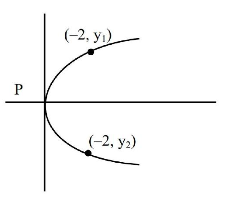
$5\left[(x+2)^{2}+(y-1)^{2}\right]=(2 x+y+2)^{2}$
Put $x=-2,5(y-1)^{2}=(y-2)^{2}$
$5\left(y^{2}-2 y+1\right)=y^{2}-4 y+4$
$\Rightarrow 4 y^{2}-6 y+1=0 \Rightarrow y_{1}+y_{2}=\frac{3}{2}$ View full question & answer→MCQ 174 Marks
The remainder when $\left((64)^{(64)}\right)^{(64)}$ is divided by 7 is equal to
AnswerB. 1
Let $\mathrm{N}=\left((64)^{64}\right)^{64}$
$\mathbf{N}=(64)^{64^{2}}$
$\mathbf{N}=(1+63)^{64^{2}}$, let $64^{2}=\mathrm{n}$
Expanding by binomial
$\mathrm{N}=(1+63)^{\mathrm{n}}=1+{ }^{\mathrm{n}} \mathrm{C}_{1} 63+{ }^{\mathrm{n}} \mathrm{C}_{2}(63)^{2}+\ldots .$.
$=1+63 \lambda=1+7(9 \lambda)$
Remainder when divided by 7 is 1
View full question & answer→MCQ 184 Marks
Let $x=-1$ and $x=2$ be the critical points of the function $\mathrm{f}(\mathrm{x})=\mathrm{x}^{3}+\mathrm{ax}^{2}+\mathrm{b} \log _{\mathrm{e}}|\mathrm{x}|+1, \mathrm{x} \neq 0$. Let $m$ and M respectively be the absolute minimum and the absolute maximum values of f in the interval $\left[-2,-\frac{1}{2}\right]$. Then $|\mathrm{M}+m|$ is equal to
(Take $\log _{\mathrm{e}} 2=0.7$ ):
AnswerA. 21.1
$f(x)=x^{2}+a x^{2}+b \ell n|x|+1, \quad x \neq 0$
$f(x)=3 x^{2}+2 a x+\frac{b}{x}$
$f(-1)=3-2 a-b=0$
$f(-2)=12+4 a-\frac{b}{2}=0$
$a=\frac{-9}{2}, b=12$
$f(x)=3 x^{2}-9 x+\frac{12}{x}=\frac{3(x+1)(x+2)^{2}}{x}$
Max. at $\mathrm{n}=-1$
$f(x)=x^{2}-\frac{9}{2} x^{2}+12 \ell n|x|+1$
$f(-1)=-1-\frac{9}{2}+1=-\frac{9}{2}$
$\mathrm{M}=-4.5$
Min. value at $\mathrm{x}=-2$
$f(-2)=-8-18+12 \ln 2+1$
$\mathrm{m}=-25+12 \ell \mathrm{n} 2=-16.6$
$|\mathrm{M}+\mathrm{m}|=21.1$
View full question & answer→MCQ 194 Marks
If the shortest distance between the lines $\frac{x-1}{2}=\frac{y-2}{3}=\frac{z-3}{4}$ and $\frac{x}{1}=\frac{y}{\alpha}=\frac{z-5}{1}$ is $\frac{5}{\sqrt{6}}$, then the sum of all possible values of $\alpha$ is
- A
$\frac{3}{2}$
- B
$-\frac{3}{2}$
- C
- D
AnswerD. -3
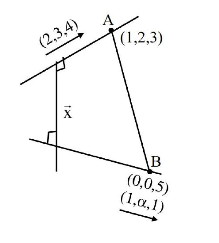
$L_{1}: \frac{x-1}{2}=\frac{y-2}{3}=\frac{z-3}{4}$
$\mathrm{L}_{1}: \frac{\mathrm{x}}{1}=\frac{\mathrm{y}}{\alpha}=\frac{\mathrm{z}-5}{1}$
$\overrightarrow{\mathrm{x}}=\left|\begin{array}{ccc}\hat{i} & \hat{\mathrm{j}} & \hat{\mathrm{k}} \\ 2 & 3 & 4 \\ 1 & \alpha & 1\end{array}\right|=\hat{\mathrm{i}}(3-4 \alpha)-\hat{\mathrm{j}}(-2)+\hat{\mathrm{k}}(2 \alpha-3)$
S.D. $=\left|\frac{\overrightarrow{\mathrm{BA}} \cdot \overrightarrow{\mathrm{n}}}{|\overrightarrow{\mathrm{n}}|}\right|=\left|\frac{(\hat{\mathrm{i}}+2 \hat{\mathrm{j}}-2 \hat{\mathrm{k}}) \cdot \overrightarrow{\mathrm{n}}}{|\overrightarrow{\mathrm{n}}|}\right|$
$\Rightarrow 6(13-8 \alpha)^{2}=25\left((4 \alpha-3)^{2}+(2 \alpha-3)^{2}+16\right)$
$6\left(64 a^{2}-280 \alpha+169\right)=25\left(20 \alpha^{2}-36 \alpha+34\right)$
$\Rightarrow 116 \alpha^{2}+348 \alpha-164=0$
$\alpha_{1}+\alpha_{2}=\frac{-348}{116}=-3$ View full question & answer→MCQ 204 Marks
$\lim _{x \rightarrow 0^{+}} \frac{\tan \left(5(x)^{\frac{1}{3}}\right) \log _{e}\left(1+3 x^{2}\right)}{\left(\tan ^{-1} 3 \sqrt{x}\right)^{2}\left(e^{5(x)^{\frac{4}{3}}}-1\right)}$ is equal to
- A
$\frac{1}{15}$
- B
- C
$\frac{1}{3}$
- D
$\frac{5}{3}$
AnswerC. $\frac{1}{3}$
$\lim _{x \rightarrow 0^{+}}\left(\frac{\tan \left(5 x^{1 / 3}\right)}{5 x^{1 / 3}}\right) \cdot\left(\frac{(3 \sqrt{x})^{2}}{\left(\tan ^{-1} 3 \sqrt{x}\right)^{2}}\right)\left(\frac{\ell\left(1+3 x^{2}\right)}{3 x^{2}}\right)\left(\frac{5 x^{4 / 3}}{e^{5 x{\frac{4}{3}}}-1}\right) \times \frac{5 x^{1 / 3} \cdot 3 x^{2}}{5 x^{4 / 3} \cdot 9 x}$
$=\frac{1}{3}$
View full question & answer→