Questions

SECTION - A [PHYSICS MCQ]

Take a timed test

20 questions · self-marked practice — reveal the answer and mark yourself.

MCQ 14 Marks
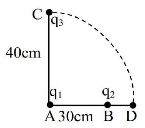
Two charges $q_{1}$ and $q_{2}$ are separated by a distance of 30 cm. A third charge $q_{3}$ initially at '$C$' as shown in the figure, is moved along the circular path of radius 40 cm from C to D. If the difference in potential energy due to movement of $q_{3}$ from $C$ to $D$ is given by $\frac{q_{3} K}{4 \pi \in_{0}}$, the value of $K$ is :
Image
  • A
    $8 q_{2}$
  • B
    $6 q_{2}$
  • C
    $8 q_{1}$
  • D
    $6 q_{1}$
Answer
A. $8 q_{2}$
Potential at C
$V_{C}=\frac{\mathrm{kq}_{1}}{0.4}+\frac{\mathrm{kq}_{2}}{0.5}$
Potential at D
$\mathrm{V}_{\mathrm{D}}=\frac{\mathrm{kq}_{1}}{0.4}+\frac{\mathrm{kq}_{2}}{0.1}$
$\Delta \mathrm{U}=\left(\mathrm{V}_{\mathrm{D}}-\mathrm{V}_{\mathrm{C}}\right)\left(\mathrm{q}_{3}\right)=\left(\frac{\mathrm{kq}_{2}}{0.1}-\frac{\mathrm{kq}_{2}}{0.5}\right)\left(\mathrm{q}_{3}\right)$
$\Delta \mathrm{U}=8 \mathrm{kq}_{2} \mathrm{q}_{3}=\frac{8 \mathrm{q}_{2} \mathrm{q}_{3}}{4 \pi \varepsilon_{0}}$
View full question & answer
MCQ 24 Marks
Two wires A and B are made of same material having ratio of lengths $\frac{L_{A}}{L_{B}}=\frac{1}{3}$ and their diameters ratio $\frac{d_{A}}{d_{B}}=2$. If both the wires are stretched using same force, what would be the ratio of their respective elongations?
  • A
    $1: 6$
  • B
    $1: 12$
  • C
    $3: 4$
  • D
    $1: 3$
Answer
B. $1: 12$
$\frac{\mathrm{L}_{\mathrm{A}}}{\mathrm{L}_{\mathrm{B}}}=\frac{1}{3}$ and $\frac{\mathrm{d}_{\mathrm{A}}}{\mathrm{d}_{\mathrm{B}}}=2$
$\Delta \mathrm{L}_{\mathrm{A}}=\frac{\mathrm{F}_{\mathrm{A}} \mathrm{L}_{\mathrm{A}}}{\mathrm{A}_{\mathrm{A}} \mathrm{Y}_{\mathrm{A}}}$ and $\Delta \mathrm{L}_{\mathrm{B}}=\frac{\mathrm{F}_{\mathrm{B}} \mathrm{L}_{\mathrm{B}}}{\mathrm{A}_{\mathrm{B}} \mathrm{Y}_{\mathrm{B}}}$
Given, $F_{A}=F_{B}$ and $Y_{A}=Y_{B}$
$\frac{\Delta L_{A}}{\Delta L_{B}}=\frac{\frac{F_{A} L_{A}}{A_{A} Y_{A}}}{\frac{F_{B} L_{B}}{A_{B} Y_{B}}}=\left(\frac{L_{A}}{L_{B}}\right)\left(\frac{A_{B}}{A_{A}}\right)$
$\frac{\Delta \mathrm{L}_{\mathrm{A}}}{\Delta \mathrm{L}_{\mathrm{B}}}=\left(\frac{\mathrm{L}_{\mathrm{A}}}{\mathrm{L}_{\mathrm{B}}}\right)\left(\frac{\frac{\pi}{4} \mathrm{~d}_{\mathrm{B}}^{2}}{\frac{\pi}{4} \mathrm{~d}_{\mathrm{A}}^{2}}\right)=\left(\frac{\mathrm{L}_{\mathrm{A}}}{\mathrm{L}_{\mathrm{B}}}\right)\left(\frac{\mathrm{d}_{\mathrm{B}}}{\mathrm{d}_{\mathrm{A}}}\right)^{2}$
$\frac{\Delta \mathrm{L}_{\mathrm{A}}}{\Delta \mathrm{L}_{\mathrm{B}}}=\left(\frac{1}{3}\right)\left(\frac{1}{2}\right)^{2}=\frac{1}{12}$
View full question & answer
MCQ 34 Marks
An object of mass 1000 g experiences a time dependent force $\overrightarrow{\mathrm{F}}=\left(2 t \hat{\mathrm{i}}+3 \mathrm{t}^{2} \hat{\mathrm{j}}\right) \mathrm{N}$. The power generated by the force at time $t$ is :
  • A
    $\left(2 t^{2}+3 t^{3}\right) W$
  • B
    $\left(2 t^{2}+18 t^{3}\right) \mathrm{W}$
  • C
    $\left(3 t^{3}+5 t^{5}\right) \mathrm{W}$
  • D
    $\left(2 t^{3}+3 t^{5}\right) \mathrm{W}$
Answer
D. $\left(2 t^{3}+3 t^{5}\right) \mathrm{W}$
$\vec{F}=(2 t \hat{i}+3 t\hat{\mathrm{j}}) \mathrm{N}$
$\mathrm{m}=1000 \mathrm{gm}=1 \mathrm{~kg}$
$\vec{F}=m \vec{a}, \vec{a}=2 t \hat{i}+3 t^{2} \hat{j}$
$\frac{d \vec{v}}{d t}=2 t \hat{i}+3 t^{2} \hat{j}$
$\overrightarrow{\mathrm{v}}=\mathrm{t}^{2} \hat{\mathrm{i}}+\mathrm{t}^{3} \hat{\mathrm{j}}$
Power, $\mathrm{P}=\overrightarrow{\mathrm{F}}\cdot\overrightarrow{\mathrm{V}}$
$\mathrm{P}=\left(2 \mathrm{t} \hat{\mathrm{i}}+3 \mathrm{t}^{2} \hat{\mathrm{j}}\right)\cdot\left(\mathrm{t}^{2} \hat{\mathrm{i}}+\mathrm{t}^{3} \hat{\mathrm{j}}\right)$
$P=\left(2 t^{3}+3 t^{5}\right) W$
View full question & answer
MCQ 44 Marks
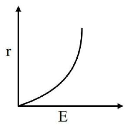
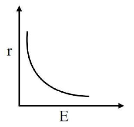
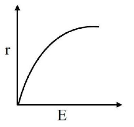
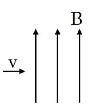
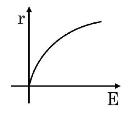
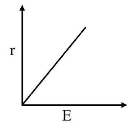
A particle of charge $q$, mass $m$ and kinetic energy E enters in magnetic field perpendicular to its velocity and undergoes a circular arc of radius(r). Which of the following curves represents the variation of $r$ with $E$ ?
  • A

    Image

  • B

    Image

  • C
    Image
  • D
    Image
Answer
D.
Image
Image
$\frac{m v^{2}}{r}=q v B$
$\mathrm{mv}=\mathrm{qBr}$
$\mathrm{E}=\frac{1}{2} \mathrm{mv}^{2}$
$\mathrm{E}=\frac{1}{2} \mathrm{~m}\left(\frac{\mathrm{q}^{2} \mathrm{~B}^{2} \mathrm{r}^{2}}{\mathrm{~m}^{2}}\right)=\frac{\mathrm{q}^{2} \mathrm{~B}^{2} \mathrm{r}^{2}}{2 \mathrm{~m}}$
$\mathrm{E}=\left(\frac{\mathrm{q}^{2} \mathrm{~B}^{2}}{2 \mathrm{~m}}\right) \mathrm{r}^{2}$
$r^{2} \propto E$
Image
View full question & answer
MCQ 54 Marks
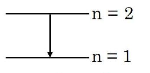
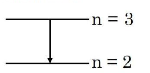
For a hydrogen atom, the ratio of the largest wavelength of Lyman series to that of the Balmer series is.
  • A
    $5: 36$
  • B
    $5: 27$
  • C
    $3: 4$
  • D
    $27: 5$
Answer
B. $5: 27$
Lyman
Image
$\frac{1}{\lambda_{1}}=\mathrm{R}\left[\frac{1}{1}-\frac{1}{4}\right]=\frac{3 \mathrm{R}}{4}$
$
\lambda_1=\frac{4}{3 R} \quad\quad\quad...(1)
$
and Balmer
Image
$\frac{1}{\lambda_{2}}=\mathrm{R}\left[\frac{1}{4}-\frac{1}{9}\right]=\frac{5 \mathrm{R}}{36}$
$\lambda_{2}=\frac{36}{5 R}$
Then, $\frac{\lambda_{1}}{\lambda_{2}}=\frac{5}{27}$
View full question & answer
MCQ 64 Marks
In a hydrogen like ion, the energy difference between the $2^{\text {nd }}$ excitation energy state and ground is 108.8 eV. The atomic number of the ion is
  • A
    4
  • B
    2
  • C
    1
  • D
    3
Answer
B. 2
$\Delta \mathrm{E}=13.6 \mathrm{z}^{2}\left[\frac{1}{\mathrm{n}_{1}^{2}}-\frac{1}{\mathrm{n}_{2}^{2}}\right]$
(13.6) $\mathrm{z}^{2}\left[\frac{1}{1}-\frac{1}{9}\right]=108.8$
$\frac{(13.6)(8)}{9}\left(\mathrm{z}^{2}\right)=108.8$
$\mathrm{z}=3$
View full question & answer
MCQ 74 Marks
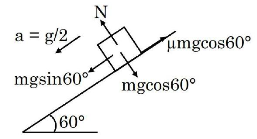
A cubic block of mass $m$ is sliding down on an inclined plane at $60^{\circ}$ with an acceleration of $\frac{\mathrm{g}}{2}$, the value of coefficient of kinetic friction is
  • A
    $\sqrt{3}-1$
  • B
    $\frac{\sqrt{3}}{2}$
  • C
    $\frac{\sqrt{2}}{3}$
  • D
    $1-\frac{\sqrt{3}}{2}$
Answer
A. $\sqrt{3}-1$
Image
$m g \sin 60^{\circ}-\mu m g \cos 60^{\circ}=m a$
$g \sin 60-\mu g \cos 60=\frac{g}{2}$
$\frac{\sqrt{3}}{2}-\frac{\mu}{2}=\frac{1}{2}$
$\mu=\sqrt{3}-1$
View full question & answer
MCQ 84 Marks
Match the List-I with List-II
List-IList-II
A.Triatomic rigid gasI.$\frac{\mathrm{C}_{\mathrm{P}}}{\mathrm{C}_{\mathrm{V}}}=\frac{5}{3}$
B.Diatomic non-rigid gasII.$\frac{\mathrm{C}_{\mathrm{P}}}{\mathrm{C}_{\mathrm{V}}}=\frac{7}{5}$
C.Monoatomic gasIII.$\frac{\mathrm{C}_{\mathrm{P}}}{\mathrm{C}_{\mathrm{V}}}=\frac{4}{3}$
D.Diatomic rigid gasIV.$\frac{\mathrm{C}_{\mathrm{P}}}{\mathrm{C}_{\mathrm{V}}}=\frac{9}{7}$
Choose the correct answer from the options given below :
  • A
    A-III, B-IV, C-I, D-II
  • B
    A-III, B-II, C-IV, D-I
  • C
    A-II, B-IV, C-I, D-III
  • D
    A-IV, B-II, C-III, D-I
Answer
A. A-III, B-IV, C-I, D-II
$\gamma=1+\frac{2}{\mathrm{f}}$
$\mathrm{f}=6$, Triatomic rigid gas
$\mathrm{f}=7$, Diatomic non-rigid gas
$f=5$, Diatomic rigid gas
$\mathrm{f}=3$, monoatomic rigid gas
$\gamma=1+\frac{2}{6}=\frac{4}{3}$ (Triatomic)
$\gamma=1+\frac{2}{7}=\frac{9}{7}$ (Diatomic, non-rigid)
$\gamma=1+\frac{2}{5}=\frac{7}{5}($ Diatomic, rigid $)$
$\gamma=1+\frac{2}{3}=\frac{5}{3}$ (Monoatomic, rigid)
View full question & answer
MCQ 94 Marks
Two projectiles are fired from ground with same initial speeds from same point at angles $\left(45^{\circ}+\alpha\right)$ and $\left(45^{\circ}-\alpha\right)$ with horizontal direction. The ratio of their times of flights is
  • A
    1
  • B
    $\frac{1-\tan \alpha}{1+\tan \alpha}$
  • C
    $\frac{1+\sin 2 \alpha}{1-\sin 2 \alpha}$
  • D
    $\frac{1+\tan \alpha}{1-\tan \alpha}$
Answer
D. $\frac{1+\tan \alpha}{1-\tan \alpha}$
$\theta_{1}=45+\alpha ; \theta_{2}=45-\alpha$
Time of flight, $\mathrm{T}=\frac{2 \mathrm{v} \sin \theta}{\mathrm{g}}$
$\frac{T_{1}}{T_{2}}=\frac{\sin (45+\alpha)}{\sin (45-\alpha)}$
$\frac{\mathrm{T}_{1}}{\mathrm{~T}_{2}}=\frac{\frac{1}{\sqrt{2}} \cos \alpha+\frac{1}{\sqrt{2}} \sin \alpha}{\frac{1}{\sqrt{2}} \cos \alpha-\frac{1}{\sqrt{2}} \sin \alpha}$
$\frac{\mathrm{T}_{1}}{\mathrm{~T}_{2}}=\frac{\cos \alpha+\sin \alpha}{\cos \alpha-\sin \alpha}=\frac{1+\tan \alpha}{1-\tan \alpha}$
View full question & answer
MCQ 104 Marks
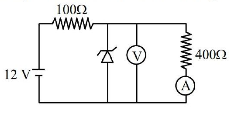
In the following circuit, the reading of the ammeter will be (Take Zener breakdown voltage $=4 \mathrm{~V}$)
Image
  • A
    24 mA
  • B
    80 mA
  • C
    10 mA
  • D
    60 mA
Answer
C. 10 mA
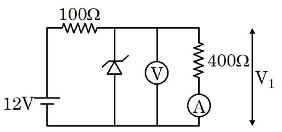
Image
$\mathrm{V}_{1}=\frac{400}{100+400} \times 12 \mathrm{~V}=\frac{4}{5} \times 12=\frac{48}{5} \mathrm{~V}$
here, $\mathrm{V}_{1}>\mathrm{V}_{\mathrm{z}},\left(\mathrm{V}_{\mathrm{z}}=\right.$ Zener Voltage$)$
So, Zener breakdown will be take place
So, voltage across $400 \Omega$ will be 4 V
$\mathrm{I}=\frac{4}{400} \mathrm{~A}=\frac{1}{100 \mathrm{~A}}=10 \mathrm{~mA}$
View full question & answer
MCQ 114 Marks
Two thin convex lenses of focal lengths 30 cm and 10 cm are placed coaxially, 10 cm apart. The power of this combination is :
  • A
    5 D
  • B
    1 D
  • C
    20 D
  • D
    10 D
Answer
D. 10 D
$\mathrm{f}_{1}=30 \mathrm{~cm}, \mathrm{f}_{2}=10 \mathrm{~cm}$
$\frac{1}{f_{e q}}=\frac{1}{f_{1}}+\frac{1}{f_{2}}-\frac{\mathrm{d}}{\mathrm{f}_{1} \mathrm{f}_{2}}, \mathrm{~d}=$ distance between lens
$\frac{1}{\mathrm{f}_{\mathrm{eq}}}=\frac{1}{0.3}+\frac{1}{0.1}-\frac{0.1}{(0.3)(0.1)}$
$\frac{1}{f_{e q}}=\frac{1}{0.1}$
Power $=\frac{1}{\mathrm{f}_{\mathrm{eq}}}=10 \mathrm{D}$
View full question & answer
MCQ 124 Marks
An ac current is represented as $\mathrm{i}=5 \sqrt{2}+10 \cos \left(650 \pi \mathrm{t}+\frac{\pi}{6}\right) \mathrm{Amp}$
The r.m.s value of the current is
  • A
    50 Amp
  • B
    100 Amp
  • C
    10 Amp
  • D
    $5 \sqrt{2}$ Amp
Answer
C. 10 Amp
$i = 5 \sqrt{2}+10 \cos \left(650 \pi t +\frac{\pi}{6}\right) $
$i ^2= 50+100 \cos ^2\left(650 \pi t +\frac{\pi}{6}\right) +(2)(5 \sqrt{2})(10) \cos \left(650 \pi t +\frac{\pi}{6}\right) $
$ < i ^2 > =50+\frac{100}{2}+0 $
$ < i ^2 > =100 $
$ < i > =$ 10 Amp.
View full question & answer
MCQ 134 Marks
A lens having refractive index 1.6 has focal length of 12 cm , when it is in air. Find the focal length of the lens when it is placed in water.
(Take refractive index of water as 1.28)
  • A
    355 mm
  • B
    288 mm
  • C
    555 mm
  • D
    655 mm
Answer
B. 288 mm
As we know,
$\frac{1}{\mathrm{f}}=\left[\frac{\mu_{\mathrm{L}}}{\mu_{\mathrm{m}}}-1\right]\left[\frac{1}{\mathrm{R}_{1}}-\frac{1}{\mathrm{R}_{2}}\right]$
For air $\mu_{\mathrm{m}}=1$
$\frac{1}{12}=[1.6-1]\left[\frac{1}{\mathrm{R}_{1}}-\frac{1}{\mathrm{R}_{2}}\right]$
$\frac{1}{12}=\frac{6}{10}\left[\frac{1}{\mathrm{R}_{1}}-\frac{1}{\mathrm{R}_{2}}\right]$
$\left[\frac{1}{\mathrm{R}_{1}}-\frac{1}{\mathrm{R}_{2}}\right]=\frac{10}{72}$
For water
$\frac{1}{\mathrm{f}}=\left[\frac{1.6}{1.28}-1\right]\left[\frac{10}{72}\right]=\frac{32}{128} \times \frac{10}{72}$
$\frac{1}{\mathrm{f}}=\frac{1}{4} \times \frac{10}{72}$
$\mathrm{f}=28.8 \mathrm{~cm}$
$\mathrm{f}=288 \mathrm{~mm}$
View full question & answer
MCQ 144 Marks
The percentage increase in magnetic field (B) when space within a current carrying solenoid is filled with magnesium (magnetic susceptibility $\chi_{\mathrm{mg}}=1.2 \times 10^{-5}$) is :
  • A
    $\frac{6}{5} \times 10^{-3} \%$
  • B
    $\frac{5}{6} \times 10^{-5} \%$
  • C
    $\frac{5}{6} \times 10^{-4} \%$
  • D
    $\frac{5}{3} \times 10^{-5} \%$
Answer
A. $\frac{6}{5} \times 10^{-3} \%$
% change in $\mathrm{B}=\frac{\mathrm{B}_{\text {new }}-\mathrm{B}_{\text {old }}}{\mathrm{B}_{\text {old }}} \times 100 \%$
$=\frac{\mu \mathrm{ni}-\mu_{0} \mathrm{ni}}{\mu_{0} \mathrm{ni}} \times 100 \%=\frac{\left(\mu-\mu_{0}\right)}{\mu_{0}} \times 100 \%$
$=\frac{\left(\mu_{0} \mu_{\mathrm{r}}-\mu_{0}\right)}{\mu_{0}} \times 100 \%$
$=\left(\mu_{\mathrm{r}}-1\right) \times 100 \%$
$=\chi_{\mathrm{n}} \times 100 \%$
$=1.2 \times 10^{-3} \%$
View full question & answer
MCQ 154 Marks
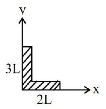
A rod of length 5 L is bent right angle keeping one side length as 2 L .
Image
The position of the centre of mass of the system: (Consider L $=10 \mathrm{~cm}$ )
  • A
    $2 \hat{i}+3 \hat{j}$
  • B
    $3 \hat{i}+7 \hat{j}$
  • C
    $5 \hat{i}+8 \hat{\mathrm{j}}$
  • D
    $4 \hat{i}+9 \hat{j}$
Answer
D. $4 \hat{i}+9 \hat{j}$
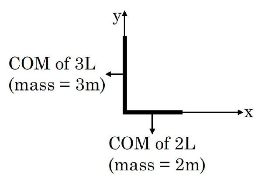
Image
$\mathrm{x}_{\mathrm{com}}=\frac{2 \mathrm{~m}(10)+3 \mathrm{~m}(0)}{5 \mathrm{~m}}=4 \mathrm{~cm}$
$y_{\text {com }}=\frac{2 \mathrm{~m}(0)+3 \mathrm{~m}(15)}{5 \mathrm{~m}}=9 \mathrm{~cm}$
$\overrightarrow{\mathrm{r}}_{\text {com }}=4 \hat{\mathrm{i}}+9 \hat{\mathrm{j}}$
View full question & answer
MCQ 164 Marks
If $\in_{0}$ denotes the permittivity of free space and $\Phi_{\mathrm{E}}$ is the flux of the electric field through the area bounded by the closed surface, then dimension of $\left(\in_{0} \frac{\mathrm{~d} \phi_{\mathrm{E}}}{\mathrm{dt}}\right)$ are that of :
  • A
    Electric field
  • B
    Electric potential
  • C
    Electric charge
  • D
    Electric current
Answer
D. Electric current
We know that formula for displacement current is given by
$\mathrm{id}=\varepsilon_{0} \frac{\mathrm{~d} \phi_{\varepsilon}}{\mathrm{dt}}$
View full question & answer
MCQ 174 Marks
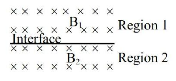
Uniform magnetic fields of different strengths $\left(B_{1}\right.$ and $\mathrm{B}_{2}$), both normal to the plane of the paper exist as shown in the figure. A charged particle of mass m and charge q, at the interface at an instant, moves into the region 2 with velocity v and returns to the interface. It continues to move into region 1 and finally reaches the interface. What is the displacement of the particle during this movement along the interface ?
Image
(Consider the velocity of the particle to be normal to the magnetic field and $\mathrm{B}_{2}>\mathrm{B}_{1}$)
  • A
    $\frac{\mathrm{mv}}{\mathrm{qB}_{1}}\left(1-\frac{\mathrm{B}_{2}}{\mathrm{~B}_{1}}\right) \times 2$
  • B
    $\frac{\mathrm{m} v}{\mathrm{qB}_{1}}\left(1-\frac{\mathrm{B}_{1}}{\mathrm{~B}_{2}}\right)$
  • C
    $\frac{\mathrm{mv}}{\mathrm{qB}_{1}}\left(1-\frac{\mathrm{B}_{2}}{\mathrm{~B}_{1}}\right)$
  • D
    $\frac{m v}{\mathrm{qB}_{1}}\left(1-\frac{\mathrm{B}_{1}}{\mathrm{~B}_{2}}\right) \times 2$
Answer
D. $\frac{m v}{\mathrm{qB}_{1}}\left(1-\frac{\mathrm{B}_{1}}{\mathrm{~B}_{2}}\right) \times 2$
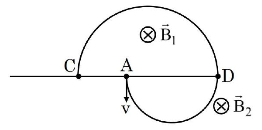
As $\vec{v}$ is $\perp$ to $\vec{B}$, so charge particle will move in circular path, whose radius is given by
Image
Starting point $\rightarrow \mathrm{A}$
Ending point $\rightarrow \mathrm{C}$
$\therefore$ Net displacement $=\mathrm{AC}$
$\mathrm{AC}=\mathrm{CD}-\mathrm{AD}$
$\mathrm{AC}=\frac{2 \mathrm{mv}}{\mathrm{qB}_{1}}-\frac{2 \mathrm{mv}}{\mathrm{qB}_{2}}$
$\mathrm{AC}=\frac{2 \mathrm{mv}}{\mathrm{qB}_{1}}\left[1-\frac{\mathrm{B}_{1}}{\mathrm{~B}_{2}}\right]$
View full question & answer
MCQ 184 Marks
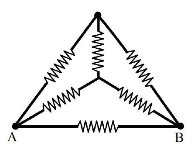
A wire of resistance $R$ is bent into a triangular pyramid as shown in figure with each segment having same length. The resistance between points $A$ and $B$ is $R / n$. The value of $n$ is :
Image
  • A
    16
  • B
    14
  • C
    10
  • D
    12
Answer
D. 12
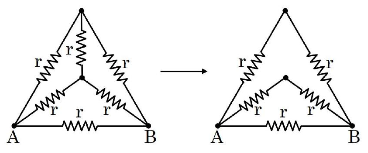
As $r=\frac{R}{6}$
Image
(As balanced wheat stone bridge is formed)
Now, Equivalent resistance between A and B can be written as
$\frac{1}{\mathrm{R}_{\mathrm{AB}}}=\frac{1}{2 \mathrm{r}}+\frac{1}{2 \mathrm{r}}+\frac{1}{\mathrm{r}}=\frac{2}{\mathrm{r}}$
$\mathrm{R}_{\mathrm{AB}}=\frac{\mathrm{R}}{12}$
View full question & answer
MCQ 194 Marks
Two plane polarized light waves combine at a certain point whose electric field components are
$\mathrm{E}_{1}=\mathrm{E}_{0} \sin \omega \mathrm{t}$
$E_{2}=E_{0} \sin \left(\omega t+\frac{\pi}{3}\right)$
Find the amplitude of the resultant wave.
  • A
    0.9 E
  • B
    $E_{0}$
  • C
    1.7 $\mathrm{E}_{0}$
  • D
    3.4 $\mathrm{E}_{0}$
Answer
C. 1.7 $\mathrm{E}_{0}$
$\mathrm{E}=\sqrt{\left(\mathrm{E}_{0}\right)^{2}+\left(\mathrm{E}_{0}\right)^{2}+2\left(\mathrm{E}_{0}\right)\left(\mathrm{E}_{0}\right) \cos \frac{\pi}{3}}$
$\mathrm{E}=\sqrt{2 \mathrm{E}_{0}^{2}+\mathrm{E}_{0}^{2}}=\sqrt{3} \mathrm{E}_{0}=1.73 \mathrm{E}_{0}$
View full question & answer
MCQ 204 Marks
Two harmonic waves moving in the same direction superimpose to form a wave $\mathrm{x}=\mathrm{a} \cos (1.5 \mathrm{t}) \cos (50.5 \mathrm{t})$ where $t$ is in seconds. Find the period with which they beat (close to nearest integer)
  • A
    6 s
  • B
    4 s
  • C
    1 s
  • D
    2 s
Answer
D. 2 s
The given equation can be written as
$x=\frac{a}{2} \cos [1.5+50.5] t+\frac{a}{2} \cos [50.5-1.5]$
$x=\frac{a}{2} \cos [52 t]+\frac{a}{2} \cos [49 t]$
Here, $2 \pi \mathrm{f}_{1}$ & $2 \pi \mathrm{f}_{2}=49$
$\mathrm{f}_{1}=\frac{52}{2 \pi}, \mathrm{f}_{2}=\frac{49}{2 \pi}$
$\therefore \mathrm{f}_{\text {Beat }}=\mathrm{f}_{1}-\mathrm{f}_{2}=\frac{3}{2 \pi} \mathrm{~Hz}$
$\therefore \mathrm{T}_{\text {Beat }}=\frac{1}{\mathrm{f}_{\text {Beat }}}=\frac{2 \pi}{3} \mathrm{sec}$
$=2.09 \mathrm{sec} \approx 2 \mathrm{sec}$
View full question & answer