MCQ 14 Marks
If the sum of the second, fourth and sixth terms of a G.P. of positive terms is 21 and the sum of its eighth, tenth and twelfth terms is 15309 , then the sum of its first nine terms is :
AnswerD. 757
$\quad a r+a r^{3}+a r^{5}=21, \quad a r^{7}+a r^{9}+a r^{11}=15309$
$\Rightarrow \operatorname{ar}\left(1+ r ^2+ r ^4\right)=21$,$\quad$...(1)
$\operatorname{ar}^7\left(1+r^2+r^4\right)=15309$$\quad$...(2)
$E q^{\mathrm{n}}(2) \div \mathrm{eq}^{\mathrm{n}}(1)$
$\Rightarrow \frac{ a.r ^7}{ ar }=\frac{15309}{21} \Rightarrow r ^6=729$
$\Rightarrow \frac{\mathrm{a} .\left(\mathrm{r}^{9}-1\right)}{\mathrm{r}-1}=\frac{\frac{7}{91}(19683-1)}{2}=\frac{7 \times 19682}{91 \times 2}$
$=\frac{9841}{13}=757$
View full question & answer→MCQ 24 Marks
Let the system of equations
$x+5 y-z=1$
$4 \mathrm{x}+3 \mathrm{y}-3 \mathrm{z}=7$
$24 x+y+\lambda z=\mu$
$\lambda, \mu \in R$, have infinitely many solutions. Then the number of the solutions of this system,
If $\mathrm{x}, \mathrm{y}, \mathrm{z}$ are integers and satisfy $7 \leq \mathrm{x}+\mathrm{y}+\mathrm{z} \leq 77$, is
AnswerA. 3
For infinitely many solution
$\Delta=0$
$\left|\begin{array}{ccc}1 & 5 & -1 \\ 4 & 3 & -3 \\ 24 & 1 & \lambda\end{array}\right|=0$
$\Rightarrow 1(3 \lambda+3)-5(4 \lambda+72)-1(4-72)=0$
$\Rightarrow-17 \lambda+3-4 \times 72-4=0$
$\Rightarrow 17 \lambda=-289$
$\Rightarrow \lambda=-17$
$\Rightarrow \Delta 1=0$
$\Rightarrow\left|\begin{array}{ccc}1 & 5 & -1 \\ 7 & 3 & -3 \\ \mu & 1 & -17\end{array}\right|=0$
$\Rightarrow 1(-51+3)-5(-119+3 \mu)-1(7-3 \mu)=0$
$\Rightarrow-48+595-15 \mu-7+3 \mu=0$
$\Rightarrow 12 \mu=540$
$\mu=45$
$x+5 y-z=1$
$4 \mathrm{x}+3 \mathrm{y}-3 \mathrm{z}=7$
$24 \mathrm{x}+\mathrm{y}-17 \mathrm{z}=45$
Let $\mathrm{z}=1$
$x+5 y=1+\lambda] \times 4$
$4 x+3 y=7+3 \lambda$
$\frac{\underset{-}{4 x}+20 y=4+4 \lambda}{-17 y=3-\lambda}$
$y=\frac{\lambda-3}{17}, x=1+\lambda-\frac{5 \lambda-15}{17}$
$=\frac{32-12 \lambda}{17}$
$7 \leq \frac{\lambda-3}{17}+\frac{32+12 \lambda}{17}+\lambda \leq 77$
$7 \leq \frac{30 \lambda+29}{17} \leq 77$
$\begin{aligned} 3 & \leq \lambda \leq 42 \\ \lambda & =3,20,37\end{aligned}$
View full question & answer→MCQ 34 Marks
Let $e_{1}$ and $e_{2}$ be the eccentricities of the ellipse $\frac{x^{2}}{b^{2}}+\frac{y^{2}}{25}=1$ and the hyperbola $\frac{x^{2}}{16}-\frac{y^{2}}{b^{2}}=1$, respectively. If $\mathrm{b}<5$ and $\mathrm{e}_{1} \mathrm{e}_{2}=1$, then the eccentricity of the ellipse having its axes along the coordinate axes and passing through all four foci (two of the ellipse and two of the hyperbola) is :
- A
$\frac{4}{5}$
- B
$\frac{3}{5}$
- C
$\frac{\sqrt{7}}{4}$
- D
$\frac{\sqrt{3}}{2}$
AnswerB. $\frac{3}{5}$
$e_{1}^{2}=1-\frac{b^{2}}{25} \quad e_{2}^{2}=1-\frac{b^{2}}{16}$
$\therefore \mathrm{e}_{1}^{2} \mathrm{e}_{2}^{2}=1$
$\left(1-\frac{b^{2}}{25}\right)\left(1+\frac{b^{2}}{16}\right)=1$
$\Rightarrow 2+\frac{\mathrm{b}^{2}}{16}-\frac{\mathrm{b}^{2}}{25}-\frac{\mathrm{b}^{2}}{400}=1$
$\Rightarrow \frac{9 \mathrm{~b}^{2}}{400}=\frac{\mathrm{b}^{4}}{400}$
$b^{2}=9$
$\frac{x^{2}}{9}+\frac{y^{2}}{25}=1 \quad \frac{x^{2}}{16}-\frac{y^{2}}{9}=0$
$\mathrm{e}_{1} \sqrt{1-\frac{9}{25}} \quad \mathrm{e}_{2}=\frac{5}{4}$
$e_{1}=\frac{4}{5}$
Focii : $-(0, \pm 4) \quad( \pm 5,0)$
ellipse passing through all four foci
$\frac{x^{2}}{25}+\frac{y^{2}}{16}=1$
$e=\sqrt{1-\frac{16}{25}}=\frac{3}{5}$
View full question & answer→MCQ 44 Marks
The number of real roots of the equation $\mathrm{x}|\mathrm{x}-2|+3|\mathrm{x}-3|+1=0$ is :
AnswerC. 1
(I) $x<2$
$-x^{2}+2 x-3 x+9+1=0$
$\Rightarrow \mathrm{x}^{2}+\mathrm{x}-10=0$
$\Rightarrow \mathrm{x}=\frac{-1+\sqrt{41}}{2}, \frac{-1-\sqrt{41}}{2}$
(II) $2 \leq x<3$
$\Rightarrow \mathrm{x}^{2}-2 \mathrm{x}-3 \mathrm{x}+9+1=0$
$\Rightarrow \mathrm{x}^{2}-5 \mathrm{x}+10=0$
D $<0$
(III) $x \geq 3$
$x^{2}-2 x+3 x-9+2=0$
$\Rightarrow \mathrm{x}^{2}+\mathrm{x}-8=0$
$x=\frac{-1+\sqrt{32}}{2}, \frac{-1-\sqrt{32}}{2}$
1 real roots
View full question & answer→MCQ 54 Marks
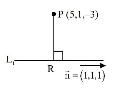
Consider the lines $\mathrm{L}_{1}: \mathrm{x}-1=\mathrm{y}-2=\mathrm{z}$ and $\mathrm{L}_{2}: \mathrm{x}-2=\mathrm{y}=\mathrm{z}-1$. Let the feet of the perpendiculars from the point $\mathrm{P}(5,1,-3)$ on the lines $\mathrm{L}_{1}$ and $\mathrm{L}_{2}$ be Q and R respectively. If the area of the triangle $P Q R$ is $A$, then $4 A^{2}$ is equal to :
AnswerB. 147
$\mathrm{L}_{1}: \frac{\mathrm{x}-1}{1}=\frac{\mathrm{y}-2}{1}=\frac{\mathrm{z}-0}{2}$
Let $\mathrm{Q}(\lambda+1, \lambda+2, \lambda)$
$\overrightarrow{\mathrm{PQ}}=(\lambda-4, \lambda-1, \lambda+3)$
$\overrightarrow{\mathrm{PQ}} \cdot \overrightarrow{\mathrm{m}}=0$
$\Rightarrow \lambda-4+\lambda+1, \lambda+3=0$
$\Rightarrow 3 \lambda=0$
$\lambda=0$
$\Rightarrow \mathrm{Q}(1,2,0)$
$L_{2}: \frac{x-2}{1}=\frac{y-0}{1}=\frac{z-1}{2}$
Let $\mathrm{R}(\mu+2, \mu, \mu+1) \overrightarrow{\mathrm{PR}}=(\mu-3, \mu-1, \mu+4)$
$\overrightarrow{\mathrm{PR}} \cdot \overrightarrow{\mathrm{n}}=0$
$\mu-3+\mu-1+\mu+4=0$
$\neq \mu=0$
R(2,0,1)
Area of $\triangle \mathrm{PQR}(\mathrm{A})=\frac{1}{2}|\overrightarrow{\mathrm{PQ}} \times \overrightarrow{\mathrm{PR}}|$
$A=\frac{1}{2}|(-4 \hat{i}+\hat{j}+3 \hat{k}) \times(-3 \hat{i}+\hat{j}+4 \hat{k})|$
$A=\frac{1}{2}|7(\hat{\mathrm{i}}+\hat{\mathrm{j}}+\hat{\mathrm{k}})|$
$\left|\begin{array}{ccc}\hat{i} & \hat{j} & \hat{k} \\ -4 & 1 & 3 \\ -3 & -1 & 4\end{array}\right|$
$=7 \hat{\mathrm{i}}+7 \hat{\mathrm{j}}+7 \hat{\mathrm{k}}$
$4 \mathrm{~A}^{2}=49 \times 3=147$ View full question & answer→MCQ 64 Marks
Let $p$ be the number of all triangles that can be formed by joining the vertices of a regular polygon P of n sides and q be the number of all quadrilaterals that can be formed by joining the vertices of $P$. If $p+q=126$, then the eccentricity of the ellipse $\frac{x^{2}}{16}+\frac{y^{2}}{n}=1$ is :
- A
$\frac{3}{4}$
- B
$\frac{1}{2}$
- C
$\frac{\sqrt{7}}{4}$
- D
$\frac{1}{\sqrt{2}}$
AnswerD. $\frac{1}{\sqrt{2}}$
Total trangles $=\Rightarrow={ }^{h} \mathrm{C}_{3}$
Total auadrilaterals $={ }^{h} \mathrm{C}_{4}=\mathrm{q}$
${ }^{\mathrm{n}} \mathrm{C}_{3}+{ }^{\mathrm{n}} \mathrm{C}_{4}=126 \Rightarrow{ }^{\mathrm{n}+1} \mathrm{C}_{4}=126$
$\Rightarrow \mathrm{n}+1=9 \Rightarrow \mathrm{n}=8$
$\frac{x^{2}}{16}+\frac{y^{2}}{n}=1 \Rightarrow \frac{x^{2}}{16}+\frac{y^{2}}{8}=1$
$\mathrm{e}=\sqrt{1-\frac{8}{16}}=\sqrt{\frac{8}{16}}=\frac{1}{\sqrt{2}}$
View full question & answer→MCQ 74 Marks
If the equation of the line passing through the point $\left(0,-\frac{1}{2}, 0\right)$ and perpendicular to the lines $\overrightarrow{\mathrm{r}}=\lambda(\hat{\mathrm{i}}+\mathrm{aj}+b \hat{\mathrm{k}})$ and
$\overrightarrow{\mathrm{r}}=(\hat{\mathrm{i}}-\hat{\mathrm{j}}-6 \hat{\mathrm{k}})+\mu(-b \hat{\mathrm{i}}+a \hat{\mathrm{j}}+5 \hat{\mathrm{k}})$
is $\frac{x-1}{-2}=\frac{y+4}{d}=\frac{z-c}{-4}$, then $a+b+c+d$ is equal to :
AnswerB. 14
Line is $\perp^{r}$ to 2 line $\Rightarrow$ line will be parallel to
$(i+a \hat{j}+b \hat{k}) \times(-b \hat{i}+a \hat{j}+5 \hat{k})$
Parallel vector along the required line is
$\hat{\mathrm{i}}(5 \mathrm{a}-\mathrm{ab})-\hat{\mathrm{j}}\left(\mathrm{b}^{2}+5\right)+\hat{\mathrm{k}}(\mathrm{a}+\mathrm{ab})$
Dr's of required line $\alpha(5 a-a b),-\left(b^{2}+5\right),(a+a b)$
Also Dr's of required line $\alpha-2, \mathrm{~d},-4$
$
\therefore \frac{5 a-ab}{-2}=\frac{-\left(b^2+5\right)}{d}=\frac{a+ab}{-4} \quad ...(1)
$
Also point $\left(0, \frac{-1}{2}, 0\right)$ will lie on $\frac{x-1}{-2}=\frac{y+4}{d}=\frac{z-c}{-4}$
$\frac{0-1}{-2}=\frac{\frac{-1}{2}+4}{d}=\frac{0-c}{-4} \Rightarrow d=7, c=2$
From (1) $\frac{5 \mathrm{a}-\mathrm{ab}}{-2}=\frac{-\mathrm{b}^{2}-5}{7}=\frac{\mathrm{a}+\mathrm{ab}}{-4}$
$\frac{5 \mathrm{a}-\mathrm{ab}}{-2}=\frac{\mathrm{a}+\mathrm{ab}}{-4} ; \frac{-\mathrm{b}^{2}-5}{7}=\frac{\mathrm{a}+\mathrm{ab}}{-4}$
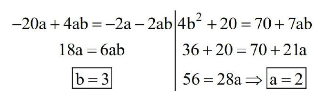
$a+b+c+d=2+3+2+7=14$ View full question & answer→MCQ 84 Marks
Let $y=y(x)$ be the solution of the differential equation $\left(x^{2}+1\right) y^{\prime}-2 x y=\left(x^{4}+2 x^{2}+1\right) \cos x$, $y(0)=1$. Then $\int_{-3}^{3} y(x) d x$ is :
AnswerA. 24
$\left(x^{2}+1\right) \frac{d y}{d x}-2 x y=\left(x^{4}+2 x^{2}+1\right) \cos x$
$\frac{d y}{d x}-\left(\frac{2 x}{x^{2}+1}\right) y=\frac{\left(x^{2}+1\right)^{2} \cos x}{c x^{2}+1}=\left(x^{2}+1\right) \cos x$
(Linear D.E)
$P=\frac{-2 x}{x^{2}+1}, Q=\left(x^{2}+1\right) \cos x$
I.F $=\mathrm{e}^{\int \mathrm{Pdx}}=\mathrm{e}^{\int \frac{-2 \mathrm{x}}{\mathrm{x}^{2}+1} \mathrm{dx}}=\frac{1}{\mathrm{x}^{2}+1}$
$y \cdot \frac{1}{x^{2}+1}=\int\left(x^{2}+1\right) \cos x \cdot \frac{1}{x^{2}+1} d x$
$\frac{y}{x^{2}+1}=\sin x+c \Rightarrow y \cos =1 \Rightarrow c=1$
$y=\left(x^{2}+1\right)(\sin x+1)$
$\int_{-3}^{3} y d x=\int_{-3}^{3}\left(x^{2}+1\right)(\sin x+1)$
$d x=\int_{-3}^{3} x^{2} \sin x+x^{2} \sin x+1 d x$
$\Rightarrow \int_{-3}^{3} x^{2} \sin x d x+\int_{-3}^{3} x^{2} d x+\int_{-3}^{3} \sin x d x+\int_{-3}^{3} 1 d x$
$=0+18+0+6=24$
View full question & answer→MCQ 94 Marks
Let the length of a latus rectum of an ellipse $\frac{x^{2}}{a^{2}}+\frac{y^{2}}{b^{2}}=$1 be 10 . If its eccentricity is the minimum value of the function $f(\mathrm{t})=\mathrm{t}^{2}+\mathrm{t}+\frac{11}{12}$, $t \in \mathbf{R}$, then $\mathrm{a}^{2}+\mathrm{b}^{2}$ is equal to :
AnswerB. 126
Length of LR $=\frac{2 b^2}{a}=10 \Rightarrow 5 a = b ^2$$\quad$....(1)
$f(t)=t^2+t+\frac{11}{12}$
$\frac{ df ( t )}{ dt }=2 t +1=0 \Rightarrow t =\frac{-1}{2}$
Min value of $f(t)=\left(\frac{-1}{2}\right)^2+\left(\frac{-1}{2}\right)+\frac{11}{12}$
$=\frac{1}{4} \frac{-1}{2}+\frac{11}{12}=\frac{3-6+11}{12}=\frac{8}{12}=\frac{2}{3}= e$
$e ^2=\frac{1- b ^2}{ a ^2} \Rightarrow \frac{4}{9}=\frac{1- b ^2}{ a ^2}$
$\Rightarrow \frac{ b ^2}{ a ^2}=\frac{1-4}{ a }=\frac{5}{ a } \Rightarrow b ^2=\frac{5 a ^2}{ a } $$\quad$....(2)
From (1) & (2)
$5 a =\frac{5 a ^2}{ a } \Rightarrow a =9, b=\sqrt{45}=3 \sqrt{5}$
$\therefore a 2+ b 2=81+45=126$
View full question & answer→MCQ 104 Marks
If the locus of $z \in \mathrm{C}$, such that
$\operatorname{Re}\left(\frac{z-1}{2 z+\mathrm{i}}\right)+\operatorname{Re}\left(\frac{\bar{z}-1}{2 \bar{z}-\mathrm{i}}\right)=2$,
is a circle of radius $r$ and center $(a, b)$ then $\frac{15 \mathrm{ab}}{\mathrm{r}^{2}}$ is equal to :
AnswerC. 18
$\operatorname{Re}\left(\frac{z-1}{2 z+i}\right)+\operatorname{Re}\left(\frac{\bar{z}-1}{2 \bar{z}-i}\right)=2$
Here, $\frac{\mathrm{z}-1}{2 \mathrm{z}+\mathrm{i}}=\left(\frac{\overline{\bar{z}-1}}{2 \bar{z}-\mathrm{i}}\right)=2$
$=\operatorname{Re}\left(\frac{z-1}{2 z+i}\right)+\operatorname{Re}\left(\overline{\frac{z-1}{2 z+i}}\right)=2$
$=2 \operatorname{Re}\left(\frac{z-1}{2 z+1}\right)=2 \Rightarrow \operatorname{Re}\left(\frac{z-1}{2 z+i}\right)=1$
Let $\mathrm{z}=\mathrm{x}+\mathrm{iy}$
$\operatorname{Re}\left(\frac{(x-1)+i y}{2 x+i(2 y+1)}\right)=1 \Rightarrow \operatorname{Re}\left[\frac{((x-1)+i y)(2 x-i(y+1)}{(2 x+i(2 y+1)(2 x-i(2 y+1))}\right]=1$
$\Rightarrow \frac{2 \mathrm{x}(\mathrm{x}-1)+\mathrm{y}(2 \mathrm{y}+1)}{4 \mathrm{x}^{2}+(2 \mathrm{y}+1)^{2}}=1$
$\Rightarrow 2 \mathrm{x}^{2}-2 \mathrm{x}+2 \mathrm{y}^{2}+\mathrm{y}=4 \mathrm{x}^{2}+4 \mathrm{y}^{2}+1+4 \mathrm{y}$
$\Rightarrow 2 \mathrm{x}^{2}+2 \mathrm{y}^{2}+3 \mathrm{y}+2 \mathrm{x}+1=0$
$\Rightarrow x^{2}+y^{2}+x+\frac{3}{2} y+\frac{1}{2}=0$
centre $=\left(\frac{-1}{2}, \frac{-3}{4}\right), \mathrm{r}=\sqrt{\frac{1}{4}+\frac{9}{16}-\frac{1}{2}}=\frac{\sqrt{5}}{4}$
$\mathrm{a}=\frac{-1}{2}, \mathrm{~b}=\frac{-3}{4}, \mathrm{r}^{2}=\frac{5}{16}$
$15 \frac{\mathrm{ab}}{\mathrm{r}^{2}}=15 \times\left(\frac{-1}{2}\right) \times\left(\frac{-3}{4}\right) \times \frac{16}{5}=18$
View full question & answer→MCQ 114 Marks
Let $\mathrm{a}_{\mathrm{n}}$ be the $\mathrm{n}^{\text {th }}$ term of an A. P.
If $S_{n}=a_{1}+a_{2}+a_{3}+\ldots+a_{n}=700, a_{6}=7$ and $S_{7}=7$, then $a_{n}$ is equal to :
AnswerC. 64
$S_{n}=700=\frac{n}{2}[2 a+(n-1) d]$$\quad$....(i)
$a_6=7 \Rightarrow a+5 d=7$$\quad$....(ii)
$S_7=7 \Rightarrow \frac{7}{2}(2 a+6 d)=7$
$a+3 d=1$$\quad$....(iii)
Solve (ii) and (iii)
$\frac{n}{2}(-16+3 n-3)=700 \Rightarrow 3 n^2-19 n-1400=0$
$(3 n+56)(n-25)=0$
$\therefore a _{25}= a +24 d=-8+24 \times 3$
$=-8+72$
$=64$
View full question & answer→MCQ 124 Marks
The number of solutions of the equation $\cos 2 \theta \cos \frac{\theta}{2}+\cos \frac{5 \theta}{2}=2 \cos ^{3} \frac{5 \theta}{2}$ in $\left[-\frac{\pi}{2}, \frac{\pi}{2}\right]$ is :
AnswerA. 7
$\cos 2 \theta \cos \frac{\theta}{2}+\cos \frac{5 \theta}{2}=2 \cos ^{3} \frac{5 \theta}{2}$
$\frac{1}{2}\left(2 \cos 2 \theta \cos \frac{\theta}{2}\right)+\cos \frac{50}{2}$
$=\frac{1}{2}\left(\cos \frac{15 \theta}{2}+3 \cos \frac{5 \theta}{2}\right)$
or solving
$\cos \frac{3 \theta}{2}=\cos \frac{15 \theta}{2}$
$\cos \frac{15 \theta}{2}-\cos \frac{3 \theta}{2}=0$
$2 \sin 30 \sin \frac{9 \theta}{2}=0$
$3 \theta=n \pi$ or $\frac{9 \theta}{2}=m \pi$
$\theta=\frac{\mathrm{n} \pi}{3} \quad \theta=\frac{2 \mathrm{~m} \pi}{9}$
$\theta=\left\{-\frac{\pi}{2}, \frac{\pi}{3}, 0\right\}$
$\theta=\left\{-\frac{4 \pi}{9}, \frac{-2 \pi}{9}, \frac{4 \pi}{9}, \frac{2 \pi}{9}\right\}$
Option (1)
View full question & answer→MCQ 134 Marks
Let $f: \mathbf{R} \rightarrow \mathbf{R}$ be a polynomial function of degree four having extreme values at $\mathrm{x}=4$ and $\mathrm{x}=5$.
If $\lim _{x \rightarrow 0} \frac{f(\mathrm{x})}{\mathrm{x}^{2}}=5$, then $f(2)$ is equal to :
AnswerB. 10
$\lim _{x \rightarrow 0} \frac{f(x)}{x^{2}}=5$
$\lim _{x \rightarrow 0} \frac{\left.a x^{4}+b x^{3}+c x^{2}+d x+e\right)}{x^{2}}=5$
$\mathrm{c}=5$ and $\mathrm{d}=\mathrm{e}=0$
$f(x)=a x^{4}+b x^{3}+5 x^{2}$
$f^{\prime}(x)=4 a x^{3}+3 b x^{2}+10 x$
$=x\left(4 a x^{2}+3 b x+10\right)$
has extremes at 4 and so $f^{\prime}(4)=0 \& f^{\prime}(5)=0$
so $\mathrm{a}=\frac{1}{8} \& \mathrm{~b}=\frac{-3}{2}$
so $f(2)=\frac{1}{8} \times 2^{4}-\frac{3}{2} \times 2^{3}+5 \times 2^{2}$
$=2-12+20=10$
View full question & answer→MCQ 144 Marks
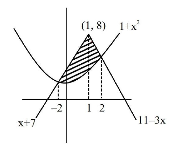
If the area of the region
$\left\{(x, y): 1+x^{2} \leq y \leq \min \{x+7,11-3 x\}\right\}$ is $A$, then 3 A is equal to
View full question & answer→MCQ 154 Marks
Let a random variable $X$ take values $0,1,2,3$ with $\mathrm{P}(\mathrm{X}=0)=\mathrm{P}(\mathrm{X}=1)=\mathrm{p}, \mathrm{P}(\mathrm{X}=2)=\mathrm{P}(\mathrm{X}=3)$ and $E\left(X^{2}\right)=2 E(X)$. Then the value of $8 p-1$ is :
AnswerB. 2
$2 \mathrm{p}+2 \mathrm{q}=\frac{1}{2}$
$p+q$
$E \left( x ^2\right)=\sum_{ i =0}^3 x _{ i }^2 p \left( x _{ i }\right)=0 \cdot p +1 \cdot p +4 \cdot q +9 q$
$E(x)=\sum_{i=0}^{3} x_{i}^{2} p\left(x_{i}\right)=0 . p+1 . p+2 q+3 q=p+5 q$
$p+13 q=2(p+5 q)$
$p=3 q$
So, $q=\frac{1}{8} \& p=\frac{3}{8}$
So, $8 \mathrm{p}-1=2 $
View full question & answer→MCQ 164 Marks
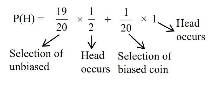
A bag contains 19 unbiased coins and one coin with head on both sides. One coin drawn at random is tossed and head turns up. If the probability that the drawn coin was unbiased, is $\frac{\mathrm{m}}{\mathrm{n}}, \operatorname{gcd}(\mathrm{m}, \mathrm{n})=1$, then $n^{2}-m^{2}$ is equal to :
View full question & answer→MCQ 174 Marks
If the range of the function $f(x)=\frac{5-x}{x^{2}-3 x+2}$, $x \neq 1,2$, is $(-\infty, \alpha] \cup[\beta, \infty)$, then $\alpha^{2}+\beta^{2}$ is equal to :
AnswerD. 194
$y=\frac{5-x}{x^{2}-3 x+2}$
$\mathrm{yx}^{2}-3 \mathrm{xy}+2 \mathrm{y}+\mathrm{x}-5=0$
$y z^{2}+(-3 y+1) x+(2 y-5)=0$
Case I : If $\mathrm{y}=0$ (Accepted)
\begin{equation*}
\Rightarrow x=5
\end{equation*}
Case II : If $y \neq 0$
\begin{equation*}
\mathrm{D} \geq 0
\end{equation*}
$(-3 y+1)^{2}-4(y)(2 y-5) \geq 0$
$9 y^{2}+1-6 y-8 y^{2}+20 y \geq 0$
$y^{2}+14 y+1 \geq 0$
$(y+7)^{2}-48 \geq 0$
$|y+7| \geq 4 \sqrt{3}$
$\Rightarrow y+7 \geq 4 \sqrt{3}$ or $y+7 \leq-4 \sqrt{3}$
$\Rightarrow \mathrm{y} \geq 4 \sqrt{3}-7$ or $\mathrm{y} \leq-4 \sqrt{3}-7$
From Case I and Case II
$\mathrm{y} \in(-\infty,-4 \sqrt{3}-7] \cup[4 \sqrt{3}-7, \infty)$
So $\alpha=-4 \sqrt{3}-7$
\begin{equation*}
\begin{aligned}
\beta= & 4 \sqrt{3}-7 \\
\Rightarrow \mathrm{a}^{2}+\mathrm{b}^{2} & =(-4 \sqrt{3}-7)^{2}+(4 \sqrt{3}-7)^{2} \\
& =2(48+49) \\
= & 194
\end{aligned}
\end{equation*}
View full question & answer→MCQ 184 Marks
Let
$A=\{(\alpha, \beta) \in \mathbf{R} \times \mathbf{R}:|\alpha-1| \leq 4$ and $|\beta-5| \leq 6\}$
and
$B=\left\{(\alpha, \beta) \in \mathbf{R} \times \mathbf{R}: 16(\alpha-2)^{2}+9(\beta-6)^{2} \leq 144\right\}$.
Then
- A
$\mathrm{B} \subset \mathrm{A}$
- B
$\mathrm{A} \cup \mathrm{B}=\{(\mathrm{x}, \mathrm{y}):-4 \leq \mathrm{x} \leq 4,-1 \leq \mathrm{y} \leq 11\}$
- C
neither $\mathrm{A} \subset \mathrm{B}$ nor $\mathrm{B} \subset \mathrm{A}$
- D
$\mathrm{A} \subset \mathrm{B}$
AnswerA. $\mathrm{B} \subset \mathrm{A}$
A : $|x-1| \leq 4$ and $|y-5| \leq 6$
$\Rightarrow-4 \leq \mathrm{x}-1 \leq 4 \Rightarrow-6 \leq y-5 \leq 6$
$\Rightarrow-3 \leq \mathrm{x} \leq 5 \quad \Rightarrow-1 \leq \mathrm{y} \leq 11$
B : $16(x-2)^{2}+9(y-6)^{2} \leq 144$
B : $\frac{(x-2)^{2}}{9}+\frac{(y-6)^{2}}{16} \leq 1$
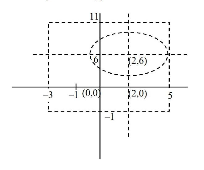
From Diagram $\mathrm{B} \subset \mathrm{A}$ View full question & answer→MCQ 194 Marks
Let $\vec{a}$ and $\vec{b}$ be the vectors of the same magnitude such that $\frac{|\vec{a}+\vec{b}|+|\vec{a}-\vec{b}|}{|\vec{a}+\vec{b}|-|\vec{a}-\vec{b}|}=\sqrt{2}+1$. Then $\frac{|\vec{a}+\vec{b}|^{2}}{|\vec{a}|^{2}}$ is :
- A
$2+4 \sqrt{2}$
- B
$1+\sqrt{2}$
- C
$2+\sqrt{2}$
- D
$4+2 \sqrt{2}$
AnswerC. $2+\sqrt{2}$
Sol. $\frac{|\overline{\mathrm{a}}+\overline{\mathrm{b}}|+|\overline{\mathrm{a}}-\overline{\mathrm{b}}|}{|\overline{\mathrm{a}}+\overline{\mathrm{b}}|-|\overline{\mathrm{a}}-\overline{\mathrm{b}}|}=\sqrt{2}+1$
Apply componendo and dividendo
$\Rightarrow \frac{2|\overline{\mathrm{a}}+\overline{\mathrm{b}}|}{2|\overline{\mathrm{a}}-\overline{\mathrm{b}}|}=\frac{\sqrt{2}+2}{\sqrt{2}}$
$\Rightarrow|\overline{\mathrm{a}}+\overline{\mathrm{b}}|=(1+\sqrt{2})|\overline{\mathrm{a}}-\overline{\mathrm{b}}|$
$\Rightarrow|\overline{\mathrm{a}}+\overline{\mathrm{b}}|^{2}=(3+2 \sqrt{2})|\overline{\mathrm{a}}-\overline{\mathrm{b}}|^{2}$
$\Rightarrow 2|\overline{\mathrm{a}}|^{2}+2 \overline{\mathrm{a}} \cdot \overline{\mathrm{b}}=(3+2 \sqrt{2})\left(2|\overline{\mathrm{a}}|^{2}-2 \overline{\mathrm{a}} \cdot \overline{\mathrm{b}}\right)$
$\Rightarrow 2|\overline{\mathrm{a}}|^{2}(2+2 \sqrt{2})=2 \overline{\mathrm{a}} \cdot \overline{\mathrm{b}}(4+2 \sqrt{2})$
$\Rightarrow \frac{\overline{\mathrm{a}} \cdot \overline{\mathrm{b}}}{|\overline{\mathrm{a}}|^{2}}=\frac{2+2 \sqrt{2}}{4+2 \sqrt{2}}=\frac{1}{\sqrt{2}}$
Now
$\frac{|\overline{\mathrm{a}}+\overline{\mathrm{b}}|^{2}}{|\overline{\mathrm{a}}|^{2}}=1+\frac{|\overline{\mathrm{b}}|^{2}}{|\overline{\mathrm{a}}|^{2}}+\frac{2 \overline{\mathrm{a}} \cdot \overline{\mathrm{b}}}{|\overline{\mathrm{a}}|^{2}}$
$=1+1+2\left(\frac{1}{\sqrt{2}}\right)=2+\sqrt{2}$
View full question & answer→MCQ 204 Marks
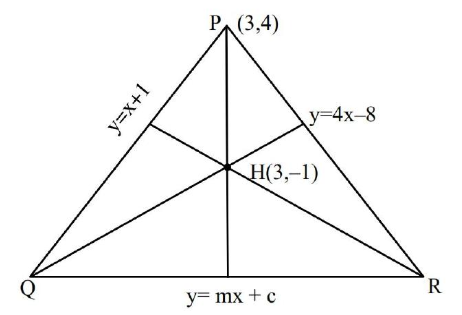
If the orthocentre of the triangle formed by the lines $\mathrm{y}=\mathrm{x}+1, \mathrm{y}=4 \mathrm{x}-8$ and $\mathrm{y}=\mathrm{mx}+\mathrm{c}$ is at $(3,-1)$, then $\mathrm{m}-\mathrm{c}$ is :
View full question & answer→