Questions

SECTION - B [CHEMISTY - NUMERIC]

Take a timed test

5 questions · self-marked practice — reveal the answer and mark yourself.

Question 24 Marks
The number of paramagnetic metal complex species among $\left[\mathrm{Co}\left(\mathrm{NH}_{3}\right)_{6}\right]^{3+}, \quad\left[\mathrm{Co}\left(\mathrm{C}_{2} \mathrm{O}_{4}\right)_{3}\right]^{3-}$, $\left[\mathrm{MnCl}_{6}\right]^{3-},\left[\mathrm{Mn}(\mathrm{CN})_{6}\right]^{3-},\left[\mathrm{CoF}_{6}\right]^{3-},\left[\mathrm{Fe}(\mathrm{CN})_{6}\right]^{3^{--}}$and $\left[\mathrm{FeF}_{6}\right]^{3-}$ with same number of unpaired electrons is__________ .
Answer
2
$\left[\mathrm{Co}\left(\mathrm{NH}_{3}\right)_{6}\right]^{3+} \mathrm{Co}^{3+} \quad 3 \mathrm{~d}^{6} \quad \mathrm{t}_{2 \mathrm{~g}}^{2,2,2} \quad \mathrm{e}_{\mathrm{g}}^{0,0}$
Diamagnetic (unpaired electron $=0$ )
$\left[\begin{array}{llll}\left.\mathrm{Co}\left(\mathrm{C}_{2} \mathrm{O}_{4}\right)_{3}\right]^{3-} \mathrm{Co}^{3+} & 3 \mathrm{~d}^{6} & \mathrm{t}_{2 \mathrm{~g}}^{2,2,2} & \mathrm{e}_{\mathrm{g}}^{0,0}\end{array}\right.$
Diamagnetic (unpaired electron $=0$ )
$\left[\begin{array}{lllll}\mathrm{MnCl}_{6}\end{array}\right]^{3-} \quad \mathrm{Mn}^{3+} \quad 3 \mathrm{~d}^{4} \quad \mathrm{t}_{2 \mathrm{~g}}^{1,1,1} \quad \mathrm{e}_{\mathrm{g}}^{1,0}$
Paramagnetic (unpaired electron $=4$ )
$\left[\begin{array}{lllll}\left.\mathrm{Mn}(\mathrm{CN})_{6}\right]^{3-} & \mathrm{Mn}^{3+} & 3 \mathrm{~d}^{4} & \mathrm{t}_{2 \mathrm{~g}}^{2,1,1} & \mathrm{e}_{\mathrm{g}}^{0,0}\end{array}\right.$
Paramagnetic (unpaired electron $=2$ )
$\left[\begin{array}{lllll}\left.\mathrm{CoF}_{6}\right]^{3-} & \mathrm{Co}^{3+} & 3 \mathrm{~d}^{6} & \mathrm{t}_{2 \mathrm{~g}}^{2,1,1} & \mathrm{e}_{\mathrm{g}}^{1,1}\end{array}\right.$
Paramagnetic (unpaired electron $=4$ )
$\left[\begin{array}{lllll}\left.\mathrm{Fe}(\mathrm{CN})_{6}\right]^{3-} & \mathrm{Fe}^{3+} & 3 \mathrm{~d}^{5} & \mathrm{t}_{2 \mathrm{~g}}^{2,2,1} & \mathrm{e}_{\mathrm{g}}^{0,0}\end{array}\right.$
Paramagnetic (unpaired electron $=1$ )
$\left[\begin{array}{lllll}\mathrm{FeF}_{6}\end{array}\right]^{3-} \quad \mathrm{Fe}^{3+} \quad 3 \mathrm{~d}^{5} \quad \mathrm{t}_{2 \mathrm{~g}}^{1,1,1} \quad \mathrm{e}_{\mathrm{g}}^{1,1}$
Paramagnetic (unpaired electron $=5$ )
View full question & answer
Question 34 Marks
Butane reacts with oxygen to produce carbon dioxide and water following the equation given below
$\mathrm{C}_{4} \mathrm{H}_{10}(\mathrm{~g})+\frac{13}{2} \mathrm{O}_{2}(\mathrm{~g}) \rightarrow 4 \mathrm{CO}_{2}(\mathrm{~g})+5 \mathrm{H}_{2} \mathrm{O}(\mathrm{l})$
If 174.0 kg of butane is mixed with 320.0 kg of $\mathrm{O}_{2}$, the volume of water formed in litres is __________.(Nearest integer)
[Given : (a) Molar mass of $\mathrm{C}, \mathrm{H}, \mathrm{O}$ are 12, 1, $16 \mathrm{~g} \mathrm{~mol}^{-1}$ respectively, (b) Density of water $\left.=1 \mathrm{~g} \mathrm{~mL}^{-1}\right]$
Answer
138
$\mathrm{C}_{4} \mathrm{H}_{10}+\frac{13}{2} \mathrm{O}_{2} \rightarrow 4 \mathrm{CO}_{2}+5 \mathrm{H}_{2} \mathrm{O}$
$3 \times 10^{3} \quad 10 \times 10^{3}$
Moles of $\mathrm{H}_{2} \mathrm{O}$ formed $=\mathrm{n}_{\mathrm{H}_{2} \mathrm{O}}=5 \times \frac{2}{13} \times 10 \times 10^{3}$
Then $\mathrm{w}_{\mathrm{H}_{2} \mathrm{O}}=\frac{10^{5}}{13} \times 18$
$=1.3846 \times 10^5 g$
Volume of $\mathrm{H}_{2} \mathrm{O}$ will be $=138.46$ litre.
Ans. 138
View full question & answer
Question 44 Marks
In Dumas' method 292 mg of an organic compound released 50 mL of nitrogen gas $\left(\mathrm{N}_{2}\right)$ at 300 K temperature and 715 mm Hg pressure. The percentage composition of ' N ' in the organic compound is __________ % (Nearest integer)
(Aqueous tension at $300 \mathrm{~K}=15 \mathrm{~mm} \mathrm{Hg}$ )
Answer
18
Organic compound $\xrightarrow{\text { DUMA'S }} \mathrm{N}_{2}$ 292 mg
$\begin{array}{c} V =50 ml \\ P =715 mm Hg \\ T =300 k \\ \text { Aq. tension }=15 mm Hg \\ P _{ N _2}=715-15=700 mmHg \\ P _{ N _2}=\frac{700}{760} atm\end{array}$
$\mathrm{n}_{\mathrm{N}_{2}}=\frac{\mathrm{P}_{\mathrm{N}_{2}} \cdot \mathrm{~V}}{\mathrm{RT}}$
$\mathrm{n}_{\mathrm{N}_{2}}=\frac{700}{760} \times \frac{50}{1000} \times \frac{1}{0.0821 \times 300}$
$\mathrm{n}_{\mathrm{N}}=2 \times \mathrm{n}_{\mathrm{N}_{2}}$
Mass of $\mathrm{N}=2 \times \mathrm{n}_{\mathrm{N}} \times 14$
$\% \mathrm{~N}=\frac{\text { mass of } \mathrm{N}}{\text { mass of organic compound }} \times 100$
$\% \mathrm{~N}=\frac{700}{760} \times \frac{50}{1000} \times \frac{2 \times 14}{0.0821 \times 300} \times \frac{1000}{292} \times 100$
$\% \mathrm{~N}=18 \%$
View full question & answer
Question 54 Marks
Only litre buffer solution was prepared by adding 0.10 mol each of $\mathrm{NH}_{3}$ and $\mathrm{NH}_{4} \mathrm{Cl}$ in deionised water. The change in pH on addition of 0.05 mol of HCl to the above solution is __________ $\times 10^{-2}$, (Nearest integer)
(Given : $\mathrm{pK}_{\mathrm{b}}$ of $\mathrm{NH}_{3}=4.745$ and $\log _{10} 3=0.477$ )
Answer
48
$\mathrm{pOH}=\mathrm{pK}_{\mathrm{b}}+\log \frac{\left[\mathrm{NH}_{4}^{+}\right]}{\left[\mathrm{NH}_{3}\right]}$
$\mathbf{p O H}=4.745$
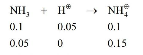
on adding 0.05 mole HCl
Image
pOH' $=4.745+\log 3$
$\mathrm{pOH}^{\prime}-\mathrm{pOH}=0.477$
$14-\mathrm{pH}^{\prime}-14+\mathrm{pH}=0.477$
$\Delta \mathrm{pH}=0.477$
$=47.7 \times 10^{-2} \approx 48 \times 10^{-2}$
View full question & answer