Question 14 Marks
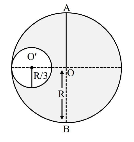
$M$ and $R$ be the mass and radius of a disc. A small disc of radius $R / 3$ is removed from the bigger disc as shown in figure. The moment of inertia of remaining part of bigger disc about an axis $A B$ passing through the centre O and perpendicular to the plane of disc is $\frac{4}{x} M^{2}$. The value of $x$ is __________ .
Answer
View full question & answer→9
Without cavity $\mathrm{I}_{1}=\frac{\mathrm{MR}^{2}}{2}$
Mass of removed disc $=\frac{\mathrm{M}}{\pi \mathrm{R}^{2}} \times\left(\frac{\mathrm{R}}{3}\right)^{2} \pi$
$=\left(\frac{\mathrm{M}}{9}\right)$
M.I. of removed disc $I_{2}=\frac{\frac{M}{9}\left(\frac{R}{3}\right)^{2}}{2}+\frac{M}{9} \times\left(\frac{2 R}{3}\right)^{2}$
\begin{equation*}
=\frac{\mathrm{MR}^{2}}{18}
\end{equation*}
$\mathrm{I}=\mathrm{I}_{1}-\mathrm{I}_{2}=\frac{\mathrm{MR}^{2}}{2}-\frac{\mathrm{MR}^{2}}{18}=\frac{4 \mathrm{MR}^{2}}{9}$
$(\mathrm{n}=9)$
Without cavity $\mathrm{I}_{1}=\frac{\mathrm{MR}^{2}}{2}$
Mass of removed disc $=\frac{\mathrm{M}}{\pi \mathrm{R}^{2}} \times\left(\frac{\mathrm{R}}{3}\right)^{2} \pi$
$=\left(\frac{\mathrm{M}}{9}\right)$
M.I. of removed disc $I_{2}=\frac{\frac{M}{9}\left(\frac{R}{3}\right)^{2}}{2}+\frac{M}{9} \times\left(\frac{2 R}{3}\right)^{2}$
\begin{equation*}
=\frac{\mathrm{MR}^{2}}{18}
\end{equation*}
$\mathrm{I}=\mathrm{I}_{1}-\mathrm{I}_{2}=\frac{\mathrm{MR}^{2}}{2}-\frac{\mathrm{MR}^{2}}{18}=\frac{4 \mathrm{MR}^{2}}{9}$
$(\mathrm{n}=9)$