MCQ 11 Mark
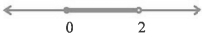
The solution set of $x<5$ and $x \geq 2$ is...
- A$(2,5)$
- ✓$[2,5)$
- C$(2,5]$
- D$[2,5]$
Answer
View full question & answer→Correct option: B.
$[2,5)$
b
46 questions · auto-graded multiple-choice test.
$x^3+y^3=65$
Let $x,y > 0$
Clearly, $(1,4)$ and $(4,1)$ holds for $x$ or $y \geq 6$ difference of two cubes is always
greater than or equal to $91$ . Hence, only $2$ ordered pair possible.
For positive integers ' $a$ ' and ' $b$ ' the numbers $\frac{2 a-1}{b}$ and $\frac{2 b-1}{a}$ are integers if ' $a$ ' and ' $b$ ' and odd integers because ' $2 a-1$ ' and ' $2 b-1$ ' are odd integers.
Now, let $\frac{2 a-1}{b}=\alpha$ and $\frac{2 b-1}{a}=\beta$, where $\alpha, \beta$ are integers. then $2 a-1=\alpha b$ and $2 b-1=\beta a$ so $4 a-2=\alpha(\beta a+1)$
$a=\frac{\alpha+2}{4-\alpha \beta}$
$\because a$ is an integer, then $0<\alpha \beta<4$
$\therefore$ Possible value of $\alpha=1,2$ or 3 and $\beta=1,2$ or $3$
such that $0<\alpha \beta<4$
Now, when $(\alpha, \beta)=(1,1)$, then $(a, b)=(1,1)$
When $(\alpha, \beta)=(1,2)$, then $(a, b)$ have no value
When $(\alpha, \beta)=(1,3)$, then $(a, b)=(3,5)$ and similarly when $(\alpha, \beta)=(3,1)$, then $(a, b)=(5,3)$
So, number of ordered pairs $(a, b)$ is $3 .$
We have,
$a^4+b^4 < 1$ and $a^2+b^2 > 1$
The graph of $x^2+y^2=1$ and $x^4+y^4=1$ are
Clearly from graph.
There are many positive real number $(a, b)$ satisfying $a^4+b^4 < 1$ and $a^2+b^2 > 1$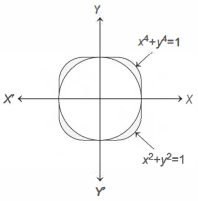
Given,
$a + b < c + d \ldots \text { (i) }$
$b + c < d + e \ldots \text { (ii) }$
$c + d < e + a \ldots \text { (iii) }$
$d + e < a + b \ldots \text { (iv) }$
From Eqs.$(i)$ and $(iii)$, we get
$a + b + c + d < c + d + e + a$
$b < e$
From Eqs.$(ii)$ and $(iv)$, we get
$b + c + d + e$ $ < d + c < a + b$
$c < a$
$\text { From Eqs. (i) and (iv), we get }$
$a + b + d + e$ $< c + d + a + b$
$e < c$
From Eqs. $(v), (vi), (vii)$, we get
$a > c > e > b$
$\therefore$ Largest value is $a$ and smallest value is $b$.
We have,
$S=\frac{a^2+b^2+c^2}{a b+b c+c a}$
We know that,
$(a-b)^2+(b-c)^2+(c-a)^2 \geq 0$
$a^2+b^2+c^2-(a b+b c+c a) \geq 0$
$a^2+b^2+c^2 \geq a b+b c+c a$
$\frac{a^2+b^2+c^2}{a b+b c+c a} \geq 1 \quad[\because a b+b c+c a>0]$
$S \geq 1$
We know that,
$(a+b+c)^2 \geq 0$
$\therefore a^2+b^2+c^2+2(a b+b c+c a) \geq 0$
$a b+b c+c a < 0$
$\frac{a^2+b^2+c^2+2(a b+b c+c a)}{a b+b c+c a}<0$
$\frac{a^2+b^2+c^2}{a b+b c+c a}+2 \leq 0$
$\quad \frac{a^2+b^2+c^2}{a b+b c+c a} \leq-2$
$\therefore \quad S \in(-\infty,-2] \cup[1, \infty)$
We have,
$\sqrt[3]{n+1}-\sqrt[3]{n} < \frac{1}{12}$
$\sqrt[3]{n+1} < \sqrt[3]{n}+\frac{1}{12}$
Cubing both sides, we get
$n+1 < n+3(n)^{23} \times \frac{1}{12}+3 \sqrt[3]{n} \times \frac{1}{144}+\frac{1}{1728}$
$\Rightarrow \quad 1 < \frac{3 n^{1 / 3}}{}-\left(n^{1 / 3}+\frac{1}{12}\right)+\frac{1}{1728}$
$\Rightarrow \quad n^{1 / 3}\left(n^{1 / 3}+\frac{1}{12}\right) > 1-\frac{1}{1728}$
$\Rightarrow \quad n^{1 / 3}\left(n^{1 / 3}+\frac{1}{12}\right) > \frac{1727}{432}$
Put $n=8$ only possible least positive integers.
(a) $[x+y] \leq[x]+[y]$
Let $\quad x=0.6, y=0.5$
$[0.6+0.5] \leq[0.6]+[0.5]$
$1 \leq 0+0 \quad$ False
(b) $\quad[x y] \leq[x] \mid y]$
Let $\quad x=15, y=16$
[(15) (16)] $\leq$ [15] [16]
$2 \leq 1 \times 1$ False
(c) $\left[2^x\right] \leq 2^{[x]}$
Let $\quad x=\frac{5}{2}$
$\left[2^{5 / 2}\right] \leq 2^{[5 / 2]}$
$[4 \sqrt{2}] \leq 2^2$
$5 \leq 4 False$
(d) $\quad\left[\frac{x}{y}\right] \leq \frac{[x]}{[y]}$
Let $\quad x, y \geq 1$
If $x < y$, then $\left[\frac{x}{y}\right]=0 \Rightarrow 0 \leq \frac{\lfloor x\rfloor}{\lfloor y\rfloor}$ True If $x \geq y$, then $\left[\frac{x}{y}\right] \leq \frac{[x]}{[y]}$ always true Hence, option (d) is correct.
Let total seats $=x$
Ticket price of each seat $=200\,Rupees$
On first day $60 \%$ of seats over filled
$\because$ Total revenue $=\frac{60}{100} x \times 200=120 x$
On second day
Ticket price $=200-20 \%$ of $200=160$
Total seat filled on 2nd day
$=\frac{60}{100} x+\frac{50}{100} \times \frac{60 x}{100}=\frac{90 x}{100}$
Total revenue on $2^{nd}$ day
$=\frac{90 x}{100} \times 160=144 x$
Percentage increase in revenue on $2^{nd}$ day
$=\left(\frac{144 x-120 x}{120 x}\right) \times 100$
$=\frac{24}{120} \times 100=20 \%$
$\log _2 \log _2 \log _2 \log _2 \log _2(n)<0<\log _2 \log _2 \log _2 \log _2(n)$. Let $l$ be the number of digits in the binary expansion of $n$. Then the minimum and the maximum possible values of $l$ are
We have,
$\log _2 \log _2 \log _2 \log _2 \log _2(n) < 0$
$ < \log _2 \log _2 \log _2 \log _2(n)$
$\begin{aligned} \log _2 \log _2 \log _2 \log _2 \log _2(n) < 0 \\ \log _2 \log _2 \log _2 \log _2(n) < 2^6 \\ \log _2 \log _2 \log _2 \log _2(n) < 1 \\ \log _2 \log _2 \log _2(n) < 2 \\ \log _2 \log _2(n) < 2^2 \\ \log _2(n) < 2^4 \\ n < 2^{16} \end{aligned}$
Similarly, for
$\log _2 \log _2 \log _2 \log _2(n) > 0 \Rightarrow n > 2^4$
Hence, $\quad 2^4 < n < 2^{16}$
$\therefore$ The minimum number of digits in binary expansion of $n$ is $5$ and maximum numbers of digits in binary expansion of $n$ is $16 .$
We have,
$\Rightarrow \sqrt{n+1}-\sqrt{n-1} < 0.2 n \in N$
$\sqrt{n+1} < 0.2+\sqrt{n-1}$
On squaring both side, we get
$n+1 < 0.04+n-1+0.4 \sqrt{n-1}$
$\Rightarrow n+1-n+1-0.04 < 0.4 \sqrt{n-1}$
$\Rightarrow \frac{2-0.04}{0.4} < \sqrt{n-1}$
$\Rightarrow 49 < \sqrt{n-1}$
$\Rightarrow n-1 > (49)^2$
$\Rightarrow n > 1+2401$
$\Rightarrow n > 25.01$
$\therefore \text { Minimum value of } n=26$
Let the side of square base of pyramid is $x m$ and height of pyramid is $y\,m$
Volume of pyramid $=\frac{1}{3}$ area of base $\times$ height $=\frac{1}{3} x^2 y$
When $x$ is increased by $p \%$ then new length $=x+p \%$ of $x=\left(\frac{100+p}{100}\right) x$
When $y$ is decreased by $p \%$, then new height
$=y-p \% \text { of } y=\left(\frac{100-p}{100}\right) y$
Now, volume is same.
$\therefore \frac{1}{3} x^2 y=\frac{1}{3}\left(\frac{100+p}{100} x\right)^2\left(\frac{100-p}{100}\right) y$
$\Rightarrow \quad 1=\left(\frac{100+p}{100}\right)^2\left(\frac{100-p}{100}\right)$
$\Rightarrow(100)^2(100)=\left(10000+200 p+p^2\right)(100-p)$
$\Rightarrow p^2+100 p-100^2=0$
$\Rightarrow p^2+100 p+(50)^2=(100)^2+(50)^2$
$\Rightarrow \quad(p+50)^2=12500$
$\Rightarrow \quad p+50=\sqrt{12500}=11180$
$\Rightarrow \quad p=11180-50$
$\Rightarrow \quad p=6180$
$60 < p < 65$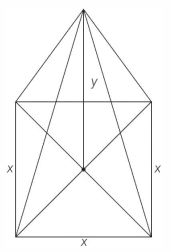
- stir the liquid in $J_1$ and transfer $10\,ml$ from $J_1$ into $J_2$
- stir the liquid in $J_2$ and transfer $10\, ml$ from $J_2$ into $J_3$
- stir the liquid in $J_3$ and transfer $10 \,ml$ from $J_3$ into $J_1$.
After performing the operation four times, let $x, y, z$ be the amounts of $X, Y, Z$ respectively, in $J_1$. Then,
We have, three kind of liquids $x, y, z$ and three jars $J_1, J_2, J_3$ contains $100 ml$ of liquids $X, Y, Z$ respectively.
When $10\,ml$ of $J_1$ transfer to $J_2$ $\therefore J_1=90 ml$ of $X, J_2=100\,ml$ of $Y$ and $10\,ml$ of $X$.
When $10\,ml$ of $J_2$ transfer to $J_3$ $J_2=\frac{1000}{11}$ of $Y$ and $\frac{100}{11}$ of $X, J_3=100\,ml$ of $Z_1, \frac{100}{11}$ of $Y$ and $\frac{10}{11}$ of $X$
When $10\,ml$ of $J_3$ transfer to $J_1$ $J_3=\frac{1100}{11}$ of $Z_1, \frac{1100}{11}$ of $Y_1, \frac{110}{11}$ of $X$ and $J_1=90+10 \times\left(\frac{1}{11}\right)^2$ of $X_1, \frac{100}{121}$ of $Y$ and $\frac{100}{11}$ of $Z$
Similarly, we can find four operation of amount of $X, Y, Z$ in $J_1$
We get $x > z > y$
We have,
$\sqrt{x+5} > 1$
$1-x \sqrt{x+5} > 0,1-x > 0$
$x > -5 \ldots \text { (i) }$
$x < 1 \ldots \text { (ii) }$
[squaring both sides]
$\Rightarrow \quad x+5 > 1+x^2-2 x$
$\Rightarrow \quad x^2-3 x-4 < 0$
$\Rightarrow \quad(x-4)(x+1) < 0$
$\Rightarrow \quad x \in(-1,4) \quad...(iii)$
From Eqs.$(i), (ii)$ and $(iii)$,we get
$x \in(-1,1)$
$\therefore \quad-1 < x < 1$
W e have three sides of quadrilateral are $5,10,20$.
Let the fourth sides of quadrilateral $=x$
We know that in quadrilateral. Sum of three side is greater than fourth sides
$\therefore \quad 5+10+20 > x \ldots \text { (i) }$
$\therefore \quad5+10+x > 20 \ldots \text { (ii) }$
$\therefore \quad5+20+x > 10 \ldots \text { (iii) }$
$\therefore \quad10+20+x > 5 \ldots \text { (iv) }$
From Eq. $(i)$ $x < 35$
From Eq. $(ii)$ $x > 5$
From Eq. $(iii)$ $x > -15$
From Eq. $(iv)$ $x > -25$
Now, $x$ is a positive integer.
$\therefore$ From Eqs. $(i), (ii), (iii)$ and $(iv)$,
$5 < x < 35$
$\therefore$ Value of $x$ is $6,7,8,9,10,11,12,13,14$,
$15,16,17,18,19,20,21,22,23,24,25$,
$26,27,28,29,30,31,32,33,34$
$\therefore$ There are $29$ possible values of $x$
$ \mathrm{L}_1=3 \mathrm{x}-\mathrm{y}+1=0$
Origin and $P$ lies same side w.r.t. $L_1$
$ \Rightarrow L_1(0) \cdot L_1(P)>0 $
$\therefore 3\left(a^2\right)-(a+1)+1>0$
$ \Rightarrow 3 a^2-a>0 $
$ a \in(-\infty, 0) \cup\left(\frac{1}{3}, \infty\right)$ .$........(i)$
Let $L_2: x+2 y-5=0$
Origin and $\mathrm{P}$ lies same side w.r.t. $\mathrm{L}_2$
$\Rightarrow \mathrm{L}_2(0) \cdot \mathrm{L}_2(\mathrm{P})>0$
$ \Rightarrow \mathrm{a}^2+2(\mathrm{a}+1)-5<0 $
$\Rightarrow \mathrm{a}^2+2 \mathrm{a}-3<0 $
$ \Rightarrow(\mathrm{a}+3)(\mathrm{a}-1)<0 $
$ \therefore \mathrm{a} \in(-3,1)$ $............(ii)$
Intersection of $(1)$ and $(2)$
$a \in(-3,0) \cup\left(\frac{1}{3}, 1\right)$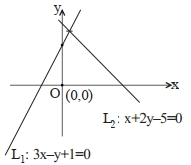
$B=\left\{x \in R : 3^x\left(\sum_{x=1}^{\infty} \frac{3}{10^x}\right)^{x-3} < 3^{-3 x}\right\}$, where $[t]$denotes greatest integer function. Then,
$2[x] \leq-4$
${[x] \leq-2 \Rightarrow x \in(-\infty,-1) .}$
$3^x\left(\frac{3 \cdot \frac{1}{10}}{1-\frac{1}{10}}\right)^{x-3} < 3^{-3 x}$
$27 < 3^{-3 x}$
$-3 x > +3$
$x < -1 \quad \ldots \ldots \ldots \ldots \ldots . .(B)$
$A=B$