Questions

(Each question 1 marks)

Take a timed test

10 questions · self-marked practice — reveal the answer and mark yourself.

Question 11 Mark
Write the coordinates of the in-centre of the triangle with vertices at (0, 0), (5, 0) and (0, 12).
Answer
Let the given vertices of the triangle are $\text{A}=(\text{x}_1,\ \text{y}_1)=(0,\ 0)$ $\text{B}=(\text{x}_2,\ \text{y}_2)=(5,\ 0)$ And $\text{C}=(\text{x}_3,\ \text{y}_3)=(0,\ 12)$ Now, $​​\text{a}=​​\text{BC}=\sqrt{(0-5)^2+(12-0)^2}$ $=\sqrt{25+144}$ $=\sqrt{169}$ $=13$ $​​\text{b}=​​\text{AB}=\sqrt{(5-0)^2+(0-0)^2}$ $=5$ The coordinates of the in-centre of the triangle ABC are $\Big(\frac{\text{ax}_1+\text{bx}_2+\text{cx}_3}{\text{a+b+c}},\ \frac{\text{ay}_1+\text{by}_2+\text{cy}3}{\text{a+b+c}}\Big)$ or $\Big(\frac{13\times0+12\times5+5\times0}{13+12+5},\ \frac{13\times0+12\times0+5\times12}{13+12+15}\Big)$ or $\Big(\frac{60}{30},\ \frac{60}{30}\Big)$ or $(2,\ 2)$ Hence, the coordinates of the in centre are (2, 2).
View full question & answer
Question 21 Mark
If the points (1, -1), (2, -1) and (4, -3) are the mid-points of the sides of a triangle, then write the coordinates of its centroid.
Answer
Let $\text{p}(1_1-1),\ \text{Q}(2_1-1)\ \text{R}(4_1-3)$ be the mid-points of sides AB, BC and CA respectively of triangle ABC. Let $\text{A}(\text{x}_1,\ \text{y}_1),\ \text{B}(\text{x}_2,\ \text{y}_2)$ and $\text{C}(\text{x}_3,\ \text{y}_3)$ be the vertices P is the mid-point of AB $\therefore\frac{\text{x}_1+\text{x}_2}{2}=1,\ \frac{\text{y}+\text{y}_2}{2}=-1$ $\Rightarrow\text{x}_1+\text{x}_2=2$ and $\text{y}_1+\text{y}_2=-2\ ......(1)$ Q is the mid-point of BC $\therefore\frac{\text{x}_2+\text{x}_3}{2}=2,\ \frac{\text{y}_2+\text{y}_3}{2}=-1$ $\Rightarrow\text{x}_2+\text{x}_3=4$ and $\text{y}_2+\text{y}_3=-2\ ....... (2)$ R is the mid-point AC $\therefore\frac{\text{x}_1+\text{x}_3}{2}=4,\ \frac{\text{y}_1+\text{y}_3}{2}=-3$ $\Rightarrow​​\text{x}_1+\text{x}_2=8$ and $\text{y}_1+\text{y}_2+\text{y}_3=-6\ .......(3)$ Adding equations (i), (ii) and (iii), we get $\text{x}_1+\text{x}_2+\text{x}_2+\text{x}_3+\text{x}_1+\text{x}_3=2+4+8$ and, $\text{y}_1+\text{y}_2+\text{y}_2+\text{y}_3+\text{y}_1+\text{y}_3=-2-2-6$ $\Rightarrow2(\text{x}_1+\text{x}_2+\text{x}_3)=14$ and, $2(\text{y}_1+\text{y}_2+\text{y}_3)=-10$ $\Rightarrow\text{x}_1+\text{x}_2+\text{x}_3=7$ and $\text{y}_1+\text{y}_2+\text{y}_3=-5$ $\therefore$ Coordinates of centroid are $\Big(\frac{\text{x}_1+\text{x}_2+\text{x}_3}{3},\ \frac{\text{y}_1+\text{y}_2+\text{y}_3}{3}\Big)$ i.e $\Big(\frac{7}{3},\ \frac{-5}{3}\Big).$
View full question & answer
Question 31 Mark
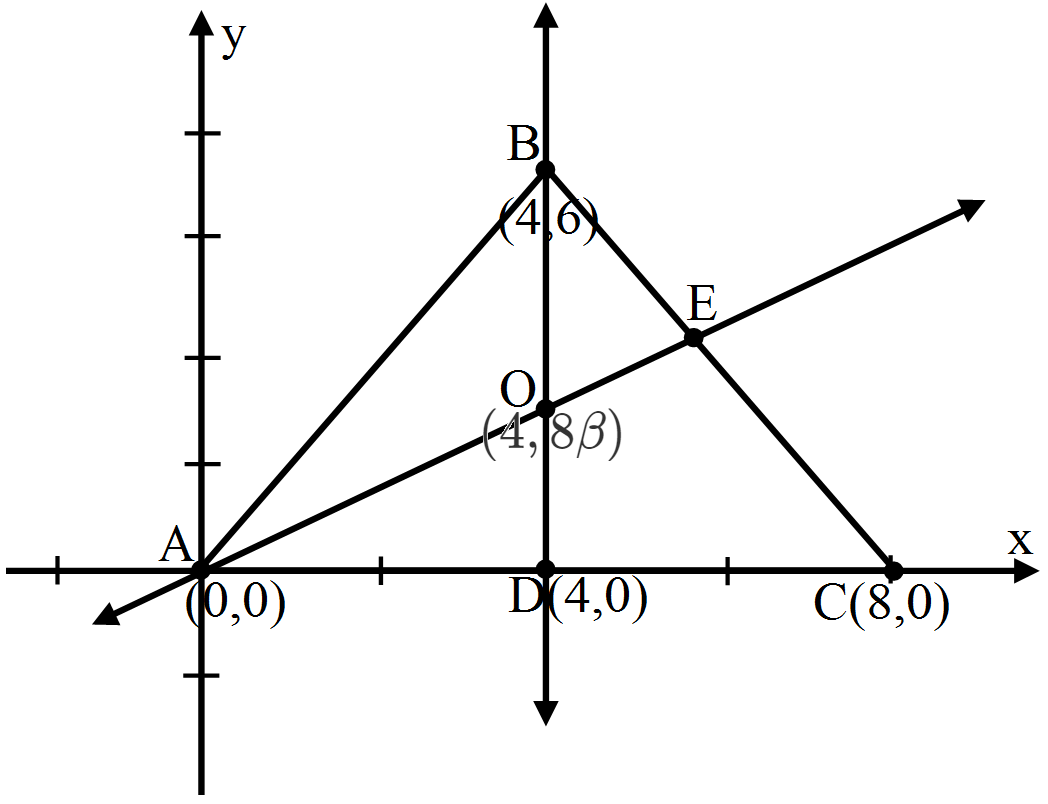
Write the coordinates of the orthocentre of the triangle formed by point(8, 0),(4, 6) and (0, 0).
Answer
Let us find the distance AB and BC
$\text{Since} \text{ AB}=\sqrt{4^2+6^2}=\sqrt{52}=2\sqrt{13}$
$\text{and}\text{ BC }=\sqrt{(8-4)^2+(6-0)^2}=\sqrt{4^2+6^2}=\sqrt{52}=2\sqrt{13}$
$\triangle \text{ABC}$ is an isosceles triangle with equal sides AB and BC.
The orthocentre of an isosceles tringle lies on the on the alitude from the vertex B to the base AC and it bisects AC.
Let D be the foot of the perpendicular from B to AC.
Thus, the coordinates if D are (4,0) since AC = 8.
Thus, equation of BD is x = 4..... (1)
Now let us find the equation of the side BC.
BC is the line joining the points B(4, 6) and C(8, 0)
Thus equation of BC is $\frac{\text{y}-\text{y}_2}{\text{y}_2-\text{y}_1}=\frac{\text{x}-\text{x}_2}{\text{x}_2-\text{x}_1}$
⇒ equation of BC is $\frac{\text{y}-0}{0-6}=\frac{\text{x}-8}{8-4}$
⇒ equation of BC is $\frac{\text{y}}{-6}=\frac{\text{x}-8}{-4}$
⇒ equation of BC is 4y = -6x + 48
⇒ equation of BC is $\text{y}=-\frac{3}{2}\times+12$
Now the slope of the perpendicular from the vertex A to the base BC is $\frac{1}{\big(-\frac{3}{2}\big)}=\frac{2}{3}$
Thus, the equation of the line AE, having slope $\frac{2}{3}$
and passing through the origin is $\text{y}=\frac{2}{2}\times....(2)$
Now let us find the intersection of the lines BD and AE.
Thus from equation (1) and (2), we have
$\text{y}=\frac{2}{2}\times4=\frac{8}{3}$
Thus the intersection point O, the orthocentre is having coordinates $\text{O}\big(4,\frac{8}{3}\big)$
View full question & answer
Question 41 Mark
Write the area of the triangle with vertices at (a, b + c), (b, c + a) and (c, a + b).
Answer
Let the given vertices of a triangle are $\text{A}=(\text{x}_1,\ \text{y}_1)=(9,\ \text{b}+\text{c})$ $\text{B}=(\text{x}_2,\ \text{y}_2)=(\text{b}​,\ \text{a}+\text{a})$ And $\text{C}=(\text{x}_3,\ \text{y}_3)=(\text{c}_1\text{a}+\text{b})$ we know th at, area of $\triangle=\frac{1}{2}|\text{x}_1(\text{y}_2-\text{y}_3)+\text{x}_2(\text{y}_3-\text{y}_1)+\text{x}_3(\text{y}_1-\text{y}_2)|$ $=\frac{1}{2}|\text{a}(\text{c}+\text{a}-\text{a}-\text{b})+\text{b}(\text{a}+\text{b}-\text{b}-\text{c})+\text{c}(\text{b}+\text{c}-\text{c}-\text{a})|$ $=\frac{1}{2}|\text{a}(\text{c}-\text{b})+\text{b}(\text{a}-\text{c})+\text{c}(\text{b}-\text{a})|$ $=\frac{1}{2}|\text{ac}-\text{ab}+\text{ba}-\text{bc}+\text{cb}-\text{ca}|$ $=0$ $\therefore$ area of $\triangle=0$
View full question & answer
Question 51 Mark
Write the coordinates of the circumcentre of a triangle whose centroid and orthocentre are at (3, 3) and (-3, 5), respectively.
Answer
We know that the orthocentre, centroid and the circumcentre of a triangle are collinear. Also we know that the distance between orthocentre and centroid is twice the distance between centroid and the circumcentre. Given that centroid of a triangle is G(3, 3), orthocentre is H(-3, 5) Let C(x, y) be the coordinates of the circumcentre of the triangle.
Hence using section formula, we have, $\frac{2\text{x}\times-3\times1}{2+1}=3$ and $\frac{2\times\text{y}+5\times1}{2+1}=3$ $\Rightarrow\frac{2\text{x}-3}{3}=3$ and $\frac{2\text{y}+5}{3}=3$ $\Rightarrow2\text{x}-3=9$ and $2\text{y}+5=9$ $\Rightarrow2\text{x}=9+3$ and $2\text{y}=9-5$ $\Rightarrow2\text{x}=12$ and $2\text{y}=4$ $\Rightarrow\text{x}=6$ and $\text{y}=2$ Thus, the circumc:entre of the triangle is C(6, 2)
View full question & answer
Question 61 Mark
There vertices of a parallelgoram, taen in order, are (-1, -6), (2, -5) and (7, 2).Write the coordinates of its fourth vertex.
Answer
It given that ABCD is parallelogram. Suppose O(x, y) is the mid-point of AC and BD. $\therefore \text{x}=\frac{-1+7}{2}\text{ and }\text{y}=\frac{-6+2}{2}$ $\Rightarrow \text{x}=3 \text{ and }\text{y}=-2$ Now, O is mid-point of BD. $\therefore3=\frac{\text{x}_1+2}{2}\text{ and }\text{y}=\frac{\text{y}_1-5}{2}$ $\Rightarrow 6=\text{x}_1+2\text{ and }-4\text{y}_1-5$ $\Rightarrow \text{x}_1=4\text{ and }\text{y}_1=1$ Hence, the coordinates of fourth verfex of the given parallelogram.
View full question & answer
Question 71 Mark
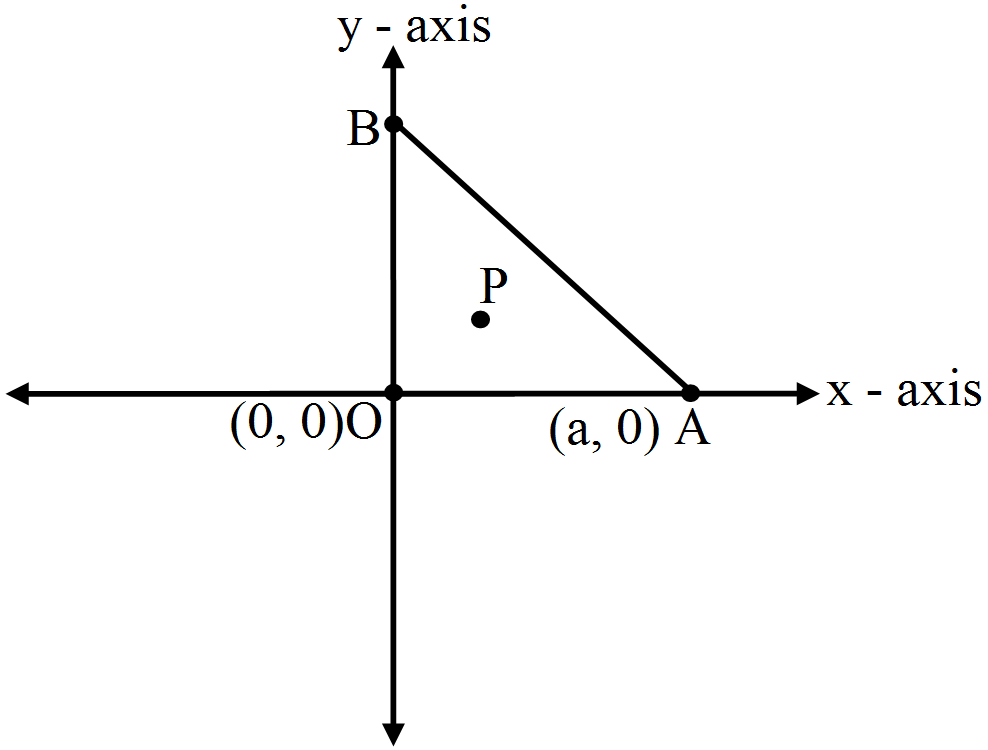
The vertices of a triangle are O(0, 0), A(a, 0) and B(0, b). Write the coordinates of its circumcentre.
Answer
Let $P(x, y)$ be the circumcentre of the given triangle, Then $P O^2=P A^2=P B^2$ Now, $P O^2=P A^2 \Rightarrow(x-0)^2+(y-0)^2=(x-$
$a)^2+(y-0)^2 \Rightarrow x^2+y^2=x^2+a^2-2 a x+y^2$
$\Rightarrow 2 a x=a^2 \Rightarrow x=\frac{a}{2} \text { and, } P O^2=P B^2 \Rightarrow(x-0)^2+(y-0)^2=(x-0)^2+(y-b)^2 \Rightarrow x^2+y^2=x^2+y^2+b^2-2 b y$
$\Rightarrow 2 b y=b^2$
$\Rightarrow y=\frac{b}{2} \text { Hence, coordinates of circumcentre are }\left(\frac{a}{2}, \frac{b}{2}\right)$
View full question & answer
Question 81 Mark
The vertices of a triangle are $O(0, 0), A(a, 0)$ and $B(0, b)$.Write the distance between the circumcenter and orthocentre of $\triangle \text{OAB}$ .
Answer


point of intersection of altitudes from vertices $A$ and $B$ of triangle is $O(0,0)$.
$\Rightarrow$ Orthocentre of triangle is $O(0,0)$
Let $P(x, y)$ be the cricumcentre of triangle
$\Rightarrow O P=A P=B P$
$O P^2=A P^2$
$x^2+y^2=(x-a)^2+y^2$
$\Rightarrow x^2+y^2=-2 a x+a^2$
$\Rightarrow a^2=2 a x$
$x=\frac{a}{2}$
And,
$O P^2=B P^2$
$x^2+y^2=(x-0)^2+(y-b)^2$
$x^2+y^2=x^2+y^2-2 b y+b^2$
$b^2=2 b y$
$\text{y}=\frac{\text{b}}{2}$
So, circuncentre $=\text{P}\Big(\frac{\text{a}}{2},\frac{\text{b}}{2}\Big)$
Distance etween orthocentre O(0, 0) and cricumcentre $\text{P}\Big(\frac{\text{a}}{2},\frac{\text{b}}{2}\Big)$ is $=\sqrt{\Big(\frac{\text{a}}{2}\Big)^2+\Big(\frac{\text{b}}{2}\Big)^2}$
Required distance $=\frac{1}{2}\sqrt{\text{a}^2+\text{b}^2}$ units.
View full question & answer
Question 91 Mark
If the point $(\text{a},0)(\text{a}\text{t}_1^2, 2\text{a}\text{t}_2)\text{ and }(\text{a}\text{t}_2^2, 2\text{a}\text{t}_2)$ are collinear, write the value of $\text{t}_1\text{t}_2.$
Answer
Let three given point be$\text{A}=(\text{x}_1,\text{y}_1)=(\text{a},0)$
$\text{B}=(\text{x}_2,\text{y}_2)=(\text{a}\text{t}_1^2, 2\text{a}\text{t}_1)$
$\text{ and }\text{C}=(\text{x}_3,\text{y}_3)=(\text{a}\text{t}_2^2, 2\text{a}\text{t}_2)$
If the given points are collinear, then
$\text{x}_1(\text{y}_2-\text{y}_3)+\text{x}_2(\text{y}_3-\text{y}_1)+\text{x}_3(\text{y}_1-\text{y}_2)=0$
$\Rightarrow\text{a}(2\text{a}\text{t}_1-2\text{a}\text{t}_2)+\text{a}\text{t}_1^2(2\text{a}\text{t}_1-0)+\text{a}\text{t}_2^2(0-2\text{a}\text{t}_1)=0$
$\Rightarrow 2\text{a}^2\text{t}^1-2\text{a}^2\text{t}^2+2\text{a}^2\text{t}_1^2\text{t}_2-2\text{a}^2\text{t}_1^2\text{t}_1=0$
$\Rightarrow 2\text{a}^2\text{t}_1(1+\text{t}_1\text{t}_2)-2\text{a}^2$
im co.
View full question & answer
Question 101 Mark
If the coordinates of the sides AB and AC of ∆ABC are (3, 5) and (-3, -3), respectively, then write the length of side BC.
Answer
Now, $\text{DE}\sqrt{(3+3)^2+(5+3)^2}$ $=\sqrt{36+64}$ $=\sqrt{100}$ $=10$ units $\Rightarrow\text{BC}=2\text{DE}$ [Using mid-point theorem] $=2\times10$ $=20$ units $\Rightarrow\text{BC}=20$ units
View full question & answer