Questions

(Each question 4 marks)

Take a timed test

25 questions · self-marked practice — reveal the answer and mark yourself.

Question 14 Marks
Find the real numbers x and y if (x – iy) (3 + 5i) is the conjugate of -6 - 24i.
Answer
Let $\text{z}=\big(\text{x}-\text{iy}\big)\big(3+5\text{i}\big)$ $\text{z}=3\text{x}+5\text{ix}-3\text{yi}-5\text{yi}^2$ $=3\text{x}+5\text{xi}-3\text{yi}+5\text{y}$ $=\big(3\text{x}+5\text{y}\big)+\text{i}\big(5\text{x}-3\text{y}\big)$ $\therefore\ \bar{\text{z}}=\big(3\text{x}+5\text{y}\big)-\text{i}\big(5\text{x}-3\text{y}\big)$ It is given that, $\bar{\text{z}}=-6-24\text{i} $ $\therefore\ \big(3\text{x}+5\text{y}\big)-\text{i}\big(5\text{x}-3\text{y}\big)=-6-24\text{i}$ Equating real and imaginary parts, we obtain $3\text{x}+5\text{y}=-6 \ ....(\text{i})$ $5\text{x}-3\text{y}=24\ .....(\text{ii})$ Multiplying equation (i) by 3 and equation (ii) by 5 and then adding them, we obtain
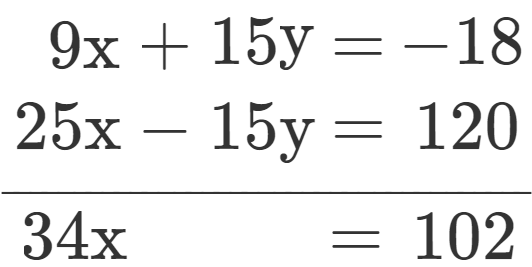
$\therefore\ \text{x}=\frac{102}{34}=3$ Putting the value of x in equation (i), we obtain $3(3)+5\text{y}=-6$ $\Rightarrow\ 5\text{y}=-6-9=-15 $ $\Rightarrow\ \text{y}=-3$ Thus, the values of x and y are 3 and -3 respectively.
View full question & answer
Question 24 Marks
If $\text{a+ib}=\frac{(\text{x+i})^2}{2\text{x}^2+1},$ prove that $\text{a}^2+\text{b}^2=\frac{(\text{x}^2+1)^2}{(2\text{x}^2+1)^2}.$
Answer
$\text{a+ib}=\frac{(\text{x+i})^2}{2\text{x}^2+1}$ $=\frac{\text{x}^2+\text{i}^2+2\text{xi}}{2\text{x}^2+1}$ $=\frac{\text{x}^2-1+\text{i2x}}{2\text{x}^2+1}$ $=\frac{\text{x}^2-1}{2\text{x}^2+1}+\text{i}\Big(\frac{2\text{x}}{2\text{x}^2+1}\Big)$ On comparing real and imaginary parts, we obtain $\text{a}=\frac{\text{x}^2-1}{2\text{x}^2+1} \text{ and b} =\frac{2\text{x}}{2\text{x}^2+1}$ $\therefore\ \text{a}^2+\text{b}^2=\Big(\frac{\text{x}^2-1}{2\text{x}^2+1}\Big)^2+\Big(\frac{2\text{x}}{2\text{x}^2+1}\Big)^2$ $=\frac{\text{x}^4+1-2\text{x}^2+4\text{x}^2}{(2\text{x}^2+1)^2}$ $=\frac{\text{x}^4+1+2\text{x}^2}{(2\text{x}^2+1)^2}$ $=\frac{(\text{x}^2+1)^2}{(2\text{x}^2+1)^2}$$\therefore\ \text{a}^2+\text{b}^2=\frac{(\text{x}^2+1)^2}{(2\text{x}^2+1)^2}$
Hence, proved.
View full question & answer
Question 34 Marks
Reduce $\Big(\frac{1}{1-4\text{i}}-\frac{2}{1+\text{i}}\Big)\Big(\frac{3-4\text{i}}{5+\text{i}}\Big)$ to the standard form.
Answer
Here $\Big[\frac{1}{1-4\text{i}}-\frac{2}{1+\text{i}}\Big]\Big[\frac{3-4\text{i}}{5+\text{i}}\Big]$$=\Big[\frac{1+\text{i}-2+8\text{i}}{(1-4\text{i})(1+\text{i})}\Big]\Big[\frac{3-4\text{i}}{5+\text{i}}\Big]$
$=\Big[\frac{-1+9\text{i}}{1+\text{i}-4\text{i}-4\text{i}^2}\Big]\Big[\frac{3-4\text{i}}{5+\text{i}}\Big]$
$=\Big[\frac{-1+9\text{i}}{5-3\text{i}}\Big]\Big[\frac{3-4\text{i}}{5+\text{i}}\Big]=\frac{-3+4\text{i}+27\text{i}-36\text{i}^2}{25+5\text{i}-15\text{i}-3\text{i}^2}$
$=\frac{33+31\text{i}}{28-10\text{i}}\times\frac{28+10\text{i}}{28+10\text{i}}$
$=\frac{924+330\text{i}+868\text{i}+310\text{i}^2}{(28)^2-(10\text{i})^2}$
$=\frac{614+1198\text{i}}{784+100}=\frac{2(307+599\text{i})}{884}$
$=\frac{307+599\text{i}}{442}$
View full question & answer
Question 44 Marks
For any two complex numbers $z_1$ and $z_2$, prove that $Re(z_1z_2) = Rez_1 Rez_2 – Imz_1 Imz_2​​​​​​​$.
Answer
Let $z_1 = x_1 + iy_1$ and $z_2 = x_2 + iy_2 \therefore\ \text{z}_1\text{z}_1=\big(\text{x}_1+\text{i}\text{y}_1\big)\big(\text{x}_2+\text{i}\text{y}_2\big)$
$=\text{x}_1\big(\text{x}_2+\text{i}\text{y}_2\big)+\text{iy}_1\big(\text{x}_2+\text{iy}_2\big) $
$=\text{x}_1\text{x}_2+\text{ix}_1\text{y}_2+\text{iy}_1\text{x}_2+\text{i}^2\text{y}_1\text{y}_2$
$=\text{x}_1\text{x}_2+\text{ix}_1\text{y}_2+\text{iy}_1\text{x}_2-\text{y}_1\text{y}_2$ $[\text{i}^2 = -1]$
$=(\text{x}_1\text{x}_2-\text{y}_1\text{y}_2)+\text{i}(\text{x}_1\text{y}_2+\text{y}_1\text{x}_2)$
$\Rightarrow\text{Re}\big(\text{z}_1\text{z}_2\big)=\text{x}_1\text{x}_2-\text{y}_1\text{y}_2$
$\Rightarrow\ \text{Re}\big(\text{z}_1\text{z}_2\big)=\text{Re z}_1\text{Re z}_2-\text{Im z}_1\text{Im z}_2$
Hence, proved.
View full question & answer
Question 54 Marks
Solve the following equation: $\sqrt{3}\text{x}^2-\sqrt{2}\text{x}+3\sqrt{3}=0.$
Answer
The given quadratic equation is $\sqrt{3}\text{x}^2-\sqrt{2}\text{x}+3\sqrt{3}=0$ On comparing the given equation with $ax^2 + bx + c = 0$, we obtain $\text{a}=\sqrt{3},\text{ b}=-\sqrt{2},\ \text{and c}=3\sqrt{3}$ Therefore, the discriminant of the givenequation is $\text{D}=\text{b}^2-4\text{ac}$ $=(-\sqrt{2})^2-4(\sqrt{3})(3\sqrt{3})=2-36=-34$ Therefore, the required solutions are $\frac{-\text{b}\pm\sqrt{\text{D}}}{2\text{a}}=\frac{-(-2)\pm\sqrt{-34}}{2\times\sqrt{3}}=\frac{\sqrt{2}\pm\sqrt{34}\text{i}}{2\sqrt{3}}$ $[\sqrt{-1}=\text{i}]$
View full question & answer
Question 64 Marks
Find the modulus and argument of the complex number $\frac{1+2\text{i}}{1-3\text{i}}.$
Answer
Let $\text{z}=\frac{1+2\text{i}}{1-3\text{i}},$ then $\text{z}=\frac{1+2\text{i}}{1-3\text{i}}\times\frac{1+3\text{i}}{1+3\text{i}}=\frac{1+3\text{i}+{2\text{i}+6\text{i}^2}}{1^2+3^2}=\frac{1+5\text{i}+6(-1)}{1+9}$ $=\frac{-5+5\text{i}}{10}=\frac{-5}{10}+\frac{5\text{i}}{10}=\frac{-1}{2}+\frac{1}{2}\text{i}$ Let $\text{z}=\text{r}\cos\theta+\text{ir}\sin\theta$ i.e., $\text{r}\cos\theta=\frac{-1}{2} \ \text{and r}\sin\theta=\frac{1}{2}$ On squaring and adding, we obtain $\text{r}^2(\cos^2\theta+\sin^2\theta)=\Big(\frac{-1}{2}\Big)^2+\Big(\frac{1}{2}\Big)^2$ $\Rightarrow\text{r}^2=\frac{1}{4}+\frac{1}{4}=\frac{1}{2}$ $\therefore\ \frac{1}{\sqrt{2}}\cos\theta =\frac{-1}{2}\text{ and }\frac{1}{\sqrt{2}}\sin\theta=\frac{1}{2}$ $\Rightarrow\ \cos\theta =\frac{-1}{\sqrt{2}}\text{ and }\sin\theta=\frac{1}{\sqrt{2}}$ $\therefore\ \theta=\pi-\frac{\pi}{4}=\frac{3\pi}{4}$ [As $\theta$ lies in the II quadrant]Therefore, the modulus and argument of the given complex number are $\frac{1}{\sqrt{2}}$ and $\frac{3\pi}{4}$ respectively.
View full question & answer
Question 74 Marks
Evaluate: $\bigg[\text{i}^{18}+\Big(\frac{1}{\text{i}}\Big)^{25}\bigg]^{3}.$
Answer
$\bigg[\text{i}^{18}+\Big(\frac{1}{\text{i}}\Big)^{25}\bigg]^{3}$ $=\Big[\text{i}^{4\times4+2}+\frac{1}{\text{i}^{4\times6+1}}\Big]^3$ $=\bigg[\big(\text{i}^4\big)^4.\text{i}^2+\frac{1}{(\text{i}^4)^6.\text{i}}\bigg]^3$ $=\Big[\text{i}^2+\frac{1}{\text{i}}\Big]^3\ \ [\text{i}^4=1]$ $=\Big[-1+\frac{1}{\text{i}}\times\frac{\text{i}}{\text{i}}\Big]^3\ \ [\text{i}^2=-1]$ $=\Big[-1+\frac{\text{i}}{\text{i}^2}\Big]^3$ $=\big[-1-\text{i}\big]^3$ $=\big(-1\big)^3\big[1+\text{i}\big]^3$ $=-\big[1^3+\text{i}^3+3.1.\text{i}\big(1+\text{i}\big)\big]$ $=-\big[1+\text{i}^3+3\text{i}+3\text{i}^2\big]$ $=-\big[1-\text{i}+3\text{i}-3\big]$ $=-\big[-2+2\text{i}\big]$$=2-2\text{i}$
View full question & answer
Question 84 Marks
Find the real numbers x and y if (x – iy) (3 + 5i) is the conjugate of -6 - 24i.
Answer
Let $\text{z}=\big(\text{x}-\text{iy}\big)\big(3+5\text{i}\big)$
$\text{z}=3\text{x}+5\text{ix}-3\text{yi}-5\text{yi}^2$
$=3\text{x}+5\text{xi}-3\text{yi}+5\text{y}$
$=\big(3\text{x}+5\text{y}\big)+\text{i}\big(5\text{x}-3\text{y}\big)$
$\therefore\ \bar{\text{z}}=\big(3\text{x}+5\text{y}\big)-\text{i}\big(5\text{x}-3\text{y}\big)$ It is given that, $\bar{\text{z}}=-6-24\text{i} $
$\therefore\ \big(3\text{x}+5\text{y}\big)-\text{i}\big(5\text{x}-3\text{y}\big)=-6-24\text{i}$ Equating real and imaginary parts, we obtain $3\text{x}+5\text{y}=-6 \ ....(\text{i})$
$5\text{x}-3\text{y}=24\ .....(\text{ii})$ Multiplying equation (i) by 3 and equation (ii) by 5 and then adding them, we obtain
$
\begin{aligned}
9 x+15 y & =-18 \\
25 x-15 y & =120 \\
\hline 34 x \quad & =102
\end{aligned}
$
$\therefore\ \text{x}=\frac{102}{34}=3$ Putting the value of x in equation (i), we obtain $3(3)+5\text{y}=-6$
$\Rightarrow\ 5\text{y}=-6-9=-15 $
$\Rightarrow\ \text{y}=-3$ Thus, the values of x and y are 3 and -3 respectively.
View full question & answer
Question 94 Marks
If $\text{a+ib}=\frac{(\text{x+i})^2}{2\text{x}^2+1},$ prove that $\text{a}^2+\text{b}^2=\frac{(\text{x}^2+1)^2}{(2\text{x}^2+1)^2}.$
Answer
$\text{a+ib}=\frac{(\text{x+i})^2}{2\text{x}^2+1}$ $=\frac{\text{x}^2+\text{i}^2+2\text{xi}}{2\text{x}^2+1}$ $=\frac{\text{x}^2-1+\text{i2x}}{2\text{x}^2+1}$ $=\frac{\text{x}^2-1}{2\text{x}^2+1}+\text{i}\Big(\frac{2\text{x}}{2\text{x}^2+1}\Big)$ On comparing real and imaginary parts, we obtain $\text{a}=\frac{\text{x}^2-1}{2\text{x}^2+1} \text{ and b} =\frac{2\text{x}}{2\text{x}^2+1}$ $\therefore\ \text{a}^2+\text{b}^2=\Big(\frac{\text{x}^2-1}{2\text{x}^2+1}\Big)^2+\Big(\frac{2\text{x}}{2\text{x}^2+1}\Big)^2$ $=\frac{\text{x}^4+1-2\text{x}^2+4\text{x}^2}{(2\text{x}^2+1)^2}$ $=\frac{\text{x}^4+1+2\text{x}^2}{(2\text{x}^2+1)^2}$ $=\frac{(\text{x}^2+1)^2}{(2\text{x}^2+1)^2}$$\therefore\ \text{a}^2+\text{b}^2=\frac{(\text{x}^2+1)^2}{(2\text{x}^2+1)^2}$
Hence, proved.
View full question & answer
Question 104 Marks
Reduce $\Big(\frac{1}{1-4\text{i}}-\frac{2}{1+\text{i}}\Big)\Big(\frac{3-4\text{i}}{5+\text{i}}\Big)$ to the standard form.
Answer
Here $\Big[\frac{1}{1-4\text{i}}-\frac{2}{1+\text{i}}\Big]\Big[\frac{3-4\text{i}}{5+\text{i}}\Big]$$=\Big[\frac{1+\text{i}-2+8\text{i}}{(1-4\text{i})(1+\text{i})}\Big]\Big[\frac{3-4\text{i}}{5+\text{i}}\Big]$
$=\Big[\frac{-1+9\text{i}}{1+\text{i}-4\text{i}-4\text{i}^2}\Big]\Big[\frac{3-4\text{i}}{5+\text{i}}\Big]$
$=\Big[\frac{-1+9\text{i}}{5-3\text{i}}\Big]\Big[\frac{3-4\text{i}}{5+\text{i}}\Big]=\frac{-3+4\text{i}+27\text{i}-36\text{i}^2}{25+5\text{i}-15\text{i}-3\text{i}^2}$
$=\frac{33+31\text{i}}{28-10\text{i}}\times\frac{28+10\text{i}}{28+10\text{i}}$
$=\frac{924+330\text{i}+868\text{i}+310\text{i}^2}{(28)^2-(10\text{i})^2}$
$=\frac{614+1198\text{i}}{784+100}=\frac{2(307+599\text{i})}{884}$
$=\frac{307+599\text{i}}{442}$
View full question & answer
Question 114 Marks
For any two complex numbers $z_1$ and $z_2$, prove that $\operatorname{Re}\left(z_1 z_2\right)=\operatorname{Rez} z_1 \operatorname{Rez} z_2-\operatorname{Im} z_1 \mid m z_2$.
Answer
Let $z_1 = x_1 + iy_1$ and $z_2 = x_2 + iy_2 \therefore\ \text{z}_1\text{z}_1=\big(\text{x}_1+\text{i}\text{y}_1\big)\big(\text{x}_2+\text{i}\text{y}_2\big)$
$=\text{x}_1\big(\text{x}_2+\text{i}\text{y}_2\big)+\text{iy}_1\big(\text{x}_2+\text{iy}_2\big) $
$=\text{x}_1\text{x}_2+\text{ix}_1\text{y}_2+\text{iy}_1\text{x}_2+\text{i}^2\text{y}_1\text{y}_2$
$=\text{x}_1\text{x}_2+\text{ix}_1\text{y}_2+\text{iy}_1\text{x}_2-\text{y}_1\text{y}_2$ $[\text{i}^2 = -1]$
$=(\text{x}_1\text{x}_2-\text{y}_1\text{y}_2)+\text{i}(\text{x}_1\text{y}_2+\text{y}_1\text{x}_2)$
$\Rightarrow\text{Re}\big(\text{z}_1\text{z}_2\big)=\text{x}_1\text{x}_2-\text{y}_1\text{y}_2$
$\Rightarrow\ \text{Re}\big(\text{z}_1\text{z}_2\big)=\text{Re z}_1\text{Re z}_2-\text{Im z}_1\text{Im z}_2$
Hence, proved.
View full question & answer
Question 124 Marks
Solve the following equation: $\sqrt{3}\text{x}^2-\sqrt{2}\text{x}+3\sqrt{3}=0.$
Answer
The given quadratic equation is $\sqrt{3}\text{x}^2-\sqrt{2}\text{x}+3\sqrt{3}=0$ On comparing the given equation with $ax^2 + bx + c = 0$, we obtain $\text{a}=\sqrt{3},\text{ b}=-\sqrt{2},\ \text{and c}=3\sqrt{3}$ Therefore, the discriminant of the givenequation is $\text{D}=\text{b}^2-4\text{ac}$ $=(-\sqrt{2})^2-4(\sqrt{3})(3\sqrt{3})=2-36=-34$ Therefore, the required solutions are $\frac{-\text{b}\pm\sqrt{\text{D}}}{2\text{a}}=\frac{-(-2)\pm\sqrt{-34}}{2\times\sqrt{3}}=\frac{\sqrt{2}\pm\sqrt{34}\text{i}}{2\sqrt{3}}$ $[\sqrt{-1}=\text{i}]$
View full question & answer
Question 134 Marks
Find the modulus and argument of the complex number $\frac{1+2\text{i}}{1-3\text{i}}.$
Answer
Let $\text{z}=\frac{1+2\text{i}}{1-3\text{i}},$ then $\text{z}=\frac{1+2\text{i}}{1-3\text{i}}\times\frac{1+3\text{i}}{1+3\text{i}}=\frac{1+3\text{i}+{2\text{i}+6\text{i}^2}}{1^2+3^2}=\frac{1+5\text{i}+6(-1)}{1+9}$ $=\frac{-5+5\text{i}}{10}=\frac{-5}{10}+\frac{5\text{i}}{10}=\frac{-1}{2}+\frac{1}{2}\text{i}$ Let $\text{z}=\text{r}\cos\theta+\text{ir}\sin\theta$ i.e., $\text{r}\cos\theta=\frac{-1}{2} \ \text{and r}\sin\theta=\frac{1}{2}$ On squaring and adding, we obtain $\text{r}^2(\cos^2\theta+\sin^2\theta)=\Big(\frac{-1}{2}\Big)^2+\Big(\frac{1}{2}\Big)^2$ $\Rightarrow\text{r}^2=\frac{1}{4}+\frac{1}{4}=\frac{1}{2}$ $\therefore\ \frac{1}{\sqrt{2}}\cos\theta =\frac{-1}{2}\text{ and }\frac{1}{\sqrt{2}}\sin\theta=\frac{1}{2}$ $\Rightarrow\ \cos\theta =\frac{-1}{\sqrt{2}}\text{ and }\sin\theta=\frac{1}{\sqrt{2}}$ $\therefore\ \theta=\pi-\frac{\pi}{4}=\frac{3\pi}{4}$ [As $\theta$ lies in the II quadrant]Therefore, the modulus and argument of the given complex number are $\frac{1}{\sqrt{2}}$ and $\frac{3\pi}{4}$ respectively.
View full question & answer
Question 144 Marks
Evaluate: $\bigg[\text{i}^{18}+\Big(\frac{1}{\text{i}}\Big)^{25}\bigg]^{3}.$
Answer
$\bigg[\text{i}^{18}+\Big(\frac{1}{\text{i}}\Big)^{25}\bigg]^{3}$ $=\Big[\text{i}^{4\times4+2}+\frac{1}{\text{i}^{4\times6+1}}\Big]^3$ $=\bigg[\big(\text{i}^4\big)^4.\text{i}^2+\frac{1}{(\text{i}^4)^6.\text{i}}\bigg]^3$ $=\Big[\text{i}^2+\frac{1}{\text{i}}\Big]^3\ \ [\text{i}^4=1]$ $=\Big[-1+\frac{1}{\text{i}}\times\frac{\text{i}}{\text{i}}\Big]^3\ \ [\text{i}^2=-1]$ $=\Big[-1+\frac{\text{i}}{\text{i}^2}\Big]^3$ $=\big[-1-\text{i}\big]^3$ $=\big(-1\big)^3\big[1+\text{i}\big]^3$ $=-\big[1^3+\text{i}^3+3.1.\text{i}\big(1+\text{i}\big)\big]$ $=-\big[1+\text{i}^3+3\text{i}+3\text{i}^2\big]$ $=-\big[1-\text{i}+3\text{i}-3\big]$ $=-\big[-2+2\text{i}\big]$$=2-2\text{i}$
View full question & answer
Question 154 Marks
Convert the complex numbers given in Exercises in the polar form: -3.
Answer
Given: $\text{z}=\text{r}(\cos\theta+\text{i}\sin\theta)=-3$$\therefore\ \text{r}\cos\theta=-3$ and $\text{r}\sin\theta=0$
Squaring both sides and adding both the equations, we get
$\text{r}^2(\cos^2\theta+\sin^2\theta)=9+0$
$\Rightarrow\ \text{r}^2=9\Rightarrow\ \text{r}=3$
$\therefore\ 3\cos\theta=-3$ and $3\sin\theta=0$
$\Rightarrow\ \cos\theta=-1$ and $\sin\theta=0$
$[\theta$ lies in second quadrant$]$
$\therefore\ \theta=(\pi-0)=\pi$
Therefore, polar form of z is $3[\cos\pi+\text{i}\sin\pi].$
View full question & answer
Question 164 Marks
Convert the complex numbers given in Exercises in the polar form:-1 - i.
Answer
-1 - iLet $\text{r}\cos\theta=-1$ and $\text{r}\sin\theta=-1$
On squaring and adding, we obtain
$\text{r}^2\cos^2\theta+\text{r}^2\sin^2\theta=(-1)^2+(-1)^2$
$\Rightarrow\ \text{r}^2(\cos^2\theta+\sin^2\theta)=1+1$
$\Rightarrow\ \text{r}^2=2$
$\Rightarrow\ \text{r}=\sqrt{2}$ [Conventionally, r > 0]
$\therefore\ \sqrt{2}\cos\theta=-1$ and $\sqrt{2}\sin\theta=-1$
$\Rightarrow\ \cos\theta=-\frac{1}{\sqrt{2}}$ and $\sin\theta=-\frac{1}{\sqrt{2}}$
$\therefore\ \theta=-\Big(\pi-\frac{\pi}{4}\Big)=-\frac{3\pi}{4}$ [As $\theta$ lies in the III quadrant]
$\therefore\ -1-\text{i}=\text{r}\cos\theta+\text{i r}\sin\theta$
$=\sqrt{2}\cos\frac{-3\pi}{4}+\text{i}\sqrt{2}\sin\frac{-3\pi}{4}$
$=\sqrt{2}\Big(\cos\frac{-3\pi}{4}+\text{i}\sin\frac{-3\pi}{4}\Big)$
This is the required polar form.
View full question & answer
Question 174 Marks
Convert the following in the polar form: $\frac{1+3\text{i}}{1-2\text{i}}$
Answer
Here, $\text{z}=\frac{1+3\text{i}}{1-2\text{i}}$$=\frac{1+3\text{i}}{1-2\text{i}}\times\frac{1+2\text{i}}{1+2\text{i}}$
$=\frac{1+2\text{i}+3\text{i}-6}{1+4}$
$=\frac{-5+5\text{i}}{5}=-1+\text{i}$
Let $\text{r}\cos\theta=-1$ and $\text{r}\sin\theta=1$
On squaring and adding, we obtain
$\text{r}^2(\cos^2\theta+\sin^2\theta)=1+1$
$\Rightarrow\ \text{r}^2(\cos^2\theta+\sin^2\theta)=2$
$\Rightarrow\ \text{r}^2=2$ $[\cos^2\theta+\sin^2\theta=1]$
$\Rightarrow\ \text{r}=\sqrt{2}$ [Conventionally, r > 0]
$\therefore\ \sqrt{2}\cos\theta=-1$ and $\sqrt{2}\sin\theta=1$
$\Rightarrow\ \cos\theta=\frac{-1}{\sqrt{2}}$ and $\sin\theta=\frac{1}{\sqrt{2}}$
$\therefore\ \theta=\pi-\frac{\pi}{4}=\frac{3\pi}{4}$ [As $\theta$ lies in II quadrant]
$\therefore\ \text{z}=\text{r}\cos\theta+\text{ir}\sin\theta$
$=\sqrt{2}\cos\frac{3\pi}{4}+\text{i}\sqrt{2}\sin\frac{3\pi}{4}$
$=\sqrt{2}\Big(\cos\frac{3\pi}{4}+\text{i}\sin\frac{3\pi}{4}\Big)$
This is the required polar form.
View full question & answer
Question 184 Marks
If $\text{x}-\text{iy}=\sqrt{\frac{\text{a}-\text{ib}}{\text{c}-\text{id}}}$ Prove that $(\text{x}^2+\text{y}^2)^2=\frac{\text{a}^2+\text{b}^2}{\text{c}^2+\text{d}^2}.$
Answer
$\text{x}-\text{iy}=\sqrt{\frac{\text{a}-\text{ib}}{\text{c}-\text{id}}}$$=\sqrt{\frac{\text{a}-\text{ib}}{\text{c}-\text{id}}\times\frac{\text{c}+\text{id}}{\text{c}+\text{id}}}$ [On multiplying numerator and denominator by (c + id)]
$=\sqrt{\frac{(\text{ac}+\text{bd})+\text{i}(\text{ad}-\text{bc})}{\text{c}^2+\text{d}^2}}$
$\therefore\ (\text{x}-\text{iy})^2=\frac{(\text{ac}+\text{bd})+\text{i}(\text{ad}-\text{bc})}{\text{c}^2+\text{d}^2}$
$\Rightarrow\ \text{x}^2-\text{y}^2-2\text{ixy}=\frac{(\text{ac}+\text{bd})+\text{i}(\text{ad}-\text{bc})}{\text{c}^2+\text{d}^2}$
On comparing real and imaginary parts, we obtain
$\text{x}^2-\text{y}^2=\frac{\text{ac+bd}}{\text{c}^2+\text{d}^2},\ -2\text{xy}=\frac{\text{ad}-\text{bc}}{\text{c}^2+\text{d}^2}\ ....(1)$
$(\text{x}^2+\text{y}^2)^2=(\text{x}^2-\text{y}^2)^2+4\text{x}^2\text{y}^2$
$=\Big(\frac{\text{ac+bd}}{\text{c}^2+\text{d}^2}\Big)^2+\Big(\frac{\text{ad}-\text{bc}}{\text{c}^2+\text{d}^2}\Big)^2\ \ [\text{Using (1)}]$
$=\frac{\text{a}^2\text{c}^2+\text{b}^2\text{d}^2+2\text{acbd}+\text{a}^2\text{d}^2+\text{b}^2\text{c}^2-2\text{adbc}}{(\text{c}^2+\text{d}^2)^2}$
$=\frac{\text{a}^2\text{c}^2+\text{b}^2\text{d}^2+\text{a}^2\text{d}^2+\text{b}^2\text{c}^2}{(\text{c}^2+\text{d}^2)^2}$
$=\frac{\text{a}^2(\text{c}^2+\text{d}^2)+\text{b}^2(\text{c}^2+\text{d}^2)}{(\text{c}^2+\text{d}^2)^2}$
$=\frac{(\text{c}^2+\text{d}^2)(\text{a}^2+\text{b}^2)}{(\text{c}^2+\text{d}^2)^2}$
$=\frac{\text{a}^2+\text{b}^2}{\text{c}^2+\text{d}^2}$
Hence, proved.
View full question & answer
Question 194 Marks
If $\alpha$ and $\beta$ are different complex numbers with $|\beta|=1,$ then find $\Big|\frac{\beta-\alpha}{1-\bar{\alpha}\beta}\Big|.$
Answer
Let $\alpha=\text{a}+\text{ib}$ and $\beta=\text{x}+\text{iy}$ It is given that, $|\beta|=1$ $\therefore\ \sqrt{\text{x}^2+\text{y}^2}=1$ $\Rightarrow\text{x}^2+\text{y}^2=1\ .....(1)$ $\bigg|\frac{\beta-\alpha}{1-\bar{\alpha}{\beta}}\bigg|=\bigg|\frac{(\text{x}+\text{iy})-(\text{a}+\text{ib})}{1-(\text{a}-\text{ib})(\text{x}+{\text{iy}})}\bigg|$ $=\bigg|\frac{(\text{x}-\text{a})+\text{i}(\text{y}-\text{b})}{1-(\text{ax}+\text{aiy}-\text{ibx}+\text{by})}\bigg|$ $=\bigg|\frac{(\text{x}-\text{a})+\text{i}(\text{y}-\text{b})}{(1-\text{ax}-\text{by})+\text{i}(\text{bx}-\text{ay})}\bigg|$ $=\frac{\big|(\text{x}-\text{a})+\text{i}(\text{y}-\text{b})\big|}{\big|(1-\text{ax}-\text{by})+\text{i}(\text{bx}-\text{ay})\big|}\ \ \bigg[\Big|\frac{\text{z}_1}{\text{z}_2}\Big|=\frac{|\text{z}_1|}{|\text{z}_2|}\bigg]$ $=\frac{\sqrt{(\text{x}-\text{a})^2+(\text{y}-\text{b})^2}}{\sqrt{(1-\text{ax}-\text{by})^2+(\text{bx}-\text{ay})^2}}$ $=\frac{\sqrt{\text{x}^2+\text{a}^2-2\text{ax}+\text{y}^2+\text{b}^2-2\text{by}}}{\sqrt{1+\text{a}^2\text{x}^2+\text{b}^2\text{y}^2-2\text{ax}+2\text{abxy}-2\text{by}+\text{b}^2\text{x}^2+\text{a}^2\text{y}^2-2\text{abxy}}}$ $=\frac{\sqrt{(\text{x}^2+\text{y}^2)+\text{a}^2+\text{b}^2-2\text{ax}-2\text{by}}}{\sqrt{1+\text{a}^2(\text{x}^2+\text{y}^2)+\text{b}^2(\text{y}^2+\text{x}^2)-2\text{ax}-2\text{by}}}$ $=\frac{\sqrt{1+\text{a}^2+\text{b}^2-2\text{ax}-2\text{by}}}{\sqrt{1+\text{a}^2+\text{b}^2-2\text{ax}-2\text{by}}}\ \ [\text{Using (1)}]$ $=1$ $\therefore\ \bigg|\frac{\beta-\alpha}{1-\bar{\alpha}\beta}\bigg|=1$
View full question & answer
Question 204 Marks
Convert the complex numbers given in Exercises in the polar form: $\sqrt{3}+\text{i}.$
Answer
$\sqrt{3}+\text{i}$ Let $\text{r}\cos\theta=\sqrt{3}$ and $\text{r}\sin\theta=1$On squaring and adding, we obtain
$\text{r}^2\cos^2\theta+\text{r}^2\sin^2\theta=(\sqrt{3})^2+1^2$ $\Rightarrow\ \text{r}^2(\cos^2\theta+\sin^2\theta)=3+1$ $\Rightarrow\ \text{r}^2=4$ $\Rightarrow\ \text{r}=\sqrt{4}=2$ [Conventionally, r > 0] $\therefore\ 2\cos\theta=\sqrt{3}$ and $2\sin\theta=1$ $\Rightarrow\ \cos\theta=\frac{\sqrt{3}}{2}$ and $\sin\theta=\frac{1}{2}$ $\therefore\ \theta=\frac{\pi}{6}$ [As $\theta$ lies on the I quadrant] $\therefore\ \sqrt{3}+\text{i}=\text{r}\cos\theta+\text{i r}\sin\theta$$=2\cos\frac{\pi}{6}+\text{i}2\sin\frac{\pi}{6}=2\Big(\cos\frac{\pi}{6}+\text{i}\sin\frac{\pi}{6}\Big)$
This is the required polar form.
View full question & answer
Question 214 Marks
Convert the complex numbers given in Exercises in the polar form:
Answer
Let $\text{r}\cos\theta=0$ and $\text{r}\sin\theta=1$ On squaring and adding, we obtain $\text{r}^2\cos^2\theta+\text{r}^2\sin^2\theta=0^2+1^2$ $\Rightarrow\ \text{r}^2(\cos^2\theta+\sin^2\theta)=1$ $\Rightarrow\ \text{r}^2=1$ $\Rightarrow\ \text{r}=\sqrt{1}=1$ [Conventionally, r > 0] $\therefore\ \cos\theta=0$ and $\sin\theta=1$ $\therefore\ \theta=\frac{\pi}{2}$ $\therefore\ \text{i}=\text{r}\cos\theta+\text{i r}\sin\theta=\cos\frac{\pi}{2}+\text{i}\sin\frac{\pi}{2}$ This is the required polar form.
View full question & answer
Question 224 Marks
Convert the following in the polar form: $\frac{1+7\text{i}}{(2-\text{i})^2}$
Answer
Here, $\text{z}=\frac{1+7\text{i}}{(2-\text{i})^2}$ $=\frac{1+7\text{i}}{(2-\text{i})^2}=\frac{1+7\text{i}}{4+\text{i}^2-4\text{i}}=\frac{1+7\text{i}}{4-1-4\text{i}}$ $=\frac{1+7\text{i}}{3-4\text{i}}\times\frac{3+4\text{i}}{3+4\text{i}}=\frac{3+4\text{i}+21\text{i}+28\text{i}^2}{3^2+4^2}$ $=\frac{3+4\text{i}+21\text{i}-28}{3^2+4^2}=\frac{-25+25\text{i}}{25}$ $=-1+\text{i}$ Let $\text{r}\cos\theta=-1$ and $\text{r}\sin\theta=1$ On squaring and adding, we obtain $\text{r}^2(\cos^2\theta+\sin^2\theta)=1+1$ $\Rightarrow\ \text{r}^2(\cos^2\theta+\sin^2\theta)=2$ $\Rightarrow\ \text{r}^2=2\ \ [\cos^2\theta+\sin^2\theta=1]$ $\Rightarrow\ \text{r}=\sqrt{2}$ [Conventionally, r > 0] $\therefore\ \sqrt{2}\cos\theta=-1$ and $\sqrt{2}\sin\theta=1$ $\Rightarrow\ \cos\theta=\frac{-1}{\sqrt{2}}$ and $\sin\theta=\frac{1}{\sqrt{2}}$$\therefore\ \theta=\pi-\frac{\pi}{4}=\frac{3\pi}{4}$ [As $\theta$ lies in II quadrant]
$\therefore\ \text{z}=\text{r}\cos\theta+\text{ir}\sin\theta$ $=\sqrt{2}\cos\frac{3\pi}{4}+\text{i}\sqrt{2}\sin\frac{3\pi}{4}$ $=\sqrt{2}\Big(\cos\frac{3\pi}{4}+\text{i}\sin\frac{3\pi}{4}\Big)$ This is the required polar form.
View full question & answer
Question 234 Marks
If $(x + iy)^3 = u + iv$, then show that $\frac{\text{u}}{\text{x}}+\frac{\text{v}}{\text{y}}=4(\text{x}^2-\text{y}^2).$
Answer
$(\text{x}+\text{iy})^3=\text{u}+\text{iv}$ $\Rightarrow\text{x}^3+(\text{iy})^3+3.\text{x}.\text{iy}(\text{x}+\text{iy})=\text{u}+\text{iv}$ $\Rightarrow\text{x}^3+\text{i}^3\text{y}^3+3\text{x}^2\text{yi}+3\text{x}\text{y}^2\text{i}^2=\text{u}+\text{iv}$ $\Rightarrow\text{x}^3-\text{i}\text{y}^3+3\text{x}^2\text{yi}-3\text{x}\text{y}^2=\text{u}+\text{iv}$ $\Rightarrow(\text{x}^3-3\text{x}\text{y}^2)+\text{i}(3\text{x}^2\text{y}-\text{y}^3)=\text{u}+\text{iv}$ On equating real and imaginary parts, we obtain $\text{u}=\text{x}^3-3\text{x}\text{y}^2,\ \text{v}=3\text{x}^2\text{y}-\text{y}^3$ $\therefore\ \frac{\text{u}}{\text{x}}+\frac{\text{v}}{\text{y}}=\frac{\text{x}^3-3\text{x}\text{y}^2}{\text{x}}+\frac{3\text{x}^2\text{y}-{\text{y}^3}}{\text{y}}$ $=\frac{\text{x}(\text{x}^2-3\text{y}^2)}{\text{x}}+\frac{\text{y}(3\text{x}^2-\text{y}^2)}{\text{y}}$ $=\text{x}^2-3\text{y}^2+3\text{x}^2-\text{y}^2$ $=4\text{x}^2-4\text{y}^2$ $=4(\text{x}^2-\text{y}^2)$ $\therefore\ \frac{\text{u}}{\text{x}}+\frac{\text{v}}{\text{y}}=4(\text{x}^2-\text{y}^2)$ Hence, proved.
View full question & answer
Question 244 Marks
Convert the complex numbers given in Exercises in the polar form: 1 - i.
Answer
Given: $\text{z}=\text{r}(\cos\theta+\text{i}\sin\theta)=1-\text{i}$ $\therefore\ \text{r}\cos\theta=1$ and $\text{r}\sin\theta=-1$Squaring both sides and adding both the equations, we get
$\text{r}^2(\cos^2\theta+\sin^2\theta)=1+1$ $\Rightarrow\ \text{r}^2=2\Rightarrow\ \text{r}=\sqrt{2}$ $\therefore\ \sqrt{2}\cos\theta=1$ and $\sqrt{2}\sin\theta=-1$$\Rightarrow\ \cos\theta=\frac{1}{\sqrt{2}}$ and $\sin\theta=\frac{-1}{\sqrt{2}}$
$[\theta$ lies in fourth quadrant$]$
$\therefore\ \theta=\frac{-\pi}{4}$
Therefore, Polar form of z is $\sqrt{2}\Big[\cos\Big(\frac{-\pi}{4}\Big)+\text{i}\sin\Big(\frac{-\pi}{4}\Big)\Big].$
View full question & answer
Question 254 Marks
Convert the complex numbers given in Exercises in the polar form:-1 + i.
Answer
-1 + i Let $\text{r}\cos\theta =-1$ and $\text{r}\sin\theta = 1$ On squaring and adding, we obtain $\text{r}^2\cos^2\theta+\text{r}^2\sin^2\theta=(-1)^2+1^2$ $\Rightarrow\ \text{r}^2(\cos^2\theta+\sin^2\theta)=1+1$ $\Rightarrow\ \text{r}^2=2$ $\Rightarrow\ \text{r}=\sqrt{2}$ [Conventionally, r > 0] $\therefore\ \sqrt{2}\cos\theta=-1$ and $\sqrt{2}\sin\theta=1$ $\Rightarrow\ \cos\theta=-\frac{1}{\sqrt{2}}$ and $\sin\theta=\frac{1}{\sqrt{2}}$ $\therefore\ \theta=\pi-\frac{\pi}{4}=\frac{3\pi}{4}$ [As $\theta$ lies in the II quadrant] It can be written, $\therefore\ -1+\text{i}=\text{r}\cos\theta+\text{i r}\sin\theta$ $=\sqrt{2}\cos\frac{3\pi}{4}+\text{i}\sqrt{2}\sin\frac{3\pi}{4}=\sqrt{2}\Big(\cos\frac{3\pi}{4}+\text{i}\sin\frac{3\pi}{4}\Big)$ This is the required polar form.
View full question & answer