Question 11 Mark
If a latus-rectum of an ellipse subtends a right angle at the centre of the ellipse, then write the eccentricity of the ellipse.
Answer
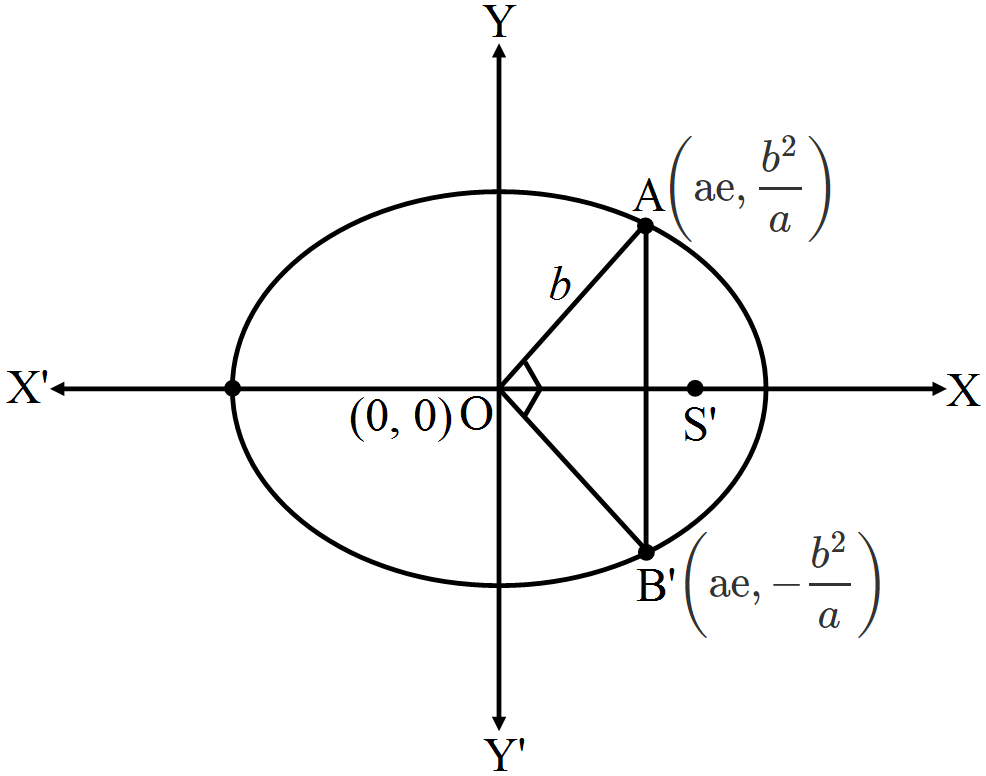 According to the Pythogoras theorem, we have:
$\text{OA}^2+\text{OB}^2=\text{AB}^2$
From the figure, we can see that
$\text{OA}=\sqrt{\big(\frac{\text{b}^2}{\text{a}}-0\big)^2+(\text{ae}-0)^2}=\sqrt{\frac{\text{b}^4}{\text{a}^2}}+\text{a}^2\text{e}^2=\text{OB}$
and $\text{AB}=\frac{2\text{b}^2}{\text{a}}$
Now, $2\Big[\text{a}^2\text{e}^2+\frac{\text{b}^4}{\text{a}^2}\Big]=\frac{4\text{b}^4}{\text{a}^2}$
$\Rightarrow\text{a}^2\text{e}^2+\frac{\text{b}^4}{\text{a}^2}=\frac{2\text{b}^4}{\text{a}^2}$
$\Rightarrow\text{a}^2\text{e}^2=-\frac{\text{b}^4}{\text{a}^2}+\frac{2\text{b}^4}{\text{a}^2}$
$\Rightarrow\text{a}^2\text{e}^2=\frac{\text{b}^4}{\text{a}^2}$
$\Rightarrow\text{e}^2=\frac{\text{b}^4}{\text{a}^4}$
$\Rightarrow\text{e}=\frac{\text{b}^2}{\text{a}^2}$
We know that $\text{e}=\sqrt{1-\frac{\text{b}^2}{\text{a}^2}}$
$\text{e}=\sqrt{1-\text{e}}$
On squaring both sides, we get:
$\text{e}^2+\text{e}-1=0$
$\Rightarrow\text{e}=\frac{-1\pm\sqrt{1+4}}{2}$ $\big(\because\ $Ecentricity cannot be negative $\big)$
$\Rightarrow\text{e}=\frac{\sqrt{5}-1}{2}$
View full question & answer→According to the Pythogoras theorem, we have:$\text{OA}^2+\text{OB}^2=\text{AB}^2$
From the figure, we can see that
$\text{OA}=\sqrt{\big(\frac{\text{b}^2}{\text{a}}-0\big)^2+(\text{ae}-0)^2}=\sqrt{\frac{\text{b}^4}{\text{a}^2}}+\text{a}^2\text{e}^2=\text{OB}$
and $\text{AB}=\frac{2\text{b}^2}{\text{a}}$
Now, $2\Big[\text{a}^2\text{e}^2+\frac{\text{b}^4}{\text{a}^2}\Big]=\frac{4\text{b}^4}{\text{a}^2}$
$\Rightarrow\text{a}^2\text{e}^2+\frac{\text{b}^4}{\text{a}^2}=\frac{2\text{b}^4}{\text{a}^2}$
$\Rightarrow\text{a}^2\text{e}^2=-\frac{\text{b}^4}{\text{a}^2}+\frac{2\text{b}^4}{\text{a}^2}$
$\Rightarrow\text{a}^2\text{e}^2=\frac{\text{b}^4}{\text{a}^2}$
$\Rightarrow\text{e}^2=\frac{\text{b}^4}{\text{a}^4}$
$\Rightarrow\text{e}=\frac{\text{b}^2}{\text{a}^2}$
We know that $\text{e}=\sqrt{1-\frac{\text{b}^2}{\text{a}^2}}$
$\text{e}=\sqrt{1-\text{e}}$
On squaring both sides, we get:
$\text{e}^2+\text{e}-1=0$
$\Rightarrow\text{e}=\frac{-1\pm\sqrt{1+4}}{2}$ $\big(\because\ $Ecentricity cannot be negative $\big)$
$\Rightarrow\text{e}=\frac{\sqrt{5}-1}{2}$
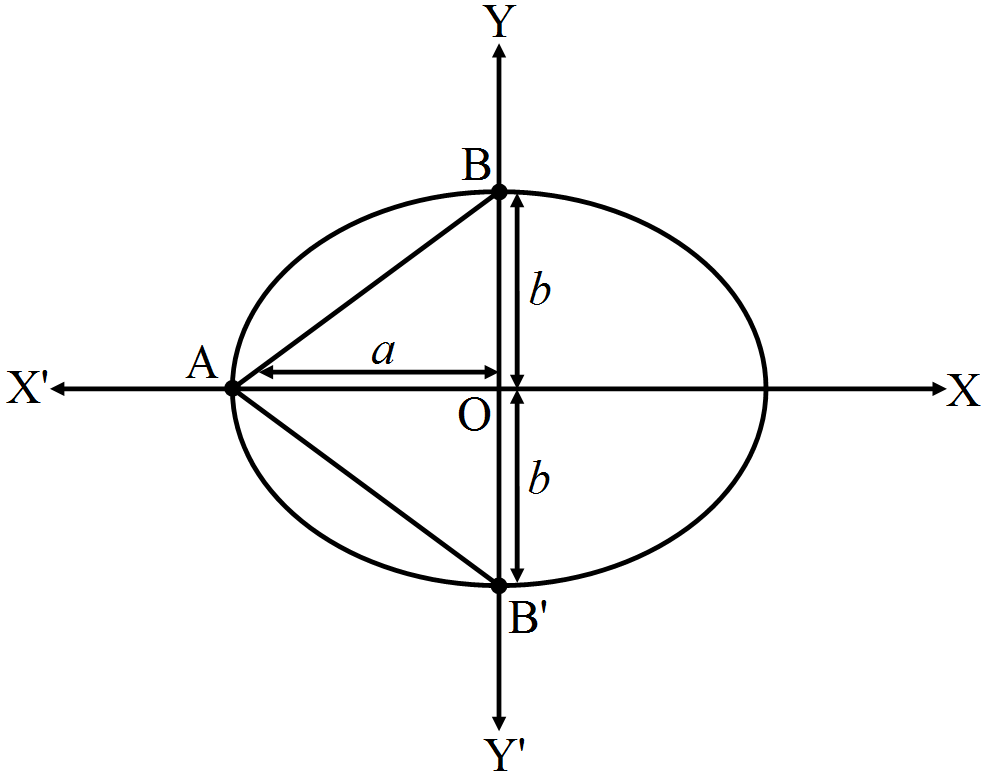 According to the question, the minor axis of the ellipse subtends an equilatreal triangle with vertex at one end of the major axis
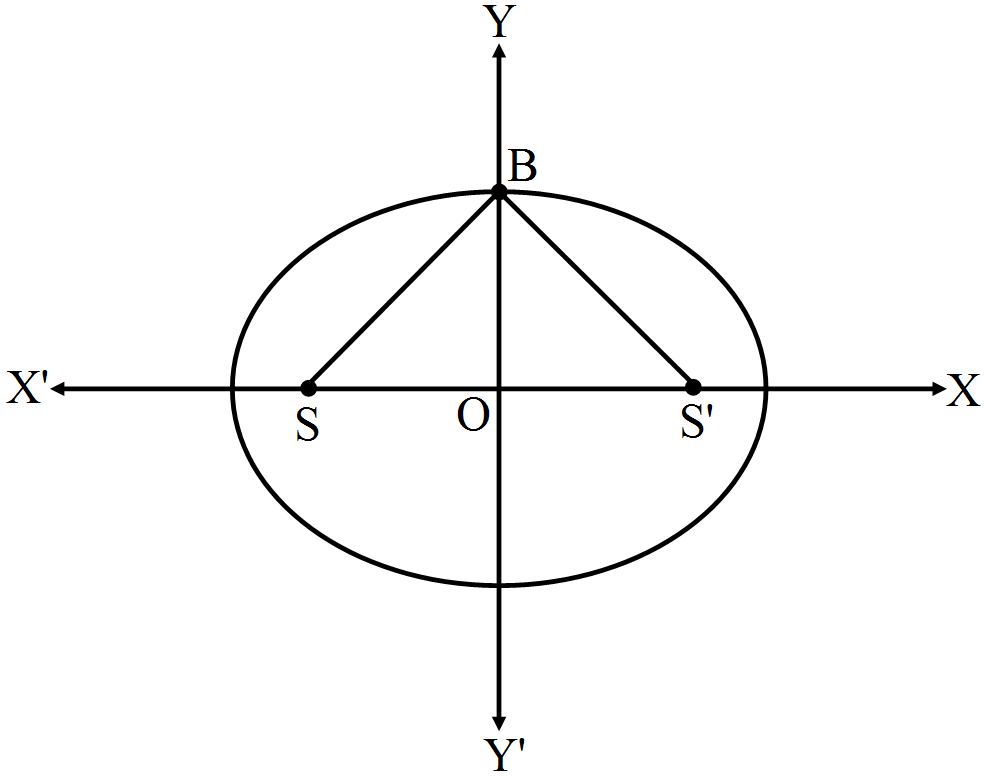 We know that the focal distance of a point B(0, b) is $\text{a}\pm\text{e}.\ 0=\text{a}$