Question 14 Marks
Find the equation to the ellipse in the following case:Foci $(\pm3, 0), a = 4$
AnswerLet the equation of the required ellipse be$\frac{\text{x}^2}{\text{a}^2}+\frac{\text{y}^2}{\text{b}^2}=1\ \dots(\text{i})$
we have, Length of major axis = 16$\text{a}=4$
$\Rightarrow\text{a}^2=16$
and, the coordinates of foci are $(\pm3, 0)$
$\therefore\ \text{ae}=3$
$\Rightarrow4\times\text{e}=3$
$\Rightarrow\text{e}=\frac{3}{4}$
Now, $\text{b}^2=\text{a}^2(1-\text{e}^2)$
$=4^2\Big[1-\Big(\frac{3}{4}\Big)^2\Big]$
$=16\times\Big(1-\frac{9}{16}\Big)$
$=16\times\frac{7}{16}$
$=7$ Substituting the values of $a^2$ and $d^2$ in (i), we get$\frac{\text{x}^2}{16}+\frac{\text{y}^2}{7}=1$
This is the equation of the required ellipse.
View full question & answer→Question 24 Marks
Find the equation to the ellipse in the following case: The ellipse passes through $(1, 4)$ and $(-6, 1)$.
AnswerLet the equation of the required ellipse be$\frac{\text{x}^2}{\text{a}^2}+\frac{\text{y}^2}{\text{b}^2}=1\ \dots(\text{i})$
Since the ellipse passes through
(1, 4) and (-6, 1).
$\therefore\ \frac{(1)^2}{\text{a}^2}+\frac{(4)^2}{\text{b}^2}=1$
$\Rightarrow\frac{1}{\text{a}^2}+\frac{16}{\text{b}^2}=1$
$\Rightarrow\text{b}^2+16\text{a}^2=\text{a}^2\text{b}^2\ \dots(\text{ii})$
and $\frac{(-6)^2}{\text{a}^2}+\frac{(1)^2}{\text{b}^2}=1$
$\Rightarrow\frac{36}{\text{a}^2}+\frac{1}{\text{b}^2}=1$
$\Rightarrow\frac{36}{\text{a}^2}+\frac{1}{\text{b}^2}=1$
$\Rightarrow36\text{b}^2+\text{a}^2=\text{a}^2\text{b}^2\ \dots\text{(iii)}$
Multipliying equation (iii) by 16, we get
$576\text{b}^2+16\text{a}^2=16\text{a}^2\text{b}^2\ \dots(\text{iv})$
Substituting equation (ii) from eqation (iv), we get
$576\text{b}^2-\text{b}^2=16\text{a}^2\text{b}^2-\text{a}^2\text{b}^2$
$\Rightarrow575\text{b}^2=15\text{a}^2\text{b}^2$
$\Rightarrow575=15\text{a}^2$
$\Rightarrow\text{a}^2=\frac{575}{15}-\frac{115}{3}$
Putting $\text{a}^2=\frac{115}{3}$ in equation (ii), we get
$\text{b}^2+16\times\frac{115}{3}-\frac{115}{3}\times\text{b}^2$
$\Rightarrow\text{b}^2-\frac{115}{3}\text{b}^2=-16\times\frac{115}{3}$
$\Rightarrow\frac{3\text{b}^2-115\text{b}^2}{3}=-\frac{16\times115}{3}$
$\Rightarrow-112\text{b}^2=-16\times115$
$\Rightarrow\text{b}^2=\frac{16\times115}{112}$
Substututing the value of $a^2$ and $b^2$ in (i), we get
$\frac{\frac{\text{x}^2}{115}}{3}+\frac{\frac{\text{y}^2}{115}}{7}=1$
$\Rightarrow\frac{3\text{x}^2+7\text{y}^2}{115}=1$
$\Rightarrow3\text{x}^2+7\text{y}^2=115$
This is the required equation of the ellipse.
View full question & answer→Question 34 Marks
Find the equation of the ellipse (referred to its axes as the axes of x and y respectively) which passes through the point (-3, 1) and eccentricity $\sqrt\frac{2}{5}.$
AnswerLet the equation of the required ellipse be$\frac{\text{x}^2}{\text{a}^2}+\frac{\text{y}^2}{\text{b}^2}=1\ \dots(\text{i})$
$\therefore\text{ e}=\sqrt{1-\frac{\text{b}^2}{\text{a}^2}}$
$\Rightarrow\sqrt\frac{2}{5}=\sqrt{1-\frac{\text{b}^2}{\text{a}^2}}$ $\bigg[\because\text{eccentricity}=\sqrt{\frac{2}{5}}\bigg]$
$\Rightarrow\sqrt\frac{2}{5}=1-\frac{\text{b}^2}{\text{a}^2}$
$\Rightarrow\frac{\text{b}^2}{\text{a}^2}=1-\frac{2}{5}$
$\Rightarrow\frac{\text{b}^2}{\text{a}^2}=\frac{3}{5}$
$\Rightarrow5\text{b}^2=3\text{a}^2$
$\Rightarrow\text{b}^2=\frac{3\text{a}^2}{5}\ \dots(\text{ii})$
Putting the value of $\text{b}^2=\frac{3\text{a}^2}{5}$in equation (ii), we get
$\frac{9}{\text{a}^2}+\frac{1}{\frac{3\text{a}^2}{5}}=1$
$\Rightarrow\frac{9}{\text{a}^2}+\frac{5}{3\text{a}^2}=1$
$\Rightarrow\frac{1}{\text{a}^2}\big[9+\frac{5}{3}\big]=1$
$\Rightarrow9+\frac{5}{3}=\text{a}^2$
$\Rightarrow\text{a}^2=\frac{32}{3}\ \dots(\text{iii})$
Putting $\text{a}^2=\frac{32}{3}$ in equation (ii), we get
$\text{b}^2=\frac{3}{5}\times\frac{32}{3}=\frac{32}{5}\ \dots(\text{iv})$
$\therefore$ The required equation of ellipse is
$\frac{\text{x}^2}{\frac{32}{3}}+\frac{\text{y}^2}{\frac{32}{5}}=1$
$\Rightarrow\frac{3\text{x}^2}{32}+\frac{5\text{y}^2}{32}=1$
$\Rightarrow3\text{x}^2+5\text{y}^2=32.$
This is the required equation of ellipse.
View full question & answer→Question 44 Marks
Find the centre, the lengths of the axes, eccentricity, foci of the following ellipse:$\text{x}^2+4\text{y}^2-2\text{x}=0$
AnswerWe have,$\text{x}^2+4\text{y}^2-2\text{x}=0$
$\Rightarrow\text{x}^2-2\text{x}+4\text{y}^2=0$
$\Rightarrow\Big(\text{x}^2-2\text{x}+1^2-1^2\Big)+4\text{y}^2=0$
$\Rightarrow\big(\text{x}-1\big)^2-1+4\text{y}^2=0$
$\Rightarrow\big(\text{x}-1\big)^2+4\text{y}^2=1$
$\Rightarrow\frac{\big(\text{x}-1\big)^2}{1}+\frac{\text{y}^2}{\frac{1}{4}}=1$
$\Rightarrow\frac{\big(\text{x}-1\big)^2}{1^2}+\frac{\text{y}^2}{\Big(\frac{1}{2}\Big)^2}=1\ \dots(\text{i})$
$\therefore\ $The coordinates of centre of the ellipse are (1, 0).
Shifting the origin at (1, 0) without rotating the coordinate axes and denoting the new coordinates with respect to the new axes by x and y, we havex = x + 1 and y = y $\dots(\text{ii})$
using these relations, equation (i) reduces to
$\Rightarrow\frac{\text{x}^2}{1^2}+\frac{\text{y}^2}{\Big(\frac{1}{2}\Big)^2}=1,$ where $\text{a}=1$ and $\text{b}=\frac{1}{2}$
clearly, a > b. so, the given equation represents an ellipse whose and minor axes are along x and y axes respectively. Length of the axes:Major-axis = $2\times\text{a}=2\times1=2$
and, Minor-axis = $2\times\text{b}=2\times\frac{1}{2}=1$
Eccentricity: The eccentricity e is given by
$\text{e}=\sqrt{1-\frac{\text{b}^2}{\text{a}^2}}$
$=\sqrt{1-\frac{1}{\frac{4}{1}}}$
$=\sqrt{1-\frac{1}{{4}}}$
$=\sqrt{\frac{3}{4}}$
$=\frac{\sqrt{3}}{2}$
foci: The coordinates of the foci with respect to the new axes are given by $\big(\text{x}=\pm\text{ae},\ \text{y}=0\big)$ i.e., $\big(\text{x}=\pm\frac{\sqrt{3}}{2},\ \text{y}=0\big)$
Putting $\text{x}=\pm\frac{\sqrt{3}}{2}$ and $\text{y}=0$ in equation (iii), we get
$\text{x}=\pm\frac{\sqrt{3}}{2}+1$ and $\text{y}=0$
$\text{x}=1\pm\frac{\sqrt{3}}{2}$ and $\text{y}=0$
So, the coordinates of foci with respect to the old axes given by $\Big(1\pm\frac{\sqrt{3}}{2},\ 0\Big).$
View full question & answer→Question 54 Marks
Find the equation of an ellipse, the distance between the foci is 8 units and the distance between the directrices is 18 units.
AnswerThe distance between the foci is 8 units.i. e. 2ae = 8 $\dots(1)$
The distance between the directrices is 18 units.i. e. $\frac{2\text{a}}{\text{e}}=\ 18\dots(2)$
Comparing eqs. (1) and (2), we get:$\text{e}=\frac{8}{2\text{a}}$
Substituting the value of eq. (2), we get:$\frac{2\text{a}}{\frac{8}{2\text{a}}}=18$
$\Rightarrow4\text{a}^2=18\times8$
$\Rightarrow\text{a}^2=36$ or $\text{a}=6$
Now, $2\text{ae}=8$
$\Rightarrow12\text{e}=8$ or $\text{a}^2\big(1-\text{e}^2\big)$
$\Rightarrow\text{b}^2=36\big(1-\frac{4}{9}\big)$
$\Rightarrow\text{b}^2=36\times\frac{5}{9}$
$\Rightarrow\text{b}^2=20$
$\therefore\ \frac{\text{x}^2}{36}+\frac{\text{y}^2}{20}=1$
This is the required equation of ellipse.
View full question & answer→Question 64 Marks
Find the equation of the ellipse in the following case:focus is (-1, 1), directrix is x - y + 3 = 0 and $\text{e}=\frac{1}{2}.$
AnswerLet P(x, y) be a point on the ellipse. Then, by definition SP = e PMHere $\text{e}=\frac{1}{2},$ coordinates of S are (-1, 1) and the equation of directrix is x - y + 3 = 0
$\therefore\text{ SP}=\frac{1}{2}\text{PM}$
$\Rightarrow\text{SP}^2=\frac{1}{4}(\text{PM})^2$
$\Rightarrow4\text{SP}^2=\text{PM}^2$
$\Rightarrow4\big[(\text{x}+1)^2+(\text{y}-1)^2\big]=\bigg[\frac{\text{x}-\text{y}+3}{\sqrt{1^2+(-1)^2}}\bigg]^2$
$\Rightarrow4\big[\text{x}^2++1+2\text{x}+\text{y}^2+1-2\text{y}\big]=\frac{(\text{x}-\text{y}+3)^2}{2}$
$\Rightarrow8\big[\text{x}^2+\text{y}^2+2\text{x}-2\text{y}+2\big]=(\text{x}-\text{y}+3)^2$
$\Rightarrow8\text{x}^2+8\text{y}^2+16\text{x}-16\text{y}+16\\=\text{x}^2+(-\text{y})^2+3^2+2\times(-\text{y})\times3+2\times(\text{x})\times(-\text{y})+2\times3\times\text{x}\\$ $\big[\because(\text{a}+\text{b}+\text{c})^2=\text{a}^2+\text{b}^2+\text{c}^2+2\text{ab}+2\text{bc}+2\text{ca}\big]$
$\Rightarrow8\text{x}^2+8\text{y}^2+16\text{x}-16\text{y}+16=\text{x}^2+\text{y}^2+9-6\text{y}-2\text{xy}+6\text{x}$
$\Rightarrow8\text{x}^2-\text{x}^2+8\text{y}^2-\text{y}^2+2\text{xy}+16\text{x}-6\text{x}-16\text{y}+6\text{y}+16-9=0$
$\Rightarrow7\text{x}^2+7\text{y}^2+2\text{xy}+10\text{x}-10\text{y}+7=0$
This is the required equation of the ellipse.
View full question & answer→Question 74 Marks
Find the equation to the ellipse in the standard form whose minor axis is equal to the distance between foci and whose latus-rectum is $10$.
AnswerThe coordinates of foci are $(\pm\text{ae, 0}).$
$\therefore$ 2ae = 2b $\Rightarrow$ ae = b $\Rightarrow(\text{ae})^2=\text{b}^2\ \dots\text{(i)}$ The length of latus-rectum is 10. $\Rightarrow\frac{2\text{b}^2}{\text{a}^2}=10$
$\big[\because\ $latus-rectum = $\frac{2\text{b}^2}{\text{a}^2}\ \big]$
$\Rightarrow\text{b}^2=\frac{10\text{a}}{2}$
$\Rightarrow\text{b}^2=5\text{a}\ \dots(\text{ii})$ Now, $\text{b}^2=\text{a}^2(1-\text{e}^2)$
$\Rightarrow\text{b}^2=\text{a}^2-\text{a}^2\text{e}^2$
$\Rightarrow\text{b}^2=\text{a}^2-\text{b}^2$
$\Rightarrow\text{b}^2=\frac{\text{a}^2}{2}$ Substituting $\text{b}^2=\frac{\text{a}^2}{2}$ in equation (ii), we get $\frac{\text{a}^2}{2}=5\text{a}$
$\Rightarrow\text{a}^2=10\text{a}$
$\Rightarrow\text{a}=10$
$\Rightarrow\text{a}^2=100$ Putting $a^2 = 100$ in $\text{b}^2=\frac{\text{a}^2}{2},$ we get $\text{b}^2=\frac{100}{2}=50$
$\therefore$ The required equation of ellipse is $\frac{\text{x}^2}{\text{a}^2}+\frac{\text{y}^2}{\text{b}^2}=1$
$\Rightarrow\frac{\text{x}^2}{100}+\frac{\text{y}^2}{50}=1$
$\Rightarrow\frac{\text{x}^2+2\text{y}^2}{100}=100$
$\Rightarrow\text{x}^2+2\text{y}^2=100$ This is the required equation of the ellipse.
View full question & answer→Question 84 Marks
Find the equation to the ellipse in the following case:Vertices $(\pm5, 0),$ foci $(\pm4, 0)$
AnswerLet the equation of the required ellipse be$\frac{\text{x}^2}{\text{a}^2}+\frac{\text{y}^2}{\text{b}^2}=1\ \dots(\text{i})$
The coordinates of its vertices and foci are $(\pm\text{a}, 0)$ and $(\pm\text{ae}, 0)$ respectively.
$\therefore\ $ a = 5 and ae = 4 $\Rightarrow\text{e}=\frac{4}{5}$
Now,$\text{b}^2=\text{a}^2\big(1-\text{e}^2\big)\Rightarrow\text{b}^2=25\Big(1-\frac{16}{25}\Big)=9$
substituting the values of $a^2$ and $d^2$ in (i), we get
$\frac{\text{x}^2}{25}+\frac{\text{y}^2}{9}=1,$ which is the equation of the required ellipse.
View full question & answer→Question 94 Marks
Find the equation of na ellipse whose foci are at $(\pm3,\ 0)$ and which passes through (4, 1).
AnswerLet the equation of the ellipse be $\frac{\text{x}^2}{\text{a}^2}+\frac{\text{y}^2}{\text{b}^2}=1\ \dots(\text{i})$Then ae = 3
Also x = 4 and y = 1 [Ellipse passing through (4, 1)]
Substititing the values of x and y in eq. (i), we get:
$\frac{4^2}{\text{a}^2}+\frac{1^2}{\text{b}^2}=1$
$\Rightarrow\frac{16}{\text{a}^2}+\frac{1}{\text{b}^2}=1$
Now, $\text{b}^2=\text{a}^2(1-\text{e}^2)$
$\Rightarrow\text{b}^2=\text{a}^2-\text{a}^2\text{e}^2$
$\Rightarrow\text{b}^2=\text{a}^2-9$ or $\text{a}^2=\text{b}^2+9\ \dots(\text{ii})$
$\Rightarrow\frac{16}{\text{a}^2}+\frac{1}{\text{b}^2}=1$
$\Rightarrow16\text{b}^2+\text{a}^2+\text{a}^2\text{b}^2$
$\Rightarrow16\text{b}^2+\text{b}^2+9=\text{b}^2\big(\text{b}^2+9\big)$
$\Rightarrow17\text{b}^2+9=\text{b}^4+9\text{b}^2$
$\Rightarrow\text{b}^4-8\text{b}^2-9=0$
$\Rightarrow\big(\text{b}^2-9\big)\big(\text{b}^2+1\big)$
$\Rightarrow\text{b}=\pm3$
Substituting the value of b in eq. (2), we get:
$\text{a}=3\sqrt{2}$
$\therefore\frac{\text{x}^2}{18}+\frac{\text{y}^2}{9}=1$
This is the required equation of the ellipse.
View full question & answer→Question 104 Marks
Find the equation of an ellipse whose axes lie along coordinate axes, which passes through the point (-3, 1) and has eccentricity equal to $\sqrt{\frac{2}{5}}.$
AnswerLet the equation of the required ellipse be$\frac{\text{x}^2}{\text{a}^2}+\frac{\text{y}^2}{\text{b}^2}=1,$ where a > b
$\big[\because\ $axes lie along the coordinates axes $\big]$
Now, $\text{b}^2=\text{a}^2(1-\text{e}^2)$
$\Rightarrow\text{b}^2-\text{a}^2\Bigg[1-\bigg(\sqrt{\frac{2}{5}}\bigg)^2\Bigg]$ $\Big[\because\text{e}=\sqrt{\frac{2}{5}}\ \Big]$
$\Rightarrow\text{b}^2=\text{a}^2\Big[1-\frac{2}{5}\Big]$
$\text{b}^2-\text{a}^2\times\frac{3}{5}$
$\Rightarrow\text{b}^2=\frac{3\text{a}^2}{5}\ \dots(\text{ii})$
The required ellipse passes through (-3, 1)
$\therefore\ \frac{(-3)^2}{\text{a}^2}+\frac{1^2}{\text{b}^2}=1$
$\Rightarrow\frac{9}{\text{a}^2}+\frac{1}{\text{b}^2}=1\ \dots(\text{ii})$
Putting $\text{b}^2=\frac{3\text{a}^2}{5}$ in equation (ii), we get
$\frac{9}{\text{a}^2}+\frac{1}{\frac{3\text{a}^2}{5}}=1$
$\Rightarrow\frac{9}{\text{a}^2}+\frac{5}{3\text{a}^2}=1$
$\Rightarrow\frac{1}{\text{a}^2}\Big[\frac{9}{1}+\frac{5}{3}\Big]=1$
$\Rightarrow\frac{27+5}{3}=\text{a}^2$
Putting $\text{a}^2=\frac{32}{3}$ in equation (ii), we get
$\text{b}^2=\frac{3}{5}\times\frac{32}{3}=\frac{32}{5}$
Substituting $\text{a}^2=\frac{32}{3}$ and $\text{b}^2=\frac{32}{5}$ in equation (i), we get
$\frac{\text{x}^2}{\frac{32}{3}}+\frac{\text{y}^2}{\frac{32}{5}}=1$
$\Rightarrow\frac{3\text{x}^2}{32}+\frac{5\text{y}^2}{32}=1$
$\Rightarrow3\text{x}^2+5\text{y}^2=32$
This is the eqution of the required ellipse.
View full question & answer→Question 114 Marks
Find the equation to the ellipse in the following case:Length of major axis $16$ foci $(0, \pm6)$
AnswerLet the equation of the required ellipse be$\frac{\text{x}^2}{\text{a}^2}+\frac{\text{y}^2}{\text{b}^2}=1\ \dots(\text{i})$
we have, Length of major axis = 16$\Rightarrow2\text{a}=16$
$\Rightarrow\text{a}=\frac{16}{2}=8$
$\Rightarrow\text{a}=64$
The coordinates of foci are $(0, \pm\text{be}).$
$\therefore\ \text{ae}=6$ $\big[\therefore\ $foci: $(0, \pm6)\ \big]$
$\Rightarrow(\text{be})^2=36$
Now, $\text{a}^2=\text{b}^2(1-\text{e}^2)$
$\Rightarrow\text{a}^2=\text{b}^2-\text{b}^2\text{e}^2$
$\Rightarrow64=\text{b}^2-36$
$\big[\because(\text{be}^2)=36$ and $\text{a}^2=64\big]$
$\Rightarrow64+36=\text{b}^2$
$\Rightarrow\text{b}^2=100$
Substituting the values of $a^2$ and $d^2$ in (i), we get$\frac{\text{x}^2}{64}+\frac{\text{y}^2}{100}=1$
This is the equation of the required ellipse.
View full question & answer→Question 124 Marks
Find the centre, the lengths of the axes, eccentricity, foci of the following ellipse:$4\text{x}^2+\text{y}^2-8\text{x}+2\text{y}+1=0$
AnswerWe have,$4\text{x}^2+\text{y}^2-8\text{x}+2\text{y}+1=0$
$\Rightarrow4\big(\text{x}^2-2\text{x}\big)+\big(\text{y}^2+2\text{y}\big)+1=0$
$\Rightarrow4\Big[\big(\text{x}^2-2\text{x}+1\big)-1\Big]+\Big[\big(\text{y}^2+2\text{y}-1\big)\Big]+1=0$
$\Rightarrow4\Big[\big(\text{x}-1\big)^2-1\Big]+\Big[\big(\text{y}+1\big)^2-1\Big]+1=0$
$\Rightarrow4\big(\text{x}-1\big)^2-4+\big(\text{y}+1\big)^2-1+1=0$
$\Rightarrow4\big(\text{x}-1\big)^2+\big(\text{y}+1\big)^2-4=0$
$\Rightarrow4\big(\text{x}-1\big)^2+\big(\text{y}+1\big)^2=4$
$\Rightarrow\frac{\big(\text{x}-2\big)^2}{1}+\frac{\big(\text{y}+3\big)^2}{4}=1$
$\Rightarrow\frac{\big(\text{x}-1\big)^2}{1^2}+\frac{\big(\text{y}+1\big)^2}{2^2}=1\ \dots(\text{i})$
$\therefore\ $The coordinates of centre of the ellipse are (1, -1).
Shifting the origin at (1, -1) without rotating the coordinate axes and denoting the new coordinates with respect to the new axes by x and y, we have
x = x + 1 and y = y - 1 $\dots(\text{ii})$
using these relations, equation (i) reduces to
$\frac{\text{x}^2}{\text{1}^2}+\frac{\text{y}^2}{\text{2}^2}=1$
This is of the form
$\frac{\text{x}^2}{\text{a}^2}+\frac{\text{y}^2}{\text{b}^2}=1,$ where a = 1 and b = 2
clearly, a > b. so, the given equation represents an ellipse whose and minor axes are along x and y axes respectively.
Length of the axes:
Major-axis = $2\text{a}=2\times2=4$
Minor-axis = $2\text{a}=2\times1=2$
Eccentricity: The eccentricity e is given by
$\text{e}=\sqrt{1-\frac{\text{b}^2}{\text{a}^2}}$
$=\sqrt{1-\frac{1}{{4}}}$
$=\sqrt{\frac{4-1}{4}}$
$=\sqrt{\frac{3}{4}}$
$={\frac{\sqrt3}{2}}.$
foci: The coordinates of the foci with respect to the new axes are given by $\big(\text{x}=0,\ \text{y}=\pm\text{be}\big)$ i.e., $\Big(\text{x}=0,\ \text{y}=\pm\sqrt{3}\Big)$
Putting $\text{x}=0$ and $\text{y}=\pm\sqrt{3}$ in equation (iii), we get
$\text{x}=0+1$ and $\text{y}=\pm\sqrt{3}-1$
$\Rightarrow\text{x}=1$ and $\text{y}=-1\pm\sqrt{3}$
View full question & answer→Question 134 Marks
Find the equation of the ellips whose focus is (1, -2), the directrix $3\text{x}-2\text{y}+5=0$ and eccentricity equal to $\frac{1}{2}$
AnswerLet S(1, -2) be the focus and ZZ' be the directrix.
Let P(x, y) be any point on the ellipse and let PM be the perpendicular from P on the directix.
Then by the definition of an ellipse, we have:
$\text{SP}=\text{e}.\text{PM},\text{where e}=\frac{1}{2}$
$\Rightarrow\text{SP}^2=\text{e}^2.\text{PM}^2$
$\Rightarrow(\text{x}-1)^2+(\text{y}+2)^2=\Big(\frac{1}{2}\Big)^2\times\Bigg|\frac{\text{3}\text{x}-2\text{y}+5}{\sqrt{(3)^2+(-2)^2}}\Bigg|^2$
$\Rightarrow\text{x}^2+1-2\text{x}+\text{y}^2+4+4\text{y}\\=\Big(\frac{1}{4}\Big)\times\bigg|\frac{9\text{x}^2+4\text{y}^2+25-12\text{xy}-20\text{y}+30\text{x}}{13}\bigg|$
$\Rightarrow52\big(\text{x}^2+1-2\text{x}+\text{y}^2+4+4\text{y}\big)\\=9\text{x}^2+4\text{y}^2+25-12\text{xy}-20\text{y}+30\text{x}$
$\Rightarrow52\text{x}^2+52-104\text{x}+52\text{y}^2+208+208\text{y}\\=9\text{x}^2+4\text{y}^2+25-12\text{xy}-20\text{y}+30\text{x}$
$\Rightarrow43\text{x}^2+48\text{y}^2-134\text{x}+228\text{y}+235=0$
This is the equation of the required ellipse.
View full question & answer→Question 144 Marks
Find the centre, the lengths of the axes, eccentricity, foci of the following ellipse:$3\text{x}^2+4\text{y}^2-12\text{x}+8\text{y}+4=0$
AnswerWe have,$3\text{x}^2+4\text{y}^2-12\text{x}+8\text{y}+4=0$
$\Rightarrow3\text{x}^2-12\text{x+4}\text{y}^2-8\text{y}+4=0$
$\Rightarrow3\Big(\text{x}^2-4\text{x}\Big)+4\Big(\text{y}^2-2\text{y}\Big)+4=0$
$\Rightarrow3\Big[\text{x}-2\times\text{x}\times2+2^2-2^2\Big]+4\Big[\text{y}^2-2\text{xy}\times1^2-1^2\Big]+4=0$
$\Rightarrow3\Big[\big(\text{x}-2\big)^2-4\Big]+4\Big[\big(\text{y}+1\big)^2-1\Big]+4=0$
$\Rightarrow3\big(\text{x}-2\big)^2-12+4\big(\text{y}-1\big)^2-4+4=0$
$\Rightarrow3\big(\text{x}-2\big)^2+4\big(\text{y}-1\big)^2-12=0$
$\Rightarrow3\big(\text{x}-2\big)^2+4\big(\text{y}-1\big)^2=12$
$\Rightarrow\frac{3\big(\text{x}-2\big)^2}{12}+\frac{4\big(\text{y}-1\big)^2}{{12}}=1$
$\Rightarrow\frac{\big(\text{x}-2\big)^2}{4}+\frac{\big(\text{y}-1\big)^2}{{3}}=1$
$\Rightarrow\frac{\big(\text{x}-2\big)^2}{2^2}+\frac{\big(\text{y}-1\big)^2}{\big(\sqrt{3}\big)^2}=1\ \dots(\text{i})$
$\therefore\ $The coordinates of centre of the ellipse are (2, -1).
Shifting the origin at (2, -1) without rotating the coordinate axes and denoting the new coordinates with respect to the new axes by x and y, we havex = x + 2 and y = y - 1 $\dots(\text{ii})$
using these relations, equation (i) reduces to
$\frac{\text{x}^2}{2^2}+\frac{\text{y}^2}{\big(\sqrt{3}\big)^2}=1,$ where $\text{a}=2$ and $\text{b}=\sqrt{3}$
clearly, a > b. so, the given equation represents an ellipse whose and minor axes are along x and y axes respectively. Length of the axes:Major-axis = $2\text{a}=2\times2=4$
and, Minor-axis = $2\text{b}=2\times\sqrt{3}=2\sqrt{3}$
Eccentricity: The eccentricity e is given by
$\text{e}=\sqrt{1-\frac{\text{b}^2}{\text{a}^2}}$
$=\sqrt{1-\frac{3}{{4}}}$
$=\sqrt{\frac{1}{4}}$
$=\frac{1}{2}$
foci: The coordinates of the foci with respect to the new axes are given by $\big(\text{x}=\pm\text{ae},\ \text{y}=0\big)$ i.e., $\big(\text{x}=\pm1,\ \text{y}=0\big)$
Putting $\text{x}=\pm\ 1$ and $\text{y}=0$ in equation (iii), we get
$\text{x}=\pm\ 1+2$ and $\text{y}=0+1$
$\Rightarrow\text{x}=2\pm1$ and $\text{y}=1$
So the coordinates of foci with respect to old axes are qiven by $(2\pm1, 1)$ i.e., (3, 1) and (1, 1).
View full question & answer→Question 154 Marks
Find the equation to the ellipse in the following case: eccentricity $\text{e}=\frac{1}{2}$ and lenght of latus-rectum = 5
AnswerLet the equation of the required ellipse be$\frac{\text{x}^2}{\text{a}^2}+\frac{\text{y}^2}{\text{b}^2}=1\ \dots(\text{i})$
The length of lacus-rectum = 5$\therefore\ \frac{2\text{b}^2}{\text{a}}=5$
$\Rightarrow\text{b}^2=\frac{5\text{a}}{2}\ \dots(\text{ii})$
Now, $\text{b}^2=\text{a}^2\big(1-\text{e}^2\big)$
$\Rightarrow\frac{5\text{a}}{2}=\text{a}^2\Big[1-\big(\frac{2}{3}\big)^2\Big]$ $\big[\because\text{e}=\frac{2}{3}\big]$
$\Rightarrow\frac{5\text{a}}{2}=\text{a}^2\Big[1-\frac{4}{9}\Big]$
$\Rightarrow\frac{5\text{a}}{2}=\text{a}\Big(\frac{5}{9}\Big)$
$\Rightarrow\frac{5}{2}\times\frac{9}{5}=\text{a}$
$\Rightarrow\text{a}=\frac{9}{2}$
$\Rightarrow\text{a}^2=\frac{81}{4}$
Putting $\text{a}=\frac{9}{2}$ in $\text{b}^2\frac{5\text{a}}{2},$ we get
$\text{b}^2=\frac{5}{2}\times\frac{9}{2}$
$\Rightarrow\text{b}^2=\frac{45}{4}$
Substituting $\text{a}^2=\frac{81}{4}$ and $\text{b}^2=\frac{45}{4}$ in equation (i), we get
$\frac{\text{x}^2}{\frac{81}{4}}+\frac{\text{y}^2}{\frac{45}{4}}=1$
$\Rightarrow\frac{4\text{x}^2}{81}=\frac{4\text{y}^2}{45}=1$
$\frac{4\text{x}^2\times5+4\text{y}^2\times9}{405}=1$
$\Rightarrow20\text{x}^2+36\text{y}^2=405$
This is the equation of the required ellipse.
View full question & answer→Question 164 Marks
Find the equation to the ellipse in the following case:Ends of major axis $(0, \pm\sqrt{5}),$ ends of minor axis $(\pm1, 0)$
AnswerLet the equation of the required ellipse be $\frac{\text{x}^2}{\text{a}^2}+\frac{\text{y}^2}{\text{b}^2}=1\ \dots(\text{i})$ The coordinates of its ends of major axis and minor axis are $(0, \pm\text{b}),$ and $(\pm\text{a}, 0)$ respectively. $\therefore\ \text{b}=\sqrt{5}$
$\big[\because\ $Ends of major axis = $(0, \pm\sqrt{5})$$\big]$
$\Rightarrow\ \text{a}^2=5$and $\text{b}=1$
$\big[\because\ $Ends of major axis = $(\pm1, 0)$$\big]$
$\Rightarrow\ \text{b}^2=1$ Substituting the values of $a^2$ and $d^2$^ in (i), we get $\frac{\text{x}^2}{9}+\frac{\text{y}^2}{4}=1$ This is the equation of the required ellipse.
View full question & answer→Question 174 Marks
Find the equation of an ellipse whose eccentricity is $\frac{2}{3},$ the latus-rectum is $5$ and the centre is at the origin.
AnswerLet the ellipse be $\frac{\text{x}^2}{\text{a}^2}+\frac{\text{y}^2}{\text{b}^2}=1.\ \dots(\text{i})$$\text{e}=\frac{2}{3}$ and latus rectum = 5 (Given)
Now, $\frac{2\text{b}^2}{\text{a}}=5$
$\Rightarrow2\text{b}^2=5\text{a}\ \dots(\text{ii})$
$\Rightarrow2\text{a}^2\big(1-\text{e}^2\big)=5\text{a}$ $\Big[\because\ \text{b}^2=\text{a}^2\big(1-\text{e}^2\big)\Big]$
$\Rightarrow2\text{a}^2\Big[1-\frac{4}{9}\Big]=5\text{a}$
$\Rightarrow2\text{a}^2\times\frac{5}{9}=5\text{a}$
$\Rightarrow10\text{a}^2=45\text{a}$
$\Rightarrow\text{a}=\frac{9}{2}$
Substituting the value of a in eq. (ii), we get:
$2\text{b}^2=5\times\frac{9}{2}$
$\Rightarrow\text{b}^2=\frac{45}{4}$
Substituting the value of $a^2$ and $b^2$ in eq. (i), we get
$\frac{\text{x}^2}{\frac{81}{4}}+\frac{\text{y}^2}{\frac{45}{4}}=1$
$\Rightarrow\frac{4\text{x}^2}{81}+\frac{4\text{y}^2}{45}=1$
This is the required equation of the ellipse.
View full question & answer→Question 184 Marks
Find the equation of the ellipse in the following case:focus is (0, 1), directrix is x + y = 0 and $\text{e}=\frac{1}{2}.$
AnswerLet P(x, y) be a point on the ellips. Then, by definition SP - ePMHere $\text{e}-\frac{1}{2}.$ coordinates of S are (0, 1) and the euation of the directrix is x + y - 0.
$\therefore\text{SP}=\frac{1}{2}\text{PM}$
$\Rightarrow\text{SP}^2=\frac{1}{2}(\text{PM})^2$
$\Rightarrow4\text{SP}^2-(\text{PM})^2$
$\Rightarrow4\big[(\text{x-0})^2+(\text{y-1})^2\big]-\bigg[\frac{\text{x+y}}{\sqrt{1^2+1^2}}\bigg]$
$\Rightarrow4\big[\text{x}^2+\text{y}^2+1-2\text{y}\big]=\frac{(\text{x+h})^2}{2}$
$\Rightarrow4\times2\big[\text{x}^2+\text{y}^2-2\text{y}+1\big]=\text{x}^2+\text{y}^2+2\text{xy}$
$\Rightarrow8\text{x}^2+8\text{y}^2-16\text{y}+8=\text{x}^2+ \text{y}^2+2\text{xy}$
$\Rightarrow8\text{x}^2-\text{x}^2+8\text{y}^2-2\text{xy}-16\text{y}+8=0$
$\Rightarrow7\text{x}^2+7\text{y}^2-2\text{xy}-16\text{y}+8-0$
This is the required equation of the ellipse.
View full question & answer→Question 194 Marks
Find the equation of an ellipse whose axes lie along coordinate axes and which passes through (4, 3) and (-1, 4).
AnswerLet the equation of the required ellipse be$\frac{\text{x}^2}{\text{a}^2}+\frac{\text{y}^2}{\text{b}^2}=1,$ where a > b $\dots(\text{i})$
The required ellipse passes through (4, 3) and (-1, 4)$\therefore\ \frac{(4)^2}{\text{a}^2}+\frac{(3)^2}{\text{b}^2}=1$
$\Rightarrow\frac{16}{\text{a}^2}+\frac{9}{\text{b}^2}=1$
$\Rightarrow16\text{b}^2+9\text{a}^2=\text{a}^2\text{b}^2\ \dots(\text{ii})$
and $\frac{(-1)^2}{\text{a}^2}+\frac{(4)^2}{\text{b}^2}=1$
$\Rightarrow\frac{1}{\text{a}^2}\times\frac{16}{\text{b}^2}=1$
$\Rightarrow\text{b}^2+16\text{a}^2=\text{a}^2\text{b}^2\ \dots(\text{iii})$
Multiplying equation (iii) by 16, we get$16\text{b}^2+256\text{a}^2=16\text{a}^2\text{b}^2\ \dots(\text{iv})$
Substracting equation (ii) from equation (iv), we get$256\text{a}^2-9\text{a}^2-16\text{a}^2\text{b}^2-\text{a}^2\text{b}^2$
$\Rightarrow247\text{a}^2=15\text{a}^2\text{b}^2$
$\Rightarrow\frac{247}{15}-\text{b}^2$
$\Rightarrow\text{b}^2-\frac{247}{15}$
Putting $\text{b}^2-\frac{247}{15}$ in equation (iii) we get
$\frac{247}{15}+16\text{a}^2=\text{a}^2\times\frac{247}{15}$
$\Rightarrow16\text{a}^2-\frac{247\text{a}^2}{15}=\frac{-247}{15}$
$\Rightarrow\frac{240\text{a}^2-247\text{a}^2}{15}=\frac{-247}{15}$
$\Rightarrow-7\text{a}^2=-247$
$\Rightarrow\text{a}^2=\frac{247}{7}$
Putting $\text{a}^2=\frac{247}{7}$ and $\text{b}^2=\frac{247}{15}$ in equation equation (i), we get
$\frac{\text{x}^2}{\frac{247}{7}}+\frac{\text{y}^2}{\frac{247}{15}}=1$
$\Rightarrow\frac{7\text{x}^2}{247}+\frac{15\text{y}^2}{247}=1$
This is the equation of the required ellipse.
View full question & answer→Question 204 Marks
Find the equation to the ellipse in the following case: eccentricity $\text{e}=\frac{1}{2}$ and major axis = 12
AnswerLet the equation of the required ellipse be $\frac{\text{x}^2}{\text{a}^2}+\frac{\text{y}^2}{\text{b}^2}=1$ where major axis $=2\text{a}\ \dots(\text{i})$Now, $2\text{a}=12$ $\big[\because$ major axis = 12$\big]$
$\Rightarrow\text{a}=6$ $\Rightarrow\text{a}^2=36$ Now, $\text{b}^2=\text{a}^2\big(1-\text{e}^2\big)$ $\Rightarrow{\text{b}^2}=36\Big(1-\frac{1}{4}\Big)$ $\big[\because\text{e}=\frac{1}{2}\big]$ $\Rightarrow{\text{b}^2}=36\times\frac{3}{4}$ $\Rightarrow\text{b}^2=27$ Substituting the value of $\text{a}^2$ and $\text{b}^2$ in (i), we get $\frac{\text{x}^2}{36}+\frac{\text{y}^2}{27}=1$ $\Rightarrow\frac{1}{9}\Big[\frac{\text{x}^2}{4}+\frac{\text{y}^2}{3}\Big]=1$ $\Rightarrow\frac{3\text{x}^2+4\text{y}^2}{12}=9$ $\Rightarrow3\text{x}^2+4\text{y}^2=108$ This is the equation of the required ellipse.
View full question & answer→Question 214 Marks
Find the centre, the lengths of the axes, eccecntricity, foci of the following ellipse:$\text{x}^2+4\text{y}^2-4\text{x}+24\text{y}+31=0$
AnswerWe have,$\text{x}^2+4\text{y}^2-4\text{x}+24\text{y}+31=0$
$\Rightarrow\text{x}^2+4\text{x}+4+\big(\text{y}^2+6\text{y}\big)+31=0$
$\Rightarrow\big[\text{x}^2-2\times\text{x}\times2^2-2^2\big]+4\big[\text{y}^2+2\times3\times\text{xy}+3^2-3^2\big]+31=0$
$\Rightarrow\Big[\big(\text{x}-2\big)^2-2^2\Big]+4\Big[\big(\text{y}+3\big)^2-9\Big]+31=0$
$\Rightarrow\big(\text{x}-2\big)^2-4+4\big(\text{y}+3\big)^2-36+31=0$
$\Rightarrow\big(\text{x}-2\big)^2+4\big(\text{y}+3\big)^2-5-4=0$
$\Rightarrow\big(\text{x}-2\big)^2+4\big(\text{y}+3\big)^2=9$
$\Rightarrow\frac{\big(\text{x}-1\big)^2}{9}\frac{4\big(\text{y}+3\big)^2}{9}=1$
$\Rightarrow\frac{\big(\text{x}-2\big)^2}{9}+\frac{\big(\text{y}+3\big)^2}{\frac{9}{4}}=1$
$\Rightarrow\frac{\big(\text{x}-2\big)^2}{(3)^2}+\frac{\big(\text{y}+3\big)^2}{\Big(\frac{3}{{2}}\Big)^2}=1\ \dots(\text{i})$
$\therefore\ $The coordinates of centre of the ellipse are (2, -3).
Shifting the origin at (2, -3) without rotating the coordinate axes and denoting the new coordinates with respect to the new axes by x and y, we havex = x + 1 and y = y - 3 $\dots(\text{ii})$
using these relations, equation (i) reduces to
$\Rightarrow\frac{\text{x}^2}{3^2}+\frac{\text{y}^2}{\Big(\frac{3}{{2}}\Big)^2}=1\ \dots(\text{iii})$
This is of the form$\frac{\text{x}^2}{\text{a}^2}+\frac{\text{y}^2}{\text{b}^2}=1,$ where a = 3
and $\text{b}=\frac{3}{{2}}.$
clearly, a > b. so, the given equation represents an ellipse whose and minor axes are along x and y axes respectively. Length of the axes:major-axis = $2\text{a}=2\times3=6$
and, minor-axis = $2\text{b}=2\times\frac{3}{{2}}=3$
eccentricity: The eccentricity e is given by
$\text{e}=\sqrt{1-\frac{\text{b}^2}{\text{a}^2}}$
$=\sqrt{1-\frac{9}{\frac{4}{9}}}$
$=\sqrt{1-\frac{9}{4\times9}}$
$=\sqrt{1-\frac{1}{4}}$
$=\sqrt{1-\frac{3}{4}}$
$=\frac{\sqrt{3}}{2}.$
foci: The coordinates of the foci with respect to the new axes are given by $\big(\text{x}=\pm\text{ae},\text{y}=0\big)$ i.e., $\Big(\text{x}=\pm\frac{3\sqrt{3}}{2},\ \text{y}=0\Big)$
Putting $\text{x}=\pm\frac{3\sqrt{3}}{2}$ and $\text{y}=0$ in equation (ii), we get
$\text{x}=\pm2$ and $\text{y}=0-3$
$\Rightarrow\text{x}=2\pm\frac{3\sqrt{3}}{\sqrt{2}}$ and $\text{y}=-3.$
So, the coordinates of foci with respect to old axes are given by $\bigg(2\pm\frac{3\sqrt{3}}{\sqrt{2}},-3\bigg)$
View full question & answer→Question 224 Marks
Find the equation of an ellipse with its foci on y-axis, eccentricity $\frac{3}{4},$ centre at the origin and passing througth (6, 4).
AnswerLet the equation of the required ellipse be$\frac{\text{x}^2}{\text{a}^2}+\frac{\text{y}^2}{\text{b}^2}=1,$ where a < b $\dots(\text{i})$
Now, $\text{a}^2=\text{b}^2\big(1-\text{e}^2\big)$
$\Rightarrow\text{a}^2=\text{b}^2\Big[1-\Big(\frac{3}{4}\Big)^2\Big]$
$\Rightarrow\text{a}^2=\text{b}^2\Big[1-\frac{9}{16}\Big]$
$\Rightarrow\text{a}^2=\text{b}^2\times\frac{7}{16}$
$\Rightarrow\text{a}^2=\frac{7}{16}\text{b}^2\ \dots(\text{ii})$
The required ellipse through (6, 4)$\therefore\ \frac{(6)^2}{\text{a}^2}+\frac{(4)^2}{\text{b}^2}=1$
$\Rightarrow\frac{36}{\text{a}^2}+\frac{16}{\text{b}^2}=1$
$\Rightarrow\frac{36}{\frac{7}{16}\text{b}^2}+\frac{16}{\text{b}^2}=1$ $\Big[\because\ \text{a}^2=\frac{7}{16}\text{b}^2\Big]$
$\Rightarrow\frac{36\times16}{7\text{b}^2}+\frac{16}{\text{b}^2}=1$
$\Rightarrow\frac{576}{7\text{b}^2}+\frac{16}{\text{b}^2}=1$
$\Rightarrow\frac{36}{\frac{7}{16}\text{b}^2}+\frac{16}{\text{b}^2}=1$ $\Big[\because\text{a}^2=\frac{7}{16}\text{b}^2\Big]$
$\Rightarrow\frac{36\times16}{7\text{b}^2}+\frac{16}{\text{b}^2}=1$
$\Rightarrow\frac{576}{7\text{b}^2}+\frac{16}{\text{b}^2}=1$
$\Rightarrow\frac{1}{\text{b}^2}\Big[\frac{576}{7}+\frac{16}{1}\Big]=1$
$\Rightarrow\frac{576}{7}+\frac{16}{1}=\text{b}^2$
$\Rightarrow\frac{576+112}{7}=\text{b}^2$
$\Rightarrow\text{b}^2=\frac{688}{7}.$
Putting $\text{b}^2=\frac{688}{7}$ in equation (i), we get
$\text{a}^2=\frac{7}{16}\times\frac{688}{7}$
$\Rightarrow\text{a}^2=\frac{688}{16}=43$
Putting $\text{a}^2=43$ and $\text{b}^2=\frac{688}{7}$ in equation (i), we get
$\frac{\text{x}^2}{43}+\frac{\text{y}^2}{\frac{688}{7}}=1$
$\Rightarrow\frac{\text{x}^2}{43}+\frac{7\text{y}^2}{688}=1$
This is the equation of the required ellipse.
View full question & answer→Question 234 Marks
Find the equation to the ellipse in the following case:Length of major axis 26, foci $(\pm5, 0)$
AnswerLet the equation of the required ellipse be$\frac{\text{x}^2}{\text{a}^2}+\frac{\text{y}^2}{\text{b}^2}=1\ \dots(\text{i})$
we have, Length of major axis = 26$\Rightarrow2\text{a}=26$
$\Rightarrow\text{a}=\frac{26}{2}=13$
$\Rightarrow\text{a}=169$
The coordinates of foci are $(\pm\text{ae, 0}).$
$\therefore\ \text{ae}=5$
$\Rightarrow13\times\text{e}=5$
$\Rightarrow\text{e}=\frac{5}{13}$
Now, $\text{b}^2=\text{a}^2(1-\text{e}^2)$
$\Rightarrow\text{b}^2=169\Big[1-\Big(\frac{5}{13}\Big)^2\Big]$
$\Rightarrow\text{b}^2=169\Big[1-\frac{25}{169}\Big]$
$\Rightarrow\text{b}^2=169\Big[\frac{144}{169}\Big]$
$\Rightarrow\text{b}^2=144$
Substituting the values of $\text{a}^2$ and $\text{d}^2$ in (i), we get$\frac{\text{x}^2}{169}+\frac{\text{y}^2}{144}=1$
This is the equation of the required ellipse.
View full question & answer→Question 244 Marks
Find the equation to the ellipse in the following case:Vertices $(\pm6, 0),$ foci $(\pm4, 0)$
AnswerLet the equation of the required ellipse be $\frac{\text{x}^2}{\text{a}^2}+\frac{\text{y}^2}{\text{b}^2}=1\ \dots(\text{i})$ The coordinates of its vertices and foci are $(\pm\text{a}, 0),$ and $(\pm\text{ae}, 0)$ respectively. $\therefore\ $a = 6 $\big[\because\ $vertices: $(\pm6, 0)$ $\big]$ $\Rightarrow\text{a}^2=36$and $\text{ae}=4$ $\big[\because\ $foci: $(\pm4, 0)$ $\big]$
$\Rightarrow6\times\text{e}=4$ $\Rightarrow\text{e}=\frac{4}{6}=\frac{2}{3}$ Now, $\text{b}^2=\text{a}^2\big(1-\text{e}^2\big)$ $\Rightarrow\text{b}^2=36\Big[1-\Big(\frac{2}{3}\Big)^2\Big]$ $=36\Big[1-\frac{4}{9}\Big]$ $=36\times\frac{5}{9}$ $=4\times5$$=20$
substituting the values of $a^2$ and $d^2$ in (i), we get $\frac{\text{x}^2}{36}+\frac{\text{y}^2}{20}=1$ This is the equation of the required ellipse.
View full question & answer→Question 254 Marks
Find the equation to the ellipse in the following case:Ends of major axis $(\pm3, 0),$ ends of minor axis $(0, \pm2)$
AnswerLet the equation of the required ellipse be $\frac{\text{x}^2}{\text{a}^2}+\frac{\text{y}^2}{\text{b}^2}=1\ \dots(\text{i})$ The coordinates of its ends of major axis and minor are $(\pm\text{a}, 0),$ and $(0, \pm\text{b})$ respectively.
$\therefore\ $a = 3 $\big[\because\ $Ends of major axis = $(\pm3, 0)$ $\big]$
$\Rightarrow\text{a}^2=9$and $\text{b}=2$ $\big[\because\ $Ends of major axis $(0, \pm2)$ $\big]$
$\Rightarrow\text{b}^2=4$ substituting the values of $a^2$ and $d^2$ in (i), we get $\frac{\text{x}^2}{9}+\frac{\text{y}^2}{4}=1$ This is the equation of the required ellipse.
View full question & answer→Question 264 Marks
Find the equation to the ellipse whose foci are (-4, 0), and (-4, 0), eccentricity = $\frac{1}{3}.$
AnswerLet the equation of the required ellipse be$\frac{\text{x}^2}{\text{a}^2}+\frac{\text{y}^2}{\text{b}^2}=1\ \dots(\text{i})$
The coordinates of foci are $(+\text{ae}, 0)$ and $(-\text{ae, 0}).$
$\therefore\ $a = 4 $\big[\because\ $focai: $(\pm4, 0)$ $\big]$
$\Rightarrow\text{a}\times\frac{1}{3}=4$ $\Big[\because\text{e}=\frac{1}{3}\Big]$
$\Rightarrow\text{a}=12$
$\Rightarrow\text{a}^2=144$
Now, $\text{b}^2=\text{a}^2\big(1-\text{e}^2\big)$
$\Rightarrow\text{b}^2=144\Big[1-\Big(\frac{1}{3}\Big)^2\Big]$
$\Rightarrow\text{b}^2=144\Big[1-\frac{1}{9}\Big]$
$\Rightarrow\text{b}^2=144\times\frac{8}{9}$
$\Rightarrow\text{b}^2=16\times8=128$
substituting the values of $\text{a}^2$ and $\text{d}^2$ in (i), we get$=\frac{\text{x}^2}{144}+\frac{\text{y}^2}{128}=1$
$\Rightarrow\frac{1}{16}\Big[\frac{\text{x}^2}{9}+\frac{\text{y}^2}{8}\Big]=1$
$\Rightarrow\frac{\text{x}^2}{9}+\frac{\text{y}^2}{8}=16$
This is the equation of the required ellipse.
View full question & answer→Question 274 Marks
Find the centre, the lengths of the axes, eccentricity, foci of the following ellipse:$\text{x}^2+2\text{y}^2-2\text{x}+12\text{y}+10=0$
AnswerWe have,$\text{x}^2+2\text{y}^2-2\text{x}+12\text{y}+10=0$
$\Rightarrow\text{x}^2-2\text{x}+2\text{y}^2+12\text{y}+10=0$
$\Rightarrow\big(\text{x}^2-2\text{x}+1-1\big)+2\big(\text{y}^2+6\text{y}\big)+10=0$
$\Rightarrow\Big[\big(\text{x}-1\big)^2-1\Big]+2\Big[\big(\text{y}^2+2\times\text{y}\times3+9\big)\Big]+10=0$
$\Rightarrow\big(\text{x}-1\big)^2-1+2\Big[\big(\text{y}+3\big)^2-9\Big]+10=0$
$\Rightarrow\big(\text{x}-1\big)^2+2\big(\text{y}+3\big)^2-18-1+10=0$
$\Rightarrow\big(\text{x}-1\big)^2+2\big(\text{y}+3\big)^2-19+10=0$
$\Rightarrow\big(\text{x}-1\big)^2+2\big(\text{y}+3\big)^2-9=0$
$\Rightarrow\big(\text{x}-1\big)^2+2\big(\text{y}+3\big)^2=9$
$\Rightarrow\frac{\big(\text{x}-1\big)^2}{9}+2\frac{\big(\text{y}+3\big)^2}{9}=1$
$\Rightarrow\frac{\big(\text{x}-1\big)^2}{9}+\frac{\big(\text{y}+3\big)^2}{\frac{9}{2}}=1$
$\Rightarrow\frac{\big(\text{x}-1\big)^2}{(3)^2}+\frac{\big(\text{y}+3\big)^2}{\Big(\frac{3}{\sqrt{2}}\Big)^2}=1\ \dots(\text{i})$
$\therefore\ $The coordinates of centre of the ellipse are (1, -3).
Shifting the origin at (1, -3) without rotating the coordinate axes and denoting the new coordinates with respect to the new axes by x and y, we havex = x + 1 and y = y - 3 $\dots(\text{i})$
using these relations, equation (i) reduces to
$\Rightarrow\frac{\text{x}^2}{3^2}+\frac{\text{y}^2}{\Big(\frac{3}{\sqrt{2}}\Big)^2}=1\ \dots(\text{iii})$
This is of the form$\frac{\text{x}^2}{\text{a}^2}+\frac{\text{y}^2}{\text{b}^2}=1,$ where a = 3
and $\text{b}=\frac{3}{\sqrt{2}}.$
clearly, a > b. so, the given equation represents an ellipse whose and minor axes are along x and y axes respectively. Length of the axes:major-axis = $2\text{a}=2\times3=6$
and, minor-axis = $2\text{b}=\frac{2\times3}{\sqrt{2}}=3\sqrt{2}$
eccentricity: The eccentricity e is given by
$\text{e}=\sqrt{1-\frac{\text{b}^2}{\text{a}^2}}$
$=\sqrt{1-\frac{\Big(\frac{3}{\sqrt{2}}\Big)^2}{3^2}}$
$\sqrt{1-\frac{9}{2\times9}}$
$=\sqrt{1-\frac{1}{2}}$
$=\sqrt{\frac{1}{2}}$
$={\frac{1}{2}}$
foci: The coordinates of the foci with respect to the new axes given by $\big(\text{x}=\pm\text{ae},\text{y}=0\big)$ i.e., $\Big(\text{x}=\pm\frac{3}{\sqrt{2}},\ \text{y}=0\Big)$
Putting $\text{x}=\pm\frac{3}{\sqrt{2}}$ and $\text{y}=0$ in equation (ii), we get
$\text{x}=\pm\frac{3}{\sqrt{2}}+1$ and $\text{y}=0-3$
$\Rightarrow\text{x}=1\pm\frac{3}{\sqrt{2}}$ and $\text{y}=-3$
View full question & answer→Question 284 Marks
Find the equation to the ellipse in the following case:Vertices $(0, \pm13),$ foci $(0, \pm5)$
AnswerLet the equation of the required ellipse be $\frac{\text{x}^2}{\text{a}^2}+\frac{\text{y}^2}{\text{b}^2}=1\ \dots(\text{i})$ The coordinates of its vertices and foci are $(0, \pm\text{b})$ and $(0, \pm\text{be})$ respectively. $\therefore\ $b = 13 $\big[\because\ $vertices: $(0, \pm13)$$\big]$
$\Rightarrow\ b^2 = 169$ and $\text{be}=5$
$\big[\because\ $foci: $(0, \pm5)$$\big]$
$\Rightarrow13\times\text{e}=5$
$\Rightarrow\text{e}=\frac{5}{13}$ Now, $\text{a}^2=\text{b}^2\big(1-\text{e}^2\big)$
$\Rightarrow\text{a}^2=(13)^2\Big[1-\Big(\frac{5}{13}\Big)^2\Big]$
$\Rightarrow\text{a}^2=169\Big[1-\frac{25}{169}\Big]$
$\Rightarrow\text{a}^2=169\Big[\frac{144}{169}\Big]$
$\Rightarrow\text{a}^2=144$ substituting the values of $a^2$ and $d^2$ in (i), we get $\frac{\text{x}^2}{144}+\frac{\text{y}^2}{169}=1$ This is the equation of the required ellipse.
View full question & answer→Question 294 Marks
Find the equation to the ellipse whose centre is (-2, 3) and semi-axis are 3 and 2 when major axis is parallel to x-axis
AnswerLet 2a and 2b the major and minor axes of the ellipse. Then, its equation is$\frac{(\text{x}+2)^2}{\text{a}^2}+\frac{(\text{y}-3)^2}{\text{b}^2}=1$ $\big[\because\ $centre: (-2, 3) $\dots(\text{i})\ \big]$
we have, semi-major axis = a = 3$\Rightarrow\text{a}^2=9$
and semi-major axis = b = 2$\Rightarrow\text{b}^2=4$
Putting $\text{a}^2$ = 9 and $\text{b}^2$ = 4 in equation (i), we get$\frac{(\text{x}+2)^2}{9}+\frac{(\text{y}-3)^2}{4}=1$
$\Rightarrow\frac{4(\text{x}+2)^2+9(\text{y}-3)^2}{36}=1$
$\Rightarrow4(\text{x}+2)^2+9(\text{y}-3)^2=36$
$\Rightarrow\big[\text{x}^2+4+4\text{x}\big]+9\big[\text{y}^2+9-6\text{y}\big]=36$
$\Rightarrow4\text{x}^2+16+16\text{x}^2+9\text{y}^2+81-54\text{y}=36$
$\Rightarrow4\text{x}^2+9\text{y}^2+16\text{x}-54\text{y}+16+81-36=0$
$\Rightarrow4\text{x}^2+9\text{y}^2+16\text{x}-54\text{y}+61=0$
View full question & answer→Question 304 Marks
Find the centre, the lengths of the axes, eccentricity, foci of the following ellipse:$4\text{x}^2+16\text{y}^2-24\text{x}-32\text{y}-12=0$
AnswerWe have,$4\text{x}^2+16\text{y}^2-24\text{x}-32\text{y}-12=0$
$\Rightarrow4\text{x}^2-24\text{x}++16\text{y}^2-32\text{y}-12=0$
$\Rightarrow4\Big(\text{x}^2-6\text{x}\Big)+16\Big(\text{y}^2-2\text{y}\Big)-12=0$
$\Rightarrow4\Big[\text{x}^2-2\times\text{x}\times3+3^2-3^2\Big]+16\Big[\text{y}^2-2\text{y}\times1^2-1^2\Big]-12=0$
$\Rightarrow4\Big[\big(\text{x}-3\big)^2-9\Big]+16\Big[\big(\text{y}-1\big)^2-1\Big]-12=0$
$\Rightarrow4\big(\text{x}-3\big)^2-36+16\big(\text{y}-1\big)^2-16-12=0$
$\Rightarrow4\big(\text{x}-3\big)^2+16\big(\text{y}-1\big)^2-36-28=0$
$\Rightarrow4\big(\text{x}-3\big)^2+16\big(\text{y}-1\big)^2-64=0$
$\Rightarrow4\big(\text{x}-3\big)^2+16\big(\text{y}-1\big)^2=64$
$\Rightarrow\frac{4\big(\text{x}-3\big)^2}{64}+\frac{\big(\text{y}-1\big)^2}{{64}}=1$
$\Rightarrow\frac{\big(\text{x}-3\big)^2}{16}+\frac{\big(\text{y}-1\big)^2}{{4}}=1$
$\Rightarrow\frac{\big(\text{x}-3\big)^2}{(4)^2}+\frac{\big(\text{y}-1\big)^2}{(2)^2}=1\ \dots(\text{i})$
$\therefore\ $The coordinates of centre of the ellipse are (3, 1).
Shifting the origin at (3, 1) without rotating the coordinate axes and denoting the new coordinates with respect to the new axes by x and y, we havex = x + 3 and y = y + 1 $\dots(\text{ii})$
using these relations, equation (i) reduces to
$\frac{\text{x}^2}{4^2}+\frac{\text{y}^2}{2^2}=1,$ where $\text{a}=4$ and $\text{b}=2$
clearly, a > b. so, the given equation represents an ellipse whose and minor axes are along x and y axes respectively. Length of the axes:Major-axis = $2\text{a}=2\times4=8$
and, Minor-axis = $2\text{b}=2\times2=4$
Eccentricity: The eccentricity e is given by
$\text{e}=\sqrt{1-\frac{\text{b}^2}{\text{a}^2}}$
$=\sqrt{1-\frac{4}{{16}}}$
$=\sqrt{1-\frac{1}{{4}}}$
$=\sqrt{\frac{3}{4}}$
$=\frac{\sqrt{3}}{2}$
foci: The coordinates of the foci with respect to the new axes are given by $\big(\text{x}=\pm\text{ae},\ \text{y}=0\big)$ i.e., $\big(\text{x}=\pm2\sqrt{3},\ \text{y}=0\big)$
Putting $\text{x}=\pm2\sqrt{3}$ and $\text{y}=0$ in equation (iii), we get
$\text{x}=\pm2\sqrt{3}+3$ and $\text{y}=0+1$
$\Rightarrow\text{x}=3\pm2\sqrt{3}$ and $\text{y}=1$
View full question & answer→Question 314 Marks
Find the equation of the set of all points whose distance from (0, 4) are $\frac{2}{3}$ of their distances from the liney y = 9.
Answer
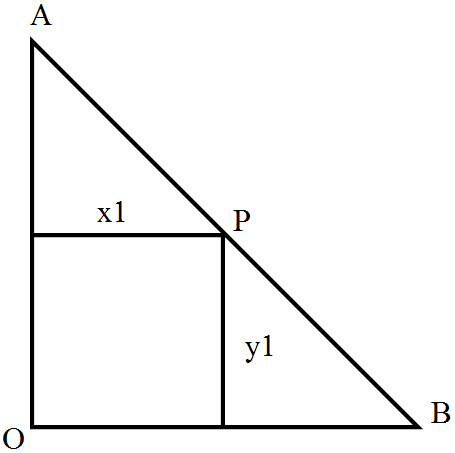 From above figure,
Assum e length AB = l
AP = a, PB = b
Assume $\overbrace{\text{ABQ}}=\theta$
So $\text{x}_1=\text{a}\cos\theta,\ \text{y}_1=\text{b}\sin\theta$
$\Rightarrow\Big(\frac{\text{x}_1}{\text{a}}\Big)^2+\Big(\frac{\text{y}_1}{\text{b}}\Big)^2=1$ View full question & answer→Question 324 Marks
Find the equation of the ellipse in the following case: eccentricity $\text{e}=\frac{1}{2}$ and foci $(\pm2, 0)$
AnswerLet the equation of the required ellipse be$\frac{\text{x}^2}{\text{a}^2}+\frac{\text{y}^2}{\text{b}^2}=1\ \dots(\text{i})$
The coordinates of the foci are $(\pm2, 0).$ This means that the major and minor axes of the ellipse are along x and y axes respectively and the coordinates of foci are $(\pm\text{ae, 0})$
$\therefore\text{ ae}=2$
$\Rightarrow\text{a}\times\frac{1}{2}=2$ $\big[\because\text{e}=\frac{1}{2}\big]$
$\Rightarrow\text{a}=4$
$\Rightarrow\text{a}^2=16$
Now, $\text{b}^2=\text{a}^2(1-\text{e}^2)$
$\Rightarrow\text{b}^2=(4)^2\bigg[1-\big(\frac{1}{2}\big)^2\bigg]$
$\Rightarrow\text{b}^2=16\big[1-\frac{1}{4}\big]$
$\Rightarrow\text{b}^2=16\times\frac{3}{4}=12$
Substituting the value of $\text{a}^2$ and $\text{b}^2$ in (i), we get
$\frac{\text{x}^2}{16}+\frac{\text{y}^2}{12}=1$
$\Rightarrow3\text{x}^2+4\text{y}^2=48$
required equation of ellipse.
View full question & answer→Question 334 Marks
Find the eccentricity, coordinates of foci, length of the latus-rectum of the following ellipse:$9\text{x}^2+25\text{y}^2=225$
Answer$\Rightarrow\frac{\text{x}^2}{25}+\frac{\text{y}^2}{9}=1$ This is of form $\frac{\text{x}^2}{\text{a}^2}+\frac{\text{y}^2}{\text{b}^2}=1,$ where $\text{a}^2=25$ and $\text{b}^2=9,\text{ i}.\text{e}.\text{ a}=5$ and $\text{b}=3.$ Clearly, a > b Now, $\text{e}=\sqrt{1-\frac{\text{a}^2}{\text{b}^2}}$ $\Rightarrow\text{e}=\sqrt{1-\frac{9}{25}}$ $\Rightarrow\text{e}=\sqrt{\frac{16}{25}}$ $\Rightarrow\text{e}=\frac{4}{{5}}$ Coordinates of the foci $=(\pm, 0)=(\pm4, 0)$ Length of the latus rectum $=\frac{2\text{a}^2}{\text{b}}$ $\\=\frac{2\times9}{5}$ $=\frac{{18}}{5}$
View full question & answer→Question 344 Marks
Find the equation to the ellipse in the following case: eccentricity $\text{e}=\frac{1}{2}$ and semi-major axis = $4$
AnswerLet the equation of the required ellipse be $\frac{\text{x}^2}{\text{a}^2}+\frac{\text{y}^2}{\text{b}^2}=1\ \dots(\text{i})$ Then, semi-major axis = a $\therefore\ \text{a}=4$
$\big[\because$ semi-major axis = 4$\big]$
$\Rightarrow\text{b}^2=16$ Now, $\text{b}^2=\text{a}^2\big(1-\text{e}^2\big)$
$\Rightarrow{\text{b}^2}=16\Big[1-\big(\frac{1}{2}\big)^2\Big]$
$\big[\because\text{e}=\frac{1}{2}\big]$
$\Rightarrow{\text{b}^2}=16\Big[1-\frac{1}{4}\Big]$
$\Rightarrow\text{b}^2=16\times\frac{3}{4}$
$\Rightarrow\text{b}^2=12$ Substituting the value of $a^2$ and $b^2$ in (i), we get $\frac{\text{x}^2}{16}+\frac{\text{y}^2}{12}=1$
$\Rightarrow3\text{x}^2+4\text{y}^2=48$ This is the equation of the required ellipse.
View full question & answer→Question 354 Marks
Find the equation of the ellips whose focus is in the following case:focus is (1, 2), directricx is 3x + 4y - 5 = 0 and $\text{e}=\frac{1}{2}.$
AnswerLet P (x, y) be a point on the ellipse. Then, by definition SP - e PM Here $\text{e}-\frac{1}{2},$ coordinates of S are (1, 2) and the eqation of directrix is 3x + 4y - 5 - 0 $\therefore\text{ SP}-\frac{1}{2}\text{ pm}$ $\Rightarrow\text{SP}^2-\frac{1}{4}(\text{PM})^2$ $\Rightarrow4\text{SP}^2-\text{PM}^2$ $\Rightarrow4\big[(\text{x}-1)^2+(\text{y}-2)^2\big]-\bigg[\frac{3\text{x}+4\text{y}-5}{\sqrt{3^2+4^2}}\bigg]^2$ $\Rightarrow\big[\text{x}^2+1-2\text{x}+\text{y}^2+4-4\text{y}\big]-\frac{(3\text{x}+4\text{y}-5)^2}{25}$ $\Rightarrow100\big[\text{x}^2+\text{y}^2-2\text{x}-4\text{y}+5\big]-(3\text{x}+4\text{y}-5)^2$ $\Rightarrow100\text{x}^2+100\text{y}-200\text{x}-400\text{y}+500=(3\text{x}+4\text{y}-5)^2$ $\Rightarrow10\text{x}^2+100\text{y}-200\text{x}-400\text{y}+500\\=(3\text{x})^2+(4\text{y})^2+(-5)^2+2\times3\text{x}\times4\text{y}\times(-5)+2\times(-5)\times3\text{x}$ $\Rightarrow100\text{x}^2+100\text{y}^2-200\text{x}-400\text{y}+500\\-9\text{x}^2+16\text{y}^2+25+24\text{xy}-40\text{y}-30\text{x}$ $\Rightarrow100\text{x}^2-9\text{x}^2+100\text{y}^2-16\text{y}^2-24\text{xy}-200\\+30\text{x}-400\text{y}+40\text{y}+500-25=0$ $\Rightarrow91\text{x}^2+84\text{y}^2-24\text{xy}-170\text{x}-360\text{y}+475-0$ This is the required equation of the ellipse.
View full question & answer→Question 364 Marks
Find the eccentricity, coordinates of foci, length of the latus-rectum of the following ellipse: $5\text{x}^2+4\text{y}^2=1$
Answer$\Rightarrow\frac{\text{x}^2}{\frac{1}{5}}+\frac{\text{y}^2}{\frac{1}{4}}=1$ This is of form $\frac{\text{x}^2}{\text{a}^2}+\frac{\text{y}^2}{\text{b}^2}=1,$ where $\text{a}^2=\frac{1}{5}$ and $\text{b}^2=\frac{1}{4},\text{ i}.\text{e}.\text{ a}=\frac{1}{\sqrt{5}}$and $\text{b}=\frac{1}{2}.$ Clearly b > a Now, $\text{e}=\sqrt{1-\frac{\text{a}^2}{\text{b}^2}}$ $\Rightarrow\text{e}=\sqrt{1-\frac{\frac{1}{5}}{\frac{1}{4}}}$ $\Rightarrow\text{e}=\sqrt{1-\frac{4}{5}}$ $\Rightarrow\text{e}=\frac{1}{\sqrt{5}}$ Coordinates of the foci $=(0, \pm\text{be})=\big (0, \pm\frac{1}{2\sqrt{5}}\big)$ Length of the latus rectum $=\frac{2\text{a}^2}{\text{b}}$ $\\=\frac{2\times\frac{1}{5}}{\frac{1}{2}}$ $=\frac{4}{5}$
View full question & answer→Question 374 Marks
Find the eccentricity, coordinates of foci, length of the latus-rectum of the following ellipse:$25\text{x}^2+16\text{y}^2=1600.$
Answer$\Rightarrow\frac{\text{x}^2}{64}+\frac{\text{y}^2}{100}=1$ This is of form $\frac{\text{x}^2}{\text{a}^2}+\frac{\text{y}^2}{\text{b}^2}=1,$ where $\text{a}^2=64$ and $\text{b}^2=100,$ i.e. $\text{ a}=8$ and $\text{b}=10.$ Clearly, b > a Now, $\text{e}=\sqrt{1-\frac{\text{a}^2}{\text{b}^2}}$ $\Rightarrow\text{e}=\sqrt{1-\frac{64}{100}}$ $\Rightarrow\text{e}=\sqrt{1-\frac{36}{100}}$ $\Rightarrow\text{e}=\frac{6}{{10}}$ or $\frac{3}{5}$ Coordinates of the foci $=(0, \pm 6)$ Length of the latus rectum= $\frac{2\text{a}^2}{\text{b}}$ $\\=\frac{2\times64}{10}$ $=\frac{{64}}{5}$
View full question & answer→Question 384 Marks
Find the eccentricity, coordinates of foci, length of the latus-rectum of the following ellipse: $4\text{x}^2+3\text{y}^2=1$
Answer$\Rightarrow\frac{\text{x}^2}{\frac{1}{4}}+\frac{\text{y}^2}{\frac{1}{3}}=1$ This is of form $\frac{\text{x}^2}{\text{a}^2}+\frac{\text{y}^2}{\text{b}^2}=1,$ where $\text{a}^2=\frac{1}{4}$ and $\text{b}^2=\frac{1}{3},\text{ i}.\text{e}.\text{ a}=\frac{1}{{2}}$ and $\text{b}=\frac{1}{\sqrt{3}}.$ Clearly b > a Now, $\text{e}=\sqrt{1-\frac{\text{a}^2}{\text{b}^2}}$ $\Rightarrow\text{e}=\sqrt{1-\frac{\frac{1}{4}}{\frac{1}{3}}}$ $\Rightarrow\text{e}=\sqrt{1-\frac{3}{4}}$ $\Rightarrow\text{e}=\frac{1}{{2}}$ Coordinates of the foci $=(0, \pm\text{be})=\big (0, \pm\frac{1}{2\sqrt{3}}\big)$ Length of the latus rectum= $\frac{2\text{a}^2}{\text{b}}$ $\\=\frac{2\times\frac{1}{4}}{\frac{1}{\sqrt{3}}}\\=\frac{\sqrt{3}}{2}$
View full question & answer→Question 394 Marks
A rod of length 12cm moves with its ends always touching the coordinate axes. Determine the equation of the locus of a point P on the rod, which is 3 cm from the end in contact with x-axis.
Answer
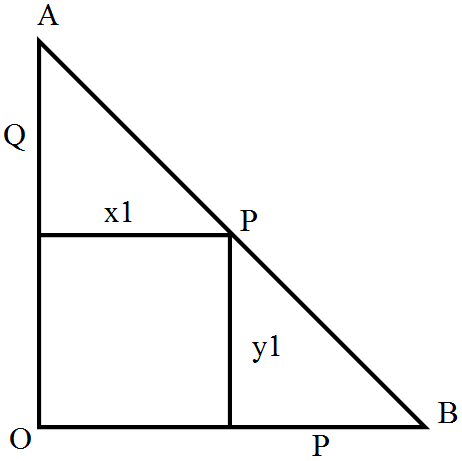 Using similar triangle principle, we can write
$\frac{\text{Q}}{9}=\frac{\text{y}_1}{3}$
$\text{Q}=3\text{y}_1$
Similarly, $\text{p}=\frac{\text{x}}{3}$
Point $\text{P}(\text{x,y})$
So $\text{OB}=\text{x}+\frac{\text{x}}{3}$
$\text{OA}=\text{y}+3\text{y}=4\text{y}$
Using Pythageorus theorem, we get
$(\text{4y})^2+\Big(\frac{4\text{x}}{3}\Big)^2=12^2$
$\frac{\text{y}^2}{9}+\frac{\text{x}^2}{81}=1$ is the equation of ellipse. View full question & answer→Question 404 Marks
Find the equation of an ellipse whose vertices are $(0,\pm10)$ and eccentricity $\text{e}=\frac{4}{5}.$
AnswerLet the equation of the ellipse be$\frac{\text{x}^2}{\text{b}^2}+\frac{\text{y}^2}{\text{b}^2}=1\ ,\dots(\text{i})$
The coordinates of vertices are $(0,\pm\text{b})$ i.e., $(0,\pm10).$
$\therefore\ \text{b}=10$
$\Rightarrow\text{b}^2=100$
Now, $\text{a}^2=\text{b}^2\big(1-\text{e}^2\big)$
$\Rightarrow\text{a}^2=100\Big[1-\Big(\frac{4}{5}\Big)^2\Big]$
$\Rightarrow\text{a}^2=100\Big[1-\frac{16}{25}\Big]$
$\Rightarrow\text{a}^2=100\Big[\frac{9}{25}\Big]$
$\Rightarrow\text{a}^2=4\times9=36$
Putting $\text{a}^2$ = 36 and $\text{b}^2$ = 100 in equation (i), we get$\frac{\text{x}^2}{36}+\frac{\text{y}^2}{100}=1$
$\Rightarrow\frac{100\text{x}^2+36\text{y}^2}{3600}=1$
$\Rightarrow100\text{x}^2+36\text{y}^2=3600$
this is the equation of the required ellipse.
View full question & answer→Question 414 Marks
Find the eccentricity, coordinates of foci, length of the latus-rectum of the following ellipes: $4\text{x}^2+9\text{y}^2=1$
Answer$\Rightarrow\frac{\text{x}^2}{\frac{1}{4}}+\frac{\text{y}^2}{\frac{1}{9}}=1$This is of the form $\frac{\text{x}^2}{\text{a}^2}+\frac{\text{y}^2}{\text{b}^2}=1,$ where $\text{a}^2=\frac{1}{4}$ and $\text{b}^2=\frac{1}{9},\text{ i}.\text{e}.\text{a}=\frac{1}{2}$and $\text{b}=\frac{1}{3}.$
Clearly a > b
Now, $\text{e}=\sqrt{1-\frac{\text{b}^2}{\text{a}^2}}$
$\Rightarrow\text{e}=\sqrt{1-\frac{\frac{1}{9}}{\frac{1}{4}}}$
$\Rightarrow\text{e}=\sqrt{1-\frac{4}{9}}$
$\Rightarrow\text{e}=\frac{\sqrt{5}}{3}$
Coordinates of the foci $=(\pm\text{ae, 0})=\Big(\pm\frac{\sqrt{5}}{6},0\Big)$
Length of the latus rectum $=\frac{2\text{b}^2}{\text{a}}$
$=\frac{2\times\frac{1}{9}}{\frac{1}{2}}$
$=\frac{4}{9}$
View full question & answer→