Questions

(Each question 2 marks)

Take a timed test

21 questions · self-marked practice — reveal the answer and mark yourself.

Question 12 Marks
A point R with x-coordinate 4 lies on the line segment joining the points P(2, -3, 4) and Q (8, 0, 10). Find the coordinates of the point R.
[Hint Suppose R divides PQ in the ratio k : 1. The coordinates of the point R are given by $\left(\frac{8 k+2}{k+1}, \frac{-3}{k+1}, \frac{10 k+4}{k+1}\right)$].
Answer
Let R (4, y, z) be any point which divides the join P(2, -3, 4) and Q (8, 0, 10) in the ratio k : 1 internally.
$\therefore$ Coordinates of R is $\left( {\frac{{8k + 2}}{{k + 1}},\frac{{ - 3}}{{k + 1}},\frac{{10k + 4}}{{k + 1}}} \right)$
But x coordinate of R is 4
$\therefore \frac{{8k + 2}}{{k + 1}} = 4 \Rightarrow$ 8k + 2 = 4k + 5 $\Rightarrow k = \frac{1}{2}$
$\therefore y = \frac{{ - 3}}{{\frac{1}{2} + 1}} = \frac{{ - 3}}{{\frac{3}{2}}} = - 2$
$z = \frac{{\frac{{10 \times 1}}{2} + 4}}{{\frac{1}{2} + 1}} = \frac{9}{{\frac{3}{2}}} = 6$
Thus coordinates of R is (4, -2, 6).
View full question & answer
Question 22 Marks
Find the coordinates of a point on y-axis which are at a distance of $5 \sqrt2$ from the point P(3, -2, 5).
Answer
Let Q (0, y, 0) be any point on y-axis.
$PQ = \sqrt {{{(0 - 3)}^2} + {{(y + 2)}^2} + {{(0 - 5)}^2}}$
$= \sqrt {9 + {y^2} + 4 + 4y + 25} = \sqrt {{y^2} + 4y + 38}$
But $\sqrt {{y^2} + 4y + 38} = 5\sqrt 2$
Squaring both sides, we have
$y^2+4 y+38=50$
$\Rightarrow y^2+4 y-12=0$
$\Rightarrow(y-2)(y+6)=0$
$\Rightarrow y=2,-6$
Thus coordinates of point $Q$ are $(0,2,0)$ and $(0,-6,0)$
View full question & answer
Question 32 Marks
If the origin is the centriod of the triangle PQR with vertices P(2a, 2, 6), Q(-4, 3b, -10) and R(8, 14, 2c), then find the values of a, b and c.
Answer
Here P(2a, 2, 6), $Q( - 4,3b, - 10)$ and R(8, 14, 2c) are vertices of triangle PQR.
$\therefore$ Coordinates of centriod of $\Delta PQR$ is $\left( {\frac{{2a - 4 + 8}}{3},\frac{{2 + 3b + 14}}{3},\frac{{6 - 10 + 2c}}{3}} \right)$
$ = \left( {\frac{{2a +4}}{3},\frac{{3b + 16}}{3},\frac{{2c - 4}}{3}} \right)$
But is it given that coordinates of centroid is (0, 0, 0)
$\frac{{2a + 4}}{3} = 0 \Rightarrow$ 2a + 4 = 0 $\therefore$ a = -2
$\frac{{3b + 16}}{3} = 0 \Rightarrow$ 3b + 16 = 0 $\Rightarrow b = \frac{{ - 16}}{3}$
$\frac{{2c - 4}}{3} = 0 \Rightarrow$ 2c - 4 = 0 $\Rightarrow$ c = 2
View full question & answer
Question 42 Marks
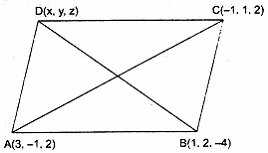
Three vertices of a parallelogram ABCD are A(3, -1, 2), B(1, 2, -4) and C(-1, 1, 2). Find the coordinates of the fourth vertex.
Answer
Let D (x, y, z) be the fourth vertex of parallelogram ABCD.
We know that diagonals of a parallelogram bisect each other. So the mid points of AC and BD coincide.

$\therefore$ Coordinates of mid point of AC $\left( {\frac{{3 - 1}}{2},\;\frac{{ - 1 + 1}}{2},\;\frac{{2 + 2}}{2}} \right)$
= (1, 0, 2)
Also coordinates of mid point of BD $\left( {\frac{{x + 1}}{2},\;\frac{{y + 2}}{2},\;\frac{{z - 4}}{2}} \right)$
$\therefore$ $\frac{{x + 1}}{2} = 1$ $\Rightarrow$ x + 1 = 2 $\Rightarrow$ x = 1
$\frac{{y + 2}}{2} = 0$ $\Rightarrow$ y + 2= 0 $\Rightarrow$ y = -2
$\frac{{z - 4}}{2} = 2$ $\Rightarrow$ z - 4 = 4 $\Rightarrow$ z = 8
Thus the coordinates of point D are (1, -2, 8)
View full question & answer
Question 52 Marks
Find the ratio in which the YZ-plane divides the line segment formed by joining the points (-2, 4, 7) and (3, - 5, 8).
Answer
Let the line joining the points A(-2, 4, 7) and B(3, -5, 8) be divided by the yz plane at a point C in the ration k : 1.
Then coordinates of C are $\left( {\frac{{3k - 2}}{{k + 1}},\;\frac{{ - 5k + 4}}{{k + 1}},\;\frac{{8k + 7}}{{k + 1}}} \right)$
Since the point C lies on yz-plane so x = 0
$\therefore \frac{{3k - 2}}{{k + 1}} = 0 \Rightarrow 3k - 2 = 0 \Rightarrow k = \frac{2}{3}$
Thus the required ratio is $\frac{2}{3}:1$ i.e. 2 : 3.
View full question & answer
Question 62 Marks
Given that P(3,2, -4), Q(5, 4, -6) and R(9, 8, -10) are collinear. Find the ratio in which Q divides PR.
Answer
Let Q(5, 4, -6) divides the line segment joining points P(3, 2, -4) and R(9, 8, -10) in the ratio k : 1 internally.
$\therefore$ Then coordinates of Q are $\left( {\frac{{9k + 3}}{{k + 1}},\;\frac{{8k + 2}}{{k + 1}},\;\frac{{ - 10k - 4}}{{k + 1}}} \right)$
But it is given that coordinates of Q is (5, 4, -6)
$\therefore \frac{{9k + 3}}{{k + 1}}=5 \ \Rightarrow$ 9k + 3 = 5

$\Rightarrow 9k+3=5(k+1)\\ \Rightarrow 9k+3=5k+5 \\ \Rightarrow 4k=2\\ \Rightarrow k=\frac{1}{2} $
Thus Q divides the line segment joining points P and R in the ratio $\frac{1}{2}:1$ i.e. 1 : 2 internally.

View full question & answer
Question 72 Marks
Find the coordinates of the point which divides the line segment joining the points (-2, 3, 5) and (1, -4, 6) in the ratio 2 : 3 externally.
Answer
Let P (x, y, z) be any point which divides the line segment joining points A(-2, 3, 5) and B(1, -4, 6) in the ratio 2 : 3 externally.
Then
x = $\frac{{2 \times 1 + ( - 3) \times - 2}}{{2 + ( - 3)}} = \frac{{2 + 6}}{{ - 1}} = - 8$
y = $\frac{{2 \times - 4 + ( - 3) \times 3}}{{2 + ( - 3)}} = \frac{{ - 8 - 9}}{{ - 1}} = 17$
z = $\frac{{2 \times 6 + ( - 3) \times 5}}{{2 + ( - 3)}} = \frac{{12 - 15}}{{ - 1}} = 3$
$\therefore$ Coordinates of P are (-8, 17, 3)
View full question & answer
Question 82 Marks
Find the coordinates of the point which divides the line segment joining the points (-2, 3, 5) and (1, -4, 6) in the ratio 2 : 3 internally.
Answer
Let P(x, y, z) be any point which divides the line segment joining points A(-2, 3, 5) and B(1, -4, 6) in the ratio 2 : 3 internally.
Then x = $ \frac{{2 \times 1 + 3 \times - 2}}{{2 + 3}} = \frac{{2 - 6}}{5} = \frac{{ - 4}}{5}$
y = $\frac{{2 \times - 4 + 3 \times 3}}{{2 + 3}} = \frac{{ - 8 + 9}}{5} = \frac{1}{5}$
z = $\frac{{2 \times 6 + 3 \times 5}}{{2 + 3}} = \frac{{12 + 15}}{5} = \frac{{27}}{5}$
$\therefore$ Coordinates of P are$\left( {\frac{{ - 4}}{5},\frac{1}{5},\frac{{27}}{5}} \right)$.
View full question & answer
Question 92 Marks
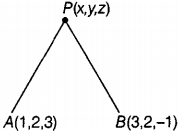
Find the equation of the set of points which are equidistance from the points (1, 2, 3) and (3, 2, -1).
Answer
Let a point P(x, y, z) be equidistant from the points A(1, 2, 3) and P(3, 2, -1).
Then, $P A = \sqrt { ( x - 1 ) ^ { 2 } + ( y - 2 ) ^ { 2 } + ( z - 3 ) ^ { 2 } }$
[$\because$ distance $= \sqrt { \left( x _ { 1 } - x _ { 2 } \right) ^ { 2 } + \left( y _ { 1 } - y _ { 2 } \right) ^ { 2 } + \left( z _ { 1 } - z _ { 2 } \right) ^ { 2 } } ]$
$= \sqrt { x ^ { 2 } - 2 x + 1 + y ^ { 2 } - 4 y + 4 + z ^ { 2 } - 6 z + 9 }$
and $P B = \sqrt { ( x - 3 ) ^ { 2 } + ( y - 2 ) ^ { 2 } + ( z + 1 ) ^ { 2 } }$
[$\because$ distance $= \sqrt { \left( x _ { 1 } - x _ { 2 } \right) ^ { 2 } + \left( y _ { 1 } - y _ { 2 } \right) ^ { 2 } + \left( z _ { 1 } - z _ { 2 } \right) ^ { 2 } } ]$
$= \sqrt { x ^ { 2 } - 6 x + 9 + y ^ { 2 } - 4 y + 4 + z ^ { 2 } + 2 z + 1 }$
$= \sqrt { x ^ { 2 } + y ^ { 2 } + z ^ { 2 } - 6 x - 4 y + 2 z + 14 }$
According to the question, PA = PB
$\therefore \sqrt { x ^ { 2 } + y ^ { 2 } + z ^ { 2 } - 2 x - 4 y - 6 z + 14 }$
$= \sqrt { x ^ { 2 } + y ^ { 2 } + z ^ { 2 } - 6 x - 4 y + 2 z + 14 }$

On squaring both sides, we get
$x^2 + y^2 + z^2 - 2x - 4y - 6z + 14 = x^2 + y^2 + z^2 - 6x - 4y + 2z + 14$
$\Rightarrow$ 4x - 8z = 0
$\Rightarrow$ x - 2z = 0 [dividing both sides by 4]
View full question & answer
Question 102 Marks
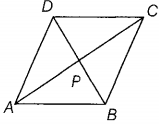
Verify that (-1, 2, 1), (1, -2, 5), (4, -7, 8) and (2, -3, 4) are the vertices of a parallelogram.
Answer

Let A (-1, 2, 1), B(1, - 2, 5), C(4, - 7, 8) and D (2, - 3 , 4) are the vertices of a quadrilateral ABCD.

Then, mid-point of
$A C = \left( \frac { - 1 + 4 } { 2 } , \frac { 2 - 7 } { 2 } , \frac { 1 + 8 } { 2 } \right) = \left( \frac { 3 } { 2 } , \frac { - 5 } { 2 } , \frac { 9 } { 2 } \right)$$\left[ { \because \text { coordinates of mid-point } } { \left( \frac { x _ { 1 } + x _ { 2 } } { 2 } , \frac { y _ { 1 } + y _ { 2 } } { 2 } , \frac { z _ { 1 } + z _ { 2 } } { 2 } \right) } \right]$
Similarly, mid-point of BD $= \left( \frac { 3 } { 2 } , - \frac { 5 } { 2 } , \frac { 9 } { 2 } \right)$
Mid-points of both the diagonals are the same (i.e., they bisect each other).
Hence, ABCD is a parallelogram.

View full question & answer
Question 112 Marks
Verify that (0, 7, 10), (-1, 6, 6) and (-4, 9, 6) are the vertices of a right-angled triangle.
Answer
Let A(0, 7, 10), B(-1, 6, 6) and C(-4, 9, 6) be three vertices of triangle ABC. Then
$AB = \sqrt {{{( - 1 - 0)}^2} + {{(6 - 7)}^2} + {{(6 - 10)}^2}}$$= \sqrt {1 + 1 + 16} = \sqrt {18}$
$BC = \sqrt {{{( - 4 + 1)}^2} + {{(9 - 6)}^2} + {{(6 - 6)}^2}}$$= \sqrt {9 + 9 + 0} = \sqrt {18} $
$AC = \sqrt {{{( - 4 - 0)}^2} + {{(9 - 7)}^2} + {{(6 - 10)}^2}}$$ = \sqrt {16 + 4 + 16} = \sqrt {36} $
$Now,(AB)^2=18,(BC)^2=18,(AC)^2=36\\ \therefore (AC)^2=(AB)^2+(BC)^2$
Hence, ∆ABC is a right-angled triangle.
View full question & answer
Question 122 Marks
Verify that (0, 7, -10), (1, 6, -6) and (4, 9, -6) are the vertices of an isosceles triangle.
Answer
Let A(0, 7, -10), B(1, 6, -6) and C(4, 9, -6) be three vertices of triangle ABC. Then
$AB = \sqrt {{{(1 - 0)}^2} + {{(6 - 7)}^2} + {{( - 6 + 10)}^2}}$$ = \sqrt {1 + 1 + 16} = \sqrt {18} = 3\sqrt 2$
$BC = \sqrt {{{(4 - 1)}^2} + {{(9 - 6)}^2} + {{( - 6 + 6)}^2}}$$ = \sqrt {9 + 9 + 0} = \sqrt {18} = 3\sqrt 2$
$AC = \sqrt {{{(4 - 0)}^2} + {{(9 - 7)}^2} + {{( - 6 + 10)}^2}}$$= \sqrt {16 + 4 + 16} = \sqrt {36} = 6$
Now AB = BC
Thus, ABC is an isosceles triangle.
View full question & answer
Question 132 Marks
Show that the points (-2, 3, 5), (1, 2, 3) and (7, 0, -1) are collinear.
Answer
Let A(-2, 3, 5), B (1, 2, 3) and C(7, 0, -1) be three given points.
Then $AB = \sqrt {{{(1 + 2)}^2} + {{(2 - 3)}^2} + {{(3 - 5)}^2}}$ $ = \sqrt {9 + 1 + 4} = \sqrt {14}$
$BC = \sqrt {{{(7 - 1)}^2} + {{(0 - 2)}^2} + {{( - 1 - 3)}^2}}$ $= \sqrt {36 + 4 + 16} = \sqrt {56} = 2\sqrt {14}$
$AC = \sqrt {{{(7 + 2)}^2} + {{(0 - 3)}^2} + {{( - 1 - 5)}^2}}$$= \sqrt {81 + 9 + 36} = \sqrt {126} = 3\sqrt {14}$
Now AC = AB + BC

Therefore,A,B,C are collinear.

View full question & answer
Question 142 Marks
Find the coordinates of the centroid of the triangle whose vertices are $(x_1 , y_1 , z_1 ), (x_2 , y_2 , z_2 )$ and $(x_3 , y_3 , z_3 )$.
Answer
Let ABC be the triangle. Let the coordinates of the vertices A, B, C be $(x_1, y_1, z_1 ), (x_2, y_2, z_2)$ and $(x_3, y_3, z_3)$, respectively. Let D be the mid-point of BC.
Hence coordinates of D are
$\left(\frac{x_{2}+x_{3}}{2}, \frac{y_{2}+y_{3}}{2}, \frac{z_{2}+z_{3}}{2}\right)$
Let G be the centroid of the triangle.
Therefore, it divides the median AD in the ratio 2:1.
Hence, the coordinates of G are
$\left(\frac{2\left(\frac{x_{2}+x_{3}}{2}\right)+x_{1}}{2+1}, \frac{2\left(\frac{y_{2}+y_{3}}{2}\right)+y_{1}}{2+1}, \frac{2\left(\frac{z_{2}+z_{3}}{2}\right)+z_{1}}{2+1}\right)$
Centroid(G) = $\left(\frac{x_{1}+x_{2}+x_{3}}{3}, \frac{y_{1}+y_{2}+y_{3}}{3}, \frac{z_{1}+z_{2}+z_{3}}{3}\right)$
View full question & answer
Question 152 Marks
Using section formula, prove that the three points (– 4, 6, 10), (2, 4, 6) and (14, 0, –2) are collinear.
Answer
Let A (– 4, 6, 10), B (2, 4, 6) and C(14, 0, – 2) be the given points. Let the point P divides AB in the ratio k : 1. Then coordinates of the point P are
$\frac{2 k-4}{k+1}, \frac{4 k+6}{k+1}, \frac{6 k+10}{k+1}$ [using section formula]
Let us examine whether, for some value of k, the point P coincides with point C.
On putting $\frac{2 k-4}{k+1}=14$, we get $k=-\frac{3}{2}$
When $k=-\frac{3}{2}, \text { then } \frac{4 k+6}{k+1}=\frac{4\left(-\frac{3}{2}\right)+6}{-\frac{3}{2}+1}=0$
and $\frac{6 k+10}{k+1}=\frac{6\left(-\frac{3}{2}\right)+10}{-\frac{3}{2}+1}=-2$
Therefore, C (14, 0, –2) is a point that divides AB externally in the ratio 3 : 2 and is the same as P.

Hence A, B, C are collinear.

View full question & answer
Question 162 Marks
Find the coordinates of the point which divides the line segment joining the points (1, –2, 3) and (3, 4, –5) in the ratio 2 : 3 externally.
Answer
Let P (x, y, z) be the point which divides segment joining A (1, –2, 3) and B (3, 4, –5) externally in the ratio 2 : 3. Then
$x=\frac{2(3)+(-3)(1)}{2+(-3)}=-3, \quad y=\frac{2(4)+(-3)(-2)}{2+(-3)}=-14, z=\frac{2(-5)+(-3)(3)}{2+(-3)}=19$ [using section formula]
Therefore, the required point is (–3, –14, 19).
View full question & answer
Question 172 Marks
Find the coordinates of the point which divides the line segment joining the points (1, –2, 3) and (3, 4, –5) in the ratio 2 : 3 internally.
Answer
Let P (x, y, z) be the point which divides the line segment joining A(1, – 2, 3) and B (3, 4, –5) internally in the ratio 2 : 3. Therefore
$x=\frac{2(3)+3(1)}{2+3}=\frac{9}{5}, y=\frac{2(4)+3(-2)}{2+3}=\frac{2}{5}, z=\frac{2(-5)+3(3)}{2+3}=\frac{-1}{5}$ [using section formula]
Thus, the required point is $\left(\frac{9}{5}, \frac{2}{5}, \frac{-1}{5}\right)$
View full question & answer
Question 182 Marks
Find the distance between the points P(1, –3, 4) and Q (– 4, 1, 2).
Answer
The distance PQ between the points P (1,–3, 4) and Q (– 4, 1, 2) is
$P Q=\sqrt{(-4-1)^{2}+(1+3)^{2}+(2-4)^{2}}$ [using distance formula]
$=\sqrt{25+16+4}$
$=\sqrt{45}=3 \sqrt{5} $units
View full question & answer
Question 192 Marks
The centroid of a triangle ABC is at the point (1, 1, 1). If the coordinates of A and B are (3, –5, 7) and (–1, 7, – 6), respectively, find the coordinates of the point C.
Answer
Let the coordinates of C be (x, y, z) and the coordinates of the centroid G be (1, 1, 1). Then
$\frac{x+3-1}{3}=1, $ $\Rightarrow$ x = 1

$\frac{y-5+7}{3}=1, $ $\Rightarrow$ y = 1

$\frac{z+7-6}{3}=1,$ $\Rightarrow$ z= 2
Hence, coordinates of C are (1, 1, 2).

View full question & answer
Question 202 Marks
Find the equation of the set of the points P such that its distances from the points A (3, 4, –5) and B (– 2, 1, 4) are equal.
Answer
If P (x, y, z) be any point such that PA = PB.
Now $\sqrt{(x-3)^{2}+(y-4)^{2}+(z+5)^{2}}=\sqrt{(x+2)^{2}+(y-1)^{2}+(z-4)^{2}}$ [using distance formula]
Squaring both the sides, we get
or $(x-3)^{2}+(y-4)^{2}+(z+5)^{2}=(x+2)^{2}+(y-1)^{2}+(z-4)^{2}$
or $10 x+6 y-18 z-29=0$
View full question & answer
Question 212 Marks

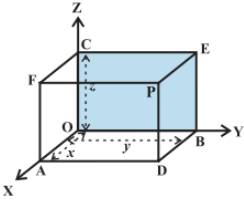
In Fig, if P is (2,4,5), find the coordinates of F.

Answer
For the point F, the distance measured along OY is zero.
Hence,, the coordinates of F are (2,0,5).
View full question & answer