Questions

(Each question 3 marks)

Take a timed test

10 questions · self-marked practice — reveal the answer and mark yourself.

Question 13 Marks
If A and B be the points $(3, 4, 5)$ and $(-1, 3, -7)$, respectively, find the equation of the set of points P such that $PA^2 + PB^2 = k^2$, where k is a constant.
Answer
The equation of the set of points $P$ such that $\mathrm{PA}^2+\mathrm{PB}^2=\mathrm{k}^2$, where k is a constant
Given: The points $A(3,4,5)$ and $B(-1,3,-7)$
$\Rightarrow x_1=3, y_1=4, z_1=5 ; x_2=-1, y_2=3, z_2=-7 ;$
$P A^2+P B^2=k^2 \ldots(i)$
Let the point be $P(x, y, z)$.
Now, by Distance Formula, we know that the distance between two points $P\left(x_1, y_1, z_1\right)$ and $Q\left(x_2, y_2, z_2\right)$ is given by
$\mathrm{PQ}=\sqrt{\left(\mathrm{x}_2-\mathrm{x}_1\right)^2+\left(\mathrm{y}_2-\mathrm{y}_1\right)^2+\left(\mathrm{z}_2-\mathrm{z}_1\right)^2}$
So, PA $=\sqrt{(3-x)^2+(4-y)^2+(5-z)^2}$
And $P B=\sqrt{(-1-x)^2+(3-y)^2+(-7-z)^2}$
Now, substituting these values in (i), we have
${\left[(3-x)^2+(4-y)^2+(5-z)^2\right]+\left[(-1-x)^2+(3-y)^2+(-7-z)^2\right]=k^2}$
$\Rightarrow\left[\left(9+x^2-6 x\right)+\left(16+y^2-8 y\right)+\left(25+z^2-10 z\right)\right]+\left[\left(1+x^2+2 x\right)+\left(9+y^2-6 y\right)+\left(49+z^2+14 z\right)\right]=k^2$
$\Rightarrow 9+x^2-6 x+16+y^2-8 y+25+z^2-10 z+1+x^2+2 x+9+y^2-6 y+49+z^2+14 z=k^2$
$\Rightarrow 2 x^2+2 y^2+2 z^2-4 x-14 y+4 z+109=k^2$
$\Rightarrow 2 x^2+2 y^2+2 z^2-4 x-14 y+4 z=k^2-109$
$\Rightarrow 2\left(x^2+y^2+z^2-2 x-7 y+2 z\right)=k^2-109$
$\Rightarrow x^2+y^2+z^2-2 x-7 y+2 z=\frac{k^2-109}{2}$
View full question & answer
Question 23 Marks
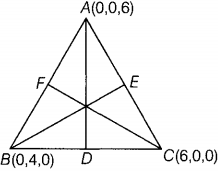
Find the length of the medians of the triangle with vertices A (0, 0, 6), B (0, 4, 0) and C (6, 0, 0).
Answer

ABC is a triangle with vertices A (0, 0, 6), (0, 4, 0) and C (6, 0, 0).
Let points D, E and F are the mid-points of BC, AC and AB, respectively. So, AD, BE and CF will be the medians of the triangle.

Coordinates of point $D = \left( \frac { 0 + 6 } { 2 } , \frac { 4 + 0 } { 2 } , \frac { 0 + 0 } { 2 } \right)$ = (3, 2, 0)
$\left[ { \because \text { coordinates of mid-point } } { \left( \frac { x _ { 1 } + x _ { 2 } } { 2 } , \frac { y _ { 1 } + y _ { 2 } } { 2 } , \frac { z _ { 1 } + z _ { 2 } } { 2 } \right) } \right]$
Coordinates of point $E = \left( \frac { 0 + 6 } { 2 } , \frac { 0 + 0 } { 2 } , \frac { 6 + 0 } { 2 } \right)$ = (3, 0, 3)
and coordinates of point$F = \left( \frac { 0 + 0 } { 2 } , \frac { 0 + 4 } { 2 } , \frac { 6 + 0 } { 2 } \right) = ( 0,2,3 )$
Now, length of median
AD = Distance between point A and D
$A D = \sqrt { ( 0 - 3 ) ^ { 2 } + ( 0 - 2 ) ^ { 2 } + ( 6 - 0 ) ^ { 2 } }$
[$\because$ distance $= \sqrt { \left( x _ { 1 } - x _ { 2 } \right) ^ { 2 } + \left( y _ { 1 } - y _ { 2 } \right) ^ { 2 } + \left( z _ { 1 } - z _ { 2 } \right) ^ { 2 } } ]$
$= \sqrt { 9 + 4 + 36 }$
$= \sqrt { 49 } = 7$
Similarly, $B E = \sqrt { ( 0 - 3 ) ^ { 2 } + ( 4 - 0 ) ^ { 2 } + ( 0 - 3 ) ^ { 2 } }$
$= \sqrt { 9 + 16 + 9 } = \sqrt { 34 }$
and $C F = \sqrt { ( 6 - 0 ) ^ { 2 } + ( 0 - 2 ) ^ { 2 } + ( 0 - 3 ) ^ { 2 } }$
$= \sqrt { 36 + 4 + 9 } = \sqrt { 49 } = 7$
Hence, length of the medians are 7, $\sqrt { 34 }$ and 7.

View full question & answer
Question 33 Marks
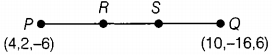
Find the coordinates of the points which trisect the line segment joining the points P(4, 2, -6) and Q(10, -16, 6).
Answer

Let R and S be two points which trisect the joining of P and Q.
PR = RS = SQ

Point R divide the join of PQ in the ratio 1:2.
$\therefore$ Coordinates of R are
$\left[ \frac { 1 ( 10 ) + 2 ( 4 ) } { 1 + 2 } , \frac { 1 ( - 16 ) + 2 ( 2 ) } { 1 + 2 } , \frac { 1 ( 6 ) + 2 ( - 6 ) } { 1 + 2 } \right]$
$= \left( \frac { 10 + 8 } { 3 } , \frac { - 16 + 4 } { 3 } , \frac { 6 - 12 } { 3 } \right) = \left( \frac { 18 } { 3 } , \frac { - 12 } { 3 } , \frac { - 6 } { 3 } \right)$
= (6, -4, -2)
Also, point S divides the join of PQ in the ratio 2:1.
$\therefore$ Coordinates of S are
$\left[ \frac { 2 ( 10 ) + 1 ( 4 ) } { 1 + 2 } , \frac { 2 ( - 16 ) + 1 ( 2 ) } { 1 + 2 } , \frac { 2 ( 6 ) + 1 ( - 6 ) } { 1 + 2 } \right]$
$= \left( \frac { 20 + 4 } { 3 } , \frac { - 32 + 2 } { 3 } , \frac { 12 - 6 } { 3 } \right)$
$= \left( \frac { 24 } { 3 } , \frac { - 30 } { 3 } , \frac { 6 } { 3 } \right) $= ( 8 , - 10,2 )

View full question & answer
Question 43 Marks
Using section formula, show that the points A(2, -3, 4)b(-1, 2, 1) and $C\left( {0,\frac{1}{3},2} \right)$ are collinear.
Answer
Let the points b(-1, 2, 1) divides the join of A(2, -3, 4) and $C\left( {0,\frac{1}{3},2} \right)$ in the ratio k : 1 internally.
Then coordinates of B are $\left( {\frac{2}{{k + 1}},\;\frac{{\frac{1}{3}k - 3}}{{k + 1}},\;\frac{{2k + 4}}{{k + 1}}} \right)$
Now, $\frac{2}{{k + 1}} = - 1 \Rightarrow 2 = - k - 1 \Rightarrow k = - 3$
Thus the point B divides the join of A and C in the ratio -3:1 so points A, B, C are collinear.
View full question & answer
Question 53 Marks
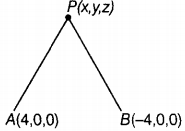
Find the equation of the set of the point P, the sum of whose distance from $A(4, 0, 0)$ and $B(-4, 0, 0)$ is equal to 10.
Answer
Let a point $P(x, y, z)$ such that $PA + PB = 10$

$\Rightarrow \sqrt { ( x - 4 ) ^ { 2 } + ( y - 0 ) ^ { 2 } + ( z - 0 ) ^ { 2 } }$$+ \sqrt { ( x + 4 ) ^ { 2 } + ( y - 0 ) ^ { 2 } + ( z - 0 ) ^ { 2 } } = 10$
[$\because$ distance $= \sqrt { \left( x _ { 1 } - x _ { 2 } \right) ^ { 2 } + \left( y _ { 1 } - y _ { 2 } \right) ^ { 2 } + \left( z _ { 1 } - z _ { 2 } \right) ^ { 2 } } ]$
$\Rightarrow \sqrt { x ^ { 2 } - 8 x + 16 + y ^ { 2 } + z ^ { 2 } }$$+ \sqrt { x ^ { 2 } + 8 x + 16 + y ^ { 2 } + z ^ { 2 } } = 10$
$\Rightarrow \sqrt { x ^ { 2 } + y ^ { 2 } + z ^ { 2 } - 8 x + 16 }$$= 10 - \sqrt { x ^ { 2 } + y ^ { 2 } + z ^ { 2 } + 8 x + 16 }$
On squaring sides, we get
$x^2 + y^2 + z^2 - 8x +16 = 100 + x^2 + y^2 + z^2 + 8x +16$
$- 20 \sqrt { x ^ { 2 } + y ^ { 2 } + z ^ { 2 } + 8 x + 16 }$
$\Rightarrow - 16 x - 100 = - 20 \sqrt { x ^ { 2 } + y ^ { 2 } + z ^ { 2 } + 8 x + 16 }$
$\Rightarrow \quad 4 x + 25 = 5 \sqrt { x ^ { 2 } + y ^ { 2 } + z ^ { 2 } + 8 x + 16 }$ [dividing both sides by -4]
Again squaring on both sides, we get
$16x^2 + 200x + 625 = 25(x^2 + y^2 + z^2 + 8x + 16)$
$\Rightarrow 16x^2 + 200x + 625 = 25x^2 + 25y^2 + 25z^2 + 200x + 400$
$\Rightarrow 9x^2 + 25y^2 + 25z^2 - 225 =0$
View full question & answer
Question 63 Marks
Find the equation of the set of points $P$ such that $PA^2 + PB^2 =2k^2$, where $A$ and $B$ are the points $(3, 4, 5)$ and $(-1, 3, -7)$, respectively.
Answer
Given points are $A(3,4,5)$ and $B(-1,3,-7)$.
Let the coordinates of point P be ( $\mathrm{x}, \mathrm{y}, \mathrm{z}$ ).
Here, $\mathrm{PA}^2=(3-x)^2+(4-y)^2+(5-z)^2$
$\left[\because\right.$ distance between two points $\left.=\sqrt{\left(x_2-x_1\right)^2+\left(y_2-y_1\right)^2+\left(z_2-z_1\right)^2}\right]$ and $\mathrm{PB}^2=(-1-\mathrm{x})^2+(3-\mathrm{y})^2+(-7-\mathrm{z})^2$
By the given condition, $\mathrm{PA}^2+\mathrm{PB}^2=2 \mathrm{k}^2$, we have
$(3-x)^2+(4-y)^2+(5-z)^2+(-1-x)^2+(3-y)^2+(-7-z)^2=2 k^2$
$\Rightarrow x^2+9-6 x+y^2+16-8 y+z^2+25-10 z+x^2+2 x+1+y^2+9-6 y+z^2+49+14 z=2 k^2$
$\Rightarrow 2 x^2+2 y^2+2 z^2-4 x-14 y+4 z=2 k^2-109$
View full question & answer
Question 73 Marks
Are the points $A(3, 6, 9), B(10, 20, 30)$ and $C(25, -41, 5)$, the vertices of a right-angled triangle?
Answer
Given: $A(3,6,9), B(10,20,30)$ and $C(25,-41,5)$,
According to the distance formula, we have
$A B^2=(10-3)^2+(20-6)^2+(30-9)^2$
$=49+196+441=686$
$B C^2=(25-10)^2+(-41-20)^2+(5-30)^2$
$=225+3721+625=4571$
$\text { and } C A^2=(3-25)^2+(6+41)^2+(9-5)^2$
$=484+2209+16=2709$
We observe that, $C A^2+A B^2 \neq B C^2$
Hence, the $\triangle \mathrm{ABC}$ is not a right angled triangle.
View full question & answer
Question 83 Marks
Show that the points P (–2, 3, 5), Q (1, 2, 3) and R (7, 0, –1) are collinear.
Answer
We know that points are said to be collinear if they lie on a line
Now, $\mathrm{PQ}=\sqrt{(1+2)^{2}+(2-3)^{2}+(3-5)^{2}}=\sqrt{9+1+4}=\sqrt{14}$
$\mathrm{QR}=\sqrt{(7-1)^{2}+(0-2)^{2}+(-1-3)^{2}}=\sqrt{36+4+16}=\sqrt{56}=2 \sqrt{14}$
and $\mathrm{PR}=\sqrt{(7+2)^{2}+(0-3)^{2}+(-1-5)^{2}}=\sqrt{81+9+36}=\sqrt{126}=3 \sqrt{14}$
Thus, PQ + QR = PR
Hence, P, Q and R are collinear.
View full question & answer
Question 93 Marks
Show that the points A (1, 2, 3), B(-1, -2, -1), C(2, 3, 2) and D(4, 7, 6) are the vertices of a parallelogram ABCD, but it is not a rectangle.
Answer
To show ABCD is a parallelogram we need to show opposite side are equal

Note that
$AB = \sqrt {{{(-1 - 1)}^2} + {{( - 2 - 2)}^2} + {{(-1 - 3)}^2}}$$ = \sqrt {4 + 16 + 16} = \sqrt {36} = 6$
$BC = \sqrt {{{(2 + 1)}^2} + {{( 3 + 2)}^2} + {{(2 + 1)}^2}}$$= \sqrt {9 + 25 + 9} = \sqrt {43}$
$CD = \sqrt {{{(4 - 2)}^2} + {{( 7 -3)}^2} + {{(6-2)}^2}}$$ = \sqrt {4 + 16 + 16} = \sqrt {36} = 6$
$DA = \sqrt {{{(1-4)}^2} + {{( 2-7)}^{^2}} + {{(3-6)}^2}}$$= \sqrt {9 + 25 + 9} = \sqrt 43$

Since AB = CD and BC = AD, ABCD is a parallelogram.

Now it is required to prove that ABCD is not a rectangle. For this, we show that diagonals AC and BD are unequal. We have
$AC = \sqrt {{{(2-1)}^2} + {{( 3 - 2)}^2} + {{(2-3)}^2}}$ $= \sqrt {1 + 1 + 1} = \sqrt 3$
$BD = \sqrt {{{(24+1)}^2} + {{( 7 + 2)}^2} + {{(6+1)}^2}}$ $ = \sqrt {25 + 81 + 49} = \sqrt {155}$
Since AB$\ne$BD, ABCD is not a rectangle

View full question & answer
Question 103 Marks
Find the ratio in which the line segment joining the points (4, 8, 10) and (6, 10, -8) is divided by the YZ-plane.
Answer
Let YZ-plane divides the line segment joining the points A(4, 8, 10) and B(6, 10, -8) at P(x, y, z) in the ratio k: 1. Then, the coordinates of P are
$\left( \frac { 4 + 6 k } { k + 1 } , \frac { 8 + 10 k } { k + 1 } , \frac { 10 - 8 k } { k + 1 } \right)$
$\left[ \begin{array} { l } { \because \text { coordinates of internal division, } } \\ { \left( \frac { m _ { 1 } x _ { 2 } + m _ { 2 } x _ { 1 } } { m _ { 1 } + m _ { 2 } } , \frac { m _ { 1 } y _ { 2 } + m _ { 2 } y _ { 1 } } { m _ { 1 } + m _ { 2 } } , \frac { m _ { 1 } z _ { 2 } + m _ { 2 } z _ { 1 } } { m _ { 1 } + m _ { 2 } } \right) } \end{array} \right]$
Since P lies on the YZ-plane, its x-coordinate is zero,
i.e., $\frac { 4 + 6 k } { k + 1 } = 0 \quad \Rightarrow \quad k = - \frac { 2 } { 3 }$
Therefore, YZ-plane divides AB externally in the ratio 2:3.
View full question & answer