Questions

(Each question 1 marks)

Take a timed test

44 questions · self-marked practice — reveal the answer and mark yourself.

Question 11 Mark
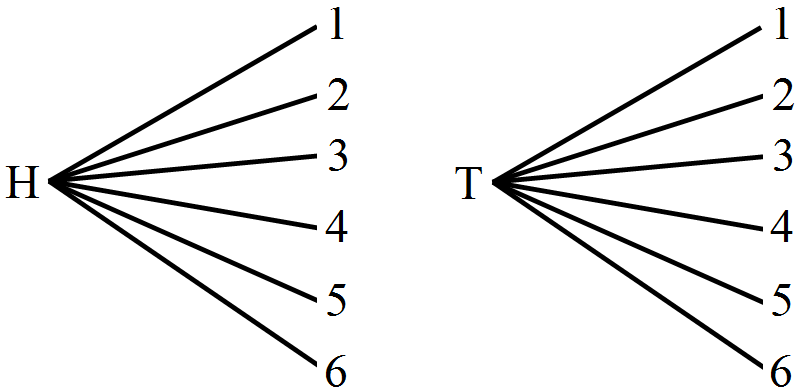
If a coin is tossed three times (or three coins are tossed together), then describe the sample space for this experiment.
Answer
A coin has two faces: a head (H) and a tail (T). When a coin is tossed three times, the total number of possible outcomes is $2^3 = 8$. Thus, when a coin is tossed three times, the sample space is given by S = {HHH, HHT, HTH, HTT, THH, THT, TTH, TTT}.
View full question & answer
Question 21 Mark
List all events associated with the random experiment of tossing of two coins. How many of them are elementary events.
Answer
The events associated with the random experiment of tossing of two coins are HH, HT, TH and TT. These 4 events are also the elementary events when two unbiased coins are tossed simultaneously.
View full question & answer
Question 31 Mark
Which of the following cannot be valid assignment of probability for elements or outcomes of sample space s = $W_1, W_2,W_{3,} W_4, W_5, W_6, W_7.$
Elementary events: $W_1$ $W_2$ $W_3$ $W_4$ $W_5$ $W_6$ $W_7$
  0.7 0.6 0.5 0.4 0.3 0.2 0.1
Answer
It is not valid as sum of $p (W_1)=2.8\neq1$
View full question & answer
Question 41 Mark
Which of the following cannot be valid assignment of probability for elements or outcomes of sample space s = $W_1, W_2,W_{3,} W_4, W_5, W_6, W_7.$
Elementary events: $W_1$ $W_2$ $W_3$ $W_4$ $W_5$ $W_6$ $W_7$
  $\frac{1}{14}$ $\frac{2}{14}$ $\frac{3}{14}$ $\frac{4}{14}$ $\frac{5}{14}$ $\frac{6}{14}$ $\frac{15}{14}$
Answer
It is not valid as sum of $p(W_7)=\frac{15}{14}>1$
View full question & answer
Question 51 Mark
In a simultanepous throw of a pair of dice, find the probability of getting:A doublet of odd numbers.
Answer
Let E be the events that a doublet of odd number apper, $\therefore \text{E}= \big\{(1,1),\ (3, 3),\ (5, 5)\big\}$ $\Rightarrow\text{n(E)=3}$ $\therefore\text{p(E)}=\frac{3}{36}=\frac{1}{12}$
View full question & answer
Question 61 Mark
In a simultanepous throw of a pair of dice, find the probability of getting, An even number on one and a multiple of 3 on the other
Answer
Let E be the events that an even number on one and a multiple of 3 on the other apper $\therefore\text{E} = \big\{(2, 3),\ (2, 6),\ (4, 3),\ (4, 6),\ (6, 3),\ (6, 6),\ (3, 2),\ (3, 4),\ (3, 6),\ (6, 2),\ (6, 4)\big\}$ $\therefore\text{n(E)=11}$ $\therefore\text{p(E)}=\frac{11}{36}$
View full question & answer
Question 71 Mark
Find the probability that in a random arrengement of the letters of the word social vowels come together?
Answer
Number of vowels in word SOCIAL are A, I, O, number of ways we can arrange SOCIAL word with vowels together is SCL(AIO) = 4 × 3 Total number of arrangements are 6 $\text{probability}=\frac{4\times3}{6}=\frac{1}{5}$
View full question & answer
Question 81 Mark
A die is thrown, find the probability of getting: A prime number.
Answer
$\because$ A die is thrown $\therefore\text{n}\text{(s)} = 6$ Let E be the event of getting prime number $\therefore\text{E} = {2, 3, 5}$ $\text{N}\text{(E)} = 3$ $\therefore\text{p}\text{(E)}=\frac{\text{n(E)}}{\text{n(S)}}=\frac{3}{6}=\frac{1}{2}$ $\therefore\text {p}\text{(E)}=\frac{1}{2}$
View full question & answer
Question 91 Mark
Three coins are tossed Describe. Two events A and B which are mutually exclusive.
Answer
When three coins are tossed, the sample space is given by, S = {HHH, HHT, HTH, HTT, THH, THT, TTH, TTT} The two events that are mutually exclusive are as follows: A: getting no heads B: getting no tails This is because sets A = {HHH} and B = {TTT} are disjoint.
View full question & answer
Question 101 Mark
Which of the following cannot be valid assignment of probability for elements or outcomes of sample space s = $W_1, W_2,W_{3,} W_4, W_5, W_6, W_7.$
Elementary events: $W_1$ $W_2$ $W_3$ $W_4$ $W_5$ $W_6$ $W_7$
  0.1 0.01 0.05 0.03 0.01 0.2 0.6
Answer
It is valid as each $p (W_1)$ lies between 0 to 1 and sum of $p (W_1)= 1$
View full question & answer
Question 111 Mark
If odds in favour of an event be 2 : 3, find the probability of occurrence of this events.
Answer
Since odd in favour of an event is 2 : 3 $\text{n}\text{(S)}=2\text{K}+3\text{K}=5\text{K}$ and, $\text{n}\text{(S)}=2\text{k}$ $\therefore$ Probability of occurance of this event $=\frac{2\text{K}}{2\text{K+3K}}=\frac{2}{5}$
View full question & answer
Question 121 Mark
In a simultanepous throw of a pair of dice, find the probability of getting, A sum greater than 9.
Answer
Let E be the events that a greater than apper, $\therefore\text{E}= \big\{(4, 6),\ (5, 5),\ (5, 6),\ (6, 4),\ (6, 5),\ (6, 6)\big\}$ $\therefore\text{n(E)=6}$ $\therefore\text{p(E)}=\frac{6}{36}=\frac{1}{6}$
View full question & answer
Question 131 Mark
In a simultanepous throw of a pair of dice, find the probability of getting: 8 as the sum.
Answer
Since a pair of dice have been thrown $\therefore$ Numbers of elementary events in sample is $6^2 = 36$ Let E be the events that the sum 8 appear on the faces of dice $\therefore\text{E}=\big\{(2, 6) ,\ (3, 6),\ (4, 9),\ (5, 3),\ (6, 2)\big\}$ $\therefore\text{n(E)=5}$ $\therefore\text{p(E)}=\frac{5}{36}$
View full question & answer
Question 141 Mark
Write the sample space for the experiment of tossing a coin four times.
Answer
When a coin is tossed once, there are two possible outcomes: a head (H) and a tail (T). When a coin is tossed four times, the total number of possible outcomes is $2^4 = 16$. Thus, when a coin is tossed four times, the sample space is given by S = {HHHH, HHHT, HHTH, HHTT, HTHH, HTHT, HTTH, HTTT, THHH, THHT, THTH, THTT, TTHH, TTHT, TTTH, TTTT}.
View full question & answer
Question 151 Mark
Which of the following cannot be valid assignment of probability for elements or outcomes of sample space s = $W_1, W_2,W_{3,} W_4, W_5, W_6, W_7.$
Elementary events: $W_1$ $W_2$ $W_3$ $W_4$ $W_5$ $W_6$ $W_7$
  $\frac{1}{7}$ $\frac{1}{7}$ $\frac{1}{7}$ $\frac{1}{7}$ $\frac{1}{7}$ $\frac{1}{7}$ $\frac{1}{7}$
Answer
It is valid as each $p (W_1)$ lies between 0 to 1 and sum of $p (w_1) = 1$
View full question & answer
Question 161 Mark
In a single throw of a die describe the following events: A = Getting a number less than 7.
Answer
When a dice is thrown, the sample space is given by S = {1, 2, 3, 4, 5, 6}. Accordingly, we have: A = {1, 2, 3, 4, 5, 6} Here, A = {1, 2, 3, 4, 5, 6} and B = Φ $\therefore$ A ∪ B = {1, 2, 3, 4, 5, 6}.
View full question & answer
Question 171 Mark
In a simultanepous throw of a pair of dice, find the probability of getting:A doublet of prime numbers.
Answer
Let E be the events that a doublet of prime number apper, $\therefore\text{E} = \big\{{(2, 2),\ (3, 3),\ (5, 5)}\big\}$ $\therefore\text{n(E)=3}$ $\therefore\text{p(E)}=\frac{3}{36}=\frac{1}{12}$
View full question & answer
Question 181 Mark
Three number are chosen at random from number 1 to 30. Write the probability that the chosen number are consecutive.
Answer
$\because$ Three number are choosen from a number from 1-30 ⇒ Number of elementary events in sample space is $\text{n}(\text{S})=^{30}\text{C}_3=\frac{30\times29\times28}{3\times2\times1}$ $=5\times29\times28$ $=4060$ Let E be the event that three consecutive number are choosen $\text{n}(\text{E})=^{28}\text{C}_1=28$ $\because\text{E}=\big\{(1,\ 2,\ 3),\ (2,\ 3,\ 4),\ (3,\ 4,\ 5),\ (4,\ 5,\ 6),\\ \ \ \ (5,\ 6,\ 7),\ .....(27,\ 28,\ 29),\ (28,\ 29,\ 30)\big\}$ $\Rightarrow\text{n}(\text{E})=28$ $\therefore\text{p}(\text{E})=\frac{28}{4060}$ $=\frac{1}{145}$
View full question & answer
Question 191 Mark
Two dice are thrown Describe the sample space of this experiment.
Answer
When two dices are thrown, there are (6 × 6) = 36 out comes The set of these outcomes is the sample space, which is given by
S = (1, 1), (1, 2), (1, 3), (1, 4), (1, 5), (1, 6)
(2, 1), (2, 2), (2, 3), (2, 4), (2, 5), (2, 6)
(3, 1), (3, 2), (3, 3), (3, 4), (3, 5), (3, 6)
(4, 1), (4, 2), (4, 3), (4, 4), (4, 5), (4, 6)
(5, 1), (5, 2), (5, 3), (5, 4), (5, 5), (5, 6)
(6, 1), (6, 2), (6, 3), (6, 4), (6, 5), (6, 6)
View full question & answer
Question 201 Mark
The letters of the word 'CLIFTON' are placed at random in a row. what is the chance two vowels come together?
Answer
AS the word CLIFTON has 7 letters so, $\text{n}\text{(S)}=7$
Now E be the event that in the arrangment two vowels come together.
$\therefore\text{n}\text{(E)}=2\times6$
$\therefore\text{P}\text{(E)}=\frac{2\times6}{7}$ $=\frac{2}{7}$
View full question & answer
Question 211 Mark
$\text{n}(\geq3)$ persons are sitting in a row. Two of them are selected. Write the probability that they are together.
Answer
$\because$ n persons are seated in a row and two persons are selected. Since both the person must be together $\therefore\text{n}(+)=^{\text{n}-1}\text{C}_1$ $\therefore\text{p}(+)=\frac{^{\text{n}-1}\text{C}_1}{^{\text{n}}\text{C}_2}$ $=\frac{\frac{\text{n}-1}{\text{n}(\text{n}-1)}}{2}$ $=\frac{\text{n}(\text{n}-1)}{\text{n}(\text{n}-1)}$ $=\frac{2}{\text{n}}$
View full question & answer
Question 221 Mark
What is the probability that the 13th days of a randomly chosen month is Friday?
Answer
The probability of 13th days of any month is friday $=\frac{1}{7}$ $\therefore$ The probability of 13th days of any month in a year is $\frac{1}{7\times12}$ $=\frac{1}{84}$
View full question & answer
Question 231 Mark
If A and B are two independent events such that $\text{p}\big(\text{A}\cup\text{B}\big)=\frac{1}{6}$ and $\text{p}\big(\overline{\text{A}}\cap\overline{\text{B}}\big)=\frac{1}{3},$ then write the values of P(A) and P(B).
Answer
$\text{p}\big(\overline{\text{A}}\cap\overline{\text{B}}\big)=1-\text{p}\big({\text{A}}\cup{\text{B}}\big)$ $\text{p}\big({\text{A}}\cup{\text{B}}\big)=1-\frac{1}{3}$ $=\frac{2}{3}$ $\text{p}\big({\text{A}})+\text{p}({\text{B}}\big)=\frac{2}{3}+\frac{1}{6}$ $=\frac{5}{6}\ ....(\text{i})$ $\because$ A and B are two independent event $\therefore\text{p}\big({\text{A}}\cap{\text{B}}\big)=\text{p}\big({\text{A}})\times\text{p}({\text{B}}\big)$ $=\frac{1}{6}$ $\big(\text{p}(\text{A})-\text{p}(\text{B})\big)^2=\big(\text{p}(\text{A})+\text{p}(\text{B})\big)^2+4\text{p}(\text{A})\text{p}(\text{B})$ $=\Big(\frac{5}{6}\Big)^2-\frac{4}{6}$ $=\frac{25}{36}-\frac{4}{6}$ $=\frac{25-24}{36}$ $=\frac{1}{36}$ $\therefore\text{p}(\text{A})-\text{p}(\text{B})=\frac{1}{6}\ ...(\text{ii})$ From (i) and (ii) $\text{p}(\text{A})=\frac{1}{2},\text{p}(\text{B})=\frac{1}{3}$
View full question & answer
Question 241 Mark
Three dice are thrown simultaneously. What is the probability of getting 15 as the sum?
Answer
Three dice are thrown $\therefore\text{n}(\text{S})=6^3=216$ A be the event of getting sum as 15 $\therefore\text{A}=\begin{bmatrix}(3,\ 6,\ 6),\ (4,\ 6,\ 5),\ (5,\ 6,\ 4),\ (6,\ 6,\ 3),\ (6,\ 3,\ 6),\ (6,\ 4,\ 5)\$6,\ 5,\ 4),\ (4,\ 5,\ 6),\ (5,\ 5,\ 5),\ (5,\ 4,\ 6),\ (5,\ 5,\ 5),\ (5,\ 5,\ 5)\end{bmatrix}$ $\therefore\text{p}(\text{A})=\frac{13}{216}$
View full question & answer
Question 251 Mark
If the letters of the word 'MISSISSIPPI' are written down at random in a row, what is the probability that four S's come together.
Answer
Number of different letter can be written from MISSISSIPPI is $\frac{11!}{4!4!2}$ $=\frac{11\times10\times9\times8\times7\times6\times5\times4!}{2!4!4}$ $=34650$ Now, 4S should come together, so considering it 1 We get, $\frac{8}{4!2!}=840$ [Different words when 4-S comes together] $\therefore\text{p}(\text{t})=\frac{840}{34650}=\frac{4}{165}$ $\therefore\text{p}(\text{t})=\frac{4}{165}$
View full question & answer
Question 261 Mark
Three coins are tossed once. Describe the following events associated with this random experiment: A = Getting three heads B = Getting two heads and one tail C = Getting three tails D = Getting a head on the first coin.
  1. Which pairs of events are mutually exclusive?
  2. Which events are elementary events?
  3. Which events are compound events?
Answer
When three coins are tossed, the sample space is given by S = {HHH, HHT, HTH, HTT, THH, THT, TTH, TTT} Accordingly, we have: A = {HHH} B = {HHT, HTH, THH} C = {TTT} D = {HHH, HHT, HTH, HTT} Now, we observe that, A ∩ B = Φ; A ∩ C = Φ; A ∩ D = {HHH} ≠ Φ; B ∩ C = Φ; B ∩ D = {HHT, {HTH} ≠ Φ and C ∩ D = Φ
  1. Events A and B; events A and C; events B and C and events C and D are all mutually exclusive.
  2. If an event has only one sample point of a sample space, it is called an elementary event. Thus, A and C are elementary events.
  3. an event has more than one sample point of a sample space, it is called a compound event. Thus, B and D are compound events.
View full question & answer
Question 271 Mark
In a simultanepous throw of a pair of dice, find the probability of getting:A doublet.
Answer
Let E be the events that the sum 8 appear on the faces of dice $\therefore\text{E} = \big\{(1, 1),\ (2, 2),\ (3, 3),\ (4, 4),\ (5, 5),\ (6, 6)\big\}$ $\therefore\text{n(E)=6}$ $\therefore\text{p(E)}=\frac{6}{36}=\frac{1}{6}$
View full question & answer
Question 281 Mark
A die is thrown, find the probability of getting:A multiple of 2 or 3.
Answer
$\text{E} = \big \{2, \ 4, \ 6,\ 3\big \}$ $\Rightarrow\text{n(E)}=4$ $\therefore\text{p}\text{(E)}=\frac{4}{6}=\frac{2}{3}$ $\therefore\text {p}\text{(E)}=\frac{2}{3}$
View full question & answer
Question 291 Mark
The letters of the word 'FORTUNATES' are arranged at random in a row. what is the chance that the two 'T' come together?
Answer
'FORTUNATES 7 there are 10 letters $\therefore\text{n}\text{(S)}=10$ Now E be the event thatboth 'T' come together.$\therefore\text{n}\text{(E)}=2\times9$
$\therefore\text{P}\text{(E)}=\frac{2\times6}{9}$ $=\frac{2}{10}$ $=\frac{1}{5}$
View full question & answer
Question 301 Mark
What is the total number of elementary events associated to the random experiment of throwing three dice together?
Answer
When we throw a dice, it can result in any of the six numbers, namely 1, 2, 3, 4, 5 and 6. When three dices are thrown together, the total number of elementary events associated is $6^3 = (6 \times 6 \times 6) = 216$.
View full question & answer
Question 311 Mark
In a single throw of a die describe the following events: C = Getting a multiple of 3C = {3, 6}
Answer
When a dice is thrown, the sample space is given by S = {1, 2, 3, 4, 5, 6}. Accordingly, we have: C = {3, 6} Here, B = Φ and C = {3, 6} $\therefore$ B ∩ C = Φ
View full question & answer
Question 321 Mark
Three of the six vertices of a regular hexagon are chosen at random. What is the probability that the triangle with these vertices is equilateral.
Answer
Total number of triangles that can be formed by joining vertices of hexagon $=^6\text{C}_3$ Number of equilateral triangle in hexagon = 12 P(triangle is equilateral) $=\frac{12}{^6\text{C}_3}$ $=\frac{12}{6\times5\times4}$ P(triangle is equilateral) $=\frac{1}{10}$
View full question & answer
Question 331 Mark
If a coin is tossed two times, describe the sample space associated to this experiment.
Answer
If a coin is tossed twice, the possible outcomes are HH, HT, TH, TT. Therefore, the sample space of this experiment is S = {HH, HT, TH, TT}.
View full question & answer
Question 341 Mark
A coin is tossed and then a die is rolled only in case a head is shown on the coin. Describe the sample space for this experiment.
Answer
A coin has two faces: a head (H) and a tail (T). A dice has six faces that are numbered from 1, 2, 3, 4, 5, 6 with one number on each face. When a head is shown on a coin toss, a dice is rolled. Thus, the sample space is given by S = {(H, 1),(H, 2), (H, 3), (H, 4), (H, 5), (H, 6), T}
View full question & answer
Question 351 Mark
In a simultaneous throw of a pair of disc, find the probability of getting: An even number on first.
Answer
Let E be the events that an even number on the first dice appear which means any number can be appear an second dice, $\therefore\text{E}=\Big\{(2,1), \ (1,2),\ (2,3),\ (2,4),\ (2,5), \ (2,6),\ (4,1),\ (4,2), (4,3)\\\ \ \ \ \ \ \ \ \ \ \ \ \ \ (4,4),\ (4,5),\ (4,6),\ (6,1),\ (6,2),\ (6,3),\ (6,4),\ (6,5),\ (6,6) \Big\}$ $\therefore\text{n(E)}=18$ $\text{P(E)}=\frac{18}{36}=\frac{1}{2}$
View full question & answer
Question 361 Mark
A coin is tossed once Write its sample space.
Answer
If a coin is tossed once, the possible outcomes are a head (H) and tail (T) Therefore, the sample space of this experiment is S = { H, T}.
View full question & answer
Question 371 Mark
What is the probability that a leap year will have 53 Fridays or 53 Saturdays?
Answer
Let A be the event that a leap year has 53 fridays or 53 saturdays. $\because$ In a leap year 52 weeks and 2 days $\therefore$ Those two days can be (M, T), (T, W), (W, TH), (TH, F), (F, S), (S, SU) or (SU, M) $\therefore\text{p}(\text{A})=\frac{2}{7},\ \text{p}(\text{B})=\frac{2}{7}$ $\text{p}(\text{A}\cap\text{B})=\frac{1}{7}$ $\therefore\text{p}(\text{A}\cup\text{B})=\text{p}(\text{A})+\text{p}(\text{B})-\text{p}(\text{A}\cap\text{B})$ $=\frac{2}{7}+\frac{2}{7}-\frac{1}{7}$ $=\frac{2+2-1}{7}$ $=\frac{3}{7}$
View full question & answer
Question 381 Mark
A single letter is selected at random from the word 'PROBABILITY'. What is the probability that it is a vowel?
Answer
Let V be the event that a vowel is choosen $\therefore\text{p}(\text{V})=\frac{4}{11}$ $\because$ there are 4 vowel amon 2 letter in the word probability. $\therefore\text{p}(\text{V})=\frac{4}{11}$
View full question & answer
Question 391 Mark
A coin is tossed and then a die is thrown Describe the sample space for this experiment.
Answer
When a coin is tossed, the outcomes are H, T. When a dice is thrown, the outcomes can be 1, 2, 3, 4, 5, 6. Thus, we can write the two parts of this experiment as follows:
Hence, the sample space is given by, S = {(H, 1), (H, 2), (H, 3), (H, 4), (H, 5), (H, 6), (T, 1), (T, 2), (T, 3), (T, 4), (T, 5), (T, 6)}.
View full question & answer
Question 401 Mark
A die is thrown, find the probability of getting: 2 or 4.
Answer
$\text{E} = \{2, \ 4\}$ $\therefore\text{N}\text{(E)} = 2$ $\therefore\text{p}\text{(E)}=\frac{2}{6}=\frac{1}{2}$ $\therefore\text {p}\text{(E)}=\frac{1}{3}$
View full question & answer
Question 411 Mark
A coin is tossed. Find the total number of elementary events and also the total number events associated with the random experiment.
Answer
In tossing a fair coin, there are two possible outcomes, namely Head (H) and Tail (T). Hence, the sample space in this experiment is given by S = {H, T}. Thus, total number of elementary events = 2 In all, there are four subsets of S: {H}, {T}, {H, T} and Φ. Each of the subsets of the sample space is an event. $\therefore$There are 4 total events associated with the random experiment. Note: If there are n elements in a set, then the number of its subset is $2^n$.
View full question & answer
Question 421 Mark
In a single throw of a die describe the following events: B = Getting a number greater than 7.
Answer
When a dice is thrown, the sample space is given by S = {1, 2, 3, 4, 5, 6}. Accordingly, we have: B = Φ Here, A = {1, 2, 3, 4, 5, 6} and B = Φ $\therefore$ A ∩ B = Φ
View full question & answer
Question 431 Mark
Three coins are tossed Describe. Three events A, B and C which are mutually exclusive and exhaustive.
Answer
When three coins are tossed, the sample space is given by, S = {HHH, HHT, HTH, HTT, THH, THT, TTH, TTT} The three events that are mutually exclusive and exhaustive are as follows: A: getting no heads B: getting exactly one head C: getting at least two heads i.e. A = {TTT}, B = {HTT, THT, TTH} and C = {HHH, HHT, HTH, THH} This is because A ∩ B = B ∩ C = C ∩ A = Φ and A ∪ B ∪ C = S.
View full question & answer
Question 441 Mark
If $E$ and $E_2$ are independent evens, write the value of $\text{p}\Big(\big(\text{E}_1\cup\text{E}_2\big)\cap\Big(\overline{\text{E}}\cap\overline{\text{E}}_2\Big)\Big).$
Answer
$\text{p}\Big(\big(\text{E}_1\cup\text{E}_2\big)\cap\Big(\overline{\text{E}}\cap\overline{\text{E}}_2\Big)\Big)$ $=\Big(\text{E}_1\cap\overline{\text{E}}_1\cap\overline{\text{E}}_2\Big)\cup\Big(\text{E}_1\cap\Big(\overline{\text{E}}_1\cap\overline{\text{E}}_2\Big)\Big)$ $=\text{P}\big(\phi\cup\phi\big)=0$ $=0$
View full question & answer