MCQ 11 Mark
If R is a relation on a finite set having n elements, then the number of relations on A is:
- A
$2^{\text{n}}$
- ✓
$2^{\text{n}^2}$
- C
$\text{n}^2$
- D
$\text{n}^\text{n}$
AnswerCorrect option: B. $2^{\text{n}^2}$
- $2^{\text{n}^2}$
Solution:
Given, A finite set with n elements
Its Cartesian product with itself will have $\text{n}^2$ elements.
$\therefore$ Number of relations on $\text{A}=2^{\text{n}^2}$ View full question & answer→MCQ 21 Mark
Let a relation R be defined by R = {(4, 5), (1, 4), (4, 6), (7, 6), (3, 7)}, then ROR is equal to:
MCQ 31 Mark
Which function is shown in graph?
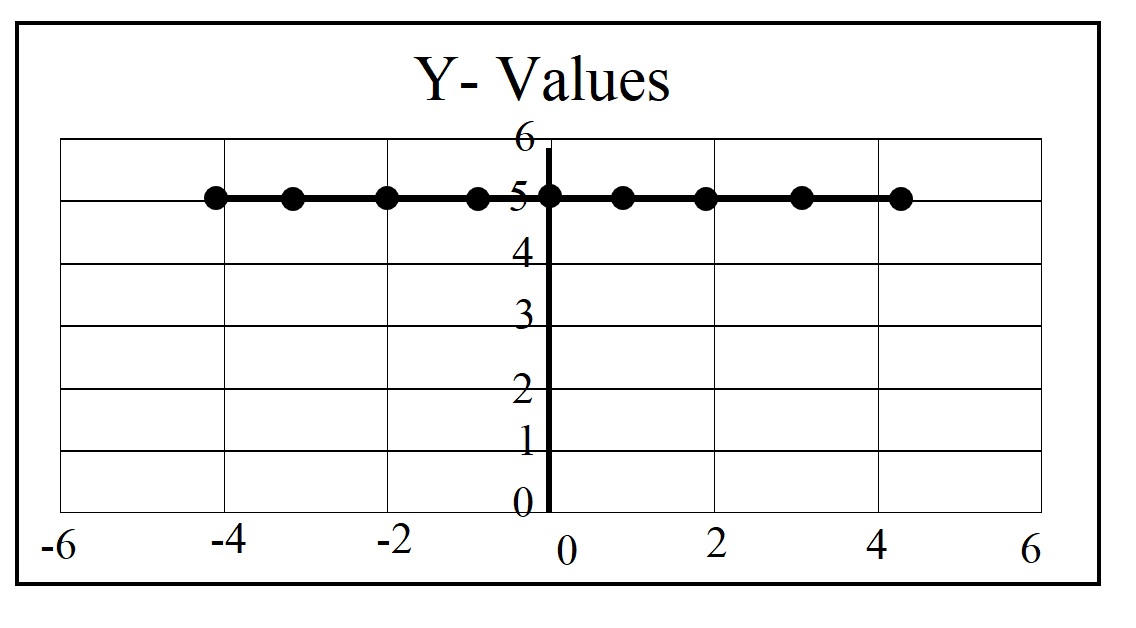
Answer{(-1, 1), (1, 1), (-2, 2), (2, 2), (-3, 3), (3, 3), ……}. This function involves relation {(x, y), y = |x|} which is involved in modulus function.
So, above function is modulus function.
View full question & answer→MCQ 41 Mark
Which of the following is not a function?
- A
- B
{(-1, 1), (-2, 4), (2, 4)}
- ✓
{(1, 2), (1, 4), (2, 5), (3, 8)}
- D
AnswerCorrect option: C. {(1, 2), (1, 4), (2, 5), (3, 8)}
A relation from a set A to a set B is said to be a function if every element of set A has one and one image in set B.
In {(1, 2), (1, 4), (2, 5), (3, 8)}, since element 1 has two images 2 and 4 which is not possible in a function so, it is not a function. Rest all have
one and only one image so they can be called a function.
View full question & answer→MCQ 51 Mark
If n is the smallest natural number such that n + 2n + 3n + …. + 99n is a perfect square, then the number of digits in square of n is:
Answer
- 3
Solution:
Given thatn + 2n + 3n + …. + 99n
$ =\text{ n} × (1 + 2 + 3 + …….. + 99)$
$=\frac{\text{n} \times99 \times100}{2}$
$=\text{n} × 99 × 50$
$= \text{n} × 9 × 11 × 2 × 25$
To make it perfect square we need $2 \times 11$
So $n=2 \times 11=22$.
Now $n^2=22 \times 22=484$
So, the number of digit in $n^2=3$. View full question & answer→MCQ 61 Mark
The domain of definition of the function $\text{f(x)}=\sqrt{\text{x}-1}+\sqrt{3-\text{x}}$ is:
- A
$[1,\infty)$
- B
$\big(-\infty,3\big)$
- C
$(1,3)$
- ✓
$\big[1,3\big]$
AnswerCorrect option: D. $\big[1,3\big]$
$\text{f(x)}=\sqrt{\text{x}-1}+\sqrt{3-\text{x}}$
For f(x) to be defined,
$(\text{x}-1)\geq0$
$\Rightarrow\text{x}\geq1\ ...(\text{i})$
and $(3-\text{x})\geq0$
From (i) and (ii),
$\text{x}\in[1,3]$
View full question & answer→MCQ 71 Mark
Let R be a relation from a set A to a set B, then:
- A
$\text{ R} = \text{A}∪\text{B}$
- B
$\text{ R} = \text{A}\cap\text{B}$
- ✓
$ \text{R} \subseteq \text{A}\times{\text{B}}$
- D
$ \text{R} \subseteq \text{B}\times{\text{A}}$
AnswerCorrect option: C. $ \text{R} \subseteq \text{A}\times{\text{B}}$
- $ \text{R} \subseteq \text{A}\times{\text{B}}$
View full question & answer→MCQ 81 Mark
If $\text{x}\neq1$ and $\text{f(x)}=\frac{\text{x}+1}{\text{x}-1}$ is a real function, then $\text{f}(\text{f}(\text{f(2)}))$ is:
Answer$\text{f(x)}=\frac{\text{x}+1}{\text{x}-1}$
$\text{f}(\text{f}(\text{f(2)}))$
$=\text{f}\Big(\text{f}\Big(\frac{2+1}{2-1}\Big)\Big)$
$=\text{f}(\text{f}(3))$
$=\text{f}\Big(\frac{3+1}{3-1}\Big)$
$=\text{f}(2)=3$
View full question & answer→MCQ 91 Mark
If (a, b) = (x, y) then___________.
AnswerTwo ordered pairs are said to be equal if and only if their corresponding elements are equal i.e. a = x and b = y.
View full question & answer→MCQ 101 Mark
If $f(x)=3 x^4-5 x^2+9$, then value of $f(x-1)$ is:
- A
$3 x^4+12 x+13 x+2 x+7$
- B
$3 x^4-12 x-13 x-2 x-7$
- ✓
$3 x^4-12 x+13 x-2 x+7$
- D
$3 x^4-12 x-13 x+2 x+7$
AnswerCorrect option: C. $3 x^4-12 x+13 x-2 x+7$
View full question & answer→MCQ 111 Mark
The function f(x) = x - [x] has period of:
AnswerLet T is a positive real number.
Let f(x) is periodic with period T.
Now, f(x + T) = f(x), for all $\text{x} \in \text{R}$
⇒ x + T - [x + T] = x - [x], for all $ \text{x} \in \text{R}$
⇒ [x + T] - [x] = T, for all $ \text{x} \in \text{R}$
Thus, there exist T > 0 such that f(x + T) = f(x) for all $ \text{x} \in \text{R}$
Now, the smallest value of T satisfying f(x + T) = f(x) for all $ \text{x} \in \text{R}$ is 1
So, f(x) = x - [x] has period 1
View full question & answer→MCQ 121 Mark
If f(x) = (x - 1)(x - 3)(x - 4)(x - 6) + 19 for all real value of x is:
MCQ 131 Mark
If $f(x)=e x$ and $g(x)=$ loge $x$ then the value of fog(1) is:
Answer
- 1
Solution:
Given, $f(x)=e^x$
and $g(x)=\log x$
$fog(x)=f(g(x))$
$=f(\log x)$
$=e^{\log x}$
$=\mathrm{x}$
So, fog $(1)=1$ View full question & answer→MCQ 141 Mark
If A × B = {(1, a), (1, b), (1, c), (2, a), (2, b), (2, c)} then find set A:
Answer
- {1, 2}
Solution:
In each ordered pair of A × B, first element belongs to set A and second element belongs to set B.
1, $ 2 ∈\text{A} $ so, $ \text{A} = {1, 2}.$ View full question & answer→MCQ 151 Mark
The domain of definition of $\text{f(x)}=\sqrt{\frac{\text{x}+3}{(2-\text{x})(\text{x}-5)}}$ is:
- ✓
$(-\infty,-3]\cup(2,5)$
- B
$(-\infty,-3]\cup(2,5)$
- C
$(-\infty,-3]\cup[2,5]$
- D
AnswerCorrect option: A. $(-\infty,-3]\cup(2,5)$
$\text{f(x)}=\sqrt{\frac{\text{x}+3}{(2-\text{x})(\text{x}-5)}}$
For f(x) to be defined,
$(2-\text{x})(\text{x}-5)\neq0$
$\Rightarrow\text{x}\neq2,5\ ...(\text{i})$
Also, $\frac{(\text{x}+3)}{(2-\text{x})(\text{x}-5)}\geq0$
$\Rightarrow\frac{(\text{x}+3)(2-\text{x})(\text{x}-5)}{(2-\text{x})^2(\text{x}-5)^2}\geq0$
$\Rightarrow(\text{x}+3)(\text{x}-2)(\text{x}-5)\leq0$
$\Rightarrow\text{x}\in\big(-\infty,-3\big]\cap(2,5)\ ...(\text{ii})$
From (i) and (ii)
$\text{x}\in\big(-\infty,-3\big]\cup(2,5)$
View full question & answer→MCQ 161 Mark
Choose the correct answers: If f(x) = ax + b, where a and b are integers, f(–1) = –5 and f(3) = 3, then a and b are equal to.
AnswerGiven that: f(x) = ax + b
⇒ f(-1) = a(-1) + b
⇒ -5 = -a + b
⇒ a - b = 5 ...........(i)
f(3) = 3a + b
⇒ 3 = 3a + b
⇒ 3a + b = 3 ........(ii)
On solving eqn. (i) and (ii), We get a = 2, b = -3
View full question & answer→MCQ 171 Mark
If $ \text{aN} = \frac{\text{ax}}{\text{x}\in\text{N}}$ and $\text{bN}\cap\text{cN}=\text{d}\text{N}$ Where $ \text{b}, \text{c }\in\text{ N}$
View full question & answer→MCQ 181 Mark
The range of the function $\text{f(x)}=\frac{\text{x}^2-\text{x}}{\text{x}^2+2\text{x}}$ is:
AnswerCorrect option: C. $\text{R}-\Big\{\frac{1}{2},1\Big\}$
$\text{f(x)}=\frac{\text{x}^2-\text{x}}{\text{x}^2+2\text{x}}$
Let, $\text{y}=\frac{\text{x}^2-\text{x}}{\text{x}^2+2\text{x}}$ $\big[\text{Also},\text{ x}\neq0\big]$
$\Rightarrow\text{y}=\frac{\text{x}(\text{x}-1)}{\text{x}(\text{x}+2)}$
$\Rightarrow\text{y}=\frac{(\text{x}-1)}{(\text{x}+2)}$
$\Rightarrow\text{xy}+2\text{y}=\text{x}-1$
$\Rightarrow\text{x}=\frac{2\text{y}+1}{1-\text{y}}$
Here, $1-\text{y}\neq0$
Or, $\text{y}\neq1$
Also, $\text{x}\neq0$
$\Rightarrow\frac{2\text{y}+1}{1-\text{y}}\neq0$
$\Rightarrow\text{y}\neq-\frac{1}{2}$
Thus, range $\text{(f)}=\text{R}-\Big\{-\frac{1}{2},1\Big\}$
View full question & answer→MCQ 191 Mark
The function $ \text{f}(\text{x}) = \sin \Big(\frac{\pi\text{x}}{2}\Big) +\cos \Big(\frac{\pi\text{x}}{2}\Big)$ is periodic with period:
AnswerPeriod of $\sin \Big(\frac{\pi\text{x}}{2}\Big) = 2\pi\Big(\frac{\pi}{2}\Big) = 4$
Period of $\cos \Big(\frac{\pi\text{x}}{2}\Big) = 2\pi\Big(\frac{\pi}{2}\Big) = 4$
So, period of f(x) = LCM (4, 4) = 4
View full question & answer→MCQ 201 Mark
If $R$ is a relation from a finite set $A$ having $m$ elements of a finite set $B$ having $n$ elements, then the number of relations from $A$ to $B$ is:
- ✓
$2^{\mathrm{mn}}$
- B
$2^{m n}-1$
- C
$2 mn$
- D
$m^n$
AnswerCorrect option: A. $2^{\mathrm{mn}}$
- $2^{\mathrm{mn}}$
Solution:
Given, n(A) = m
n(B) = n
$\therefore$ n(A × B) = mn
Then, the number of relations from A to is $2^{\mathrm{mn}}$ View full question & answer→MCQ 211 Mark
Domain of $\sqrt{\text{a}^{2} -\text{x}^{2}} (\text{a} > 0)$ is:
View full question & answer→MCQ 221 Mark
Let A = {1, 2, 3}. The total number of distinct relations that can be defined over A, is:
MCQ 231 Mark
Two functions f and g are said to be equal if:
- A
The domain of f = the domain of g
- B
The co-domain of f = the co-domain of g
- C
- ✓
AnswerTwo functions f and g are said to be equal if
- The domain of f = the domain of g
- The co-domain of f = the co-domain of g
- F(x) = g(x) for all x
View full question & answer→MCQ 241 Mark
If the function$ \text{f}(\text{x})=\frac{\text{ax} -{\text{x}}}{2,(\text{a>2})}$, then $ \text{f}(\text{x + y}) + \text{f}(\text{x – y})$ is equal to:
- ✓
$ 2\text{f}(\text{x} ) \text{ f}(\text{y})$
- B
$ \text{f}(\text{x} ) \text{ f}(\text{y})$
- C
$ \frac{\text{f} (\text{x})}{\text{f}(\text{y})}$
- D
$ \text{None of these} $
AnswerCorrect option: A. $ 2\text{f}(\text{x} ) \text{ f}(\text{y})$
- $ 2\text{f}(\text{x} ) \text{ f}(\text{y})$
View full question & answer→MCQ 251 Mark
If set A has 2 elements and set B has 4 elements then how many relations are possible?
Answer
- 256
Solution:
We know, $\mathrm{A} \times \mathrm{B}$ has $2 \times 4$ i.e. 8 elements.
Number of subsets of $A \times B$ is $2^8$ i.e. 256 .
A relation is a subset of cartesian product so,
number of possible relations are 256 . View full question & answer→MCQ 261 Mark
If the set A has p elements, B has q elements, then the number of elements in A × B is:
Answer
- pq
Solution:
n(A × B) = n(A) × n(B)
n(A × B) = p × q = pq
View full question & answer→MCQ 271 Mark
If $f: R \rightarrow R$ and $g: R \rightarrow R$ are defined by $f(x)=2 x+3$ and $g(x)=x^2+7$, then the values of $x$ such that $g(f(x))=8$ are:
Answer
- -1, -2
Solution:
$f(x)=2 x+3 \text { and } g(x)=x^2+7$
$g(f(x))=8$
$\Rightarrow(f(x))^2+7=8$
$\Rightarrow(2 x+3)^2+7=8$
$\Rightarrow x^2+3 x+2=0$
$\Rightarrow(x+2)(x+1)=0$
$\Rightarrow x=-1,-2$ View full question & answer→MCQ 281 Mark
Which of the following relation is a function?
- A
(a, b) (b, e) (c, e) (b, x)
- B
(a, d) (a, m) (b, e) (a, b)
- ✓
(a, b) (b, e) (c, e) (b, x)
- D
(a, d) (b, m) (b, y) (d, x)
AnswerCorrect option: C. (a, b) (b, e) (c, e) (b, x)
- (a, b) (b, e) (c, e) (b, x)
View full question & answer→MCQ 291 Mark
The relation R defined on the set of natural numbers as (a, b) : a differs from b by 3 is given:
- A
((1, 4), (2, 5), (3, 6),.....)
- ✓
((4, 1), (5, 2), (6, 3),.....)
- C
((1, 3), (2, 6), (3, 9),.....)
- D
AnswerCorrect option: B. ((4, 1), (5, 2), (6, 3),.....)
- ((4, 1), (5, 2), (6, 3),.....)
View full question & answer→MCQ 301 Mark
Let R be a relation from a set A to a set B, then:
- A
$\text{R}=\text{A}\cup\text{B}$
- B
$\text{R}=\text{A}\cap\text{B}$
- ✓
$\text{R}\subseteq\text{A}\times\text{B}$
- D
$\text{R}\subseteq\text{B}\times\text{A}$
AnswerCorrect option: C. $\text{R}\subseteq\text{A}\times\text{B}$
If R is a relation from set A to set B, then R is always a subset of A × B.
View full question & answer→MCQ 311 Mark
Let A = {1, 2} B = {1, 2, 3, 4} C = {5, 6} and D = {5, 6, 7, 8} Following statements are given below:
- $ \text{A }\times ({\text{B} \cap\text{C})} = (\text{A}\times \text{ B}) ∩ (\text{A}\times \text{ C})$
- A, C is a subset of $\text{ B }\times\text{ D}$
Which of the following statment is correct? View full question & answer→MCQ 321 Mark
If $\text{R}=\{(\text{x, y}):\text{x, y}\in\text{Z},\text{ x}^2+\text{y}^2\leq4\}$ is a relation on Z, then the domain of R is:
Answer$\text{R}=\{(\text{x, y}):\text{x, y}\in\text{Z},\text{ x}^2+\text{y}^2\leq4\}$
We know that,
$(-2)^2+0^2\leq4$
$\Rightarrow(2)^2+0^2\leq4$
$\Rightarrow(-1)^2+0^2\leq4$
$\Rightarrow(1)^2+0^2\leq4$
$\Rightarrow(-1)^2+(1)^2\leq4$
$\Rightarrow0^2+0^2\leq4$
$\Rightarrow(1)^2+(1)^2\leq4$
$\Rightarrow(-1)^2+(-1)^2\leq4$
Hence, domain(R) = {-2, -1, 0, 1, 2}
View full question & answer→MCQ 331 Mark
If A × B = {(1, a), (1, b), (1, c), (2, a), (2, b), (2, c)} then find set B:
MCQ 341 Mark
If the function f : R → R be given by $ \text{f}(\text{x}) = \text{x}^2 + 2$ and g : R → R is given by $\text{g}(\text{x})=\frac{\text{x}}{\text{ x - 1}}$ The value of gof(x) is.
- ✓
$ \frac{(\text{x}^{2} + 2)}{(\text{x}^{2} + 1)}$
- B
$ \frac{\text{x}^{2}}{(\text{x}^{2} + 1)}$
- C
$ \frac{\text{x}^{ 2}}{(\text{x}^{2} + 2)}$
- D
$ \text{None of these}$
AnswerCorrect option: A. $ \frac{(\text{x}^{2} + 2)}{(\text{x}^{2} + 1)}$
Given $ \text{f}(\text{x}) = \text{x}^2 + 2$ and $\text{gof}(\text{x}) =\text{g}(\text{x}^{2} - 1)$
Now, $\text{gof}(\text{x}) =\text{g}(\text{x}^{2} + 2)$
$ = \frac{(\text{x}^{2} + 2)}{(\text{x}^{2} + 2 – 1)}$
$ = \frac{(\text{x}^{2} + 2)}{(\text{x}^{2} + 1)}$
View full question & answer→MCQ 351 Mark
Let A = {1, 2, 3}, B = {1, 3, 5}. If relation R from A to B is given by = {(1, 3), (2, 5), (3, 3)}, Then $R^{-1}$ is:
Answer
- {(3, 3), (3, 1), (5, 2)}
Solution:
$A=\{1,2,3\}, B=\{1,3,5\}$
$R=\{(1,3),(2,5),(3,3)\}$
$\therefore R^{-1}=\{(3,3),(3,1),(5,2)\}$ View full question & answer→MCQ 361 Mark
If $\text{e}^{\text{f(x)}}=\frac{10+\text{x}}{10-\text{x}},\text{ x}\in(-10,10)$ and $\text{f(x)}=\text{kf}\Big(\frac{200\text{x}}{100+\text{x}^2}\Big),$ then k =
Answer$\text{e}^{\text{f(x)}}=\frac{10+\text{x}}{10-\text{x}}$
$\Rightarrow\text{ f(x)}=\log_\text{e}\Big(\frac{10+\text{x}}{10-\text{x}}\Big)\ ...(\text{i})$
$\Rightarrow\ \text{f(x)}=\text{kf}\Big(\frac{200\text{x}}{100+\text{x}^2}\Big)$
$\Rightarrow\ \log_\text{e}\Big(\frac{10+\text{x}}{10-\text{x}}\Big)=\text{k}\log_\text{e}\Bigg(\frac{10+\frac{200\text{x}}{100+\text{x}^2}}{10-\frac{200\text{x}}{100+\text{x}^2}}\Bigg)$ {from (1)}
$\Rightarrow\ \log_\text{e}\Big(\frac{10+\text{x}}{10-\text{x}}\Big)=\text{k}\log_\text{e}\Big(\frac{1000+10\text{x}^2+200\text{x}}{1000+10\text{x}^2-200\text{x}}\Big)$
$\Rightarrow\ \log_\text{e}\Big(\frac{10+\text{x}}{10-\text{x}}\Big)=\text{k}\log_\text{e}\bigg(\frac{(\text{x}+10)^2}{(\text{x}-10)^2}\bigg)$
$\Rightarrow\ \log_\text{e}\Big(\frac{10+\text{x}}{10-\text{x}}\Big)=2\text{k}\log_\text{e}\frac{(\text{x}+10)}{(\text{x}+10)}$
$\Rightarrow\ 1=2\text{k}$
$\Rightarrow\ \text{k}=\frac{1}{2}=0.5$
View full question & answer→MCQ 371 Mark
Let f(x) = x, $\text{g(x)}=\frac{1}{\text{x}}$ and h(x) = f(x) g(x). Then, h(x) = 1
AnswerCorrect option: D. $\text{x}\in\text{R},\text{ x}\neq0$
Given,
$\text{f(x)}=\text{x},\text{ g(x)}=\frac{1}{\text{x}}$ and $\text{h(x)}=\text{f(x)}\text{g(x)}$
Now,
$\text{h(x)}=\text{x}\times\frac{1}{\text{x}}=1$
We observe that the domain of f is R and the domain of g is R - {0}
$\therefore\ \text{Domain of h}=\text{Domain of f }\cap\text{ Domain of g}\\\ \ \ =\text{R }\cap\big[\text{R}-\{0\}\big]=\text{R}-\{0\}$
$\Rightarrow\text{x}\in\text{R},\text{ x}\neq0$
View full question & answer→MCQ 381 Mark
If $f(x)=3 x^4-5 x^2+9$, then value of $(x-1)$ is:
- ✓
$3 x^4+12 x^2+13 x^2+2 x+7$
- B
$3 x^4-12 x^3-13 x^2-2 x-7$
- C
$3 x^4-12 x^3+13 x^2-2 x+7$
- D
$3 x^4-12 x^3-13 x^2+2 x+7$
AnswerCorrect option: A. $3 x^4+12 x^2+13 x^2+2 x+7$
- $3 x^4+12 x^2+13 x^2+2 x+7$
View full question & answer→MCQ 391 Mark
If $f: R \rightarrow R$ is defined by $f(x)=x^2-3 x+2$, the $f(y)$ is:
- A
$x^4+6 x^3+10 x^2+3 x$
- B
$x^4-6 x^3+10 x^2+3 x$
- C
$x^4+6 x^3+10 x^2-3 x$
- ✓
$x^4-6 x^3+10 x^2-3 x$
AnswerCorrect option: D. $x^4-6 x^3+10 x^2-3 x$
- $x^4-6 x^3+10 x^2-3 x$
Solution:
Given, $f(x)=x^2-3 x+2$
Now, $f(f(y))=f\left(x^2-3 x+2\right)$
$=\left(x^2-3 x+2\right)^2-3\left(x^2-3 x+2\right)+2$
$=x^4-6 x^3+10 x^2-3 x$ View full question & answer→MCQ 401 Mark
If A = {1, 2, 3}, B = {1, 2} and C = {2, 3}, which one of the following is correct?
- A
$(\text{A} \times\text{B})\ \cap\ (\text{B}\times\text{A})=(\text{A} \times\text{C})\ \cap\ (\text{B}\times\text{C})$
- B
$(\text{A} \times\text{B})\ \cap\ (\text{B}\times\text{A})=(\text{C} \times\text{A})\ \cap\ (\text{C}\times\text{B})$
- ✓
$(\text{A} \times\text{B})\ \cup\ (\text{B}\times\text{A})=(\text{A} \times\text{B})\ \cup\ (\text{B}\times\text{C})$
- D
$(\text{A} \times\text{B})\ \cup\ (\text{B}\times\text{A})=(\text{A} \times\text{B})\ \cup\ (\text{A}\times\text{C})$
AnswerCorrect option: C. $(\text{A} \times\text{B})\ \cup\ (\text{B}\times\text{A})=(\text{A} \times\text{B})\ \cup\ (\text{B}\times\text{C})$
- $(\text{A} \times\text{B})\ \cup\ (\text{B}\times\text{A})=(\text{A} \times\text{B})\ \cup\ (\text{B}\times\text{C})$
View full question & answer→MCQ 411 Mark
Choose the correct answers:The domain and range of real function f defined by $\text{f(x)}=\sqrt{\text{x}-1}$ is given by.
- ✓
Domain $= [1, \infty),$ Range $= [0, \infty)$
- B
Domain $= [1, \infty),$ Range $= [0, \infty)$
- C
Domain $= [1, \infty),$ Range $= [0, \infty)$
- D
Domain $= [1, \infty),$ Range $= [0, \infty)$
AnswerCorrect option: A. Domain $= [1, \infty),$ Range $= [0, \infty)$
We have, $\text{f(x)}=\sqrt{\text{x}-1}$
Clearly, f(x) is defined if $\text{x}-1\geq0$
$\Rightarrow\text{x}\geq1$
$\therefore$ Domain of $\text{f}=[1, \infty)$
Now for $\text{x}\geq1,\text{x}-1\geq0$
$\Rightarrow\sqrt{\text{x}-1}\geq1$
⇒ Range of $= [0, \infty)$
View full question & answer→MCQ 421 Mark
If (x + 2, y - 3) = (5, 7) then find values of x and y:
AnswerTwo ordered pairs are said to be equal if and only if their corresponding elements are equal.
x + 2 = 5 ⇒ x = 3
y - 3 = 7 ⇒ y = 10
Hence, x = 3 and y = 10.
View full question & answer→MCQ 431 Mark
The range of the function f(x) = |x - 1| is:
- A
$\big(-\infty,0\big)$
- ✓
$\big[0,\infty\big)$
- C
$\big(0,\infty\big)$
- D
$\text{R}$
AnswerCorrect option: B. $\big[0,\infty\big)$
$\text{f(x)}=|\text{x}-1|\geq0\ \forall\text{ x}\in\text{R}$
Thus, range $=\big[0,\infty\big)$
View full question & answer→MCQ 441 Mark
Let f : R → R be defined by f(x) = 2x + |x|. Then f(2x) + f(-x) - f(x) =
Answerf(x) = 2x + |x|
Then, f(2x) + f(-x) - f(x)
= 2(2x) + 2|x| + (-2x) + |-x| - 2x + |x|
= 4x - 2x - 2x + 2|x| + |-x| - |x|
= 0 + 2|x| + |x| - |x| = 2|x|
= 2|x|
View full question & answer→MCQ 451 Mark
Let A = {1, 2, 3, 4, 5} and R be a relation from A to A, R = {(x, y) : y = x + 1}. Find the range:
AnswerRange is the set of elements of codomain which have their preimage in domain.
Relation R = {(1, 2), (2, 3), (3, 4), (4, 5)}.
Range = {2, 3, 4, 5}.
View full question & answer→MCQ 461 Mark
The function $ \text{f}(\text{x})=\sin(\frac{\pi\text{x}}{2})+2\cos\Big(\frac{\pi\text{x}}{3}\Big) -\tan\Big(\frac{\pi\text{x}}{4}\Big) +2\cos\Big(\frac{\pi\text{x}}{3}\Big)-\tan\Big(\frac{\pi\text{x}}{4}\Big)$ is periodic with period:
AnswerPeriod of sin$ \sin\Big(\frac{\pi\text{x}}{2}\Big)=\frac{2\pi}{\big(\frac{\pi\text{x}}{2}\big) }=4=\frac{2\pi}{\big(\frac{\pi\text{x}}{2}\big)}=4$
Period of cos$ \cos\Big(\frac{\pi\text{x}}{3}\Big)=\frac{2\pi}{\big(\frac{\pi\text{x}}{3}\big) }=6 $
Period of tan$ \sin\Big(\frac{\pi\text{x}}{2}\Big)=\frac{2\pi}{\big(\frac{\pi\text{x}}{2}\big) }=4$
So, period of f(x) = LCM (4, 6, 4) = 12
View full question & answer→MCQ 471 Mark
Let R be a relation in the set of real numbers defined as a R b if $ |\text{a}-\text{b}| ≥ \frac{1}{2}$, Then the relation R is:
- A
- B
Reflexive and symmetric but not transitive.
- C
Symmetric and transitive but not reflexive.
- ✓
Esymmetric but neither reflexive nor transitiv.
AnswerCorrect option: D. Esymmetric but neither reflexive nor transitiv.
- Esymmetric but neither reflexive nor transiti
View full question & answer→MCQ 481 Mark
Let R be a relation in the set of real numbers defined as a R b if |a - b| ≥ $\frac{1}{2}$, Then the relation R is:
- A
- B
Reflexive and symmetric but not transitive
- C
Symmetric and transitive but not reflexive
- ✓
Symmetric but neither reflexive nor transitive
AnswerCorrect option: D. Symmetric but neither reflexive nor transitive
d. Symmetric but neither reflexive nor transitive
View full question & answer→MCQ 491 Mark
Choose the correct answers: The domain of the function f defined by $\text{f(x)}=\sqrt{4-\text{x}}+\frac{1}{\sqrt{\text{x}^2-1}}$ is equal to.
- ✓
$(–\infty, –1) \cup (1, 4]$
- B
$(–\infty, –1] \cup (1, 4]$
- C
$(–\infty, –1) \cup [1, 4]$
- D
$(–\infty, –1) \cup [1, 4)$
AnswerCorrect option: A. $(–\infty, –1) \cup (1, 4]$
We have, $\text{f(x)}=\sqrt{4-\text{x}}+\frac{1}{\sqrt{\text{x}^2-1}}$
f(x) is defined if $4 - \text{x}\geq 0$and $\text{x}^2-1>0$
$\Rightarrow\text{x}\leq4$ and $(\text{x}+1)(\text{x}-1)>0$
$\Rightarrow\text{x}\leq4$ and $(\text{x}<-1 \ \text{or} \ \text{x}>1)$
$\therefore$ Domain of $\text{f}=(-\infty, -1)\cup(1, 4]$
View full question & answer→MCQ 501 Mark
Choose the correct answers: Domain of $\sqrt{\text{a}^2-\text{x}^2}(\text{a}>0)$ is.
AnswerWe have $\text{f(x)}\sqrt{\text{a}^2-\text{x}^2}$
Clearly f(x) is defined, if ${\text{a}^2-\text{x}^2}\geq0$
$\Rightarrow\text{x}^2\leq\text{a}^2$
$\Rightarrow-\text{a}\leq\text{x}\leq\text{a} \ [\therefore\text{a}>0]$
$\therefore$ Domain of f is [-a, a]
View full question & answer→MCQ 511 Mark
If A is the set of even natural numbers less than 8 and B is the set of prime numbers less than 7, then the number of relations from A to B is:
MCQ 521 Mark
Let $n(A)=m$, and $n(B)=n$, Then the total number of non-empty relations that can be defined from $A$ to $B$ is:
- A
$\mathrm{m}^n$
- B
$\mathrm{n}^m-1$
- C
$m^n-1$
- ✓
$2^{m n}-1$
AnswerCorrect option: D. $2^{m n}-1$
View full question & answer→MCQ 531 Mark
If $\text{f(x)} = \sin^{2}\text{x}$ and the composite function $ \text{g}{\text{f(x)}} = | \sin\text{ x } |$, then the function g(x) is equal to:
- A
$\sqrt{\text{x} - 1}$
- ✓
$\sqrt{\text{x}}$
- C
$\sqrt{\text{x} + 1}$
- D
$-\sqrt{\text{x}}$
AnswerCorrect option: B. $\sqrt{\text{x}}$
View full question & answer→MCQ 541 Mark
The domain of definition of the function $\text{f(x)}=\sqrt{\frac{\text{x}-2}{\text{x}+2}}+\sqrt{\frac{1-\text{x}}{1+\text{x}}}$ is:
AnswerCorrect option: C. $\phi$
$\text{f(x)}=\sqrt{\frac{\text{x}-2}{\text{x}+2}}+\sqrt{\frac{1-\text{x}}{1+\text{x}}}$
For f(x) to be defined,
$\text{x}+2\neq0$
$\Rightarrow\text{x}\neq-2\ ...(\text{i})$
And $1+\text{x}\neq0$
$\Rightarrow\text{x}\neq-1\ ...(\text{ii})$
Also, $\frac{\text{x}-2}{\text{x}+2}\geq0$
$\Rightarrow\frac{(\text{x}-2)(\text{x}-2)}{(\text{x}-2)^2}\ge0$
$\Rightarrow(\text{x}-2)(\text{x}+2)\geq0$
$\Rightarrow\text{x}\in(\infty,-2)\cup\big[2,\infty\big)\ ...(\text{iii})$
And $\frac{1-\text{x}}{1+\text{x}}\geq0$
$\Rightarrow\frac{(1-\text{x})(1+\text{x})}{(1+\text{x})^2}\geq0$
$\Rightarrow(1-\text{x})(1+\text{x})\geq0$
$\Rightarrow\text{ x}\in\big(-\infty,-1\big)\cup\big[1,\infty\big)\ ...(\text{iv})$
From (i), (ii), (iii) and (iv) we get
$\text{x }\in\phi$
Thus, domain $(\text{f(x)})=\phi$
View full question & answer→MCQ 551 Mark
If $\text{f(x)}=\cos(\log\text{x}),$ then value of $\text{f(x)}\text{f(4)}-\frac{1}{2}\Big\{\text{f}\Big(\frac{\text{x}}{4}\Big)+\text{f}(4\text{x})\Big\}$ is:
AnswerGiven, $\text{f(x)}=\cos(\log\text{x})$
Then, $\text{f(x)}\text{f(4)}-\frac{1}{2}\Big\{\text{f}\Big(\frac{\text{x}}{4}\Big)+\text{f}(4\text{x})\Big\}$
$=\cos(\log\text{x})\cos(\log4)+\frac{1}{2}\Big\{\cos\Big(\log\frac{\text{x}}{4}\Big)+\cos(\log4\text{x})\Big\}$
$=\frac{1}{2}\big[\cos(\log\text{x}+\log4\big)+\cos(\log\text{x}-\log4)\big]\\-\frac{1}{2}\Big\{\cos\Big(\log\frac{\text{x}}{4}\Big)+\cos(\log4\text{x})\Big\}$
$=\frac{1}{2}\Big\{\cos(\log4\text{x})+\cos\Big(\log\frac{\text{x}}{4}\Big)-\cos\Big(\log\frac{\text{x}}{4}\Big)-\cos(\log4\text{x})\Big\}$
$=\frac{1}{2}\times0=0$
View full question & answer→MCQ 561 Mark
If f : R → R is defined by f(x) = 3x + |x|, then f(2x) - f(-x) - 6x =
MCQ 571 Mark
If f : [-2, 2] → R is defined by $\text{f(x)}=\begin{cases}-1,&\text{for}-2\leq\text{x}\leq0\\\text{x}-1,&\text{for }0\leq\text{x}\leq2\end{cases}$ then $\{\text{x}\in[-2,2]:\text{x}\leq0\text{ and }\text{f}(\text{|x|})=\text{x}\}=$
AnswerCorrect option: C. $\Big\{-\frac{1}{2}\Big\}$
Given,
$\text{f(x)}=\begin{cases}-1,&\text{for}-2\leq\text{x}\leq0\\\text{x}-1,&\text{for }0\leq\text{x}\leq2\end{cases}$
We know,
$|\text{x}|\geq0$
$\Rightarrow\text{f(|x|)}=|\text{x}|-1\ ...(\text{i})$
Also,
If $\text{x}\leq0,$ then $|\text{x}|=-\text{x}\ ...(\text{ii})$
$\{\text{x}\in[-2,2]:\text{x}\leq0\text{ and }\text{f}(\text{|x|})=\text{x}\}$
$=\{\text{x}:|\text{x}|-1=\text{x}\}$ [Using(i)]
$=\{\text{x}:-\text{x}-1=\text{x}\}$ [Using (ii)]
$=\Big\{\text{x}:2\text{x}=\frac{-1}{2}\Big\}$
$=\Big\{\text{x}:\text{x}=\frac{-1}{2}\Big\}$
$=\Big\{-\frac{1}{2}\Big\}$
View full question & answer→MCQ 581 Mark
The domain of definition of $\text{f(x)}=\sqrt{\text{x}-3-2\sqrt{\text{x}-4}}-\sqrt{\text{x}-3+2\sqrt{\text{x}-4}}$ is:
- ✓
$\big[4,\infty\big)$
- B
$\big(-\infty,4\big]$
- C
$(4,\infty)$
- D
$(-\infty,4)$
AnswerCorrect option: A. $\big[4,\infty\big)$
$\text{f(x)}=\sqrt{\text{x}-3-2\sqrt{\text{x}-4}}-\sqrt{\text{x}-3+2\sqrt{\text{x}-4}}$
For f(x) to be defined, $\text{x}-4\geq0$
$\Rightarrow\text{x}-4\geq0$
$\Rightarrow\text{x}\geq4\ ...(\text{i})$
Also, $\text{x}-3-2\sqrt{\text{x}-4}\geq0$
$\Rightarrow\text{x}-3-2\sqrt{\text{x}-4}\geq0$
$\Rightarrow\text{x}-3\geq2\sqrt{\text{x}-4}$
$\Rightarrow(\text{x}-3)^2\geq\big(2\sqrt{\text{x}-4}\big)^2$
$\Rightarrow\text{x}^2+9-6\text{x}\geq4(\text{x}-4)$
$\Rightarrow\text{x}^2-10\text{x}+25\geq0$
$\Rightarrow\big(\text{x}-5\big)^2\geq0,$ which is always true.
Similarly, $\text{x}-3+2\sqrt{\text{x}-4}\geq0$ is always true.
Thus, domain $(\text{f(x)})=\big[4,\infty)$
View full question & answer→MCQ 591 Mark
If $A=\{1,4,8,9\}$ and $B=\{1,2,-1,-2,-3,3,5\}$ and $R$ is a relation from set $A$ to set $B\left\{(x, y) x=y^2\right\}$. Find codomain of the relation:
- A
$\{1,4,9\}$
- B
$\{-1,1,-2,2,-3,3\}$
- C
$\{1,4,8,9\}$
- ✓
$\{-1,1,-2,2,-3,3,5\}$
AnswerCorrect option: D. $\{-1,1,-2,2,-3,3,5\}$
- $\{-1,1,-2,2,-3,3,5\}$
Solution:
We know, codomain of a relation is the set to which relation is defined i.e. set B.
So, codomain $=\{-1,1,-2,2,-3,3,5\}$. View full question & answer→MCQ 601 Mark
The range of the function: $\text{f}(\text{x})=\sqrt{(\text{x}-1)(3-\text{x})}$ :
View full question & answer→MCQ 611 Mark
Which one of the following is not a function?
- A
$\{(\text{x, y}):\text{x},\text{ y}\in\text{R},\text{x}^2=\text{y}\}$
- ✓
$\{(\text{x, y}):\text{x},\text{ y}\in\text{R},\text{y}^2=\text{x}\}$
- C
$\{(\text{x, y}):\text{x},\text{ y}\in\text{R},\text{x}^2=\text{y}^3\}$
- D
$\{(\text{x, y}):\text{x},\text{y}\in\text{R},\text{y}=\text{x}^3\}$
AnswerCorrect option: B. $\{(\text{x, y}):\text{x},\text{ y}\in\text{R},\text{y}^2=\text{x}\}$
- $\{(\text{x, y}):\text{x},\text{ y}\in\text{R},\text{y}^2=\text{x}\}$
Solution:
$y^2$ = x gives two values of y for a value of x
i.e. there are two images for a value of x.
For example: $(2)^2 = 4$ and $(-2)^2 = 4$
Thus, it is not a function. View full question & answer→MCQ 621 Mark
A relation R is defined from {2, 3, 4, 5} to {3, 6, 7, 10} by : x R y ⇔ x is relatively prime to y. Then, domain of R is:
AnswerGiven,
From {2, 3, 4, 5} to {3, 6, 7, 10}, x R y ⇔ x is relatively prime to y
2 is relatively prime to 3, 7
3 is relatively prime to 7, 10
4 is relatively prime to 3, 7
5 is relatively prime to 3, 6, 7
So, domain of R is {2, 3, 4, 5}
View full question & answer→MCQ 631 Mark
If $\text{f(x)}=\log\Big(\frac{1+\text{x}}{1-\text{x}}\Big)$ and $\text{g(x)}=\frac{3\text{x}+\text{x}^3}{1+3\text{x}^2},$ then f(g(x)) is equal to:
AnswerCorrect option: C. $3 \mathrm{f}(\mathrm{x})$
- $3 \mathrm{f}(\mathrm{x})$
Solution:
$\text{f(x)}=\log\Big(\frac{1+\text{x}}{1-\text{x}}\Big)$ and $\text{g(x)}=\frac{3\text{x}+\text{x}^3}{1+3\text{x}^2}$
Now,
$\frac{1+\text{g(x)}}{1-\text{g(x)}}=\frac{1+\frac{3\text{x}+\text{x}^3}{1+3\text{x}^2}}{1-\frac{3\text{x}+\text{x}^3}{1+3\text{x}^2}}$
$=\frac{1+3\text{x}^2+3\text{x}+\text{x}^3}{1+3\text{x}^2-3\text{x}-\text{x}^3}$
$=\frac{(1+\text{x})^3}{(1-\text{x})^3}$
Then, $\text{f}(\text{g(x)})=\log=\log\Big(\frac{1+\text{g(x)}}{1-\text{g(x)}}\Big)$
$=\log\Big(\frac{1+\text{x}}{1-\text{x}}\Big)^3$
$=3\text{f}(\text{x})$ View full question & answer→MCQ 641 Mark
If $\text{f(x)}=\cos(\log\text{x}),$ then the value of $\text{f(x})\text{f}(\text{y})-\frac{1}{2}\Big\{\text{f}\Big(\frac{\text{x}}{\text{y}}\Big)+\text{f}\big(\text{x}\text{y}\big)\Big\}$ is:
AnswerGiven,
$\text{f(x)}=\cos(\log\text{x})$
$\therefore\ \text{f(y)}=\cos(\log\text{y})$
Now,
$\text{f}\Big(\frac{\text{x}}{\text{y}}\Big)=\cos\Big(\cos\Big(\frac{\text{x}}{\text{y}}\Big)\Big)=\cos(\log\text{x}-\log\text{y})$
and
$\text{f(xy)}=\cos(\log\text{xy})=\cos(\log\text{x}+\log\text{y})$
$\Rightarrow\text{f}\Big(\frac{\text{x}}{\text{y}}\Big)+\text{f(xy)}=\cos(\log\text{x}-\log\text{y})+\cos(\log\text{x}+\log\text{y})$
$\Rightarrow\text{f}\Big(\frac{\text{x}}{\text{y}}\Big)+\text{f(xy)}=2\cos(\log\text{x})\cos(\log\text{y})$
$\Rightarrow\frac{1}{2}\Big[\text{f}\Big(\frac{\text{x}}{\text{y}}\Big)+\text{f(xy)}\Big]=\cos(\log\text{x})\cos(\log\text{y})$
$\Rightarrow\text{f(x})\text{f}(\text{y})-\frac{1}{2}\Big\{\text{f}\Big(\frac{\text{x}}{\text{y}}\Big)+\text{f}\big(\text{x}\text{y}\big)\Big\}\\=\cos(\log\text{x})\cos(\log\text{y})-\cos(\log\text{x})\cos(\log\text{y})=0$
View full question & answer→MCQ 651 Mark
Choose the correct answers: The domain of the function f given by $\text{f(x)}=\frac{\text{x}^2+2\text{x}+1}{\text{x}^2-\text{x}-6}.$
Answer
- R – {3, –2}
Solution:
Given that: $\text{f(x)}=\frac{\text{x}^2+2\text{x}+1}{\text{x}^2-\text{x}-6}$
f(x) is defined if $\text{x}^2-\text{x}-6\neq0$
$\Rightarrow\text{x}^2-3\text{x}+2\text{x}-6\neq0$
$\Rightarrow(\text{x}-3)(\text{x}+2)\neq0$
$\Rightarrow\text{x}\neq-2,\text{x}\neq3$
So, the domain of f(x) = R - {-2, 3} View full question & answer→MCQ 661 Mark
The range of the function $\text{f(x)}=\frac{\text{x}}{|\text{x}|}$ is:
Answer$\text{f(x)}=\frac{\text{x}}{|\text{x}|}$
Let $\text{y}=\frac{\text{x}}{|\text{x}|}$
For x > 0, |x| = x
$\Rightarrow\text{y}=\frac{\text{x}}{\text{x}}=1$
For x < 0, = -x
$\Rightarrow\text{y}=\frac{\text{x}}{-\text{x}}=-1$
Thus, range of f(x) is {-1, 1}
View full question & answer→MCQ 671 Mark
The range of $\text{f(x)}=\cos[\text{x}],$ for $-\frac{\pi}{2}<\text{x}<\frac{\pi}{2}$ is:
- A
$\{-1,1,0\}$
- ✓
$\{\cos1,\cos2,1\}$
- C
$\{\cos1,-\cos1,1\}$
- D
$[-1,1]$
AnswerCorrect option: B. $\{\cos1,\cos2,1\}$
Since, $\text{f(x)}=\cos[\text{x}],$ where $\frac{-\pi}{2}<\text{x}<\frac{\pi}{2}$
$-\frac{\pi}{2}<\text{x}<\frac{\pi}{2}$
$\Rightarrow-1.57<\text{x}<1.57$
$\Rightarrow[\text{x}]\ \in\ \{-1,0,1,2\}$
Thus, $\cos[\text{x}]=\{\cos(-1),\cos0,\cos1,\cos2\}$
Range of $\text{f(x)}=\{\cos1,1,\cos2\}$
View full question & answer→MCQ 681 Mark
Find the range of the function $f(x)=x^2+2$
- A
$(-2, 2)$
- ✓
$(2, \infty)$
- C
$(3, \infty)$
- D
AnswerCorrect option: B. $(2, \infty)$
View full question & answer→MCQ 691 Mark
Given g(1) = 1 and g(2) = 3. If g(x) is described by the formula g(x) = ax + b, then the value of a and b is:
AnswerGiven, g(x) = ax + b
Again, g(1) = 1
⇒ a × 1 + b = 1
⇒ a + b = 1 ……… 1
and g(2) = 3
⇒ a × 2 + b = 3
⇒ 2a + b = 3 …….. 2
Solve equation 1 and 2, we get
a = 2, b = -1
View full question & answer→MCQ 701 Mark
Let A = {1, 2, 3} and B = {2, 3, 4}. Then which of the following is a function from A to B?
- A
{(1, 2), (1, 3), (2, 3), (3, 3)}
- B
- ✓
- D
{(1, 2), (2, 3), (3, 2), (3, 4)}
AnswerWe have,
R = {(1, 3), (2, 2), (3, 3)}
We observe that each element of the given set has appeared as first component in one and only one ordered pair of R.
So, R = {(1, 3), (2, 2), (3, 3)} is a function.
View full question & answer→MCQ 711 Mark
The relation R defined on the set $A=\{1,2,3,4,5\}$ by $R=\left\{(x, y):\left|x^2-y^2\right|<16\right\}$ is given by:
- A
{(1, 1), (2, 1), (3, 1), (4, 1), (2, 3)}
- B
{(2, 2), (3, 2), (4, 2), (2, 4)}
- C
{(3, 3), (4, 3), (5, 4), (3, 4)}
- ✓
View full question & answer→MCQ 721 Mark
If $2\text{f(x)}-3\text{f}\Big(\frac{1}{\text{x}}\Big)=\text{x}^2(\text{x}\neq0),$ then f(2) is equal to:
- ✓
$-\frac{7}{4}$
- B
$\frac{5}{2}$
- C
$-1$
- D
AnswerCorrect option: A. $-\frac{7}{4}$
$2\text{f(x)}-3\text{f}\Big(\frac{1}{\text{x}}\Big)=\text{x}^2\ ...(\text{i})$ $(\text{x}\neq0)$
Replacing x by $\frac{1}{\text{x}}$
$2\text{f}\Big(\frac{1}{\text{x}}\Big)-3\text{f(x)}=\frac{1}{\text{x}^2}\ ...(\text{ii})$
Solving equations (i) & (ii)
$-5\text{f(x)}=\frac{3}{\text{x}^2}+2\text{x}^2$
$\Rightarrow\text{f(x)}=\frac{-1}{5}\Big(\frac{3}{\text{x}^2}+2\text{x}^2\Big)$
Thus, $\text{f(2)}=\frac{-1}{5}\Big(\frac{3}{4}+2\times4\Big)$
$=\frac{-1}{5}\Big(\frac{3+32}{4}\Big)$
$=-\frac{7}{4}$
View full question & answer→MCQ 731 Mark
In a function from set A to set B, every element of set A has___________ image in set B:
AnswerA relation from a set A to a set B is said to be a function if every element of set A has one and one image in set B.
View full question & answer→MCQ 741 Mark
If $\text{f(x)}=\frac{2^{\text{x}}+2^{-\text{x}}}{2},$ then f(x + y)f(x - y) is equal to:
- ✓
$\frac{1}{2}\big[\text{f(2}\text{x})+\text{f}(2\text{y})\big]$
- B
$\frac{1}{2}\big[\text{f(2}\text{x})-\text{f}(2\text{y})\big]$
- C
$\frac{1}{4}\big[\text{f(2}\text{x})+\text{f}(2\text{y})\big]$
- D
$\frac{1}{4}\big[\text{f(2}\text{x})-\text{f}(2\text{y})\big]$
AnswerCorrect option: A. $\frac{1}{2}\big[\text{f(2}\text{x})+\text{f}(2\text{y})\big]$
Given,
$\text{f(x)}=\frac{2^{\text{x}}+2^{-\text{x}}}{2}$
Now,
$\text{f}(\text{x}+\text{y})\text{f}(\text{x}-\text{y})=\Big(\frac{2^{\text{x}+\text{y}}+2^{-\text{x}-\text{y}}}{2}\Big)\Big(\frac{2^{\text{x}-\text{y}}+2^{-\text{x}+\text{y}}}{2}\Big)$
$\Rightarrow\ \text{f}(\text{x}+\text{y})\text{f}(\text{x}-\text{y})=\frac{1}{4}\big(2^{2\text{x}}+2^{-2\text{y}}+2^{2\text{y}}+2^{-2\text{x}}\big)$
$\Rightarrow\ \text{f}(\text{x}+\text{y})\text{f}(\text{x}-\text{y})=\frac{1}{2}\Big(\frac{2^{2\text{x}}+2^{-2\text{x}}}{2}+\frac{2^{2\text{y}}+2^{-2\text{y}}}{2}\Big)$
$\Rightarrow\text{f}(\text{x}+\text{y})\text{f}(\text{x}-\text{y})=\frac{1}{2}\big[\text{f}(2\text{x})+\text{f}(2\text{y})\big]$
View full question & answer→MCQ 751 Mark
If set $P$ has 4 elements and set $Q$ has 5 elements then find the number of elements in $P \times Q$ :
Answer
- $20$
Solution:
If set P has m elements and set Q has n elements then P × Q has m × n elements.
Here, m = 4 and n = 5 therefore P × Q has 4 × 5 = 20 element. View full question & answer→MCQ 761 Mark
If $[\text{x}^2]-5[\text{x}]+6=0,$ where [.] denotes the greatest integer function, then:
- A
$\text{x}\in[3,4]$
- B
$\text{x}\in\big(2,3\big]$
- C
$\text{x}\in\big[2,3\big]$
- ✓
$\text{x}\in\big[2,4\big)$
AnswerCorrect option: D. $\text{x}\in\big[2,4\big)$
The given equation is $[\text{x}^2]-5[\text{x}]+6=0$
$[\text{x}^2]-5[\text{x}]+6=0$
$\Rightarrow[\text{x}^2\big]-3\big[\text{x}\big]-2\big[\text{x}\big]+6=0$
$\Rightarrow\big[\text{x}\big]\big([\text{x}]-3\big)-2\big([\text{x]}-3\big)=0$
$\Rightarrow\big([\text{x}]-2)\big([\text{x}]-3)=0$
$\Rightarrow\big[\text{x}\big]-2=0$ or $[\text{x}]-3=0$
$\Rightarrow[\text{x}]=2$ or $[\text{x}]=3$
$\Rightarrow\text{x}\in\big[2,3\big)$ or $\big[3,4\big)$
$\Rightarrow\text{x}\in\big[2,4\big)$
View full question & answer→MCQ 771 Mark
If $A=\{1,4,8,9\}$ and $B=\{1,2,-1,-2,-3,3,5\}$ and $R$ is a relation from set $A$ to set $B\left\{(x, y) x=y^2\right\}$. Find range of the relation:
Answer
- {-1, 1, -2, 2, -3, 3}
Solution:
Range is the set of elements of codomain which have their preimage in domain.
Relation R = {(1, 1), (1, -1), (4, 2), (4, -2), (9, 3), (9, -3)}.
Range = {-1, 1, -2, 2, -3, 3}.
View full question & answer→MCQ 781 Mark
If $\text{f(x)}=\log\Big(\frac{1+\text{x}}{1-\text{x}}\Big),$ then $\text{f}\Big(\frac{2\text{x}}{1+\text{x}^2}\Big)$ is equal to:
AnswerCorrect option: C. $2 f(x)$
- $2 f(x)$
Solution:
$\text{f(x)}=\log\Big(\frac{1+\text{x}}{1-\text{x}}\Big)$
Then, $\text{f}\Big(\frac{2\text{x}}{1+\text{x}^2}\Big)=\log\Bigg(\frac{1+\frac{2\text{x}}{1+\text{x}^2}}{1-\frac{2\text{x}}{1+\text{x}^2}}\Bigg)$
$=\log\Bigg(\frac{\frac{1+\text{x}^2+2\text{x}}{1+\text{x}^2}}{1-\frac{2\text{x}}{1+\text{x}^2}}\Bigg)$
$=\log\bigg(\frac{(1+\text{x})^2}{(1-\text{x})^2}\bigg)$
$=2\log\Big(\frac{1+\text{x}}{1-\text{x}}\Big)$
$=2(\text{f(x)})$ View full question & answer→MCQ 791 Mark
Let R = {(2, 3), (3, 4)} be relation defined on the set of natural numbers. The minimum number of ordered pairs required to be added in R so that enlarged relation becomes an equivalence relation is:
MCQ 801 Mark
The domain of the function $\text{f}(\text{x})=\frac{\text{x}}{(1+\text{x}^2)}$ is:
AnswerGiven, function $\text{f}(\text{x})=\frac{\text{x}}{(1+\text{x}^2)}$
Since f(x) is defined for all real values of x
So, domain(f) = R.
View full question & answer→MCQ 811 Mark
A relation $\phi$ from C to R is defined by $\text{x }\phi\text{ y}\Leftrightarrow|\text{x}|=\text{y}.$ Which one is correct?
AnswerCorrect option: D. $\text{i}\ \phi\ 1$
We have,
$|\text{i}|=\sqrt{1^2+0^2}=1$
Thus, $\text{i }\phi\ 1$ satisfies $\text{x}\ \phi\text{ y}\Leftrightarrow|\text{x}|=\text{y}$
View full question & answer→MCQ 821 Mark
A relation $R$ is defined from the set of integers to the set of real numbers as $(x, y)=R$ if $x^2+y^2=16$ then the domain of $R$ is:
- A
$(0,4,4)$
- ✓
$1$
- C
$(0,-4,-4)$
- D
Answer
- $1$
Solution:
Given, $f(x)=e^x$
and $g(x)=\log x$
$f \circ g(x)=f(g(x))$
$=f(\log x)$
$=e^{\log x}$
$=\mathrm{x}$
So, fog $(1)=1$ View full question & answer→MCQ 831 Mark
If $ \text{f}(\text{x}) = 2\text{x} + 2-\sqrt{\frac{\text{x}}{2}}$, then $\text{f}(\text{x + y}), \text{f}(\text{x - y}) =$
- ✓
$ \frac{1}{2} \big[\text{}f(\text{2x}) +\text{ f} \text{(2y)}\big]$
- B
$ \frac{1}{4} \big[\text{[}f(\text{2x}) +\text{ f} \text{(2y)}\big]$
- C
$ \frac{1}{2} \big[\text{}f(\text{2x}) \text{ f} \text{(2y)}\big]$
- D
$ \frac{1}{4} \text{[}f(\text{2x}) \text{ f} \text{(2y)}]$
AnswerCorrect option: A. $ \frac{1}{2} \big[\text{}f(\text{2x}) +\text{ f} \text{(2y)}\big]$
- $ \frac{1}{2} \big[\text{}f(\text{2x}) +\text{ f} \text{(2y)}\big]$
View full question & answer→MCQ 841 Mark
The range of the function $\text{f(x)}=\frac{\text{x}+2}{|\text{x}+2|},\text{ x}\neq-2$ is:
Answer$\text{f(x)}=\frac{\text{x}+2}{|\text{x}+2|},\text{ x}\neq-2$
Let $\text{y}=\frac{\text{x}+2}{|\text{x}+2|}$
For |x + 2| > 0
Or x > -2
$\text{y}=\frac{\text{x}+2}{\text{x}+2}=1$
For |x + 2| < 0
Or x < -2
$\text{y}=\frac{\text{x}+2}{-(\text{x}+2)}=-1$
Thus, y = {-1, 1}
Or range f(x) = {-1, 1}
View full question & answer→MCQ 851 Mark
Domain of the function $ \text{ f}(\text{x}) =\sqrt{( 2 -\text{ 2x} - \text{x })} $ is:
AnswerCorrect option: B. $ -1- \sqrt{3 ≤ \text{x} ≤ -1}$
- $ -1- \sqrt{3 ≤ \text{x} ≤ -1}$
View full question & answer→MCQ 861 Mark
Let R be a relation on N defined by x + 2y = 8. The domain of R is:
Answerx + 2y = 8
⇒ x = 8 - 2y
For y = 1, x = 6
y = 2, x = 4
y = 3, x = 2
Then R = {(2, 3), (4, 2), (6, 1)}
$\therefore$ Domain of R = {2, 4, 6}
View full question & answer→MCQ 871 Mark
If two sets A and B are having 99 elements in common, then the number of elements common to each of the sets A × B and B × A are:
AnswerCorrect option: B. $99^2$
View full question & answer→MCQ 881 Mark
If R is a relation on the set A = {1, 2, 3, 4, 5, 6, 7, 8, 9} given by x R y ⇔ y = 3x, then R =
- A
[(3, 1), (6, 2), (8, 2), (9, 3)]
- B
- C
- ✓
AnswerA = {1, 2, 3, 4, 5, 6, 7, 8, 9}
x R y ⇔ y = 3x
For x = 1, y = 3
For x = 2, y = 6
For x = 3, y = 9
Thus, R = {(1, 3), (2, 6), (3, 9)}
View full question & answer→MCQ 891 Mark
If n(A) = 3, n(B) = 4, then n (A × A × B) is equal to:
MCQ 901 Mark
Choose the correct answers: If $[x]^2-5[x]+6=0$, where [.] denote the greatest integer function, then.
- A
$x \in[3,4]$
- B
$x \in(2,3]$
- ✓
$x \in[2,3]$
- D
$x \in[2,4)$
AnswerCorrect option: C. $x \in[2,3]$
- $x \in[2,3]$
Solution:
We have $[x]^2-5[x]+6=0$
$\Rightarrow[x]^2-3[x] 2[x]+6=0$
$\Rightarrow[x]([x]-3)-2([x]-3)=0$
$\Rightarrow([x]-3)([x]-2)=0 \Rightarrow[x]=2,3$
So, $x \in[2,3]$ View full question & answer→MCQ 911 Mark
Choose the correct answers: Let n(A) = m, and n(B) = n. Then the total number of non-empty relations that can be defined from A to B is.
- A
$m^n$
- B
$\mathrm{n}^m-1$
- C
$m n-1$
- ✓
$2^{m n}-1$
AnswerCorrect option: D. $2^{m n}-1$
- $2^{m n}-1$
Solution:
We have, $n(A)=m$ and $n(B)=n$
$n(A \times B)=n(A) \cdot n(B)=m n$
Total number of relation from $A$ to $B=$ Number of subsets of $A \times B=2^{m n}$
So, total number if non-empty relations $=2^{\mathrm{mn}}-1$ View full question & answer→MCQ 921 Mark
For the following relation R = {(0, 0), (0, 1), (1, 1), (2, 1), (2, 2), (2, 0), (1, 0), (0, 2), (0, 1)}:
MCQ 931 Mark
$\text{f}(\text{x})={\frac{\text{|x|}}{\text{x}}}$ for $ \text{x} ≠ 0$ and $ 0$ for $ \text{x} = 0$ Which function is this?
Answer$\text{f}(\text{x})={\frac{\text{|x|}}{\text{x}}}$ {for $ \text{x} ≠ 0$ and 0 for $ \text{x} = 0$}.
Function is {(-3, -1), (-2, -1), (-1, 1), (0, 0), (1, 1), (2, 1), (3, 1), …….}
This is signum function.
View full question & answer→MCQ 941 Mark
Let A = {1, 2, 3, 4, 5} and R be a relation from A to A, R = {(x, y) : y = x + 1}. Find the domain:
AnswerWe know, codomain of a relation is the set to which relation is defined i.e. set A.
So, codomain = {1,2,3,4,5}.
View full question & answer→MCQ 951 Mark
The range of the function f(x) = P is:
MCQ 961 Mark
If $A=\{1,2,3\}$ and $B=\{x, y\}$, then the number of functions that can be defined from $A$ into $B$ is:
Answer
- 8
Solution:
Given,
Number of elements in set $A=3$
Number of elements in set $B=2$
Therefore, the number of functions that can be defined from $A$ into $B$ is $=2^3=8$ View full question & answer→MCQ 971 Mark
If $3\text{f(x)}+5\text{f}\Big(\frac{1}{\text{x}}\Big)=\frac{1}{\text{x}}-3$ for all non-zero x, then f(x) =
- A
$\frac{1}{14}\Big(\frac{3}{\text{x}}+5\text{x}-6\Big)$
- B
$\frac{1}{14}\Big(-\frac{3}{\text{x}}+5\text{x}-6\Big)$
- C
$\frac{1}{14}\Big(-\frac{3}{\text{x}}+5\text{x}+6\Big)$
- ✓
Answer$3\text{f(x)}+5\text{f}\Big(\frac{1}{\text{x}}\Big)=\frac{1}{\text{x}}-3\ ...(\text{i})$
Multiplying (1) by 3,
$15\text{f}\Big(\frac{1}{\text{x}}\Big)+9\text{f(x)}=\frac{3}{\text{x}}-9\ ...(\text{ii})$
Replacing x by $\frac{1}{\text{x}}$ in (i)
$3\text{f}\Big(\frac{1}{\text{x}}\Big)+5\text{f(x)}=\text{x}-3$
Multiplying by 5
$15\text{f}\Big(\frac{1}{\text{x}}\Big)+25\text{f(x)}=5\text{x}-15\ ...(\text{iii})$
Solving (ii) and (iii),
$-16\text{f(x)}=\frac{3}{\text{x}}-5\text{x}+6$
$\Rightarrow\text{f(x)}=\frac{1}{16}\Big(-\frac{3}{\text{x}}+5\text{x}-6\Big)$
Disclaimer: The question in the book has some error, so, none of the options are matching with the solution. The solution is created according to the question given in the book.
View full question & answer→MCQ 981 Mark
Let A = {1, 2} and B = {3, 4}. Which of the following cannot be relation from set A to set B?
- ✓
{(1, 1), (1, 2), (1, 3), (1, 4)}
- B
- C
- D
{(1, 3), (1, 4), (2, 3), (2, 4)}
AnswerCorrect option: A. {(1, 1), (1, 2), (1, 3), (1, 4)}
A relation from set A to set B is a subset of cartesian product of A × B In ordered pair, first element should belong to set A and secondelement should belongs to set B.
In {(1, 1), (1, 2), (1, 3), (1, 4)}, 1 and 2 should also be in the set B which is not so as given in question.
Hence, {(1, 1), (1, 2), (1, 3), (1, 4)} is not a relation from set A to set B.
View full question & answer→MCQ 991 Mark
Let $R$ be the relation on $Z$ defined by $R=\{(a, b): a, b$ $\hat{l} z, a-b$ is an interger $\}$. Find the domain and Range of $R$ :
AnswerCorrect option: A. $z, z$
View full question & answer→MCQ 1001 Mark
If $ \text{g}(\text{x}) = 1 +\sqrt{\text{x}}$ and $ \text{fg} (\text{x}) = 3 + 2\sqrt{\text{x} +\text{ x}},$ then $\text{f}(\text{x})=$
- A
$1+2 x^2$
- ✓
$2+x^2$
- C
$1+\mathrm{x}$
- D
$2+x$
AnswerCorrect option: B. $2+x^2$
View full question & answer→MCQ 1011 Mark
$ \text{f} (\text{x}) = \frac{\sqrt{(\text{x} 1) (\text{x} 3)}} {\text{(x} 2)}=$ is a real valued function in the domain:
- A
$ (-∞, -1 ) \ \cup\ ( 3, ∞)$
- B
$ (-∞, -1) \ \cup\ (2, 3)$
- ✓
$ (-1, 2)\ \cup \ (3, \infty)$
- D
$ \text{none of these}$
AnswerCorrect option: C. $ (-1, 2)\ \cup \ (3, \infty)$
- $ (-1, 2) \ \cup\ (3, \infty)$
View full question & answer→MCQ 1021 Mark
Which one of the following is the domain of the relation R defined on the set N of natural numbers as R = {(m, n) : 2m + 3n = 30m, in}.
MCQ 1031 Mark
If A × B = (5, 5), (5, 6), (5, 7), (8, 6), (8, 7), (8, 5), then the value A:
MCQ 1041 Mark
The function f : R → R is defined by $\text{f(x)}=\cos^2\text{x}+\sin^4\text{x}.$ Then, f(R) =
- A
$\Big[\frac{3}{4},1\Big]$
- B
$\Big(\frac{3}{4},1\Big]$
- ✓
$\Big[\frac{3}{4},1\Big]$
- D
$\Big(\frac{3}{4},1\Big)$
AnswerCorrect option: C. $\Big[\frac{3}{4},1\Big]$
Given,
$\text{f(x)}=\cos^2\text{x}+\sin^4\text{x}$
$\Rightarrow\text{f(x)}=1-\sin^2\text{x}+\sin^4\text{x}$
$\Rightarrow\text{f(x)}=\Big(\sin^2\text{x}-\frac{1}{2}\Big)^2+\frac{3}{4}$
The minimum value of $\text{f(x)}$ is $\frac{3}{4}$
Also,
$\sin^2\text{x}\leq1$
$\Rightarrow\ \sin^2\text{x}-\frac{1}{2}\leq\frac{1}{2}$
$\Rightarrow\ \Big(\sin^2\text{x}-\frac{1}{2}\Big)^2\leq\frac{1}{4}$
$\Rightarrow\ \Big(\sin^2\text{x}-\frac{1}{2}\Big)^2+\frac{3}{4}\leq\frac{1}{4}+\frac{3}{4}$
$\Rightarrow\ \text{f(x)}\leq1$
The maximum value of f(x) is 1
$\therefore\ \text{f(R)}=\Big(\frac{3}{4},1\Big)$
View full question & answer→MCQ 1051 Mark
Choose the correct answers: The domain and range of the real function f defined by $\text{f(x)}=\frac{4-\text{x}}{\text{x}-4}$ is given by.
- A
Domain = R, Range = {-1, 1}
- B
Domain = R - {1}, Range = R
- ✓
Domain = R - {4}, Range = {-1}
- D
Domain = R - {-4}, Range = {-1, 1}
AnswerCorrect option: C. Domain = R - {4}, Range = {-1}
Given that: $\text{f(x)}=\frac{4-\text{x}}{\text{x}-4}$
We know that f(x) is defined if $\text{x}-4\neq0 \Rightarrow \text{x}\neq4$
So, the domain of f(x) is = R - {4}
Let $\text{f(x)}=\text{y}=\frac{4-\text{x}}{\text{x}-4}$
$\Rightarrow\text{yx}-4\text{y}=4-\text{x}\Rightarrow\text{yx}+\text{x}=4\text{y}+4$
$\Rightarrow\text{x}(\text{y}+1)=4\text{y}+4\Rightarrow\text{x}=\frac{4(1+\text{y})}{1+\text{y}}$
If x is real number, then $1+\text{y}\neq0\Rightarrow\text{x}\neq1$
$\therefore$ Range of f(x) = R - {-1)
View full question & answer→MCQ 1061 Mark
The domain of the function $ \text{f}(\text{x}) = \sqrt{(2-2\text{x}-\text{x2})}$ is:
- A
$ – \sqrt{3} ≤ \times ≤ \sqrt{3}$
- ✓
$ -1– \sqrt{3} ≤ \times ≤ -1+\sqrt{3}$
- C
$ -2 ≤ \times ≤ 2$
- D
$ -2 – \sqrt{3} ≤\times ≤ – 2 + \sqrt3 $
AnswerCorrect option: B. $ -1– \sqrt{3} ≤ \times ≤ -1+\sqrt{3}$
- $ -1– \sqrt{3} ≤ \times ≤ -1+\sqrt{3}$
View full question & answer→MCQ 1071 Mark
If f(x) = ax + b and g(x) = cx + d and f{g(x)} = g{f(x)} then:
AnswerGiven, f(x) = ax + b and g(x) = cx + d and
Now, f{g(x)} = g{f(x)}
⇒ f{cx + d} = g{ax + b}
⇒ a(cx + d) + b = c(ax + b) + d
⇒ ad + b = cb + d
⇒ f(d) = g(b)
View full question & answer→MCQ 1081 Mark
If the relation R : A → B, where A = {1, 2, 3, 4} and B = {1, 3, 5} is defined by $ \text{R} = {(\text{x, y}) : \text{x} < \text{y}, \text{x } \text{iA}, \text{y} ∈ \text{B}},$ then $R^{-1}$ OR is:
- A
(1, 3), (1, 5), (2, 3), (2, 5), (3, 5), (4, 5)
- B
(3, 1), (5, 1), (5, 2), (5, 3), (5, 4)
- ✓
(3, 3), (3, 5), (5, 3), (5, 5)
- D
AnswerCorrect option: C. (3, 3), (3, 5), (5, 3), (5, 5)
- (3, 3), (3, 5), (5, 3), (5, 5)
View full question & answer→MCQ 1091 Mark
The domain of definition of $\text{f(x)}=\sqrt{4\text{x}-\text{x}^2}$ is:
- A
$\text{R}-[0,4]$
- B
$\text{R}-(0,4)$
- C
$(0,4)$
- ✓
$[0,4]$
AnswerCorrect option: D. $[0,4]$
$\text{f(x)}=\sqrt{4\text{x}-\text{x}^2}$
Clearly, f(x) assumes real values if
$4\text{x}-\text{x}^2\geq0$
$\Rightarrow\text{x}(4-\text{x})\geq0$
$\Rightarrow-\text{x}(\text{x}-4)\geq0$
$\Rightarrow\text{x}(\text{x}-4)\leq0$
$\Rightarrow\text{x}\in[0,4]$
Hence, domain $(\text{f})=[0,4]$
View full question & answer→MCQ 1101 Mark
If A is the null set and B is an infinite set, then what is A × B?
MCQ 1111 Mark
Let a relation $R$ be defined by $R = ((4, 5), (1, 4), (4, 6), (7, 6), (3, 7)),$ then $\ce{ROR}$ is equal to:
- A
$((1, 5), (1, 6), (3, 6))$
- B
$((1, 4), (1, 5), (3, 6))$
- C
$((1, 5), (1, 6), (3, 7))$
- ✓
$((1, 4), (1, 5), (3, 7))$
AnswerCorrect option: D. $((1, 4), (1, 5), (3, 7))$
$((1, 4), (1, 5), (3, 7))$
View full question & answer→MCQ 1121 Mark
If $\text{f(x)}=64\text{x}^3+\frac{1}{\text{x}^3}$ and $\alpha,\beta$ are the roots of $4\text{x}+\frac{1}{\text{x}}=3.$ Then,
- ✓
$\text{f}(\alpha)=\text{f}(\beta)=-9$
- B
$\text{f}(\alpha)=\text{f}(\beta)=63$
- C
$\text{f}(\alpha)\neq\text{f}(\beta)$
- D
AnswerCorrect option: A. $\text{f}(\alpha)=\text{f}(\beta)=-9$
$\text{f(x)}=64\text{x}^3+\frac{1}{\text{x}^3}$
$\Rightarrow\text{f(x)}=\Big(4\text{x}+\frac{1}{\text{x}}\Big)\Big(16\text{x}^2+\frac{1}{\text{x}^2}-4\Big)$
$\Rightarrow\text{f(x)}=\Big(4\text{x}+\frac{1}{\text{x}}\Big)\Big(\Big(4\text{x}+\frac{1}{\text{x}}\Big)^2-12\Big)$
$\Rightarrow\text{f}(\text{a})=\Big(4\alpha+\frac{1}{\alpha}\Big)\Big(\Big(4\alpha+\frac{1}{\alpha}\Big)^2-12\Big)$ and $\text{f}(\beta)=\Big(4\beta+\frac{1}{\beta}\Big)\Big(\Big(4\beta+\frac{1}{\beta}\Big)^2-12\Big)$
Since $\alpha$ and $\beta$ are the roots of $4\text{x}+\frac{1}{\text{x}}=3,$
$4\alpha+\frac{1}{\alpha}=3$ and $4\beta+\frac{1}{\beta}=3$
$\Rightarrow\text{f}(\alpha)=3\big((3)^2-12\big)=-9$ and $\text{f}(\beta)=3\big((3)^2-12\big)=-9$
$\Rightarrow\text{f}(\alpha)=\text{f}(\beta)=-9$
View full question & answer→MCQ 1131 Mark
If the domain of the function $\text{f}(\text{x})=\text{x}^2$ then the range of function is:
- ✓
$ (-2, \infty )$
- B
$ ( -\infty, \infty )$
- C
$ (-2, +1)$
- D
$ (-\infty, -2)$
AnswerCorrect option: A. $ (-2, \infty )$
View full question & answer→MCQ 1141 Mark
The domain of the function $\text{f}(\text{x})= ^{7-\text{x}}\text{P}_\text{x-3}$ is:
AnswerThe function $\text{f}(\text{x})= ^{7-\text{x}}\text{P}_\text{x-3}$ is defined only if x is an integer satisfying the following inequalities:
$ 7 - \text{x} ≥ 0.....(1)$
$ \text{x} - 3 ≥ 0......(2)$
$ 7 - \text{x} ≥ \text{x} - 3........(3)$
Now, from 1, we get $ \text{x} ≤ 7 ……… (4)$
from 2, we get $\text{x} ≥ 3 ……………. (5)$
and from 2, we get $\text{x} ≤ 5 ………. (6)$
From 4, 5 and 6, we get
$ 3 ≤ \text{x} ≤ 5$
So, the domain is {3, 4, 5}.
View full question & answer→MCQ 1151 Mark
The domain of the function $\text{f(x)}=\sqrt{5|\text{x}|-\text{x}^2-16}$ is:
- A
$(-3,-2)\cup(2,3)$
- B
$\big[-3,-2\big]\cup\big[2,3\big) $
- ✓
$\big[-3,-2\big]\cup\big[2,3\big] $
- D
AnswerCorrect option: C. $\big[-3,-2\big]\cup\big[2,3\big] $
$\text{f(x)}=\sqrt{5|\text{x}|-\text{x}^2-16}$
For f(x) to be defined, $5|\text{x}|-\text{x}^2-6\geq0$
$\Rightarrow5|\text{x}|-\text{x}^2-6\geq0$
$\Rightarrow\text{x}^2-5|\text{x}|+6\leq0$
For x > 0, |x| = x
$\Rightarrow\text{x}^2-5\text{x}+6\leq0$
$\Rightarrow(\text{x}-2)(\text{x}-3)\leq0$
$\Rightarrow\text{x}\in[2,3]\ ...(\text{i})$
For x < 0, |x| = -x
$\Rightarrow\text{x}^2+5\text{x}+6\leq0$
$\Rightarrow(\text{x}+2)(\text{x}+3)\leq0$
$\Rightarrow\text{x}\in\big[-3,-2\big]\ ...(\text{ii})$
From (i) and (ii),
$\text{x}\in\big[-3,-2\big]\cup\big[2,3\big]$
Or, $\text{domain(f)}=\big[-3,-2\big]\cup\big[2,3\big]$
View full question & answer→MCQ 1161 Mark
If $A = \{1, 2, 3\}, B = \{3, 4\}, C = \{4, 5, 6\},$ then:
AnswerCorrect option: C. $ \{(1, 4), (3, 4)\}$
$ \{(1, 4), (3, 4)\}$
View full question & answer→MCQ 1171 Mark
f is a real valued function given by $\text{f(x)}=27\text{x}^3+\frac{1}{\text{x}^3}$ and $\alpha,\beta$ are roots of $3\text{x}+\frac{1}{\text{x}}=12$ Then,
Answer$\text{f(x)}=27\text{x}^3+\frac{1}{\text{x}^3}$
$\Rightarrow\text{f(x)}=\Big(3\text{x}+\frac{1}{\text{x}}\Big)\Big(9\text{x}^2+\frac{1}{\text{x}^2}-3\Big)$
$\Rightarrow\text{f(x)}=\Big(3\text{x}+\frac{1}{\text{x}}\Big)\Big(\Big(3\text{x}+\frac{1}{\text{x}}\Big)^2-9\Big)$
$\Rightarrow\text{f}(\alpha)=\Big(3\alpha+\frac{1}{\alpha}\Big)\Big(\Big(3\alpha+\frac{1}{\alpha}\Big)^2-9\Big)$
Since $\alpha$ and $\beta$ are the roots of $3\text{x}+\frac{1}{\text{x}}=12,$
$3\alpha+\frac{1}{\alpha}=12$ and $3\beta+\frac{1}{\beta}=12$
$\Rightarrow\text{f}(\alpha)=12\big((12)^2-9\big)$ and $\text{f}(\beta)=12\big((12)^2-9\big)$
$\Rightarrow\text{f}(\alpha)=\text{f}(\beta)=\big((12)^2-9\big)$
View full question & answer→MCQ 1181 Mark
If the function f : R → R be given by $f(x)=x^2+2$ and g : R → R is given by $ \text{g}(\text{x})=\frac{\text{x}}{(\text{x} - 1)}$. The value of gof(x) is:
- ✓
$\frac{\text{ (x}^{2} + 2)}{(\text{x}^{2} + 1)}$
- B
$ \frac{\text{x}^{2}}{(\text{x} - 1)}$
- C
$ \frac{\text{x}^{2}}{(\text{x} +2)}$
- D
$\text{none of these}$
AnswerCorrect option: A. $\frac{\text{ (x}^{2} + 2)}{(\text{x}^{2} + 1)}$
- $\frac{\text{ (x}^{2} + 2)}{(\text{x}^{2} + 1)}$
Solution:
$\frac{\text{ (x}^{2} + \ 2)}{(\text{x}^{2} + \ 1)}$
Given $f(x)=x^2+2$ and $ \text{g}(\text{x})=\frac{\text{x}}{(\text{x}\ - \ 1)}$
Now, $\text{gof(x)} = \text{g}(\text{x}^2 + 2) = \text{got}(\text{x})=\text{g}(\text{x}^2 +2)=\frac{\text{ (x}^{2} +\ 2)}{(\text{x}^{2} \ +\ 2\ -\ 1)}=\frac{(\text{x}^2\ +\ 2)}{(\text{x}^2\ +\ 1)}$ View full question & answer→MCQ 1191 Mark
If the set A has 3 elements and the set B = {1, 3, 4, 5}, then the number of elements in (A × B) is:
MCQ 1201 Mark
Choose the correct answers: Range of $\text{f(x)}=\frac{1}{1-2\cos\text{x}}$ is.
- A
$\Big[\frac{1}{3}, 1\Big]$
- B
$\Big[-1, \frac{1}{3}\Big]$
- ✓
$(-\infty, -1]\cup\Big[\frac{1}{3},\infty\Big)$
- D
$\Big[-\frac{1}{3}, 1\Big]$
AnswerCorrect option: C. $(-\infty, -1]\cup\Big[\frac{1}{3},\infty\Big)$
We know that, $-1\leq-\cos\text{x}\leq1$
$\Rightarrow-1\leq-\cos\text{x}\leq1$
$\Rightarrow-2\leq-2\cos\text{x}\leq2$
$\Rightarrow-1\leq-2\cos\text{x}\leq3$
Now $\text{f(x)}=\frac{1}{1-2\cos\text{x}}$ is defined if
$-1\leq-2\cos\text{x}\leq0$ or $0<1-2\cos\text{x}\leq3$
$\Rightarrow-1\geq\frac{1}{1-2\cos\text{x}}>-\infty$ or $\infty>\frac{1}{1-2\cos\text{x}}\geq\frac{1}{3}$
$\Rightarrow\frac{1}{1-2\cos\text{x}}\in(-\infty, -1]\cup\Big[\frac{1}{3},\infty\Big)$
View full question & answer→MCQ 1211 Mark
The domain of the function $ \text {f} (\text{x}) = \frac{1}{(2 -\cos 3\text{x})}$ is:
- A
$ \Big (\frac{1}{3}, 1\Big)$
- B
$ \Big (\frac{1}{3}, 1\Big)$
- C
$ \Big (\frac{1}{3}, 1\Big)$
- ✓
$ \text{R}$
AnswerCorrect option: D. $ \text{R}$
Given,
function is $ \text{f}(\text{x}) = \frac{1}{(2 -\cos 3\text{x})}$
Since $ -1 \leq \cos \text{3x} \leq1$ for all$\text{ x }∈\text{R}$
So,$ -1 \leq 2 \cos \text{3x} \leq1$for all$\text{ x }∈\text{R}$
⇒ $\text{f}(\text{x})$ is defined for all$\text{ x }∈\text{R}$
So, domain of f(x) is R.
View full question & answer→MCQ 1221 Mark
The domain of the function $\text{f(x)}=\sqrt{\frac{(\text{x}+1)(\text{x}-3)}{\text{x}-2}}$ is:
AnswerCorrect option: A. $\big[-1,2\big)\cap\big[3,\infty\big)$
$\text{f(x)}=\sqrt{\frac{(\text{x}+1)(\text{x}-3)}{\text{x}-2}}$
For f(x) to be defined,
$(\text{x}-2)\neq0$
$\Rightarrow\text{x}\neq2\ ...(\text{i})$
Also,
$\frac{(\text{x}+1)(\text{x}-3)}{\text{x}-2}\geq0$
$\Rightarrow\frac{(\text{x}+1)(\text{x}-3)(\text{x}-2)}{(\text{x}-2)^2}\geq0$
$\Rightarrow(\text{x}+1)(\text{x}-3)(\text{x}-2)\geq0$
$\Rightarrow\text{x}\in\big[-1,2\big)\cup\big[3,\infty\big)\ ...(\text{ii})$
From (i) and (ii),
$\text{x}\in\big[-1,2\big)\cap\big[3,\infty\big)$
View full question & answer→MCQ 1231 Mark
Let $\text{f(x)}=\sqrt{\text{x}^2+1}$ Then which of the following is correct?
- A
$\text{f(xy)}=\text{f(x)}\text{f(y)}$
- B
$\text{f(xy)}\geq\text{f(x)}\text{f(y)}$
- ✓
$\text{f(xy)}\leq\text{f(x)}\text{f(y)}$
- D
AnswerCorrect option: C. $\text{f(xy)}\leq\text{f(x)}\text{f(y)}$
Given, $\text{f(x)}=\sqrt{\text{x}^2+1}\ ...(\text{i})$
Replacing x by y in (i), we get
$\text{f(y)}=\sqrt{\text{y}^2+1}$
$\therefore\ \text{f(x)}\text{f(y)}=\sqrt{\text{x}^2+1}\sqrt{\text{y}^2+1}$
$=\sqrt{(\text{x}^2+1)(\text{y}^2+1)}$
$=\sqrt{\text{x}^2\text{y}^2+\text{x}^2+\text{y}^2+1}$
Also, replacing x by xy in (i), we get
$\text{f(xy)}=\sqrt{\text{x}^2\text{y}^2+1}$
Now,
$\text{x}^2\text{y}^2+1\leq\text{x}^2\text{y}^2+\text{x}^2+\text{y}^2+1$
$\Rightarrow\sqrt{\text{x}^2\text{y}^2+1}\leq\sqrt{\text{x}^2\text{y}^2+\text{x}^2+\text{y}^2+1}$
$\Rightarrow\text{f}(\text{xy})\leq\text{f(x)}\text{f(y)}$
View full question & answer→MCQ 1241 Mark
The period of the function $\text{f(x)}=\sin \big(\frac{2\pi\text{x}}{3}\big)+\cos\big(\frac{\pi\text{x}}{3}\big)$:
AnswerGiven, function $ \text{f}(\text{x})=\sin \big(\frac{2\pi\text{x}}{3}\big)+\cos \big(\frac{\pi\text{x}}{2}\big)$
Now, period of $ \text{f}(\text{x})=\big(\frac{2\pi\text{x}\times{3}}{2\pi}\big)=3$
and period of $\cos \Big(\frac{\text{n}\pi}{2}\Big)=\frac{2\text{n}}{\frac{\text{n}}{2}} = \big(\frac{2\pi\text{}\times{2}}{ \pi}\big)= 2 × 2 = 4$ $$
Now, period of f(x) = LCM(3, 4) = 12 Hence, period of function $\text{f(x)} = \sin\frac{2\pi\text{x}}{3} + \cos \big(\frac{\pi\text{x}}{2}\big) + \cos$ $$is 12
View full question & answer→MCQ 1251 Mark
$R$ is a relation from $\{11,12,13\}$ to $\{8,10,12\}$ defined by $y=x-3$. Then, $R^{-1}$ is:
- ✓
$\{(8,11),(10,13)\}$
- B
$\{(11,8),(13,10)\}$
- C
$\{(10,13),(8,11),(12,10)\}$
- D
AnswerCorrect option: A. $\{(8,11),(10,13)\}$
- {(8, 11), (10, 13)}
Solution:
$R$ is a relation from $\{11,12,13\}$ to $\{8,10,12\}$, defined by $y=x-3$
Now, we have,
$11-3=8$
$13-3=10$
So, $R=\{(13,10),(11,8)\}$
$\therefore R^{-1}=\{(10,13),(8,11)\}$ View full question & answer→MCQ 1261 Mark
If $\text{f(x)}=\cos(\log\text{x}),$ then the value of $\text{f(x}^2)\text{f}(\text{y}^2)-\frac{1}{2}\Big\{\text{f}\Big(\frac{\text{x}^2}{\text{y}^2}\Big)+\text{f}\big(\text{x}^2\text{y}^2\big)\Big\}$ is:
AnswerGiven,
$\text{f(x)}=\cos(\log\text{x})$
$\Rightarrow\ \text{f(x}^2)=\cos(\log(\text{x}^2))$
$\Rightarrow\ \text{f(x}^2)=\cos(2\log(\text{x}))$
Similarly,
$\text{f}(\text{y}^2)=\cos(2\log(\text{y}))$
Now,
$\text{f}\Big(\frac{\text{x}^2}{\text{y}^2}\Big)=\cos\Big(\log\Big(\frac{\text{x}^2}{\text{y}^2}\Big)\Big)=\cos\big(\log\text{x}^2-\log\text{y}^2\big)$
and $\text{f}(\text{x}^2\text{y}^2)=\cos(\log\text{x}^2\text{y}^2)=\cos\big(\log\text{x}^2+\log\text{y}^2\big)$
$\Rightarrow\ \text{f}\Big(\frac{\text{x}^2}{\text{y}^2}\Big)+\text{f}(\text{x}^2\text{y}^2)=\cos\big((2\log\text{x}-2\log\text{y})\big)+\cos\big((2\log\text{x}-2\log\text{y})\big)$
$\Rightarrow\ \text{f}\Big(\frac{\text{x}^2}{\text{y}^2}\Big)+\text{f}(\text{x}^2\text{y}^2)=2\cos(2\log\text{x})\cos(2\log\text{y})$
$\Rightarrow\frac{1}{2}\bigg[\Big(\text{f}\Big(\frac{\text{x}^2}{\text{y}^2}\Big)+\text{f}(\text{x}^2\text{y}^2)\bigg]=\cos(2\log)\cos(2\log\text{y})$
$\Rightarrow\ \text{f(x}^2)\text{f}(\text{y}^2)-\frac{1}{2}\Big\{\text{f}\Big(\frac{\text{x}^2}{\text{y}^2}\Big)+\text{f}\big(\text{x}^2\text{y}^2\big)\Big\}\\\ =\cos(2\log)\cos(2\log\text{y})-\cos(2\log)\cos(2\log\text{y})=0$
View full question & answer→MCQ 1271 Mark
Choose the correct answers: The domain for which the functions defined by $f(x)=3 x^2-1$ and $g(x)=3+x$ are equal is.
- ✓
$\Big\{-1, \frac{4}{3}\Big\}$
- B
$\Big[-1, \frac{4}{3}\Big]$
- C
$\Big(-1, -\frac{4}{3}\Big)$
- D
$\Big[-1, -\frac{4}{3}\Big)$
AnswerCorrect option: A. $\Big\{-1, \frac{4}{3}\Big\}$
- $\Big\{-1, \frac{4}{3}\Big\}$
Solution:
We have, $f(x)=3 x^2-1$ and $g(x)=3+x$
$f(x)=g(x)$
$\Rightarrow 3 x^2-1=3+x$
$\Rightarrow 3 x^2-x-4=0$
$\Rightarrow(3 x-4)(x+1)=0$
$\therefore x=-1, \frac{4}{3}$ View full question & answer→MCQ 1281 Mark
If $f: Q \rightarrow Q$ is defined as $f(x)=x^2$, then $f^{-1}(9)$ is equal to:
Answer
- {-3, 3}
Solution:
If f : A → B, such that $\text{y}\in\text{B},$ then $\text{f}^{-1}(\text{y})=\{\text{x}\in\text{A}:\text{f(x)}=\text{y}\}$
In other words, $\text{f}^{-1}{y}$ is the set of pre-images of y.
Let $\text{f}^{-1}\{9\}=\text{x}$
Then, $\text{f(x)}=9$
$\Rightarrow\text{x}^2=9$
$\Rightarrow\text{x}=\pm3$
$\therefore\ \text{f}^{-1}\{9\}=\{-3,3\}$ View full question & answer→MCQ 1291 Mark
If $A=\{1,4,8,9\}$ and $B=\{1,2,-1,-2,-3,3,5\}$ and $R$ is a relation from set $A$ to set $B\left\{(x, y): x=y^2\right\}$. Find domain of the relation:
Answer
- {1, 4, 8, 9}
Solution:
We know, domain of a relation is the set from which relation is defined i.e. set A.
So, domain = {1, 4, 8, 9}.
View full question & answer→MCQ 1301 Mark
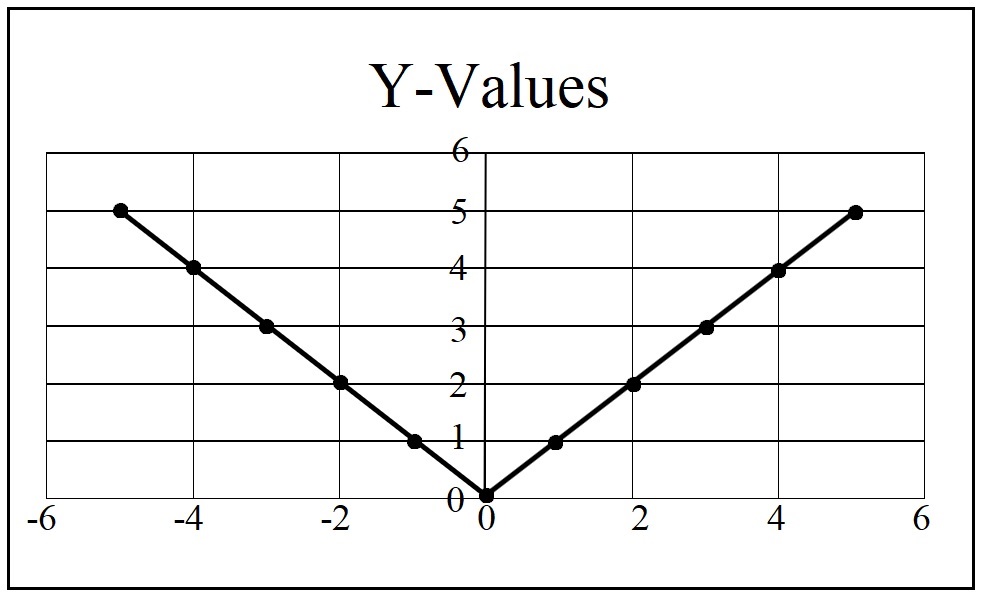
Find range of function |x|:
- A
- ✓
Set of positive real numbers
- C
- D
AnswerCorrect option: B. Set of positive real numbers
Since the above function can have positive real value of y for all real values of x. So, range is set of positive real numbers.
View full question & answer→MCQ 1311 Mark
The domain of definition of the function $\text{f(x)}=\log|\text{x}|$ is:
- A
$\text{R}$
- B
$\big(-\infty,0\big)$
- C
$(0,\infty)$
- ✓
$\text{R}-\{0\}$
AnswerCorrect option: D. $\text{R}-\{0\}$
$\text{f(x)}=\log|\text{x}|$
For f(x) to be defined,
$|\text{x}|>0,$ which is always true.
But $|\text{x}|\neq0$
$\Rightarrow\text{x}\neq0$
Thus, $\text{domain(f)}=\text{R}-\{0\}$
View full question & answer→MCQ 1321 Mark
If set A has 2 elements and set B has 3 elements then how many subsets does A × B have?
- 6
- 8
- 32
- 64
Answer
- 64
Solution:
If set $A$ has $m$ elements and set $B$ has $n$ elements then $A \times B$ has $m \times n$ elements. We know, a set has $2^r$ subsets if it has r number of elements.
Here, $A \times B$ has $2 \times 3=6$ elements. So, number of subsets of $A \times B$ will be $2^6$ i.e. 64 . View full question & answer→MCQ 1331 Mark
$\text{f}(\text{x})=\sqrt{9-\text{x}^2}$. Find the domain of the function:
AnswerWe know radical cannot be negative.
So, $9-\text{x}^2,\geq 0$
$ (3 - \text{x}) (3 + \text{x}) ≥$
$\Rightarrow (\text{x} - 3) (\text{x} + 3) ≤ 0$
$ \Rightarrow \text{x} ∈ [-3,3].$
View full question & answer→MCQ 1341 Mark
Let $\text{A}=\{\text{x}\in\text{R}:\text{x}\neq0-4\leq\text{x}\leq4\}$ and $\text{f}:\text{A}\in\text{R}$ be defined by $\text{f(x)}=\frac{|\text{x}|}{\text{x}}$ for $\text{x}\in\text{A}$ Then A:
AnswerCorrect option: A. $[1,-1]$
As, $\text{|x|}=\begin{cases}\text{x},\ \text{x}\geq0\\-\text{x}<0\end{cases}$
So, $\text{f(x)}=\frac{\text{x}}{|\text{x}|}$
When, $\text{x}<0\text{ i.e.,}\text{ x}\in\big[-4,0\big)$
$\text{f(x)}=\frac{\text{x}}{-\text{x}}=-1$
and when, $\text{x}>0\text{ i.e., x}\in\big(0,4\big]$
$\text{f(x)}=\frac{\text{x}}{\text{x}}=1$
So, range $\text{f}=\{-1,1\}$
View full question & answer→MCQ 1351 Mark
If f(x) = (x - 1), (x - 3), (x - 4), (x - 6) + 19 for all real value of x is:
MCQ 1361 Mark
Let $f: R \rightarrow R$ be a function given by $f(x)=x^2+1$ then the value of $f^{-1}(26)$ is:
- A
$ 5$
- B
$ -5$
- ✓
$ ±5$
- D
$ \text{None of these}$
Answer
- $ ±5$
Solution:
Let $\text{y}=\text{f}(\text{x})=\text{x}^{2}+1$
⇒ $\text{y}=\text{x}^{2}+1$
⇒ $ \text{y}-1=\text{x}^{2}$
⇒ $ \text{x} = ±\sqrt{(\text{y} – 1)}$
⇒ $\text{f}^{-1} \text{x} = ±\sqrt{(\text{x} – 1)}$
Now, $\text{f}^{-1} (26) = ±\sqrt{(\text{26} – 1)}$
⇒ $\text{f}^{-1} (26) = ±\sqrt{(\text{25} )}$
⇒ $\text{f}^{-1} (26) = ± {5 }$ View full question & answer→MCQ 1371 Mark
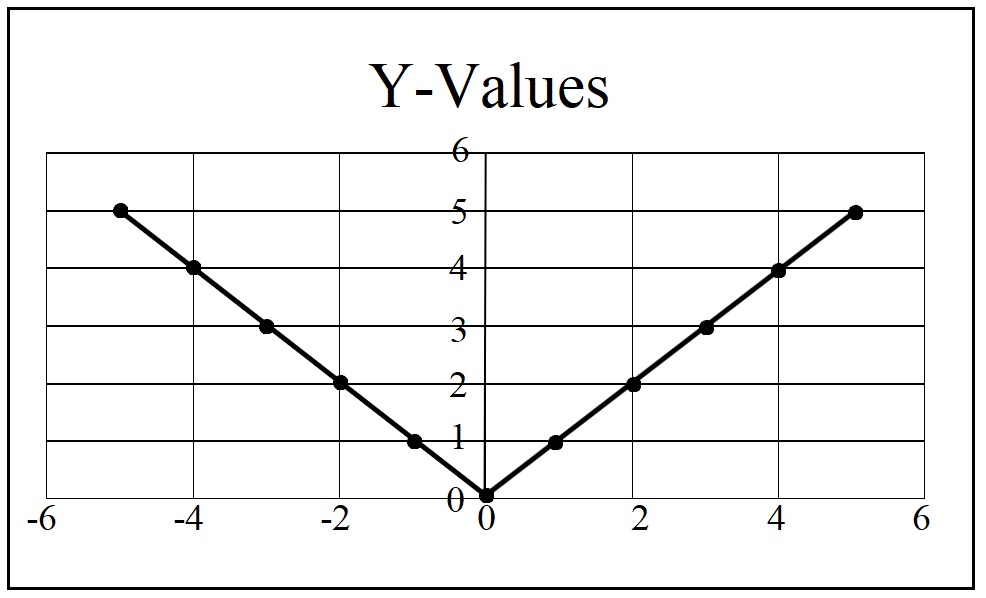
Find domain of function |x|:
- ✓
- B
Set of positive real numbers
- C
- D
AnswerSince the above function can have all real values of x. So, domain is set of real numbers.
View full question & answer→MCQ 1381 Mark
Let f(x) = |x - 1|. Then:
Answer$\text{f(x)}=|\text{x}-1|$
Since, $|\text{x}^2-1|\neq|\text{x}-1|^2$
$\text{f(x)}^2\neq(\text{f(x)})^2$
Thus, (i) is wrong.
Since, $|\text{x}+\text{y}-1|\neq|\text{x}-1||\text{y}-1|$
$\text{f}(\text{x}+\text{y})\neq\text{f(x)}\text{f(y)}$
Thus, (ii) is wrong.
Since, $|\text{|x|}-1\neq||\text{x}-1||=|\text{x}-1|$
$\text{f(|x|)}\neq|\text{f(x)}|$
Thus, (iii) is wrong.
Hence, none of the given options is the answer.
View full question & answer→MCQ 1391 Mark
If $\text{f(x)}=\cos(\log_\text{e}),$ then $\text{f}\Big(\frac{1}{\text{x}}\Big)\text{f}\Big(\frac{1}{\text{y}}\Big)-\frac{1}{2}\Big\{\text{f(xy)}+\text{f}\Big(\frac{\text{x}}{\text{y}}\Big)\Big\}$ is equal to:
- A
$\cos(\text{x}-\text{y})$
- B
$\log(\cos(\text{x}-\text{y}))$
- C
$1$
- ✓
$\cos(\text{x}+\text{y})$
AnswerCorrect option: D. $\cos(\text{x}+\text{y})$
$\text{f(x)}=\cos(\log_\text{e}\text{x})$
$\Rightarrow\text{f}\Big(\frac{1}{\text{x}}\Big)=\cos\Big(\log_\text{e}\Big(\frac{1}{\text{x}}\Big)\Big)$
$\Rightarrow\text{f}\Big(\frac{1}{\text{x}}\Big)=\cos\Big(-\log_\text{e}(\text{x})\Big)$
$\Rightarrow\text{f}\Big(\frac{1}{\text{x}}\Big)=\cos\Big(\log_\text{e}(\text{x})\Big)$
Similarly,
$\text{f}\Big(\frac{1}{\text{y}}\Big)=\cos(\log_\text{e}\text{y})$
Now,
$\text{f(xy)}=\cos(\log_\text{e}\text{xy})=\cos\big(\log_\text{e}\text{x}+\log_\text{e}\text{y}\big)$
and
$\text{f}\Big(\frac{\text{x}}{\text{y}}\Big)=\cos\Big(\log_\text{e}\frac{\text{x}}{\text{y}}\Big)=\cos\big(\log_\text{e}\text{x}-\log_\text{e}\text{y}\big)$
$\Rightarrow\text{f}\Big(\frac{\text{x}}{\text{y}}\Big)+\text{f(xy)}=\cos\big(\log_\text{e}\text{x}+\log_\text{e}\text{y}\big)+\cos\big(\log_\text{e}\text{x}-\log_\text{e}\text{y}\big)$
$\Rightarrow\text{f}\Big(\frac{\text{x}}{\text{y}}\Big)+\text{f(xy)}=2\cos\big(\log_\text{e}\text{x}\big)\cos(\log_\text{e}\text{y})$
$\Rightarrow\frac{1}{2}\Big[\text{f}\Big(\frac{\text{x}}{\text{y}}\Big)+\text{f(xy)}\Big]=\cos\big(\log_\text{e}\text{x}\big)\cos\big(\log_\text{e}\text{y}\big)$
$\Rightarrow\text{f}\Big(\frac{1}{\text{x}}\Big)\text{f}\Big(\frac{1}{\text{y}}\Big)-\frac{1}{2}\Big\{\text{f(xy)}+\text{f}\Big(\frac{\text{x}}{\text{y}}\Big)\Big\}=\cos\big(\log_\text{e}\text{x}\big)\cos\big(\log_\text{e}\text{y}\big)\\\ \ -\cos\big(\log_\text{e}\text{x}\big)\cos\big(\log_\text{e}\text{y}\big)=0$
Disclaimer: The question in the book has some error, so none of the options are matching with the solution. The solution is created according to the question given in the book.
View full question & answer→MCQ 1401 Mark
If $\text{f(x)}=\sin[\pi^2]\text{x}+\sin[-\pi^2]\text{x},$ where [x] denotes the greatest integer less than or equal to x, then:
AnswerCorrect option: A. $\text{f}\Big(\frac{\pi}{2}\Big)=1$
$\text{f(x)}=\sin[\pi^2]\text{x}+\sin[-\pi^2]\text{x}$
$\Rightarrow\text{f(x)}=\sin\big[9.8\big]\text{x}+\sin\big[-9.8\big]\text{x}$
$\Rightarrow\text{f(x)}=\sin9\text{x}-\sin10\text{x}$
$\Rightarrow\text{f}\Big(\frac{\pi}{2}\Big)=\sin9\times\frac{\pi}{2}-\sin10\times\frac{\pi}{2}$
$\Rightarrow\text{f}\Big(\frac{\pi}{2}\Big)=1-0=1$
View full question & answer→MCQ 1411 Mark
Choose the correct answers: Let $\text{f(x)}=\sqrt{1+\text{x}^2}$ then.
- A
$\text{f(xy)} = \text{f(x)}.\text{f(y)}$
- B
$\text{f(xy)} \geq \text{f(x)}.\text{f(y)}$
- ✓
$\text{f(xy)} \leq \text{f(x)}.\text{f(y)}$
- D
AnswerCorrect option: C. $\text{f(xy)} \leq \text{f(x)}.\text{f(y)}$
Given that: $\text{f(x)}=\sqrt{1+\text{x}^2}$
$\Rightarrow\text{f(xy)}=\sqrt{1+\text{x}^2\text{y}^2}$
and $\text{f(x)}.\text{f(y)}=\sqrt{1+\text{x}^2}.\sqrt{1+\text{x}^2}=\sqrt{1+\text{x}^2 +\text{y}^2+\text{x}^2\text{y}^2}$
$\therefore\sqrt{1+\text{x}^2\text{y}^2}\leq\sqrt{1+\text{x}^2 +\text{y}^2+\text{x}^2\text{y}^2}$
$\text{f(xy)} \leq \text{f(x)}.\text{f(y)}$
View full question & answer→MCQ 1421 Mark
If P × Q is an empty set then which of the following is a null set?
AnswerIf either set P or set Q is a null set then $\text{P}\times\text{Q}$ is an empty set.
i.e. if P is $ \phi$ or Q is $ \phi$ then $ \text{P} ×\text{Q}=\phi $.
View full question & answer→MCQ 1431 Mark
Let f : R × R be a function defined by $ \text{f}(\text{x}) = \cos(2\text{x} + 5)$, then f is:
AnswerGiven, $ \text{f}(\text{x}) = \cos(2\text{x} + 5)$
Period of $\text{f}(\text{x})=\frac{2\pi}{5}$
Since f(x) is a periodic function with period $\text{f}(\text{x})=\frac{2\pi}{5}$ so it is not injective.
The function f is not surjective also as its range [-1, 1] is a proper subset of its co-domain R.
View full question & answer→MCQ 1441 Mark
If g= {(1, 1), (2, 3), (3, 5), (4, 7)} is a function described by the formula, g(x) = ax + b then what values should be assigned to a and b?
MCQ 1451 Mark
If $\text{f(x)}=\frac{\sin^{4}\text{x}+\cos^2\text{x}}{\sin^2\text{x}+\cos^4\text{x}}$ for $\text{x}\in\text{R},$ then f(2002) =
AnswerGiven,
$\text{f(x)}=\frac{\sin^{4}\text{x}+\cos^2\text{x}}{\sin^2\text{x}+\cos^4\text{x}}$
On dividing the numerator and denominator by $\cos^4\text{x},$ we get
$\text{f(x)}=\frac{\tan^4\text{x}+\sec^2\text{x}}{1+\tan^2\text{x}\sec^2\text{x}}$
$=\frac{1+\tan^4\text{x}+\tan^2\text{x}}{1+\tan^2\text{x}(1+\tan^2\text{x})}$
$=\frac{1+\tan^{4}\text{x}+\tan^{2}\text{x}}{1+\tan^{4}\text{x}+\tan^{2}\text{x}}=1$ $(\text{For every x}\in\text{R})$
$\text{For x}=2002,$
We have,
$\text{f}(2002)=1$
View full question & answer→MCQ 1461 Mark
If f : R → R be given by for all $\text{f(x)}=\frac{4^{\text{x}}}{4^{\text{x}}+2}\text{ x }\in\text{R},$ then:
Answer$\text{f(x)}=\frac{4^{\text{x}}}{4^{\text{x}}+2}\text{ x }\in\text{R},$
$\text{f}\big(\text{1}-\text{x}\big)=\frac{4^{1-\text{x}}}{4^{1-\text{x}}+2}$
$=\frac{4}{2\times4^{\text{x}}+4}$
$=\frac{2}{4^{\text{x}}+2}$
$\text{f(x)}+\text{f}(1-\text{x})=\frac{4^{\text{x}}}{4^{\text{x}}+2}+\frac{2}{4^{\text{x}}+2}$
$=\frac{4^{\text{x}}+2}{4^{\text{x}}+2}=1$
View full question & answer→MCQ 1471 Mark
If $\text{f}(\text{x})=\frac{\text{x - 1}^{3}}{\text{x}^3}$ then $\text{f}(\text{x}) +\text{f}\big(\frac{1}{\text{x}}\big)$is equal to:
- A
$2\text{x}^{3}$
- B
$\frac{1}{\text{x}^{3}}$
- ✓
$0$
- D
$1$
View full question & answer→MCQ 1481 Mark
Domain and range of $ \text{f}(\text{x})=\frac{|\text{x - 3}|}{\text{x - 3}}$ are respectively:
View full question & answer→MCQ 1491 Mark
The range of $\text{f(x)}=\frac{1}{1-2\cos\text{x}}$ is:
- A
$\Big[\frac{1}{3},1\Big]$
- ✓
$\Big[-1,\frac{1}{3}\Big]$
- C
$\big(-\infty,-1\big)\cup\Big[\frac{1}{3},\infty\Big)$
- D
$\Big[-\frac{1}{3},1\Big]$
AnswerCorrect option: B. $\Big[-1,\frac{1}{3}\Big]$
We know that $-1\leq\cos\text{x}\leq1$ for all $\text{x}\in\text{R}$
Now,
$-1\leq\cos\text{x}\leq1$
$\Rightarrow-1\leq\cos\text{x}\leq1$
$\Rightarrow-2\leq-2\cos\text{x}\leq2$
$\Rightarrow-1\leq1-2\cos\text{x}\leq3$ (Adding 1 ro each term)
But,
$\cos\text{x}\neq\frac{1}{2}$
$\Rightarrow1-2\cos\text{x}\in\big[-1,3\big]-\{0\}$
$\Rightarrow\frac{1}{1-2\cos\text{x}}\in\big(-\infty,-1\big]\cap\Big[\frac{1}{3},\infty\Big)$
$\therefore\ \text{Range of }\text{f(x)}=\big(-\infty,-1\big]\cap\Big[\frac{1}{3},\infty\Big)$
Disclaimer: The range of the function does not matches with either of the given options. The range matches with option (c) if it is given as $\big(-\infty,-1\big]\cap\Big[\frac{1}{3},\infty\Big)$
View full question & answer→MCQ 1501 Mark
If : R → R is defined by f(x) = 3x + |x|, then f(2x) - f(-x) -6x =:
MCQ 1511 Mark
Choose the correct answers:The domain and range of the function f given by f(x) = 2 - x - 5| is.
- A
Domain = $\mathrm{R}^{+}$, Range $= ( –\infty, 1]$
- ✓
Domain = R, Range $= ( –\infty, 2]$
- C
Domain = R, Range $= ( –\infty, 2]$
- D
Domain = $\mathrm{R}^{+}$, Range $= ( –\infty, 2]$
AnswerCorrect option: B. Domain = R, Range $= ( –\infty, 2]$
- Domain = R, Range $= ( –\infty, 2]$
Solution:
We have, f(x) = 2 - |x - 5|
Clearly, f(x) is defined for all $\text{x}\in\text{R}.$
$\therefore$ Domain of f = R
Now, $|\text{x}-5|\geq0,\forall\text{x}\in\text{R}$
$\Rightarrow-|\text{x}-5|\leq0$
$\Rightarrow2-|\text{x}-5|\leq2$
$\therefore\text{f(x)}\leq2$
$\therefore$ Range of $\text{f}=(-\infty, 2]$ View full question & answer→MCQ 1521 Mark
If P, Q and R are subsets of set A, then $\text{R }\times(\text{p}^\text{c} \cup\text{Q}^{\text{c}})^\text{c}=$
- ✓
$(\text{R}\times\text{P}) \cap(\text{R}\times\text{Q})$
- B
$(\text{R}\times\text{Q}) \cap(\text{R}\times\text{P})$
- C
$(\text{R}\times\text{P}) \cup(\text{R}\times\text{Q})$
- D
$\text{ None of these}$
AnswerCorrect option: A. $(\text{R}\times\text{P}) \cap(\text{R}\times\text{Q})$
- $(\text{R}\times\text{P}) \cap(\text{R}\times\text{Q})$
View full question & answer→MCQ 1531 Mark
Let $n(A)=m$ and $n(B)=n$, Then, the total number of non-empty relations that can be defined from $A$ to $B$ is:
- A
$m^n$
- B
$-1{ }^m n$
- C
$2 m n-1$
- ✓
$2^{m n}-1$
AnswerCorrect option: D. $2^{m n}-1$
View full question & answer→MCQ 1541 Mark
If $A=\left\{x: x^2-5 x+6=0\right\} B=\{2,4\}, C=\{4,5\}$, then $A \times(B \cap C)$ is:
- ✓
- B
- C
- D
{(2, 2), (3, 3), (4, 4), (5, 5)}
View full question & answer→MCQ 1551 Mark
The domain of the function $\text{f(x)}=\sqrt{2-2\text{x}-\text{x}^2}$ is:
- A
$\big[-\sqrt{3},\sqrt{3}\big]$
- ✓
$\big[-1,-\sqrt{3},-1+\sqrt{3}\big]$
- C
$\big[-2,2\big]$
- D
$\big[-2-\sqrt{3},-2+\sqrt{3}\big]$
AnswerCorrect option: B. $\big[-1,-\sqrt{3},-1+\sqrt{3}\big]$
$\text{f(x)}=\sqrt{2-2\text{x}-\text{x}^2}$
Since, $2-2\text{x}-\text{x}^2\geq0$
$\text{x}^2+2\text{x}-2\leq0$
$\Rightarrow\text{x}^2-2\text{x}-2+1-1\leq0$
$\Rightarrow(\text{x}-1)^2-\big(\sqrt{3}\big)^2\leq0$
$\Rightarrow\big[\text{x}-\big(1-\sqrt{3}\big)\big]\big[\text{x}-\big(1+\sqrt{3}\big)\big]\leq0$
$\Rightarrow\big(-1-\sqrt{3}\big)\leq\text{x}\leq(-1+\sqrt{3})$
Thus, domain $(\text{f})=\big[-1-\sqrt{3},-1+\sqrt{3}\big]$
View full question & answer→MCQ 1561 Mark
$\text{f}(\text{x})=\sqrt{9-\text{x}^2}$. Find the range of the function:
- A
$R$
- B
$R^{+}$
- C
$[-3,3]$
- ✓
$[0,3]$
AnswerCorrect option: D. $[0,3]$
- $[0,3]$
Solution:
We know, square root is always non-negative.$\sqrt{9-\text{x}^2}>0$.
So, the range of the function is set of positive real numbers from 0 to 3. View full question & answer→MCQ 1571 Mark
If A = {1, 2, 4}, B = {2, 4, 5}, C = {2, 5}, then (A - B) × (B - C) is:
AnswerA = {1, 2, 4}, B = {2, 4, 5} and C = {2, 5}
(A - B) = {1}
(B - C) = {4}
So, (A - B) × (B - C) = {(1, 4)}
View full question & answer→MCQ 1581 Mark
Consider the following statements:
- If n(A) = p and n(B) = q then n(A × B) = pq
- A × f = f
- In general, A × B¹ B × A
Which of the above statements are true?
MCQ 1591 Mark
Consider the following statements:
- If $\text{A } \cap \text{B}=\phi$ then either $ \text{A}=\phi$ or $ \text{B}=\phi$
- For $ \text{a} ≠ \text{b}, \ ({\text{a}},\text{b})=(\text{b}, \text{a})$ and $ \text{a} ≠ \text{b}$
- If $\text{A}\subseteq \text{B}$, then $ \text{A } \times\text{A }\subseteq ( \text{A } \times\text{B })\ \cap ( \text{B} \times\text{A })$
- If $\text{A}\subseteq \text{B}$ and $\text{C}\subseteq \text{D}$, then $ \text{A } \times\text{C }\subseteq ( \text{B} \times\text{D }) $ Which of these is/are correct?
- A
Only $(II)$
- B
Only $(I)$
- C
Only $(IV)$
- ✓
$(II), (III)$ and $(IV)$
AnswerCorrect option: D. $(II), (III)$ and $(IV)$
$(II), (III)$ and $(IV)$
View full question & answer→MCQ 1601 Mark
If $P \times Q$ has $10$ elements then which is not possible?
- A
$n(P) = 1$ and $n(Q ) = 10$
- B
$n(P) = 10$ and $n(Q) = 1$
- C
$n(P) = 2$ and $n(Q) = 5$
- ✓
$n(P) = 5$ and $n(Q) = 4$
AnswerCorrect option: D. $n(P) = 5$ and $n(Q) = 4$
$n(P) = 5$ and $n(Q) = 4$
View full question & answer→MCQ 1611 Mark
If A and B are two sets, then $ \text{A}\times\text{ B }=\text{ B}\times\text{A}$ If and only if:
- A
$\text{A}\subset \text{ B}$
- B
$\text{B}\subset\text{C}$
- ✓
$\text{A}= \text{ B}$
- D
$\text{None of the above} $
AnswerCorrect option: C. $\text{A}= \text{ B}$
View full question & answer→MCQ 1621 Mark
The domain of $ \tan^{-1}(2\text{x}+1)$ is:
- ✓
$ \text{R}$
- B
$ \text{R}-\frac{1}{2}$
- C
$ \text{R}-\frac{-1}{2}$
- D
$\text{None of these}$
AnswerCorrect option: A. $ \text{R}$
Since $ \tan^1$ x exists if $\text{x}\in(-\infty,\infty)$
So, (2x + 1) is defined if
$ -\infty < 2\text{x} + 1 <\infty$
$\Rightarrow-\infty < \times <\infty$
$\Rightarrow \text{x}\in (-\infty,\infty)$
$\Rightarrow \text{x}\in \text{R}$
So, domain of $ \tan^-1(2\text{x}+1)$ is R.
View full question & answer→MCQ 1631 Mark
Which of the following are functions?
- A
$\{(\text{x, y}):\text{y}^2=\text{x, x, y}\in\text{R}\}$
- ✓
$\{(\text{x, y}):\text{y}=\text{|x|},\text{x, y}\in\text{R}\}$
- C
$\{(\text{x, y}):\text{x}^2+\text{y}^2=1,\text{x, y}\in\text{R}\}$
- D
$\{(\text{x, y}):\text{x}^2-\text{y}^2=1\text{x, y}\in\text{R}\}$
AnswerCorrect option: B. $\{(\text{x, y}):\text{y}=\text{|x|},\text{x, y}\in\text{R}\}$
For every value of $\text{x}\in\text{R},$ there is a unique value $\text{y} \in\text{R}$
i.e., there is a unique image for all values of $\text{x}\in\text{R},$
Also, values of x occur only once in the ordered pairs.
Thus, it is a function.
View full question & answer→MCQ 1641 Mark
If $9(x)=3 x^4-5 x^2+$, then value of $f(x-1)$ is:
- ✓
$3 x^4+12 x+13 x+2 x+7$
- B
$3 x^4-12 x-13 x-2 x-7$
- C
$3 x^4-12 x+13 x-2 x+7$
- D
$3 x^4-12 x-13 x+2 x+7$
AnswerCorrect option: A. $3 x^4+12 x+13 x+2 x+7$
View full question & answer→MCQ 1651 Mark
If A = {1, 2, 3}, B = {1, 4, 6, 9} and R is a relation from A to B defined by 'x' is greater than y. The range of R is
AnswerA = {1, 2, 3} and B = {1, 4, 6, 9}
R is a relation from A to B defined by: x is greater than y.
Then R = {(2, 1), (3, 1)}
$\therefore$ Range (R) = {1}
View full question & answer→