Questions

(Each question 2 marks)

Take a timed test

22 questions · self-marked practice — reveal the answer and mark yourself.

Question 12 Marks
Is it true that for any sets A and B,$P(A) \cup P(B) = P(A \cup B)?$Justify your answer.
Answer
No, it is not true.
Take A = {1, 2} ad B = {2, 3}
Then$A \cup B = \{ 1,2,3\} $
$P(A) = \{ \phi ,\{ 1\} ,\{ 2\} ,\{ 1,2\} \}$
$P(B) = \{ \phi ,\{ 2\} ,\{ 3\} ,\{ 2,3\} \}$
$\therefore P(A) \cup P(B) = \{ \phi ,\{ 1\} ,\{ 2\} ,\{ 3\} ,\{ 1,2\} ,\{ 2,3\} \} $. . (i)
$A \cup B = \{ 1,2,3\}$

$P(A \cup B) = \{ \phi \}$,{1}, {2}, {3}, {1, 2}, {2, 3}, {1, 3}, {1, 2, 3}} . . . (ii)
From (i) and (ii), we have
$P(A \cup B) \ne P(A) \cup P(B)$
View full question & answer
Question 22 Marks
Assume that P(A) = P(B) show that A = B.
Answer
Let$X \in A \Rightarrow \{ x\} \in P(A)$
$\Rightarrow \{ x\} \in P(B)\,[\because P(A) = P(B)]$
$\Rightarrow X \notin B$
$\therefore A \subset B$. . . (i)
Let $X \in B \Rightarrow \{ x\} \in P(B)$
$\Rightarrow \{ X\} \in P(A)\,[\because \,P(A) = P(B)]$
$ \Rightarrow X \in A$. . . (ii)
$\therefore B \subset A$
From (i) and (ii) we have A = B
View full question & answer
Question 32 Marks
Let A, B and C be the sets such that $A \cup B = A \cup C$ and $A \cap B = A \cap C$ Show that B = C.
Answer
We know that$A = A \cap (A \cup B)$and$A = A \cup (A \cap B)$
Now $A \cap B = A \cap C$and$A \cup B = A \cup C$
$\therefore B = B \cup (B \cap A) = B \cup (A \cap B) = B \cup (A \cap C)$$[\because \,A \cap B = A \cap C]$
$ = (B \cup A) \cap (B \cup C)$(By distributive law)
$ = (A \cup C) \cap (B \cup C)$
$ = (A \cup C) \cap (B \cup C)$$[\because \,A \cup B = A \cup C]$
$ = (C \cup A) \cap (C \cup B)$
$= C \cup (A \cap B)$(by distributive law)
$ = C \cup (A \cap C)$$[\because \,A \cap B = A \cap C]$
$ = C \cup (C \cap A) = C$
Hence B = C.
View full question & answer
Question 42 Marks
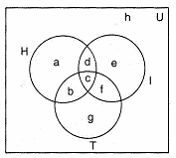
In a survey of 60 people, it was found that 25 people read newspaper H, 26 read newspaper T, 26 read newspaper I, 9 read both H and I, 11 read both H and T, 8 read both T and I, 3 read all three newspapers.
Find the number of people who read exactly one newspaper.
Answer
Here
n(U) = a + b + c + d + e + f + g + h = 60 ....(i)
n(H) = a + b + c +d = 25 ....(ii)
n(T) = b + c + f + g = 26 .....(iii)
n(I) = c + d + e + f = 26 ....(iv)
$n(H \cap I) $ = c + d = 9 ....(v)
$n(H \cap T) $= b + c = 11 .....(vi)
$n(T \cap I) $ = c + f = 8 .....(vii)
$n(H \cap T \cap I) $ = c = 3 ....(viii)

Putting value of c in (vii),
3 + f = 8 $\Rightarrow$ f = 5
Putting value of c in (vi),
3 + b = 11 $\Rightarrow$ b = 8
Putting values of c in (v),
3 + d = 9 $\Rightarrow$ d = 6
Putting value of c, d, f in (iv),
3 + 6 + e + 5 = 26 $\Rightarrow$ e = 26 - 14= 12
Putting value of b, c, f in (iii),
8 + 3 + 5 + g = 26 $\Rightarrow$ g = 26 - 16= 10
Putting value of b, c, d in (ii)
a + 8 + 3 + 6 = 25 $\Rightarrow$ a = 25 - 17 = 8
Number of people who read exactly one newspapers
= a + e + g
= 8 + 12 + 10 = 30
View full question & answer
Question 52 Marks
In a survey of 60 people, it was found that 25 people read newspaper H, 26 read newspaper T, 26 read newspaper I, 9 read both H and I, 11 read both H and T, 8 read both T and I, 3 read all three newspapers.
Find the number of people who read at least one of the newspaper.
Answer
Here
n(U) = a + b + c + d + e + f + g + h = 60....(i)
n (H) = a + b + c +d = 25....(ii)
n(T) = b + c + f + g = 26 .....(iii)
n(I) = c + d + e + f = 26....(iv)
$n(H \cap I) $ = c + d = 9 .....(v)
$n(H \cap T) $ = b + c = 11 .....(vi)
$n(T \cap I) $= c + f = 8 ....(vii)
$n(H \cap T \cap I) $= c = 3 ....(viii)

Putting value of c in (vii),
3 + f = 8 $\Rightarrow$f = 5
Putting value of c in (vi),
3 + b = 11$\Rightarrow$b = 8
Putting values of c in (v),
3 + d = 9$\Rightarrow$d = 6
Putting value of c, d, f in (iv),
3 + 6 + e + 5 = 26$\Rightarrow$ e = 26 - 14= 12
Putting value of b, c, f in (iii),
8 + 3 + 5 + g = 26 $\Rightarrow$g = 26 - 16= 10
Putting value of b, c, d in (ii)
a + 8 + 3 + 6 = 25 $\Rightarrow$a = 25 - 17 = 8
Number of people who read at least one of the three newspapers
= a + b + c + d + e + f + g
= 8 + 8 + 3 + 6 + 12 + 5 + 10 = 52
View full question & answer
Question 62 Marks
In a group of students, 100 students know Hindi, 50 know English and 25 know both. Each of the students knows either Hindi or English. How many students are there in the group?
Answer
Let H be the set of students who know Hindi and E be the set of students who know English.
Here n(H) = 100, n(E) = 50 and$n(H \cap E) = 25$
We know that$n(H \cup E) = n(H) + n(E) - n(H \cap E)$
= 100 + 50 - 25 = 125.
View full question & answer
Question 72 Marks
In a survey of 600 students in a school, 150 students were found to be taking tea and 225 taking coffee, 100 were taking both tea and coffee. Find how many students were taking neither tea nor coffee.
Answer
Let T be the set of students who like tea and C be the set of students who like coffee.
Here n(T) = 150, m (C) = 225 and$n(C \cap T) = 100$
We know that$n(C \cup T) = n(C) + n(T) - n(C \cap T)$
= 150 + 225 - 100 = 275
$\therefore$Number of students taking either tea or coffee += 275
$\therefore$Number of students taking neither tea nor coffee = 600 - 275 = 325
View full question & answer
Question 82 Marks
Find sets A, B and C such that$A \cap B,B \cap C$and $A \cap C$are non-empty sets and$A \cap B \cap C = \phi $
Answer
Take A = {1, 2} B = {1, 4} and C = {2, 4}
Now$A \cap B = \{ 1\} \ne \phi$
$B \cap C = \{ 4\} \ne \phi$
$A \cap C = \{ 2\} \ne \phi$
But$A \cap B \cap C = \phi$
View full question & answer
Question 92 Marks
In a committee, 50 people speak French, 20 speak Spanish and 10 speak both Spanish and French. How many speak at least one of these two languages?
Answer
Let F be the set of people who speak French and 'S' be the set of people who speak Spanish.
Here n(F) = 50, n(S) = 20 and $n(F \cap S) = 10$
We know that$n(F \cup S) = n(F) + n(S) - n(F \cap S)$
$\therefore n(F \cup S) = 50 + 20 - 10 = 60$
Number of people who speak at least one of these two languages = 60
View full question & answer
Question 102 Marks
In a group of 65 people, 40 like cricket, 10 like both cricket and tennis. How many like tennis only and not cricket? How many like tennis?
Answer
Let C be the set of people who like cricket and T be the set of people who like tennis.
Here n(C) = 40,$n(C \cap T) = 10$and $n(C \cup T) = 65$
We know that$n(C \cup T) = n(C) + n(T) - n(C \cap T)$
$\therefore$65 = 40 + n(T) - 10
$\therefore$n(T) = 65 - 30= 35
Number of people who like tennis = 35
Now number of people who like tennis only and not cricket
= n(T - C)

$ = n(T) - n(C \cap T)$
= 35 - 10 = 25

View full question & answer
Question 112 Marks
In a group of 70 people, 37 like coffee, 52 like tea and each person likes at least one of the two drinks. How many people like both coffee and tea?
Answer
Let C be the set of persons who like coffee and T be the set of persons who like tea.
$\therefore $n(C) = 30,n(T) = 52 and$n(C \cup T) $ = 70
We know that$n(C \cup T) = n(C) + n(T) - n(C \cap T)$
$\therefore$ 70 = 37 + 52 - n(C$ \cap$ T)
$\therefore n(C \cap T) $ = 89 - 70 = 19
View full question & answer
Question 122 Marks
In a group of 400 people, 250 can speak Hindi and 200 can speak English. How many people can speak both Hindi and English.
Answer
Let H be the set of people speaking Hindi and E be the set of people speaking English.
$\therefore$n(H) = 250, n(E) = 200 and $n(H \cup E) = 400$
We have to find $n(H \cap E)$
We know that$n(H \cap E) = n(H) + n(E) - n(H \cap E)$
$\therefore 400 = 250 + 200 - n(H \cap E)$
$\therefore n(H \cap E) = 450 - 400 = 50$
View full question & answer
Question 132 Marks
If U = {1, 2, 3, 4, 5, 6, 7, 8, 9}, A = {2, 4, 6, 8} and B= {2, 3, 5, 7}, verify that: (A $\cap$ B)' = A' $\cup$ B'.
Answer
Here U = {1, 2, 3, 4, 5, 6, 7, 8, 9}
A = {2, 4, 6, 8} and B = {2, 3, 5, 7}
$A \cap B $ = {2, 4, 6, 8} $\cap$ {2, 3, 5, 7}
= {2}
$(A \cap B)' = U - (A \cap B) $ = {1, 2, 3, 4, 5, 6, 7, 8, 9} - {2}
= {1, 3, 4, 5, 6, 7, 8, 9} . . . (i)
A' = U - A = {1, 2, 3, 4, 5, 6, 7, 8, 9} - {2, 4, 6, 8}
= {1, 3, 5, 7, 8}
B' = U - B = {1, 2, 3, 4, 5, 6, 7, 8, 9} - {2, 3, 5, 7}
= {1, 4, 6, 8, 9}
$A' \cup B'$ = {1, 3, 5, 7, 9} $\cup$ {1, 4, 6, 8, 9}
= {1, 3, 4, 5, 6, 7, 8, 9} . . . (ii)
From (i) and (ii) we have
$(A \cap B)' = A' \cup B'$
View full question & answer
Question 142 Marks
If U = {1, 2, 3, 4, 5, 6, 7, 8, 9}, A = {2, 4, 6, 8} and B= {2, 3, 5, 7}, verify that: (A $\cup$ B)' = A' $\cap$ B'
Answer
Here U = {1, 2, 3, 4, 5, 6, 7, 8, 9}
A = {2, 4, 6, 8} and B = {2, 3, 5, 7}
$A \cup B $ = {2, 4, 6, 8} $\cup$ {2, 3, 5, 7}
= {2, 3, 4, 5, 6, 7,8}
$\therefore (A \cup B)' = U - (A \cup B)$= {1,2, 3, 4, 5, 6, 7, 8, 9} - {2, 3, 4, 5, 6, 7, 8}
= {1, 9} . . . (i)
A' = U - A = {1, 2, 3, 4, 5, 6, 7, 8, 9} - {2, 4, 6, 8}
= {1, 3, 5, 7, 9}
B' = U - B = {1, 2, 3, 4, 5, 6, 7, 8, 9} - {2, 3, 5, 7}
= {1, 4, 6, 8, 9}
$A' \cap B' $ = {1, 3, 5, 7, 9} $\cap$ {1, 4, 6, 8, 9} = {1, 9} ....(ii)
From (i) and (ii), we have
$(A \cup B)' = A' \cap B'$
View full question & answer
Question 152 Marks
Find the pairs of equal sets, if any, give reasons: $A=\{0\}, B=\{x: x>15$ and $x<5\}, C=\{x: x-5=0\}, D=\left\{x: x^2=25\right\}, E$ $=\left\{x: x\right.$ is an integral positive root of the equation $\left.x^2-2 x-15=0\right\}$
Answer
Since $0 \in A$ and 0 does not belong to any of the sets $B, C, D$ and $E$, Therefore, $A \neq B, A \neq C, A \neq D, A \neq E$.
Since $B=\phi$ but none of the other sets are empty. Therefore $B \neq C, B \neq D$ and $B \neq E$.
Also $C=\{5\}$ but $-5 \in D$, hence $C \neq D$.
Since $E=\{5\}, C=E$. Further, $D=\{-5,5\}$ and $E=\{5\}$, we find that, $D \neq E$.
Therefore, the only pair of equal sets is C and E .
View full question & answer
Question 162 Marks
A market research group conducted a survey of 1000 consumers and reported that 720 consumers like product A and 450 consumers like product B, what is the least number that must have liked both products?
Answer
Let U be the set of consumers questioned, S be the set of consumers who liked the product A and T be the set of consumers who like the product B.
Given that:
n(U) = 1000, n(S) = 720, n(T) = 450
Therefore, n(S $\cup$T) = n(S) + n(T) – n(S ∩ T)
= 720 + 450 – n (S ∩ T) = 1170 – n(S $\cup$T)
Thus, n(S $\cup$T) is maximum whenn(S $\cap$T) is least. But S $\cup$T $\subset$U implies
n(S $\cup$T) ≤ n ($\cup$) = 1000. So, maximum values of n(S $\cup$T) is 1000.
Therefore, the leastvalue of n(S $\cup$T) is 170.
View full question & answer
Question 172 Marks
Show that the set of letters needed to spell CATARACT and the set of letters needed to spell TRACT are equal.
Answer
The set formed by distinct letters of the word CATARACT are {A, C, R, T}
The set formed by distinct letters of the word TRACT are {A, C, R, T}
As we see, the set of letters to spell CATARACT is same to the setof letters to spell TRACT, we can say the two sets are equal.
View full question & answer
Question 182 Marks
In a class of 35 students, 24 like to play cricket and 16 like to play football. Also, each student likes to play at least one of the two games. How many students like to play both cricket and football?
Answer
Let C be the set of students who like to play cricket and F be the set of students who like to play football.
Here n(C) = 24, n(F) = 16, $n(C \cup F) $ = 35.
We know that
$n(C \cup F) = n(C) + n(F) - n(C \cap F)$
35 = 24 + 16 - $n(C \cap F)$
$n(C \cap F) $ = 40 - 35 = 5
View full question & answer
Question 192 Marks
In a school, there are 20 teachers who teach mathematics or physics. Of these, 12 teach mathematics and 4 teach physics and mathematics. How many teach physics?
Answer
Let n(P) denote the number of teachers who teach Physics and n(M) denote the number of teachers who teach mathematics.
We have,
n(P$\cup $M) = 20, n(M) = 12 and n(P$\cap$M) = 4
To find : n(P)
We know that
n(P$\cup $M) = n(P) + n(M) - n(P$\cap$M)
$\Rightarrow$ 20 = n(P) + 12 - 4
$\Rightarrow$ 20 = n(P) + 8
$\Rightarrow$ n(P) = 20 - 8
= 12
$\therefore$ 12 teachers teach Physics.
View full question & answer
Question 202 Marks
If X and Y are two sets such that X $\cup$Y has 50 elements, X has 28 elements, and Y has 32 elements, how many elements does X $\cap$ Y have?
Answer
Here,
n (X $\cup$Y) = 50, n (X) = 28, n (Y) = 32,
n (X $\cap$Y) = ?
By using the formula,we have
n (X $\cup$Y) = n (X) + n (Y) – n (X $\cap$Y),
we find that
n (X $\cap$Y) = n (X) + n (Y) – n (X $\cup$Y)
= 28 + 32 – 50 = 10
View full question & answer
Question 212 Marks
Let U be universal set of all the students of Class XI of a coeducational school and A be the set of all girls in Class XI. Find A′.
Answer
We know that,In a coeducational school, there can be only boys and girls in a school.
A is the set of all girls,then
A' = Set of all Students - Set of all girls
A' = Set of all boys in class XI
View full question & answer
Question 222 Marks
Let A = { 1, 2, 3, 4, 5, 6}, B = { 2, 4, 6, 8 }. Find A – B and B – A.
Answer
Here, A -B = {1, 3, 5}, since the elements 1, 3, 5 belong to A but not to B and also B -A = {8}, since the element 8 belongs to B and not to A.then,
We note that A -B $\ne$B – A
View full question & answer