Questions

(Each question 4 marks)

Take a timed test

21 questions · self-marked practice — reveal the answer and mark yourself.

Question 14 Marks
Find the general solution for each of the following equations: $\sin2\text{x}+\cos\text{x}=0$
Answer
$\sin2\text{x}+\cos\text{x}=0$$\Rightarrow\sin2\text{x}+\cos\text{x}+\cos\text{x}=0$
$\Rightarrow\cos\text{x}(2\sin\text{x}+1)=0$
$\Rightarrow\cos\text{x}=0$ or $2\sin\text{x}+1=0$
Now, $\cos\text{x}=0\Rightarrow\cos\text{x}=(2\text{n}+1)\frac{\pi}{2},$ where $\text{n}\in\text{Z}$
$2\sin\text{x}+1=0$
$\Rightarrow\sin\text{x}=\frac{-1}{2}=-\sin\frac{\pi}{6}=\sin\Big(\pi+\frac{\pi}{6}\Big)$
$=\sin\Big(\pi+\frac{\pi}{6}\Big)=\sin\frac{7\pi}{6}$
$\Rightarrow\text{x}=\text{n}\pi+(-1)^\text{n}\frac{7\pi}{6},$ where $\text{n}\in\text{Z}$
Therefore, the general solution is $(2\text{n}+1)\frac{\pi}{2}$ or $\text{n}\pi+(-1)^2\frac{7\pi}{6},\text{n}\in\text{Z}$
View full question & answer
Question 24 Marks
Prove the following: $\sin2\text{x}+2\sin4\text{x}+\sin6\text{x}=4\cos^2\text{x}\sin4\text{x}$
Answer
$\text{L.H.S.}=\sin2\text{x}+2\sin4\text{x}+\sin6\text{x}$$=[\sin2\text{x}+\sin6\text{x}]+2\sin4\text{x}$
$=\Big[2\sin\Big(\frac{2\text{x}+6\text{x}}{2}\Big)\Big(\frac{2\text{x}-6\text{x}}{2}\Big)\Big]+2\sin4\text{x}$
$=\Big[\therefore\sin\text{A}+\sin\text{B}=2\sin\Big(\frac{\text{A}+\text{B}}{2}\Big)\cos\Big(\frac{\text{A}-\text{B}}{2}\Big)\Big]$
$=2\sin4\text{x}\cos(-2\text{x})+2\sin4\text{x}$
$=2\sin4\text{x}\cos2\text{x}+2\sin4\text{x}$ $=2\sin4\text{x}(\cos2\text{x}+1)$ $=2\sin4\text{x}(2\cos^2\text{x}-1+1)$ $=2\sin4\text{x}(2\cos^2\text{x})$ $=4\cos^2\text{x}\sin4\text{x}$ $= \text{R.H.S.}$
View full question & answer
Question 34 Marks
Prove the following: $\cos\Big(\frac{3\pi}{4}+\text{x}\Big)-\cos\Big(\frac{3\pi}{4}-\text{x}\Big)=-\sqrt{2}\sin\text{x}$
Answer
It is known that $\cos\text{A}-\cos\text{B}=-2\sin\Big(\frac{\text{A}+\text{B}}{2}\Big).\sin\Big(\frac{\text{A}-\text{B}}{2}\Big)$ $\therefore\text{L.H.S.}=\cos\Big(\frac{3\pi}{4}+\text{x}\Big)-\cos\Big(\frac{3\pi}{4}-\text{x}\Big)$$=-2\sin\Bigg\{\frac{\Big(\frac{3\pi}{4}+\text{x}\Big)+\Big(\frac{3\pi}{4}-\text{x}\Big)}{2}\Bigg\}.\sin\Bigg\{\frac{\Big(\frac{3\pi}{4}+\text{x}\Big)+\Big(\frac{3\pi}{4}-\text{x}\Big)}{2}\Bigg\}$
$=-2\sin\Big(\frac{3\pi}{4}\Big)\sin\text{x}$
$=-2\sin\Big(\pi-\frac{\pi}{4}\Big)\sin\text{x}$
$=-2\sin\frac{\pi}{4}\sin\text{x}$
$=-2\times\frac{1}{\sqrt{2}}\sin\text{x}$ $=-\sqrt{2}\sin\text{x}$ $= \text{R.H.S.}$
View full question & answer
Question 44 Marks
Prove the following: $\sin(\text{n}+1)\text{x}\sin(\text{n}+2)\text{x}+2\cos(\text{n}+1)\text{x}\cos(\text{n}+2)\text{x}=\cos\text{x}$
Answer
$ \text{L.H.S.}=$ $=\frac{1}{2}[2\sin(\text{n}+1)\text{x}\sin(\text{n}+2)\text{x}+2\cos(\text{n}+1)\text{x}\cos(\text{n}+2)\text{x}]$$=\frac{1}{2}\begin{bmatrix}\cos\{(\text{n}+1)\text{x}-(\text{n}+2)\text{x}\}-\cos\{(\text{n}+1)\text{x}+(\text{n}+2)\text{x}\}\\+\cos\{(\text{n}+1)\text{x}+(\text{n}+2)\text{x}\}+\cos\{(\text{n}+1)\text{x}-(\text{n}+2)\text{x}\}\end{bmatrix}$
$\begin{bmatrix}\therefore-2\sin\text{A}\sin\text{B}=\cos(\text{A}+\text{B})-\cos(\text{A}-\text{B})\\2\cos\text{A}\cos\text{B}=\cos(\text{A}+\text{B})+\cos(\text{A}-\text{B})\end{bmatrix}$
$=\frac{1}{2}\times2\cos\{(\text{n}+1)\text{x}-(\text{n}+2)\text{x}\}$
$=\cos(-\text{x})=\cos\text{x}$
$= \text{R.H.S.}$
View full question & answer
Question 54 Marks
Prove the following: $\cot4\text{x}(\sin5\text{x}+\sin3\text{x})=\cot4\text{x}(\sin5\text{x}-\sin3\text{x})$
Answer
$\text{L.H.S.}=\cot4\text{x}(\sin5\text{x}+\sin3\text{x})$$=\frac{\cos4\text{x}}{\sin4\text{x}}[2\sin4\text{x}\cos\text{x}]$
$=2\cos4\text{x}\cos\text{x}$
$\text{R.H.S.}=\cot4\text{x}(\sin5\text{x}-\sin3\text{x})$
$\text{L.H.S.} = \text{R.H.S.}$
View full question & answer
Question 64 Marks
Find the principal and general solutions of the following equations: $\text{cosec x}=-2$
Answer
$\text{cosec x}=-2$ It is known that $\Rightarrow\text{cosec x}=\frac{\pi}{6}=2$ $\therefore\text{cosec}\Big(\pi+\frac{\pi}{6}\Big)=-\text{cosec}\frac{\pi}{6}=-2$ $\text{cosec}\Big(2\pi-\frac{\pi}{6}\Big)=-\text{cosec}\frac{\pi}{6}=-2$ i.e. $\text{cosec}\frac{7\pi}{6}=-2$ or $\text{cosec x}=\frac{11\pi}{6}=-2$ Therefore, the principal solutions are $\text{x}=\frac{7\pi}{6}$ and $\frac{11\pi}{6}.$ Now, $\text{cosec x}=\text{cosec}\frac{7\pi}{6}$ $\Rightarrow\sin\text{x}=\sin\frac{7\pi}{6}\ \Big[\text{cosec x}=\frac{1}{\sin\text{x}}\Big]$ $\Rightarrow\text{x}=\text{n}\pi+(-1)^\text{n}\frac{7\pi}{6}$ where $\text{n}\in\text{Z}$ Therefore, the general solution is $\text{x}=\text{n}\pi+(-1)^\text{n}\frac{7\pi}{6}$ where $\text{n}\in\text{Z}$
View full question & answer
Question 74 Marks
Find the general solution for each of the following equations: $\cos4\text{x}=\cos2\text{x}$
Answer
$\cos4\text{x}=\cos2\text{x}$ $\Rightarrow\cos4\text{x}-\cos2\text{x}=0$ $\Rightarrow-2\sin\Big(\frac{4\text{x}+2\text{x}}{2}\Big)\sin\Big(\frac{4\text{x}-2\text{x}}{2}\Big)=0$ $\Big[\therefore\cos\text{A}-\cos\text{B=}-2\sin\Big(\frac{\text{A}+\text{B}}{2}\Big)\sin\Big(\frac{\text{A}-\text{B}}{2}\Big)\Big]$ $\Rightarrow\sin3\text{x}\sin\text{x}=0$ $\Rightarrow\sin3\text{x}=0$ or $\sin\text{x}=0$ $\therefore3\text{x}=\text{n}\pi$ or $\text{x}=\text{n}\pi,$ where $\text{n}\in\text{Z}$ $\Rightarrow\text{x}=\frac{\text{n}\pi}{3}$ or $\text{x}=\text{n}\pi,$ where $\text{n}\in\text{Z}$
View full question & answer
Question 84 Marks
Prove that: $(\cos\text{x}-\cos\text{y})^2+(\sin\text{x}-\sin\text{y})^2=4\sin^2\frac{\text{x}-\text{y}}{2}$
Answer
$\text{L.H.S.}=(\cos\text{x}-\cos\text{y})^2+(\sin\text{x}-\sin\text{y})^2$$=\Big(-2\sin\frac{\text{x}+\text{y}}{2}\sin\frac{\text{x}-\text{y}}{2}\Big)^2+\Big(2\cos\frac{\text{x}+\text{y}}{2}\sin\frac{\text{x}-\text{y}}{2}\Big)^2$
$\bigg[\because\cos\text{A}-\cos\text{B}=-2\sin\frac{\text{A}+\text{B}}{2}\sin\frac{\text{A}-\text{B}}{2}\text{and} \sin\text{B}=2\cos\frac{\text{A}+\text{B}}{2}\sin\frac{\text{A}-\text{B}}{2}\bigg]$
$=\Big(4\sin^2\frac{\text{x}+\text{y}}{2}\sin^2\frac{\text{x}-\text{y}}{2}\Big)+\Big(4\cos^2\frac{\text{x}+\text{y}}{2}\sin^2\frac{\text{x}-\text{y}}{2}\Big)$
$=4\sin^2\frac{\text{x}-\text{y}}{2}\Big(\sin^2\frac{\text{x}+\text{y}}{2}+\cos^2\frac{\text{x}+\text{y}}{2}\Big)$
$=4\sin^2\frac{\text{x}-\text{y}}{2}=\text{R.H.S.}$
View full question & answer
Question 94 Marks
Prove that: $(\cos\text{x}+\cos\text{y})^2+(\sin\text{x}-\sin\text{y})^2=4\cos^2\frac{\text{x}+\text{y}}{2}$
Answer
$\text{L.H.S.}=(\cos\text{x}+\cos\text{y})^2+(\sin\text{x}-\sin\text{y})^2$$=\cos^2\text{x}+\cos^2\text{y}+2\cos\text{x}\cos\text{y}+\sin^2\text{x}+\sin^2\text{y}-2\sin\text{x}\sin\text{y}$
$=(\cos^2\text{x}+\sin^2\text{x})+(\cos^2\text{y}+\sin^2\text{y})+2(\cos\text{x}\cos\text{y}-\sin\text{x}\sin\text{y})$
$=1+1+2\cos(\text{x}+\text{y})\ [\cos(\text{A}+\text{B})=(\cos\text{A}\cos\text{B}-\sin\text{A}\sin\text{B})]$
$=2+2\cos(\text{x}+\text{y})$
$=2[1+\cos(\text{x}+\text{y})]$
$=2\Big[1+2\cos^2\Big(\frac{\text{x}+\text{y}}{2}\Big)-1\Big]\ [\cos2\text{A}=2\cos^2\text{A}-1]$
$=4\cos^2\frac{\text{x}+\text{y}}{2}=\text{R.H.S.}$
View full question & answer
Question 104 Marks
Prove that: $\frac{(\sin7\text{x}+\sin5\text{x})+(\sin9\text{x}+\sin3\text{x})}{(\cos7\text{x}+\cos5\text{x})(\cos9\text{x}+\cos3\text{x})}=\tan6\text{x}$
Answer
$\text{L.H.S.}=\frac{(\sin7\text{x}+\sin5\text{x})+(\sin9\text{x}+\sin3\text{x})}{(\cos7\text{x}+\cos5\text{x})(\cos9\text{x}+\cos3\text{x})}$$=\frac{\Big[2\sin\Big(\frac{7\text{x}+5\text{x}}{2}\Big)\cos\Big(\frac{7\text{x}-5\text{x}}{2}\Big)\Big]+\Big[2\sin\Big(\frac{9\text{x}+3\text{x}}{2}\Big)\cos\Big(\frac{9\text{x}-3\text{x}}{2}\Big)\Big]}{\Big[2\cos\Big(\frac{7\text{x}+5\text{x}}{2}\Big)\cos\Big(\frac{7\text{x}-5\text{x}}{2}\Big)\Big]+\Big[2\cos\Big(\frac{9\text{x}+3\text{x}}{2}\Big)\cos\Big(\frac{9\text{x}-3\text{x}}{2}\Big)\Big]}$
$=\frac{2\sin6\text{x}\cos\text{x}+2\sin6\text{x}\cos3\text{x}}{2\cos6\text{x}\cos\text{x}+2\cos6\text{x}\cos3\text{x}}$
$=\frac{2\sin6\text{x}(\cos\text{x}+\cos3\text{x})}{2\cos6\text{x}(\cos\text{x}+\cos3\text{x})}$
$=\tan6\text{x}=\text{R.H.S.}$
View full question & answer
Question 114 Marks
Prove the following: $\cos6\text{x}=32\cos^6\text{x}-48\cos^4\text{x}+18\cos^2\text{x}-1$
Answer
$\text{L.H.S.}=\cos6\text{x}$ $=\cos3(2\text{x})$ $=4[(2\cos^2\text{x}-1)^3-3(2\cos^2\text{x}-1)[\cos2\text{x}=2\cos^2\text{x}-1]$ $=4[(2\cos^2\text{x})^3-(1)^3-3(2\cos^2\text{x})^2+3(2\cos^2\text{x}=2\cos^2\text{x})]-\cos^2\text{x}+3$ $=4[8\cos^6\text{x}-1-12\cos^4\text{x}+6\cos^2\text{x}]-6\cos^2\text{x}+3$ $=32\cos^6\text{x}-4-48\cos^4\text{x}+24\cos^2\text{x}-6\cos^2\text{x}+3$ $=32\cos^6\text{x}-48\cos^4\text{x}+18\cos^2\text{x}-1=\text{R.H.S.}$
View full question & answer
Question 124 Marks
Find $\sin\frac{\text{x}}{2},\cos\frac{\text{x}}{2}$ and $\tan\frac{\text{x}}{2}$ in each of the following : $\cos\text{x}=-\frac{1}{3},$ x in quadrant III
Answer
Here, $\cos\text{x}=-\frac{1}{3},$ x is in quadrant III. Now, $\pi<\text{x}<\frac{3\pi}{2}$ $\Rightarrow\frac{\pi}{2}<\frac{\pi}{2}<\frac{3\pi}{4}$ $\therefore\frac{\text{x}}{2}$ lies in second quadrant. $\therefore\sin\frac{\text{x}}{2}$ are positive and $\cos\frac{\text{x}}{2},\tan\frac{\text{x}}{2}$ are negative. Now, $\cos\frac{\text{x}}{2}=\sqrt{\frac{1+\cos\text{x}}{2}}=-\sqrt{\frac{1-\frac{1}{3}}{2}}=-\frac{1}{\sqrt{3}}\times\frac{\sqrt{3}}{\sqrt{3}}=\frac{-\sqrt{3}}{3}$ $\sin\frac{\text{x}}{2}=\sqrt{\frac{1-\cos\text{x}}{2}}=\sqrt{\frac{1+\frac{1}{3}}{2}}=\sqrt{\frac{2}{3}}\times\frac{\sqrt{3}}{\sqrt{3}}=\frac{\sqrt{6}}{3}$ $\tan\frac{\text{x}}{2}=\frac{\sin\frac{\text{x}}{2}}{\cos\frac{\text{x}}{2}}=\frac{\frac{\sqrt{2}}{\sqrt{3}}}{-\frac{1}{\sqrt{3}}}=-\sqrt{2}$
View full question & answer
Question 134 Marks
Find the general solution for each of the following equations: $\cos3\text{x}+\cos\text{x}-\cos2\text{x}=0$
Answer
Given: $\cos3\text{x}+\cos\text{x}-\cos2\text{x}=0$ $\Rightarrow2\cos\Big(\frac{3\text{x}+\text{x}}{2}\Big)\cos\Big(\frac{3\text{x}-\text{x}}{2}\Big)-\cos2\text{x}=0$ $\Rightarrow2\cos2\text{x}\cos\text{x}-\cos2\text{x}=0$ $\Rightarrow\cos2\text{x}(2\cos\text{x}-1)=0$ $\Rightarrow\cos2\text{x}=0$ or $2\cos\text{x}-1=0$ $\Rightarrow2\text{x}=(2\text{n}+1)\frac{\pi}{2}$ or $\cos\text{x}=\frac{1}{2}=\cos\frac{\pi}{3},\text{n}\in\text{Z}$ $\Rightarrow\text{x}=(2\text{n}+1)\frac{\pi}{4}$ or $\text{x}=2\text{n}\pi\pm\frac{\pi}{3},\text{n}\in\text{Z}$
View full question & answer
Question 144 Marks
Prove that: $\sin\text{x}+\sin3\text{x}+\sin5\text{x}+\sin7\text{x}=4\cos2\text{x}\sin4\text{x}\cos\text{x}$
Answer
It is known that $\sin\text{A}+\sin\text{B}=2\sin\Big(\frac{\text{A}+\text{B}}{2}\Big).\cos\Big(\frac{\text{A}-\text{B}}{2}\Big).$$\text{L.H.S.}=\sin\text{x}+\sin3\text{x}+\sin5\text{x}+\sin7\text{x}$
$=(\sin\text{x}+\sin5\text{x})+(\sin3\text{x}+\sin7\text{x})$ $=2\sin\Big(\frac{\text{x}+5\text{x}}{2}\Big).\cos\Big(\frac{\text{x}-5\text{x}}{2}\Big)+2\sin\Big(\frac{3\text{x}+7\text{x}}{2}\Big)\cos\Big(\frac{3\text{x}-7\text{x}}{2}\Big)$ $=2\sin3\text{x}\cos(-2\text{x})+2\sin5\text{x}\cos(-2\text{x})$ $=2\sin3\text{x}\cos2\text{x}+2\sin5\text{x}\cos2\text{x}$ $=2\cos2\text{x}[\sin3\text{x}+\sin5\text{x}]$ $=2\cos2\text{x}\Big[2\sin\Big(\frac{3\text{x}+5\text{x}}{2}\Big).\cos\Big(\frac{3\text{x}-5\text{x}}{2}\Big)\Big]$ $=2\cos2\text{x}[2\sin4\text{x}.\cos(-\text{x})]$ $=4\cos2\text{x}\sin4\text{x}\cos\text{x}=\text{R.H.S.}$
View full question & answer
Question 154 Marks
Prove the following: $\cos^22\text{x}-\cos^26\text{x}=\sin8\text{x}\sin4\text{x}$
Answer
It is known that $\cos\text{A}+\cos\text{B}=2\cos\Big(\frac{\text{A}+\text{B}}{2}\Big).\cos\Big(\frac{\text{A}-\text{B}}{2}\Big).$ $\cos\text{A}-\cos\text{B}=-2\sin\Big(\frac{\text{A}+\text{B}}{2}\Big).\sin\Big(\frac{\text{A}-\text{B}}{2}\Big)$ $\therefore\text{L.H.S.}=\cos^22\text{x}-\cos^26\text{x}$$=(\cos2\text{x}+\cos6\text{x})(\cos2\text{x}-6\text{x})$
$=\Big[2\cos\Big(\frac{2\text{x}+6\text{x}}{2}\Big)\cos\Big(\frac{2\text{x}-6\text{x}}{2}\Big)\Big]\Big[-2\sin\Big(\frac{2\text{x}+6\text{x}}{2}\Big)\sin\Big(\frac{2\text{x}-6\text{x}}{2}\Big)\Big]$
$=[2\cos4\text{x}\cos(-2\text{x})][-2\sin4\text{x}\sin(-2\text{x})]$
$=[2\cos4\text{x}\cos2\text{x}][-2\sin4\text{x})(\sin-2\text{x})]$
$=(2\cos4\text{x}\cos4\text{x})(2\sin2\text{x}\cos2\text{x})$ $=\sin8\text{x}\sin4\text{x}$ $=\text{R.H.S.}$
View full question & answer
Question 164 Marks
Prove that: $\sin3\text{x}+\sin2\text{x}-\sin\text{x}=4\sin\text{x}\cos\Big(\frac{\text{x}}{2}\Big)\cos\Big(\frac{3\text{x}}{2}\Big)$
Answer
$\text{L.H.S.}=\sin3\text{x}+\sin2\text{x}-\sin\text{x}$$=\sin3\text{x}+(\sin2\text{x}-\sin\text{x})$
$=\sin3\text{x}+\Big[2\cos\Big(\frac{2\text{x}+\text{x}}{2}\Big)\sin\Big(\frac{2\text{x}-\text{x}}{2}\Big)\Big]$$\Big[\sin\text{A}-\sin\text{B}=2\cos\Big(\frac{\text{A}+\text{B}}{2}\Big)\sin\Big(\frac{\text{A}-\text{B}}{2}\Big)\Big]$
$=\sin3\text{x}+\Big[2\cos\Big(\frac{3\text{x}}{2}\Big)+\sin\Big(\frac{\text{x}}{2}\Big)\Big]$
$=\sin3\text{x}+2\cos\frac{3\text{x}}{2}\sin\frac{\text{x}}{2}$
$=2\sin\frac{3\text{x}}{2}.\cos\frac{3\text{x}}{2}+2\cos\frac{3\text{x}}{2}\sin\frac{\text{x}}{2}$ $[\sin2\text{A}=2\sin\text{A}.\cos\text{B}]$
$=2\sin\cos\Big(\frac{3\text{x}}{2}\Big)\Big[\sin\Big(\frac{3\text{x}}{2}\Big)+\sin\Big(\frac{\text{x}}{2}\Big)\Big]$
$=2\cos\Big(\frac{3\text{x}}{2}\Big)\begin{bmatrix}2\sin\begin{Bmatrix}\frac{\Big(\frac{3\text{x}}{2}\Big)+\Big(\frac{\text{x}}{2}\Big)}{2}\end{Bmatrix}\end{bmatrix}\cos\begin{Bmatrix}\frac{\Big(\frac{3\text{x}}{2}\Big)-\Big(\frac{\text{x}}{2}\Big)}{2}\end{Bmatrix}$ $\Big[\sin\text{A}+\sin\text{B}=2\sin\Big(\frac{\text{A}+\text{B}}{2}\Big)\cos\Big(\frac{\text{A}-\text{B}}{2}\Big)\Big]$
$=2\cos\Big(\frac{3\text{x}}{2}\Big).2\sin\text{x}\cos\Big(\frac{\text{x}}{2}\Big)$
$=4\sin\text{x}\cos\Big(\frac{\text{x}}{2}\Big)\cos\Big(\frac{3\text{x}}{2}\Big)=\text{R.H.S.}$
View full question & answer
Question 174 Marks
Find the general solution for each of the following equations: $\sin\text{x}+\sin3\text{x}+\sin5\text{x}=0$
Answer
Given: $\sin\text{x}+\sin3\text{x}+\sin5\text{x}=0$ $\Rightarrow2\sin\Big(\frac{5\text{x}+\text{x}}{2}\Big)\cos\Big(\frac{5\text{x}-\text{x}}{2}\Big)+\sin3\text{x}=0$ $\Rightarrow2\sin3\text{x}\cos2\text{x}+\sin3\text{x}=0$ $\Rightarrow\sin3\text{x}(2\cos2\text{x}+1)=0$ $\Rightarrow\sin3\text{x}=0$ or $2\cos2\text{x}+1=0$ $\Rightarrow3\text{x}=\text{n}\pi$ or $\cos2\text{x}=\frac{-1}{2}=\cos\frac{2\pi}{3},\text{n}\in\text{Z}$ $\Rightarrow\text{x}=\frac{\text{n}\pi}{3}$ where $2\text{x}=2\text{n}\pi\pm\frac{2\pi}{3},\text{n}\in\text{Z}$ $\Rightarrow\text{x}=\frac{\text{n}\pi}{3}$ where $\text{x}=\text{n}\pi\pm\frac{\pi}{3},\text{n}\in\text{Z}$
View full question & answer
Question 184 Marks
Find the general solution for each of the following equations: $\sec^22\text{x}=1-\tan2\text{x}$
Answer
$\sec^22\text{x}=1-\tan2\text{x}$$\Rightarrow1+\tan^22\text{x}=1-\tan2\text{x}$
$\Rightarrow\tan^22\text{x}+\tan2\text{x}=0$
$\Rightarrow\tan2\text{x}(\tan2\text{x}+1)=0$
$\Rightarrow\tan2\text{x}=0$ or $\tan2\text{x}+1=0$
Now, $\tan2\text{x}=0$
$\Rightarrow\tan2\text{x}=\tan0$
$\Rightarrow2\text{x}=\text{n}\pi+0,$ where $\text{n}\in\text{Z}$
$\Rightarrow\text{x}=\frac{\text{n}\pi}{2},$ where $\text{n}\in\text{Z}$
$\tan2\text{x}+1=0$
$\Rightarrow\tan2\text{x}=-1=-\tan\frac{\pi}{4}=\tan\Big(\pi-\frac{\pi}{4}\Big)=\tan\frac{3\pi}{4}$
$\Rightarrow2\text{x}=\text{n}\pi+\frac{3\pi}{8},$ where $\text{n}\in\text{Z}$
$\Rightarrow2\text{x}=\frac{\text{n}\pi}{2}+\frac{3\pi}{8}$ where $\text{n}\in\text{Z}$
Therefore, the general solution is $\frac{\text{n}\pi}{2}$ or $\frac{\text{n}\pi}{2}+\frac{3\pi}{8},\text{n}\in\text{Z}$
View full question & answer
Question 194 Marks
Prove that: $2\sin^2\frac{3\pi}{4}+2\cos^2\frac{\pi}{4}+2\sec^2\frac{\pi}{3}=10$
Answer
L.H.S =$2\sin^2\frac{3\pi}{4}+2\cos^2\frac{\pi}{4}+2\sec^2\frac{\pi}{3}$
$=2\Big\{\sin\Big(\pi-\frac{\pi}{4}\Big)\Big\}^2+2\Big(\frac{1}{\sqrt{2}}\Big)^2+2(2)^2$ $=2\Big\{\sin\frac{\pi}{4}\Big\}^2+2\times\frac{1}{2}+8$ $=2\Big(\frac{1}{\sqrt{2}}\Big)^2+1+8$ $=1+1+8$ $=10$ = R.H.S.
View full question & answer
Question 204 Marks
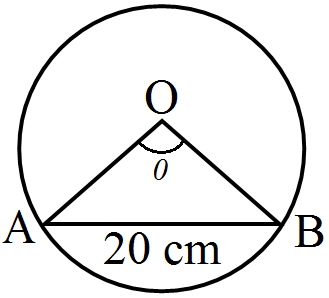
In a circle of diameter 40cm, the length of a chord is 20cm. Find the length of minor arc of the chord.
Answer
Diameter of the circle = 40cm Radius (r) of the circle $=\frac{40}{2}\text{cm}=20\text{cm}$ Let AB be a chord (length = 20cm) of the circle.
In $\triangle\text{OAB}$ OA = OB = Radius of circle = 20cm Also, AB = 20cm Thus, $\triangle\text{OAB}$ is an equilateral triangle. $\therefore\theta=60^\circ=\frac{\pi}{3}\text{radian}$ We know that in a circle of radius r unit, if an are of length l unit subtends an angle $\theta$ radian at the centre, then $\theta=\frac{\text{l}}{\text{r}}.$ $\frac{\pi}{3}=\frac{\widehat{\text{AB}}}{20}\Rightarrow\widehat{\text{AB}}=\frac{20\pi}{3}\text{cm}$ Thus, the length of the minor are of the chord is $\frac{20\pi}{3}\text{cm}.$
View full question & answer
Question 214 Marks
Find $\sin\frac{\text{x}}{2},\cos\frac{\text{x}}{2}$ and $\tan\frac{\text{x}}{2}$ in each of the following : $\tan\text{x}=-\frac{4}{3},$ x in quadrant II
Answer
Here, x is in quadrant II. i.e. $\frac{\pi}{2}<\text{x}<\pi$ $\Rightarrow\frac{\pi}{4}<\frac{\text{x}}{2}<\frac{\pi}{2}$ Therefore, $\sin\frac{\text{x}}{2},\cos\frac{\text{x}}{2}$ and $\tan\frac{\text{x}}{2}$ are all positive. It is given that $\tan\text{x}=-\frac{4}{3}.$ $\sec^2\text{x}=1+\tan^2\text{x}=1+\Big(\frac{-4}{3}\Big)^2=1+\frac{16}{9}=\frac{25}{9}$ $\therefore\cos^2\text{x}=\frac{9}{25}$ $\Rightarrow\cos\text{x}=\pm\frac{-3}{5}$ As x is in quadrant II, cos x is negative. $\therefore\cos\text{x}=\frac{-3}{5}$ Now, $\cos\text{x}=2\cos^2\frac{\text{x}}{2}-1$ $\Rightarrow\frac{-3}{5}=2\cos^2\frac{\text{x}}{2}-1$ $\Rightarrow2\cos^2\frac{\text{x}}{2}=1-\frac{3}{5}$ $\Rightarrow2\cos^2\frac{\text{x}}{2}=\frac{2}{5}$ $\Rightarrow\cos^2\frac{\text{x}}{2}=\frac{1}{5}$ $\Rightarrow\cos^2\frac{\text{x}}{2}=\frac{1}{\sqrt{5}}$ $\Big[\therefore\cos\frac{\text{x}}{2}\text{ is positive}\Big]$ $\therefore\cos\frac{\text{x}}{2}=\frac{\sqrt{5}}{5}$ $\sin^2\frac{\text{x}}{2}+\cos^2​​​​\frac{\text{x}}{2}=1$ $\Rightarrow\sin^2\frac{\text{x}}{2}+\Big(\frac{1}{\sqrt{5}}\Big)^2=1$ $\Rightarrow\sin^2\frac{\text{x}}{2}=1-\frac{1}{5}=\frac{4}{5}$ $\Rightarrow\sin\frac{\text{x}}{2}=\frac{2}{\sqrt{5}}$ $\Big[\therefore\sin\frac{\text{x}}{2}\text{ is positive}\Big]$ $\therefore\sin\frac{\text{x}}{2}=\frac{2\sqrt{5}}{5}$ $\tan\frac{\text{x}}{2}=\frac{\sin\frac{\text{x}}{2}}{\cos\frac{\text{x}}{2}}=\frac{\Big(\frac{2\sqrt{5}}{5}\Big)}{\Big(\frac{1}{\sqrt{5}}\Big)}=2$ Thus, the respective values of $\sin\frac{\text{x}}{2},\cos\frac{\text{x}}{2}$ and $\tan\frac{\text{x}}{2}$ are $\frac{2\sqrt{5}}{5},\frac{\sqrt{5}}{5}$ and $2.$
View full question & answer