MCQ 14 Marks
Match List-I with List-II| List-I | List-II |
| (A) Biot-Savart's law | (i) $\frac{\mu_0 I_1 I_2}{2 \pi d}$ |
| B) Ampere's circuit law | (ii) $q [\vec{ E }+(\vec{ V } \times \vec{ B })]$ |
| C) Force between two parallel current carrying conductors | (iii) $\oint \overline{ B } \cdot \overline{ dl }=\mu_0 \Sigma i$ |
| (D) Lorentz force | (iv) $\vec{B}=\frac{\mu_0 i}{4 \pi} \int \frac{d l \sin \theta}{r^2} \hat{n}$ |
Choose the correct answer from the options given below : - ✓
A - iv, B - iii, C - i, D - ii
- B
A - ii, B - i, C - iv, D - iii
- C
A - iv, B - iii, C - ii, D - i
- D
A - ii, B - i, C - iv, D - iii
AnswerCorrect option: A. A - iv, B - iii, C - i, D - ii
View full question & answer→MCQ 24 Marks
Given two vectors; $\vec{ A }=\hat{ i }+\hat{ j }$ and $\vec{ B }=\hat{ i }-\hat{ j }$. Then match the following List :| List - I | List - II |
| (A) $\frac{(\vec{ A }+\vec{ B })}{2}$ | (i) $\hat{ i }$ |
| (B) $\frac{(\vec{ A }-\vec{ B })}{2}$ | (ii) $\hat{ j }$ |
| (C) $\frac{(\vec{ A } \cdot \vec{ B })}{2}$ | (iii) $-\hat{ k }$ |
| (D) $\frac{(\vec{ A } \times \vec{ B })}{2}$ | (iv) 0 |
Choose the correct answer from the options given below : - A
A - iv, B - i, C - ii, D - iii
- B
A - ii, B - iv, C - iii, D - i
- C
A - iii, B - ii, C - iv, D - i
- ✓
A - i, B - ii, C - iv, D - iii
AnswerCorrect option: D. A - i, B - ii, C - iv, D - iii
View full question & answer→MCQ 34 Marks
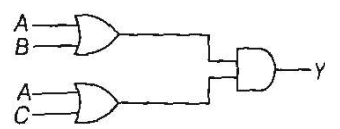
The output Y of given logic circuit is
MCQ 44 Marks
A particle moved towards east with a velocity $5 ms^{-1}$. After 10 s its direction changes towards north with the same velocity. The average acceleration of the particle is :
- A
- ✓
$\frac{1}{\sqrt{2}} ms^{-2} N- W$
- C
$\frac{1}{\sqrt{2}} ms^{-2} N- E$
- D
$\frac{1}{\sqrt{2}} ms^{-2} S- W$
AnswerCorrect option: B. $\frac{1}{\sqrt{2}} ms^{-2} N- W$
(B) $\frac{1}{\sqrt{2}} ms^{-2} N- W$
$\begin{array}{l}\Delta \vec{ v }=5 \hat{ j }-5 \hat{ i } \\ |\Delta \vec{ v }|=\sqrt{5^2+5^2}=5 \sqrt{2} \\ a _{ av }=\frac{5 \sqrt{2}}{10}=\frac{1}{\sqrt{2}} m / s ^2\end{array}$
View full question & answer→MCQ 54 Marks
Assertion : In YDSE, if $I_1=9 I_0$ and $I_2=4 I_0$ then $\frac{I_{\max }}{I_{\min }}=25$.
Reason: In YDSE, $I_{\text {max }}=\frac{1}{2}\left(\sqrt{I_1}+\sqrt{I_2}\right)^2$ and $I_{\text {min }}=\frac{1}{2}\left(\sqrt{l_1}-\sqrt{I_2}\right)^2$.
- A
Assertion is correct, reason is correct; reason is a correct explanation for assertion.
- B
Assertion is correct, reason is correct; reason is not a correct explanation for assertion.
- ✓
Assertion is correct, reason is incorrect.
- D
Assertion is incorrect, reason is incorrect.
AnswerCorrect option: C. Assertion is correct, reason is incorrect.
View full question & answer→MCQ 64 Marks
A sphere has bulk modulus $B$. It is placed inside a pressure chamber, if a constant pressure $p$ is maintained inside chamber. The fractional decrement in diameter is
- A
$\frac{ p }{2 B}$
- B
$\frac{3 p}{B}$
- ✓
$\frac{ p }{3 B}$
- D
$\frac{p}{B}$
AnswerCorrect option: C. $\frac{ p }{3 B}$
(C) $\frac{ p }{3 B}$
$B=\frac{\Delta v}{v}=\frac{P}{B}$
$\frac{\Delta v}{v}=3 \frac{\Delta D}{D}=\frac{p}{B}$
So, $\frac{\Delta D }{ D }=\frac{ p }{3 B}$
View full question & answer→MCQ 74 Marks
The two ends $P$ and $N$ of a P-N diode junction are joined by a wire
- ✓
There will not be a steady current in the circuit
- B
There will be a steady current from N side to P side
- C
There will be a steady current from P side to N side
- D
There may not be a current depending upon the resistance of the connecting wire
AnswerCorrect option: A. There will not be a steady current in the circuit
View full question & answer→MCQ 84 Marks
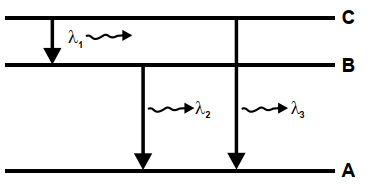
Energy levels A, B and C of a certain atom correspond to increasing values of energy, i.e., $E _{ A }< E _{ B }< E _{ c }$. If $\lambda_1, \lambda_2$ and $\lambda_3$ are wavelengths of photon corresponding to transitions shown, then
- A
$\lambda_3=\lambda_1+\lambda_2$
- ✓
$\lambda_3=\lambda_1 \lambda_2 / \lambda_1+\lambda_2$
- C
$\lambda_1+\lambda_2+\lambda_3=0$
- D
$\lambda_3^2=\lambda_1^2+\lambda_2^2$
AnswerCorrect option: B. $\lambda_3=\lambda_1 \lambda_2 / \lambda_1+\lambda_2$
(B) $\lambda_3=\lambda_1 \lambda_2 / \lambda_1+\lambda_2$
$E_C-E_A=E_C-E_B+E_B-E_A$
$\frac{ hc }{\lambda_3}=\frac{\lambda c }{\lambda_1}+\frac{ hc }{\lambda_2} \quad$ or $\quad \lambda_3=\frac{\lambda_1 \lambda_2}{\lambda_1+\lambda_1}$
View full question & answer→MCQ 94 Marks
The energy of hydrogen atom in nth orbit is $E _{ n }$, then the energy in nth orbit of singly ionised helium atom will be :
- ✓
$4 E_n$
- B
$E_n / 4$
- C
$2 E_n$
- D
$E_n / 2$
AnswerCorrect option: A. $4 E_n$
(A) $4 E_n$
$E \propto Z ^2$
$\frac{ E _{ H }}{ E _{ He }}=\frac{ Z _{ H }^2}{ Z _{ He }^2}=\frac{1}{4}$
$E _{ He }=4 E _{ H }$
$E _{ H }= E _{ n }$
$E _{ He }=4 E _{ n }$
View full question & answer→MCQ 104 Marks
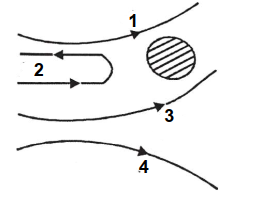
In the Rutherford experiment, $\alpha$-particles are scattered from a nucleus as shown in figure. Out of the four paths, which path is not possible?
View full question & answer→MCQ 114 Marks
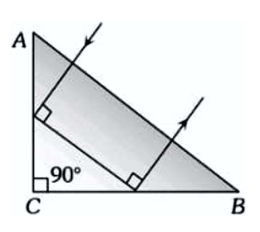
A ray of light incident normally on an isosceles right angled prism travels as shown in the figure. The least value of the refractive index of the prism must be
AnswerCorrect option: A. $\sqrt2$
(A) $\sqrt2$
From figure, T, R take place at surface $A C$ and $B C$
i.e. $45^{\circ}> C$
$\sin 45^{\circ}>\sin C$
$\frac{1}{\sqrt{2}}>\frac{1}{\mu}=\mu>\sqrt{2}$
Hence, $\mu_{\text {least }}=\sqrt{2}$
View full question & answer→MCQ 124 Marks
In the circuit, if the forward voltage drop for the diode is 0.5 V, the current will be
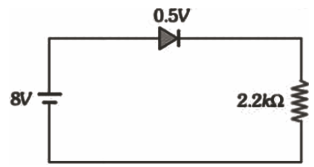
Answer(A) 3.4 mA
Voltage drop across resistance
$ \begin{aligned} & 8-0.5=7.5 \\ \therefore & \text { Current }(i)=\frac{7.5}{2.2 \times 10^3}=3.4 mA \end{aligned} $
View full question & answer→MCQ 134 Marks
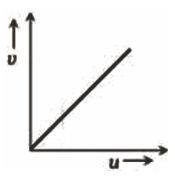
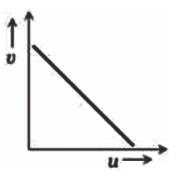
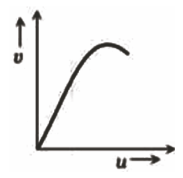
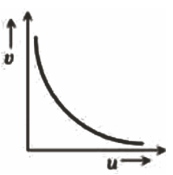
The distance $v$ of the real image formed by a convex lens is measured for various object distance $u$. A graph is plotted between $v$ and $u$, which one of the following graphs is correct
View full question & answer→MCQ 144 Marks
The plane face of a plano-convex lens is silvered. If $\mu$ be the refractive index and $R$ be the radius of curvature of curved surface, then system will behave like a concave mirror of radius of curvature
- A
$\mu R$
- B
$R ^2 / \mu$
- ✓
$R /(\mu-1)$
- D
$[(\mu+1) /(\mu+1)] R$
AnswerCorrect option: C. $R /(\mu-1)$
(C) $R /(\mu-1)$
$\left(\because f_m=\frac{R}{2}=\infty\right) \quad \frac{1}{f}=\frac{1}{f_1}+\frac{1}{f_m}$
$\frac{1}{f_1}=(\mu-1) \frac{1}{ R }$
$\therefore \quad \frac{1}{F}=\frac{2(\mu-1)}{ R }$
$F =\frac{2}{ R (\mu-1)}$
$R =2 F=\frac{ R }{\mu-1}$
View full question & answer→MCQ 154 Marks
A convex lens of focal length 40 cm is in contact with concave lens of focal length 25 cm . The power of combination is :
- ✓
$-1.5 D$
- B
$-6.5 D$
- C
$+6.5 D$
- D
$+1.5 D$
AnswerCorrect option: A. $-1.5 D$
(A) $-1.5 D$
$\begin{array}{l}P=\frac{1}{f_1}+\frac{1}{f_2} \\ P=\frac{100}{40}-\frac{100}{25} \\ P=-1.5 D\end{array}$
View full question & answer→MCQ 164 Marks
The ratio of de-Broglie wavelength of molecules of hydrogen and helium in two jars kept separately at temperatures of $27^{\circ} C$ and $127^{\circ} C$ respectively is:
- A
$\sqrt{\frac{1}{2}}$
- ✓
$\sqrt{\frac{8}{3}}$
- C
$\frac{4}{3}$
- D
$\frac{3}{4}$
AnswerCorrect option: B. $\sqrt{\frac{8}{3}}$
(B) $\sqrt{\frac{8}{3}}$
$\frac{\lambda_{ H _2}}{\lambda_{ He }} =\sqrt{\frac{ M _{ He } \cdot T _{ He }}{ M _{ H _2} \cdot T_{ H _2}}}$
$=\sqrt{\frac{4(127+273)}{2(27+273)}}=\sqrt{\frac{8}{3}}$
View full question & answer→MCQ 174 Marks
If a cell of emf 12 V is connected with load of $5 \Omega$ provides of current of 2 A , then internal resistance of the cell is
- A
$1.5 \Omega$
- B
$2 \Omega$
- C
$2.5 \Omega$
- ✓
$1 \Omega$
AnswerCorrect option: D. $1 \Omega$
(D) $1 \Omega$
$i =\frac{ E }{ R + r }$
$2=\frac{12}{5+ r }$
$10+2 r =12$
$2 r =2$
$r =1 \Omega$
View full question & answer→MCQ 184 Marks
In a field free region, two electrons are released to move a line towards each other with velocities $10^{ 7 } m / s$. The distance of their closest approach will be nearer to
- A
$1.28 \times 10^{-10} m$
- B
$1.92 \times 10^{-10} m$
- ✓
$2.56 \times 10^{-12} m$
- D
$3.84 \times 10^{-10} m$
AnswerCorrect option: C. $2.56 \times 10^{-12} m$
(C) $2.56 \times 10^{-12} m$
$K . E =2 \times \frac{1}{2} mv ^2$
$P . E =\frac{ Ke ^2}{ r }$
$mv =\frac{ Ke ^2}{ r }$
$r =\frac{ Ke ^2}{ mv ^2}$
$ =\frac{9 \times 10^9 \times\left(1.6 \times 10^{-19}\right)^2}{9.1 \times 10^{-31} \times\left(10^7\right)^2}$
$ =2.56 \times 10^{-12}$
View full question & answer→MCQ 194 Marks
The frequency of tuning forks $A$ and $B$ are respectively $3 \%$ more and $2 \%$ less than the frequency of tuning fork C. When A and B simultaneously excited, 5 beats per second are produced. Then the frequency of the tuning fork ' A ' (in Hz) is
Answer(C) 103
Let n be the frequency of fork C then
$ \begin{array}{l} n_{A}=n+\frac{3 n}{100}=\frac{103 n}{100} \\ \text { and } n_{B}=n-\frac{2 n}{100}=\frac{98}{100} \end{array} $
But $n _{ A }- n _{ B }=5 \Rightarrow \frac{5 n }{100}=5 \Rightarrow n =100$
$ n_{A}=\frac{103 \times 100}{100}=103 Hz $
View full question & answer→MCQ 204 Marks
A cube of side $I$ is placed in a uniform electric field $E=E \hat{i}$. The net electric flux through the cube is
- ✓
- B
$4I^2 E$
- C
$I ^2 E$
- D
$6I^2 Er$
Answer(A) zero
In uniform field, the intensity of field on any two opposite sides will be equal. But the area vector will be zero.
View full question & answer→MCQ 214 Marks
When a stationary wave is formed then its frequency is
- ✓
Same as that of the individual waves
- B
Twice that of the individual waves
- C
Half that of the individual waves
- D
AnswerCorrect option: A. Same as that of the individual waves
View full question & answer→MCQ 224 Marks
The figure below shows the plot of $\frac{P V}{n T}$ versus $P$ for oxygen gas at two different temperatures.
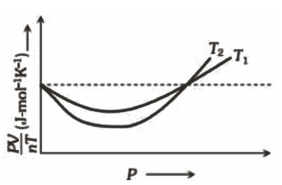
Read the following statements concerning the above curves :
(i) The dotted line corresponds to the 'ideal' gas behaviour.
(ii) $T _1> T _2$
(iii) The value of $\frac{ PV }{ nT }$ at the point where the curves meet on the $y$-axis is the same for all gases. Which of the above statement is true View full question & answer→MCQ 234 Marks
Which of the following can not determine the state of a thermodynamic system
- A
- B
- C
- ✓
Any one of pressure, volume or temperature
AnswerCorrect option: D. Any one of pressure, volume or temperature
View full question & answer→MCQ 244 Marks
Magnetic field in a plane EM wave is given by $B _{ Z }=2 \times 10^{-7} \sin \left(0.5 \times 10^3 x -1.5 \times 10^{11} t \right) T$ then electric field is given by :
- A
$E _{ z }=60 \sqrt{2} \sin \left(0.5 \times 10^3 x -1.5 \times 10^{11} t \right) V / m$
- B
$E_z=60 \sin \left(0.5 \times 10^3 x -1.5 \times 10^{11} t \right) V / m$
- C
$E _{ y }=60 \sqrt{2} \sin \left(0.5 \times 10^3 x -1.5 \times 10^{11} t \right) V / m$
- ✓
$E_y=60 \sin \left(0.5 \times 10^3 x-1.5 \times 10^{11} t\right) V / m$
AnswerCorrect option: D. $E_y=60 \sin \left(0.5 \times 10^3 x-1.5 \times 10^{11} t\right) V / m$
View full question & answer→MCQ 254 Marks
A transformer is used to light a 100 W and 110 V lamp from a 220 V mains. If the main current is 0.5 A, the efficiency of the transformer is approximately
- A
$50 \%$
- ✓
$90 \%$
- C
$10\%$
- D
$30 \%$
AnswerCorrect option: B. $90 \%$
(B) $90 \%$
The efficiency $n =\frac{100}{220 \times 0.5} \times 100=90.9 \approx 90 \%$
View full question & answer→MCQ 264 Marks
A good lubricant should have :
MCQ 274 Marks
If the reading of voltmeter $V_1$ and $V_2$ in the given circuit diagram are 300 V each, then reading of voltmeter $V _3$ and ammeter $A$ are, respectively
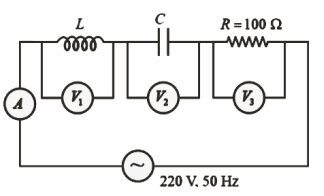
Answer(C) 220 V, 2.2 A
$V_1$ and $V_2$ are equal and out of phase with each other and thus gets cancelled. Thus $V _3=220 V$ and $i =\frac{220}{100}=2.2 A$.
View full question & answer→MCQ 284 Marks
An AC current is given by $I=I_1 \cos \omega t+I_2 \sin \omega t$. The root mean square current is
- A
$\frac{I_1+I_2}{\sqrt{2}}$
- B
$\frac{\left(I_1+I_2\right)^2}{2}$
- ✓
$\sqrt{\frac{I_1^2+I_2^2}{2}}$
- D
$\sqrt{\frac{I_1^2-I_2^2}{2}}$
AnswerCorrect option: C. $\sqrt{\frac{I_1^2+I_2^2}{2}}$
View full question & answer→MCQ 294 Marks
The atmospheric pressure is $1.01 \times 10^5 Pa$. How much force (in N) does the air in a room exert on the side of a window pane whose size is $50 \times 100$ $cm ^2$
- A
$5.05 \times 10^3$
- B
$5.05 \times 10^6$
- ✓
$5.05 \times 10^4$
- D
$5.05 \times 10^5$
AnswerCorrect option: C. $5.05 \times 10^4$
(C) $5.05 \times 10^4$
$\begin{aligned} F & = P \times A \\ & =1.01 \times 10^5 \times 50 \times 10^{-2} \times 100 \times 10^{-2} \\ & =5.05 \times 10^4 N\end{aligned}$
View full question & answer→MCQ 304 Marks
Statement - I: The drift velocity of electrons in a metallic wire increases with the increase of temperature of wire.
Statement - II : On incerasing the temperature, conductivity of metallic wire decreases.
In the above statement, choose the correct one given below.
- A
Both Statement I and Statement II are correct.
- B
Both Statement I and Statement II are incorrect.
- C
Statement I is correct but Statement II is incorrect.
- ✓
Statement II is correct but Statement I is incorrect.
AnswerCorrect option: D. Statement II is correct but Statement I is incorrect.
View full question & answer→MCQ 314 Marks
The average emf induced in a coil when a current changes from 0 to 2 A in 0.05 sec is 8 V . The selfinductance of the coil is
Answer(B) 0.2 H
$e = M \frac{ di }{ dt }$
$8= L \frac{(2-0)}{0.05}$
$L=0.2 H$
View full question & answer→MCQ 324 Marks
Due to the flow of current in a circular loop of radius $R$, the magnetic field produced at the centre of the loop is $B$. The magnetic moment of the loop is:
- A
$BR ^3 / 2 \pi \mu_0$
- ✓
$2 \pi BR ^3 / \mu_0$
- C
$BR ^2 / 2 \pi \mu_0$
- D
$2 \pi BR ^2 / 2 \mu_0$
AnswerCorrect option: B. $2 \pi BR ^3 / \mu_0$
(B) $2 \pi BR ^3 / \mu_0$
$B =\frac{\mu_0 i }{2 R}$
$i =\frac{ B \times 2 R }{\mu_0}$
Magnetic moment $(M)=i A=i \pi R^2$
$M =\frac{ B \times 2 R }{\mu_0} \times \pi R ^2$
$M =\frac{2 \pi BR ^3}{\mu_0}$
View full question & answer→MCQ 334 Marks
A beam of ions enters normally into a uniform magnetic field of $4 \times 10^{-2} T$ with velocity $2 \times 1 0 ^ { 5 } ~ m /$ $s$. If the specific charge of the ion is $5 \times 10^{ 7 } C / kg$, then the radius of the circular path is
Answer(A) 0.10 m
$\begin{aligned} r & =\frac{m v}{\operatorname{Be}} \\ & =\frac{2 \times 10^5}{5 \times 10^7 \times 4 \times 10^{-2}}=0.1 m\end{aligned}$
View full question & answer→MCQ 344 Marks
If linear density of a rod of length $3 m$ varies as $\lambda=2+x$, then the position of the centre of gravity of the rod is
- A
$\frac{7}{3} m$
- ✓
$\frac{12}{7} m$
- C
$\frac{10}{7} m$
- D
$\frac{9}{7} m$
AnswerCorrect option: B. $\frac{12}{7} m$
(B) $\frac{12}{7} m$
Position of COM
$x _{ dm }=\frac{\int dm \times x }{\int dm }$
$=\frac{\int_0^3(\lambda d x) x}{\int_0^3 \lambda d x}=\frac{\left[x^2+\frac{x^3}{3}\right]_0^3}{\left[2 x+\frac{x^2}{2}\right]_0^3}=\frac{12}{7} m$
View full question & answer→MCQ 354 Marks
The centre of mass of a system of two particles divides the distance between them
- A
In inverse ratio of the square of masses of particles
- B
In direct ratio of square of masses of particles
- ✓
In inverse ratio of masses of particles
- D
In direct ratio of masses of particles
AnswerCorrect option: C. In inverse ratio of masses of particles
(C) In inverse ratio of masses of particles
$\begin{aligned} & m_1 r_1=m_2 r_2 \\ \therefore \quad & r \propto \frac{1}{m}\end{aligned}$
View full question & answer→MCQ 364 Marks
A thin uniform rod of length $I$ and mass $m$ is swinging freely about a horizontal axis passing through its end. Its maximum angular speed is $\omega$. Its centre of mass rises to a maximum height of
- A
$\frac{1}{3} \frac{I^2 \omega^2}{g}$
- B
$\frac{1}{6} \frac{I\omega}{g}$
- C
$\frac{1}{2} \frac{I^2 \omega^2}{g}$
- ✓
$\frac{1}{6} \frac{I^2 \omega^2}{g}$
AnswerCorrect option: D. $\frac{1}{6} \frac{I^2 \omega^2}{g}$
(D) $\frac{1}{6} \frac{I^2 \omega^2}{g}$
$mgh=\frac{1}{2}I\omega^{2}=\frac{1}{2}$$\left(\frac{m l^2}{3}\right) \omega^2$
$h=\frac{I^2 \omega^2}{6 g}$
View full question & answer→MCQ 374 Marks
A particle of mass $m$ moving in the x-direction with speed $2 v$ is hit by another particle of mass $2 m$ moving in the $y$ direction with speed $v$. If the collision is perfectly inelastic, the percentage loss in the energy during the collision is close to
- A
$44 \%$
- B
$50 \%$
- ✓
$56 \%$
- D
$62\%$
AnswerCorrect option: C. $56 \%$
(C) $56 \%$
$E_1=2 m v^2+m v^2=3 m v^2$
After collision
$3 mv=\sqrt{2} .2 mv$
$v=\frac{2 \sqrt{2} v}{3}$
So, $E _2=\frac{4}{3} v ^2$
$\frac{E_1-E_2}{E_1}=\frac{\frac{5}{3} v^2}{3 v^2}=\frac{5}{9}$
$\%$ loss $=\frac{5}{9} \times 100=55.6=56 \%$
View full question & answer→MCQ 384 Marks
A block of mass ' $m$ ' moving at a speed ' $v$ ' compresses a spring through a distance ' $x$ ' before its speed has halved. The spring constant of the spring is :
- ✓
$\frac{3 m v^2}{4 x^2}$
- B
$\frac{2 m v^2}{3 x^2}$
- C
$\frac{m v^2}{3 x^2}$
- D
$\frac{2 m v^2}{x^2}$
AnswerCorrect option: A. $\frac{3 m v^2}{4 x^2}$
(A) $\frac{3 m v^2}{4 x^2}$
$\frac{1}{2} m v^2-\frac{1}{2} m\left(\frac{v}{2}\right)^2=\frac{1}{2} k x^2$
$\frac{3 m v^2}{8}=\frac{1}{2} k x^2$
$k=\frac{3 m v^2}{4 x^2}$
View full question & answer→MCQ 394 Marks
A body executes simple harmonic motion. The potential energy (PE) kinetic energy (KE) and total energy (TE) are measured as a function of displacement $x$. Which of the following statement is true :
- A
TE is zero when $x=0$
- B
PE is maximum when $x=0$
- ✓
KE is maximum when $x=0$
- D
KE is maximum when x is maximum
AnswerCorrect option: C. KE is maximum when $x=0$
(C) KE is maximum when $x=0$
In SHM, at mean position i.e. at $x=0$ K.E will be maximum and P.E will be minimum. Total energy is always contt.
View full question & answer→MCQ 404 Marks
A 50 kg man with $2 0 ~ k g$ load on his head climbs up 20 steps of 0.25 m height each. The work done in climbing is
Answer(D) 3430 J
$\begin{aligned} & \text { Total mass }=50+20=70 kg \\ & \text { Total height }=20 \times 0.25=5 m \\ \therefore \quad & W = mgh =70 \times 98 \times 5=3430 J\end{aligned}$
View full question & answer→MCQ 414 Marks
Given below are two statements
Statement I : A dimensionally incorrect equation must be incorrect.
Statement II : A dimensionally correct equation may or may not be corret.
In the above statement, choose the correct one given below.
- ✓
Both Statement I and Statement II are correct.
- B
Both Statement I and Statement II are incorrect.
- C
Statement I is correct but Statement II is incorrect.
- D
Statement I is incorrect but Statement II is correct.
AnswerCorrect option: A. Both Statement I and Statement II are correct.
View full question & answer→MCQ 424 Marks
A cannon and a target are $2 \sqrt{3} km$ apart and located at a same level. How soon will the shell fired with an initial velocity of $200 ms^{-1}$ reach the target in the absence of air drag? $\left(g=10 ms^{-2}\right)$
- ✓
After 20 s or $20 \sqrt{3} s$
- B
After 10 s or $10 \sqrt{3} s$
- C
- D
After $40 \sqrt{3}$ s only
AnswerCorrect option: A. After 20 s or $20 \sqrt{3} s$
View full question & answer→MCQ 434 Marks
Suppose, the acceleration due to gravity at the earth's surface is $10 m / s ^2$ and at the surface of Mars it is $4.0 m / s ^2$. A 60 kg passenger goes from the earth to the Mars in a spaceship moving with a constant velocity. Neglect all other objects in the sky. Which part of figure best represents the weight (net gravitational force) of the passenger as a function of time
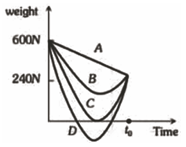
View full question & answer→MCQ 444 Marks
In the experiment of Ohm's law, a potential difference of 5.0 V is applied across the end of a conductor of length $10.0 ~ c m$ and diameter of 5.00 mm . The measured current in the conductor is 2.00 A . The maximum permissible percentage error in the resistivity of the conductor is
Answer(A) 3.9
$\begin{array}{l} R =\frac{\rho l }{ A }=\frac{ v }{ l } \quad\left( A =\frac{\pi d ^2}{4}\right) \\ \frac{\Delta \rho}{\rho}=2 \frac{\Delta d}{ d }+\frac{\Delta v }{ V }+\frac{\Delta l }{ l }+\frac{\Delta \ell}{\ell} \\ \end{array}$
$\%$ error $=\frac{\Delta \rho}{\rho} \times 100=3.90 \% .$
View full question & answer→MCQ 454 Marks
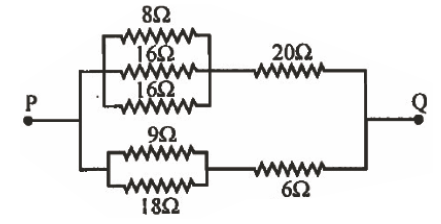
The equivalent resistance of the arrangement of resistances shown in adjoining figure between the points $A$ and $B$ is :
- A
$6 \Omega$
- ✓
$8 \Omega$
- C
$10 \Omega$
- D
AnswerCorrect option: B. $8 \Omega$
(B) $8 \Omega$
$R_{\text {eq }}$ for 1st circuit
$ \begin{aligned} \frac{1}{R_{eq}} & =\frac{1}{8}+\frac{1}{16}+\frac{1}{16} \\ & =\frac{2+1+1}{16}=\frac{4}{16} \\ R_{eq} & =4 \Omega \end{aligned} $
$R_{\text {eq }}$ for 2nd circuit
$ \begin{array}{l} \frac{1}{R_{eq}}=\frac{1}{9}+\frac{1}{18}=\frac{2+1}{18}=\frac{3}{18} \\ R_{eq}=6 \Omega \\ R_{eq}=\frac{1}{24}+\frac{1}{12}=\frac{1+2}{24}=\frac{3}{24} \\ R_{eq}=8 \Omega \end{array} $
View full question & answer→