Questions

SECTION - A [BOTANY - MCQ]

Take a timed test

45 questions · 43 auto-graded MCQ + 2 self-marked written.

Question 14 Marks
Select the incorrect match
(A) Dense regular connective tissue-Collagen fiber
(B) Dense irregular connective tissue-Collagen fiber
(C) RBC, WBC-Fluid ephithelial tissue
(D) Hormone-Secretion of ductless gland
Answer
(C) RBC, WBC - Fluid ephithelial tissue
(A) Dense regular connective tissue-Collagen fiber
(B) Dense irrgular connective tissue-Collagen fiber
(C) RBC, WBC-Fluid connective tissue
(D) Hormone-Secretion of ductless gland
View full question & answer
MCQ 24 Marks
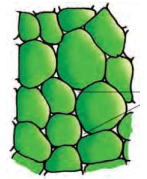
Select the correct option for the given diagram
Image
  • A
    Non living complex tissue
  • Living permanent tissue
  • C
    Non living mechanical tissue
  • D
    None
Answer
Correct option: B.
Living permanent tissue
(B) Living permanent tissue
The given diagram is parenchyma
Living permanent tissue - parenchyma
View full question & answer
MCQ 34 Marks
In ______________ , the lateral branches originate from the basal and underground portion of the main stem, grow horizontally beneath the soil and them come out obliquely upward giving rise to leafy shoots
Fill in the blank in given sentence
  • Chrysanthemum
  • B
    Mustard
  • C
    Eichhornia
  • D
    Pistia
Answer
Correct option: A.
Chrysanthemum
(A) Chrysanthemum
In Chrysanthemum the lateral branches originate from the basal and underground portion of the main stem, grow horizontally beneath the soil and them come out obliquely upward giving rise to leafy shoots
View full question & answer
MCQ 44 Marks
Select the Incorrect option for cockroach
  • A
    Uricotelic
  • B
    Nymph
  • Blood transport oxygen
  • D
    Spermatophore
Answer
Correct option: C.
Blood transport oxygen
(C) Blood transport oxygen
In cockroach blood does not transport oxygen.
View full question & answer
Question 54 Marks
Select the incorrect match for cockroach
(A) Eyes-Ommatidia
(B) Maxillary palps-Excretory organ
(C) Sclerites-Chitin
(D) Entire foregut is lined-Cuticle
Answer
(B) Maxillary palps - Excretory organ
The correct match for cockroach
(A) Eyes-Ommatidia
(B) Maxillary palps-Sensory organ
(C) Sclerites-Chitin
(D) Entire foregut is-Cuticle
View full question & answer
MCQ 64 Marks
Select the correct match for muscle
  • Smooth - Involuntary - Blood vessel
  • B
    Skeletal - Voluntary - Intestine
  • C
    Smooth - Voluntary - Intestine
  • D
    Cardiac - Voluntary - Intercalated disc
Answer
Correct option: A.
Smooth - Involuntary - Blood vessel
(A) Smooth - Involuntary - Blood vessel
(B) Skeletal - Voluntary - Biceps
(C) Smooth - Involuntary - Intestine
(D) Cardiac - Involuntary - Intercalated disc
View full question & answer
MCQ 74 Marks
The radial conduction of water takes place by which tissue/cells
  • A
    Xylem fiber
  • Ray parenchyma
  • C
    Companion cell
  • D
    Phloem fiber
Answer
Correct option: B.
Ray parenchyma
(B) Ray parenchyma
The radial conduction of water takes place by Ray parenchyma
View full question & answer
MCQ 84 Marks
Select the correct option for family Brassicaceae
a. Tetradynamous
b. Cruciform corolla
c. Replum
d. Glumes and Rachilla
e. Dimerous or Tetramerous flower
  • A
    a, b, c, d
  • B
    Only a, b, c
  • a, b, c, e
  • D
    All
Answer
Correct option: C.
a, b, c, e
(C) a, b, c, e
The correct option for family Brassicaceae -
a. Tetradynamous
b. Cruciform corolla
c. Replum
e. Dimerous or Tetramerous flower
View full question & answer
MCQ 94 Marks
Select the correct match:
(A) Severo ochoa enzymeI. Polynucleotide phosphorylase
(B) Sickel cell AnaemiaII. Change of glutamic acid to valine
(C) AUGIII. Dual functions
(D) t RNAIV. Look like a clover-leaf
  • A-I, B-II, C-III, D-IV
  • B
    A-II, B-I, C-IV, D-III
  • C
    A-IV, B-I, C-II, D-III
  • D
    A-IV, B-I, C-III, D-II
Answer
Correct option: A.
A-I, B-II, C-III, D-IV
(A) A-I, B-II, C-III, D-IV
(A) Severo ochoa enzymeI. Polynucleotide phosphorylase
(B) Sickel cell AnaemiaII. Change of glutamic acid to valine
(C) AUGIII. Dual functions
(D) t RNAIV. Look like a clover-leaf
View full question & answer
MCQ 104 Marks
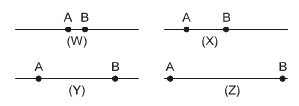
$A$ and $B$ are two types of genes. They are located upon chromosome. In the given four sample of chromosome select the correct ascending order of % of recombination
Image
  • W $<$ X $<$ Y $<$ Z
  • B
    X $<$ Y $<$ Z $<$ W
  • C
    Z $<$ X $<$ W $<$ Y
  • D
    Y $<$ X $<$ W $<$ Z
Answer
Correct option: A.
W $<$ X $<$ Y $<$ Z
(A) W $<$ X $<$ Y $<$ Z
Distance between two genes $\propto \%$ of recombination.
View full question & answer
MCQ 114 Marks
RR - Red flower
rr - White flower
Rr - Pink flower
Select the correct statement for given type of cross
$ R r \times R R $
a. The percentage of pink flower are $50 \%$
b. The percentage of red flower are $50 \%$
c. The percentage of white flower are $25 \%$
d. The percentage of white flower are zero %
  • A
    Only a , b
  • a, b, d
  • C
    a, b, c
  • D
    Only b, d
Answer
Correct option: B.
a, b, d
(B) a, b, d
RR - Red flower, rr - White flower, Rr - Pink flower the correct statement for given type of cross
$
R r \times R R
$
a. The percentage of pink flower are $50 \%$
b. The percentage of red flower are $50 \%$
d. The percentage of white flower are zero %
View full question & answer
MCQ 124 Marks
Select the disease that are caused by pathogen
a. Syphilis
b. Gonormea
c. Genital warts
d. Genital herpes
e. Trichomoniasis
  • A
    Only a, b, c, d
  • B
    Only b, c, d, e
  • All
  • D
    Only a, d, e
Answer
Correct option: C.
All
(C) All
STIs - caused by pathogen
View full question & answer
MCQ 134 Marks
Assertion (A): Use of condoms has increase in recent years.
Reason (R) : Generally condoms are useful in birth control but it also protect the user from STIs and AIDS.
  • A
    Both (A) and (R) are true but (R) is not the correct explanation of (A)
  • B
    (A) is true but (R) is false
  • C
    (A) is false but (R) is true
  • Both (A) and (R) are true and (R) is the correct explanation of (A)
Answer
Correct option: D.
Both (A) and (R) are true and (R) is the correct explanation of (A)
D
View full question & answer
MCQ 144 Marks
Select the correct order for events of menstrual cycle
  • Follicular development $\rightarrow$ maturation of follicle $\rightarrow$ ovulation $\rightarrow$ development of corpus luteum
  • B
    Follicular development $\rightarrow$ maturation of follicle $\rightarrow$ development of corpus luteum $\rightarrow$ ovulation
  • C
    Development of corpus luteum $\rightarrow$ Follicular development $\rightarrow$ maturation of follicle $\rightarrow$ ovulation
  • D
    Ovulation $\rightarrow$ Follicular development $\rightarrow$ maturation of follicle $\rightarrow$ development of corpus luteum
Answer
Correct option: A.
Follicular development $\rightarrow$ maturation of follicle $\rightarrow$ ovulation $\rightarrow$ development of corpus luteum
(A) Follicular development $\rightarrow$ maturation of follicle $\rightarrow$ ovulation $\rightarrow$ development of corpus luteum
The correct order for events of menstrual cycle
(1) Follicular development $\rightarrow$ maturation of follicle $\rightarrow$ ovulation $\rightarrow$ development of corpus Iuteum
View full question & answer
MCQ 154 Marks
Given below are two statements
Statement I:
The secondary oocyte retains bulk of the nutrient rich cytoplasm of the primary oocyte
Statement II:
The more layers of granulosa cells are present in secondary follicles than primary follicles
Choose the correct answer from the option given below:
  • A
    Both Statement I and Statement II are incorrect
  • B
    Statement I is correct but Statement II is incorrect
  • C
    Statement I is incorrect but Statement II is correct
  • Both Statement I and Statement II are correct
Answer
Correct option: D.
Both Statement I and Statement II are correct
(D) Both Statement I and Statement II are correct
Statement I:
The secondary oocyte retains bulk of the nutrient rich cytoplasm of the primary oocyte
Statement II:
The more layers of granulosa cells are present in secondary follicles than primary follicles
View full question & answer
MCQ 164 Marks
Assertion (A): The presence or absence of hymen is not a reliable indicator of virginity or sexual experience.
Reason (R): The hymen is often torn during the first coitus however it can also be broken by a sudden fall or jolt, insertion of a vaginal tampon, active participation in some sports like horseback riding, cyclling etc.
  • A
    Both (A) and (R) are true but (R) is not the correct explanation of (A)
  • B
    (A) is true but (R) is false
  • C
    (A) is false but (R) is true
  • Both (A) and (R) are true and (R) is the correct explanation of (A)
Answer
Correct option: D.
Both (A) and (R) are true and (R) is the correct explanation of (A)
(D) Both (A) and (R) are true and (R) is the correct explanation of (A)
Both $(A)$ and $(R)$ are true and $(R)$ is the correct explanation of $(A)$
View full question & answer
MCQ 174 Marks
Select the In-situ conservation:
  • A
    Seed bank
  • B
    Tissue culture
  • Khasi and jaintia Hills
  • D
    Pollen bank
Answer
Correct option: C.
Khasi and jaintia Hills
(C) Khasi and jaintia Hills
Seed bank, Tissue culture, Pollen bank - Ex-situ conservation
Khasi and jaintia Hills - In-situ conservation
View full question & answer
MCQ 184 Marks
The species area relationships are given by:
  • A
    Indian naturalist Alexander von Humboldt
  • B
    German Naturalist David Tilman
  • C
    German Naturalist Edward wilson
  • German Naturalist Alexander von Humboldt
Answer
Correct option: D.
German Naturalist Alexander von Humboldt
(D) German Naturalist Alexander von Humboldt
The species area relationships are given by German Naturalist Alexander von Humboldt
View full question & answer
MCQ 194 Marks
Given below are two statements
Statement I:
Lichen and mycorrhizae are example of mutualism.
Statement II :
In lichen the fungi help the plant in the absorption of essential nutrients from the soil while the plant in turn provides the fungi with energy - yielding carbohydrates.
Choose the correct answer from the option given below:
  • A
    Both Statement I and Statement II are incorrect
  • B
    Statement I is correct but Statement II is incorrect
  • C
    Statement I is incorrect but Statement II is correct
  • Both Statement I and Statement II are correct
Answer
Correct option: D.
Both Statement I and Statement II are correct
(D) Both Statement I and Statement II are correct
Statement I:
Lichen and mycorrhizae are example of mutualism.
Statement II :
In lichen the fungi help the plant in the absorption of essential nutrients from the soil while the plant in turn provides the fungi with energy - yielding carbohydrates.
View full question & answer
MCQ 204 Marks
Select the correct statements
a. Seeds are formed inside embryo sac
b. The cotyledons of the embryo are simple structures, generally thick and swollen due to storage of food reserves
c. Ploidy of perisperm and nucellus are not same
d. Many fruits have evolved mechanisms for dispersal of seeds
  • A
    a, b, c
  • B
    Only a, b
  • C
    a, b, d
  • b, d
Answer
Correct option: D.
b, d
(D) b, d
a. Seeds are formed inside fruit
b. The cotyledons of the embryo are simple structures, generally thick and swollen due to storage of food reserves
c. Ploidy of perisperm and nucellus are same
d. Many fruits have evolved mechanisms for dispersal of seeds
View full question & answer
MCQ 214 Marks
Select the incorrect match for $\frac{ dN }{ dt }= rN \left(\frac{ K - N }{ k }\right)$
  • A
    N - Population density at time t
  • B
    r - Intrinsic rate of natural increase
  • C
    K-Carrying capacity
  • r - Represent colour of organism
Answer
Correct option: D.
r - Represent colour of organism
(D) r - Represent colour of organism
The correct match for $\frac{ dN }{ dt }= rN \left(\frac{ K - N }{ k }\right)$
(1) N - Population density and time t
(2) r - Intrinsic rate of natural increase
(3) K - Carrying capacity
View full question & answer
MCQ 224 Marks
Select the incorrect match
  • A
    Natality - Increase in population density
  • B
    Immigration - Increase in population density
  • C
    Emigration - Decrease in population density
  • Mortality - Increase in population density
Answer
Correct option: D.
Mortality - Increase in population density
(D) Mortality - Increase in population density
(1) Natality - Increase in population density
(2) Immigration - Increase in population density
(3) Emigration - Decrease in population density
(4) Mortality - Decrease in population density
View full question & answer
MCQ 234 Marks
Select the incorrect match
  • A
    Active transport - Energy dependent process
  • Peroxisomes - Part of endomembrane system
  • C
    Osmosis - Movement of water by diffusion
  • D
    $52 \%$ protein - Membrane of erythrocyte in Human
Answer
Correct option: B.
Peroxisomes - Part of endomembrane system
(B)
(1) Active transport-Energy dependent process
(2) Peroxisomes-Not a part of endomembrane system
(3) Osmosis-Movement of water by diffusion
(4) $52 \%$ protein-Membrane of erythrocyte
View full question & answer
MCQ 244 Marks
Which of the following is largest in size:
  • A
    Mycoplasma
  • B
    Virus
  • C
    PPLO
  • Eukaryotic cell
Answer
Correct option: D.
Eukaryotic cell
(D) Eukaryotic cell
(1) Mycoplasma $-0.3 \mu m$
(2) Virus $-0.02$ to $0.2 \mu m$
(3) PPLO $-0.1 \mu m$
(4) Eukaryotic cell - $10$ to $20 \mu m$
View full question & answer
MCQ 254 Marks
Select the correct option for frog
  • A
    Enucleated RBC
  • B
    Uricotelic
  • Sexual dimorphism
  • D
    All
Answer
Correct option: C.
Sexual dimorphism
(C) Sexual dimorphism
Frog - Nucleated RBC, Ureotelic and Sexual dimorphism
View full question & answer
MCQ 264 Marks
Select the correct statements for Primrose
  • A
    The placenta forms a ridge along the ventral suture of the ovary and the ovules are borne on this ridge forming two rows
  • B
    The placenta is axial and the ovules are attached to it in a multilocular ovary
  • C
    The ovules develop on the inner wall of the ovary or on peripheral part
  • The ovules are borne on central axis and septa are absent
Answer
Correct option: D.
The ovules are borne on central axis and septa are absent
(D) The ovules are borne on central axis and septa are absent
The correct statements for Primrose
• The ovules are borne on central axis and septa are absent
View full question & answer
MCQ 274 Marks
Select the correct match
A. ElephantI. Respiration by lungs
B. PigeonII. Crop and gizzard
C. ViperIII. One ventricle
D. BalanoglossusIV. Stomochord
  • A-I, B-II, C-III, D-IV
  • B
    A-II, B-III, C-IV, D-I
  • C
    A-IV, B-I, C-II, D-III
  • D
    A-II, B-I, C-III, D-IV
Answer
Correct option: A.
A-I, B-II, C-III, D-IV
(A) A-I, B-II, C-III, D-IV
A. ElephantI. Respiration by lungs
B. PigeonII. Crop and gizzard
C. ViperIII. One ventricle
D. BalanoglossusIV. Stomochord
View full question & answer
MCQ 284 Marks
Select the correct match
A. PTHI. Decreases the glucose level in the blood
B. TCTII. Increases the $Ca ^{+2}$ level in the blood
C. GlucagonIII. Increases the glucose level in the blood
D. InsulinIV. Decreases the $Ca ^{+2}$ level in the blood
  • A
    A-I, B-II, C-III, D-IV
  • B
    A-I, B-II, C-IV, D-III
  • A-II, B-IV, C-III, D-I
  • D
    A-IV, B-I, C-II, D-III
Answer
Correct option: C.
A-II, B-IV, C-III, D-I
(C) A-II, B-IV, C-III, D-I
A. PTHII. Increases the $Ca ^{+2}$ level in the blood
B. TCTIV. Decreases the $Ca ^{+2}$ level in the blood
C. GlucagonIII. Increases the glucose level in the blood
D. InsulinI. Decreases the glucose level in the blood
View full question & answer
MCQ 294 Marks
Select the correct option for cerebrum
a. Control gastric secretion
b. Control respiration
c. Learning and thinking
d. Control body temperature
e. Urge for eating and drinking
  • A
    Only a, c
  • Only c
  • C
    a , b , c , e
  • D
    c, d, e
Answer
Correct option: B.
Only c
(B) Only c
a. Control gastric secretion - Medulla
b. Control respiration - Medulla
c. Learning and thinking - cerebrum
d. Control body temperature - Hypothalamus
e. Urge for eating and drinking - Hypothalamus
View full question & answer
MCQ 304 Marks
Amygdala is a part of:
  • A
    Mid Brain
  • Fore Brain
  • C
    Hind Brain
  • D
    None
Answer
Correct option: B.
Fore Brain
(B) Mid Brain
Amygdala is a part of Fore Brain
View full question & answer
MCQ 314 Marks
Select the correct match
  A. SacrumI. Cranial bone
B. Temporal boneII. Vertebral column
C. ScapulaIII. Pelvic girdle
D. Coxal boneIV. Pectoral girdle
  • A-II, B-I, C-IV, D-III
  • B
    A-I, B-II, C-III, D-IV
  • C
    A-IV, B-III, C-II, D-I
  • D
    A-III, B-II, C-I, D-IV
Answer
Correct option: A.
A-II, B-I, C-IV, D-III
(A) A-II, B-I, C-IV, D-III
A. SacrumII. Vertebral column
B. Temporal boneI. Cranial bone
C. ScapulaIV. Pectoral girdle
D. Coxal boneIII. Pelvic girdle
View full question & answer
MCQ 324 Marks
Given below are two statements :
Statement I:
The contractile property of muscles are effectively used for locomotion and other movements by human beings and majority of multicellular organisms.
Statement II :
Cytoskeletal elements like microfilaments are also involved in Amoeboid movements.
In the light of the above statements, choose the most appropriate answer from the options given below :
  • A
    Both Statement I and Statement II are incorrect
  • B
    Statement I is correct but Statement II is incorrect
  • C
    Statement I is incorrect but Statement II is correct
  • Both Statement I and Statement II are correct
Answer
Correct option: D.
Both Statement I and Statement II are correct
(D) Both Statement I and Statement II are correct
Statement I:
The contractile property of muscles are effectively used for locomotion and other movements by human beings and majority of multicellular organisms.
Statement II :
Cytoskeletal elements like microfilaments are also involved in Amoeboid movements.
View full question & answer
MCQ 334 Marks
The Frogs and Humans are respectively:
  • A
    Uricotelic
  • Ureotelic
  • C
    Uricotelic, Ammonotelic
  • D
    Ammonotelic
Answer
Correct option: B.
Ureotelic
(B) Ureotelic
Frogs and Humans - Ureotelic
View full question & answer
MCQ 344 Marks
Select the incorrect match
  • A
    Fishes - One Auricle
  • B
    Amphibians - One ventricle
  • Crocodile - One ventricle
  • D
    Mammals - Two ventricle
Answer
Correct option: C.
Crocodile - One ventricle
(C)
(1) Fishes-One Auricle
(2) Amphibians-One ventricle
(3) Crocodile-Two ventricle
(4) Mammals-Two ventricle
View full question & answer
MCQ 354 Marks
Select the correct match for human
  • A
    Leucocytes - Nucleus absent
  • B
    Leucocytes - Average $60000-80000$ $mm ^{-3}$ of blood
  • C
    Basophils - $2-3 \%$ of WBC
  • Monocytes - Agranulocytes
Answer
Correct option: D.
Monocytes - Agranulocytes
(D)
(1) Leucocytes-Nucleated
(2) Leucocytes-Average 6000-8000 $mm ^{-3}$ of blood
(3) Eosinophills-$2-3 \%$ of WBC
(4) Monocytes-Agranulocytes
View full question & answer
MCQ 364 Marks
Select the correct match
A. $pO _2-104 mmHg-$ At alveoli
B. $pO _2-95 mmHg-$ Deoxygenated blood
C. $pCO _2-45 mmHg-$ At tissue
D. $pCO _2-40 mmHg-$ At alveoli
  • $A, C, D$
  • B
    A, B, C
  • C
    A, B, D
  • D
    All
Answer
Correct option: A.
$A, C, D$
(A) $A, C, D$
A. $pO _2-104 mmHg-$At alveoli
B. $pO _2-95 mmHg -$ Oxygenated blood
C. $pCO _2-45 mmHg-$At tissue
D. $pCO _2-40 mmHg-$ At alveol
View full question & answer
MCQ 374 Marks
Pulmonary Respiration occurs in:
  • A
    Coelenterata
  • B
    Fishes
  • Birds
  • D
    Annelida
Answer
Correct option: C.
Birds
(C) Birds
Birds - Pulmonary Respiration
View full question & answer
MCQ 384 Marks
Given below are two statements :
Statement I:
Ethylene is largely an inhibitor of growth activities
Statement II:
Ethylene enhances the photosynthesis rate during ripening of the fruits this rise in rate of photosynthesis is called photosynthesis climactic.
In the light of the above statements, choose the most appropriate answer from the options given below :
  • A
    Both Statement I and Statement II are incorrect
  • Statement I is correct but Statement II is incorrect
  • C
    Statement I is incorrect but Statement II is correct
  • D
    Both Statement I and Statement II are correct.
Answer
Correct option: B.
Statement I is correct but Statement II is incorrect
(B) Statement I is correct but Statement II is incorrect
Statement I:
Ethylene is largely an inhibitor of growth activities
Statement II :
Ethylene enhances the respiration rate during ripening of the fruits this rise in rate of respiration is called respiratory climactic.
View full question & answer
MCQ 394 Marks
Given below are two statements :
Statement I:
During differentiation, cells undergo few to major structural changes both in their cell walls and protoplasm.
Statement II :
Heterophyllous development due to environment occurs in buttercup.
In the light of the above statements, choose the most appropriate answer from the options given below :
  • A
    Both Statement I and Statement II are incorrect
  • B
    Statement I is correct but Statement II is incorrect
  • C
    Statement I is incorrect but Statement II is correct
  • Both Statement I and Statement II are correct.
Answer
Correct option: D.
Both Statement I and Statement II are correct.
(D) Both Statement I and Statement II are correct.
Statement I:
During differentiation, cells undergo few to major structural changes both in their cell walls and protoplasm.
Statement II :
Heterophyllous development due to environment occurs in buttercup.

View full question & answer
MCQ 404 Marks
In ETS of mitochondria which is the complex III
  • Cyt $bc_1$
  • B
    Cytochrome c oxidase
  • C
    ATP synthase
  • D
    Succinate dehydrogenase
Answer
Correct option: A.
Cyt $bc_1$
(A) Cyt $bc_1$
In ETS of mitochondria Cyt $bc_1$ is the complex III
View full question & answer
MCQ 414 Marks
Tetrad is formed in
  • Prophase I
  • B
    metaphase I
  • C
    Anaphase I
  • D
    Telophase I
Answer
Correct option: A.
Prophase I
(A) Prophase I
Tetrad is formed in Prophase I
View full question & answer
MCQ 424 Marks
Select the incorrect match
  • A
    NAD - Organic compound
  • B
    NADP - Organic compound
  • Haem group in peroxidase - Inorganic compound
  • D
    Components of cell wall in plants, fungi - Polysaccharides
Answer
Correct option: C.
Haem group in peroxidase - Inorganic compound
(C)
(1) NAD-Organic compound
(2) NADP-Organic compound
(3) Haem group in peroxidase-Organic compound
(4) Components of cell wall in plants, fungi-Polysaccharides
View full question & answer
MCQ 434 Marks
Select the correct match
A. RiboseI. Nucleic acid
B. RuBisCOII. Protein
C. NADPIII. Vitamin niacin
D. $C _3 H _4 O _3$IV. Pyruvic acid
  • A
    A-IV, B-I, C-III, D-II
  • A-I, B-II, C-III, D-IV
  • C
    A-III, B-IV, C-II, D-I
  • D
    A-IV, B-II, C-I, D-III
Answer
Correct option: B.
A-I, B-II, C-III, D-IV
(B) A-I, B-II, C-III, D-IV
A. RiboseI. Nucleic acid
B. RuBisCOII. Protein
C. NADPIII. Vitamin niacin
D. $C _3 H _4 O _3$IV. Pyruvic acid
View full question & answer
MCQ 444 Marks
Select the incorrect match
  • A
    Saturated fatty acid - Without double bond
  • B
    Unsaturated fatty acid - One or more $C = C$ double bond
  • Guanylic acid - Nucleoside
  • D
    Glycerol - More carbon atom than glycine
Answer
Correct option: C.
Guanylic acid - Nucleoside
(C)
(A) Saturated fatty acid-Without double bond
(B) Unsaturated fatty acid-One or more $C = C$ double bond
(C) Guanylic acid-Nucleotide
(D) Glycerol-More carbon atom than glycine
View full question & answer
MCQ 454 Marks
Select the 4 carbon containing compound:
  • A
    OAA
  • B
    Succinic Acid
  • C
    Fumaric Acid
  • All
Answer
Correct option: D.
All
(D) All
(1) OAA, Succinic Acid, Fumaric Acid - 4 carbon containing compound.
View full question & answer