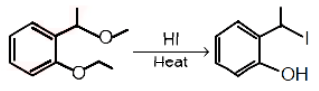
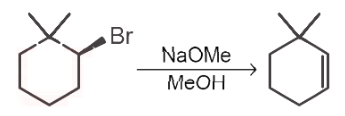
MCQ 14 Marks
Match the following reactants and reagents given in Column I with the product given in Column II and choose the correct option from the codes given below :
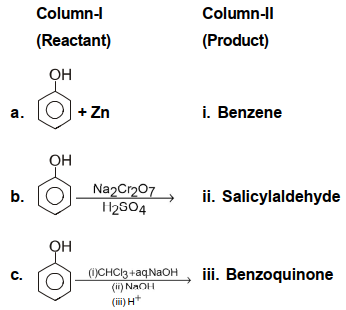
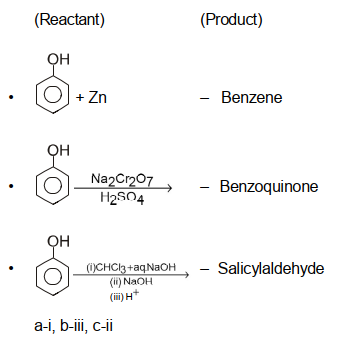
Answer(B) a-i, b-iii, c-ii
View full question & answer→MCQ 24 Marks
The main oxides formed on combustion of $Li , Na$ and $K$ in excess of air are respectively :
- ✓
$Li _2 O , Na _2 O _2$ and $KO _2$
- B
$Li _2 O , Na _2 O$ and $KO _2$
- C
$LiO _2, Na _2 O _2$ and $K _2 O$
- D
$Li _2 O _2, Na _2 O _2$ and $KO _2$
AnswerCorrect option: A. $Li _2 O , Na _2 O _2$ and $KO _2$
View full question & answer→Question 34 Marks
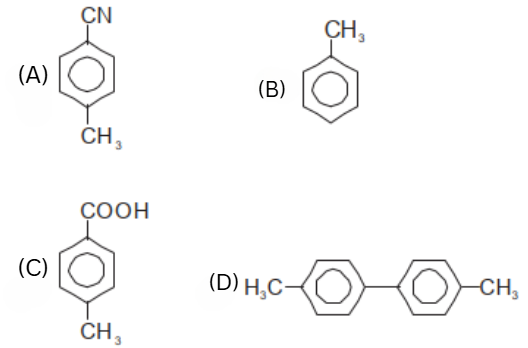
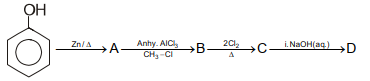 Compound ' D ' is :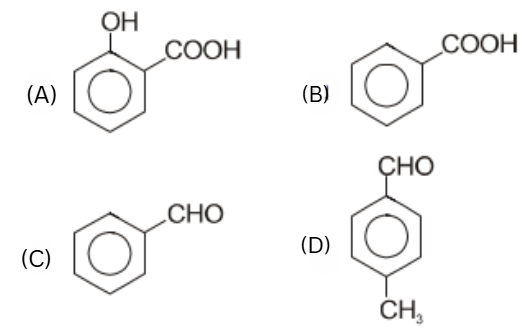
Answer(C)
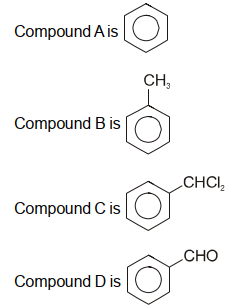
View full question & answer→Question 44 Marks
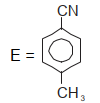
Give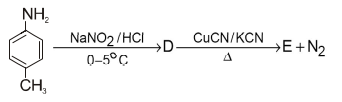 The product E is :
Answer(A)
View full question & answer→MCQ 54 Marks
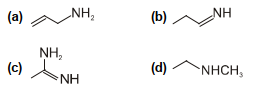
The increasing order of basicity of the following compounds is
- A
(b) $<$ (a) $<$ (c) $<$ (d)
- ✓
(b) $<$ (a) $<$ (d) $<$ (c)
- C
(d) $<$ (b) $<$ (a) $<$ (c)
- D
(a) $<$ (b) $<$ (c) $<$ (d)
AnswerCorrect option: B. (b) $<$ (a) $<$ (d) $<$ (c)
(B) (b) $<$ (a) $<$ (d) $<$ (c)
(b) $<$ (a) $<$ (d) $<$ (c)
View full question & answer→MCQ 64 Marks
In the Hofmann bromamide degradation reaction, the number of moles of NaOH and $Br _2$ used per mole of amine produced are :
- ✓
Four moles of NaOH and one mole of $Br _2$
- B
One mole of NaOH and one mole of $Br _2$
- C
Four moles of NaOH and two moles of $Br _2$
- D
Two moles of NaOH and two moles of $Br _2$
AnswerCorrect option: A. Four moles of NaOH and one mole of $Br _2$
View full question & answer→MCQ 74 Marks
Which of the following salts is the most basic in aqueous solution?
AnswerCorrect option: A. $CH _3 COOK$
(A) $CH _3 COOK$
The most basic in aqueous solution $CH _3 COOK$
View full question & answer→Question 84 Marks
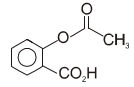
Phenol on treatment with $CO _2$ in the presence of NaOH followed by acidification produces compound X as the major product. X on treatment with $\left( CH _3 CO \right)_2 O$ in the presence of catalytic amount of $H _2 SO _4$ produces :
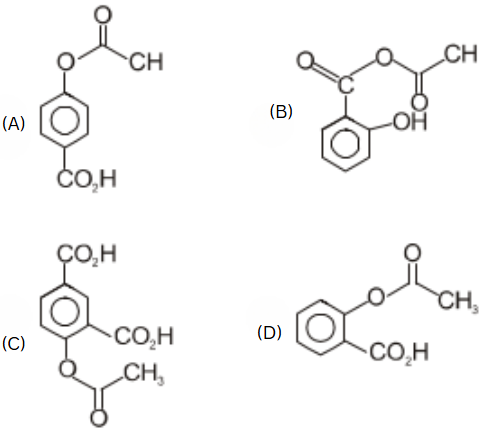
Answer(D)
View full question & answer→Question 94 Marks
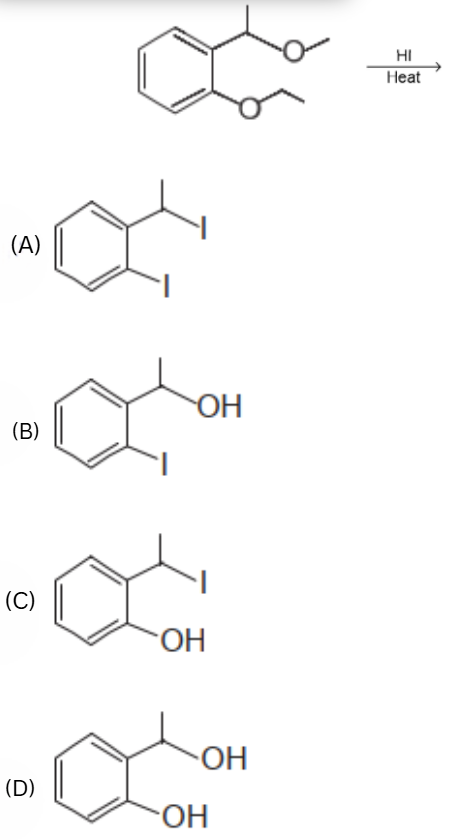
The major product formed in the following reaction is :
Question 104 Marks

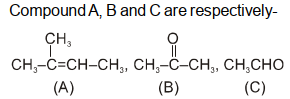
यौगिक $A , B$, और C क्रमशः है :
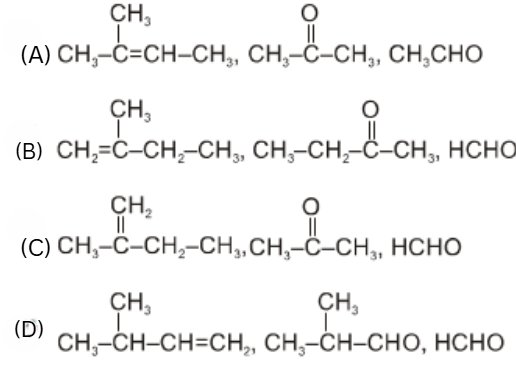
Answer(A)
View full question & answer→Question 114 Marks
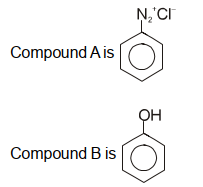
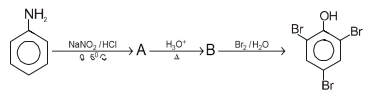 Compound ' B ' is :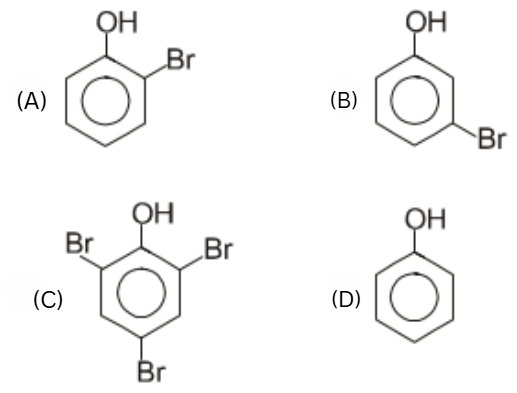
Answer(C)
View full question & answer→MCQ 124 Marks
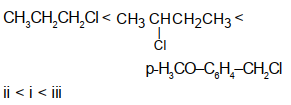
The increasing order of the reactivity of the following halides for the $S_N 1$ reaction is
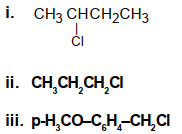
- A
iii $<$ ii $<$ i
- ✓
ii $<$ i $<$ iii
- C
i $<$ iii $<$ ii
- D
ii $<$ iii $<$ i
AnswerCorrect option: B. ii $<$ i $<$ iii
(B) ii $<$ i $<$ iii
View full question & answer→MCQ 134 Marks
Match List-I with List-II| List - I | List - II |
| A. | $\left[ Co \left( NH _3\right)_{ 6 }\right]\left[ Cr ( CN )_6\right]$ | (i) | Linkage isomerism |
| B. | $\left.\left[ Co \left( NH _3\right)_3 NO _2\right)_3\right]$ | (ii) | Solvate isomerism |
| C. | $\left[ Cr \left( H _2 O \right)_6\right] Cl _3$ | (iii) | Co-ordination isomerism |
| D. | cis- $\left.\left[ CrCl _2( ox )_{ 2 }\right]\right]^{3-}$ | (iv) | Optical isomerism |
Choose the correct answer from the options given below. View full question & answer→MCQ 144 Marks
Two reactions $R_1$ and $R_2$ have identical preexponential factors. Activation energy of $R_1$ exceeds that of $R_2$ by $10 kJ mol ^{-1}$. If $k_1$ and $k_2$ are rate constants for reactions $R_1$ and $R_2$ respectively at 300 K , then $\ln \left( k _2 / k _1\right)$ is equal to :-
$\left( R =8.314 J mol ^{-1} K^{-1}\right)$
View full question & answer→MCQ 154 Marks
Given below are two statements :
Statement I:
Rate constant increases exponentially with decreasing activation energy an incrasing temperature.
Statement II :
$e^{-E a / R T}$ refer to the fraction of molecules with energy equal to or greater than activation energy.
In the light of the above statements, choose the most appropriate answer from the options given below :
- A
Both Statement I and Statement II are incorrect
- B
Statement I is correct but Statement II is incorrect
- C
Statement I is incorrect but Statement II is correct
- ✓
Both Statement I and Statement II are correct.
AnswerCorrect option: D. Both Statement I and Statement II are correct.
View full question & answer→MCQ 164 Marks
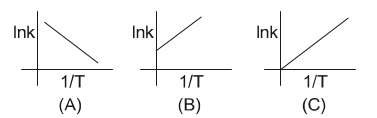
Which of the following graph correctly show the temperature dependence of rate constant, K , for an reaction :
MCQ 174 Marks
Give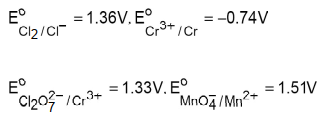
Among the following, the strongest oxidising agent is :
- ✓
$Cl _2$
- B
$Cr ^{+3}$
- C
$Cr _2 O _7^{--}$
- D
$MnO _4^{-}$
AnswerCorrect option: A. $Cl _2$
View full question & answer→MCQ 184 Marks
The reduction potential of hydrogen half-cell will be negative; if :
- A
$p\left( H _2\right)=1 atm$ and $\left[ H ^{+}\right]=2.0 M$
- B
$p\left( H _2\right)=1 atm$ and $\left[ H ^{+}\right]=1.0 M$
- ✓
$p\left( H _2\right)=2 atm$ and $\left[ H ^{+}\right]=1.0 M$
- D
$p\left( H _2\right)=2 atm$ and $\left[ H ^{+}\right]=2.0 M$
AnswerCorrect option: C. $p\left( H _2\right)=2 atm$ and $\left[ H ^{+}\right]=1.0 M$
View full question & answer→Question 194 Marks
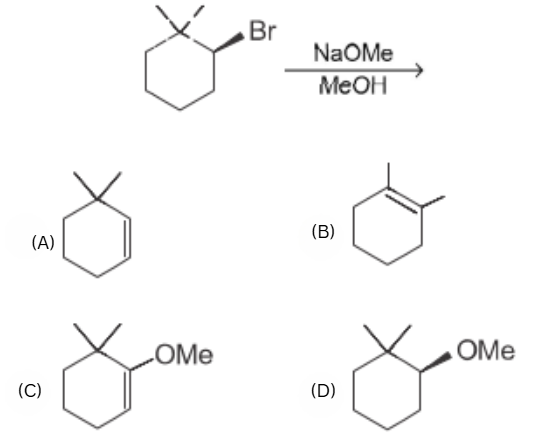
The major product of the following reaction is :
MCQ 204 Marks
3-Methyl-pent-2-ene on reaction with HBr in presence of peroxide forms an addition product. The number of possible stereoisomers for the product is :-
MCQ 214 Marks
The trans-alkenes are formed by the reduction of alkynes with :
- A
$NaBH _4$
- ✓
$Na /liq. NH _3$
- C
$Sn - HCl$
- D
$H _2- Pd / C , BaSO _4$
AnswerCorrect option: B. $Na /liq. NH _3$
(B) $Na /liq. NH _3$
The trans-alkenes are formed by the reduction of alkynes with $Na / liq . NH _3$
View full question & answer→MCQ 224 Marks
Which of the following compounds will exhibit geometrical isomerism?
MCQ 234 Marks
Which of the following reactions is an example of a redox reaction ?
- ✓
$XeF _4+ O _2 F_2 \rightarrow XeF _6+ O _2$
- B
$XeF _2+ PF _5 \rightarrow[ XeF ]+ PF _6-$
- C
$XeF _6+ H _2 O \rightarrow XeOF _4+2 HF$
- D
$XeF _6+2 H _2 O \rightarrow XeO _2 F_2+4 HF$
AnswerCorrect option: A. $XeF _4+ O _2 F_2 \rightarrow XeF _6+ O _2$
View full question & answer→MCQ 244 Marks
The vapour pressure of acetone at $20^{\circ} C$ is $1 8 5$ torr. When 1.2 g of non-volatile substance was dissolved in 100 g of acetone at $20^{\circ} C$, its vapour pressure was 183 torr. The molar mass ( $g mol ^{-1}$ ) of the substance is :
View full question & answer→MCQ 254 Marks
The IUPAC name for the complex $\left[ Co \left( NH _3\right)_5\left( NO _2\right)\right] Cl _2$ is:
- A
nitrito-N-pentaammine cobalt (III) chloride
- B
nitrito-N-pentaammine cobalt (II) chloride
- C
pentaamminenitrito-N-cobalt(II) chloride
- ✓
pentaamminenitrito-N-cobalt(III) chloride
AnswerCorrect option: D. pentaamminenitrito-N-cobalt(III) chloride
(D) pentaamminenitrito-N-cobalt(II) chloride
$
\left[Co\left(NH_3\right)_5\left(NO_2\right)\right] Cl_2
$
pentaamminenitrito-N-cobalt(III) chloride
View full question & answer→MCQ 264 Marks
On treatment of 100 mL of 0.1 M solution of $CoCl _3 .6 H _2 O$ with excess $AgNO _3 ; 1.2 \times 10^{22}$ ions are precipitated. The complex is :
- ✓
$\left[ Co \left( H _2 O \right)_4 Cl _2\right] Cl \cdot 2 H _2 O$
- B
$\left[ Co \left( H _2 O \right)_3 Cl _3\right] \cdot 3 H _2 O$
- C
$\left[ Co \left( H _2 O \right)_6\right] Cl _3$
- D
$\left[ Co \left( H _2 O \right)_5 Cl\right] Cl _2 \cdot H _2 O$
AnswerCorrect option: A. $\left[ Co \left( H _2 O \right)_4 Cl _2\right] Cl \cdot 2 H _2 O$
View full question & answer→MCQ 274 Marks
For 1 molal aqueous solution of the following compounds, which one will show the highest freezing point :
- A
$\left[ Co \left( H _2 O \right)_5 Cl\right] Cl _2 \cdot H _2 O$
- B
$\left[ Co \left( H _2 O \right)_4 Cl _2\right] Cl\cdot 2 H _2 O$
- ✓
$\left[ Co \left( H _2 O \right)_3 Cl _3\right] \cdot 3 H _2 O$
- D
$\left[ Co \left( H _2 O \right)_6\right] Cl _3$
AnswerCorrect option: C. $\left[ Co \left( H _2 O \right)_3 Cl _3\right] \cdot 3 H _2 O$
View full question & answer→MCQ 284 Marks
Arrange the following in order of decreasing number of unpaired electrons :
i. $\left[ Fe \left( H _2 O \right)_6\right]^{2+}$
ii. $\left[ Fe ( CN )_6\right]^{3-}$
iii. $\left[ Fe ( CN )_6\right]^{2-}$
iv. $\left[ Fe \left( H _2 O \right)_6\right]^{3+}$
Answer(D) iv, i, ii and iii
$\left[ Fe ( CN )_6\right]^{2-}$ and $\left[ Fe ( CN )_8\right]^{3-}$ are inner orbital complexes having 0 and 1 unpaired electron respectively. $\left[ Fe \left( H _2 O \right)_6{ }]^{3+}\right.$ and $\left[ Fe \left( H _2 O \right)_6\right]^{2+}$ are out orbital complexes having 5 and 4 unpaired electrons.
View full question & answer→MCQ 294 Marks
The basic character of the transition metal monoxides follows the order (Atomic no's. $Ti = 22,$ $V=23, Cr =24, Fe =26)$ :
- A
$VO > CrO > TiO > FeO$
- B
$CrO > VO > FeO > TiO$
- C
$TiO > FeO > VO > CrO$
- ✓
$TiO > VO > CrO > FeO$
AnswerCorrect option: D. $TiO > VO > CrO > FeO$
(D) $TiO > VO > CrO > FeO$
As the ionisation energy increase basic nature decreases.
View full question & answer→MCQ 304 Marks
The radius of the second Bohr orbit for hydrogen atom is :
(Plank's const. $h =6.6262 \times 10^{-34} Js$; mass of electron $=9.1091 \times 10^{-31} kg$; charge of electron $e=1.60210 \times 10^{-19} C$; permittivity of vaccum $\left.\in_0=8.854185 \times 10^{-12} k g ^{-1} m^{-3} A^2\right)$
View full question & answer→MCQ 314 Marks
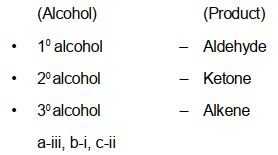
Match the following alcohols given in Column I with the product formed during their reactio with $Cu / 573 K$ in Column II and choose the correct option from the codes given below :Column-I
(Alcohol) | Column-II
(Product) |
| a. $1^0$ alcohol | i. Ketone |
| b. $2^0$ alcohol | ii. Alkene |
| c. $3^0$ alcohol | iii. Aldehyde |
Answer(A) a-iii, b-i, c-ii
View full question & answer→MCQ 324 Marks
The freezing point of benzene decreases by $0.45^{\circ} C$ when 0.2 g of acetic acid is added to $20 . g$ of benzene. If acetic acid associates to form a dimer in benzene, percentage association of acetic acid in benzene will be :-
$\left( K _{ f }\right.$ for benzene $\left.=5.12 K kg mol ^{-1}\right)$
- A
$64.6 \%$
- B
$80.4 \%$
- C
$74.6 \%$
- ✓
$94.6 \%$
AnswerCorrect option: D. $94.6 \%$
View full question & answer→MCQ 334 Marks
Given
$
\begin{array}{l}
C_{\text {(graphite) }}+O_2(g) \rightarrow CO_2(g) \\
\Delta_{r} H^{\circ}=-393.5 kJ mol^{-1} \\
H_2(g)+1 / 2 O_2(g) \rightarrow H_2 O(l) \\
\Delta_{r} H^{\circ}=-285.8 kJ mol^{-1} \\
CO_2(g)+2 H_2 O(l) \rightarrow CH_4(g)+2 O_2(g) \\
\Delta_{r} H^{\circ}=+890.3 kJ mol^{-1}
\end{array}
$
Based on the above thermochemical equations, the value of $\Delta_{ r } H ^{\circ}$ at 298 K for the reaction:
$C _{\text {(graphite) }}+2 H _2(g) \rightarrow CH _4(g)$ will be :
- A
$+74.8 kJ mol ^{-1}$
- B
$+144.0 kJ mol ^{-1}$
- ✓
$-74.8 kJ mol ^{-1}$
- D
$-144.0 kJ mol ^{-1}$
AnswerCorrect option: C. $-74.8 kJ mol ^{-1}$
View full question & answer→MCQ 344 Marks
Match List-I with List-IIList-I
(Molecule) | List-II
(Bond order) |
| (a) $Ne _2$ | (i) 1 |
| (b) $N _2$ | (ii) 2 |
| (c) $F _2$ | (iii) 0 |
| (d) $O _2$ | (iv) 3 |
Choose the correct answer from the options given below : - ✓
(a) $\rightarrow$ (iii), (b) $\rightarrow$ (iv), (c) $\rightarrow$ (i), (d) $\rightarrow$ (ii)
- B
(a) $\rightarrow$ (i), (b) $\rightarrow$ (ii), (c) $\rightarrow$ (iii), (d) $\rightarrow$ (iv)
- C
(a) $\rightarrow$ (ii), (b) $\rightarrow$ (i), (c) $\rightarrow$ (iv), (d) $\rightarrow$ (iii)
- D
(a) $\rightarrow$ (iv), (b) $\rightarrow$ (iii), (c) $\rightarrow$ (ii), (d) $\rightarrow$ (i)
AnswerCorrect option: A. (a) $\rightarrow$ (iii), (b) $\rightarrow$ (iv), (c) $\rightarrow$ (i), (d) $\rightarrow$ (ii)
(a) $\rightarrow$ (iii), (b) $\rightarrow$ (iv), (c) $\rightarrow$ (i), (d) $\rightarrow$ (ii) (ii)| Species | BO |
| $Ne _2$ | 0 |
| $N_2$ | 3 |
| $F_2$ | 1 |
| $O_2$ | 2 |
View full question & answer→MCQ 354 Marks
Which one of the following complexes shows optical isomerism :-
(en = ethylenediamine)
- A
$\left[ Co \left( NH _3\right)_4 Cl _2\right] Cl$
- B
$\left[ Co \left( NH _3\right)_3 Cl _3\right]$
- ✓
$\operatorname{cis}\left[ Co ( en )_2 Cl _2\right] Cl$
- D
$trans \left[ Co ( en )_2 Cl _2\right] Cl$
AnswerCorrect option: C. $\operatorname{cis}\left[ Co ( en )_2 Cl _2\right] Cl$
View full question & answer→MCQ 364 Marks
$pK _{ a }$ of a weak acid $(HA)$ and $pK _{ b }$ of a weak base $( BOH )$ are 3.2 and 3.4, respectively. The pH of their salt ($A B$) solution is :
View full question & answer→MCQ 374 Marks
Given below are two statements : one is labelled as Statement-I and the other is labelled as Statement-II.
Statement-I:
$BCl _3$ is trigonal planer while $PCl _5$ is trigonal bipyramidal.
Statement-II
B in $BCl _3$ is $sp ^2$ hybridised while P in $PCl _5$ is $sp ^3 d$ hybridised.
In the light of the above statements, choose the correct answer from the options given below :
- A
Both Statement I and Statement II are incorrect
- B
Statement I is correct but Statement II is incorrect
- C
Statement I is incorrect but Statement II is correct
- ✓
Both Statement I and Statement II are correct.
AnswerCorrect option: D. Both Statement I and Statement II are correct.
View full question & answer→MCQ 384 Marks
Assertion : $CH _2 Cl _2$ is non-polar and $CCl _4$ is polar molecule.
Reason : Molecule with zero dipole moment is nonpolar in nature.
- A
Assertion is correct, reason is correct, reason is the correct explanation for assertion.
- B
Assertion is correct, reason is correct, reason is the not correct explanation for assertion.
- C
Assertion is correct, reason is incorrect
- ✓
Assertion is incorrect, reason is correct
AnswerCorrect option: D. Assertion is incorrect, reason is correct
(D) Assertion is incorrect, reason is correct
$CH _2 Cl _2$ is polar.
View full question & answer→MCQ 394 Marks
The pair having the same magnetic moment is:
[At. No.: $Cr =24, Mn =25, Fe =26, Co =27]$
- A
$\left[ CoCl _4\right]^{2-}$ and $\left[ Fe \left( H _2 O \right)_6\right]^{2+}$
- B
$\left[ Cr \left( H _2 O \right)_6\right]^{2+}$ and $\left[ CoCl _4\right]^{2-}$
- ✓
$\left[ Cr \left( H _2 O \right)_6\right]^{2+}$ and $\left[ Fe \left( H _2 O \right)_6\right]^{2+}$
- D
$\left[ Mn \left( H _2 O \right)_6\right]^{2+}$ and $\left[ Cr \left( H _2 O \right)_6\right]^{2+}$
AnswerCorrect option: C. $\left[ Cr \left( H _2 O \right)_6\right]^{2+}$ and $\left[ Fe \left( H _2 O \right)_6\right]^{2+}$
View full question & answer→MCQ 404 Marks
Three elements $X, Y$ and $Z$ are in the $3^{\text {rd }}$ period of the periodic table. The oxides of $X, Y$ and $Z$, respectively, are basic, amphoteric and acidic. The correct order of the atomic numbers of $X , Y$ and $Z$ is:
- A
$Z< Y< X$
- ✓
$X< Y< Z$
- C
$X< Z < Y$
- D
$Y < X< Z$
AnswerCorrect option: B. $X< Y< Z$
(B) $X< Y< Z$
On moving left to right in a period, the acidic character of oxides increases.
$3^{\text {rd }}$ period element oxides
View full question & answer→MCQ 414 Marks
The standard Gibbs energy change at 300 K for the reaction $2 A= B + C$ is 2494.2 J . At a given time, the composition of the reaction mixture is $[A]=1 / 2,[B]=2$ and $[C]=1 / 2$. The reaction proceeds in the $[R=8.314 J / K / mol , e =2.718]$
- A
forward direction because $Q < K _{ c }$
- B
reverse direction because $Q < K _{ c }$
- C
forward direction because $Q > K _{ c }$
- ✓
reverse direction because $Q > K_c$
AnswerCorrect option: D. reverse direction because $Q > K_c$
View full question & answer→MCQ 424 Marks
1 gram of a carbonate $\left( M _2 CO _3\right)$ on treatment with excess HCl produces 0.01186 mole of $CO _2$, the molar mass of $M _2 CO _3$ in $g mol ^{-1}$ is :
View full question & answer→MCQ 434 Marks
The equilibrium constants at 298 K for a reaction $A+B \rightleftharpoons C+D$ is 100 . If the initial concentration of all the four species were 1 M each, then equilibrium concentration of $D$ (in $mol L ^{-1}$ ) will be:
View full question & answer→Question 444 Marks
Find the incorrect match:| Compound | Geometry |
| (A) $BF _3$ | Trigonal planer |
| (B) $PCl _5$ | Trigonal bipyramidal |
| (C) $SF _6$ | Square planer |
| (D) $BeCl _2$ | Linear |
Answer(C)
$SF_6 \rightarrow \text { Octahedral }$
View full question & answer→MCQ 454 Marks
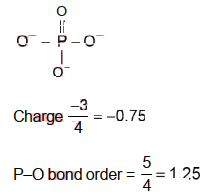
In $PO _4{ }^{3-}$ ion, formal charge on each oxygen atom and $P - O$ bond order respectively are :
- A
$-0.75,0.6$
- B
$-0.75,1.0$
- ✓
$-0.75,1.25$
- D
$-3,1.25$
AnswerCorrect option: C. $-0.75,1.25$
(C) $-0.75,1.25$
View full question & answer→