Questions

SECTION - A [BOTANY - MCQ]

Take a timed test

45 questions · auto-graded multiple-choice test.

MCQ 14 Marks
Match the following cell structure with its characteristic feature:
(a) Tight junctions(i) Cement neighbouring cells together to form sheet
(b) Adhering junctions(ii) Transmit information through chemical to another cells
(c) Gap junctions(iii) Establish a barrier to prevent leakage of fluid across epithelial cells
(d) Synaptic junctions(iv) Cytoplasmic channels to facilitate communication between adjacent cells
Select correct option from the following:
  • A
    (a)-(ii), (b)-(iv), (c)-(i), (d)-(iii)
  • B
    (a)-(iv), (b)-(ii), (c)-(i), (d)-(iii)
  • (a)-(iii), (b)-(i), (c)-(iv), (d)-(ii)
  • D
    (a)-(iv), (b)-(iii), (c)-(i), (d)-(ii)
Answer
Correct option: C.
(a)-(iii), (b)-(i), (c)-(iv), (d)-(ii)
C
View full question & answer
MCQ 24 Marks
Bicarpellary, Syncarpous ovary with obliquely placed septum is seen in :
  • Brassica
  • B
    Gulmohar
  • C
    Soyabean
  • D
    Sesbania
Answer
Correct option: A.
Brassica
(A) Brassica
Bicarpellary, Syncarpous ovary is seen in Brassica.
View full question & answer
MCQ 34 Marks
From the following, identify the correct combination of salient features of Genetic Code
  • A
    Universal, Non-ambiguous, Overlapping
  • B
    Degenerate, Overlapping, Commaless
  • C
    Universal, Ambiguous, Degenerate
  • Degenerate, Non-overlapping, Non ambiguous
Answer
Correct option: D.
Degenerate, Non-overlapping, Non ambiguous
(D) Degenerate, Non-overlapping, Non ambiguous
the correct combination of salient features of Genetic Code
View full question & answer
MCQ 44 Marks
In the process of transcription in Eukaryotes, the RNA polymerase I transcribes -
  • A
    mRNA with additional processing, capping and tailing
  • B
    tRNA, 5 S rRNA and snRNAS
  • rRNAs - 28 S, 18 S and 5.8 S
  • D
    Precursor of mRNA, hnRNA
Answer
Correct option: C.
rRNAs - 28 S, 18 S and 5.8 S
(C) rRNAs - 28 S, 18 S and 5.8 S
In the process of transcription in Eukaryotes, the RNA polymerase I transcribes -
View full question & answer
MCQ 54 Marks
What will be the sequence of mRNA produced by the following stretch of DNA?
3' ATGCATGCATGCATG 5' TEMPLATE STRAND
5' TACGTACGTACGTAC 3' CODING STRAND
  • A
    3'AUGCAUGCAUGCAUG 5'
  • 5' UACGUACGUACGUAC 3'
  • C
    3' UACGUACGUACGUAC 5'
  • D
    5'AUGCAUGCAUGCAUG 3
Answer
Correct option: B.
5' UACGUACGUACGUAC 3'
B
View full question & answer
MCQ 64 Marks
Which scientist experimentally proved that DNA is the sole genetic material in bacteriophage ?
  • A
    Beadle and Tatum
  • B
    Messelson and Stahl
  • Hershey and Chase
  • D
    Jacob and Monod
Answer
Correct option: C.
Hershey and Chase
(C) Hershey and Chase
Hershey and Chase – scientist experimentally proved that DNA is the sole genetic material in bacteriophage
View full question & answer
MCQ 74 Marks
In which genetic condition, each cell in the affected person, has three sex chromosomes XXY?
  • A
    Thalassemia
  • B
    Klinefelter's Syndrome
  • Phenylketonuria
  • D
    Turner's Syndrome
Answer
Correct option: C.
Phenylketonuria
(C) Klinefelter's Syndrome
Klinefelter's Syndrome – each cell in the affected person, has three sex chromosomes XXY
View full question & answer
MCQ 84 Marks
In a marriage between male with blood group A and female with blood group B, the progeny had either blood group AB or B. What could be the possible genotype of parents?
  • $\left.\right|^{ A } i$ (Male) $;\left.|^{ B }\right|^{ B }$ (Female)
  • B
    $\left.\right|^A |^A$ (Male) $; |^B |^B$ (Female)
  • C
    $|^A |^A$ (Male) $; |^{ B } i ($ Female $)$
  • D
    |${ }^A i$ (Male) $; |^B i($ Female $)$
Answer
Correct option: A.
$\left.\right|^{ A } i$ (Male) $;\left.|^{ B }\right|^{ B }$ (Female)
(A) $\left.\right|^{ A } i$ (Male) $;\left.|^{ B }\right|^{ B }$ (Female)
In a marriage between male with blood group A and female with blood group $B$, the progeny had either blood group $A B$ or $B$. the possible genotype of parents is - $I^A$ i (Male) ; $I ^{ B } I ^{ B }$ (Female)
View full question & answer
MCQ 94 Marks
Which of the following sexually transmitted diseases do not specifically affect reproductive organs ?
  • A
    Genital warts and Hepatitis-B
  • Syphilis and Genital herpes
  • C
    AIDS and Hepatitis B
  • D
    Chlamydiasis and AIDS
Answer
Correct option: B.
Syphilis and Genital herpes
(B) AIDS and Hepatitis B
AIDS and Hepatitis B – sexually transmitted diseases do not specifically affect reproductive organs
View full question & answer
MCQ 104 Marks
Which of the following is a correct statement?
  • A
    IUDs once inserted need not be replaced.
  • B
    IUDs are generally inserted by the user herself.
  • IUDs increase phagocytosis of sperms in the uterus.
  • D
    IUDs suppress gametogenesis.
Answer
Correct option: C.
IUDs increase phagocytosis of sperms in the uterus.
C
View full question & answer
MCQ 114 Marks
No new follicles develop in the luteal phase of the menstrual cycle because:
  • A
    Follicles do not remain in the ovary after
  • B
    FSH levels are high in the luteal phase
  • C
    LH levels are high in the luteal phase
  • Both FSH and LH levels are low in the luteal phase
Answer
Correct option: D.
Both FSH and LH levels are low in the luteal phase
(D) Both FSH and LH levels are low in the luteal phase
No new follicles develop in the luteal phase of the menstrual cycle b ecause
(D) Both FSH and LH levels are low in the luteal phase
View full question & answer
MCQ 124 Marks
Select the correct sequence of events.
  • Gametogenesis $\rightarrow$ Gamete transfer $\rightarrow$ Syngamy $\rightarrow$ Zygote $\rightarrow$ Cell division (Cleavage) $\rightarrow$ Cell differentiation $\rightarrow$ Organogenesis
  • B
    Gametogenesis $\rightarrow$ Gamete transfer $\rightarrow$ Syngamy $\rightarrow$ Zygote $\rightarrow$ Cell division (Cleavage) $\rightarrow$ Organogenesis $\rightarrow$ Cell differentiation
  • C
    Gametogenesis $\rightarrow$ Syngamy $\rightarrow$ Gamete transfer $\rightarrow$ Zygote $\rightarrow$ Cell division (Cleavage) $\rightarrow$ Cell differentiation $\rightarrow$ Organogenesis
  • D
    Gametogenesis $\rightarrow$ Gamete transfer $\rightarrow$ Syngamy $\rightarrow$ Zygote $\rightarrow$ Cell differentiation $\rightarrow$ Cell division (Cleavage) $\rightarrow$ Organogenesis
Answer
Correct option: A.
Gametogenesis $\rightarrow$ Gamete transfer $\rightarrow$ Syngamy $\rightarrow$ Zygote $\rightarrow$ Cell division (Cleavage) $\rightarrow$ Cell differentiation $\rightarrow$ Organogenesis
(A) Gametogenesis $\rightarrow$ Gamete transfer $\rightarrow$ Syngamy $\rightarrow$ Zygote $\rightarrow$ Cell division (Cleavage) $\rightarrow$ Cell differentiation $\rightarrow$ Organogenesis
View full question & answer
MCQ 134 Marks
Western Ghats have a large number of plant and animal species that are not found anywhere else. Which of the following terms will you use to notify such species?
  • Endemic
  • B
    Vulnerable
  • C
    Threatened
  • D
    Keystone
Answer
Correct option: A.
Endemic
(A) Endemic
Endemic – Western Ghats have a large number of plant and animal species that are not found anywhere else.
View full question & answer
MCQ 144 Marks
Select the correct match for population interactions
  • A
    Predator and prey = + and +
  • Liver fluke and human = + and -
  • C
    Cuckoo and crow = + and +
  • D
    Sea anemone and clown Fish = - and 0
Answer
Correct option: B.
Liver fluke and human = + and -
B
View full question & answer
MCQ 154 Marks
Exploitation of bioresources of a nation by multinational companies without authorization from the concerned country is referred to as
  • A
    Bioweapon
  • Biopiracy
  • C
    Bioethics
  • D
    Biowar
Answer
Correct option: B.
Biopiracy
(B) Biopiracy
Exploitation of bioresources of a nation by multinational companies without authorization from the concerned country is referred to as Biopiracy
View full question & answer
MCQ 164 Marks
The two antibiotic resistance genes on vector pBR 322 are for
  • Ampicillin and Tetracycline
  • B
    Ampicillin and Chloramphenicol
  • C
    Chloramphenicol and Tetracycline
  • D
    Tetracycline and Kanamycin
Answer
Correct option: A.
Ampicillin and Tetracycline
(A) Ampicillin and Tetracycline
The two antibiotic resistance genes on vector pBR 322 are for (A) Ampicillin and Tetracycline
View full question & answer
MCQ 174 Marks
In which one of the following, both autogamy and geitonogamy are prevented?
  • A
    Wheat
  • Papaya
  • C
    Castor
  • D
    Maize
Answer
Correct option: B.
Papaya
(B) Papaya
Papaya – both autogamy and geitonogamy are prevented
View full question & answer
MCQ 184 Marks
Humans have acquired immune system that produces antibodies to neutralize pathogens. Still innate immune system is present at the time of birth because it
  • A
    is very specific and uses different macrophages
  • B
    produces memory cells for mounting fast secondary response
  • has natural killer cells which can phagocytose and destroy microbes
  • D
    provides passive immunity
Answer
Correct option: C.
has natural killer cells which can phagocytose and destroy microbes
(C) has natural killer cells which can phagocytose and destroy microbes
Humans have acquired immune system that produces antibodies to neutralize pathogens. Still innate immune system is present at the time of birth because it
View full question & answer
MCQ 194 Marks
Select the correct match
A. MicrosporumI. Fungi
B. Entamoeba histolyticaII. Protozoa
C. Wuchereria malayiIII. Animal
D. Streptococcus pneumoniaeIV. Bacteria
  • A-I, B-II, C-III, D-IV
  • B
    A-IV, B-II, C-III, D-I
  • C
    A-III, B-II, C-I, D-IV
  • D
    A-III, B-I, C-II, D-IV
Answer
Correct option: A.
A-I, B-II, C-III, D-IV
A
View full question & answer
MCQ 204 Marks
What type of pollination takes place in Vallisneria
  • Pollination occurs in submerged condition by water.
  • B
    Flowers emerge above surface of Water and pollination occurs by insects.
  • C
    Flowers emerge above water surface and pollen is carried by wind.
  • D
    Male flowers are carried by water currents to female flowers at surface of water
Answer
Correct option: A.
Pollination occurs in submerged condition by water.
(A) Pollination occurs in submerged condition by water.
The type of pollination takes place in Vallisneria
View full question & answer
MCQ 214 Marks
Given below are two statements: One is labelled asAssertion (A) and the other is labelled as Reason (R)
Assertion (A): Potato and sweet potato is an example of analogy.
Reason(R): Potato is modification of stem while sweet potato is modification of root but they perform similar function (storage of food).
In the light of the above statements, choosethe correct answer from the options given below:
  • A
    (A) is correct but (R) is not correct
  • B
    (A) is not correct but (R) is correct
  • Both (A) and (R) are correct and (R) is the correct explanation of (A)
  • D
    Both (A) and (R) are correct but (R) is not the correct explanation od (A)
Answer
Correct option: C.
Both (A) and (R) are correct and (R) is the correct explanation of (A)
C
View full question & answer
MCQ 224 Marks
Which of the following is most common type of embryo sac in angiosperms?
  • A
    Tetrasporic with one mitotic stage of divisions
  • Monosporic with three sequential mitotic divisions
  • C
    Monosporic with two sequential mitotic divisions
  • D
    Bisporic with two sequential mitotic divisions
Answer
Correct option: B.
Monosporic with three sequential mitotic divisions
(B) Monosporic with three sequential mitotic divisions
The most common type of embryo sac in angiosperms
View full question & answer
MCQ 234 Marks
The main difference between active and passive transport across cell membrane is:
  • A
    passive transport is non-selective whereas active transport is selective
  • passive transport requires a concentration gradient across a biological membrane whereas active transport requires energy to move solutes.
  • C
    No any difference between them
  • D
    active transport requires more ATP while passive transport requires less ATP to move solutes
Answer
Correct option: B.
passive transport requires a concentration gradient across a biological membrane whereas active transport requires energy to move solutes.
(B) passive transport requires a concentration gradient across a biological membrane whereas active transport requires energy to move solutes.
The main difference between active and passive transport across cell membrane is :
(2) passive transport requires a concentration gradient across a biological membrane whereas active transport requires energy to move solutes.
View full question & answer
MCQ 244 Marks
Which of the following nucleic acids is present in an organism having 70 S ribosomes only?
  • A
    Single stranded DNA with protein coat
  • Double stranded circular naked DNA
  • C
    Double stranded DNA enclosed in nuclear membrane
  • D
    Double stranded circular DNA with histone proteins
Answer
Correct option: B.
Double stranded circular naked DNA
(B) Double stranded circular naked DNA
Double stranded circular naked DNA – nucleic acids is present in an organism having 70 S ribosomes only
View full question & answer
MCQ 254 Marks
Which of the following shows whorled phyllotaxy?
  • A
    Mustard
  • B
    China rose
  • Alstonia
  • D
    Calotropis
Answer
Correct option: C.
Alstonia
(C) Alstonia
Alstonia – shows whorled phyllotaxy
View full question & answer
MCQ 264 Marks
Which of the following animals are true coelomates with bilateral symmetry?
  • A
    Adult Echinoderms
  • B
    Aschelminthes
  • C
    Platyhelminthes
  • Annelids
Answer
Correct option: D.
Annelids
(D) Annelids
Annelids are true coelomates with bilateral symmetry
View full question & answer
MCQ 274 Marks
Select the correct match
  • A
    Flatworms - Network of trachea
  • B
    Sponges - Book lungs
  • Aquatic arthropods - Gills
  • D
    Coelenterates - Lungs
Answer
Correct option: C.
Aquatic arthropods - Gills
(C) Aquatic arthropods - Gills
(A) Flatworms – General body surface
(B) Sponges – General body surface
(C) Aquatic arthropods – Gills
(D) Coelenterates – General body surface
View full question & answer
MCQ 284 Marks
Match the following genera with their respective phylum:
(a) Ophiura(i) Mollusca
(b) Physalia(ii) Platyhelminthes
(c) Pinctada(iii) Echinodermata
(d) Planaria(iv) Coelenterata
  • A
    (a)-(iv), (b)-(i), (c)-(iii), (d)-(ii)
  • (a)-(iii), (b)-(iv), (c)-(i), (d)-(ii)
  • C
    (a)-(i), (b)-(iii), (c)-(iv), (d)-(ii)
  • D
    (a)-(iii), (b)-(iv), (c)-(ii), (d)-(i)
Answer
Correct option: B.
(a)-(iii), (b)-(iv), (c)-(i), (d)-(ii)
B
View full question & answer
MCQ 294 Marks
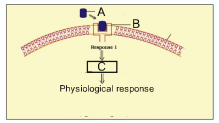
Identify A, B and C in the diagrammatic representation of the mechanism of hormone action.
Image
Select the correct option from the following:
  • A
    A = Steroid Hormone; B = Hormone receptor Complex; C = Protein
  • A = Protein Hormone; B = Receptor; C = Cyclic AMP
  • C
    A = Steroid Hormone; B = Receptor; C = Second Messenger
  • D
    A = Protein Hormone; B = Cyclic AMP; C = Hormone-receptor Complex
Answer
Correct option: B.
A = Protein Hormone; B = Receptor; C = Cyclic AMP
B
View full question & answer
MCQ 304 Marks
Which of the following conditions will stimulate parathyroid gland to release parathyroid hormone
  • A
    Fall in active Vitamin D levels
  • Fall in blood Ca+2 levels
  • C
    Fall in bone Ca+2 levels
  • D
    Rise in blood Ca+2 levels
Answer
Correct option: B.
Fall in blood Ca+2 levels
(B) Fall in blood Ca+2 levels
Fall in blood $Ca ^{+2}$ levels - will stimulate
parathyroid gland to release parathyroid hormone
View full question & answer
MCQ 314 Marks
Which of the following diseases is an auto-immune disorder?
  • Myasthenia gravis
  • B
    Arthritis
  • C
    Osteoporosis
  • D
    Gout
Answer
Correct option: A.
Myasthenia gravis
(A) Myasthenia gravis
Myasthenia gravis diseases is an auto-immune disorder
View full question & answer
MCQ 324 Marks
Mad cow disease in cattle is caused by an agent which has:
  • A
    Inert crystal
  • Abnormally folded protein
  • C
    Free RNA without protein coat
  • D
    Free DNA without protein coat
Answer
Correct option: B.
Abnormally folded protein
(B) Abnormally folded protein
Mad cow disease in cattle is caused by an agent which has Abnormally folded protein
View full question & answer
MCQ 334 Marks
A specialised nodal tissue embedded in the lower corner of the right atrium, close to Atrio-ventricular septum, delays the spreading of impulses to heart apex for about 0.1 sec.
This delay allows -
  • A
    blood to enter aorta.
  • B
    the ventricles to empty completely
  • C
    blood to enter pulmonary arteries.
  • the atria to empty completely
Answer
Correct option: D.
the atria to empty completely
D
View full question & answer
MCQ 344 Marks
All the components of the nodal tissue are autoexcitable. Why does the SA node act as the normal pacemaker ?
  • A
    SA node has the lowest rate of depolarisation
  • B
    SA node is the only component to generate the threshold potential.
  • C
    Only SA node can convey the action potential to the other
  • SA node has the highest rate of depolarisation
Answer
Correct option: D.
SA node has the highest rate of depolarisation
D
View full question & answer
MCQ 354 Marks
The maximum volume of air a person can breathe in after a forced expiration is known as:
  • A
    Expiratory Capacity
  • Vital Capacity
  • C
    Inspiratory Capacity
  • D
    Total Lung Capacity
Answer
Correct option: B.
Vital Capacity
(B) Vital Capacity
The maximum volume of air a person can breathe in after a forced expiration is known as Vital Capacity
View full question & answer
MCQ 364 Marks
In order to increase the yield of sugarcane crop, which of the following plant growth regulators should be sprayed?
  • A
    Ethylene
  • B
    Auxins
  • Gibberellins
  • D
    Cytokinins
Answer
Correct option: C.
Gibberellins
(C) Gibberellins
In order to increase the yield of sugarcane crop, Gibberellins plant growth regulators should be sprayed
View full question & answer
MCQ 374 Marks
Where is the respiratory electron transport system (ETS) located in plants?
  • A
    Mitochondrial matrix
  • B
    Outer mitochondrial membrane
  • Inner mitochondrial membrane
  • D
    Intermembrane space
Answer
Correct option: C.
Inner mitochondrial membrane
(C) Inner mitochondrial membrane
the respiratory electron transport system (ETS) located in Inner mitochondrial membrane of cell in plants
View full question & answer
MCQ 384 Marks
In Hatch and Slack pathway, the primary CO2 acceptor is
  • A
    Oxaloacetic acid
  • B
    Phosphoglyceric acid
  • Phosphoenol pyruvate
  • D
    RuBisCO
Answer
Correct option: C.
Phosphoenol pyruvate
(C) Phosphoenol pyruvate
In Hatch and Slack pathway, the primary $CO _2$ acceptor is Phosphoenol pyruvate
View full question & answer
MCQ 394 Marks
One scientist cultured Cladophora in a suspension of Azotobacter and illuminated the culture by splitting light through a prism. He observed that bacteria accumulated mainly in the region of:
  • A
    Violet and green light
  • B
    Indigo and green light
  • C
    Orange and yellow light
  • Blue and red light
Answer
Correct option: D.
Blue and red light
(D) Blue and red light
One scientist cultured Cladophora in a suspension of Azotobacter and illuminated the culture by splitting light through a prism. He observed that bacteria accumulated mainly in the region of Blue and red light
View full question & answer
MCQ 404 Marks
After meiosis I, the resultant daughter cells have
  • A
    same amount of DNA as in the parent cell in S
  • twice the amount of DNA in comparison to haploid gametes
  • C
    same amount of DNA in comparison to haploid gamete
  • D
    four times the amount of DNA in comparison to haploid gamete
Answer
Correct option: B.
twice the amount of DNA in comparison to haploid gametes
(B) twice the amount of DNA in comparison to haploid gametes
After meiosis I, the resultant daughter cells have
(2) twice the amount of DNA in comparison to haploid gametes
View full question & answer
MCQ 414 Marks
Crossing over takes place between which chromatids and in which stage of the cell cycle?
  • A
    Non-sister chromatids of non-homologous chromosomes at Zygotene stage of prophase I.
  • Non-sister chromatids of homologous chromosomes at Pachytene stage of prophase I.
  • C
    Non-sister chromatids of homologous chromosomes at Zygotene stage of prophase I.
  • D
    Non-sister chromatids of non-homologous chromosomes at Pachytene stage of prophase I.
Answer
Correct option: B.
Non-sister chromatids of homologous chromosomes at Pachytene stage of prophase I.
(B) Non-sister chromatids of homologous chromosomes at Pachytene stage of prophase I.
Crossing over takes place between Non-sister chromatids of homologous chromosomes at Pachytene stage of prophase I of the cell cycle
View full question & answer
MCQ 424 Marks
Prosthetic groups differ from co-enzymes in that
  • A
    they require metal ions for their activity
  • they (prosthetic groups) are tightly bound to apoenzymes.
  • C
    their association with apoenzymes is transient.
  • D
    they can serve as co-factors in a number of enzyme catalyzed reactions.
Answer
Correct option: B.
they (prosthetic groups) are tightly bound to apoenzymes.
(B) they (prosthetic groups) are tightly bound to apoenzymes.
prosthetic groups are tightly bound to apoenzymes while coenzyme is loosely bound
View full question & answer
MCQ 434 Marks
Given below are two statements
Statement I:
During the chemical reaction the number of carbon atom and functional group are changed in enzyme molecule.
Statement II:
In all enzymes A non protein constituents called cofactors are bound to the enzyme to make the enzyme catalytically active.
Choose the correct answer from the option given below:
  • Both Statement I and Statement II are incorrect
  • B
    Statement l is correct but Statement II is incorrect
  • C
    Statement l is incorrect but Statement II is correct
  • D
    Both Statement I and Statement II are correct
Answer
Correct option: A.
Both Statement I and Statement II are incorrect
(A) Both Statement I and Statement II are incorrect
Statement I:
During the chemical reaction no changed in enzyme molecule.
Statement II :
In some enzymes A non protein constituents called cofactors are bound to the enzyme to make the
enzyme catalytically active.
View full question & answer
MCQ 444 Marks
Which of the following organic compounds is the main constituent of Lecithin?
  • A
    Arachidonic acid
  • Phospholipid
  • C
    Cholesterol
  • D
    Phosphoprotein
Answer
Correct option: B.
Phospholipid
(B) Phospholipid
Phospholipid – organic compounds is the main constituent of Lecithin
View full question & answer
MCQ 454 Marks
Non-membranous nucleoplasmic structures in nucleus are the site for active synthesis of
  • A
    protein synthesis
  • B
    mRNA
  • rRNA
  • D
    tRNA
Answer
Correct option: C.
rRNA
(C) rRNA
Non-membranous nucleoplasmic structures in nucleus are the site for active synthesis of Rrna
View full question & answer