Questions

SECTION - A [BOTANY - MCQ]

Take a timed test

45 questions · auto-graded multiple-choice test.

MCQ 14 Marks
Phytotron is a device by which:
  • Plants are grown in controlled environment
  • B
    Electron bombarding system
  • C
    Induce mutation breeding in wheat
  • D
    Heavy water plants
Answer
Correct option: A.
Plants are grown in controlled environment
(A)Plants are grown in controlled environment
Explanation:
Plants are grown in controlled environment
View full question & answer
MCQ 24 Marks
The main purpose of electron transport chain is to
  • A
    Glucose - 6 - PO4, to fructose - e - PO4,
  • cycle NADH + H+ back to NAD+.
  • C
    use the intermediates from TCA cycle.
  • D
    breakdown pyruvate.
Answer
Correct option: B.
cycle NADH + H+ back to NAD+.
(B)cycle NADH + H+ back to NAD+.
Explanation:
The electron transport chain is a process in which the NADH and FADH2 produced during glycolysis, beta-oxidation, and other catabolic processes are oxidised with a release of energy in the form of ATP. The main purpose of electron transport chain is to cycle NADH + H+ back to NAD+.
View full question & answer
MCQ 34 Marks
Photosynthesis is that it:
  • Converts light energy into chemical energy
  • B
    Creates useful energy
  • C
    Fixes CO2 into carbohydrates
  • D
    Reverses the action of respiration
Answer
Correct option: A.
Converts light energy into chemical energy
(A)Converts light energy into chemical energy
Explanation:
Converts light energy into chemical energy
View full question & answer
MCQ 44 Marks
Jan Ingenhousz showed that small bubbles were formed around the green parts of an aquatic plant in bright sunlight (not in dark). These bubbles were of
  • A
    H2O
  • B
    CO2
  • C
    H2
  • 02
Answer
Correct option: D.
02
(D)02
Explanation:
The small bubbles formed around the green parts of an aquatic plant in bright sunlight in the experiment performed by Jan Ingenhousz were of oxygen.
View full question & answer
MCQ 54 Marks
Blackmann's law of limiting factor is applied to:
  • Photosynthesis
  • B
    Growth
  • C
    Transpiration
  • D
    Respiration
Answer
Correct option: A.
Photosynthesis
(A)Photosynthesis
Explanation:
Blackman proposed the law of limiting factors in 1905. According to this law, when a process depends on a number of factors, its rate is limited by the pace of the slowest factor. Blackman's law of limiting factors determines the rate of photosynthesis.
View full question & answer
MCQ 64 Marks
In the leaves of $C _4$ plants, malic acid formation during $CO _2$ fixation occurs in the cells of:
  • A
    Epidermis
  • Mesophyll
  • C
    Bundle sheath
  • D
    Phloem
Answer
Correct option: B.
Mesophyll
(B)Mesophyll
Explanation:
Mesophyll is the site in plant leaves, where chlorophyll pigment is present. Thus carbon dioxide fixation occurs there, which produces malic acid. It is then transferred to agranal chloroplast in bundle sheath.
View full question & answer
MCQ 74 Marks
The dividing and undifferentiated cells are known as:
  • A
    Primordial
  • B
    Tissue
  • Callus
  • D
    Embryo
Answer
Correct option: C.
Callus
(C)Callus
Explanation:
Callus - unspecialised, unorganised growing, undifferentiated cell & dividing the mass of cells.
View full question & answer
MCQ 84 Marks
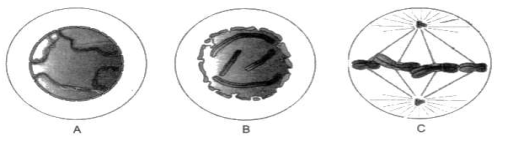
Given diagram A, B and C are different stages of cell division, choose correct option for given diagram:
Image
  • A
    A - Early Prophase, B -Anaphase, C - Metapha
  • B
    A - Prophase, B - Metaphase, C - Telophase
  • A - Early Prophase, B - Late Prophase, C - Metaphase
  • D
    A - Prophase, B - Anaphase, C-Metaphase
Answer
Correct option: C.
A - Early Prophase, B - Late Prophase, C - Metaphase
(C)A - Early Prophase, B-Late Prophase, C - Metaphase
Explanation:
• Early prophase - the nuclear membrane becomes more and more indistinct and the chromatin fibers become more and more packaged and condensed.
• Late prophase - the nuclear membrane and the nucleolus finally vanishes completely.
• Metaphaseis a stage in the cell cycle where all the genetic material is condensing into chromosomes.
View full question & answer
MCQ 94 Marks
Meaning of MAB is:
  • Man and Biosphere programme
  • B
    Mammals and Biosphere
  • C
    Man and Biology programme
  • D
    Mammals and Biology programm
Answer
Correct option: A.
Man and Biosphere programme
(A)Man and Biosphere programme
Explanation:
Man and Biosphere programme
View full question & answer
MCQ 104 Marks
New Wild Life Protection Act was passed in:
  • A
    1987
  • B
    1962
  • 1972
  • D
    1982
Answer
Correct option: C.
1972
(C)1972
Explanation:
1972
View full question & answer
MCQ 114 Marks
Silent valley of Kerala is preserved because:
  • A
    Many new plants
  • B
    New hybrids
  • C
    New fauna
  • Has many rare species
Answer
Correct option: D.
Has many rare species
(D)Has many rare species
Explanation:
Has many rare species.
View full question & answer
MCQ 124 Marks
The nutritive medium for growing bacteria and many fungi in the laboratory is called
  • A
    fermentation media
  • B
    growth media
  • culture media
  • D
    baking media
Answer
Correct option: C.
culture media
(C)culture media
Explanation:
The nutritive medium for growing bacteria and many fungi in the laboratory is called culture media.
View full question & answer
MCQ 134 Marks
Study the given differences between primary sludge and activated sludge and select the incorrect ones.
Primary sludgeActivated sludge
(i) It is sludge formed during primary-sew-age treatmentIt is sludge formed during secondary sewage treatment
(ii) It possesses floes of decomposer microbesIt does not posses floes of decomposer microbes
(iii) It does not require aerationFormation of activated sludge requires aeration
(iv) A lot of decomposition occurs during formation of primary sludgeVery little decomposition occurs during formation of activated sludge
  • A
    (i) and (ii)
  • (ii) and (iv)
  • C
    (i), (iii) and (iv)
  • D
    (ii) and (iii)
Answer
Correct option: B.
(ii) and (iv)
(B)(ii) and (iv)
Explanation:
Activated sludge possesses floes of decomposer microbes, whereas, primary sludge does not possess floes. Unlike primary sludge, a lot of decomposition occurs during formation of activated sludge.
View full question & answer
MCQ 144 Marks
Rate of decomposition depends upon
  • A
    temperature
  • All of these
  • C
    chemical composition of detritus
  • D
    soil moisture and soil pH
Answer
Correct option: B.
All of these
(B)All of these
Explanation:
Rate of decomposition of detritus depends upon chemical nature of detritus, temperature, soil moisture and soil pH. A soil temperature of $25^{\circ} C$ and more hastens decomposition. A low temperature of less than $10^{\circ} C$ reduces rate of decomposition. Moisture is essential for decomposition. Excessive moisture also impedes decomposition probably due to anaerobiosis. Neutral and slightly alkaline soils are rich in detritivores, earthworms and decomposer microbes. Acidity decreases the number of detritivores and earthworms. Soil with small amount of lignin/chitin/cellulose and rich in nitrogen and water soluble substances (like sugars), decomposes rapidly.
View full question & answer
MCQ 154 Marks
Term biosphere is used for the zone of earth where life exists:
  • A
    In the lithosphere and hydrosphere only
  • B
    In the hydrosphere only
  • C
    On lithosphere only
  • In the lithosphere, hydrosphere and atmosphere
Answer
Correct option: D.
In the lithosphere, hydrosphere and atmosphere
(D)In the lithosphere, hydrosphere and atmosphere
Explanation:
In the lithosphere, hydrosphere and atmosphere.
View full question & answer
MCQ 164 Marks
Which one of the following structures is not found in mitotic cells of higher plants?
  • A
    Centromere
  • B
    Cell plate
  • C
    Spindle fibres
  • Centrioles and asters
Answer
Correct option: D.
Centrioles and asters
(D)Centrioles and asters
Explanation:
The centriole and Aster is not common to the mitotic cell of higher plants. The main function of the centrosome is at the time of cell division when the two centrioles separate and move on two poles. Aster and spindle are formed from it which help in the movement of chromatids. They form the basal body, cilia, flagella, etc.
View full question & answer
MCQ 174 Marks
The branch, which is associated with diagnosis, prevention and cure of mental disorders is called
  • A
    Neuropsychiatry
  • B
    Psychology
  • Psychiatry
  • D
    Neurology
Answer
Correct option: C.
Psychiatry
(C)Psychiatry
Explanation:
The branch of medicine associated with diagnosis, prevention and cure of mental disorders is called psychiatry.
View full question & answer
MCQ 184 Marks
Tick the correct option about disorder, causative factor, effected organ and treatment of this:
DisorderCausative factorEffected organ
(i) Rheumatoid arthritisIgMJoints
(ii) AscariasisNematodeScrotum and intestine
(iii) PneumoniaStreptococcusNeuromuscular junction
(iv) RingwormEpidermophytonT-lymphocytes
  • A
    (ii)
  • B
    (iii)
  • (i)
  • D
    (iv)
Answer
Correct option: C.
(i)
(C)(i)
Explanation:
(i)
View full question & answer
MCQ 194 Marks
The substance given to cancer patients in order to activate their immune system and destroy the tumour is
  • $\alpha$-interferon
  • B
    interleukin
  • C
    morphine
  • D
    histamine
Answer
Correct option: A.
$\alpha$-interferon
(A)$\alpha-$ interferon
Explanation:
Cancer patients are given substances called biological response modifiers like $\alpha-$ interferon which activate their immune system and help in destroying the tumours.
View full question & answer
MCQ 204 Marks
When an organ is transplanted and is rejected by the body, the lymphocytes responsible for it is:
  • A
    Neutrophils
  • B
    P-cells
  • C
    B-cells
  • T-cells
Answer
Correct option: D.
T-cells
(D)T-cells
Explanation:
T-cells
View full question & answer
MCQ 214 Marks
The structures that help some bacteria to attach to rocks and for host tissues are:
  • Fimbriae
  • B
    Mesosomes
  • C
    Holdfast
  • D
    Rhizoids
Answer
Correct option: A.
Fimbriae
(A)Fimbriae
Explanation:
The structures that help some prokaryotic cells (bacteria) to attach to rocks and/or host tissues are Fimbriae.
Fimbriae are thin, protein tubes originating from the cytoplasmic membrane.
View full question & answer
MCQ 224 Marks
Which of the following components of plasma membrane facilitated the process of cell recognition and cell adhesion?
  • Glycolipids and glycoproteins
  • B
    Peptidoglycan
  • C
    Lipids only
  • D
    Sugar molecule
Answer
Correct option: A.
Glycolipids and glycoproteins
(A)Glycolipids and glycoproteins
Explanation:
Glycolipids and glycoproteins of plasma membrane facilitated the process of cell recognition and cell adhesion
View full question & answer
MCQ 234 Marks
The word chromosome was given by:
  • Waldeyer
  • B
    C. de Duve
  • C
    Benda
  • D
    Johnson
Answer
Correct option: A.
Waldeyer
(A)Waldeyer
Explanation:
The word chromosome was given by Waldeyer in the year 1888.
View full question & answer
MCQ 244 Marks
Operon system consists of:
  • A
    Operator, regulator, repressor
  • B
    Promoter, regulator
  • Promoter, operator, regulator, repressor and structural genes
  • D
    Operator and structural genes
Answer
Correct option: C.
Promoter, operator, regulator, repressor and structural genes
(C)Promoter, operator, regulator, repressor and structural genes
Explanation:
Promoter, operator, regulator, repressor, and structural genes
View full question & answer
MCQ 254 Marks
DNA consists of two complementary nucleotide chains. If the sequence of nucleotides in one of the chains is AGCTTCGA, then the nucleotides sequence in the other chain shall be:
  • A
    GCTAAGCT
  • B
    GATCCTAG
  • C
    TAGCATAT
  • TCGAAGCT
Answer
Correct option: D.
TCGAAGCT
(D)TCGAAGCT
Explanation:
TCGAAGCT
View full question & answer
MCQ 264 Marks
Match List I with List II and select the correct answer using the codes given below the list:
List I (peculiarity of male determining sperm)List II (Organism in which it is seen)
(A) Sex-linked(1) Baldness
(B) Sex-influenced(2) Acquired immune deficiency syndrome
(C) Sex-limited(3) Klinefelter's syndrome
 (4) Haemophilia
 (5) Beard in man
  • A
    A-5, B-1, C-3
  • A-4, B-1, C-5
  • C
    A-4, B-3, C-2
  • D
    A-5, B-3, C-2
Answer
Correct option: B.
A-4, B-1, C-5
(B)A-4, B-1, C-5
Explanation:
A-4, B-1, C-5
View full question & answer
MCQ 274 Marks
Probability of four son to a couple is:
  • A
    $\frac{1}{32}$
  • B
    $\frac{1}{4}$
  • $\frac{1}{16}$
  • D
    $\frac{1}{8}$
Answer
Correct option: C.
$\frac{1}{16}$
(C)$\frac{1}{16}$
Explanation:
$\frac{1}{16}$
View full question & answer
MCQ 284 Marks
Epidermis is usually consist of how many layers?
  • A
    Triple layer
  • B
    Multi layer
  • C
    Double layer
  • Five
Answer
Correct option: D.
Five
(D)Five
Explanation:
Five
View full question & answer
MCQ 294 Marks
Closed vascular bundles lack:
  • A
    Conjunctive tissue
  • B
    Ground tissue
  • C
    Pith
  • Cambium
Answer
Correct option: D.
Cambium
(D)Cambium
Explanation:
In monocot stem vascular bundles are closed ie they lack Cambium. Thus no secondary thickening occurs.
View full question & answer
MCQ 304 Marks
The term Meristem was given by:
  • A
    Hanstein
  • B
    M. Malpighi
  • C
    N. Grew
  • Nageli
Answer
Correct option: D.
Nageli
(D)Nageli
Explanation:
The term meristem is given by C.Nageli in 1858. It was derived from Greek word meristos which means divisible.
View full question & answer
MCQ 314 Marks
Flowers are zygomorphic in
  • A
    mustard
  • B
    Datura
  • gulmohur
  • D
    tomato
Answer
Correct option: C.
gulmohur
(C)gulmohur
Explanation:
Flowers are zygomorphic in gulmohur. Flowers of gulmohur have bilateral symmetry. The other three options (Datura, mustard and tomato) have actinomorphic flowers.
View full question & answer
MCQ 324 Marks
In angiosperms, __________ could be used to study the various stages of meiosis.
  • A
    zygote
  • B
    mature anthers
  • C
    primary endosperm nucleus
  • young anthers
Answer
Correct option: D.
young anthers
(D)young anthers
Explanation:
Meiosis takes place in reproductive parts of plants such as young anthers so these can be used the stages of meiosis
View full question & answer
MCQ 334 Marks
A close relation between flower and the pollinating agent is best exhibited by:
  • A
    Yucca
  • B
    Amorphophallus
  • C
    Wheat
  • Both Amorphophallus and Yucca
Answer
Correct option: D.
Both Amorphophallus and Yucca
(D)Both Amorphophallus and Yucca
Explanation:
Both Amorphophallus and Yucca
View full question & answer
MCQ 344 Marks
Heterospory has been reported in:
  • A
    Equisetum
  • B
    Lycopodium
  • Selaginella
  • D
    Ophioglossum
Answer
Correct option: C.
Selaginella
(C)Selaginella
Explanation:
Selaginella produces two types of spores, macro(large) and micro(small) spores, hence it is known as heterosporous.
View full question & answer
MCQ 354 Marks
Choose the correct one for Phaeophyceae from given statements.
i. The members of Phaeophyceae are found primarily in freshwater habitats.
ii. Kelps is simple branched, filamentous form while Ectocarpus is profusely branched form, which may reach at height of 100 metres.
iii. They possess chlorophyll-a, c, carotenoids and xanthophylls.
iv. They vary in colour from olive green to various shades of brown.
v. Colour depending upon the amount of the xanthophylls and fucoxanthin pigment.
  • A
    (i), (ii), (iv) and (v)
  • (iii), (iv) and (v)
  • C
    (ii), (iii), (iv) and (v)
  • D
    (i), (iii) and (iv)
Answer
Correct option: B.
(iii), (iv) and (v)
(B)(iii), (iv) and (v)
Explanation:
(iii), (iv) and (v) are right
• The members of Phaeophyceae or brown algae are found primarily in marine habitats.
• They show great variation in size and form. They range from simple branched, filamentous forms (Ectocarpus) to profusely branched forms as represented by kelps, which may reach a height of 100 meters.
• They possess chlorophyll a, c, carotenoids, and xanthophylls.
• They vary in colour from olive green to various shades of brown.
• The colour of brown algae depends upon the amount of the xanthophyll pigment, fucoxanthin present in them.
View full question & answer
MCQ 364 Marks
The coralloid roots of Cycas are:
  • Apogeotropic
  • B
    Positively geotropic
  • C
    Phototropic
  • D
    Aerial
Answer
Correct option: A.
Apogeotropic
(A)Apogeotropic
Explanation:
The coralloid roots of Cycas are apogeotropic, that is they grow upward toward the surface of the soil, instead of downward into its depths.
View full question & answer
MCQ 374 Marks
Primitive types of stomata are found in the
  • A
    All of these
  • Apophysis of capsule
  • C
    Axis of the moss plant
  • D
    Leaves of moss plants
Answer
Correct option: B.
Apophysis of capsule
(B)Apophysis of capsule
Explanation:
In apophysis of capsule of moss, the guard cells and subsidiary cells originate from same mother cell.
View full question & answer
MCQ 384 Marks
The true embryo develops as a result of fusion of
  • A
    a synergid and a male gamete.
  • B
    two polar nuclei of embryo sac.
  • an egg cell and a male gamete.
  • D
    a male gamete and antipodals.
Answer
Correct option: C.
an egg cell and a male gamete.
(C)an egg cell and a male gamete.
Explanation:
The embryo develops from zygote which results from the fusion of a male gamete with the egg cell.
View full question & answer
MCQ 394 Marks
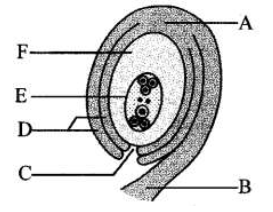
Identify the parts labelled as A to F in the given figure and select the correct option.
Image
  • A
    A-Embryo sac; B-Funicle; C-Chalaza; D-Integuments; E-Nucellus; F-Micropyle
  • B
    A-Chalaza; B-Funicle; C-Micropyle; D-Integuments; E-Nucellus; F-Embryo sac
  • C
    A-Funicle; B-Embryo sac; C-Integuments; D-Chalaza; E-Nucellus; F-Micropyle
  • A-Chalaza; B-Funicle; C-Micropyle; D-Integuments; E-Embryo sac; F-Nucellus
Answer
Correct option: D.
A-Chalaza; B-Funicle; C-Micropyle; D-Integuments; E-Embryo sac; F-Nucellus
(D)A-Chalaza; B-Funicle; C-Micropyle; D-Integuments; E-Embryo sac; F-Nucellus
Explanation:
The given figure represents an anatropous ovule where the parts labelled from A to F are chalaza, funicle, micropyle, integuments, embryo sac, and nucellus, respectively.
View full question & answer
MCQ 404 Marks
In which type of flowers, stigma is rough and sticky?
  • Insect pollinated
  • B
    All of these
  • C
    Wind pollinated
  • D
    Water pollinated
Answer
Correct option: A.
Insect pollinated
(A)Insect pollinated
Explanation:
Insect pollinated
View full question & answer
MCQ 414 Marks
Which of the following is correct for kingdom plantae?
  • A
    Cellulosic cell wall present
  • B
    Nuclear membrane present
  • C
    Eukaryotic cell type
  • All of these
Answer
Correct option: D.
All of these
(D)All of these
Explanation:
Kingdom Plantae contains eukaryotic, multicellular autotrophs with cell wall formed of cellulose and other polysaccharides.
View full question & answer
MCQ 424 Marks
How many characters for lichens are correct from given characters?
i. Lichens are symbiotic associations.
ii. It is an association between algae and fungi.
iii. The algal component is known as mycobiont. 
iv. The fungal component as phycobiont.
v. Lichens are very good pollution indicators.
  • A
    Two
  • B
    Four
  • Three
  • D
    One
Answer
Correct option: C.
Three
(C)Three
Explanation:
(iii) and (iv) are the wrong statement.
The algal component is known as phycobiont and fungal component as mycobiont, which are autotrophic and heterotrophic, respectively. Algae prepare food for fungi and fungi provide shelter and absorb mineral nutrients and water for its partner.
View full question & answer
MCQ 434 Marks
Which of the following is true for living organisms?
  • A
    Metabolic reactions are living
  • B
    All of these
  • All living organisms are made of chemicals
  • D
    Anabolic reactions constitutes breakdown reactions
Answer
Correct option: C.
All living organisms are made of chemicals
(C)All living organisms are made of chemicals
Explanation:
The body of all living organisms are made of a variety of chemicals. The sum total of all chemical reactions occurring in an organism due to specific interactions amongst different types of molecules within the interior of cells is called metabolism.
View full question & answer
MCQ 444 Marks
Select the incorrect statement about taxon, and genus.
  • A
    It is a group or assemblage of related species
  • A genus essentially possesses more than one number of species.
  • C
    Solanum, Penicillium, Withania and Canis are the examples of genera.
  • D
    Lion, Tiger, Leopard, Jaguar are closely related species which have been placed in the genus Panthera and are respectively named as Panthera leo, P tigris, P pardus and P onca.
Answer
Correct option: B.
A genus essentially possesses more than one number of species.
(B)A genus essentially possesses more than one number of species.
Explanation:
It is not essential for a genus to have several species. The genus which has single species is called monotypic, while the genus which has several species is called polytypic.
View full question & answer
MCQ 454 Marks
Which one of the following animals is correctly matched with its particular named taxonomic category?
  • A
    Housefly - Musca, order
  • B
    Humans - Primate, family
  • C
    Cuttlefish - Mollusca, class
  • Tiger - Tigris, species
Answer
Correct option: D.
Tiger - Tigris, species
(D)Tiger - Tigris, species
Explanation:
The scientific name of the tiger is Panthera tigris where Panthera is the genus name and tigris is the species name. Hence, the correct animal name matched with its particular taxonomic category is Tiger - Tigris, the species.
View full question & answer