MCQ 14 Marks
Consider two nuclei of the same radioactive nuclide. One of the nuclei was created in a supernova explosion 5 billion years ago. The other was created in a nuclear reactor 5 minute ago. The probability of decay during the next time is:
- A
nuclei created in explosion
- B
nuclei created in the reactor
- ✓
independent of the time of creation
- D
different for each nuclei
AnswerCorrect option: C. independent of the time of creation
(C)independent of the time of creation
Explanation:
Radioactive decay is a statistical process that depends upon the instability of the particular radioisotope. But as far as two nuclei are concerned, one cannot predict anything. The statistical probability is applied to a large number of nuclei. One cannot apply this to an individual nucleus.
View full question & answer→MCQ 24 Marks
If m is the mass of electron, v its velocity, r is the radius of stationary circular orbit around a nucleus with charge Ze, then from Bohr's second postulate, the radius of the quantised orbit in CGS system is given by:
- ✓
$\frac{n^2 h^2}{4 \pi^2 m e^2 Z}$
- B
$\frac{4 \pi^2 m}{n^2 h^2 Z e^2}$
- C
$\frac{4 \pi^2 m Z e^2}{n^2 h^2}$
- D
$\frac{n^2 h^2 Z e^2}{4 \pi^2 m}$
AnswerCorrect option: A. $\frac{n^2 h^2}{4 \pi^2 m e^2 Z}$
(A)$\frac{n^2 h^2}{4 \pi^2 m e^2 Z}$
Explanation:
$\frac{n^2 h^2}{4 \pi^2 m e^2 Z}$
View full question & answer→MCQ 34 Marks
For which one of the following, Bohr model is not valid?
- A
Singly ionized helium atom ( He+ )
- B
- ✓
Singly ionized neon atom ( Ne+ )
- D
AnswerCorrect option: C. Singly ionized neon atom ( Ne+ )
(C)Singly ionized neon atom (Ne+)
Explanation:
Singly ionized neon has electron count more than one. Bohr's model is valid for atoms with single electron.
View full question & answer→MCQ 44 Marks
An electron, a doubly ionized helium ion ( He++ ) and a proton are having the same kinetic energy. The relation between their respective de-Broglie wavelengths $\lambda_e$, $\lambda_{H e^{++}}$ and $\lambda_p$ is:
- A
$\lambda_{ e }<\lambda_{ p }<\lambda_{H e^{++}}$
- B
$\lambda_{ e }>\lambda_{H e^{++}}>\lambda_{ p }$
- ✓
$\lambda_{ e }>\lambda_{ p }>\lambda_{H e^{++}}$
- D
$\lambda_{ e }<\lambda_{H e^{++}}=\lambda_{ p }$
AnswerCorrect option: C. $\lambda_{ e }>\lambda_{ p }>\lambda_{H e^{++}}$
(C)$\lambda_{ e }>\lambda_{ p }>\lambda_{H e^{++}}$
Explanation:
de-Broglie wavelength, $\lambda=\frac{h}{P}=\frac{h}{\sqrt{2 m( KE )}}$
$\therefore \lambda \propto \frac{1}{\sqrt{m}}$
As $m_{H e^{++}}> m _{ p }> m _{ e }$
$\lambda_{He^{++}}<\lambda_P<\lambda_e \text { or } \lambda_e>\lambda_p>\lambda_{He^{++}}$
View full question & answer→MCQ 54 Marks
If a thin mica sheet of thickness t and refractive index $\mu$ is placed in the path of one of the waves producing interference, then the whole interference pattern shifts towards the side of the sheet by a distance:
- A
$\frac{d}{D}(\mu-1) t$
- ✓
$\frac{D}{d}(\mu-1) t$
- C
$(\mu-1) t$
- D
$D d(\mu-1) t$
AnswerCorrect option: B. $\frac{D}{d}(\mu-1) t$
(B)$\frac{D}{d}(\mu-1) t$
Explanation:
$\frac{D}{d}(\mu-1) t$
View full question & answer→MCQ 64 Marks
Out of the following:
A. pole
B. focus
C. the radius of curvature and
D. principal axis for a spherical mirror, the quantities that do not depend on whether the rays are paraxial or not, are
- A
- B
all (A), (B), (C) and (D)
- ✓
- D
Answer(C)only (A), (C) and (D)
Explanation:
only (A), (C) and (D)
View full question & answer→MCQ 74 Marks
The target element in an X-ray tube must have a high:
- A
- B
- ✓
both atomic number and melting point
- D
AnswerCorrect option: C. both atomic number and melting point
(C)both atomic number and melting point
Explanation:
both atomic number and melting point
View full question & answer→MCQ 84 Marks
For a series LCR circuit R = XL = 2XC The impedance of the circuit and phase difference between V and I respectively will be:
- ✓
$\frac{\sqrt{5} R}{2}, \tan ^{-1}\left(\frac{1}{2}\right)$
- B
$\frac{\sqrt{5} R}{2}, \tan ^{-1}(2)$
- C
$\sqrt{5} R , \tan ^{-1}\left(\frac{1}{2}\right)$
- D
$\sqrt{5} X _{ C }, \tan ^{-1}(2)$
AnswerCorrect option: A. $\frac{\sqrt{5} R}{2}, \tan ^{-1}\left(\frac{1}{2}\right)$
(A)$\frac{\sqrt{5} R}{2}, \tan ^{-1}\left(\frac{1}{2}\right)$
Explanation:
Given:
$\begin{array}{l} R = X _{ L }=2 X _{ C }
\\ Z =\sqrt{R^2+\left(X_L-X_C\right)^2}
\\ =\sqrt{\left(2 X_C\right)^2+\left(2 X_C-X_C\right)^2}
\\ =\sqrt{4 X_C^2+X_C^2}
\\ =\sqrt{5} X _{ C }
\\ =\frac{\sqrt{5} R}{2}
\\ \tan \phi=\frac{X_L-X_C}{R}
\\ =\frac{2 X_C-X_C}{2 X_C}
\\ \tan \phi=\frac{1}{2}
\\ \phi=\tan ^{-1}\left(\frac{1}{2}\right)\end{array}$
View full question & answer→MCQ 94 Marks
A copper disc of radius 0.1 m rotates about its centre with 10 revolutions per second in a uniform magnetic field of 0.1 T. The emf induced across the radius of the disc is:
- A
$\frac{2 \pi}{10} V$
- ✓
$10 \pi mV$
- C
$\frac{\pi}{10} V$
- D
$20 \pi mV$
AnswerCorrect option: B. $10 \pi mV$
(B)$10 \pi mV$
Explanation:
The induced emf between centre and rim of the rotating disc is,
$\begin{array}{l} E =\frac{1}{2} B \omega r ^2
\\ =\frac{1}{2} \times 0.1 \times 2 \pi \times 10 \times(0.1)^2
\\ =10 \pi \times 10^{-3} V
\\ =10 \pi mV \end{array}$
View full question & answer→MCQ 104 Marks
A small piece of metal wire is dragged across the gap between the poles of a magnet in 0.4 s. If the change in magnetic flux in the wire is $8 \times 10^{-4}$ wb, then emf induced in the wire is:
- A
$6 \times 10^{-3} V$
- ✓
$2 \times 10^{-3} V$
- C
$4 \times 10^{-3} V$
- D
$8 \times 10^{-3} V$
AnswerCorrect option: B. $2 \times 10^{-3} V$
(B)$2 \times 10^{-3} V$
Explanation:
Given: Time (t) = 0.4 sec and magnetic flux($\phi$) = 8 × 10⁻⁴ Wb. From the Faraday's law of electromagnetic induction that the induced e.m.f. in the wire
$\begin{array}{l}\varepsilon=\frac{d \phi}{d t}=\frac{8 \times 10^{-4}}{0.4}
\\ =2 \times 10^{-3} V\end{array}$
View full question & answer→MCQ 114 Marks
Permanent magnet has properties-retentivity and coercivity respectively:
Answer(D)high, high
Explanation:
The material for a permanent magnet should have high retentivity (so that magnet is strong) and high coercivity (so that magnetism is not wiped out by strong magnetic fields).
View full question & answer→MCQ 124 Marks
The magnetic needle of an oscillation magnetometer makes 10 oscillation per minute under the action of the earth's magnetic field alone. When a bar magnet is placed at some distance along the axis of the needle it makes 14 oscillation per minute. If the bar magnet is turned so that its poles interchange their position, then the new frequency of oscillation of the needle is:
Answer(B)2 vibration per minute
Explanation:
First case: $\frac{60}{10}=2 \pi \sqrt{\frac{I}{M B_H}} \ldots$ (i)
Second case: $\frac{30}{7}=2 \pi \sqrt{\frac{I}{M\left(B_H+B\right)}} \ldots$ (ii)
$\therefore \quad \frac{6}{30 / 7}=\sqrt{\frac{B_H+B}{B_H}}$
$\text { or } B=\left(\frac{24}{25}\right) B_H \ldots \text { (iii) }$
Third case: $\frac{60}{n}=2 \pi \sqrt{\frac{I}{M\left(B_H-B\right)}}$
$\begin{array}{l}
=2 \pi \sqrt{\frac{I}{M\left(B_H-\frac{24}{25} B_H\right)}} \\
=2 \pi \sqrt{\frac{I}{M B_H \times(1 / 25)}} \\
=2 \pi \times 5 \times \sqrt{\frac{I}{M B_H}}\end{array}$
From eqn. (i) and (iv), we get
$\frac{60}{n}=5 \times 6=30$
$\therefore n =2$ vibration per minute
View full question & answer→MCQ 134 Marks
A conducting circular loop of radius r carries a constant current I. It is placed in a uniform magnetic field $\vec{B}$ such that $\vec{B}$ is perpendicular to the plane of the loop. The magnetic force acting on the loop is:
Answer(A)Zero
Explanation:
The forces acting on various small current-carrying elements of the circumference of the loop will be distributed randomly in all possible directions. The vector addition of such randomly distributed forces will be zero.
View full question & answer→MCQ 144 Marks
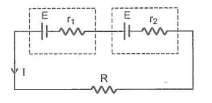
If the potential difference across the internal resistance r
1 is equal to the emf E of the battery, then:
- A
$R =\frac{r_2}{r_1}$
- B
$R =\frac{r_1}{r_2}$
- ✓
- D
Answer(C)R = r1 - r2
Explanation:
$\begin{array}{l}\text { From circuit, } V _1+ V _2= IR
\\ \text { or } E - Ir _1+ E - IR 2= IR \\
\text { Given, } Ir _1= E
\\ \therefore Ir _1- Ir _1+ Ir _1- Ir _2= IR
\\ \therefore R = r _1- r _2\end{array}$
View full question & answer→MCQ 154 Marks
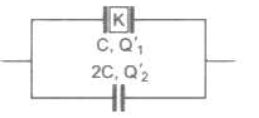
Two parallel plate capacitors of capacitances C and 2C are connected in parallel and charged to a potential difference V0 The battery is then disconnected and the region between the plates of the capacitor C completely filled with a material of dielectric constant 2. The potential difference across the capacitors now becomes:
- A
$\frac{V_0}{2}$
- ✓
$\frac{3 V_0}{4}$
- C
$\frac{V_0}{4}$
- D
AnswerCorrect option: B. $\frac{3 V_0}{4}$
(B)$\frac{3 V_0}{4}$
Explanation:
$Q_1=CV_0$
$\text { or } V_0=\frac{Q_1}{C}$
Capacitors are in parallel.
$\begin{array}{l}\therefore \quad \frac{Q_1}{C}=\frac{Q_2}{2 C} \\
\text { or } Q_2=2 Q_1 \\
V_0=\frac{Q_2}{2 C}\end{array}$
After disconnecting the battery and inserting the dielectric in C .
$\begin{array}{l}V_1^{\prime}=\frac{Q_1}{C K}=\frac{Q_1}{2 C} \\
V_2^{\prime}=\frac{Q_2}{2 C}=\frac{2 Q_1}{2 C}=\frac{Q_1}{C} \text { [from eqn. (i)] }\end{array}$
Charge will flow from 2 to 1 till $\frac{Q_2^{\prime}}{2 C}=\frac{Q_1^{\prime}}{2 C}$ i.e.., the two potentials are equal.
$Q_1=Q_2^{\prime}$
Earlier potential is $V_0=\frac{Q_1}{C}$
Now, it is $\frac{Q_1^{\prime}}{2 C}$
$\begin{array}{l}Q_1+Q_2=3 Q_1=Q_1{ }^{\prime}+Q_2{ }^{\prime} . \\
\frac{Q_2^{\prime}}{2 C}=\frac{Q_1^{\prime}}{2 C} \\
\text { or } Q_2^{\prime}=Q_1^{\prime}=\frac{3 Q_1}{2}\end{array}$
$\therefore$ New potential $=\frac{3 Q_1}{4 C} \quad$ or $\quad \frac{3 V_0}{4}$
View full question & answer→MCQ 164 Marks
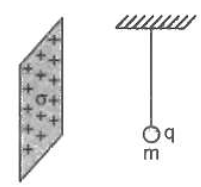
A small charged particle of mass m and charge q is suspended by an insulated thread in front of a very large conducting charged sheet of uniform surface density of charge $\sigma$. The angle made by the thread with the vertical in equilibrium is:
- ✓
$\tan ^{-1}\left(\frac{\sigma q}{2 \varepsilon_0 m g}\right)$
- B
- C
$\tan ^{-1}\left(\frac{\sigma}{q \varepsilon_0 m g}\right)$
- D
$\tan ^{-1}\left(\frac{q}{2 \sigma \varepsilon_0 m g}\right)$
AnswerCorrect option: A. $\tan ^{-1}\left(\frac{\sigma q}{2 \varepsilon_0 m g}\right)$
(A)$\tan ^{-1}\left(\frac{\sigma q}{2 \varepsilon_0 m g}\right)$
Explanation:
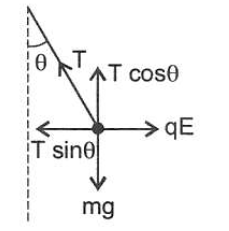
$T \sin \theta=q E=\frac{q \sigma}{2 \varepsilon_0} \ldots$ (i)
$T \cos \theta= mg$
$\tan \theta=\frac{q \sigma}{2 \varepsilon_0 m g}$ View full question & answer→MCQ 174 Marks
- A
Energy is uniformly distributed
- B
Alternating maxima and minima of energy are produced at nodes and antinodes
- C
Energy is maximum at nodes and minimum at antinodes
- ✓
Energy is minimum at nodes and maximum at antinodes
AnswerCorrect option: D. Energy is minimum at nodes and maximum at antinodes
(D)Energy is minimum at nodes and maximum at antinodes
Explanation:
Energy is minimum at nodes and maximum at antinodes
View full question & answer→MCQ 184 Marks
$x_1-A \sin (\omega t-0.1 x)$
and $X _2=A \sin \left(\omega t-0.1 x-\frac{\phi}{2}\right)$
resultant amplitude of combined wave is:
- ✓
$2 A \cos \frac{\phi}{4}$
- B
$2 A \cos \frac{\phi}{2}$
- C
$A \sqrt{2\left(1+\cos \frac{\phi}{4}\right)}$
- D
$A \sqrt{2 \cos \phi / 2}$
AnswerCorrect option: A. $2 A \cos \frac{\phi}{4}$
(A)$2 A \cos \frac{\phi}{4}$
Explanation:
$\begin{array}{l} x _1= A \sin (\omega t-0.1 x ) \\ x_2=A \sin \left(\omega t-0.1 x-\frac{\phi}{2}\right) \\ x _1+ x _2= A \sin (\omega t-0.1 x )+ A \sin \left(\omega t-0.1 x-\frac{\phi}{2}\right) \\ =A\left[\sin (\omega t-0.1 x)+\sin \left(\omega t-0.1 x-\frac{\phi}{2}\right)\right] \\ =A \times 2 \sin \left[\frac{\omega t-0 . L x+\omega t-0.1 x-(\phi / 2)}{2}\right] \\ \cos \left[\frac{\omega t-0.1 x-\omega t+0.1 x+\phi / 2}{2}\right] \\ =2 A \sin \left[\omega t-0.1 x-\frac{\phi}{4}\right] \cos \left(\frac{\phi}{4}\right) \\ =2 A \cos \left(\frac{\phi}{4}\right) \sin \left(\omega t-0.1 x-\frac{\phi}{4}\right)\end{array}$
View full question & answer→MCQ 194 Marks
What happens to the natural frequency of vibration of stretched spring, when its length and diameter are increased?
Answer(B)Frequency decreases
Explanation:
The frequency decreases when its length and diameter are increased.
View full question & answer→MCQ 204 Marks
A body executes SHM, with an amplitude A. At what displacement from the mean position is the PE of the body 25% of its total energy?
- A
$\frac{3 A}{4}$
- B
$\frac{2 A}{3}$
- ✓
$\frac{A}{2}$
- D
$\frac{A}{4}$
AnswerCorrect option: C. $\frac{A}{2}$
(C)$\frac{A}{2}$
Explanation:
According to a given condition,
$\begin{array}{l} PE =\frac{25}{100} \times( TE ) \\
\therefore \frac{1}{2} m \omega^2 x^2=\frac{1}{4}\left(\frac{1}{2} m \omega^2 A^2\right) \\
\therefore x^2=\frac{1}{4} A^2 \\
\text { or, } x =\frac{A}{2}\end{array}$
View full question & answer→MCQ 214 Marks
One moles of a gas A at $27^{\circ} C$ mixed with two moles of gas at $37^{\circ} C$. If both are monatomic ideal gases, what will be the temperature of the mixture?
- A
$37^{\circ} C$
- B
$27^{\circ} C$
- C
$34.27^{\circ} C$
- ✓
$33.67^{\circ} C$
AnswerCorrect option: D. $33.67^{\circ} C$
(D)$33.67^{\circ} C$
Explanation:
Since there is no loss of energy in the process. So, Temperature of the mixture,
$\begin{array}{l} T =\frac{n_1 T_1+n_2 T_2}{n_1+n_2} \\
=\frac{1(27+273)+2(37+273)}{1+2} \\
=\frac{920}{3} \\ \therefore T=306.67 K \\
=33.67^{\circ} C \end{array}$
View full question & answer→MCQ 224 Marks
The initial pressure and volume of an ideal gas are P0 and V0. The final pressure of the gas when the gas is suddenly $\frac{V_0}{4}$ compressed to volume will be: (Given $\gamma$ = ratio of specific heats at constant pressure and at constant volume)
AnswerCorrect option: C. $P _0(4)^\gamma$
(C)$P_0(4)^\gamma$
Explanation:
If gas is compressed suddenly, the processes is adiabatic.
And equation for adiabatic process $P V^\gamma=$ constant
or $P _1 V_1^\gamma= P _2 V_2^\gamma$
$\Rightarrow P _0 V_0^\gamma= P _2\left(\frac{V_0}{4}\right)^\gamma \therefore P _2= P _0(4)^\gamma$
View full question & answer→MCQ 234 Marks
Air in a cylinder is suddenly compressed by a piston, which is then maintained at the [4] same position. After some time, the
- A
- B
- ✓
- D
pressure will remain the same
Answer(C)pressure will decrease
Explanation:
The pressure of the gas on the cylinder will try to balance the weight of the piston. If compressed and left, the pressure would relieve itself until it is balancing the weight of the piston.
View full question & answer→MCQ 244 Marks
A monoatomic gas at pressure P and volume V is suddenly compressed to one eights of its original volume. The final pressure at constant entropy will be:
Answer(B)32 P
Explanation:
For monoatomic gas, $\gamma=\frac{5}{3}$
For an adiabatic process, $P V^\gamma=$ constant
For an adiabatic process, $P V^\gamma= P ^{\prime}\left( V ^{\prime}\right)^\gamma$
$\begin{array}{l}\Rightarrow \quad PV^{5 / 3}=P^{\prime}\left(\frac{V}{8}\right)^{5 / 3} \quad\left(\text { Given, } V^{\prime}=\frac{V}{8}\right) \\
\Rightarrow P^{\prime}=(8)^{5 / 3} P=(2) 5 P=32 P\end{array}$
View full question & answer→MCQ 254 Marks
A thermometric liquid which can be used to measure temperature between $-40^{\circ} C$ to $40^{\circ} C$ is:
Answer(B)alcohol
Explanation:
Alcohol can be used to measure temperature between $-40^{\circ} C$ to $40^{\circ} C$ is:
View full question & answer→MCQ 264 Marks
Two rods of different materials having coefficients of linear expansion $\alpha_1$ and $\alpha_2$ and Young's moduli Y1 and Y2 respectively are fixed between two rigid massive walls. The rods are heated such that they undergo the same increase in temperature. There is no bending of rods. If: $\alpha_1: \alpha_2=2: 3$, the thermal stress developed in two rods are equal provided Y1 : Y2 is equal to:
Answer(A)3:2
Explanation:
We know that $\gamma=\frac{\text { stress }}{\text { strain }} \gamma=$ Young's modulus
Stress $=\gamma$. strain $\rightarrow 1$
Also, Strain $=\frac{\Delta L}{L}=\frac{\alpha \triangle T}{L}$
Using equation 1
$\gamma_1 \cdot$ strain $1=\gamma_2 \cdot$ straub 2
$\gamma_1 \cdot \frac{\gamma_1 \Delta T}{L}=\gamma_2 \cdot \frac{\gamma_2 \Delta T}{L}$$
\frac{\gamma_1}{\gamma_2}=\frac{\alpha_2}{\alpha_1}=\frac{3}{2}$
Hence ratio of $Y _1: Y _2$ is $3: 2$
View full question & answer→MCQ 274 Marks
A load of 1 kg weight is attached to one end of a steel wire of area of cross-section 3 mm2 and Young's modulus 1011 N / m2. The other end is suspended vertically from a hook on a wall, then the load is pulled horizontally and released. When the load passes through its lowest position the fractional change in length is: (Take g = 10m / (s2) )
- ✓
$0.3 \times 10^{-4}$
- B
$0.3 \times 10^3$
- C
$0.3 \times 10^{-3}$
- D
$0.3 \times 10^4$
AnswerCorrect option: A. $0.3 \times 10^{-4}$
(A)$0.3 \times 10^{-4}$
Explanation:
$\begin{array}{l}Y=\frac{m g l}{A \Delta l} \quad \text { or } \quad \frac{\Delta l}{l}=\frac{m g}{A Y} \\
\therefore \frac{\Delta l}{l}=\frac{1 \times 10}{3 \times 10^{-6} \times 10^{11}}=0.3 \times 10^{-4}\end{array}$
View full question & answer→MCQ 284 Marks
The earth (mass= $6 \times 10^{24}$ kg ) revolves around the sun with an angular velocity of $2 \times 10^{-7}$ radian/sec in a circular orbit of radius $1.5 \times 10^8 km$. The force exerted by the sun, on the earth is:
- A
$27 \times 10^{39} N$
- B
$6 \times 10^{19} N$
- ✓
$36 \times 10^{21} N$
- D
$18 \times 10^{25} N$
AnswerCorrect option: C. $36 \times 10^{21} N$
(C)$36 \times 10^{21} N$
Explanation:
$\begin{array}{l}M=6 \times 10^{24} kg, \omega=2 \times 10^{-7} rad / sec \\
r=1.5 \times 10^8 km=1.5 \times 10^{11} m\end{array}$
Force exerted on the earth
$\begin{array}{l}
=m \omega^2 r=\left(6 \times 10^{24}\right) \times\left(2 \times 10^{-7}\right)^2 \times\left(15 \times 10^{11}\right) \\
=36 \times 10^{21} N\end{array}$
View full question & answer→MCQ 294 Marks
The radius of orbit of a planet is two times that of the earth. The time-period of the planet is:
Answer(D)2.8 T
Explanation:
$\begin{array}{l} T ^2 \propto R ^2 \\
\therefore\left(\frac{T_1}{T_2}\right)^2=\left(\frac{ R _1}{ R _2}\right)^3 \\
\therefore T_2=\sqrt{\left(\frac{ R _2}{ R _1}\right)^3 \cdot T_1^2} \\
\Rightarrow \sqrt{\left(\frac{2 R }{ R }\right)^3 \cdot 1} \because T_1=1 \text { year } \\
\Rightarrow \sqrt{8}=2.8 \text { years }\end{array}$
View full question & answer→MCQ 304 Marks
The dependence of acceleration due to gravity g on the distance r from the centre of the earth assumed to be a sphere of radius R of uniform density is as shown in figures given below. The correct figure is:
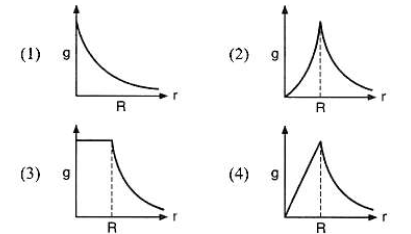
Answer(A)(4)
Explanation:
The acceleration due to gravity at a depth d below surface of the earth is,
$g^{\prime}=\frac{G M}{R^2}\left(1-\frac{d}{R}\right)=g\left(1-\frac{d}{R}\right)$
$g^{\prime}=0$ at $d = R$
i.e., acceleration due to gravity is zero at the centre of the earth.
Thus, the variation in the value of $g$ with $r$ is:
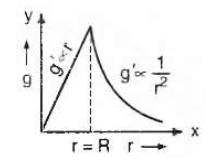
For $r>R$ :
$g^{\prime}=\frac{g}{\left(1+\frac{h}{R}\right)^2}=\frac{g R^2}{r^2}$
or $g^{\prime} \propto \frac{1}{r^2}$
Here, $R + h = r$
For $r < R : g^{\prime}=g\left(1-\frac{d}{R}\right)=\frac{g r}{R}$
Here, R - d = r
or $g^{\prime} \propto r$
Therefore, the variation of g with distance from centre of the earth will be as shown in the figure above. View full question & answer→MCQ 314 Marks
A rigid horizontal smooth rod AB of mass 0.75 kg and length 40 cm can rotate freely about a fixed vertical axis through its mid-point O. Two rings each of mass 1 kg initially at rest at a distance of 10 cm from O on either side of the rod. The rod is set in rotation with an angular velocity of 30 radian per sec and when the rings reach the ends of the rod, the angular velocity (in rad/sec) is:
Answer(A)10
Explanation:
According to law of conservation of angular momentum,
$I_1 \omega_1=I_2 \omega_2$
$\left(\frac{M L^2}{12}+2 m d^2\right) \omega_1=\left[\frac{M L^2}{12}+2 m\left(\frac{L}{2}\right)^2\right] \omega_2$
or $\left[\frac{0.75 \times(0.4)^2}{12}+2 \times 1 \times(0.1)^2\right] 30=\left[\frac{0.75 \times(0.4)^2}{12}+2 \times 1 \times(0.2)^2\right] \omega_2$
Solving it, we get; $\omega_2=10 rad / sec$
View full question & answer→MCQ 324 Marks
A cylinder of mass 10 kg is rolling on a rough plane with a velocity of 10 m/s. If the coefficient of friction between the surface and cylinder is 0.5, then before stopping, it will cover a distance of: (Take g = 10 m/s2)
Answer(C)10 m
Explanation:
$S =\frac{ u ^2}{2 \mu g}=\frac{10^2}{2 \times 0.5 \times 10}=10 m$
View full question & answer→MCQ 334 Marks
The working principle of rocket propulsion is conservation of:
Answer(A)linear momentum
Explanation:
A rocket propulsion is based on the conservation of linear momentum.
View full question & answer→MCQ 344 Marks
A force $\overrightarrow{ F }=3 \hat{ i }+2 \hat{ j }+a \hat{k}$ acting on a particle causes a displacement $\vec{s}=\hat{i}+\hat{j}-2 \hat{k}$ in its own direction. If the work done is 11 J, then the value of a will be
- A
0 along positive z direction
- B
1 along negative z direction
- C
3 along positive z direction
- ✓
-3 along the negative z-direction
AnswerCorrect option: D. -3 along the negative z-direction
(D)-3 along the negative z-direction
Explanation:
$W =\overrightarrow{ F } \cdot \overrightarrow{ s }=(3 \hat{i}+2 \hat{j}+a \hat{k}) \cdot(\hat{i}+\hat{j}-2 \hat{k})$
$\therefore 11=3+2-2 a$
$\Rightarrow a =-3$ i.e., along negative z direction.
View full question & answer→MCQ 354 Marks
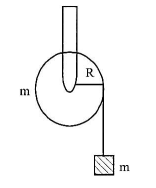
A mass
m is supported by a massless string wound around a uniform hollow cylinder of mass m and radius R. If the string does not slip on the cylinder, with what acceleration will the mass fall or release?
- A
$\frac{5 g}{2}$
- B
- C
$\frac{2 g}{3}$
- ✓
$\frac{g}{2}$
AnswerCorrect option: D. $\frac{g}{2}$
(D)$\frac{g}{2}$
Explanation:
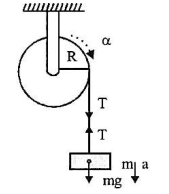
From figure,
Acceleration $a=R \alpha \ldots$ (i)
and mg - T =ma...(ii)
From equation (i) and (ii)
$T \times R = mR ^2 \alpha=m R^2\left(\frac{a}{R}\right)$
or T = ma
$\Rightarrow mg - ma = ma$
$\Rightarrow a=\frac{g}{2}$ View full question & answer→MCQ 364 Marks
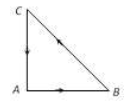
Three forces start acting simultaneously on a particle moving with velocity $\vec{v}_{.}$ These forces are represented in magnitude and direction by the three sides of a triangle ABC (as shown). The particle will now move with velocity
- A
less than $\vec{v}_{.}$
- B
$|\vec{v}|$, in the direction of the largest force BC
- C
greater than $\vec{v}$
- ✓
$\vec{v}$ , remaining unchanged
AnswerCorrect option: D. $\vec{v}$ , remaining unchanged
(D)$\vec{v}$, remaining unchanged
Explanation:
Net force on the particle is zero so the $\vec{v}$ remains unchanged.
View full question & answer→MCQ 374 Marks
The time taken by an object to slide down $45^{\circ}$ rough inclined plane is n times as it takes to slide down a perfectly smooth $45^{\circ}$incline plane. The coefficient of kinetic friction between the object and the incline plane is
- ✓
$1-\frac{1}{n^2}$
- B
$\sqrt{\frac{1}{1-n^2}}$
- C
$\sqrt{1-\frac{1}{n^2}}$
- D
$1+\frac{1}{ n ^2}$
AnswerCorrect option: A. $1-\frac{1}{n^2}$
(A)$1-\frac{1}{n^2}$
Explanation:
Let a1 be the acceleration when it slide down smooth incline plane.
Then, a1 $= g \sin \theta=\frac{g}{\sqrt{2}}$
Let a2 be the acceleration when it slide down rough inclined plane
Then, a2 $=g \sin \theta-\mu_{ k } g \cos \theta=\frac{ g }{\sqrt{2}}-\frac{\mu_{ k } g}{\sqrt{2}}$
Let t1 be the time taken when it slide down smooth surface
and t2 be the time taken when it slide down rough surface.
$t _2= nt _1 \frac{1}{2} a _1 t _1^2=\frac{1}{2} a _2 t _2^2$
$\Rightarrow \frac{1}{2} \frac{g}{\sqrt{2}} t _1^2=\frac{1}{2}\left(\frac{g}{\sqrt{2}}-\frac{\mu_{ k } g }{\sqrt{2}}\right) n ^2 t _1^2 \Rightarrow \mu_k=1-\frac{1}{n^2}$
View full question & answer→MCQ 384 Marks
When a projectile is fired at an angle $\theta$ w.r.t. horizontal component ignoring air resistance:
i. remains same
ii. goes on increasing with height
iii. goes on decreasing with height
iv. first increases then decrease with height
Answer(C)only i
Explanation:
Because there is no acceleration or retardation along the horizontal direction, hence the horizontal component of velocity remains the same.
View full question & answer→MCQ 394 Marks
A cannon is adjusted at an angle to obtain a maximum range of 20 m with initial velocity 20 m/s. Minimum range of fire is obtained when the cannon is fired with an angle of $30^{\circ}$ with initial velocity 15 m/s. If bullets are fired from both the angles, the difference in the height attained will be
Answer(D)2.13 m
Explanation:
$H _{\max }=\frac{R_{\max }}{4}$
$\therefore H _1=\frac{20}{4}=5 m$
$H _2=\frac{\left(v_0 \sin \theta_0\right)^2}{2 g}=\frac{(15 \times \sin 30)^2}{2 \times 9.8}=2.87 m$
Difference in heights attained,
H1 - H2 = 5 - 2.87 = 2.13 m
View full question & answer→MCQ 404 Marks
A stone falls freely under gravity. It covers distances h1, h2 and h3 in the first 4 seconds, the next 4 seconds and the next 4 seconds respectively. The relation between h1, h2 and h3 is (g = 10m / s2)
Answer(B)h2= 3h1 and h3= 5h1
Explanation:
At point A, u = 0
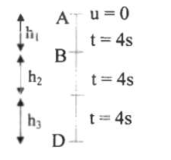
$\therefore h _1=\frac{1}{2} gt ^2=\frac{1}{2} \times 10 \times 16$
$\therefore h _1=80 m$
Now, v = u + gt = 0 + 10(4)
$\therefore v =40 m / s$
At point B, final velocity from A to B = initial velocity at B
$\therefore h _2= ut +\frac{1}{2} gt ^2=40 \times 4+\frac{1}{2} \times 10 \times 16$
= 240m
v = u + gt = 40 + 10(4)
$\therefore v =80 m / s$
Similarly, At point C,
h3 = 400m
$\therefore h _1: h _2: h _3=80: 240: 400=1: 3: 5$
i.e., h2 = 3h1 and h3 = 5h1 View full question & answer→MCQ 414 Marks
A body is thrown upwards with velocity 100 m/s and it travels 5 m in the last second of its upward journey. If the same body is thrown upward with velocity 200 m/s, what distance will it travel in the last second of an upward journey?
Answer(B)5 m
Explanation:
$s=u+\frac{a}{2}(2 n-1)$
$u =100 m / s , a =-10 m / s ^2, s=5 m$
$5=100-\frac{10}{2}(2 n-1)$ or $n =10$
Body thrown upwards with velocity 100 m/s takes 10 sec to reach the highest point. So body thrown upwards with velocity of 200 m/s will take 20 sec to reach the highest point. Hence, distance travelled in 20th sec,
$s=200-\frac{10}{2}(20 \times 2-1)$
$=200-5 \times 39=200-195=5 m$
[Note: Bodies travel the same distance in the last second of their upward journey irrespective of their velocities.]
View full question & answer→MCQ 424 Marks
A ball is dropped on the floor from a height of 10 m. It rebounds to a height of 2.5 m. If the ball is in contact with the floor for 0.01 sec, the average acceleration during contact is:
AnswerCorrect option: B. $2100 \frac{m}{ sec ^2}$ upwards
(B)$2100 \frac{m}{\sec ^2}$ upwards
Explanation:
The velocity at time the ball strikes the floor,
$u =\sqrt{2 gh _1}$
$=\sqrt{2 \times 9.8 \times 2.5}$
$=7 m / s$
Hence, change in velocity:
$\Delta v=7-(-14)$
$=21 m / s$
Acceleration $=\frac{\Delta v}{\Delta t }$
$=\frac{21}{0.01}$
$=2100 m / s ^2$, upwards
View full question & answer→MCQ 434 Marks
The period of oscillation of a simple pendulum in the experiment is recorded as 2.63 s, 2.56 s, 2.42 s, 2.71 s and 2.80 s respectively. The average absolute error is:
Answer(C)0.11 s
Explanation:
As we know that,
Average value $=\frac{2.63+2.56+2.42+2.71+2.80}{5}$
$\overline{ a }_{ n }=2.62 s$
$\left|\Delta T_1\right|=|2.63-2.62|=0.01$
$\left|\Delta T_2\right|=|2.62-2.56|=0.06$
$\left|\Delta T_3\right|=|2.62-2.42|=0.20$
$\left|\Delta T_4\right|=|2.71-2.62|=0.09$
$\left|\Delta T_5\right|=|2.80-2.62|=0.18$
$|\Delta T|=\frac{\left|T_1\right|+\left|T_2\right|+\left|T_3\right|+\left|T_4\right|+\left|T_5\right|}{5}$
$=\frac{0.54}{5}$
$=0.108 \approx 0.11 s$
View full question & answer→MCQ 444 Marks
A wire has a mass $0.3 \pm 0.003 g$., radius $0.5 \pm 0.005$ mm and length $6 \pm 0.06 cm$. The maximum percentage error in the measurement of density is:
Answer(A)4
Explanation:
Since, $\rho=\frac{m}{\pi r^2 l}$
$\therefore\left(\frac{\Delta \rho}{\rho}\right) \times 100=\left(\frac{\Delta m}{m}+\frac{2 \Delta r}{r}+\frac{\Delta L}{L}\right) \times 100$
$=\left(\frac{0.003}{0.3}+2 \times \frac{0.005}{0.5}+\frac{0.06}{6}\right) \times 100$
$=(0.01+0.02+0.01) \times 100=4$
View full question & answer→MCQ 454 Marks
The SI unit of pole strength is:
Answer(D)Am
Explanation:
$[ m ]=\frac{[M]}{2 l}=\frac{ Am ^2}{m}= A - m.$
View full question & answer→