Questions

SECTION - A [BOTANY - MCQ]

Take a timed test

45 questions · 11 auto-graded MCQ + 34 self-marked written.
MCQ 14 Marks
The process of growth is determined by:
  • Increase in size and dry weight
  • B
    Increase in weight only
  • C
    Increase in dry weight
  • D
    Increase in size
Answer
Correct option: A.
Increase in size and dry weight
A
View full question & answer
MCQ 24 Marks
In which of the following steps of Glycolysis a water molecule is released?
  • A
    2-Phosphoenol pyruvate $\longrightarrow$ Pyruvic acid
  • B
    2-Phosphoglycerate $\longrightarrow$ Phosphoenol pyruvate
  • C
    Fructose-6-phosphate $\longrightarrow$ Fructose 1, 6-diphosphate
  • D
    2-Phosphoglycerate $\longrightarrow$ Phosphoenol pyruvate
Answer
D. 2-Phosphoglycerate $\longrightarrow$ Phosphoenol pyruvate
Explanation:
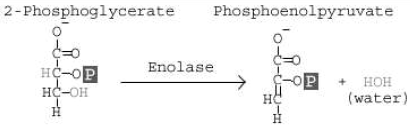
During the formation of phosphoenol pyruvate (PEP) from 2-phosphoglycerate, a water molecule is eliminated. This reaction is catalysed by the enzyme enolase. This is a step of glycolysis. This reaction takes place in the cytoplasm.
Image
View full question & answer
MCQ 34 Marks
The conversion of PGA into glyceraldehyde 3-phosphate occurs during
  • A
    regeneration
  • B
    photorespiration
  • C
    carboxylation
  • D
    reduction
Answer
D. reduction
Explanation:
During reduction stage of Calvin cycle, a glucose molecule is formed through a series of reactions. Each molecule of 3PGA is phosphorylated using ATP and 1, 3-bisphosphoglyceric acid is formed. Each molecule of 1,3-bisphosphoglyceric acid is converted into glyceraldehyde 3-phosphate (G3P) using NADPH. Glyceraldehyde 3-phosphate is converted into one molecule of glucose through a series of reactions that are reversal of glycolysis. So, this is also called glycolytic reversal.
View full question & answer
MCQ 44 Marks
$\text{NADPH} _2$ is generated through ____________ pigment systems:
  • A
    Magnesium
  • Both Photosystem-I and Photosystem-II
  • C
    Photosystem-I
  • D
    Photosystem-II
Answer
Correct option: B.
Both Photosystem-I and Photosystem-II
B
View full question & answer
MCQ 54 Marks
Given below are two reactions $( P$ and Q $)$ representing photosynthesis in organisms - A and B respectively.
Reaction P : $CO _2+2 H _2 O \longrightarrow\left[ CH _2 O \right]+ H _2 O + O _2$
Reaction Q : $CO _2+2 H _2 S \longrightarrow\left[ CH _2 O \right]+ H _2 O +2 S$
Select the statement that can be concluded about these organisms.
a. Organism A performs anoxygenic photosynthesis whereas organism $B$ performs oxygenic photosynthesis.
b. Organism A could be a cyanobacterium and organism B could be a plant.
c. Organism A could be a plant and organism B could be a photosynthetic bacterium.
d. Both (a) and (c)
  • A
    Statement (c) is correct.
  • B
    Statement (a) is correct.
  • C
    Statement (d) is correct.
  • D
    Statement (b) is correct.
Answer
A. Statement (c) is correct.
Explanation:
Since oxygen is evolved in reaction P, the equation represents oxygenic photosynthesis which occurs in green plants and cyanobacteria whereas no oxygen is evolved as per equation Q, this is anoxygenic photosynthesis which occurs in photosynthetic bacteria which do not use water an electron donor and forms sulphur instead of oxygen.
View full question & answer
MCQ 64 Marks
Chemiosmotic theory of ATP synthesis in the chloroplasts and mitochondria is based on:
  • A
    Membrane potential
  • B
    Proton gradient
  • C
    Accumulation of K ions
  • D
    Accumulation of Na ions
Answer
B. Proton gradient
Explanation:
According to the chemiosmosis theory of ATP generation. The ATP is generated utilizing the electrochemical gradient generated due to the accumulation of protons in the thylakoid lumen of chloroplast or peri-mitochondrial space in mitochondria. The accumulation of protons gives rise to an electric gradient, due to the accumulation of positive charge and a chemical gradient due to the accumulation of hydrogen atom. When protons move along this electrochemical gradient through $F _0- F _1$ ATP synthase enzyme complex, ATP generation occurs.
View full question & answer
MCQ 74 Marks
In plant cell cytokinesis occurs by:
  • A
    Both Cell furrow formation and Cell plate formation
  • B
    Cytokinesis not occurs after karyokinesis
  • C
    Cell plate formation
  • D
    Cell furrow formation
Answer
C. Cell plate formation
Explanation:
Cytokinesis occurs by a special mechanism in higher-plant cells in which the cytoplasm is partitioned by the construction of a new cell wall, the cell plate, inside the cell. The position of the cell plate is determined by the position of a preprophase band of microtubules and actin filaments.
View full question & answer
MCQ 84 Marks
The centriole, which had undergone duplication during S-phase of interphase, begins to move towards opposite poles of the cell in which phase?
  • A
    Metaphase
  • B
    Anaphase
  • C
    Prophase
  • D
    Telophase
Answer
C. Prophase
Explanation:
Prophase is the first phase of mitosis, the process that separates the duplicated genetic material carried in the nucleus of a parent cell into two identical daughter cells. In prophase condensation of chromosomal material (Chromosomes form), centriole begins to move towards opposite poles of the cell, Initiation of the assembly of the mitotic spindle, the microtubules.
View full question & answer
MCQ 94 Marks
Cryopreservation of gametes of threatened species in viable and fertile condition can be referred to as:
  • A
    In situ conservation of biodiversity
  • B
    Advanced ex-situ conservation of biodiversity
  • C
    In situ cryo-conservation of biodiversity
  • D
    In situ conservation by sacred groves
Answer
B. Advanced ex-situ conservation of biodiversity
Explanation:
Cryopreservation is an advanced method of ex situ conservation. It involves preservation at $-196^{\circ} C$ in liquid nitrogen. It can maintain tissue culture, embryos, animal cells tissues, spermatozoa indefinitely. The cryopreserved material is revived through special technique, when required.
View full question & answer
MCQ 104 Marks
Match the column and select correct option for animal and area where it find?
Column I (Animals)Column II (Country)
 (A) Dodo (i) Africa
 (B) Quagga (ii) Russia
 (C) Thylacine (iii) Mauritius
 (D) Steller's sea cow (iv) Australia
 (E) Passenger pigeon (v) North America
  • (A)-(iii); (B)-(i); (C)-(iv); (D)-(ii); (E)-(v)
  • B
    (A)-(ii); (B)-(i); (C)-(iv); (D)-(v); (E)-(iii)
  • C
    (A)-(i); (B) - (iv); (C)-(iii); (D)-(ii); (E)-(v)
  • D
    (A)-(iii); (B)-(ii); (C)-(iv); (D)-(i); (E)-(v)
Answer
Correct option: A.
(A)-(iii); (B)-(i); (C)-(iv); (D)-(ii); (E)-(v)
A
View full question & answer
MCQ 124 Marks
Which one of the following plant is commonly used as green manure?
  • A
    Acacia nilotica
  • B
    Dalbergia sissoo
  • C
    Cassia fistula
  • D
    Crotalaria juncea
Answer
D. Crotalaria juncea
Explanation:
Green manure is an organic substance that increases the fertility of the soil. Crotalaria juncea is grown into and ploughed to a soil that decomposes and increases the fertility.
View full question & answer
MCQ 134 Marks
Secondary sewage treatment is mainly a:
  • A
    Chemical process
  • B
    Physical process
  • C
    Biological process
  • D
    Mechanical process
Answer
C. Biological process
Explanation:
Secondary sewage treatment is mainly biological process.
View full question & answer
MCQ 144 Marks
Maximum biomass and variable organism are found in:
  • Pond
  • B
    River
  • C
    Lake
  • D
    Estuary
Answer
Correct option: A.
Pond
A
View full question & answer
MCQ 154 Marks
Environmental resistance includes factor:
  • All of these
  • B
    Shortage of food
  • C
    Limited space
  • D
    Diseases and predation
Answer
Correct option: A.
All of these
A
View full question & answer
MCQ 164 Marks
At which of the following stages, the chromosomes appear single, thin and thread like?
  • A
    Pachytene
  • B
    Zygotene
  • C
    Leptotene
  • D
    Diplotene
Answer
C. Leptotene
Explanation:
Leptotene also known as leptonema is the first stage of prophase I during which individual chromosomes begin to condense into long strands within the nucleus which are loosely interwoven. However, the two sister chromatids are still so tightly bound that they are indistinguishable from one another. They possess a string of swollen areas called chromomeres.
View full question & answer
MCQ 174 Marks
Which one of the following statements is correct?
a. Benign tumours show the property of metastasis.
b. Heroin accelerates body functions.
c. Malignant tumours may exhibit metastasis.
d. Patients who have undergone surgery are given cannabinoids to relieve pain.
  • A
    Benign tumours show the property of metastasis.
  • B
    Heroin accelerates body functions.
  • C
    Patients who have undergone surgery are given cannabinoids to relieve pain.
  • D
    Malignant tumours may exhibit metastasis.
Answer
D. Malignant tumours may exhibit metastasis.
Explanation:
Tumouris of two types: benign and malign.Malign or malignant tumour exhibits metastasis.It is the phenomenon in which cancer cells spread to distant sites through body fluids to develop secondary tumour.
View full question & answer
MCQ 184 Marks
Marijuana is extracted from:
  • A
    Ergot fungus
  • B
    Papaver somniferum
  • C
    Dried leaves and flowers of Cannabis sativa
  • D
    Cocoa plant
Answer
C. Dried leaves and flowers of Cannabis sativa
Explanation:
Dried leaves and flowers of Cannabis sativa
View full question & answer
MCQ 194 Marks
Necessary steps for achieving good health are
i. awareness about diseases.
ii. vaccination.
iii. proper disposal of wastes.
iv. maintenance of hygienic food and water resources.
v. water resources.
The correct combination having necessary steps are
  • A
    (i), (ii) and (iii)
  • B
    (i), (ii), (iii) and (iv)
  • C
    (ii), (iii) and (iv)
  • D
    (i), (iii) and (iv)
Answer
B. (i), (ii), (iii) and (iv)
Explanation:
Good health is maintained by balanced diet, personal hygiene, regular exercise, awareness about disease, vaccination against infectious diseases, proper disposal of wastes, control of vectors and maintenance of hygienic food and water resources.
View full question & answer
MCQ 204 Marks
Short lived immunity acquired from mother to foetus across the placenta or through mother's milk to the infant is categorised as:
  • A
    Innate non-specific immunity
  • B
    Cellular immunity
  • Passive immunity
  • D
    Active immunity
Answer
Correct option: C.
Passive immunity
C
View full question & answer
MCQ 214 Marks
Which of the following is a wrong statement about Golgi apparatus?
i. Camillo Golgi (1898) first observed densely stained reticular structures near the nucleus.
ii. The Golgi cisternae are concentrically arranged near the nucleus with distinct convex cis or the forming face and concave trans or the maturing face.
iii. The Golgi apparatus principally performs the function of packaging materials.
iv. Materials to be packaged in the form of vesicles from the ER fuse with the trans face of the Golgi apparatus and move towards the forming face.
v. A number of proteins synthesised by ribosomes on the endoplasmic reticulum are modified by Golgi apparatus.
vi. Golgi apparatus is the important site of formation of proteins and lipids.
  • (iv) and (vi)
  • B
    (i), (ii) and (v)
  • C
    (i), (iii) and (v)
  • D
    (iv), (v) and (vi)
Answer
Correct option: A.
(iv) and (vi)
A
View full question & answer
MCQ 224 Marks
Transmembrane protein present:
  • A
    Across the cell membrane
  • B
    In between the two layers of cell membrane
  • C
    On outer surface of cell membrane
  • D
    On inner surface of cell membrane
Answer
A. Across the cell membrane
Explanation:
Integral proteins that go through the membrane are called transmembrane proteins. They have hydrophobic regions within the interior of the membrane and hydrophilic regions at the outer membrane surface.
View full question & answer
MCQ 234 Marks
Which of the following is not related with mesosome?
  • A
    This structure also found in eukaryotes
  • B
    They also help in respiration, secretion processes, to increase the surface area of the plasma membrane and enzymatic content.
  • C
    It present in form of vesicles, tubules and lamellae
  • D
    They help in cell wall formation, DNA replication and distribution to daughter cells
Answer
A.This structure also found in eukaryotes
Explanation:
Mesosome which is formed by the extensions of the plasma membrane into the cell. These extensions are in the form of vesicles, tubules and lamellae. They help in cell wall formation, DNA replication and distribution to daughter cells. They also help in respiration, secretion processes, to increase the surface area of the plasma membrane and enzymatic content.
View full question & answer
MCQ 244 Marks
Removal of introns and joining of exons in a defined order during transcription is called:
  • A
    Slicing
  • B
    Splicing
  • C
    Looping
  • D
    Inducing
Answer
B. Splicing
Explanation:
Splicing is the removal of intervening sequences of introns and the joining of expressing sequences or exons in a specific order during transcription.
View full question & answer
MCQ 254 Marks
A complex of ribosomes attached to a single strand of RNA is known as
  • A
    Okazaki fragment.
  • B
    polypeptide.
  • C
    polymer.
  • D
    polysome.
Answer
D. polysome.
Explanation:
A polyribosome (or polysome) is a complex of an mRNA molecule and two or more ribosomes that act to translate mRNA instructions into polypeptides.
View full question & answer
MCQ 264 Marks
An abnormal human baby with XXX chromosomes was born due to:
  • A
    Fusion of two sperms and one ovum
  • B
    Formation of abnormal sperms in the father
  • C
    Fusion of two ova and one sperm
  • D
    Formation of abnormal ova in the mother
Answer
D.Formation of abnormal ova in the mother
Explanation:
The karyotype XXX represents that it is a female which results from the fusion of a sperm with X chromosome with an ovum with two X chromosomes. So, abnormal ova are produced in them
View full question & answer
MCQ 274 Marks
A colourblind man marries the daughter of a normal woman and a colourblind man. The ratio of carrier daughters, colourblind daughters, normal sons, and colourblind sons born to this couple will be:
  • $1: 1: 1: 1$
  • B
    $1: 2: 2: 1$
  • C
    $2: 1: 1: 2$
  • D
    $1: 0: 1: 0$
Answer
Correct option: A.
$1: 1: 1: 1$
A
View full question & answer
MCQ 284 Marks
The transverse section of a plant shows the following anatomical features:
i. A large number of scattered vascular bundles surrounded by bundle sheath
ii. Large conspicuous parenchymatous ground tissue.
iii. Vascular bundles are conjoint and closed.
iv. Phloem parenchyma absent.
Identify the category of plant and its part:
  • A
    Dicotyledonous stem
  • B
    Monocotyledonous root
  • C
    Dicotyledonous root
  • D
    Monocotyledonous stem
Answer
D. Monocotyledonous stem
Explanation:
Closed vascular bundles are scattered and surrounded by bundle sheath embedded in large parenchymatous ground tissue is characteristic of monocot stem. The vascular bundles are open, conjoint, and arranged in a ring with inconspicuous pith in the dicot stem. In roots, the vascular tissues are arranged radially.
View full question & answer
MCQ 294 Marks
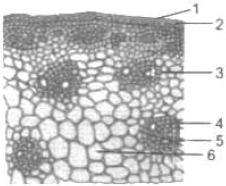
Identify the given diagram and choose the correct answer for labelled $1,2,3,4,5$, and 6 of the given diagram.
Image
  • A
    Dicot stem -1 - Epidermis, 2 - Hypodermis, 3 - Vascular bundles, 4 - Phloem, 5 - Xylem, 6 - Ground tissue
  • B
    Monocot stem-1-Epidermis, 2 - Hypodermis, 3 - Vascular bundles, 5 - Xylem, 4 - Phloem, 6 - Ground tissue
  • C
    Monocot stem-1-Epidermis, 2 - Hypodermis, 3 - Vascular bundles, 4 - Phloem, 5 - Xylem, 6 - Ground tissue
  • D
    Monocot leaf-1-Epidermis, 2 - Hypodermis, 3 - Vascular bundles, 4 - Phloem, 5 - Xylem, 6 - Ground tissue
Answer
C. Monocot stem - 1 - Epidermis, 2 - Hypodermis, 3 - Vascular bundles, 4 - Phloem, 5 - Xylem, 6 - Ground tissue
Explanation:
The diagram is of transverse section of a Monocot stem - 1 - Epidermis, 2 - Hypodermis, 3 - Vascular bundles, 4 - Phloem, 5 -Xylem, 6 - Ground tissue.
View full question & answer
MCQ 304 Marks
Select the wrong statement for placentation.
i. In Mustard and Argemone, the ovary is one-chambered but it becomes two-chambered due to the formation of the false septum.
ii. In Dianthus and Primrose, the placentation is called free central.
iii. In basal placentation, the placenta develops at the base of the ovary and many ovules are attached.
iv. In sunflower and marigold, basal placentation present.
v. In mustard and Argemone, free central placentation present.
  • A
    (i), (iii) and (v)
  • B
    (iii) and (v)
  • C
    (iii), (iv) and (v)
  • D
    (ii), (iv) and (v)
Answer
B. (iii) and (v)
Explanation:
(iii) and (v) statements are incorrect.
The corrected statements are given below:
• In basal placentation, the placenta develops at the base of the ovary and a single ovule is attached to it.
• In mustard and argemone, Parietal placentation is present.
View full question & answer
MCQ 314 Marks
Which of the following symbols denotes presence of tepals and epitepalous stamens in a flower?
  • A

    Image
  • B

    Image
  • C

    Image
  • D

    Image
Answer
C.
Image
Presence of tepals and epitepalous stamens in a flower can be denoted by
Image
View full question & answer
MCQ 324 Marks
8-nucleate embryo sac is:
  • A
    Tetrasporic
  • B
    Bisporic
  • C
    Monosporic
  • D
    All of these
Answer
D. All of these
Explanation:
On the basis of megaspores contributing to the development of embryo sac, a number of mitotic divisions occur in the functional megaspore. There are three types of embryo sacs:
i. Monosporic embryo sac: In this type of embryo sac, out of the four megaspores, one megaspore at the chalazal side takes part in the formation of the embryo sac. The nucleus divides three times to form 8 nuclei. This type is called the Polygonum type.
ii. Bisporic embryo sac: In this type of embryo sac, two megaspores take part in the formation of the embryo sac. The nucleus of two megaspores undergo two mitotic divisions and the resulting embryo sac is 8 nucleate.
iii. Tetrasporic embryo sac: In this type of embryo sac, all four megaspores take part in the formation of the embryo sac. All the four haploid nuclei remain in a common cytoplasm and forming a coenomegaspore. The final organization of the embryo sac is 8 -nucleate. Hence, the 8-nucleate embryo sac can be monosporic, bisporic, and tetrasporic.
View full question & answer
MCQ 334 Marks
Mature male gametophyte is made up of:
  • A
    One cell
  • B
    Four cell
  • Three cell
  • D
    Two cell
Answer
Correct option: C.
Three cell
C
View full question & answer
MCQ 344 Marks
Flagellated cells are absent in:
  • A
    Red algae
  • B
    Blue-green algae
  • C
    All of these
  • D
    Higher seed plants
Answer
C. All of these
Explanation:
A flagellum is a long, whip-like structure that helps some single-celled organisms move. It is composed of microtubules. They help propel cells and organisms in a whip-like motion. The flagellum of eukaryotes usually moves with an " S " motion and is surrounded by the cell membrane. Red algae, Blue-Green algae, and higher plants lack flagella in their cells.
View full question & answer
MCQ 354 Marks
Protonema stage develops from:
  • A
    Sporophytes
  • B
    Secondary protonema
  • C
    Directly from a spore
  • D
    Lateral bud
Answer
C. Directly from a spore
Explanation:
When a moss first grows from the spore, it starts as a germ tube which lengthens and branches into a filamentous complex known as a protonema, which develops into a leafy gametophore, the adult form of a gametophyte in bryophytes. Moss spores germinate to form an algae-like filamentous structure called the protonema.
View full question & answer
MCQ 364 Marks
Which one of the following pairs is wrongly matched?
  • A
    Virioids-RNA
  • B
    Mustard-Synergids
  • C
    Ginkgo-Archegonia
  • D
    Salvinia-Prothallus
Answer
D. Salvinia-Prothallus
Explanation:
Prothallus is the gametophyte in most of the pteridophytes in which both male and female sex organs called antheridia and archegonia are present. But salvinia is heterosporous and produces male and female gametes on different plant so it do not possess prothallus.
View full question & answer
MCQ 374 Marks
Select one of the following of important features distinguising Gnetum from Cycas and Pinus and showing:
  • A
    Absence of resin duct and leaf venation
  • B
    Presence of vessel elements and absence of archegonia
  • C
    Perianth and two integuments
  • D
    Embryo development and apical meristem
Answer
B. Presence of vessel elements and absence of archegonia
Explanation:
Members of order Gnetales posses vessels and show absence of archegonia.
View full question & answer
MCQ 384 Marks
Pollination in lotus is carried out by:
  • A
    Both Water and Insects
  • Insects
  • C
    Wind
  • D
    Water
Answer
Correct option: B.
Insects
B
View full question & answer
MCQ 394 Marks
The cell which develops into endosperm, results from the fusion of
  • A
    two male gametes and the egg.
  • B
    two male gametes and two polar nuclei.
  • C
    one male gamete and two polar nuclei.
  • D
    a male gamete and the egg.
Answer
C. one male gamete and two polar nuclei.
Explanation:
Endosperm develops from primary endosperm cell (PEC) which is formed from the fusion of two polar nuclei of the central cell with a male gamete.
View full question & answer
MCQ 404 Marks
In angiosperm, archesporium gives rise to:
  • A
    Wall of anther
  • B
    Wall of sporangium
  • C
    Both wall of sporangium and sporogenous cells
  • D
    Tapetum and sporogenous cells
Answer
C. Both wall of sporangium and sporogenous cells
Explanation:
Both wall of sporangium and sporogenous cells
View full question & answer
MCQ 414 Marks
Aristotle classified plants into:
  • A
    Trees, shrubs, and herbs
  • B
    Shrubs only
  • C
    Trees only
  • D
    herbs only
Answer
A.Trees, shrubs, and herbs
Explanation:
Aristotle classified plants on the basis of their morphological characters into trees, shrubs, and herbs.
View full question & answer
MCQ 424 Marks
Bacteria reproduce mainly by:
  • A
    Spores
  • B
    Recombination
  • C
    Conjugation
  • D
    Fission
Answer
D. Fission
Explanation:
Bacteria increase their cell number or individuals mainly by binary fission. Rest of the processes are mostly used during unfavourable conditions.
View full question & answer
MCQ 434 Marks
Which of the following is correct for Mangifera indica Linn?
  • A
    This species was first described by Linnaeus
  • B
    Name of mango was not changed by Linnaeus
  • C
    Name of mango was changed by Linnaeus
  • D
    This species was not first described by Linnaeus
Answer
A.This species was first described by Linnaeus
Explanation:
Mangifera indica Linn indicates that this species was first described by Linnaeus as in binomial nomenclature, the name of author appears after the species name. This method of mentioning the author's name is called a citation.
View full question & answer
MCQ 444 Marks
Circulation of blood was discovered by :
  • A
    William Harvey
  • B
    Bose
  • C
    Karl Landsteiner
  • D
    Watson and Crick
Answer
A. William Harvey
Explanation:
William Harvey discovered of the circulation of the blood.
View full question & answer
MCQ 454 Marks
Mango is grouped in which Order?
  • A
    Indica
  • B
    Mangifera
  • C
    Anacardiaceae
  • D
    Sapindales
Answer
D. Sapindales
Explanation:
Mango is included in Order Sapindales.
View full question & answer