Questions

SECTION - A [ZOOLOGY - MCQ]

Take a timed test

45 questions · 12 auto-graded MCQ + 33 self-marked written.

MCQ 14 Marks
Choose the correct option regarding retrovirus:
  • A
    A dsRNA virus
  • B
    A DNA virus that can synthesise RNA during infection
  • C
    An RNA virus that can synthesise DNA during infection
  • D
    A ssDNA virus
Answer
C. An RNA virus that can synthesise DNA during infection
Explanation:
A retrovirus is RNA virus which is capable to synthesize DNA during infection.
View full question & answer
MCQ 24 Marks
The two polypeptides of human insulin are linked together by:
  • A
    Hydrogen bonds
  • B
    Covalent bond
  • C
    Phosphodiester bond
  • D
    Disulphide bridges
Answer
D. Disulphide bridges
Explanation:
Human insulin is made up of 51 amino acids arranged in two polypeptide chains. Chain A has 21 amino acids and chain B has 30 amino acids. The two polypeptide chains are interconnected by disulphide bridges or S - S - linkages.
View full question & answer
MCQ 34 Marks
Match Column I with Column II and select the correct answer from the given codes.
Column IColumn II
A. Transformation(i) Sequences cut by restriction enzymes
B. Recognition site(ii) Process by which DNA fragments are separated based on their size
C. Gel electrophoresis(iii) Plasmid DNA that has incorporated human DNA
D. Recombinant DNA(iv) Process by which bacteria take up pieces of DNA from the environment
  • A
    A - (iii), B - (ii), C - (i), D - (iv)
  • B
    A - (iv), B - (i), C - (ii), D - (iii)
  • C
    A - (i), B - (iv), C - (ii), D - (iii)
  • D
    A - (iii), B - (i), C - (ii), D - (iv)
Answer
B. A - (iv), B - (i), C - (ii), D - (iii)
Explanation:
Transformation is a procedure through which a piece of DNA is introduced in a host bacterium, the DNA fragments resulting from digestion of DNA by restriction endonucleases can be separated by a technique known as gel electrophoresis, each restriction endonuclease recognises a specific palindromic nucleotide sequence in the DNA called recognition site, and recombinant DNA is composed of DNA from two different sources or organisms.
View full question & answer
MCQ 44 Marks
Which of the following steps are catalysed by Taq polymerase in a PCR reaction?
  • A
    All of these
  • B
    Denaturation of template DNA
  • C
    Annealing of primers to template DNA
  • Extension of primer end on the template DNA
Answer
Correct option: D.
Extension of primer end on the template DNA
D
View full question & answer
MCQ 54 Marks
During heat shock to the bacterium, the temperature used for giving thermal shock is:
  • A
    $100^{\circ} \text{C}$
  • B
    $-196^{\circ} \text{C}$
  • C
    $82^{\circ} \text{C}$
  • D
    $42^{\circ} \text{C}$
Answer
D. $42^{\circ} \text{C}$
Explanation:
Recombinant DNA can be forced into competent cells by incubating the cells with recombinant DNA on ice, followed by placing them briefly at $42^{\circ} \text{C}$ (heat shock), and then putting them back on ice.
View full question & answer
MCQ 64 Marks
Select incorrect statement.
  • A
    Lymph = (Plasma - Plasma proteins) + Few lymphocytes.
  • B
    Plasma = Blood - (RBCs + WBCs + Platelets).
  • C
    Lymphocytes = Formed elements - (RBC + Thrombocytes + Monocytes + Granulocytes).
  • Serum = Blood - Plasma proteins.
Answer
Correct option: D.
Serum = Blood - Plasma proteins.
D
View full question & answer
MCQ 74 Marks
Right atrium or auricle in mammalian heart receives blood from
  • A
    Precavals and postcavals
  • B
    Sinus venosus
  • C
    Pulmonary veins
  • D
    Precavals
Answer
A. Precavals and postcavals
Explanation:
The superior and inferior vena cavas (pre and post caval) are the great veins which empty blood in the right auricle.
Superior Vena Cava is the veins of the head, neck, upper extremities, and chest all drain into the superior vena cava, which goes to the heart. It is formed by the union of the right and left brachiocephalic veins, which drain the head, neck, and upper extremities. The azygos vein drains the veins of the chest wall and empties into the superior vena cava just before the latter empties into the heart.
Inferior Vena Cava is much longer than the superior vena cava and returns the blood from the parts of the body below the diaphragm. It begins in the lower abdomen with the union of the two common iliac veins. It then ascends along the back wall of the abdomen, through a groove in the posterior part of the liver, through the diaphragm, and finally through the lower thorax to empty into the right atrium of the heart.
View full question & answer
MCQ 84 Marks
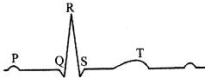
Given below is the ECG of a normal human. Which one of its components is correctly interpreted below?
Image
  • A
    Peak P and Peak R together - systolic and diastolic blood pressures
  • B
    Peak P - Initiation of left atrial contraction only
  • C
    Peak T - Initiation of total cardiac contraction
  • D
    Complex QRS - One complete pulse
Answer
D. Complex QRS - One complete pulse
Explanation:
The QRS complex shows one complete pulse. It represents the depolarisation of the ventricles, which initiates the ventricular contraction. The contraction starts shortly after Q and marks the beginning of the systole.
View full question & answer
MCQ 94 Marks
Which is gastrointestinal hormone?
  • A
    Cholecystokinin
  • B
    GIP
  • C
    Secretin
  • All of these
Answer
Correct option: D.
All of these
D
View full question & answer
MCQ 104 Marks
Growth hormone of pituitary is more effective in
  • A
    absence of thyroxine.
  • B
    presence of thyroxine.
  • C
    absence of insulin.
  • D
    presence of adrenaline.
Answer
B. presence of thyroxine.
Explanation:
Growth hormone of pituitary is more effective in presence of thyroxine hormone.
View full question & answer
MCQ 114 Marks
When a person suffers from a marked fall in blood pressure, it is helpful to administer to him the following hormone:
  • Adrenaline
  • B
    GH
  • C
    Oxytocin
  • D
    Thyroxine
Answer
Correct option: A.
Adrenaline
A
View full question & answer
MCQ 124 Marks
Saltatory conduction occurs in:
  • A
    Both Non-myelinated fibres and Myelinated fibres
  • Myelinated fibres
  • C
    Non-myelinated fibres
  • D
    None of them
Answer
Correct option: B.
Myelinated fibres
B
View full question & answer
MCQ 134 Marks
Broca's area is located in:
  • A
    Ventral part of temporal lobe
  • B
    Dorsal part of optic lobe
  • C
    Lateral part of frontal lobe
  • D
    forward part of temporal lobe
Answer
C. Lateral part of frontal lobe
Explanation:
Broca's area is located in a region called the inferior frontal gyrus, found in the frontal lobe.
View full question & answer
MCQ 144 Marks
The part of the brain, which has posterior choroid plexus:
  • A
    Cerebrum
  • B
    Posterior brain
  • C
    Diencephalon
  • D
    Medulla
Answer
D. Medulla
Explanation:
The choroid plexus is located in the posterior medullary velum which partially forms the roof of the fourth ventricle.
View full question & answer
MCQ 154 Marks
Match the pairs of the human being listed under Column I with the functions given under Column II; choose the choice which gives the correct combination of the alphabets of the two columns:
Column IColumn II
(A) Cerebral hemisphere(p) Relaying impulses
(B) Thalamus(q) Posture and balance
(C) Cerebellum(r) Control of heart, stomach, lungs, etc.
(D) Medulla oblongata(s) Reflex actions
(t) Voluntary control, intelligence, hearing, speech, etc
  • A
    (A) - (r), (B) - (s), (C) - (q), (D) - (t)
  • B
    (A) - (t), (B) - (q), (C) - (p), (D) - (r)
  • C
    (A) - (r), (B) - (q), (C) - (p), (D) - (s)
  • (A) - (t), (B) - (P), (C) - (q), (D) - (r)
Answer
Correct option: D.
(A) - (t), (B) - (P), (C) - (q), (D) - (r)
D
View full question & answer
MCQ 164 Marks
The junction between a motor neuron and the sarcolemma of the muscle fibre is called:
  • A
    Motor-end plate
  • B
    Neuromuscular junction
  • C
    Motor unit
  • D
    All of these
Answer
B. Neuromuscular junction
Explanation:
The junction between a motor neuron and the sarcolemma of a muscle fiber is called a neuromuscular junction.
View full question & answer
MCQ 174 Marks
In $X$ disorder, abnormal genes (mutations) interfere with the production of proteins needed to form healthy muscle. Identify X and its common cause.
  • A
    Both Muscular dystrophy, lack of a protein called dystrophin and Osteoporosis, increased levels of estrogen.
  • B
    Muscular dystrophy, lack of a protein called dystrophin.
  • C
    Osteoporosis, increased levels of estrogen.
  • D
    Myasthenia gravis, increased levels of estrogen.
Answer
B. Muscular dystrophy, lack of a protein called dystrophin.
Explanation:
Muscular dystrophy (MD) is a group of muscle diseases that results in increasing weakening and breakdown of skeletal muscles over time. This damage and weakness is due to the lack of a protein called dystrophin, which is necessary for normal muscle function. The absence of this protein can cause problems with walking, swallowing, and muscle coordination. The disorders differ in which muscles are primarily affected, the degree of weakness, how fast they worsen, how and when symptoms begin.
View full question & answer
MCQ 184 Marks
The number of bones in the human body is:
  • A
    203
  • B
    306
  • C
    206
  • D
    260
Answer
C. 206
Explanation:
Every single person has a skeleton made up of many bones. These bones give your body structure, let you move in many ways, protect your internal organs, and more. It's time to look at all your bones the adult human body has $2 0 6$ of them.
View full question & answer
MCQ 194 Marks
The glomerular filtrate possesses:
  • A
    Plasma minus cells
  • B
    Blood minus cells proteins
  • Blood minus cells minus proteins
  • D
    Blood minus proteins
Answer
Correct option: C.
Blood minus cells minus proteins
C
View full question & answer
MCQ 204 Marks
Excretory organ of crustaceans are:
  • A
    Nephridia
  • B
    Protonephridia
  • C
    Green gland
  • D
    Malpighian tubules
Answer
C. Green gland
Explanation:
Green gland are the excretory organ of crustaceans.
View full question & answer
MCQ 214 Marks
Trimethylamine is the excretory product in:
  • A
    Molluscs
  • B
    Freshwater fishes
  • C
    Amphibious
  • D
    Marine teleost
Answer
D. Marine teleost
Explanation:
Certain marine molluscs, crustaceans, and teleost fishes first form trimethylamine from their ammonia by a process known as methylation. Then, the trimethylamine is oxidized to trimethylamine oxide for excretion. This oxide is soluble in water, but non-toxic.
View full question & answer
MCQ 224 Marks
A condition in which body's internal environment remains relatively constant with limits is called:
  • A
    Haemopoiesis
  • Homeostasis
  • C
    Hematoma
  • D
    Hemostatis
Answer
Correct option: B.
Homeostasis
B
View full question & answer
MCQ 234 Marks
Which of the following is the vestigial organs of man?
  • A
    Caudal vertebrae, wisdom teeth and patella
  • Caudal vertebrae, vermiform appendix and ear muscles
  • C
    Hair, cochlea and vermiform appendix
  • D
    Hair, atlas and ear muscles
Answer
Correct option: B.
Caudal vertebrae, vermiform appendix and ear muscles
B
View full question & answer
MCQ 244 Marks
Which evidence of evolution is related to Darwin's finches?
  • A
    Evidences from comparative anatomy.
  • B
    Evidences from palaeontology.
  • C
    Evidences from biogeographical distribution.
  • D
    Evidences from embryology.
Answer
C. Evidences from biogeographical distribution.
Explanation:
Galapagos Islands are a chain of 14 islands in the Pacific Ocean on the west coast of South America. Charles Darwin visited these islands during his famous voyage on HMS Beagle (name of his ship) in 1835. The flora and fauna of these islands resemble with those of the South American mainland with which the Galapagos Islands were once connected. However, Darwin's finches (birds of Galapagos Islands) influenced Darwin to think about the evolutionary change. These birds designated as Darwins' finches by Dr. David Lack (1947) do not resemble the birds of the South American species. These finches were the first to reach the Galapagos Islands as migrants from the mainland (South America). When they reached the islands, they faced many problems for obtaining food. They had to change their feeding habits.
View full question & answer
MCQ 254 Marks
Select the odd one out.
AIDS, Genital herpes, Hepatitis-B, Gonorrhoea
  • A
    Genital herpes
  • B
    Gonorrhoea
  • C
    AIDS
  • D
    Hepatitis-B
Answer
B. Gonorrhoea
Explanation:
Gonorrhoea is a sexually transmitted disease caused by a bacterium whereas AIDS, hepatitis-B, and genital herpes are caused by viruses.
View full question & answer
MCQ 264 Marks
Consider the statements given below regarding contraceptive methods.
i. The chances of conception are generally nil until mother breast - feeds the infant up to 2 years.
ii. Intra uterine devices like copper-Tare effective contraceptives.
iii. Contraception pills may be taken up to 1 week after coitus to prevent conception.
Select the option with correct statements.
  • A
    (i) and (iii)
  • B
    (ii) and (iii)
  • C
    Only (ii)
  • D
    (i) and (ii)
Answer
C. Only (ii)
Explanation:
Intra uterine devices like copper-Tare effective contraceptives.
View full question & answer
MCQ 274 Marks
Test tube babies are given birth by the woman who is unable to:
  • A
    Fertilize, implant and develop the embryo
  • Complete the process of fertilization in the uterus
  • C
    Implant and develop the embryo in the uterus
  • D
    Develop the embryo upto 32 - cells stage after fertilization
Answer
Correct option: B.
Complete the process of fertilization in the uterus
B
View full question & answer
MCQ 284 Marks
The seminal plasma is rich in
  • A
    fructose and certain enzymes but it has low calcium.
  • B
    fructose, calcium, and certain enzymes.
  • C
    glucose and certain enzymes but it has no calcium.
  • D
    fructose and calcium but it has no enzymes.
Answer
B. fructose, calcium, and certain enzymes.
Explanation:
Secretions of male accessory glands such as seminal vesicles, prostate, and bulbourethral glands constitute the seminal plasma which is rich in fructose, calcium, and certain enzymes.
View full question & answer
MCQ 294 Marks
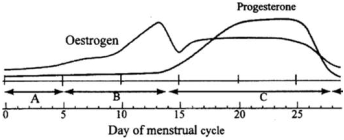
Read the graph and correlate the uterine events that takes place according to the hormonal levels during the phases of menstrual cycle labelled as $A , B$, and C.
Image
  • A
    A - Degeneration of endometrium, B - Regeneration of endometrium, C - Endometrium thickness increases and becomes vascularised to receive and implant embryo
  • B
    A - Degeneration of endometrium, B - Myometrium thickens, and becomes vascularised to receive and implant embryo, C - Degeneration of endometrium
  • C
    A - Degeneration of endometrium, B - Myometrium thickens, and becomes vascularised to receive and implant embryo, C - Regeneration of endometrium
  • D
    A - Degeneration of endometrium, B - Endometrium thickness increases and becomes vascularised to receive and implant embryo, C - Regeneration of endometrium
Answer
A. A - Degeneration of endometrium, B - Regeneration of endometrium, C - Endometrium thickness increases and becomes vascularised to receive and implant embryo
Explanation:
During menstrual phase (A), endometrium degenerates. The menstrual phase is followed by the follicular phase (B). During this phase, oestrogen made by the maturing ovarian follicle causes the glands to grow and the endometrium regenerates. Follicular phase is followed by luteal phase during which corpus luteum secretes large amounts of progesterone which is essential for maintenance of the endometrium.
View full question & answer
MCQ 304 Marks
Ovulation occurs on the __________ day of menstrual cycle.
  • A
    $12-14 \text{th}$
  • B
    $14-16 \text{th}$
  • C
    $9-13 \text{th}$
  • D
    $8-10\text{th}$
Answer
A. $12-14\text{th}$
Explanation:
Both LH and FSH attain a peak level in the middle of cycle (about fourteenth day). Rapid secretion of LH leading to its maximum level during the mid-cycle called LH surge induces rupture of Graafian follicle and thereby the release of ovum (ovulation).
View full question & answer
MCQ 314 Marks
The fimbriae of fallopian tubes help in
  • A
    development of ovary
  • B
    fertilisation
  • C
    collection of the ovum after ovulation
  • D
    development of ova
Answer
C. collection of the ovum after ovulation
Explanation:
The edges of the infundibulum possess finger-like projections called fimbriae, which help in collection of the ovum after ovulation.
View full question & answer
MCQ 324 Marks
Given below are few respiratory disorders. Identify occupational respiratory disorders amongst these.
i. Coryza
ii. SARS
iii. Silicosis
iv. Asbestosis
v. Emphysema
  • A
    (i) and (ii)
  • B
    (i) and (v)
  • C
    (iii) and (iv)
  • D
    (i), (ii), and (v)
Answer
C. (iii) and (iv)
Explanation:
Silicosis and asbestosis are known as occupational disorders as they occur due to one's occupation. Workers working in industries where silica and asbestos are used can suffer from these respiratory disorders.
View full question & answer
MCQ 334 Marks
Which of following statements is not true?
a. The partial pressure of oxygen in deoxygenated blood is 40 mm Hg.
b. The partial pressure of oxygen in oxygenated blood is 95 mm Hg.
c. The partial pressure of oxygen in alveolar air is 104 mm Hg.
d. The partial pressure of $CO _2$ in the alveolar air is 40 mm Hg.
  • A
    Statement (c) is not true.
  • B
    Statement (a) is not true.
  • C
    Statement (b) is not true.
  • D
    Statement (d) is not true.
Answer
D. Statement (d) is not true.
Explanation:
The partial pressure of $CO _2$ in deoxygenated blood is 40 mm of Hg .
View full question & answer
MCQ 344 Marks
Which of the following activity is more difficult during bronchial asthma?
  • Expiration
  • B
    Transportation of oxygen
  • C
    Forced inspiration
  • D
    Inspiration
Answer
Correct option: A.
Expiration
A
View full question & answer
MCQ 354 Marks
Approximate volume of air a healthy man can expire or inspire per minute is:
  • A
    $6000-8000 \text{ mL}$
  • B
    $7000-9000 \text{ mL}$
  • C
    $6000-7000 \text{ mL}$
  • D
    $5000-6000 \text{ mL}$
Answer
A. $6000-8000 \text{ mL}$
Explanation:
Approximate volume of air a healthy man can expire or inspire per minute is $6000-8000$ mL .
View full question & answer
MCQ 364 Marks
Residual air is present in:
  • A
    Trachea and Bronchi and bronchioles
  • B
    Lungs
  • C
    Bronchi and bronchioles
  • D
    Trachea
Answer
B. Lungs
Explanation:
Residual volume (RV) is the volume of air remaining in the lungs after maximum forceful expiration. In other words, it is the volume of air that cannot be expelled, thus causing the alveoli to remain open at all times. The residual volume remains unchanged regardless of the lung volume at which expiration was started.
View full question & answer
MCQ 374 Marks
Which of the following changes usually tends to occur in plain dwellers when they move to the high altitudes?
1. Increased breathing rate.
2. Increased RBC production.
3. Increased WBC Production.
4. Increased thrombocyte count.
Choose the correct option.
  • A
    (i) and (ii)
  • B
    (i) and (iii)
  • C
    (i) and (iv)
  • D
    (iii) and (iv)
Answer
A. (i) and (ii)
Explanation:
When a person moves to higher altitudes, $PO _2$ and total atmospheric pressure decrease. Hypoxia stimulates the juxta-glomerular cells of the kidney to release erythropoietin hormone, which stimulates erythropoiesis in the bone marrow, causing polycythemia. Hypoxia increases the breathing rate and number of RBC.
View full question & answer
MCQ 384 Marks
The type of epithelial cells which line the inner surface of fallopian tubes, bronchioles and small bronchi are known as
  • A
    Columnar epithelium
  • B
    Cubical epithelium
  • C
    Squamous epithelium
  • Ciliated epithelium
Answer
Correct option: D.
Ciliated epithelium
D
View full question & answer
MCQ 394 Marks
Tendon is made up of:
  • A
    Elastic connective tissue fibers
  • B
    Dense fibrous connective tissue
  • C
    Collagen fibers
  • D
    Elastic and inelastic connective tissue
Answer
B. Dense fibrous connective tissue
Explanation:
A tendon is composed of dense fibrous connective tissue made up primarily of collagenous fibres.
View full question & answer
MCQ 404 Marks
Match the figures in column II with characters given in column I and choose correct option :
Image
  • A
    (A) - (i), (vii), (viii); (B) - (ii),(vi), (ix); (C) - (iii), (iv), (v)
  • B
    (A) - (iii), (iv), (v); (B) - (ii),(vii), (ix); (C) - (i), (vi), (viii)
  • C
    (A) - (ii), (vii), (ix) ;(B) - (i), (vi), (viii) ;(C) - (iii), (iv), (v)
  • D
    (A) - (i), (vi), (viii); (B) - (ii),(vii), (ix); (C) - (iii), (iv), (v)
Answer
D. (A) - (i), (vi), (viii); (B) - (ii), (vii), (ix); (C) - (iii), (iv), (v)
Explanation:
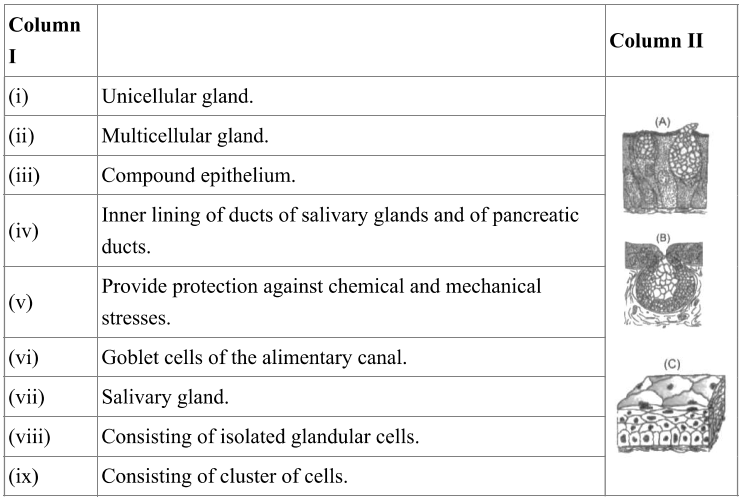
Image A is a unicellular gland consisting of isolated glandular cells or goblet cells of the alimentary canal.
Image B is a multicellular gland consisting of a cluster of cells such as the salivary gland.
Image C represents a compound epithelium made of more than one layer (multi-layered) of cells. Their main function is to provide protection against chemical and mechanical stresses. They cover the dry surface of the skin, the moist surface of the buccal cavity, pharynx, the inner lining of ducts of salivary glands, and of pancreatic ducts.
Hence, the correct match is (A) - (i), (vi), (viii); (B) - (ii), (vii), (ix); (C) - (iii), (iv), (v).
View full question & answer
MCQ 414 Marks
Which of the following is/are included in Cnidarians?
  • A
    All of these
  • B
    Aurelia
  • C
    Obelia
  • D
    Hydra
Answer
A. All of these
Explanation:
Obelia, Aurelia, and Hydra are aquatic, sessile, or free-swimming, radially symmetrical animals belonging to phylum Cnidaria, and hence all are cnidarians.
View full question & answer
MCQ 424 Marks
Which one of the following statements is totally wrong about the occurrence of notochord while the other three are correct?
  • A
    It is present only in larval tail in Ascidians
  • B
    It is replaced by a vertebral column in adult frog
  • C
    It is present throughout life in Amphioxus
  • D
    It is absent throughout life in humans from the very beginning
Answer
D. It is absent throughout life in humans from the very beginning
Explanation:
Humans are vertebrates belonging to Class Mammals in which the notochord is replaced by a cartilaginous or bony vertebral column in the adult.
View full question & answer
MCQ 434 Marks
All vertebrates are chordates but all chordates are not vertebrates, why?
  • A
    Ventral hollow nerve cord remains throughout life in some chordates.
  • B
    Notochord is replaced by vertebral column in adult of some chordates.
  • C
    All chordates possess notochord throughout their life.
  • D
    All chordates possess vertebral column.
Answer
B. Notochord is replaced by vertebral column in adult of some chordates.
Explanation:
All chordates have a notochord but only in adult of some chordates or vertebrates, the notochord is replaced by a cartilaginous or bony vertebral column. So, all chordates are not vertebrates. All vertebrates are chordates as they have notochord during the embryonic stage.
View full question & answer
MCQ 444 Marks
Which of the following cell type is capable of giving rise to other cell types in sponges?
  • A
    Thesocytes
  • B
    Pinacocytes
  • C
    Collenocytes
  • D
    Archaeocytes
Answer
D. Archaeocytes
Explanation:
Archaeocytes may be converted into other types of cells and are also called as undifferentiated totipotent cells.
View full question & answer
MCQ 454 Marks
Which one of the following pairs of animals comprises jawless fishes?
  • A
    Lampreys and hagfishes
  • B
    Lampreys and eels
  • C
    Mackerals and Rohu
  • D
    Guppies and hagfishes
Answer
A. Lampreys and hagfishes
Explanation:
Lamprey and, Hagfish are Cyclostomes which are jawless fishes.
View full question & answer