Questions

SECTION - A [BOTANY - MCQ]

Take a timed test

45 questions · self-marked practice — reveal the answer and mark yourself.

MCQ 14 Marks
Identify the correct and incorrect statements from the following.
i. 17,500 new cells are produced per hour by a single maize root apical meristem.
ii. With the help of length, growth of pollen tube is measured.
iii. The growth of the leaf is measured in term of volume.
iv. Cells in a watermelon may increase in size by up to 3,50,000 times.
  • A
    (i), (ii), (iii) are correct and (iv) is incorrect.
  • B
    (ii), (iii) are correct and (i), (iv) are incorrect.
  • C
    (i), (ii), (iv) are correct and (iii) is incorrect.
  • D
    (i), (iv) are correct and (ii), (iii) are incorrect.
Answer
C. (i), (ii), (iv) are correct and (iii) is incorrect.
Explanation:
The growth of the leaf is measured in term of surface area.
View full question & answer
MCQ 24 Marks
Cellular respiration
  • A
    converts kinetic energy to potential energy
  • B
    converts energy stored in the chemical bonds of glucose to an energy that the cell can use
  • C
    converts energy stored in the chemical bonds of proteins to an energy that the cell can use.
  • D
    converts potential energy to kinetic energy.
Answer
B. converts energy stored in the chemical bonds of glucose to an energy that the cell can use
Explanation:
The main purpose of cellular respiration is to get energy that is utilised for functioning various purposes. Energy from chemical bonds of glucose is transferred to ATP molecules.
View full question & answer
MCQ 34 Marks
Granal chloroplasts are found in
  • A
    bundle sheath cells of C4 plants
  • B
    mesophyll cells of C4 plants.
  • C
    bundle sheath cells of C3 plants
  • D
    both bundle sheath and mesophyll cells of C4 plants.
Answer
B. mesophyll cells of C4 plants.
Explanation:
Chloroplasts in the mesophyll cells of C4 plants are granal and in bundle sheath cells are agranal. So, chloroplasts are dimorphic.
View full question & answer
MCQ 44 Marks
$CO _2$ acceptor in $C _3$ plants is:
  • A
    3-phosphoglyceric acid
  • B
    Xylulose-5-phosphate
  • C
    Ribulose-1, 5-diphosphate
  • D
    Phosphoenol pyruvic acid
Answer
C. Ribulose-1, 5-diphosphate
Explanation:
Ribulose-1, 5-diphosphate
View full question & answer
MCQ 54 Marks
Photorespiration involves
  • A
    mitochondria and peroxisome
  • B
    chloroplasts, peroxisome and mitochondria
  • C
    chloroplasts, cytoplasm, and mitochondria
  • D
    chloroplast and mitochondria
Answer
B. chloroplasts, peroxisome and mitochondria
Explanation:
Photorespiration involves a series of reactions which occur in three organelles - chloroplast, peroxisome and mitochondrion.
View full question & answer
MCQ 64 Marks
First stable product of Calvin cycle has:
  • A
    3 carbon atoms
  • B
    6 carbon atoms
  • C
    2 carbon atoms
  • D
    4 carbon atoms
Answer
A. 3 carbon atoms
Explanation:
3 carbon atoms
View full question & answer
MCQ 74 Marks
Which of the following stages of meiosis involves division of centromere?
  • A
    Anaphase II
  • B
    Metaphase II
  • C
    Metaphase I
  • D
    Telophase II
Answer
A. Anaphase II
Explanation:
Meiosis ensures the production of the haploid phase in the life cycle. It involves two sequential cycles of nuclear division called meiosis I and meiosis II.
In meiosis II, during anaphase II, sister chromatids are held together with centromere. During this phase, the splitting of the centromere of each chromosome takes place. It allows moving chromosomes towards the opposite poles.
View full question & answer
MCQ 84 Marks
To observe chiasmata, the most appropriate stage of meiosis would be:
  • A
    Diplotene
  • B
    Diakinesis
  • C
    Metaphase - II
  • D
    Pachytene
Answer
A. Diplotene
Explanation:
Chiasmata is observed in meiosis during diplotene, sub-stage of Prophase-I of meiosis I. It is the result of crossing over. Each chiasma is the site of genetic crossing over between chromosomes that have paired up (i.e . between bivalents. It is produced by breakage and reunion between any two of the four strands present at each site.
View full question & answer
MCQ 94 Marks
Animals and plants are best protected in
  • A
    zoos
  • B
    national parks
  • C
    sanctuaries
  • D
    botanical gardens
Answer
B. national parks
Explanation:
National Park is a protected area, which is strictly reserved for the welfare of the wildlife and where activities like forestry, grazing and cultivation are not permitted. Their boundaries are well marked and circumscribed. In national parks, the emphasis is on the preservation of a single plant or animal species.
View full question & answer
MCQ 104 Marks
Which one of the following statement is correct for botanical garden?
  • A
    They allow ex-situ conservation of germ plasm.
  • B
    They provide a beautiful area for recreation.
  • C
    One can observe tropical plants there.
  • D
    They provide the natural habitat for wildlife.
Answer
A. They allow ex-situ conservation of germ plasm.
Explanation:
A botanical garden is a place where plants are grown and revealed for the purposes of research and education and allows ex situ conservation for germ plasm. Botanical gardens distinguish them from other parks and gardens where plants, with beautiful flowers, are grown for public convenience. Botanical gardens specialize in trees are referred to as arboreta.
View full question & answer
MCQ 114 Marks
Match the column and select correct option for sacred groves and area where it find?
Column I (sacred groves)Column II (State)
(A) Khasi and Jaintia Hills(i) Meghalaya
(B) Aravalli Hills(ii) Madhya Pradesh
(C) Western Ghat regions(iii) Karnataka and Maharashtra
(D) Sarguja, Chanda and Bastar areas(iv) Rajasthan
  • A
    (A)-(i); (B)-(iv); (C)-(iii); (D)-(ii)
  • B
    (A)-(iii); (B)-(ii); (C)-(i); (D)-(iv)
  • C
    (A)-(i); (B)-(ii); (C)-(iii); (D)-(iv)
  • D
    (A)-(ii); (B)-(i); (C)-(iv); (D)-(iii)
Answer
A. (A)-(i); (B)-(iv); (C)-(iii); (D)-(ii)
Explanation:
(A)-(i); (B)-(iv); (C)-(iii); (D)-(ii)
View full question & answer
MCQ 124 Marks
Which of the following statements regarding antibiotics is not correct?
i. Antibiotics are the attenuated microorganisms which in small concentration can kill or retard the growth of other harmful microorganisms.
ii. Penicillin was the first antibiotic discovered by Alexander Fleming (1928) while working on bacterium Staphylococcus aureus.
iii. The full potential of penicillin as an effective antibiotic was established by Ernest Chain and Howard Florey.
iv. Fleming, Chain and Florey were awarded the Nobel Prize in 1945.
  • A
    (iii) only
  • B
    (i), (iii) and (iv)
  • C
    (ii) and (iv)
  • D
    (i) only
Answer
D. (i) only
Explanation:
Antibiotics are chemical substances secreted by certain microbes which inhibit the growth and development of other microbes. Most of them are produced by actinomycetes (specially the genus Streptomyces) and filamentous fungi. Some important antibiotics are: tetracycline, chloramphenicol, streptomycin, etc.
View full question & answer
MCQ 134 Marks
Which of the following organism derives energy for $N_2$ fixation by performing photosynthesis?
  • A
    Rhizobium
  • B
    Anabaena
  • C
    Bacillus
  • D
    Azotobacter
Answer
B. Anabaena
Explanation:
Anabaena
View full question & answer
MCQ 144 Marks
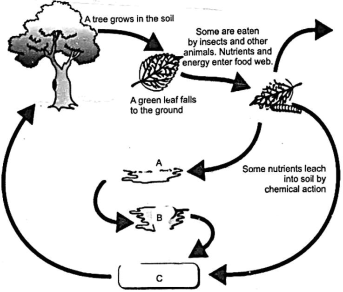
Given figure is a diagrammatic representation of decomposition cycle in a terrestrial ecosystem, which of the following option is correct about $A , B$, and C ?
Image
  • A
    A-decomposition by fungus and bacteria; B-organic rich soil; C-decomposition by fungus and earthworm.
  • B
    A-decomposition by earthworm; B-decomposition by fungus and bacteria; C-organic rich soil.
  • C
    A-organic rich soil; B-decomposition by fungus and earthworm; C-decomposition by fungus and bacteria.
  • D
    A-decomposition by fungus and bacteria; B-decomposition by fungus and earthworm; C-organic rich soil.
Answer
D.  A-decomposition by fungus and bacteria; B-decomposition by fungus and earthworm; C-organic rich soil.
Explanation:
A-decomposition by fungus and bacteria; B-decomposition by fungus and earthworm; Corganic rich soil.
View full question & answer
MCQ 154 Marks
In a growing population of country:
  • A
    Pre-reproductive individuals are less than the reproductive individuals.
  • B
    Reproductive and pre-reproductive individuals are equal in number.
  • C
    Reproductive individuals are less the post-reproductive individuals.
  • D
    Pre-reproductive individuals are more then the reproductive individuals.
Answer
D. Pre-reproductive individuals are more then the reproductive individuals.
Explanation:
In a growing population the younger population size is large than the reproductive group.
View full question & answer
MCQ 164 Marks
Which of the following statements are true?
i. Some cells in the adult animals do not appear to exhibit division.
ii. Many cells of animals divide only occasionally.
iii. These cells that do not divide further exit $G _1$ - phase to enter an inactive stage called $G _0$.
iv. Cells in quiescent stage remain metabolically active but no longer proliferate unle called on to do so.
v. In animals, mitotic cell division is only seen in the haploid somatic cells.
vi. Plants can show mitotic divisions in both haploid and diploid cells.
  • A
    (i), (ii), (iv) and (v)
  • B
    (i), (ii), (iii), (v) and (vi)
  • C
    (i), (ii) and (iii)
  • D
    All except (v)
Answer
D. All except (v)
Explanation:
In animals, mitotic cell division is only seen in the diploid somatic cells whereas plant shows the mitotic division in both haploid and diploid cells.
View full question & answer
MCQ 174 Marks
Which form of tumour remains confined to their original location and do not spread to other parts of the body?
  • A
    Benign tumour
  • B
    Both Malignant tumour and Benign tumour
  • C
    Malignant tumour
  • D
    Leukaemia
Answer
A. Benign tumour
Explanation:
A benign tumour is a mass of cells (tumour) that lacks the ability to invade neighbouring tissue or metastasize. These do not spread into, or invade, nearby tissues; however, they can sometimes be quite large. Common examples of benign tumours include moles and uterine fibroids.
View full question & answer
MCQ 184 Marks
A person smokes many cigarettes daily. It may lead into:
  • A
    Throat cancer, oral cancer, syphilis, dysentery
  • B
    Bronchitis, oral cancer, CAD, anaemia, increased $O _2$ level in blood
  • C
    Throat cancer, urinary bladder cancer, hepatitis, gastric ulcer
  • D
    Throat cancer, lung cancer, high b.p., emphysema, gastric ulcer
Answer
D. Throat cancer, lung cancer, high b.p., emphysema, gastric ulcer
Explanation:
Throat cancer, lung cancer, high b.p., emphysema, gastric ulcer
View full question & answer
MCQ 194 Marks
Salmonella typhi causes:
  • A
    All of these
  • B
    Enlargement of spleen and pain in stomach
  • C
    An acute infection of intestine that causes high fever and weakness
  • D
    Rose coloured rashes on the body
Answer
A.  All of these
Explanation:
The primary lymphoid organs are bone marrow and thymus where immature lymphocytes differentiate into antigen-sensitive lymphocytes. After maturation, the lymphocytes migrate to secondary lymphoid organs like the spleen, lymph nodes, tonsils, Peyer's patches of the small intestine and appendix. The secondary lymphoid organs provide the sites for interaction of lymphocytes with the antigen, which then proliferate to become effector cells. There is lymphoid tissue also located within the lining of the major tracts (respiratory, digestive, and urogenital tracts) called mucosa-associated lymphoid tissue (MALT). It constitutes about 50 percent of the lymphoid tissue in the human body.
View full question & answer
MCQ 214 Marks
Identify the condition, related to cell which is very active in the synthesis and secretion of proteins.
  • A
    Equal amount of RER and SER
  • B
    More SER than RER
  • C
    More RER than SER
  • D
    More Golgi bodies and no ER
Answer
C. More RER than SER
Explanation:
The RER offers extensive surface on which protein synthesis can be conveniently carried on by ribosomes. The proteins formed on ribosomes pass into the ER lumen where they are modified. Then the modified proteins move into the transitional area, where the ER buds off membranous sacs, the transport vesicles, carrying the proteins to the Golgi apparatus. Here, they are further processed and packaged into secretory vesicles for export by exocytosis at the plasma membrane.
View full question & answer
MCQ 224 Marks
A scientist wanted to genetically engineer a new type of corn plant that could withstand cold temperatures. He decided to try to change the composition of the plant's membrane to lower the temperature of phase transition. Which of the following membrane changes might be expected to improve the cold tolerance of the plants?
  • A
    Increasing the length of the fatty acyl chains.
  • B
    Decreasing the frequency of unsaturated fatty acyl chains.
  • C
    Eliminating all the steroids.
  • D
    Increasing the frequency of unsaturated fatty acyl chains.
Answer
D. Increasing the frequency of unsaturated fatty acyl chains.
Explanation:
The temperature dependence of biological membrane is affected by the lipid composition of the membrane. Low temperatures can cause a membrane to enter a gel-like phase with very high membrane-lipid viscosity, whereas high temperatures can cause a membrane to become 'hyper fluid' with very little viscosity. The greater the proportion of unsaturated carbon - carbon bonds (double-bonds) in a lipid's fatty acid molecules, the easier solidification of it occurs, in cold temperature and thus the lesser the changes in plants membrane at lower temperature.
View full question & answer
MCQ 234 Marks
Select the mismatch:
a. Gas vacuoles - Green bacteria
b. Large central vacuoles - Animal cells
c. Protists - Eukaryotes
d. Methanogens - Prokaryotes
  • A
    Option (d) is mismatch
  • B
    Option (a) is mismatch
  • C
    Option (b) is mismatch
  • D
    Option (c) is mismatch
Answer
C. Option (b) is mismatch
Explanation:
Large central vacuoles are characteristics of plant cells.
View full question & answer
MCQ 244 Marks
Which of the following is not produced by E.coli in the lactose?
  • A
    Transacetylase
  • B
    Lactose permease
  • C
    Lactose dehydrogenase
  • D
    Beta-galactosidase
Answer
C. Lactose dehydrogenase
Explanation:
Lactose dehydrogenase
View full question & answer
MCQ 254 Marks
Genetic code is called degenerative:
  • A
    One type of mRNA synthesizes many types of enzymes
  • B
    Amino acid can be coded by more than one codon
  • C
    One tRNA recognizes one amino acid
  • D
    Amino acid codes for different codons
Answer
B. Amino acid can be coded by more than one codon
Explanation:
Amino acid can be coded by more than one codon
View full question & answer
MCQ 264 Marks
Colour blindnesses due to:
  • A
    Dominant male chromosome
  • B
    Recessive male chromosome
  • C
    Recessive female chromosome
  • D
    Dominant female chromosome
Answer
C. Recessive female chromosome
Explanation:
Recessive female chromosome
View full question & answer
MCQ 274 Marks
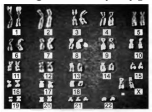
The given karyotype represents:
Image
  • A
    Down's syndrome
  • B
    Klinefelter's syndrome
  • C
    Turner's syndrome
  • D
    Normal man
Answer
A.  Down's syndrome
Explanation:
Down's syndrome
View full question & answer
MCQ 284 Marks
Anatomically old dicotyledonous root is distinguished from the dicotyledonous stem by:
  • A
    Presence of cortex
  • B
    Absence of secondary phloem
  • C
    Absence of secondary xylem
  • D
    Position of protoxylem
Answer
D.  Position of protoxylem
Explanation:
In dicot root the protoxylem is located near the periphery of the vascular cylinder, the metaxylem farther inward i.e., exarch or centripetal. In dicot stem the protoxylem is located near the centre of vascular bundle and metaxylem is located near the periphery i.e., endarch or centrifugal.
View full question & answer
MCQ 294 Marks
In Barley stem, vascular bundles are:
  • A
    Closed and radial
  • B
    Open and scattered
  • C
    Open and in a ring
  • D
    Closed and scattered
Answer
D. Closed and scattered
Explanation:
The vascular bundles in Hordeum vulgare (barley) plant are scattered in ground tissues, many in number, and vary in size-smaller towards the periphery and bigger towards the centre of the ground tissue, oval or rounded in outline, conjoint, collateral, and closed.
View full question & answer
MCQ 304 Marks
Which structure becomes green flashy and photosynthetic in Australian Acacia?
  • A
    Rachis
  • B
    Petiole
  • C
    All of these
  • D
    Lamina
Answer
B. Petiole
Explanation:
In some plants such as Australian acacia, the leaves are small and short-lived. The petioles in these plants expand, become green, and synthesise food.
View full question & answer
MCQ 314 Marks
Whorled type phyllotaxy found in:
  • A
    Alstonia
  • B
    Mustard
  • C
    Calotropis
  • D
    China rose
Answer
A. Alstonia
Explanation:
Plants with whorled phyllotaxy have three or more leaves arising from the node. It is found in Alstonia.
View full question & answer
MCQ 324 Marks
Select the structure which exhibits a fascinating array of patterns and designs.
  • A
    Anther wall
  • B
    Exine of pollen grain
  • C
    Intine of pollen grain
  • D
    Synergids of embryo sac
Answer
B. Exine of pollen grain
Explanation:
The exine exhibits a fascinating array of patterns and designs.
View full question & answer
MCQ 334 Marks
Progeny produced as a result of cross-pollination:
  • A
    Genetically inferior
  • B
    Is homozygous with phenotypic uniformity
  • C
    Shows a high degree of variability and is evolutionary important
  • D
    Genetically abnormal
Answer
C. Shows a high degree of variability and is evolutionary important
Explanation:
Cross-pollination is the transfer of pollen from the anthers of one flower to the stigma of another flower with the help of pollinating agents like wind, insects, etc. Cross-pollination leads to genetic variabilities because of the more chances of mixing of characters and thus, phenotypes and genotypes. Hence, it enriches the gene pool.
View full question & answer
MCQ 344 Marks
$I _2$ is obtained from:
  • A
    Brown algae
  • B
    Red algae
  • C
    green algae
  • D
    Blue-green algae
Answer
A. Brown algae
Explanation:
Iodine is obtained from the members of Brown algae. Brown algae are also known as ribbon seaweeds. They accumulate iodine by obtaining iodide ions from the seawater.
View full question & answer
MCQ 354 Marks
Which of the following statements is incorrect?
i. Genes expressed as RNA
ii. Polypeptide expression
iii. DNA polymorphism
iv. Novel DNA sequences
  • A
    Option (iii)
  • B
    Option (ii)
  • C
    Option (i)
  • D
    Option (iv)
Answer
D. Option (iv)
Explanation:
Option(iv)
View full question & answer
MCQ 364 Marks
The plant body of moss (Funaria) is
  • A
    Predominantly sporophyte with gametophyte
  • B
    Completely sporophyte gametophyte
  • C
    Completely gametophyte
  • D
    Predominantly gametophyte with sporophyte
Answer
D. Predominantly gametophyte with sporophyte
Explanation:
Funaria is a bryophyte. In bryophyte, the main plant body is gametophytic in nature. Embryo formed by fertilization grows into a sporophyte. The sporophyte is dependent on gametophyte. It produces haploid meiospores which germinate to produce a gametophyte.
View full question & answer
MCQ 374 Marks
Leaves bear sporangia called:
  • A
    Macrophylls
  • B
    All of these
  • C
    Microphylls
  • D
    Sporophylls
Answer
D. Sporophylls
Explanation:
The sporophytes bear sporangia that are subtended by leaf-like appendages called sporophylls. In some cases, sporophylls may form distinct compact structures called strobili or cones.
View full question & answer
MCQ 384 Marks
The type of pollination which brings genetically different pollen grains to the stigma is
  • A
    xenogamy
  • B
    Both geitonogamy and autogamy
  • C
    autogamy
  • D
    geitonogamy
Answer
A. xenogamy
Explanation:
Xenogamy is the transfer of pollen grains from anther to the stigma of a different plant. This is the only type of pollination which brings genetically different pollen grains to the stigma.
View full question & answer
MCQ 394 Marks
Match the structures given in column I with their ploidy levels given in column II and select the correct option.
Column I(Structures)Column II(Ploidy)
(A) Megaspore(i) 2 n
(B) Microspore mother cell(ii) ( n + n )
(C) Central cell(iii) n
(D) Antipodal cell 
  • A
    A-(i), B-(i), C-(ii), D-(iii)
  • B
    A-(i), B-(i), C-(ii), D-(iii)
  • C
    A-(iii), B-(i), C-(ii), D-(iii)
  • D
    A-(ii), B-(i), C-(iii), D-(i)
Answer
C. A-(iii), B-(i), C-(ii), D-(iii)
Explanation:
Megaspore and antipodal are haploid cells, central cell has two haploid polar nuclei, and megaspore mother cell is diploid.
View full question & answer
MCQ 404 Marks
Ruminate endosperm is present in:
  • A
    Coconut
  • B
    Myristica (jaiphel)
  • C
    Tradescantia
  • D
    Walnut
Answer
B. Myristica (jaiphel)
Explanation:
Myristica(jaiphel)
View full question & answer
MCQ 414 Marks
Match the entities in Column I with their character in Column II.
Column IColumn II
(A) Plante(i) Reproduce only by asexual spores
(B) Deuteromycetes(ii) Alternation of generation
(C) Basidiomycetes(iii) Conidia
(D) Ascomycetes(iv) Asexual spores are generally not found
(e) Phycomycetes(v) Aseptate and coenocytic
  • A
    (a)-(ii), (b)-(i), (c)-(iii), (d)-(iv),(e)-(v)
  • B
    (a)-(iv), (b)-(ii), (c)-(iii), (d)-(i),(e)-(v)
  • C
    (a)-(iii), (b)-(v), (c)-(i), (d)-(iv), (e)-(ii)
  • D
    (a)-(ii), (b)-(i), (c)-(iv), (d)-(iii),(e)-(v)
Answer
D. (a)-(ii), (b)-(i), (c)-(iv), (d)-(iii),(e)-(v)
Explanation:
• Plants commonly show alteration of generation.
• In Deuteromycetes, only asexual or vegetative mode of reproduction is found that is why they are known as imperfect fungi.
• Basidiomycetes do not reproduce asexually however vegetative reproduction, commonly, occurs by fragmentation.
• Ascomycetes reproduce asexually by conidia formation.
• In Phycomycetes mycelium is aseptate and coenocytic.
View full question & answer
MCQ 424 Marks
Which statement is correct for bacterial transduction?
  • A
    Transfer of some genes from one bacteria to another bacteria through virus
  • B
    Transfer of genes from one bacteria to another bacteria by conjugation
  • C
    Bacteria obtained DNA from other external source
  • D
    Bacteria obtained its DNA directly
Answer
A. Transfer of some genes from one bacteria to another bacteria through virus 
Explanation:
Transduction is the process by which foreign DNA is introduced into a cell by a virus or viral vector. When the DNA is transferred from one bacterium to another with the help of a virus or viral vector-like bacteriophage it is known as bacterial transduction.
View full question & answer
MCQ 434 Marks
In taxonomic hierarchy family comes between
  • A
    class and order.
  • B
    division and class.
  • C
    genus and species.
  • D
    order and genus.
Answer
D. order and genus
Explanation:
Taxonomic hierarchy is the arrangement of various taxa. Carl Linnaeus developed a hierarchical system for organising living organisms in which highest rank was given to kingdom, followed subsequently by phylum, class, order, family, genus, and species. Species was Linnaeus's least inclusive level of classification and includes all organisms of similar morphologies that can interbreed and produce viable offspring. According to the given hierarchical system, family comes between order and genus.
View full question & answer
MCQ 444 Marks
Match the entities in Column I with their mode of reproduction in Column II.
Column IColumn II
(A) Planaria(i) Binary fission
(B) Fungi(ii) Asexual spores
(C) Yeast(iii) Budding
(D) Amoeba(iv) True regeneration
  • A
    (A) - (i), (B) - (ii), (C) - (iii), (D) - (iv)
  • B
    (A) - (iv), (B) - (ii), (C) - (i), (D) - (iii)
  • C
    (A) - (ii), (B) - (iii), (C) - (i), (D) - (iv)
  • D
    (A) - (iv), (B) - (ii), (C) - (iii), (D) - (i)
Answer
D.(A) - (iv), (B) - (ii), (C) - (iii), (D) - (i)
Explanation:
(A) - (iv), (B) - (ii), (C) - (iii), (D) - (i)
View full question & answer
MCQ 454 Marks
Which of the following genera placed in the family Solanaceae?
  • A
    Petunia
  • B
    All of these
  • C
    Datura
  • D
    Solanum
Answer
B. All of these
Explanation:
Solanum, Petunia and Datura are placed in the family Solanaceae which are based on both vegetative and reproductive features of plant species.
View full question & answer