Questions

5 Marks Each

🎯

Test yourself on this topic

39 questions · timed · auto-graded

Question 15 Marks
Give your views on the positive and negative effects of globalization on the Indian economy.
Answer
Positive effects of globalization:
  • Large scale production
  • Increased competition leads to greater consumer protection
  • Consumers get improvised, technically upgraded product at an economical price
  • Opportunities of employment generation
  • Consumers will be able to use quality products and service at a low price
  • Speedier generation of infrastructural facilities in the country
  • Increased importance of education has led to increase in spread of education
  • Easier to set up new industries
  • The whole world is becoming a global village
  • Freedom from political bureaucracy and red tapism.
Negative effects of globalization:
  • Arrangement for market set-up becomes difficult and costly
  • Rise in the production of luxurious goods and services at the cost of necessities
  • New problems arises because of the change in human mentality
  • Rise in inequalities of income and wealth distribution
  • Spread of economic situation of one country or continent to other countries quickly
  • Competition is at the cost of ethical values
  • Larger units get more profit and small scale units experience difficulty to survive
  • When the spread of education is relatively lesser than the spread of development, the competitive ability of employees become weak
  • Multinational companies show more loyalty to their home country rather than – to the host country
  • Internationally renowned companies influence the monetary policy of the country which is suitable to them by collaborating with the political parties.
View full question & answer
Question 25 Marks
Give the meaning of globalization and explain it in detail.
Answer
  • When a country permits foreign companies to do business in their domestic economy and allows domestic companies to do business globally, it is known as globalization.
  • Earlier, every country used to protect its industries from foreign competition and did not accept globalization.
  • Later, the companies of developed countries established industries or started selling their goods and services in developing and undeveloped countries. Subsequently, developing and under developed countries also allowed their companies to do business in other countries.
  • Globalization is a two way activity. The way multinational companies get permission to start industries in other countries, in the same way domestic companies can also seek permission to do business in developed countries. This way the industries get international exposure.
  • In order to develop business and industry of the entire world, an arrangement and specific rules and regulation was needed at the international level. With this objective, the World Trade Organization $(WTO)$ was formed.
  • $WTO$ makes effort to see that trade between nations take place smoothly as per the guidelines.
  • It enables its member countries to eliminate the barriers that arise in the path of globalization. India is a member of $WTO$ since its inception and hence the process of globalization has become slightly easier for India.
  • $WTO$ was established from $GATT ($General Agreement on Tariffs and Trade$).$ As a part of the policy of globalization, India has accepted the $GATT.$ It has also accepted foreign products and services to enter the country subject to certain conditions.
  • Globalization has enabled a fast growth of service sector.
  • Services such as banking, insurance, transportation, communication grew rapidly and also crossed countries.
  • Owing to globalization, the world has now become a global village. India has also globalized quite rapidly.
View full question & answer
Question 35 Marks
What is privatization? State the factor which led to privatization and explain the favorable effects of privatization on the Indian economy.
Answer
Privatization:
The transfer of control and management of public sector enterprise to private sector or say, the process of passing on the ownership and management of public sector unit to private firms is called privatization.Privatization in India:
  • When India became independent, its economic condition was very bad. To grow the economy rapidly it was important that large scale industries be set-up. However, the private sector was not ready to invest in heavy industries fearing lesser and slower returns against heavy investment.
  • So, the government decided to encourage public sector industries. Government had a vision that public sector would help in creating necessary infrastructure in the nation for other industries, trade and commerce.
  • With all these factors and visions, production of goods and services through public sector enterprises started in India. Government gave prime importance to public sector in its various five year plans.
  • After $1991,$ India decided that it will allow private companies to take over sick public sector companies as well as to venture into those industries which were till then only under public sector.
  • As a part of privatization, the structure of continuously loss making units was changed and few very sick units were closed.
  • Many public sectors offered equity shares to the general public and increased public private partnership.
  • When shares are sold to private enterprise, it is known as privatization. When public sector units offer its capital for the participation of general public, it is known as disinvestment. Government of India has started separate ministry ‘ for disinvestment.
Privatization was also done to increase the efficiency of industries and to achieve targets which the public sector was not able to.Reasons for inefficient public sector units include:
  • Bureaucracy
  • Obsolete technology
  • Rising corruption and bribery
  • Absence of accountability
  • Growing influence of labour unions
  • Political interference, etc.
Positive effects of privatization:
  • Rise in production efficiency
  • Absence of political interference
  • Improved quality goods and services
  • Systematic marketing
  • Use of modern technology
  • Hierarchical set-up for accountability
  • Creation of competitive environment
  • Advancement in research and development
  • Advancement in modernization and innovation
  • Maximum utilization of factors of production
  • Growth of infrastructural facilities
Apart from this, there are also several negative effects of privatization but still, government is promoting it.
  • Under privatization, the government has given a number of public sector units to private sector. The government owns $51 \%$ or more equity capital in these units and rest percentage is sold either to private sector or general public.
  • Thus, the period in between $1951$ to $1991$ was dominated by public sector but after $1991$ private sector marched ahead of public sector and is still dominating.
View full question & answer
Question 45 Marks
State the technological factors, political factor and legal factor affecting business environment.
Answer
Political factors affecting business environment :
  • The factors connected with the government and the ideologies of the ruling government are called political factors.
  • Government’s attitude towards industry, canvassing done by interested groups, laws framed by the government and government’s enforcement in its implementation, ideologies of political parties, etc. are included in political factors.
  • E.g The Bengal Government didn’t approve Tata Motor’s ‘Nano’ plant so it was shifted to another states.
  • The Gujarat Government invited it and provided many incentives near Sanand.
  • This is reflected in very fast industrial progress of Gujarat.
  • Due to this, industrial progress of Gujarat is increases.
  • Industrial progress is fast where there is less political interference, less government regulations and primary infrastructure facilities are provided by the government.
  • Legal factors affecting business environment :
  • Legal factors are those which are the Acts approved by the parliament and / or the Assembly.
  • It is compulsory to be obeyed by business units.
  • Legal activities are carried out with a view to developing society very fast and increasing welfare activities.
  • Development of business and social welfare are connected.
  • Government imposes legal restrictions so that adverse effect of business should but its fruits can be enjoyed by society.
  • For legal regulations, government has passed certain acts such as Industries Development and Regulation Act – $1969,$ Consumer Protection Act $– 1986$. Etc.
  • As per the need, amendments are made in older laws and sometimes they are abolished too e.g.
  • Monopolies and Restrictive Trade Practices Act $– 1951.$
  • Amendments were made in this Act as a result of which many India companies could increase their size as per global standard and norms.
  • Technological factors :
  • Technological factors include the type of technology used. Management thinks about the type of product / service and its simple use etc.
  • The cause of speedy change in technology is because of research and development carried out in the country.
  • To some extent import from foreign countries is also responsible.
  • At one stage in Indian concept of employment was accepted and less use of machines was appreciated.
  • But as a part of liberalization maximum use of machine is accepted.
  • Many industries use robot for qualitative product and large scale production.
  • All banks have provided E-Banking and M-Banking facilities in such a manner as customers can use and understand it easily.
  • To avail benefit of an E-Banking computers with internet connection are necessary and smart mobile phone is required to avail M-Banking facility.
View full question & answer
Question 55 Marks
“Business environment creates opportunities as well as obstacles.”-Explain.
Answer
Introduction :
  • Business environment cover factors such as economic, technological, social, employees, competitors. They all are directly or indirectly connected.
  • All there factors sometimes create new avenues for employment along with some obstacles.
  • How business opportunities are created by business environment ?
  • Free trade policy is adopted in capitalist economic system. It permits manufacturers to take all decisions regarding economic activity.
  • As a result many new business opportunities can be seized.
  • Government implements various schemes for development of agriculture sector.
  • It creates business opportunities in this sector.
  • Due to development of transport, banking, tourism, education, hygiene, service sector opportunities of business investment increases along with it increase the development opportunities.
  • With the increase of national income, prestige value based product / services are in demand which also create opportunities for business investment.
  • Raw material and its supply machinery, financial facilities etc. generate new opportunities.
  • Social factors include human being, social organization, social traditions, people’s life-style, people’s living, etc. which include business opportunities.
  • Political factors include ideology of the concerned ruling party.
  • It covers its economic ideology too.
  • Business opportunities emerge from this. E.g. providing cleanliness campaign, related instruments, constructing latrines, manufacturing solar energy producing instruments for which government sanction grant.
  • How business environment becomes obstacles ?
  • Business entrepreneurs analyze business environment and size business opportunities.
  • Factors influencing business are never stable.
  • Sometimes changes occurred in business harm individual and community and become obstacles in business.
  • In capital economic system there is policy of free trade and all the decisions are taken by manufacturers.
  • Probability of exploitation of customers is not avoided.
  • So community protests some of the products.
  • Due to government’s subsidy to agriculture sector, employment does increase and work force for other sectors is not available which is an obstacle in the progress of other sectors.
  • Agriculture, industry and service sectors are inter-related. So problem arise in one sector affects other sectors and finally the investors suffer.
  • With the increase of national income, new business opportunities emerge. But as it is unequally distributed, class difference are found in society which result in social conflict.
  • Due to the facilities of raw – material and its supply, machinery and financial facilities evils like hoarding of goods, manmade shortage, monopoly, etc. arise.
  • Social factors include social traditions, life-style of people, etc. these factors are not stable.
  • They sometimes create obstacles in business environment.
  • Business opportunities emerge from the ideologies of the concerned political parties.
  • When government is changes or rules and regulations of the present government changes and laws are changed then industries have to suffer.
  • Conclusion :
  • Business opportunities are created from various factors affecting business environment.
  • If foresight is not used then these factors are proved obstacles for investors and society.
View full question & answer
Question 65 Marks
Explain the meaning of business environment and state the importance of study of business environment.
Answer
Introduction :
  • All business firm are associated with various group of society such as customers, employees, investors, suppliers of material, etc. A business firm without all these groups cannot be imagines.
  • Yet the study considering their trend is necessary for the stability of business.
  • Meaning of business environment :
  • Business environment includes economic social, cultural, technological, political and legal factors.
  • Beside all this, some group such as employees, competitors, material suppliers, too is included in business environment.
  • Business environment is a group of such factors which creates continuous new opportunities and challenges.
  • So it must be considered while determining business activities.
  • Business environment include such factors and control on which in normal circumstances there is no control of any individual, firm management, or business or industry.
  • Business factors are constantly changing with changing of situation of the nation and policies are formulated accordingly.
  • Factors of business environment such as economic condition, customs, government regulations, availability of natural raw material, availability of employees etc create obstacle.
  • Invention of new technologies, continuous research, development, constant improvement of standard of living, expansion and growth of products and service create new job opportunities.
  • Importance and business environment :
  • Advantages of early entry :
  • Those business firm which studies business environment can understand opportunities in advance and introduces product in the market before his prior to competitors. E.g.
  • A cycle manufacturer can foresee the demand of motorcycle in future and collaborating with a foreign company for technology can make motorcycles popular in Indian market.
  • Sensitivity of the manger :
  • Manage have become increasingly sensitive towards business environment e.g. A dominating camera manufacturing unit in India, increased its profit by producing printer and copier machine.
  • Grab opportunities :
  • Understanding business environment enables to seize future opportunities of business.
  • Due to hike in the prices of petrol and diesel in international market, fuel efficient vehicles were in demand.
  • Considering this, vehicle manufactures started using alternative string fine material which reduced the weight of the vehicle that resulted into high mileage and such vehicles were demanded.
  • Indentifying dangers :
  • Ever changing environment contains some dangers too, so some customers do not accept certain products.
  • Identifying dangers and making certain required changed in the business can be beneficial e.g. Today through fm band $($frequency modulation band$), $ radio service is available.
  • Announcer of various channels of radio are known as $RJ($Radio Jokey$)$ and $MJ ($Music Jockey$).$
  • As their announcement is different from traditional style, announcers of various channels of fm band radio have become much popular.
  • Pressure cookers with safety valves, washing machines with dryer, Atta makers, juicier machines, ball pen in place of fountain pen have come in to existence due to society’s needs and some dangers.
  • Helpful in policy decisions :
  • With times understanding and analysis of business environment by a business men takes timely policy decisions and surplus their competitors E.g. Insurance companies was nationalized in post independence period and after $1991$ economic policy was changed and foreign direct investment $(FDI)$ was accepted.
  • As a result business firms with diversified business have concentrated on insurance business also.
  • Continuous study :
  • Managers have opportunity to learn many new things through continuous study of business environment.
  • This result into increasing size and growth of business.
  • Managers can plan their business firm through the knowledge of the future demand of their product and capital market condition. E.g.
  • In the field of computer many new software are being innovated continuously.
  • People connected with this sector have to study continuously.
  • This has lead to continuous development in this field.
  • Continuous study of environment is applicable to every business sector.
  • Conclusion :
  • It is important to study business environment to seize opportunities, and to exist against probable threats and dangers in business.
  • Managers also should be familiar with the changing business environment and bring modification in product.
View full question & answer
Question 75 Marks
Enlist reasons for inefficient public sector units.
Answer
Reasons for inefficient public sector units include:
  • Bureaucracy
  • Obsolete technology
  • Rising corruption and bribery
  • Absence of accountability
  • Growing influence of labour unions
  • Political interference, etc.
View full question & answer
Question 85 Marks
Enlist positive and negative effects of privatization.
Answer
$(A)$ Positive effects of privatization:
  • Rise in production efficiency
  • Absence of political interference
  • Improved quality goods and services
  • Systematic marketing
  • Use of modern technology
  • Hierarchical set-up for accountability
  • Creation of competitive environment
  • Advancement in research and development
  • Advancement in modernization and innovation
  • Maximum utilization of factors of production
  • Growth of infrastructural facilities
$(B)$ Negative effects of privatization:
  • Exploitation of employees
  • Misuse of powers by top management
  • Unequal distribution of income and wealth
  • Absence of job security
  • Priority to profit
  • Consumer exploitation, etc.
View full question & answer
Question 95 Marks
What was License Raj? Howdid India tackle it under the policy of liberalization?
Answer
Before liberalization, most industries were dependent on licenses that they had to procure from the government by undergoing a very tedious and time consuming procedure. Critics called this as License Raj. After $1991,$ the government removed the License Raj $($License System$)$ and made the registration of new firms quite simple.
View full question & answer
Question 105 Marks
What is $GST?$
Answer
The full form of $GST$ is Goods and Service Tax. $GST$ has replaced all types of sales tax and excise duties. The introduction of $GST$ has simplified the tax structure and made it more transparent.
View full question & answer
Question 115 Marks
Which steps did government take to increase foreign direct investment in share market of India?
Answer
o attract more foreign investments in Indian equity market, the procedure of purchase and sale of shares have been made completely transparent by taking various steps. Dematerialization $(DEMAT)$ service has been introduced to convert the physical shares in electronic form. Due to this the purchase and sale of shares and the transactions of money involved therein became more transparent. The procedure of trading has been developed as per international norms.
View full question & answer
Question 125 Marks
Which steps did government take to increase foreign direct investment in India?
Answer
$1.$ The government removed barrier of foreign direct investment $(FDI)$ in Indian industries. The government also increased the limit of $FDI$ which was quite low before. Moreover, to attract foreign investors and businessmen, various economic and non-economic incentives and exemptions are being given.
$2.$ To attract more foreign investments in Indian equity market, the procedure of purchase and sale of shares have been made completely transparent by taking various steps.
Dematerialization $(DEMAT)$ service has been introduced to convert the physical shares in electronic form. Due to this the purchase and sale of shares and the transactions of money involved therein became more transparent. The procedure of trading has been developed as per international norms.
View full question & answer
Question 135 Marks
What obstacles do business environment create?
Answer
In socialist economy, the government controls and regulates the trade. In this system all major decisions are taken by the government. Individuals do not have a major role to play. Such a business environment is a hindrance to innovation and efficiency.
  • The government gives various subsidies in the agriculture sector. As a result, people tend to remain in agriculture and do not move to other sectors. This hinders the employment rate of other sectors. Moreover, the capital distributed as subsidies could be used for important projects in other sectors.
  • As the country develops, the business environment rises and shifts from agriculture to industries and finally to service. Flowever, it is important that the country maintains a fine balance between these three sectors. Many a times, the balance gets disturbed and the other sectors do not get proper attention.
  • Rise in national income increases demand for better and luxurious products. But, if the income is unequally divided then it leads to class difference and social conflicts.
  • If the political parties are biased and slow in decision making, the decisions taken become obstacle for the growth of the nation.
View full question & answer
Question 145 Marks
What opportunities do business environment create?
Answer
Opportunities created by business environment:
  • If the country follows capitalistic type economic system, it means that the country will adopt a policy of free trade. In this system, the government allows
    the producer to take all the major decisions with respect to production and distribution. The business unit can take advantage of this policy.
  • Government implements several schemes for the growth of the three major sectors such as agriculture, industries and service. These schemes open new doors of growth and opportunities.
  • As the developing country grows, industries such as transport, communication, banking and insurance, etc. also get boosted. New employment is generated and national income increases.
  • When the national income increases, demand for luxurious and prestigious products increase. This creates opportunities for market of such products.
  • With the advancement of society, people’s preference, taste and adaptability towards new goods increase. This gives rise to new markets and hence opportunities.
  • If changes in the monetary policy are positive, the demand for capital for new businesses, new house, etc. increases. Also, opportunities for steel, cement, banking and insurance, etc, industries increase.
  • Ruling parties can pass certain acts favourable to the society and industry. These acts create business opportunities. For example, development of public infrastructure, cleanliness drive, moving to eco-friendly products, etc. all create new opportunities.
View full question & answer
Question 155 Marks
What are the main objectives of fiscal policy?
Answer
The main objectives of fiscal policy are:
  • Maximum utilization of resources and factors
  • Distribution of resources in the best possible manner to achieve fast economic development
  • Bring about equal distribution of resources in the best possible way
  • Stabilize prices of goods and services
View full question & answer
Question 165 Marks
Sectorial changes bring about a favourable business environment.
Answer
  • All the three sectors of an economy are dependent on each other and so development of one sector will lead to the development of the other. For example, to boost agriculture sector, people will have to adopt mechanization i.e. have to move towards industrial sector. Once the production rises, the country will require a strong infrastructure of services such as warehousing, transportation, communication, insurance, etc.
  • So, sectorial changes bring about a favourable business environment.
View full question & answer
Question 175 Marks
Why is government alert about the relationship between business and social welfare?
Answer
  • Any business activity is practically meant for the development of the entire society. Business activities are designed with the objective of attaining speedy economic development and increasing the welfare activities.
  • There is a direct relationship between development of business and welfare of society. The government sees to it that businesses grow ethically. It frames various policies and regulations to nullify the long term negative impacts if any from the business to society.
  • Hence, the government is alert that although business development should be fast, it should not have adverse impact on the society.
View full question & answer
Question 185 Marks
Explain the various types of economic system that countries follow.
Answer
Economic system:
  • The organized way in which a country allocates resources and distributes goods and services is known as the economic system of that nation.
  • How the country functions and in which direction is its economy moving is ascertained by the economic system that the country follows.
There are three major types of economic system existing in the world:
$(A)$ Capitalist economic system:
  • If the country follows capitalistic economic system, it means that the country will adopt a policy of free trade.
  • In this system, the government does not interfere much. It allows the producer to take all the major decisions with respect to production and distribution.
  • Such a free trade policy boosts the economy.
  • America, UK, Germany, etc. follow capitalist system.
$(B)$ Socialist system:
  • The economic system which is controlled and regulated by the government so as to ensure welfare and equal opportunity for people of the society is known as socialist system.
  • In this system, all major decisions related to how much to produce, what to produce and how to produce and distribute are taken by the government. Individuals do not have a major role to play as far as decision making is concerned.
  • China follows socialist system.
$(C)$ Mixed economy $($Mixed economic system$):$
  • The economy which has some features of capitalist economy and some of socialist economy is called mixed economy.
  • India has adopted a mixed economy. Under this system, India allows businesses of certain sectors to do business freely whereas certain sectors are controlled by the government itself.
View full question & answer
Question 195 Marks
What is economic system? What can you learn by knowing the economic system of a country?
Answer
  • The organized way in which a country allocates resources and distributes ‘ goods and services is known as the economic system of that nation.
  • How the country functions and in which direction is its economy moving is ascertained by the economic system that the country follows.
View full question & answer
Question 205 Marks
Write a note on legal factors affecting business environment.
Answer
Legal factors affecting business environment:
  • Acts approved by the Parliament and/or the Assembly which then become laws become the legal factors that affect the economy of the nation. Every business unit need to follow these acts.
  • In order to boost business as well as maintain social welfare, the government passes various laws.
  • Industrial Development and Regulation Act $1951,$ Essential Commodities Act $1955,$ Trade Mark Act $1969,$ Standard of Weights and Measures Act $1969,$ Consumer Protection Act $1986,$ etc. are few examples of trade related laws passed by the government.
  • As per the need of the hour, the government also amends the laws and at times removes the unnecessary laws. For example, when the government amended Monopolies and Restrictive Trade Practices $(MRTP)$ Act $1951,$ several Indian companies could grow and make themselves at par with international companies.
View full question & answer
Question 215 Marks
Discuss the West Bengal industrial conflict as a business opportunity for Gujarat.
Answer
  • In West Bengal, there was a large opposition for Nano car project of Tata group. This opposition was so fierce that Tata group had to leave West Bengal. Gujarat government took this as opportunity and provided various incentives to the Tata group to establish their Nano car production plant at Sanand near Ahmedabad.
  • Tata agreed and as a result, several ancillary industries also came up at Sanand along with Tata. This is a fine example of active role of the political party to grab the opportunity and establish positive business environment.
View full question & answer
Question 225 Marks
Explain how political factors affect business environment.
Answer
  • Factors related to government and financial ideologies of the ruling party are known as political factors.
  • The ruling parties frame various laws in the nation. They also establish several policies to expand trade and commerce in the nation. How well the party does all these tasks decide the business environment of the nation.

Example:

  • In West Bengal, there was a large opposition for Nano car project of Tata group. This opposition was so fierce that Tata group had to leave West Bengal. Gujarat government took this as opportunity and provided various incentives to the Tata group to establish their Nano car production plant at Sanand near Ahmedabad.
  • Tata agreed and as a result, several ancillary industries also came up at Sanand along with Tata. This is a fine example of active role of the political party to grab the opportunity and establish positive business environment.
View full question & answer
Question 235 Marks
Explain how technological factors affect business environment?
Answer
Effect of technological factors on business environment:
  • Technological factors affect the production decision and hence the business environment of a region.
  • Based on the technological factors, the producer needs to decide as to what technology should he adopt to produce goods so that he can deliver the best possible products and increase profit.
  • Research and Development $(R\ \&\ D)$ takes place at a very fast rate across the world. This leads to constant improvement in technology of production and processing methods. The country has to adopt these changes else it will not be able to compete the international market and the businesses will start making losses. For example, there was a time when India believed that use of machines should be kept at its lowest to enable employment generation. But India had to adopt fast mechanization owing to liberalization of industrial policy.
  • Many industries have started using robotic machines. Using such machines products can be produced much faster that too with very high precision.
  • In banking sector, internet banking and mobile banking have become quite common now. People use these technologies to save time and effort. These technologies have given rise to a new level of business environment where in the need for development of banking software, mobile applications, etc. have increased tremendously.
View full question & answer
Question 245 Marks
How do cultural factors affect business environment?
Answer
Effect of cultural factors on business environment:
Factors like, traditions, practices, life style, habits etc. are part of cultural factors. These factors affect the decisions that a business unit takes.
  • If the business management ignores the cultural factors prevailing in a society, there are high chances for the business to fail.
  • History has recorded several examples where in companies having strong management have failed by neglecting cultural factors. And at the same, time various products which are not economically acceptable have become acceptable because of cultural factors and they have become successful.
  • Cultural factors are constantly changing and these changes are constant and periodical.
View full question & answer
Question 255 Marks
How do social factors affect business environment?
Answer
Effect of social factors on business environment:
  • All the business activities originate, grow and end in the society. So naturally, society plays a major role in the environment it gives for the business activities.
  • A business activity can never be separated from society. Society represents groups of people, social institutions, social traditions, etc.
  • The society of a nation constantly evolves and hence is dynamic in nature. As a result, the lifestyle, preferences and practices also keep on changing. All these factors change the business environment too.
  • Beliefs and ideologies of people cannot remain same throughout. So, with time people give importance to their decisions, ideologies and rituals to achieve their development.
  • Before producing several type of products the producer needs to consider religion, caste, sect, social norms, ideologies, etc. that exists in a particular society. The decision for the economic activity will be largely affected by these parameters.
  • For example, if the society is quite conservative with respect to clothing, then the producer should not produce very bold clothes else he will face loss.
  • The society or a section of society which does not restrict itself to all these social constraint develops much faster. People of such societies are open to new ideas and are ready to accept new products. As a result, business activities have a higher chance to innovate and expand.
View full question & answer
Question 265 Marks
Write a detailed note on economic factors affecting business environment.
Answer
  • The economic factors of a country play a major role in deciding the special features or limitation of its economy or society.
  • The size and the nature of business development are also dependent on economic factors prevailing in the nation.
Following economic factors affect the business environment of the country:
$1.$ Economic system:
  • The organized way in which a country allocates resources and distributes goods and services is known as the economic system of that nation.
  • How the country functions and in which direction is its economy moving is ascertained by the economic system that the country follows.
There are three major types of economic system existing in the world:
$(A)$ Capitalist economic system:
  • If the country follows capitalist economic system, it means that the country will adopt a policy of free trade.
  • In this system, the government does not interfere much. It allows the producer to take all the major decisions with respect to production and distribution.
$(B)$ Socialist system:
  • The economic system which is controlled and regulated by the government so as to ensure welfare and equal opportunity for people of the society is known as socialist system.
  • In this system, all major decisions are taken by the government. Individuals do not have a major role to play.
$(C)$ Mixed economy $($Mixed economic system$):$
India has adopted a mixed economy i.e. a combination of socialist and capitalist economy. Under this system, India allows businesses of certain sectors to do business freely whereas certain sectors are controlled by the government itself.
$2.$ Degree of economic development:
By studying the business structure it can be known whether the country is economically developed, developing or underdeveloped i.e. one can know the degree of economic development.
The level of development determines the business environment in that country.
$(A)$ Developed country:
  • In a developed country, the level of gross national income and per capita income is high and all the available resources are fully developed.
  • Such an environment encourages growth and development of business and industry. For example, America, UK, etc.
$(B)$ Developing country:
  • In a developing country, the national income and per capita income show positive growth. Moreover, there is also a rising trend in the use of available resources and the standard of living. For example, India.
  • In such countries the business opportunities continuously increase. Also, the social structure keeps on transforming which then proves favourable for business.
$(C)$ Underdeveloped country:
  • In underdeveloped countries, income levels are very weak. This weakens the business development and hence the economic growth.
  • Underutilization of available resources is easily visible. For example, Afghanistan.
$3.$ Sectorial growth and inter-sectorial combinations:
A country’s economy is divided into three sectors namely,
$(A) $ Agricultural,
$(B)$ Industrial and
$(C)$ Service.
The division of country’s economic activities among these sectors and the environment of these sectors largely affect the business environment.
$(A)$ Agriculture $($Primary$)$ sector:
  • If majority population of a country earns its livelihood from agriculture, then it can be said that agriculture is the primary sector of economy for that nation.
  • In such a country, development of agriculture leads to the overall development of the economy.
  • Majority of the resources are used in primary sector and hence the industrial growth is quite slow.
$(B)$ Industrial $($Secondary$)$ sector:
  • There is wide and large use of minerals and metals in an economy dominated by industries.
  • The industrial sector employs large number of people for producing several goods.
  • Strong hold of industrial sector leads to several innovations and modernization. This overall increases business opportunities.
$(C)$ Service sector:
  • The service sector comprises of providing social and economic services.
  • Development of services such as transport, communication, banking, tourism, education, health, etc. fuels investment in various businesses. This in turn develops the economy.
  • As the country develops, the business environment rises and shifts from agriculture to industries and finally to service. However, it is important that the country maintains a fine balance between these three sectors so as to have a healthy economic development and favourable business environment for all.
$4.$ National income and per capita income:
  • When the national income rises, it creates a favourable business environment.
  • If the national income rises but the population does not rise proportionately, the rate of rise in per capita income will be more than the rate of rise in national income.
  • When both, national income and per capita income rise, it increases the demand for goods and services and other basic necessities. This becomes favourable for business.
  • Also, when income rises, the demand for superior quality goods i.e. luxurious goods and branded clothes also rises.
$5.$ Distribution of national income:
  • How the national income is distributed among the different sections of the society affects the business environment of that country.
  • For example, if the distribution is quite unequal then there will be very high demand of luxurious and prestigious goods and services.
  • If the distribution pattern changes, it will affect the demand for goods and services.
$6.$ Monetary policy:
  • The macroeconomic policy laid down by the central bank with respect to management of money supply, rate of interest, etc. is called the monetary policy.
  • Monetary policy includes changes in interest rates, inflation rate, credit creation, credit availability, etc.
  • If the interest rate on housing loan is reduced, the demand for houses will increase. This will also increase the demand of products of industries like cement, steel, furniture, sand, raw dust, bricks, etc. related to housing.
$7.$ Fiscal policy:
  • Fiscal policy is the means by which a government adjusts its spending levels and tax rates to monitor and influence national economy. Thus, fiscal policy depends on the tax structure and governmental expenditure.
    1. How can the tax structure be made effective for individual, units and the entire industry.
    2. How much is the effect of public expenditure on economic activities.
  • The framework of fiscal policy largely impacts the business environment of the nation.
$8.$ Other factors:
Apart from factors discussed above, other factors such as raw materials, its supply, components of machinery, financial facilities, manpower and its productivity etc. also affect the economy and the business environment.
View full question & answer
Question 275 Marks
What do you mean by external factors of business environment?
Answer
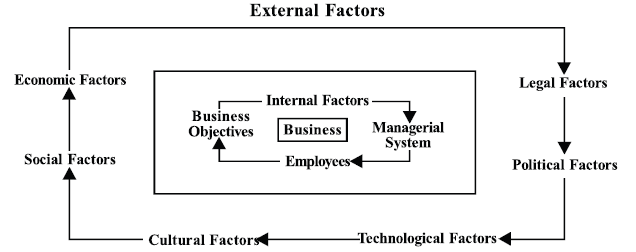
  • The factors which cannot be controlled by the managerial personnel of the organization are called external factors of business environment.
  • In order to survive in the market and keep going with the competition, the business has to make necessary changes with regard to external factors.

These factors can be broadly classified as:

  • Economic factors
  • Social factors
  • Cultural factors
  • Technological factors
  • Political factors
  • Legal factors
View full question & answer
Question 295 Marks
Give only names of factors and sub-factors related to business environment.
Answer
The business environment is highly dynamic and also quite uncertain.
$(A)$ Internal factors
  • Business objectives
  • Employees
  • Managerial systems i.e. organizational structure
$(B)$ External factors
  • Economic factors
    $(a)$ Economic systems
    $(b)$ Degree of economic development
    $(c)$ Regional development and international integration
    $(d)$ National and per capita income
    $(e)$ Distribution of national income
    $(f)$ Monetary policy
    $(g)$ Fiscal policy
    $(h)$ Other factors
  • Social factors
  • Cultural factors
  • Technological factors
  • Political factors
  • Legal factors
View full question & answer
Question 305 Marks
How did policy decision regarding insurance evolve the industry and increased the opportunities?
Answer
Helpful in policy decisions:
Understanding the business environment helps in deciding correct business policies.

Example:
Two types of insurance exist in India namely,

  1. Life insurance and
  2. General insurance.
  • Initially, the government companies used to take care of insurance business, but in 1991, the government changed its policy and allowed private companies to enter into insurance business.
  • Government saw that the business was expanding in India and it became quite important to expand insurance services so that people could do business with ease.
  • Later, the government also allowed foreign direct investment in private Indian
    insurance companies. This further allowed various new business houses to enter in the field of insurance.
  • These policy decisions have expanded the insurance business in India as a result of which today even a very common man is able to avail insurance.
View full question & answer
Question 315 Marks
Into which of the three categories does a business fall on the basis of / business environment?
Answer
  • Each and every business is related to several factors of the society. These factors could be economic, social, cultural, technological, political and legal. These factors include many groups like consumers, competitors, suppliers of raw materials, employees, etc. The environment created by the group of all such factors that directly or indirectly affect the business is called business environment.
  • No business can operate on its own aloof from the society i.e. the factors of the society affect the business environment and hence the business.
View full question & answer
Question 325 Marks
What do you mean by business environment? How is it created? Also classify the types of businesses on the basis of business environment.
Answer
  • Each and every business is related to several factors of the society. These factors could be economic, social, cultural, technological, political and legal. These factors include many groups like consumers, competitors, suppliers of raw materials, employees, etc. The environment created by the group of all such factors that directly or indirectly affect the business is called business environment.
  • No business can operate on its own aloof from the society i.e. the factors of the society affect the business environment and hence the business.
  • Business environment is highly dynamic and also quite uncertain.

The businesses can be classified into three types on the basis of business environment. They are:

  1. Business units that anticipate the environmental aspects well in advance and make necessary changes to the business.
  2. Business units that bring necessary changes based on the existing environmental situation.
  3. Business units that are not in a position to adjust to the existing environment easily.
View full question & answer
Question 335 Marks
Explain the various types of economic system that countries follow.
Answer
Economic system:
  • The organized way in which a country allocates resources and distributes goods and services is known as the economic system of that nation.
  • How the country functions and in which direction is its economy moving is ascertained by the economic system that the country follows.
There are three major types of economic system existing in the world:
$(A)$ Capitalist economic system:
  • If the country follows capitalistic economic system, it means that the country will adopt a policy of free trade.
  • In this system, the government does not interfere much. It allows the producer to take all the major decisions with respect to production and distribution.
  • Such a free trade policy boosts the economy.
  • America, UK, Germany, etc. follow capitalist system.
$(B)$ Socialist system:
  • The economic system which is controlled and regulated by the government so as to ensure welfare and equal opportunity for people of the society is known as socialist system.
  • In this system, all major decisions related to how much to produce, what to produce and how to produce and distribute are taken by the government. Individuals do not have a major role to play as far as decision making is concerned.
  • China follows socialist system.
$(C)$ Mixed economy $($Mixed economic system$):$
  • The economy which has some features of capitalist economy and some of socialist economy is called mixed economy.
  • India has adopted a mixed economy. Under this system, India allows businesses of certain sectors to do business freely whereas certain sectors are controlled by the government itself.
View full question & answer
Question 345 Marks
How do social factors affect business environment?
Answer
Effect of social factors on business environment:
  • All the business activities originate, grow and end in the society. So naturally, society plays a major role in the environment it gives for the business activities.
  • A business activity can never be separated from society. Society represents groups of people, social institutions, social traditions, etc.
  • The society of a nation constantly evolves and hence is dynamic in nature. As a result, the lifestyle, preferences and practices also keep on changing. All these factors change the business environment too.
  • Beliefs and ideologies of people cannot remain same throughout. So, with time people give importance to their decisions, ideologies and rituals to achieve their development.
  • Before producing several type of products the producer needs to consider religion, caste, sect, social norms, ideologies, etc. that exists in a particular society. The decision for the economic activity will be largely affected by these parameters.
  • For example, if the society is quite conservative with respect to clothing, then the producer should not produce very bold clothes else he will face loss.
  • The society or a section of society which does not restrict itself to all these social constraint develops much faster. People of such societies are open to new ideas and are ready to accept new products. As a result, business activities have a higher chance to innovate and expand.
View full question & answer
Question 355 Marks
Write a detailed note on economic factors affecting business environment.
Answer
  • The economic factors of a country play a major role in deciding the special features or limitation of its economy or society.
  • The size and the nature of business development are also dependent on economic factors prevailing in the nation.
Following economic factors affect the business environment of the country:
$1.$ Economic system:
  • The organized way in which a country allocates resources and distributes goods and services is known as the economic system of that nation.
  • How the country functions and in which direction is its economy moving is ascertained by the economic system that the country follows.
There are three major types of economic system existing in the world:
$(A)$ Capitalist economic system:
  • If the country follows capitalist economic system, it means that the country will adopt a policy of free trade.
  • In this system, the government does not interfere much. It allows the producer to take all the major decisions with respect to production and distribution.
$(B)$ Socialist system:
  • The economic system which is controlled and regulated by the government so as to ensure welfare and equal opportunity for people of the society is known as socialist system.
  • In this system, all major decisions are taken by the government. Individuals do not have a major role to play.
$(C)$ Mixed economy $($Mixed economic system$):$
India has adopted a mixed economy i.e. a combination of socialist and capitalist economy. Under this system, India allows businesses of certain sectors to do business freely whereas certain sectors are controlled by the government itself.
$2.$ Degree of economic development:
By studying the business structure it can be known whether the country is economically developed, developing or underdeveloped i.e. one can know the degree of economic development.
The level of development determines the business environment in that country.
$(A)$ Developed country:
  • In a developed country, the level of gross national income and per capita income is high and all the available resources are fully developed.
  • Such an environment encourages growth and development of business and industry. For example, America, UK, etc.
$(B)$ Developing country:
  • In a developing country, the national income and per capita income show positive growth. Moreover, there is also a rising trend in the use of available resources and the standard of living. For example, India.
  • In such countries the business opportunities continuously increase. Also, the social structure keeps on transforming which then proves favourable for business.
$(C)$ Underdeveloped country:
  • In underdeveloped countries, income levels are very weak. This weakens the business development and hence the economic growth.
  • Underutilization of available resources is easily visible. For example, Afghanistan.
$3.$ Sectorial growth and inter-sectorial combinations:
A country’s economy is divided into three sectors namely,
$(A)$ Agricultural,
$(B)$ Industrial and
$(C)$ Service.
The division of country’s economic activities among these sectors and the environment of these sectors largely affect the business environment.
$(A)$ Agriculture $($Primary$)$ sector:
  • If majority population of a country earns its livelihood from agriculture, then it can be said that agriculture is the primary sector of economy for that nation.
  • In such a country, development of agriculture leads to the overall development of the economy.
  • Majority of the resources are used in primary sector and hence the industrial growth is quite slow.
$(B)$ Industrial $($Secondary$)$ sector:
  • There is wide and large use of minerals and metals in an economy dominated by industries.
  • The industrial sector employs large number of people for producing several goods.
  • Strong hold of industrial sector leads to several innovations and modernization. This overall increases business opportunities.
$(C)$ Service sector:
  • The service sector comprises of providing social and economic services.
  • Development of services such as transport, communication, banking, tourism, education, health, etc. fuels investment in various businesses. This in turn develops the economy.
  • As the country develops, the business environment rises and shifts from agriculture to industries and finally to service. However, it is important that the country maintains a fine balance between these three sectors so as to have a healthy economic development and favourable business environment for all.
$4.$ National income and per capita income:
  • When the national income rises, it creates a favourable business environment.
  • If the national income rises but the population does not rise proportionately, the rate of rise in per capita income will be more than the rate of rise in national income.
  • When both, national income and per capita income rise, it increases the demand for goods and services and other basic necessities. This becomes favourable for business.
  • Also, when income rises, the demand for superior quality goods i.e. luxurious goods and branded clothes also rises.
$5.$ Distribution of national income:
  • How the national income is distributed among the different sections of the society affects the business environment of that country.
  • For example, if the distribution is quite unequal then there will be very high demand of luxurious and prestigious goods and services.
  • If the distribution pattern changes, it will affect the demand for goods and services.
$6.$ Monetary policy:
  • The macroeconomic policy laid down by the central bank with respect to management of money supply, rate of interest, etc. is called the monetary policy.
  • Monetary policy includes changes in interest rates, inflation rate, credit creation, credit availability, etc.
  • If the interest rate on housing loan is reduced, the demand for houses will increase. This will also increase the demand of products of industries like cement, steel, furniture, sand, raw dust, bricks, etc. related to housing.
$7.$ Fiscal policy:
  • Fiscal policy is the means by which a government adjusts its spending levels and tax rates to monitor and influence national economy. Thus, fiscal policy depends on the tax structure and governmental expenditure.
    1. How can the tax structure be made effective for individual, units and the entire industry.
    2. How much is the effect of public expenditure on economic activities.
  • The framework of fiscal policy largely impacts the business environment of the nation.
$8.$ Other factors:
Apart from factors discussed above, other factors such as raw materials, its supply, components of machinery, financial facilities, manpower and its productivity etc. also affect the economy and the business environment.
View full question & answer
Question 365 Marks
Show the factors affecting business environment –with chart.
Answer
 

Internal factors :
  • Internal factors in business environment are the factors which are controlled by the managers.
  • Managers can change them as per their requirement.eg. Objectives of business, employees, managerial structure, method of production, training program etc.
  • External factors :
  • External factors in business environment are the factors on which there is no control of managers.
  • According to these factors managers have to make certain changes in business.
  • It includes economic, social cultural, technological, political and legal factors.
View full question & answer
Question 375 Marks
Explain the meaning of liberalization and discuss its effects in brief?
Answer
Introduction:
  • Development of industries in India depend on industrial policy of government.
  • Higher the regulation on industries slower is its progress.
  • It is but natural.
  • Period from $1947$ to $1991$ the environment for trade and commerce and industry in India has been that of control and restraint on economy till the end of July $1991.$ Which were gradually lifted.
  • Meaning of liberalization :
  • Liberalization means an attempt to progress leaving the path of controlled economy for trade and commerce and towards the path of liberalism.
  • Effects of liberalization:
  • Investment barriers were lifted :
  • There were some barriers in India industries for foreign capital investment which are lifted.
  • Moreover ceiling for investment in India industries for foreign businessmen is increased.
  • Many relaxation and economic and non economic incentives are given to attracts investors and foreign business men.
  • Transparency of share market sector :
  • Share purchase – sale transaction has been made transparent do that foreign investors can enter India share market.
  • Physical shares have been converted into ‘Demat’ form purchase – sale of securities, delivery, and mode of payment are made according to international norms.
  • Transparency in tax structure :
  • Government has started making tax structure transparent Sales tax and excise procedure is being made simple.
  • Certain regulations have been relaxed in tax structure.
  • Recently Government of India has undertaken the procedure of applying goods and service tax $(GST).$
  • This is an important step in simplification and transparency of tax structure.
  • New symbol of Indian currency :
  • For certification of India rupee new sign is given `, Indian rupee is made free subject to conditions.
  • Abolition of License :
  • Prior to liberalization most of the industries were license based.
  • But after $1991$ as a part of liberalization, Indian government has adopted the concept of abolition of license. Now its level is very low.
  • Export incentives :
  • Indian government has undertaken many attempts for export promotion.
  • Various incentives has been provided to India business for export.
  • Besides rates of import – export is reduced.
  • Restrictions of foreign exchange are lifted :
  • Old Foreign Exchange Regulation Act $FERA$ has been cancelled and Foreign Exchange Management Act $FEMA$ is implemented.
  • Under this act management is to be done in such way as the flow of foreign exchange is diverted towards the development of trade and commerce of our country.
  • Change in monopolies and restrictive trade practices act $(MRTP$ Act $) :$
  • Number of relaxations have been made in the act .
  • Regulation provision is continued related to undesirable trade practices.
  • Freedom to reserve bank to determine the rate of interest :
  • Reserve Bank of India has given freedom to various banks to decide the deposit and lending rate of interest subject to certain conditions.
  • Easy to import guides and service :
  • Import of goods and services have become easier.
  • Payment of foreign exchanges has become simple. For the purpose of foreign tours, foreign education of children, for the purchase of property in foreign country, availability of foreign exchanges is made easier.
  • Conclusion :
  • Due to the policy of liberalization rate of development has increased.
  • Not only in India but also in villages many facilities are availed.
  • Productivity is increased in agriculture and industrial sector.
  • Employment opportunities have remarkably increased and incentives has been given to new business entrepreneurs.
View full question & answer
Question 385 Marks
Explain social and cultural factors affecting business environment.
Answer
Social factors affecting business environment :
  • Community means a group of people, social institutions, social traditions etc.
  • Ant business unit emerges, develops and ends in society.
  • Life style of people can remain the same for ever but social change affect business.
  • If effects belief, customs religion, sect, friend circle, relatives and their economic decisions.
  • All these factors should be considered in the country where social institutions dominates.
  • In our country certain special business are related to caste and social groups.
  • These classes of societies which are aloof from social restrictions have been able to achieve much faster development.
  • Such societies are open to new ideas, and encourage business activities.
  • Cultural factors affecting business environment :
  • Cultural factors include traditions, customs, habits etc.
  • Which affect decision making process of a business unit.
  • If cultural factor is ignored, strategies of business unit fail or chances of failing increase.
  • Many products have failed due to ignoring cultural aspect, through the product was manufactured by efficient managers.
  • There are many products which are not acceptable monetarily yet have captured market due to acceptance of cultural aspects.
  • Cultural factors are constantly changing.
  • Changes are periodical and constant.
View full question & answer
Question 395 Marks
Explain in brief economic factors affecting business environment.
Answer
Introduction :
  • Among all external factors affecting business environment, economic factors is considered of great importance.
  • Economic factors are considered in formulating policies for development and to maintain continuity of daily activities of business.
  • It is highly required for development of business to evaluate.
  • Economic factors affecting business environment :
  • Economic specialties and limitations of the nation or society affect business decisions.
  • The level and form of the development of business depend on the following economic factors.
  • Economic system :
  • Economic system plays vital role in determining economic activities of the nation.
  • If capitalist economic system is adopted, it means ‘free trade’ policy is adopted.
  • Under this system manufacturers are at liberty to take all decisions related to economic activity.
  • In this type of economy government interference is less.
  • Most of the decisions are taken by the government in socialist economy.
  • Individual motivation or encouragement is not found in such type of economy.
  • As India has adopted ‘mixed’ economy, business freedom is observed in some sectors and in other sectors government dominance is observed
View full question & answer