Questions

3 Marks Each

🎯

Test yourself on this topic

50 questions · timed · auto-graded

Question 13 Marks
Explain about elements of Delegation of an Authority.
Answer
According to Louis Allen, following three elements are included in the
delegation of authority:
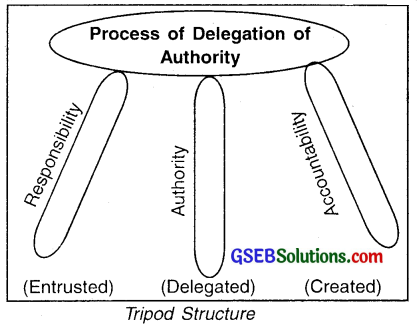
  1. Entrustment of responsibility
  2. Conferment of authority
  3. Creation of accountability
  • These three elements act as the supports of delegation and so we get a tripod structure wherein delegation rest on these three elements.
  • All the three elements are equally important and independent and yet mutually connected.
  • An effective organizational structure can be formed by balancing these elements.
GSEB Solutions Class 12 Organization of Commerce and Management Chapter 4 Organizing 1
$(A)$ Entrustment of responsibility:
  • The duty assigned by the top level officer to the subordinates for a particular work is called entrustment of responsibility.
  • Entrusting responsibility creates a relationship between superior and subordinate because the subordinate is expected to follow the orders given by the superior and also report him about the assigned work duty. Thus, assignment of responsibility flows from top to bottom level.
$(B)$ Conferment of authority:
  • By giving authority to a person, one can expect results and accomplished works.
  • During delegation, the administrators should provide enough power to the ‘ sub ordinates so that they can further allot or distribute the work in various parts to the lower levels and get the work done.
  • Hence delegation of authority is an important step towards allotment of power. This flows from upper to lower level.
$(C)$ Creation of accountability:
The person who has been delegated the power and work is accountable for this work to the higher authorities.
  • He needs to provide proper explanation and follow reporting process to the top level management. This is known as accountability.
  • The middle level authority holder cannot free himself from his responsibility of getting work done. Note that this accountability flows from lower level to upper level i.e. the lower level is accountable to the middle level and middle to upper level.
View full question & answer
Question 23 Marks
Write a note on Matrix Organization.
Answer
Matrix organisation is the combining of project or product patterns of departmentation and functional departmentation within the same organisational structure. In a matrix organisation, there is more than one line of reporting managers. In other words, there is more than one boss for the employees. Organisations that deal in a diverse array of products opt for this kind of a structure. 
Explain the Matrix Organizational Structure
As we explain the matrix organizational structure, we must also discuss the three other organisational structures namely functional, line and third and line and staff. However, the matrix structure is way more complex and resembles a matrix or a grid-like representation. Both project management and functional organisation have been combined to form a matrix structure.
Matrix Organizational Structure Advantages and Disadvantages
There are a good number of matrix organizational structure advantages and disadvantages. In the following section, we will first describe the benefits of matrix management. These are:
  • The benefits of matrix management are mostly enjoyed by the employees as they can gather dual support from the product manager and the functional manager both. Thus knowledge, effort, skill and work all are taken care of.
  • The available resources are more efficiently used when this structure is implemented. The resources are not stagnated either as they can be shared among the ongoing projects. This reduces the cost also.
  • The flow of information is smooth in all directions
  • All the departments involved coordinate with each other and thus miscommunication does not occur.
  • With more than one manager in place, the employees have to take decisions autonomously sharpening their decision-making skill.
  • Both lateral coordination and specialization are encouraged.
There are Some Disadvantages of Matrix Organization as Well, These are:
  • The structure is overtly complex; not all employees are comfortable working here.
  • The dual authority may pose many problems in terms of complexity. Employees may often get confused about whom to approach as the higher authority.
  • If any of the managers showcase ineffectiveness in management, miscommunication my follow
  • It is more expensive than other organizational structures.
  • If there is a lack of communication between the managers or there is internal competition between them, conflicts are bound to occur leading to the failure of achieving organisational objectives.
In a nutshell, this is all about matrix structure along with matrix organization advantages and disadvantages. Though profitable, it has its complexities. In today’s world, the matrix structure is the most prominent one in the corporate sector. The involvement of two managers and their relationship with the employees pave the path for the achievement of the organizational goals.
View full question & answer
Question 33 Marks
Explain Functional Organisation with its formation.
Answer
Functional $($Work-based$)$ Organization
  • Linear organization gives more importance to department than work. This is the greatest limitation of this kind of structure.
  • Keeping this limitation in mind, the ‘work based’ or say ‘function based’ organization came into existence.
  • An organization with a functional structure is divided based on functional areas, such as IT, finance, or marketing.
  • In this structure, the experts with specialized knowledge are given special responsibilities for areas of their expertise. This type of structure is called ‘ functional organization. For example, Human Resource Manager will look after the recruitment, transfer, promotions, etc.
  • Thus, in functional organization, the distribution of work is not done according to the departmental but according to the nature of work.
Formation of functional organization:
The core of functional organization lies in giving special importance to work distribution on the basis of specialization.
  • Specialized experts are appointed for each kind of work. These experts do not serve only as advisors but they are also administrative heads of their work areas. They are fully responsible for the task assigned to them. For example, the purchase officer is fully responsible for all type of purchase related work.
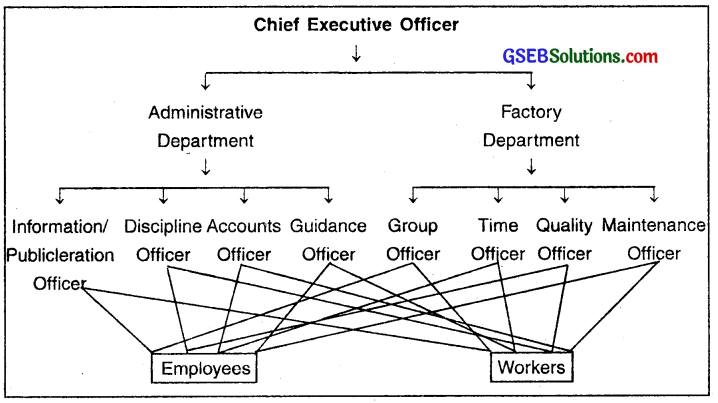
  • The Chief Executive Officer is at the top and holds the supreme powers of the functional organization.
GSEB Solutions Class 12 Organization of Commerce and Management Chapter 4 Organizing 2
Functional Organization
  • As demonstrated in the chart, the unit can be divided into two $($or more$)$ parts. Each unit has its assigned list of activities and works.
  • The units then assign the tasks and works to different officers. For example, the factory unit $($or department$)$ will assign the work to Quality Control Officer, Chief Maintenance Engineer and so on.
  • Each officer then gives orders to the employees under him to perform the task.
  • In functional organization, not a single work remains unassigned and at the same time not a single work is assigned twice.
  • This structure is more favourable for units where there are a variety of works to be done. For example, IT Industry, Telecom industry, etc.
View full question & answer
Question 43 Marks
Describe characteristics of Informal organization.
Answer
Characteristics informal organization:
$1.$ As the name suggest, the structure of this type of organization is informal.
  • It develops from inter-relationships and interactions.
  • This kind of structure is naturally formed when the employees working together work for a commonly defined goal.
$2.$ Based on human relations:
  • This kind of structure is based on human relations.
  • It is formed between people who share similar feelings, interests, values, hobbies, habits and beliefs.
$3.$ Ever-changing:
  • The informal structure is ever changing.
  • When an employee leaves one group and joins another work group, the new informal structure is created or changed, as per the change in work environment.
$4.$ Universal:
  • This structure is universal i.e. it is not only found in businesses.
  • It is found in all places wherever human activities take place.
$5.$ Informal communication:
  • The channel of communication is informal i.e. the communication is done informally and mainly orally.
  • As a result, there are chances to have more opinions and fewer facts in it. This kind of communication is very fast.
$6.$ Small size:
  • The size of this organization is mostly small because it forms due to individual relationships, exchange of ideas, sharing same wave-length, etc.
  • A large organization can have several such informal organizations but members in each would mostly less.
$7.$ Lack of control:
These organizations are formed on the basis of circle and mindset of ‘ individuals. Hence, no control can be maintained within an informal
organization.

$8.$ Complements formal structure:
  • Since informal organization emerges from formal organization it is said that informal organization complements formal organizations.
  • In the modern times, informal fcommunication structure is used widely. This helps to reduce industrial disputes and maintain discipline. Hence this structure is more popular.
View full question & answer
Question 53 Marks
A task may be delegated but not the accountability. Explain.
Answer
  • During delegation of work, the person who has been delegated the power and work is accountable for this work to the higher authorities.
  • He needs to provide proper explanation and follow reporting process to the top level management.
  • The delegated person may be having the powers to get the work done by others but finally the responsibility of getting the work done rests with the upper level administrators only.
  • This means if the delegated work is not done as planned, the person who has delegated cannot put the blame on the shoulder of the person to whom the work was delegated. Hence, a task may be delegated but not the accountability.
View full question & answer
Question 63 Marks
Power is the key to administration, but delegation of power is the key to organization. OR Delegation is the base for the success of an organization. Explain.
Answer
  • In business terminology, ‘power’ refers to giving orders and also to see to it that the orders are followed.
  • Person having power has right to make decisions and execute tasks. This leads to smooth functioning of management and administration.
  • However, when the size of the organization becomes large, it becomes difficult .for the upper level administrators to conduct all work on their own and execute all their powers on own. Hence, they assign some work to their assistants.
  • By delegating power to the lower level, the upper level administrators get free from such works that can be performed by junior level staff. This helps the upper level people to focus upon their core tasks i.e. policy making.
  • This increases efficiency of the management and organizing.
View full question & answer
Question 73 Marks
Write a short note on creation of accountability.
Answer
  • During delegation of work, the person who has been delegated the power and work is accountable for this work to the higher authorities.
  • He needs to provide proper explanation and follow reporting process to the top level management. This is known as accountability.
  • The delegated person may be having the powers to get the work done by / others but finally the responsibility of getting the work done rests with the upper level administrators only.
  • Hence the middle level authority holders i.e. the ones who are delegated the power should take care to ensure that the work is properly done by the lower level staff.
  • The middle level authority holder cannot free himself from his responsibility of getting work done. Note that this accountability flows from lower level to upper level i.e. the lower level is accountable to the middle level and middle to upper level.
  • This accountability cannot be passed on. For example, the Accounts Officer may give the work of writing accounts to his accountant but when the accounts are written, it is the Accounts Officer who has to check the accuracy of the work done and not the Accountant.
View full question & answer
Question 83 Marks
State the definition and views of Louis Allen on delegation of authority.
Answer
  • According to Louis Allen, “Delegation of authority means assignment of responsibility and power to the subordinates by creating accountability for effective performance.”
  • He also says that “Delegation of power is such kind of process in which the administrator gives a part of the powers to his helpers along with duties, and the helpers, with the help of others, for the purpose of work performance, accepts such powers consciously.”
View full question & answer
Question 93 Marks
Define delegation of authority and state one example.
Answer
  • The system of giving power to the other person for doing a particular task is called delegation of power.
  • For example, marketing managers are given power to incur necessary expenditure in their work area, appointment of employees, take disciplinary actions against the employees, etc.
View full question & answer
Question 103 Marks
What is the limitation of decentralization?
Answer
  • Decentralization cannot be adopted in very small units, especially because the business secrets cannot be maintained.
  • Sometimes when common policies are not implemented or if co-ordination is not maintained properly, decentralization becomes unsuccessful.
View full question & answer
Question 113 Marks
Define and explain the concept of decentralization.
Answer
Decentralization:
The delegation of power from upper to lower level in orderly manner is known as decentralization of power.
  • According to Henri Fayol, “To assign powers to the superiors, to enable distribution of work, and to include in decision making process is called decentralization.”
  • Whether to opt for centralization or decentralization largely depends of the size of the unit and the approach of the administrators.
  • Small sized organization can have centralized powers but generally large sized organizations should have decentralized form of management for successful organizing.
  • Under decentralization not all but some major powers such as executive powers are given by the upper level administrators to the lower level.
View full question & answer
Question 123 Marks
Define centralization and decentralization of power.
Answer
Centralization:
The concentration of control of an activity or organization under a single authority is called centralization.

Decentralization:
The delegation of power from upper to lower level in orderly manner is known as decentralization of power.

View full question & answer
Question 133 Marks
State the limitations of matrix organization.
Answer
Matrix structure can result in internal complexity. Some employees may become confused as to who is their direct supervisor. For example, an employee may receive different directions concerning the same thing from supervisors in different departments.
  • Miscommunication and ineffective managing can result in employee dissatisfaction and low morale.
  • Prolonged issues may cause the organization to experience high employee turnover.
  • Matrix organizational structure is expensive to maintain.
  • A company’s overhead cost typically increases because of the need for double management.
View full question & answer
Question 143 Marks
Matrix organization is multi-faced. Explain.
Answer
  • Matrix organization is a modern form of organization, which has two different types of structures.
    One is the functional structure which forms the part of decision making. The second is the technical problems solution based structure which is called project structure. The combination of both these structures results in matrix organization.
  • Moreover, in matrix organization, the organization gets the benefits of specialized work as well as that of project management.
  • Hence, matrix organization is multi-faced structure.
View full question & answer
Question 153 Marks
What is a matrix organization?
Answer
Matrix Organization:
  • The organizational structure in which people with similar skills are pooled for work assignments, resulting in more than one manager is called a matrix organization.
  • Matrix organization is a combination of work based $($functional organization$)$ and project based organization.
  • Matrix management is the practice of managing individuals with more than one reporting line i.e. in a matrix organization structure.
  • For example, all engineers may be in one engineering department and report to an engineering manager $($i.e. part of functional organization structure$),$ but these same engineers may be assigned to different projects and report to a different engineering manager or a project manager while working on that project. Therefore, each engineer may have to work under several managers at same point of time.
View full question & answer
Question 163 Marks
Differentiate between format and informal organization.
Answer
Basis of comparison Formal organization Informal organization
$1.$ Formation Formed systematically with proper guidelines Formed informally by members while working in the organization and interacting with each other
$2.$ Objective To fulfill business goals To satisfy social and psychological needs
$3.$ What is it? A systematic organization A group of like minded people
$4.$ Size Members of the entire organization Small sized on the basis of like mindedness of employees
$5.$ Nature Stable. Continues for a long time Unstable and keeps on changing
$6.$ Control mechanism Controlled through rules and regulations of the organization Controlled through values and beliefs of the associated people
$7.$ Focus on Work performance  
$8.$ Authority Members follow the authority as decided by the hierarchy of the organization Inter personal relationships All members have equal authority
View full question & answer
Question 173 Marks
Informal organization is now acceptable and has become widespread. Explain.
Answer
  • In the formal organizational structure individuals are assigned various job positions. While working at those job positions, the individuals interact with each other and develop some social and friendly groups in the organization. This network of social and friendly groups forms another structure in the organization which is called informal organizational structure.
  • The members while doing the formal work also interact at social level, bring their own values and assumptions during work discussion.
  • The members of informal organization develop friendship, alliances, trusted sources of information and share preferences on how work should be done.
  • This makes achieving the goals easily and in a harmonious manner.
  • Owing to several benefits the organization gets, it accepts informal organization.
View full question & answer
Question 183 Marks
State the characteristics of formal organization.
Answer
Characteristics of formal organization:
  1. Formal structure: The administrators form the formal structure very cautiously to achieve the desired goals.
  2. Lacking flexibility: In this kind of structure, the position assigned to the employees generally cannot be changed or altered. So, this structure is not flexible.
  3. Delegation of power from upper to lower level: The delegation of power is done by superior officer and it flows from upper level to lower level.
  4. Large size: Formal organization structure is a large size structure.
  5. Particular relations: Since the formal organization is formed with proper method, the relations among the employees are particularly formed.
  6. Communication: Communication is done only through a formal method. There is no scope for informal communication.
View full question & answer
Question 193 Marks
What is a formal organization?
Answer
Formal organization:
  • In order to achieve the predefined goals, the formal structure of relationship established among persons and work is called formal organization.
  • Linear organization and functional organization are types of formal organization.
  • In formal organization, necessary powers are given to enable the person to perform certain kind of responsibilities.
  • The organization also clarifies matters related to delegation of authority among superior officers.
View full question & answer
Question 203 Marks
Differentiate between linear and functional organization.
Answer
Basis of comparison Linear organization Functional organization
$1.$ Formation It consists of several departments It is based on specific functions of the organization
$2.$ Authority The authority flows from top level to lower level Authority is given as per the functions taken care of
$3.$ Specialized knowledge Benefit of specialized knowledge is not available Benefit of specialized knowledge and skills is available
$4.$ Co ordination Co ordination among various division is required Here, co ordination among various functions is required
$5.$ Discipline Discipline is properly followed It is difficult to follow proper discipline
$6.$ Suited for Any type of organization More favourable for units where there are a variety of works to be done
View full question & answer
Question 213 Marks
What is a functional organization? Explain briefly. Why did the need arise to set-up functional organization structure?
Answer
Functional $($Work-based$)$ Organization
  • Linear organization gives more importance to department than work. This is the greatest limitation of this kind of structure.
  • Keeping this limitation in mind, the ‘work based’ or say ‘function based’ organization came into existence.
  • An organization with a functional structure is divided based on functional areas, such as $IT,$ finance, or marketing.
  • In this structure, the experts with specialized knowledge are given special responsibilities for areas of their expertise. This type of structure is called ‘ functional organization. For example, Human Resource Manager will look after the recruitment, transfer, promotions, etc.
  • Thus, in functional organization, the distribution of work is not done according to the departmental but according to the nature of work.
View full question & answer
Question 223 Marks
Linear organization is the most commonly found organizational structure. Explain.
Answer
  • Linear organization is the most simple and ancient type of organization.
  • Linear organization is more favourable if the organization is of small size, the work area is limited and the problems of control and discipline are also limited.
  • In such types of organization there is a unity of command which follows from top to bottom.
  • These characteristics are quite suitable even for organizations which are pretty small size. As a result, linear organization is most commonly found organizational structure.
View full question & answer
Question 233 Marks
Explain the limitation of linear organization structure.
Answer
  • Linear organization flows from top to bottom with top having unlimited powers and bottom level, minimal.
  • Linear organization gives more importance to department than work. This is the greatest limitation of linear organization structure.
  • Linear organization does not have scope for specialized work because the stress is more on departments and less on functions.
  • The administrators and officers in one unit have to perform many several types of tasks. Naturally, all of them are not experts in all the types of works.
View full question & answer
Question 243 Marks
Linear organization is also known as departmental $($divisional$)$ organization.
Answer
  • In a linear organization, the entire business unit is classified into different departments.
  • Then a department head is appointed for each section or area. This departmental head is answerable to the superior head of his area.
  • The area head or say departmental head holds the supreme power for his department.
  • In this type of organization, division is hot done according to the work but according to departments.
  • Hence linear organization is also known as departmental $($divisional$)$ organization.
View full question & answer
Question 253 Marks
State the various types of structures that an organization can have.
Answer
Mainly the organization can have any of the following structures:
  1. Linear Organization
  2. Functional Organization
  3. Formal Organization
  4. Informal Organization
  5. Matrix Organization
  • By looking at the structure of the organization one can know the type of organization.
  • What structures will the business follow depends on the nature, size and responsibilities of business unit and its classification.
View full question & answer
Question 263 Marks
What is departmentalization?
Answer
  • In a business unit, after preparing the list of functions, the works that are similar in nature are classified and similar functions are placed together. Then the division of work is done accordingly. This is called departmentalization.
  • For example, work related to purchase is put under purchase department, work related to sales is put under sales department, work related to finance is put under accounts department and Sb on.
View full question & answer
Question 273 Marks
Why is it important to follow proper steps of organizing?
Answer
Forming an organizing is a scientific process.
  • According to Peter F. Drucker, “The lack of proper formation of organization cannot sustain for longtime. Hence, the unit slowly gets destroyed.”
  • Organizing gives a proper direction and flow to the business unit.
  • Goals, roles, responsibilities and authorities are clearly understood by all the . employees if organizing is done properly.
  • It is therefore necessary to see that organizing done by following proper steps and that the functional relations are established in proper manner.
View full question & answer
Question 283 Marks
State the characteristics of organizing.
Answer
The characteristics of organizing are:
  1. Goal oriented activity
  2. Planning based
  3. Delegation of authority and responsibilities
  4. Gives importance to human element
View full question & answer
Question 293 Marks
What is organizing? Explain briefly.
Answer
  • The structure formed in order to enable delegation of authority and responsibility towards the people actively engaged for common goal is known as organizing. Organizing is also called arrangement.
  • For smooth and effective administration and management there should be proper organization in the unit.
  • Most of problems of management arise due to ineffective organization in the management.
  • Proper organizing can enable the unit to achieve its goals that too in desired time. It also enables optimum use of resources, time, energy and money.
View full question & answer
Question 303 Marks
State the various definition of organizing.
Answer
Various definitions:
  • The structure formed in order to enable delegation of authority and responsibility towards the people actively engaged for common goal is known as organizing.
  • As per Chester I. Bernard, “The activity conducted by the co-operation of two or more people and their co-ordination is called organizing.”
  • As Per Louie Allen, “Organizing is the process of identifying and classifying the work to be performed, defining and delegating responsibility and authority, and establishing relationships for the purpose of enabling people to work most effectively together in accomplishing objectives.”
View full question & answer
Question 313 Marks
“Work has to be delegated”-Explain.
Answer
No person can do all functions of his division.
  • The reason is that it is not possible that officer has knowledge of all functions and even if he has, the limitations of time will always be there.
  • Therefore, each officer does some functions on his own and delegates other functions to other.
  • Officers can reduce their workload by delegating authority.
  • They can use the time saved for considering growth strategies for future and can concentrate on research function.
  • They can increase the reputation of unit by developing public relations by providing necessary expiations and information to various parties connected with the company.
  • In modern age, the delegation of authority is used also for availing benefits of labour division and specialization.
View full question & answer
Question 323 Marks
How delegation of authority motivates the employees?
Answer
Delegation of authority creates formal relations between subordinates and officers.
  • Due to recentralization of power, the employees have the chance to develop have the chance to develop their abilities.
  • Due to which they also gain psychological benefits.
  • Thus interrelations develop in the unit.
  • Due to this right kind of motivation is obtained.
View full question & answer
Question 333 Marks
“On account of Delegation of authority, divisional activities become effective.”- Explain.
Answer
Before delegating job-responsibility and authority the qualification, ability experience in respect of other person are considered.
  • On account of that they can carry out the job-duty properly and the misuse of authority is avoided.
  • On account of proper delegation of authority the activities of each division are performed timely.
  • As a result, the functions of co-ordination and control are also eased.
  • In short, in the achievement of divisional and organizational goals the contribution of delegation of authority is considered important.
View full question & answer
Question 343 Marks
“On account of delegation of authority, divisional activities become effective.”-Explain.
Answer
When top managers delegates the responsibility of some of their functions and the authority in respect thereof, to others, it is called delegation of authority.
  • But when the top managers delegate the authority to take decisions to the officers of each level in respect of their functions, it is called Delegation of authority.
  • In short, the Delegation gives the freedom of decisions making to each level.
  • Thus, without the Delegation of authority, Delegation of authority is not possible and hence, both are said to be two sides of a dingle coin.
  • There is only a thin line of difference between them.
View full question & answer
Question 353 Marks
“Delegation of authority and decentralization of authority are two sides of single coin”-Explain.
Answer
Delegation of authority gives opportunity and freedom to employees to take decisions in respect of their duties.
  • So, the responsibility to provide leadership and direction to the subordinates also arises.
  • The delegator reduces his workload by delegating the work but the accountability to answer the questions in respect of the work lies with him only.
  • Thus, due to delegation the leadership skills such as leadership, direction, enthusiasm, co-ordination etc. grow in the person and so the managers for future get prepared.
View full question & answer
Question 363 Marks
“On account of decentralization of authority, future managers get generated.”-Explain.
Answer
Top manager cannot perform all important functions of unit such as purchase, sale, production, human resource management, accounting etc.
  • On his own because it is not possible to have the knowledge of all these functions with him. And if he tries it, all functions will be delayed.
  • But if the authority to take decisions in respect of these functions is delegated to the functional heads, the benefits of their skills and knowledge can be obtained and effective decisions can be made for all divisional functions.
  • On the other hand, as the workload of top managers is reduced, they are required to only co-ordinate the divisional functions.
  • That is why delegation of authority is considered the base for the success of organisation.
View full question & answer
Question 373 Marks
“Delegation of authority is the base for the success of organization.”-Explain.
Answer
In a business unit al activities are done by formally formed organization.
  • The activities are done in accordance with division of authority and responsibility among officers and employees.
  • Line organization, functional, committee and matrix organization etc.
  • Are formal organizations.
  • But nowadays an organization based neither on authority and responsibility but an organization based on human group activity.
  • There in, the human relation, feeling, relatedness\reference, religious-traditions play an important role.
  • Employees show preparedness to work for each other voluntarily.
  • Which is considered useful from the viewpoint of continuity of activities and co-ordination.
  • Moreover, for the solution of industrial disputes and maintain of discipline also informal organization can be used positively, so its importance has become acceptable.
View full question & answer
Question 383 Marks
“Informal organization has now become acceptable.”-Explain.
Answer
Merits of Informal Organization :
  • Mental stress of employees is reduced
  • The authority of management is restrained.
  • This organisation complements the accomplishments of objective of formal organisation.
  • Risk of rumors being spread.
  • Social restrictions on employees are reduced.
Demerits of informal Organisation :
  • There is a possibility to oppose the change.
  • Indiscipline to be encouraged.
  • Industrial peace is endangered.
  • Risk of rumors being spread.
  • Possibility of obstacles being placed in management.
View full question & answer
Question 393 Marks
State the merits and demerits of informal organization.
Answer
In functional organisation, authority and responsibility are assigned on the basis of functions.
  • Different experts are appointed and these experts are advisers and administrative officers also.
  • As experts are appointed and these experts are advisers and administrative officers also.
  • As experts are to be appointed, they have to be paid high remuneration.
  • So, this type of organisation is generally found to be more expensive.
View full question & answer
Question 403 Marks
“In functional organization, functions have more importance than department”-Explain.
Answer
While forming department id functional organisation, functions are taken into consideration.
  • E.g. Purchase function, Production function, Sales function, Publicity function etc.
  • Here, different experts are appointed for every function.
  • Here small segments are decided upon and handed over to different experts like account officers, quality officer etc.
  • Every officer can give orders to every worker of the unit.
  • So, here functions have more importance that department.
View full question & answer
Question 413 Marks
“Linear organization is found to be used in many organizations.”-Explain.
Answer
In liner organization, the liner of authority and responsibility is broken from top to the bottom level.
  • Hence, all employees remain connected with on another.
  • In this type of organisation, various divisions are created as per various functions e.g. purchase division, sales division, finance division etc.
  • The head of each division is held responsible for the activities of this division.
  • Supervisors, employees are subordinated to divisional head.
  • They are assigned authority in respect of their work.
  • This way each person can do his work easily.
  • Hence, in view of work division and control line organization is thought more appropriate.
View full question & answer
Question 423 Marks
“The Success or Failure of management primarily depends on its organization rather than other factor”-Explain.
Answer
Whether a business unit will succeed or fail depends primarily on the organisation.
  • Even if the various factors affecting business are favorable but if the organisation implementing the activities is inefficient, the maximum utilization of resources will be wasted and it will become difficult to meet production targets.
  • As a result, it will be difficult to put in the market timely the right quality of products, the market will be lost and business unit will fail.
  • As per opinion of a successful industrialist, if organisation is efficient, the lost factories, transportation vehicles, business-trade and finance can be regained.
View full question & answer
Question 433 Marks
“Delegation of authority and accountability go in opposite direction”-Explain.
Answer
The delegation of authority takes place from the top level to the bottom level of management.
  • Officers delegate authority to the subordinates, while the accountability moves from the bottom level to the top level management.
  • Executives reduce the workload by delegation but it does not reduce the responsibility.
  • The answerability i.e. the accountability to the superiors for the success or failure of the job delegated lies with the delegator of authority.
  • The chain of accountability moves from employee to supervisor, supervisor to officer, officer to divisional head to general manager.
  • Hence, accountability is considered towards top level from the bottom level of management.
  • Thus, delegation of authority and the accountability go in opposite directions.
View full question & answer
Question 443 Marks
“The centralization of authority becomes obstacle to the growth of the company”-Explain.
Answer
It is true that centralization of authority with the top manager gives the benefits of quick decisions and preservation of secrets.
  • But on account of it, the workload of top managers increases and so they cannot think of the growth plans for the unit.
  • Moreover, the subordinates of officers do not have any authority, so they also cannot engage themselves in any inventive.
  • Hence, the growth of company is hindered.
  • On account of lack of authority, branch officers cannot exploit the domestic factors and so the profitability of the unit is hampered.
View full question & answer
Question 453 Marks
“Only work cannot be assigned”-Explain.
Answer
Superior officers can reduce their workload by assigning work, but the belief that just by assigning work the subordinates will perform, it is wrong .
  • In fact, while assigning the work, necessary authority also has to be delegated in order that subordinates can perform the work properly,
  • Otherwise the work will be interrupted on account of lack of authority.
  • Example: ‘A’ person is assigned the responsibility to ensure cleanliness of the office. If the officers have not given authority to expand to that person, due to lack of enough tools, cleanliness will not be maintained.
  • On account of lack of requisite authority, employees will fail to perform their duties.
  • They become negligent for their duties and hence, the purpose of delegation is not achieved.
  • Hence, not only the work but relevant authority should also be delegated.
View full question & answer
Question 463 Marks
“In functional organization by applying foreman method, benefits of labour division can be obtained”-Explain.
Answer
In functional organisation, divisions are formed keeping in view various functions/ activities and for each function expert person is appointed.
  • Hence, the benefit of labour division is obtained.
  • But, Mr. Frederick Taylor, has suggested to classify the functions of foremen into two categories, in his foremanship style of functional organisation.
  • Planning division in which procedure/method officer, directing officer, discipline officer, cost officer are included.
  • In this method instead of handing over all the functions of production division to one or two foremen, they are assigned to experts concerned.
  • So, all activities become effective and benefits of labour division are gained.
View full question & answer
Question 473 Marks
“Linear organization is also called divisional organization”-Explain.
Answer
In liner organization, various activities are divided in various divisions.
  • For each division a head is appointed.
  • He is given full authority and responsibility of that division, e.g. production division, sales division, finance division, administrative division etc.
  • In each of these divisions the various functions related to that division are performed.
  • E.g. With production division, the functions purchase, storage of materials, machine maintenance etc.
  • Are connected. With the sales division, distribution activities are connected.
  • Thus, not on the basis of functions but on the basis of division the activities are divided, hence it is also called divisional organisation.
View full question & answer
Question 483 Marks
“Organization gives importance to human factor”-Explain.
Answer
The employees working in various divisions of organisation are assigned authority and responsibility. While structuring the organisation, care is taken to see that the employees get job satisfaction and their intellectual growth is ensured. Thus, in organisation, human factor is given importance.
View full question & answer
Question 493 Marks
“Balance between Authority and responsibility are the basis of organization”-Explain.
Answer
Organisation involves creation of various divisions.
  • The workers of the divisions are assigned job-duties in respect of their work and also authority to perform them.
  • E.g. when sales officer is given responsibility to increase the sales, the authority to advertise has to be given.
  • If the authority and responsibility are not divided properly,
  • Due to lack of requisite authority, employees cannot discharge their duties,
  • Excess authority given will be misused,
  • If authority is less compared to work assigned, the work will be interrupted,
  • Due to lack of authority time, energy and resources are wasted,
  • The divisional and business goals will not be achieved easily.
  • That is why it is said that balance of authority and responsibility are the base of organisation.
  • It cannot exist without it.
View full question & answer
Question 503 Marks
Explain functional organization with its design.
Answer
  • The work distribution is done according to the nature of work.
  • An expert is appointed for each kind of work.
  • The experts are advisors as well as administrative heads who are fully responsible for the task.
  • Diagram of Functional Organization :
View full question & answer
3 Marks Each - OCM STD 12 Commerce Questions - Vidyadip