Question 13 Marks
Find $\frac{d y}{d x}$ for $y=x^{3}+\sqrt{x}-\frac{4}{x}+\frac{1}{\sqrt[3]{x}}+\frac{1}{4}$.
Answer$y =x^3+\sqrt{x}-\frac{4}{x}+\frac{1}{\sqrt[3]{x}}+\frac{1}{4}$
$ =x^3+x^{\frac{1}{2}}-4 x^{-1}+x^{-\frac{1}{3}}+\frac{1}{4}$
$\therefore \frac{d y}{d x} =\frac{d}{d x}\left(x^3\right)+\frac{d}{d x}\left(x^{\frac{1}{2}}\right)-4 \frac{d}{d x}\left(x^{-1}\right)+\frac{d}{d x}\left(x^{-\frac{1}{3}}\right)+\frac{d}{d x}\left(\frac{1}{4}\right)$
$ =3 x^2+\frac{1}{2} x^{\frac{1}{2}-1}-4\left(-1 x^{-1-1}\right)+\left(\frac{-1}{3}\right) x^{\frac{-1}{3}-1}+0$
$ =3 x^2+\frac{1}{2} x^{-\frac{1}{2}}+4 x^{-2}-\frac{1}{3} x^{-\frac{4}{3}}$
$ =3 x^2+\frac{1}{2 x^{\frac{1}{2}}}+\frac{4}{x^2}-\frac{1}{3 x^{\frac{4}{3}}}$
View full question & answer→Question 23 Marks
Obtain derivative of $f(x)=\frac{1}{x}$ with the help of definition.
AnswerHere, $f(x)=\frac{1}{x}$
$ \therefore f(x+h)=\frac{1}{x+h} $
Now, $f^{\prime}(x)=\lim _{h \rightarrow 0} \frac{f(x+h)-f(x)}{h}$
$ =\lim _{h \rightarrow 0} \frac{\frac{1}{x+h}-\frac{1}{x}}{h}$
$ =\lim _{h \rightarrow 0} \frac{x-(x+h)}{h x(x+h)}$
$ =\lim _{h \rightarrow 0} \frac{x-x-h}{h x(x+h)}$
$ =\lim _{h \rightarrow 0} \frac{-h}{h x(x+h)}$
$ =\lim _{h \rightarrow 0} \frac{-1}{x(x+h)}$
$ =\frac{-1}{x(x+0)}$
$ =\frac{-1}{x^{2}} $
Hence, if $f(x)=\frac{1}{x}$ then $f^{\prime}(x)=\frac{-1}{x^{2}}$
View full question & answer→Question 33 Marks
The demand function of a commodity is $p=12-\sqrt{x}$. Find the elasticity of demand when the price is $9$ units and interpret it.
AnswerDemand function $p=12-\sqrt{x}$
$ \therefore \frac{d p}{d x} =0-\frac{1}{2 \sqrt{x}}$
$ =-\frac{1}{2 \sqrt{x}}$
$\therefore \frac{d x}{d p} =-2 \sqrt{x} $
Now, elasticity of demand $=-\frac{p}{x} \cdot \frac{d x}{d p}$
$ =\frac{-(12-\sqrt{x})}{x} \times(-2 \sqrt{x})$
$ =\frac{(12-\sqrt{x})(2 \sqrt{x})}{x} $
When demand is $9$ units then
$ \text { Elasticity of demand } =\frac{(12-\sqrt{9})(2 \sqrt{9})}{9}$
$ =\frac{(12-3)(2 \times 3)}{9}$
$ =\frac{9 \times 6}{9}$
$ =6 $
Interpretation : When price changes by $1$ percent, demand changes by $6$ percent $($in opposite direction$)$ when demand is $9$ units.
View full question & answer→Question 43 Marks
Obtain derivative of $f(x)=x^{n}$ with the help of definition.
AnswerHere, $f(x)=x^{n}$
$ \therefore f(x+h)=(x+h)^{n} $
Now, $f^{\prime}(x)=\lim _{h \rightarrow 0} \frac{f(x+h)-f(x)}{h}$
$ =\lim _{h \rightarrow 0} \frac{(x+h)^{n}-x^{n}}{h} $
$($Taking $x+h=t$, when $h \rightarrow 0$ then $t \rightarrow x )$
$ =\lim _{t \rightarrow x} \frac{t^{n}-x^{n}}{t-x} \quad(\because x+h=t)$
$ =n x^{n-1} \left(\because \lim _{x \rightarrow a} \frac{x^{n}-a^{n}}{x-a}=n a^{n-1}\right) $
Hence, if $f(x)=x^{n}$ then $f^{\prime}(x)=n x^{n-1}$
View full question & answer→Question 53 Marks
If the demand function of a commodity is $x=\frac{50-p}{2}$ then find the marginal revenue when price is $₹ 30$.
AnswerDemand function $x=\frac{50-p}{2}$
$ \therefore 2 x=50-p$
$ \therefore p=50-2 x $
Now, revenue function $R=p \cdot x$
$ =(50-2 x) x$
$\therefore R =50 x-2 x^{2} $
Marginal revenue $\frac{d R}{d x}=50-4 x$
When price $p=30$ then
$ x =\frac{50-30}{2}$
$\therefore x =10 $
When demand $x=10$ then
$ \text { Marginal Revenue } =\frac{d R}{d x}=50-4(10)$
$ =10 $
Interpretation : Revenue for selling the $11th$ unit is approximately $₹ 10 .$
View full question & answer→Question 63 Marks
Decide whether the function $y=x^{3}-3 x^{2}+7$ is increasing or decreasing at $x = 1$ and $x = 3.$
Answer$ y=x^{3}-3 x^{2}+7$
$ \therefore \frac{d y}{d x}=3 x^{2}-6 x$
$ \text { At } \boldsymbol{x}=\mathbf{1}$
$ \frac{d y}{d x}=3(1)^{2}-6(1)$
$ =3-6$
$ =-3<0 $
$\therefore \quad$ Function is decreasing at $x=1$.
$ \text { At } \boldsymbol{x}= \mathbf{3}$
$\frac{d y}{d x}= 3(3)^{2}-6(3)$
$= 27-18$
$= 9>0 $
$\therefore \quad$ Function is increasing at $x=3$.
View full question & answer→Question 73 Marks
Obtain derivative of $f(x)=x^{3}$ with the help of definition.
AnswerHere, $f(x)=x^{3}$
$ \therefore f(x+h) =(x+h)^{3}$
$ =x^{3}+3 x^{2} h+3 x h^{2}+h^{3} $
Now, $f^{\prime}(x)=\lim _{h \rightarrow 0} \frac{f(x+h)-f(x)}{h}$
$ =\lim _{h \rightarrow 0} \frac{\left(x^{3}+3 x^{2} h+3 x h^{2}+h^{3}\right)-x^{3}}{h}$
$ =\lim _{h \rightarrow 0} \frac{3 x^{2} h+3 x h^{2}+h^{3}}{h}$
$ =\lim _{h \rightarrow 0} \frac{h\left(3 x^{2}+3 x h+h^{2}\right)}{h}$
$ =\lim _{h \rightarrow 0} 3 x^{2}+3 x h+h^{2}$
$ =3 x^{2}+3 x(0)+(0)^{2}$
$ =3 x^{2} $
Hence, if $f(x)=x^{3}$ then $f^{\prime}(x)=3 x^{2}$
View full question & answer→Question 83 Marks
If $2 x y+3 x+y-4=0$ then find $\frac{d y}{d x}$.
Answer$ 2 x y+3 x+y-4=0$
$\therefore 2 x y+y=4-3 x$
$\therefore y(2 x+1)=4-3 x$
$\therefore y=\frac{4-3 x}{2 x+1} $
Here, take $u=4-3 x$ and $v=2 x+1$.
$ \therefore \frac{d u}{d x}=-3 \text { and } \frac{d v}{d x}=2 $
Now, $y=\frac{u}{v}$
$ \therefore \frac{d y}{d x} =\frac{v \frac{d u}{d x}-u \frac{d v}{d x}}{v^{2}}$
$ =\frac{(2 x+1)(-3)-(4-3 x)(2)}{(2 x+1)^{2}}$
$ =\frac{-6 x-3-8+6 x}{(2 x+1)^{2}}$
$ =\frac{-11}{(2 x+1)^{2}} $
View full question & answer→Question 93 Marks
Obtain derivative of $y=1+\frac{2}{3+\frac{4}{x}}$ with respect to $x$.
Answer$ y =1+\frac{2}{3+\frac{4}{x}}$
$ =1+\frac{2 x}{3 x+4}$
$ =\frac{(3 x+4)+2 x}{3 x+4}$
$\therefore y =\frac{5 x+4}{3 x+4} $
Here, take $u=5 x+4$ and $v=3 x+4$
$ \therefore \frac{d u}{d x}=5 \text { and } \frac{d v}{d x}=3 $
Now, $y=\frac{u}{v}$
$ \therefore \frac{d y}{d x} =\frac{v \frac{d u}{d x}-u \frac{d v}{d x}}{v^{2}}$
$ =\frac{(3 x+4)(5)-(5 x+4)(3)}{(3 x+4)^{2}}$
$ =\frac{(15 x+20)-(15 x+12)}{(3 x+4)^{2}} $
$ =\frac{15 x+20-15 x-12}{(3 x+4)^{2}}$
$ =\frac{8}{(3 x+4)^{2}} $
View full question & answer→Question 103 Marks
If $y=\frac{2 x^{2}+3 x+4}{x^{2}+5}$ then find $\frac{d y}{d x}$.
Answer$ y =\frac{2 x^{2}+3 x+4}{x^{2}+5}$
$\text { Take } u =2 x^{2}+3 x+4 \text { and } v=x^{2}+5 .$
$\therefore \frac{d u}{d x}=4 x+3 \text { and } \frac{d v}{d x}=2 x $
Now, $y=\frac{u}{v}$.
$ \therefore \frac{d y}{d x} =\frac{v \frac{d u}{d x}-u \frac{d v}{d x}}{v^{2}}$
$ =\frac{\left(x^{2}+5\right)(4 x+3)-\left(2 x^{2}+3 x+4\right)(2 x)}{\left(x^{2}+5\right)^{2}}$
$ =\frac{\left(4 x^{3}+20 x+3 x^{2}+15\right)-\left(4 x^{3}+6 x^{2}+8 x\right)}{\left(x^{2}+5\right)^{2}}$
$ =\frac{4 x^{3}+20 x+3 x^{2}+15-4 x^{3}-6 x^{2}-8 x}{\left(x^{2}+5\right)^{2}}$
$ =\frac{-3 x^{2}+12 x+15}{\left(x^{2}+5\right)^{2}} $
View full question & answer→Question 113 Marks
Find $\frac{d y}{d x}, y=\frac{2 x+3}{3 x-2}$
Answer$ y=\frac{2 x+3}{3 x-2}$
$\text { Take } u=2 x+3 \text { and } v=3 x-2 .$
$ \therefore \frac{d u}{d x}=2 \text { and } \frac{d v}{d x}=3 $
Now, $y=\frac{u}{v}$
$ \therefore \frac{d y}{d x} =\frac{v \frac{d u}{d x}-u \frac{d v}{d x}}{v^{2}}$
$ =\frac{(3 x-2)(2)-(2 x+3)(3)}{(3 x-2)^{2}}$
$ =\frac{(6 x-4)-(6 x+9)}{(3 x-2)^{2}}$
$ =\frac{6 x-4-6 x-9}{(3 x-2)^{2}}$
$ =\frac{-13}{(3 x-2)^{2}} $
View full question & answer→Question 123 Marks
Find $\frac{d y}{d x}$ if $(2 x+3)(y+2)=15$.
View full question & answer→Question 133 Marks
Find the derivative of $y=1+\frac{1}{1+\frac{1}{x}}$ with respect to $x$.
View full question & answer→Question 143 Marks
Find $\frac{d y}{d x}$ if $y =\frac{a x+b}{b x+a}$ (a and $b$ are constants).
View full question & answer→Question 153 Marks
Find the derivative of $y=\left(3 x^{2}+4 x-2\right)(3 x+2)$ with respect to $x$.
Answer$\mathrm{y}=\left(3 \mathrm{x}^2+4 \mathrm{x}-2\right)(3 \mathrm{x}+2)$
$ \text { Suppose, } \mathrm{u}=3 \mathrm{x}^2+4 \mathrm{x}-2$
$ \therefore \frac{d y}{d x}=3(2 \mathrm{x})+4(1)-0$
$ =6 \mathrm{x}+4$
$ \text { and } v=3 \mathrm{x}+2$
$ \therefore \frac{d v}{d x}=3(1)+0=3$
$ \text { Now } \mathrm{y}=\mathrm{u} \cdot \mathrm{v}$
$ \therefore \frac{d y}{d x}=\mathrm{u} \cdot \frac{d v}{d x}+v \cdot \frac{d u}{d x}$
$ =\left(3 \mathrm{x}^2+4 \mathrm{x}-2\right) 3+(3 \mathrm{x}+2)(6 \mathrm{x}+4)$
$ =9 \mathrm{x}^2+12 \mathrm{x}-6+18 \mathrm{x}^2+12 \mathrm{x}+12 \mathrm{x}+8$
$ =27 \mathrm{x}^2+36 \mathrm{x}+2$
Hence, $y=\left(3 x^2+4 x-2\right)(3 x+2)$ then $\frac{d y}{d x}=27 x^2+36 \mathrm{x}+2$
View full question & answer→Question 163 Marks
Find $f^{\prime}(2)$ if $f(x)=\frac{4 x^{5}+3 x^{3}+2 x^{2}+24}{x^{2}}$
Answer$f(x)=\frac{4 x^5+3 x^3+2 x^2+24}{x^2}$
$ =\frac{4 x^5}{x^2}+\frac{3 x^3}{x^2}+\frac{2 x^2}{x^2}+\frac{24}{x^2}$
$ =4 x^3+3 x+2+24 x^{-2}$
$ \therefore f^{\prime}(x)=4\left(3 x^2\right)+3(1)+0+24(-2) x^{-2-1}$
$ =12 x^2+3-48 x^{-3}$
$ =12 x^2+3-\frac{48}{x^3}$
$ \text { Putting, } x=2$
$ f^{\prime}(2)=12(2)^2+3-\frac{48}{(2)^3}$
$ =(12 \times 4)+3-\frac{48}{8}$
$ =48+3-6$
$ =45$
$ \text { Hence, if } f(x)=\frac{4 x^5+3 x^3+2 x^2+24}{x^2}$
$ \text { then } f^{\prime}(2)=45$
View full question & answer→Question 173 Marks
$y=x^{3}-3 x^{2}-3 x+80 .$ For which value of $x, \frac{d y}{d x}=-6 ?$
Answer$\mathrm{y}=\mathrm{x}^3-3 \mathrm{x}^2-3 \mathrm{x}+80$
$ \therefore \frac{d y}{d x}=3 \mathrm{x}^2-3(2 \mathrm{x})-3(1)+0$
$ =3 \mathrm{x}^2-6 \mathrm{x}-3$
$ \text { Hence, } f(x)=\mathrm{x} 10 \text { then } /^{\prime}(\mathrm{x})=10 \times 9$
$ \text { But } \frac{d y}{d x}=-6$
$ \therefore-6=3 x^2-6 x-3$
$ \therefore 3 x^2-6 x-3+6=0$
$ \therefore 3 x^2-6 x+3=0$
$ \therefore 3\left(x^2-2 x+1\right)=0$
$ \therefore x^2-2 x+1=0$
$ \therefore(x-1)^2=0$
$ \therefore x-1=0$
$ \therefore x=1$
Hence, when $\mathrm{x}=1 \frac{d y}{d x}=-6$.
View full question & answer→Question 183 Marks
Find derivative of $\frac{2}{3+4 x}$ using definition.
View full question & answer→Question 193 Marks
State the method of obtaining maximum or minimum value of a function.
AnswerSuppose, $y = f(x).$
- Find $\frac{d y}{d x} = f’ (x)$ for the given function.
- Solve the equation $\frac{d y}{d x} = 0$ and obtain the values of $x.$ These values are the stationary points of function.
- Obtain second order derivative $\frac{d^{2} y}{d x^{2}} = f”(x).$
- At the stationary value of $x$ if $\frac{d^{2} y}{d x^{2}} > 0 ($Positive$),$ then that value of $x$ gives the minimum value of the function. Putting this value of $x$ In the function, the minimum value of the function is obtained.
- At the stationary value of $x$ if $\frac{d^{2} y}{d x^{2}} < 0 ($Negative$),$ then that value of $x$ gives the maximum value of the function. Putting this value of $x$ in the function, the maximum value of the function is obtained.
View full question & answer→Question 203 Marks
The cost function of producing $x$ units of a commodity is $C = 50 + 2x + \sqrt x .$ Find the marginal cost if the production is $100$ units and interpret it.
View full question & answer→Question 213 Marks
Find derivative of $f ( x )=x^{10}$ using definition.
AnswerHere, $f(x) = x^{10}$
$\therefore f(x + h) = (x + h)^{10}$
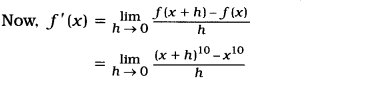
Take, $x + h = t.$ When $h \rightarrow 0, t \rightarrow x$ and $h = t – x$
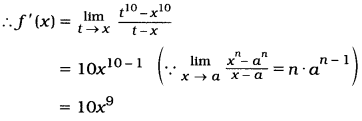
Hence, $f(x) = x^{10}$ then $f ‘(x) = 10x^9$ View full question & answer→Question 223 Marks
Production cost of a factory producing sugar is $C = \frac{x^{2}}{10} + 5x + 200. $ Find the marginal cost if the production is $100$ units and interpret it.
AnswerProduction cost $C = \frac{x^{2}}{10} + 5x + 200$
$\therefore $ Marginal cost $= \frac{d \mathrm{C}}{d x}$
$= \frac{d}{d x}\left[\frac{x^{2}}{10}+5 x+200\right]$
$= \frac{2 x}{10} + 5$
$= \frac{x}{5} + 5$
If the production is $x = 100,$ then
Marginal cost $= \frac{100}{5} + 5 = 20 + 5 = 25$
Interpretation: The cost of producing $101th$ unit will be $₹ 25.$
View full question & answer→Question 233 Marks
Determine whether the function $\mathrm{y}=3+2 \mathrm{x}-7 \mathrm{x}^2$ is increasing or decreasing at $\mathrm{x}=-4$ and $\mathrm{x}=4$.
Answer$y=3+2 x-7 x^2$
$\therefore \frac{d y}{d x}=0+2(1)-7(2 x)$
$=2-14 x$
$\text { At } x=-4, \frac{d y}{d x}=2-(14)(-4)$
$=2+56=58>0$
So, at $x=-4$ function is increasing.
At $x=4, \frac{d y}{d x}=2-(14)(4)=2-56=-54<0$
So, at $x=4$ function is decreasing.
View full question & answer→Question 243 Marks
Determine whether the function $y = 2x^3 – 7x^2 – 11x + 5$ is increasing or decreasing at $x = \frac{1}{2}$ and $x = 3.$
Answer$y = 2x^3 – 7x^2 – 11x + 5$
$\therefore \frac{d y}{d x} = 2(3x^2) – 7(2x) – 11(1) + 0$
$= 6x^2 – 14x – 11$
At $x = \frac{1}{2}, \frac{d y}{d x} = 6\left(\frac{1}{2}\right)^{2} – 14\left(\frac{1}{2}\right) – 11$
$= \frac{6}{4} – 7 – 11$
$= \frac{6}{4} – 18$
$= \frac{6 -72}{4}$
$= –\frac{66}{4}, < 0$
So, at $x = \frac{1}{2}$ function is decreasing.
At $x = 3, \frac{d y}{d x} = 6(3)^2 – 14(3) – 11$
$= (6 \times 9) – 42 – 11$
$= 54 – 53 = 1 > 0$
So, at $x = 3$ function is increasing.
View full question & answer→Question 253 Marks
Determine whether the function $\mathrm{y}=3 \mathrm{x}^2-\mathrm{x}+7$ is increasing or decreasing at $\mathrm{x}=1$ and $\mathrm{x}=2$.
Answer$y=3 x^2-x+7$
$\therefore \frac{d y}{d x}=3(2 x)-10(1)+0$
$=6 x-10$
At, $x=1 \frac{d y}{d x}=6(1)-10=6-10=-4<0$.
So, at $x=1$ function is decreasing.
At $x=2, \frac{d y}{d x}=6(2)-10=12-10=2 >0$.
So, at $x=2$ function is increasing.
View full question & answer→Question 263 Marks
Find marainal revenue if demand function is $D =\frac{2500-x^{2}}{\cdots}$
View full question & answer→Question 273 Marks
If $f(x)=3 x^{2}+4 x+5$, then for which value of $x, f^{\prime}(x)=f^{\prime \prime}(x) ?$
Answer$f(x)=3 x^2+4 x+5$
$ \therefore f^{\prime}(x)=3(2 x)+4(1)+0$
$ =6 x+4$
$ \text { Now } f^{\prime \prime}(x)=\frac{d}{d x}\left[f^{\prime}(x)\right]$
$ =\frac{d}{d x}[6 x+4]$
$ =6+0=6$
$ \text { But } f^{\prime}(x)=f^{\prime \prime}(x)$
$ \therefore 6 x+4=6$
$ \therefore 6 x=6-4$
$ \therefore 6 x=2$
$ \therefore x=\frac{2}{6}=\frac{1}{3}$
Hence, for $f(x)=3 x^2+4 x+5$ when $x=\frac{1}{3}, f^{\prime}(x)=f^{\prime \prime}(x)$.
View full question & answer→Question 283 Marks
Find $f^{\prime}(x)$ if $f(x)=\left(x^{2}+3 x+4\right)^{7}$
Answer$f(x)=\left(x^2+3 x+4\right)^7$
Taking, $\mathrm{u}=\mathrm{x}^2+3 \mathrm{x}+4$
$f(x)=u^7$
As per the chain rule,
$f^{\prime}(\mathrm{x})=\frac{d}{d u}\left(u^7\right) \times \frac{d}{d x}\left(\mathrm{x}^2+3 \mathrm{x}+4\right)$
$ =7 u^6 \times(2 \mathrm{x}+3)$
Putting, $u=x^2+3 x+4$
$f^{\prime}(x)=7\left(x^2+3 x+4\right)^6 \cdot(2 x+3)$
Hence, $f(x)=\left(x^2+3 x+4\right)^7$ then
$f^{\prime}(x)=7\left(x^2+3 x+4\right)^6 \cdot(2 x+3)$
View full question & answer→Question 293 Marks
Find the derivative of $\left(3 x^{3}-2 x^{2}+1\right)^{\frac{5}{2}}$ with respect to $x$.
View full question & answer→Question 303 Marks
Find $f^{\prime}(x)$ if $f(x)=\sqrt{x^{2}+5}$
View full question & answer→Question 313 Marks
Find $\frac{d y}{d x}$ if $y = 5 + \frac{6}{7 x+8}$
View full question & answer→Question 323 Marks
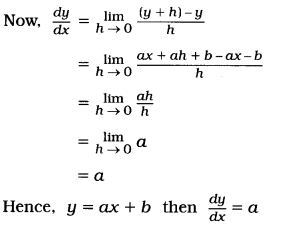
Find derivative of $y=a x+b(a$ and $b$ are constants$)$ using definition.
AnswerHere, $y = ax + b$
$\therefore (y + h) = a (x + h) = ax + ah + b$
View full question & answer→Question 333 Marks
Obtain the derivatives of the following function with the help of definition :
$f(x)=\frac{2}{3 x-4}, \quad x \neq \frac{4}{3}$
AnswerHere, $f(x)=\frac{2}{3 x-4}$
$\therefore f(x+h)=\frac{2}{3(x+h)-4}$
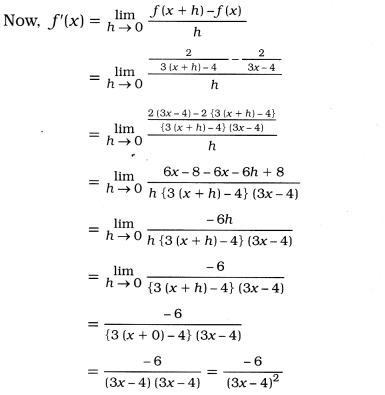
$\text { Hence, } f(x)=\frac{2}{3(x+h)-4} \text { then } f^{\prime}(x)=\frac{-6}{(3 x-4)^2} \text {. }$ View full question & answer→Question 343 Marks
Obtain the derivatives of the following function with the help of definition $f(x)=\sqrt[3]{x}$
AnswerHere, $\mathrm{f}(\mathrm{x})=\sqrt[3]{x}=x^{\frac{1}{3}}$
$\therefore f(x+h)=(x+h)^{\frac{1}{3}}$
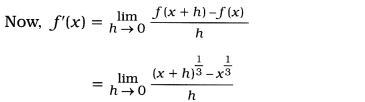
Take, $x + h = t,$ when $h \rightarrow 0, t \rightarrow x$ and $h = t – x$
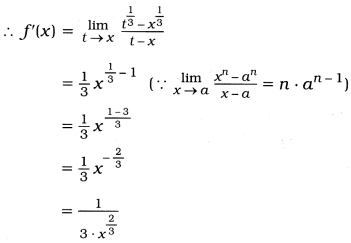
$\text { Hence, } f(x)=\sqrt[3]{x} \text { then } \mathrm{f}^{\prime}(x)=\frac{1}{3 \cdot x^{\frac{2}{2}}} \text {. }$ View full question & answer→Question 353 Marks
$f(x) = \frac{1}{x+1}, x \neq -1$
AnswerHere, $f(x) = \frac{1}{x+1}$
$\therefore f(x + h) = f(x)$
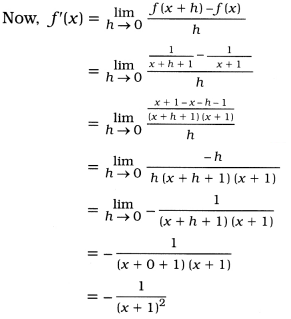
Hence, $f(x) = \frac{1}{x+1}$ then $f'(x) = -\frac{1}{(x+1)^{2}}$. View full question & answer→Question 363 Marks
Obtain the derivative of the following functions by using definition: $\frac{C}{\sqrt{x}}$
Answer$-\frac{c}{2 x^{\frac{3}{2}}}$
View full question & answer→Question 373 Marks
Obtain the derivative of the following functions by using definition: $5 x^{2}-3 x+7$
View full question & answer→Question 383 Marks
Obtain the derivative of the following functions by using definition: $3 k$
View full question & answer→Question 393 Marks
Obtain the derivative of the following functions by using definition: $\frac{1}{x+5}$
Answer$-\frac{1}{(x+5)^{2}}$
View full question & answer→Question 403 Marks
Obtain the derivative of the following functions by using definition: $\frac{x^{3}}{3 a}$
View full question & answer→Question 413 Marks
Obtain the derivative of the following functions by using definition: $a x^{2}+b x+c$
View full question & answer→Question 423 Marks
Find $f'(x)$ if $f(x)=(x^{2}+3x+4)^{7}.$
AnswerUsing Chain Rule :
$f'(x) = 7(x^2 + 3x + 4)^{7-1} \cdot \frac{d}{dx}(x^2 + 3x + 4)$
$f'(x) = 7(x^2 + 3x + 4)^6 (2x + 3)$.
View full question & answer→Question 433 Marks
If $f(x)=3x^{2}+4x+5$ then for which value of x, $f'(x)=f''(x)$ ?
Answer$f'(x) = 6x + 4$
$f''(x) = 6$
Set $f'(x) = f''(x)$:
$6x + 4 = 6$
$6x = 2$
$x = \frac{2}{6} = \frac{1}{3}$.
View full question & answer→Question 443 Marks
Determine whether the function $ y=3+2x-7x^{2} $ is increasing or decreasing at $ x=-4 $ and $ x=4 $.
Answer$ f'(x) = 2 - 14x $
At $ x = -4 $: $ f'(-4) = 2 - 14(-4) = 2 + 56 = 58 > 0 $ (Increasing)
At $ x = 4 $: $ f'(4) = 2 - 14(4) = 2 - 56 = -54 < 0 $ (Decreasing)
View full question & answer→Question 453 Marks
Find $\frac{dy}{dx}$, $y=\frac{2x+3}{3x-2}$.
AnswerUsing Quotient Rule : $\frac{v(du/dx) - u(dv/dx)}{v^2}$
$\frac{(3x-2)(2) - (2x+3)(3)}{(3x-2)^2}$
$= \frac{6x - 4 - 6x - 9}{(3x-2)^2}$
$ = \frac{-13}{(3x-2)^2}$.
View full question & answer→