Question 14 Marks
Find $\lim _{x \rightarrow 2} \frac{3 x^{2}-4 x-4}{x^{2}-4}, x \in R-\{2\}$ by tabular method.
Answer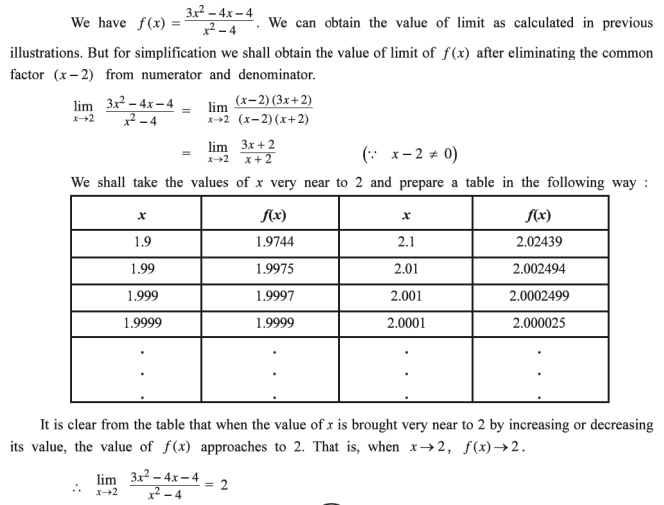
$(2)\ \lim _{x \rightarrow a}\left[\frac{x^{n}-a^{n}}{x-a}\right]=n a^{n-1}, \quad n \in Q$
We will see some illustrations based on View full question & answer→Question 24 Marks
Find $\lim _{x \rightarrow 1} \frac{1}{x-1}, x \in R-\{1\}$ by tabular method.
View full question & answer→Question 34 Marks
Find $\lim _{x \rightarrow 0} \frac{2 x^{2}+3 x}{x}, x \in R-\{0\}$ using tabular method.
View full question & answer→Question 44 Marks
Find $\lim _{x \rightarrow-1} \frac{x^{2}-1}{x+1}, x \in R-\{-1\}$ by preparing table.
View full question & answer→Question 54 Marks
Find $\lim _{x \rightarrow 3} 2 x+5$ by tabular method.
View full question & answer→Question 64 Marks
Express $(0.9, 1.1)$ in neighbourhood and modulus form.
AnswerComparing $(0.9,1.1)$ with $(a-\delta, a+\delta)$,
we get $a-\delta=0.9$ and $a+\delta=1.1$.
Adding $a-\delta=0.9$ and $a+\delta=1.1$, we get $2 a=2$
$\therefore a=1$.
Putting $a=1$ in $a+\delta=1.1$, we get $\delta=0.1$.
Neighbourhood form : $N(a, \delta)$
Putting $a=1$ and $\delta=0.1$,
$(0.9,1.1)=N(1,0.1)$
Modulus form : $|x-a|<\delta$
Putting $a=1$ and $\delta=0.1$,
$(0.9,1.1)=|x-1|<0.1$
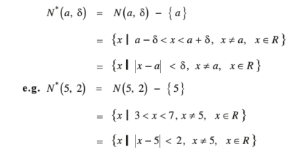
Punctured $\delta$ neighbourhood of $a$ :
If $a \in R$ and $\delta$ is a non-negative real number then the open interval $(a-\delta, a+\delta)-\{a\}$ is called punctured $\delta$ neighbourhood of $a$. It is denoted by $N^*(a, \delta)$.
Here, it can be understood that
View full question & answer→Question 74 Marks
Find the value of $\lim _{x \rightarrow 1} \frac{\sqrt{x+3}-2}{\sqrt{x+8}-3}$
Answer
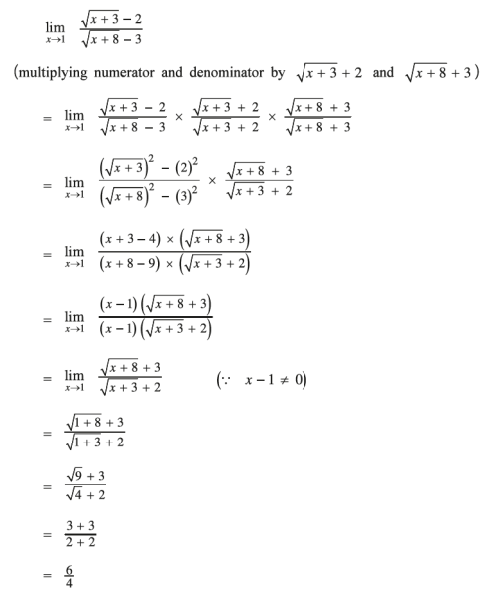
$=\frac{3}{2}$ View full question & answer→Question 84 Marks
Find the value of $\lim _{h \rightarrow 0} \frac{f(x+h)-f(x)}{h}$ where $f(x)=\sqrt{x}, x>0$.
View full question & answer→Question 94 Marks
If $f(x)=x^{3}$ then find the value of $\lim _{h \rightarrow 0} \frac{f(3+h)-f(3-h)}{2 h} .$
View full question & answer→Question 104 Marks
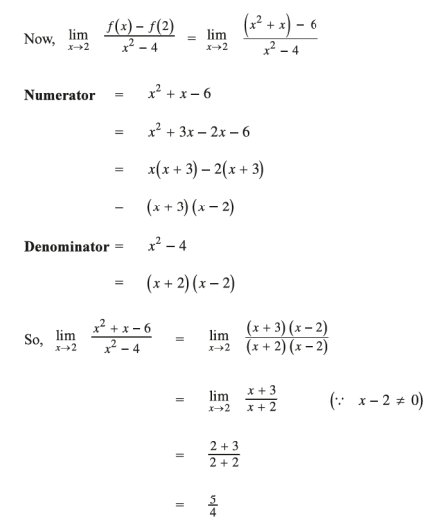
If $f(x)=x^{2}+x$ then find the value of $\lim _{x \rightarrow 2} \frac{f(x)-f(2)}{x^{2}-4}$.
AnswerHere, $f(x)=x^{2}+x$
$
\begin{aligned}
\therefore \quad f(2) &=(2)^{2}+2 \\
&=4+2 \\
&=6
\end{aligned}
$
View full question & answer→Question 114 Marks
Find the value of $\lim _{x \rightarrow-\frac{1}{2}} \frac{2 x^{2}-x-1}{4 x^{2}+8 x+3}$
View full question & answer→Question 124 Marks
$\lim\limits_{x \rightarrow 0} \frac{f(2+x)-f(2-x)}{2 x}$ where $f(x)=x^2$
Answer$f(x)=x^2$
$ \therefore f(2+x)=(2+x)^2=4+4 x+x^2$
$ f(2-x)=(2-x)^2=4-4 x+x^2$
$ \therefore \lim\limits_{x \rightarrow 0} \frac{f(2+x)-f(2-x)}{2 x}$
$ =\lim\limits_{x \rightarrow 0} \frac{4+4 x+x^2-4+4 x-x^2}{2 x}$
$ =\lim\limits_{x \rightarrow 0} \frac{8 x}{2 x} \quad$
$ =\lim\limits_{x \rightarrow 0} 4=4$
Hence, $ \lim\limits_{x \rightarrow 0} \frac{f(2+x)-f(2-x)}{2 x}=4$
View full question & answer→Question 134 Marks
$\lim\limits_{h \rightarrow 0} \frac{f(2+h)-f(2)}{h}$ where $f(x)=2 x^2+3$
Answer$f(x)=2 x^2+3$
$ \therefore f(2+h)=2(2+h)^2+3$
$ =2\left(4+4 h+h^2\right)+3$
$ =8+8 h+2 h^2+3$
$ =2 h^2+8 h+11$
$ f(2)=2\left(2^2\right)+3=2 \times 4+3=8+3=11$
$ \therefore \lim\limits_{h \rightarrow 0} \frac{f(2+h)-f(2)}{h}$
$ =\lim\limits_{h \rightarrow 0} \frac{2 h^2+8 h+11-11}{h}$
$ =\lim\limits_{h \rightarrow 0} \frac{h(2 h+8)}{h}$
$ =\lim\limits_{h \rightarrow 0} 2 h+8$
$ =0+8=8$
Hence, $ \lim\limits_{h \rightarrow 0} \frac{f(2+h)-f(2)}{h}=8$
View full question & answer→Question 144 Marks
Find the values of the following: $\lim\limits_{\mathbf{h} \rightarrow 0} \frac{f(x)-f(2)}{x-2}$; where $f(x)=\sqrt{x+7}$
Answer$f(x)=\sqrt{x+7}$
$ \therefore f(2)=\sqrt{2+7}=\sqrt{9}$
$ \therefore \lim\limits_{x \rightarrow 2} \frac{f(x)-f(2)}{x-2}=\lim\limits_{x \rightarrow 2} \frac{\sqrt{x+7}-\sqrt{9}}{x-2}$
Put $x+7=t$,
So when $x \rightarrow 2, t \rightarrow 9$ and $x=t-7$
$\therefore \lim\limits_{x \rightarrow 2} \frac{\sqrt{x+7}-\sqrt{9}}{x-2}$
$ =\lim\limits_{t \rightarrow 9} \frac{\sqrt{t}-\sqrt{9}}{t-7-2}$
$ =\lim\limits_{t \rightarrow 9} \frac{t^{\frac{1}{2}}-9^{\frac{1}{2}}}{t-9} \quad$
$ =\frac{1}{2}(9)^{\frac{1}{2}-1} \quad\left(\because \lim\limits_{x \rightarrow a} \frac{x^n-a^n}{x-a}=n \cdot a^{n-1}\right)$
$ =\frac{1}{2}(9)^{-\frac{1}{2}}$
$ =\frac{1}{2}\left[3^2\right]^{-\frac{1}{2}}=\frac{1}{2} \cdot(3)^{-1}$
$ =\frac{1}{2 \times 3}=\frac{1}{6}$
Hence, $ \lim\limits_{x \rightarrow 2} \frac{f(x)-f(2)}{x-2}=\frac{1}{6}$
View full question & answer→Question 154 Marks
$\lim\limits_{h \rightarrow 0} \frac{f(x+h)-f(x)}{h}$ where $f(x)=x^7$
Answer$f(x)=x^7$
$ \therefore f(x+h)=(x+h)^7$
$ \therefore h \rightarrow 0 \frac{f(x+h)-f(x)}{h}=\lim\limits_{h \rightarrow 0} \frac{(x+h)^7-x^7}{h}$
Put $x+h=t$
So when $h \rightarrow 0, t \rightarrow x$ and $h=t-x$
$\therefore \lim _{h \rightarrow 0} \frac{(x+h)^7-x^7}{h}$
$ =\lim\limits_{t \rightarrow x} \frac{t^7-x^7}{t-x} \quad$
$ =7(x)^{7-1} \quad\left(\because \lim\limits_{x \rightarrow a} \frac{x^n-a^n}{x-a}=n \cdot a^{n-1}\right)$
$ =7 x^6$
Hence, $ \lim\limits_{h \rightarrow 0} \frac{f(x+h)-f(x)}{h}=7 x^6$
View full question & answer→Question 164 Marks
$\lim\limits_{h \rightarrow 0} \frac{f(x+h)-f(x)}{h}$ where $f(x)=x^3$
Answer$f(x)=x^3$
$ \therefore f(x+h)=(x+h)^3$
$ \quad=x^3+3 x^2 h+3 x h^2+h^3$
$ \therefore \lim _{h \rightarrow 0} \frac{f(x+h)-f(x)}{h}$
$ =\lim\limits_{h \rightarrow 0} \frac{x^3+3 x^2 h+3 x h^2+h^3-x^3}{h}$
$ =\lim\limits_{h \rightarrow 0} \frac{h\left(3 x^2+3 x h+h^2\right)}{h}$
$ =\lim\limits_{h \rightarrow 0} 3 x^2+3 x h+h^2$
$ =3 x^2+3 x(0)+0=3 x^2+0=3 x^2$
Hence, $\lim\limits_{h \rightarrow 0} \frac{f(x+h)-f(x)}{h}=3 x^2$
View full question & answer→Question 174 Marks
$\lim\limits_{x \rightarrow \frac{1}{2}} \frac{f(x)-f\left(\frac{1}{2}\right)}{2 x-1}$ where $f(x)=x^2+x-1$
Answer$f(x)=x^2+x-1, \text { putting } x=\frac{1}{2}$
$ \therefore f\left(\frac{1}{2}\right)=\left(\frac{1}{2}\right)^2+\frac{1}{2}-1$
$ =\frac{1}{4}+\frac{1}{2}-1=\frac{1}{4}-\frac{1}{2}=-\frac{1}{4}$
$ \therefore \lim _{x \rightarrow \frac{1}{2}} \frac{f(x)-f\left(\frac{1}{2}\right)}{2 x-1}$
$ =\lim\limits_{x \rightarrow \frac{1}{2}} \frac{x^2+x-1-\left(-\frac{1}{4}\right)}{2 x-1}$
$ =\lim\limits_{x \rightarrow \frac{1}{2}} \frac{x^2+x-1+\frac{1}{4}}{2 x-1}$
$ =\lim\limits_{x \rightarrow \frac{1}{2}} \frac{x^2+x-\frac{3}{4}}{2 x-1}$
$ =\lim\limits_{x \rightarrow \frac{1}{2}} \frac{4 x^2+4 x-3}{4(2 x-1)}$
$ =\lim\limits_{x \rightarrow \frac{1}{2}} \frac{4 x^2+6 x-2 x-3}{4(2 x-1)}$
$ =\lim\limits_{x \rightarrow \frac{1}{2}} \frac{2 x(2 x+3)-1(2 x+3)}{4(2 x-1)}$
$ \left(\because \text { Common factor is }\left(x-\frac{1}{2}\right)=(2 x-1)\right)$
$ =\lim\limits_{x \rightarrow \frac{1}{2}} \frac{(2 x-1)(2 x+3)}{4(2 x-1)}$
$ =\lim\limits_{x \rightarrow \frac{1}{2}} \frac{2 x+3}{4} \quad$
$ =\frac{2\left(\frac{1}{2}\right)+3}{4}=\frac{1+3}{4}=\frac{4}{4}=1$
Hence, $\lim\limits_{x \rightarrow \frac{1}{2}} \frac{f(x)-f\left(\frac{1}{2}\right)}{2 x-1}=1$
View full question & answer→Question 184 Marks
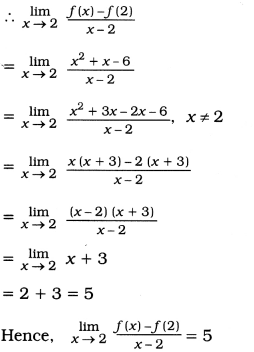
$\lim\limits_{x \rightarrow 2} \frac{f(x)-f(2)}{x-2}$ where $f(x)=x^2+x$
Answer$f(x) = x^2 + x$
$\therefore f(2) = (2)^2 + 2 = 4 + 2 = 6$
View full question & answer→Question 194 Marks
Find the values of the following: $\lim\limits_{h \rightarrow 0} \frac{(x+h)^7-x^7}{h}$
AnswerPut $x+h=t$,
So when $h \rightarrow 0, t \rightarrow x$ and $h=t-x$
$\therefore \lim\limits_{h \rightarrow 0} \frac{(x+h)^7-x^7}{h} =\lim\limits_{t \rightarrow x} \frac{t^7-x^7}{t-x}$
$ =7 \cdot(x)^{7-1}$
$\left(\because \lim _{x \rightarrow a} \frac{x^n-a^n}{x-a}=n \cdot a^{n-1}\right)$
$ =7 x^6$
Hence, $\lim\limits_{h \rightarrow 0} \frac{(x+h)^7-x^7}{h}=7 x^6$
View full question & answer→Question 204 Marks
Find the value of the following using tabular method: $\lim _{x \rightarrow 0} 3 x-1$
AnswerHere, $f(x) = 3x\ – 1$ and $x \rightarrow 0.$ Taking the values of $x$ very close to $0,$ the following table is prepared :
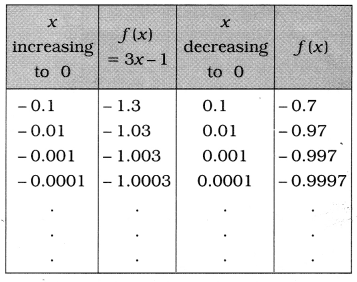
It is clear from the table that when $x$ is brought nearer to $0$ by increasing or decreasing its value, the value of $f(x)$ approaches to $– 1.$ That is.
when $x \rightarrow 0, f(x) \rightarrow\ – 1.$
$\therefore \lim _{x \rightarrow 0} 3 x-1=-1$ View full question & answer→Question 214 Marks
Find the values of the following using tabular method: $\lim\limits_{x \rightarrow-1} \frac{4 x^2+5 x+1}{x+1}$
AnswerHere, $f(x)=\frac{4 x^2+5 x+1}{x+1}$
Putting $x=-1$ in $f(x)$, we get $f(x)=\frac{0}{0}$.
So after eliminating the common factor $(x+1)$ of numerator and denominator of $f(x)$, the limit of $f(x)$ is found.
$f(x)=\frac{4 x^2+5 x+1}{x+1}$
$ =\frac{4 x^2+4 x+x+1}{x+1}$
$ =\frac{4 x(x+1)+1(x+1)}{x+1}$
$ =\frac{(4 x+1)(x+1)}{(x+1)}$
$ =4 x+1$
$ \therefore \lim\limits_{x \rightarrow-1} \frac{4 x^2+5 x+1}{x+1}=\lim\limits_{x \rightarrow-1} 4 x+1$
We shall take the value of $x$ very near to $-1$ and prepare a table in the following :
| $x$ |
$f(x)$ |
$x$ |
$f(x)$ |
| $-1.1$ |
$-3.4$ |
$-0.9$ |
$-2.6$ |
| $-1.01$ |
$-3.04$ |
$-0.99$ |
$-2.96$ |
| $-1.001$ |
$-3.004$ |
$-0.999$ |
$-2.996$ |
| $-1.0001$ |
$-3.0004$ |
$-0.9999$ |
$-2.9996$ |
| $∙$ |
$∙$ |
$∙$ |
$∙$ |
| $∙$ |
$∙$ |
$∙$ |
$∙$ |
| $∙$ |
$∙$ |
$∙$ |
$∙$ |
It is clear from the table that when the value of $x$ is brought very near to $-1$ by increasing or decreasing its value,
the value of $f(x)$ approaches to $-3.$
That is, when $x \rightarrow -1, f(x) \rightarrow -3.$
$\therefore \lim\limits_{x \rightarrow-1} \frac{4 x^2+5 x+1}{x+1}=-3$ View full question & answer→Question 224 Marks
Find the values of the following using tabular method: $\lim\limits_{x \rightarrow 1} \frac{2 x^2-3 x-5}{x-1}$
Answer$f(x)=\frac{2 x^2+3 x-5}{x-1}$
Putting $x=1$ in $f(x)$
$f(x)=\frac{0}{0}$.
So the common factor $(x-1)$ of numerator and denominator of $f(x)$, limit is found by tabular method.
$f(x)=\frac{2 x^2+3 x-5}{x-1}$
$ =\frac{2 x^2+5 x-2 x-5}{x-1}$
$ =\frac{x(2 x+5)-1(2 x+5)}{x-1}$
$ =\frac{(2 x+5)(x-1)}{x-1}$
$ =2 x+5$
$\therefore \lim\limits_{x \rightarrow 1} \frac{2 x^2+3 x-5}{x-1}=\lim\limits_{x \rightarrow 1} 2 x+5$
We shall take the value of $x$ very near to $1$ and prepare a table in the following :
| $x$ |
$f(x)$ |
$x$ |
$f(x)$ |
| $0.8$ |
$6.9$ |
$1.1$ |
$7.2$ |
| $0.99$ |
$6.98$ |
$1.01$ |
$7.02$ |
| $0.999$ |
$6.998$ |
$1.001$ |
$7.002$ |
| $0.9999$ |
$6.9998$ |
$1.0001$ |
$7.0002$ |
| $∙$ |
$∙$ |
$∙$ |
$∙$ |
| $∙$ |
$∙$ |
$∙$ |
$∙$ |
| $∙$ |
$∙$ |
$∙$ |
$∙$ |
It is clear from the table that when the value of $x$ is brought very near to $1$ by increasing or decreasing its value,
the value of $f(x)$ approaches to $7.$
That is, when $x \rightarrow 1, f(x) \rightarrow 7.$
$\therefore \lim\limits_{x \rightarrow 1} \frac{2 x^2+3 x-5}{x-1}=7$ View full question & answer→Question 234 Marks
Find the values of the following using tabular method: $\lim\limits_{x \rightarrow 5} \frac{x^2-3 x-10}{x-5}$.
AnswerHere, $f(x)=\frac{x^2-3 x-10}{x-5}$
Putting $x=5$ in $f(x)$
$f(x)=\frac{0}{0}$.
So the common factor of numerator and denominator of $f(x)$ is $x-5$.
After eliminating this common factor from $f(x)$, we find the limit of $f(x)$.
$\mathrm{f}(x)=\frac{x^2-5 x+2 x-10}{x-5}$
$ =\frac{x(x-5)+2(x-5)}{x-5}$
$ =\frac{(x-5)(x+2)}{x-5}$
$ =x+2$
$ \therefore \lim\limits_{x \rightarrow 5} \frac{x^2-3 x-10}{x-5}=\lim\limits_{x \rightarrow 5} x+2$
We shall take the value of $x$ very near to $5$ and prepare a table in the following :
| $x$ |
$f(x)$ |
$x$ |
$f(x)$ |
| $4.9$ |
$6.9$ |
$5.1$ |
$7.1$ |
| $4.99$ |
$6.99$ |
$5.01$ |
$7.01$ |
| $4.999$ |
$6.999$ |
$5.001$ |
$7.001$ |
| $4.9999$ |
$6.9999$ |
$5.0001$ |
$7.0001$ |
| $∙$ |
$∙$ |
$∙$ |
$∙$ |
| $∙$ |
$∙$ |
$∙$ |
$∙$ |
| $∙$ |
$∙$ |
$∙$ |
$∙$ |
It is clear from the table that when the value of $x$ is brought very near to $5$ by increasing or decreasing its value,
the value of $f(x)$ approaches to $7.$
That is, when $x \rightarrow 5, f(x) \rightarrow 7.$
$\therefore \lim\limits_{x \rightarrow 5} \frac{x^2-3 x-10}{x-5}=7$ View full question & answer→Question 244 Marks
Using tabular method, prove that $\lim\limits_{x \rightarrow-1} \frac{3}{x+1}$ does not exist.
Answer$\lim\limits_{x \rightarrow-1} \frac{3}{x+1}$
Here, $f(x)=\frac{3}{x+1}$
$x \rightarrow-1$.
So taking the values of $x$ very close to $-1,$ the following table is prepared:
$\lim\limits_{x \rightarrow 1} \frac{2 x^2+3 x-5}{x-1}$
It is clear from the table that when $\mathrm{x}$ is brought nearer to $-1$ by increasing or decreasing its value,
the value of $f(x)$ does not approach to a particular value.
That is, when $x \rightarrow -1, f(x)$ does not tend to a particular value.
Hence, it is proved that $\lim\limits_{x \rightarrow-1} \frac{3}{x+1}$ does not exist.
View full question & answer→Question 254 Marks
If $y=\frac{3 x^2+16 x+16}{x+4}$ then using tabular method, prove that when $x \rightarrow-4, y \rightarrow-8$.
Answer$ y=\frac{3 x^2+16 x+16}{x+4}$
$ =\frac{3 x^2+12 x+4 x+16}{x+4}$
$ =\frac{3 x(x+4)+4(x+4)}{x+4}$
$ =\frac{(x+4)(3 x+4)}{x+4}$
$ =3 x+4$
We shall take the value of $x$ very near to $-4$ and prepare a table in the following way.
| $x$ |
$f(x)$ |
$x$ |
$f(x)$ |
| $-4.1$ |
$-8.3$ |
$-3.9$ |
$-7.7$ |
| $-4.01$ |
$-8.03$ |
$-3.99$ |
$-7.97$ |
| $-4.001$ |
$-8.003$ |
$-3.999$ |
$-7.997$ |
| $-4.0001$ |
$-8.0003$ |
$-3.9999$ |
$-7.9997$ |
| $∙$ |
$∙$ |
$∙$ |
$∙$ |
| $∙$ |
$∙$ |
$∙$ |
$∙$ |
| $∙$ |
$∙$ |
$∙$ |
$∙$ |
It is clear from the table that when the value of $x$ is brought very neat ot $-4$ by increasing or decreasing its value,
the value of $y$ approaches to $-8.$
That is, when $x \rightarrow 4, y \rightarrow -8.$ View full question & answer→Question 264 Marks
Find the values of the following using tabular method: $\lim\limits_{x \rightarrow 0} 3 x-1$.
AnswerHere, $f(x) = 3x - 1$ and $x \rightarrow 0.$
We shall take the value of $x$ very near to $-1$ and prepare a table in the following :
| $X$ |
$f(x)$ |
$x$ |
$f(x)$ |
| $-1.1$ |
$-1.3$ |
$0.1$ |
$-0.7$ |
| $-1.01$ |
$-1.03$ |
$0.01$ |
$-0.97$ |
| $-1.001$ |
$-1.003$ |
$0.001$ |
$-0.997$ |
| $-1.0001$ |
$-1.0003$ |
$0.0001$ |
$-0.9997$ |
| $∙$ |
$∙$ |
$∙$ |
$∙$ |
| $∙$ |
$∙$ |
$∙$ |
$∙$ |
| $∙$ |
$∙$ |
$∙$ |
$∙$ |
It is clear from the table that when the value of $x$ is brought very near to $0$ by increasing or decreasing its value,
the value of $f(x)$ approaches to $-1.$
That is, when $x \rightarrow 0, f(x) \rightarrow -1.$
$\therefore \lim _{x \rightarrow 0} 3 x-1=-3$ View full question & answer→Question 274 Marks
Find the value of the following: $\lim _{x \rightarrow 3} \frac{x^{5}-243}{x-3}$
View full question & answer→Question 284 Marks
Find the value of the following: $\lim _{x \rightarrow 2} \frac{x^{7}-128}{x-2}$
View full question & answer→Question 294 Marks
If $f(x)=x^{2}+5$, find $\lim _{h \rightarrow 0} \frac{f(3+h)-f(3)}{h}$
View full question & answer→Question 304 Marks
If $f(x)=x^{2}+5 x+1$, find $\lim _{x \rightarrow \frac{5}{2}} \frac{f(x+2)-f(x-2)}{4 x^{2}-25}$
View full question & answer→Question 314 Marks
If $f ( x )=x^{2}+5$, find $\lim _{x \rightarrow 0} \frac{f(x+2)-f(x-2)}{x}$
View full question & answer→Question 324 Marks
If $f(x)=x^{2}+x-1$, find $\lim _{x \rightarrow \frac{1}{2}} \frac{f(x)-f\left(\frac{1}{2}\right)}{2 x-1}$
View full question & answer→Question 334 Marks
If $f(x)=2 x^{2}+3 x$, find $\lim _{h \rightarrow 0} \frac{f(2+h)-f(2)}{h}$
View full question & answer→Question 344 Marks
Find the value of the following: $\lim _{x \rightarrow 2}\left[\frac{1}{x-2}-\frac{1}{x^{2}-3 x+2}\right]$
View full question & answer→Question 354 Marks
Find the value of the following: $\lim _{x \rightarrow 0}\left[\frac{1}{2 x}\left(x+\frac{3 x}{2 x+5}\right)\right]$
View full question & answer→Question 364 Marks
Find the value of the following : $\lim _{x \rightarrow 0}\left[\frac{1}{x}\left(\frac{5 x+14}{x+2}-7\right)\right]$
View full question & answer→Question 374 Marks
Find the value of the following : $\lim _{x \rightarrow 2}\left[\frac{1}{x-2}-\frac{2}{x^{2}-2 x}\right]$
View full question & answer→Question 384 Marks
Find the value of the following: $\lim _{h \rightarrow 0} \frac{1}{h}\left[\frac{a}{a+h}-1\right]$
View full question & answer→Question 394 Marks
Find the limit of the following functions using tabular method: $\lim _{x \rightarrow 2} \frac{2 x^{2}-3 x-2}{x-2}$
View full question & answer→Question 404 Marks
Find the limit of the following functions using tabular method: $\lim _{x \rightarrow-3} \frac{x^{2}+4 x+3}{x+3}$
View full question & answer→Question 414 Marks
Find the value of $\lim _{x \rightarrow 2} \frac{f(x)-f(2)}{x-2}$ where $f(x)=x^2+x$.
Answer$f(2) = 2^2 + 2 = 6$.
$lim_{x\rightarrow2} \frac{x^2+x-6}{x-2} = lim_{x\rightarrow2} \frac{(x+3)(x-2)}{x-2}$
$= lim_{x\rightarrow2} (x+3) = 2+3 = 5$.
View full question & answer→Question 424 Marks
Find the value of : $\lim_{x\rightarrow2}\frac{\sqrt{x+7}-3}{x-2}$
AnswerMultiply numerator and denominator by conjugate $\sqrt{x+7}+3$ :
$\lim_{x\rightarrow2}\frac{(\sqrt{x+7}-3)(\sqrt{x+7}+3)}{(x-2)(\sqrt{x+7}+3)}$
= $\lim_{x\rightarrow2}\frac{x+7-9}{(x-2)(\sqrt{x+7}+3)}$
= $\lim_{x\rightarrow2}\frac{x-2}{(x-2)(\sqrt{x+7}+3)}$
= $\lim_{x\rightarrow2}\frac{1}{\sqrt{x+7}+3}$
= $\frac{1}{\sqrt{9}+3} = \frac{1}{3+3} = \frac{1}{6}$.
View full question & answer→Question 434 Marks
Find the value of $ lim_{x\rightarrow0} \frac{\sqrt{3+x}-\sqrt{3}}{x} $
AnswerMultiply numerator and denominator by conjugate :
$ \frac{\sqrt{3+x}-\sqrt{3}}{x} \cdot \frac{\sqrt{3+x}+\sqrt{3}}{\sqrt{3+x}+\sqrt{3}} = \frac{3+x-3}{x(\sqrt{3+x}+\sqrt{3})} = \frac{1}{\sqrt{3+x}+\sqrt{3}} $
Taking limit $ x \rightarrow 0 $ :
$ \frac{1}{\sqrt{3}+\sqrt{3}} = \frac{1}{2\sqrt{3}} $
View full question & answer→Question 444 Marks
Find the value of : $\lim _{x \rightarrow-\frac{1}{2}} \frac{2 x^2-x-1}{4 x^2+8 x+3}$
Answer$\lim _{x \rightarrow-\frac{1}{2}} \frac{(2 x+1)(x-1)}{(2 x+1)(2 x+3)}$
$\lim _{x \rightarrow-\frac{1}{2}} \frac{x-1}{2 x+3}$
$\frac{-\frac{1}{2}-1}{2\left(-\frac{1}{2}\right)+3}=\frac{-\frac{3}{2}}{-1+3}=\frac{-\frac{3}{2}}{2}$
$\frac{-3}{4}$
View full question & answer→