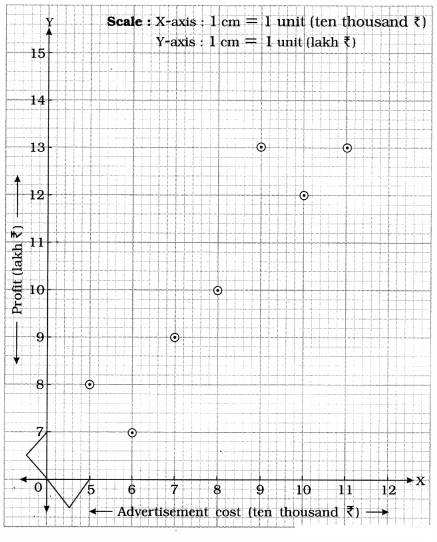
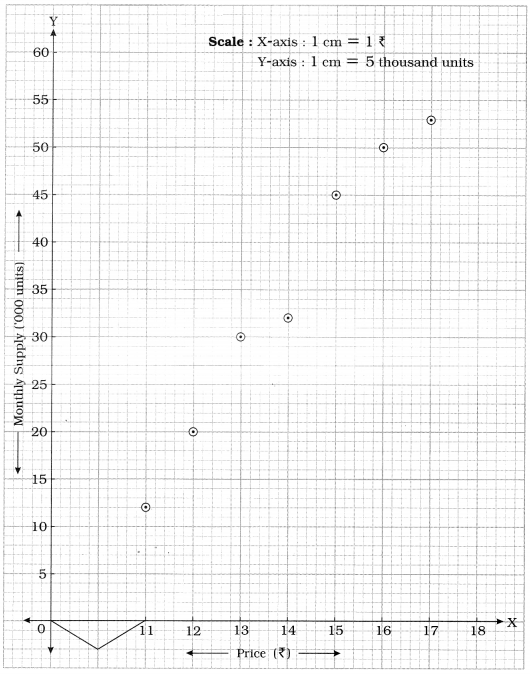
Since one of the means is fractional and the values of variables $X$ and $Y$ are not very large, we shall compute $r$ as follows.
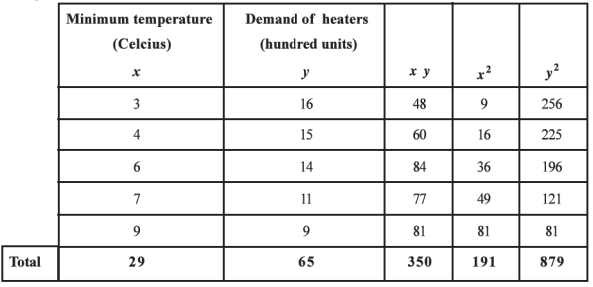
$ r =\frac{n \Sigma x y-(2 x)(2 y)}{\sqrt{n \Sigma x^{2}-(\Sigma x)^{2}} \cdot \sqrt{n \Sigma y^{2}-(\Sigma y)^{2}}}$
$ =\frac{5(350)-(29)(65)}{\sqrt{5(191)-(29)^{2}} \cdot \sqrt{5(879)-(65)^{2}}}$
$ =\frac{1750-1885}{\sqrt{955-841} \cdot \sqrt{4395-4225}}$
$ =\frac{-135}{\sqrt{114} \cdot \sqrt{170}}$
$ =\frac{-135}{\sqrt{19380}}$
$ =\frac{-135}{139.2121}$
$ =-0.9697$
$\therefore r \sim-0.97 $
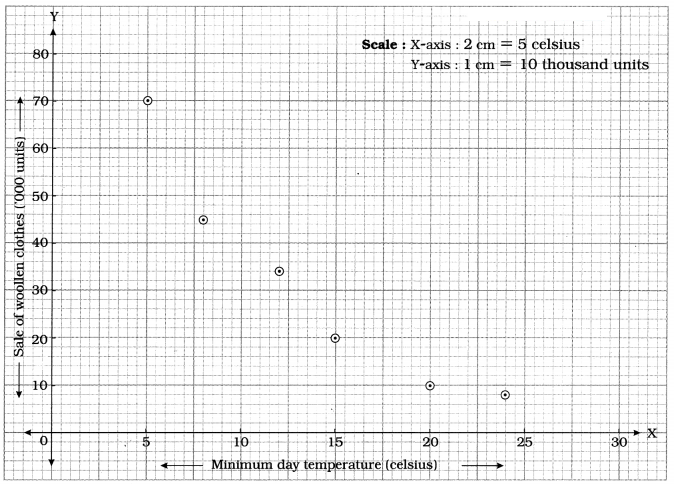
We can see that the value ofr is very close to $-1.$
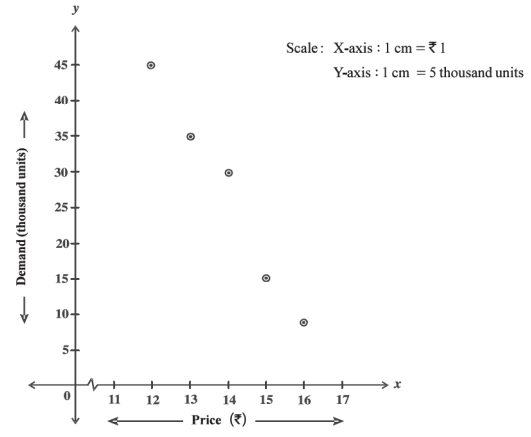
Thus, there is a high degree of negative correlation between minimum temperature and $d$
emand of heaters.
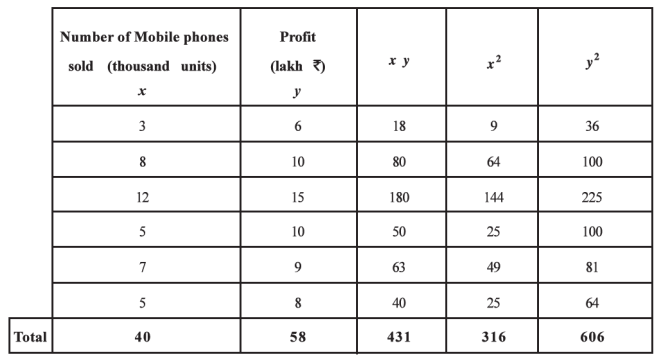
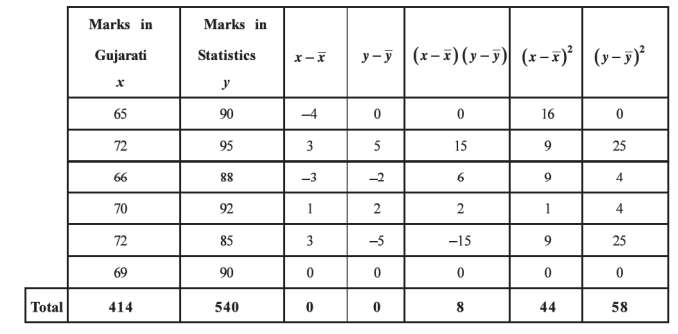
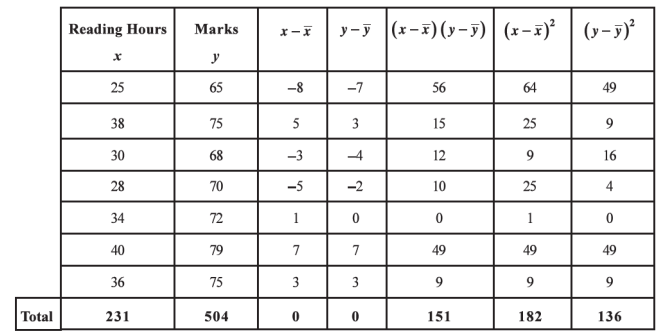
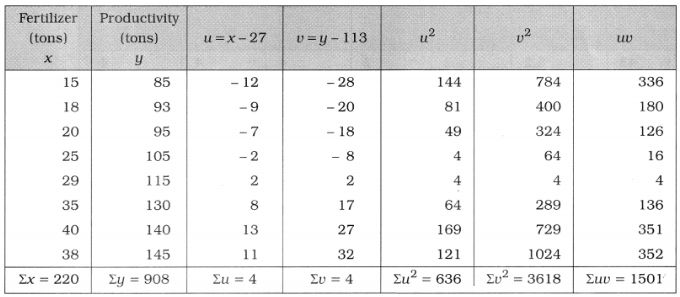
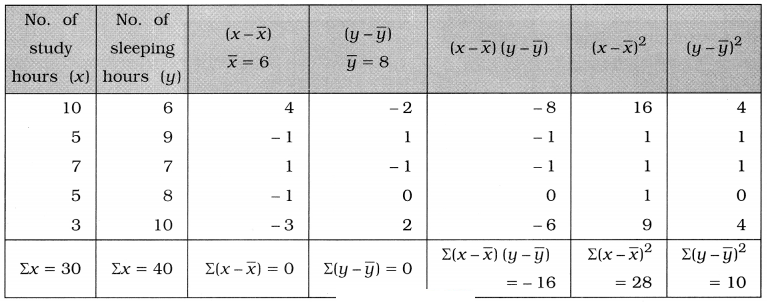
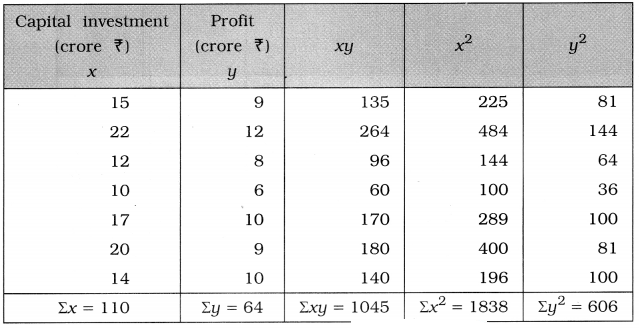
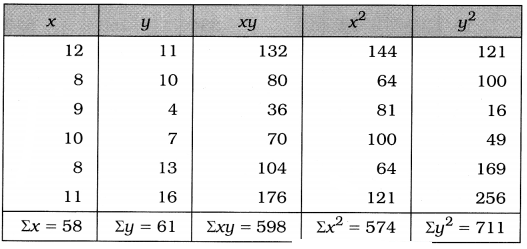
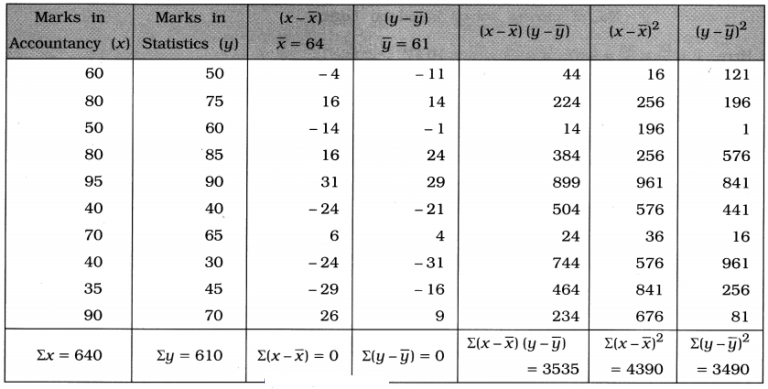
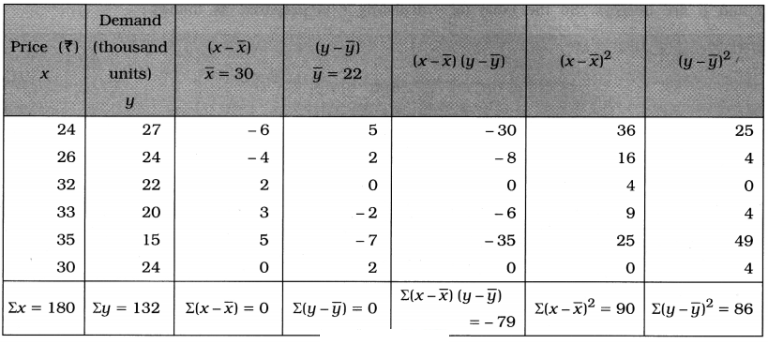
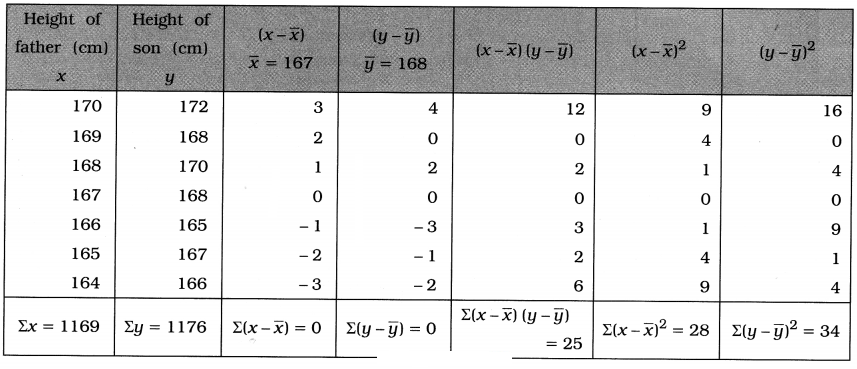
In illustrations $(7)$ and $(8),$ we have seen that both means were not integers and the values of $X$ and $Y$ were not very large and hence we have used the following formula to compute the value of $r.$
$r=\frac{n \Sigma x y-(\Sigma x)(\Sigma y)}{\sqrt{n \Sigma x^{2}-(\Sigma x)^{2}} \cdot \sqrt{n \Sigma y^{2}-(\Sigma y)^{2}}}$
But when the values of two variables are numerically large and/or fractional, the computation of $x y, x^{2}, y^{2}$ becomes more difficult and hence the calculation of $r$ becomes tedius.
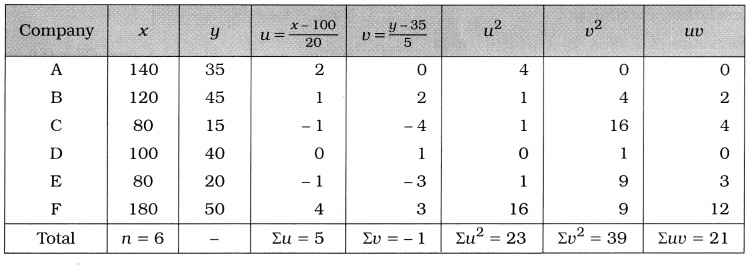
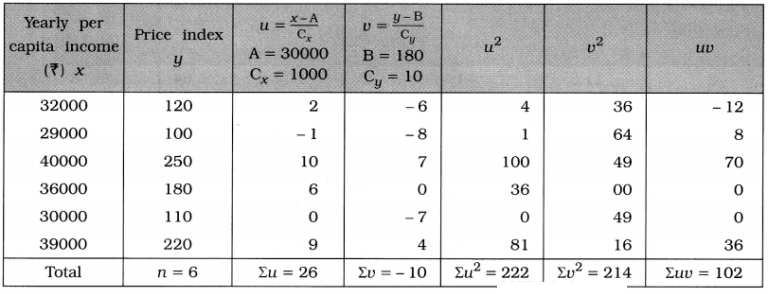
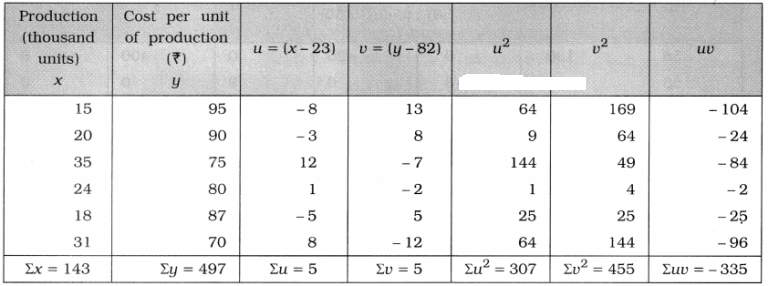
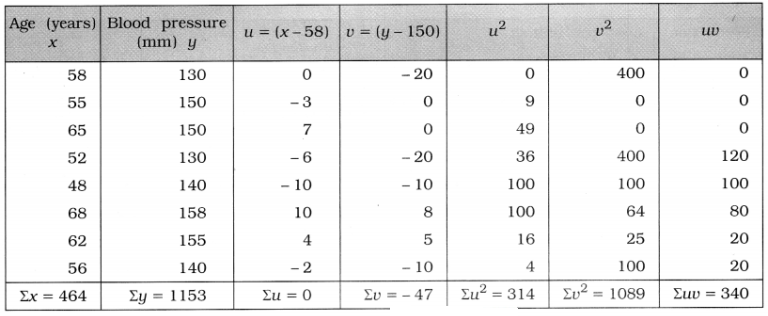
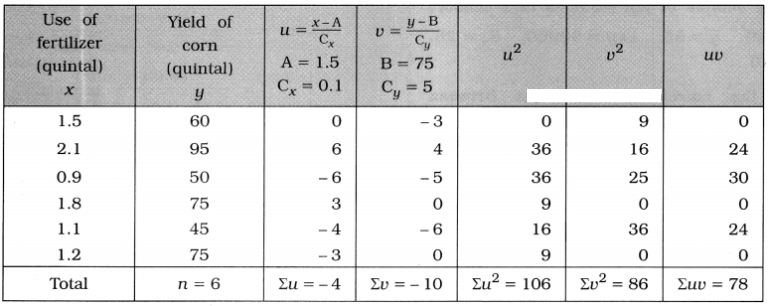
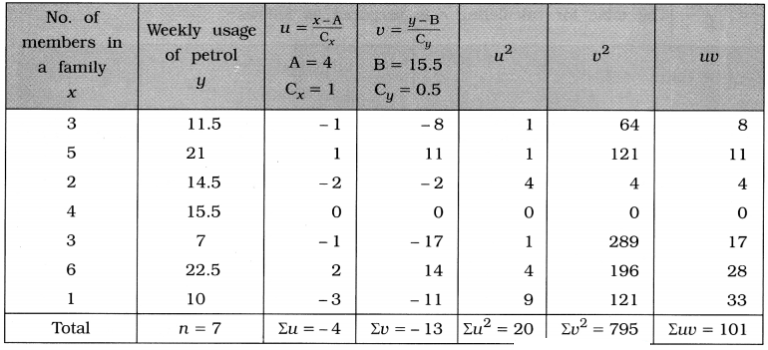
So, in order to make the computation of $r$ simple, a short-cut method is used. This short-cut method is based on the property $($No. $4)$ of $r$.
According to this property, replacing $x$ by $u$ and $y$ by $v$ in the formula of $r,$ we get the following formula of $r$ by short-cut method.
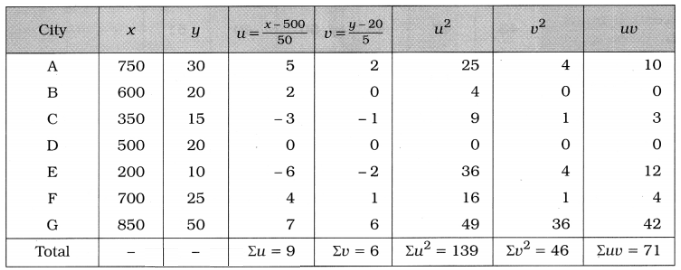
$r=\frac{n \Sigma u v-(\Sigma u)(\Sigma v)}{\sqrt{n \Sigma u^{2}-(\Sigma u)^{2}} \cdot \sqrt{n \Sigma v^{2}-(\Sigma v)^{2}}}$
Now, we consider some examples to illustrate the computation of $r$ by the short-cut method.