Question 12 Marks
The events $A_{1}$ and $A_{2}$ of a random experiment are defined as follows. Find the sets showing union event $A_{1} \cup A_{2}$ and intersection event $A_{1} \cap A_{2}$.
Answer$A_{1}=\{x \mid x=-1,0,1\}, A_{2}=\{x \mid x=1,2,3\}$
It is given that $A_{1}=\{-1,1,0\}$ and $A_{2}=\{1,2,3\}$.
Union of events $A_{1} \cup A_{2}=\{-1,0,1,2,3\}$
Intersection of events $A_{1} \cap A_{2}=\{1\}$
View full question & answer→Question 22 Marks
Write the sample space of a random experiment of randomly selecting any one number from the natural numbers.
AnswerThe natural numbers are $1,2,3, \ldots . .$
If one number is randomly selected from these numbers then the sample space will be as follows: $U=\{1,2,3,4, \ldots\}$
It should be noted here that this is an infinite sample space.
View full question & answer→Question 32 Marks
Write the sample space of random experiment of randomly selecting three numbers from the first four natural numbers.
AnswerIf three numbers are selected simultaneously from the first four natural numbers $1,2,3,4$ then those three numbers can be $(1,2,3),(1,2,4),(1,3,4)$ or $(2,3,4)$.
Thus, the sample space of the random experiment will be as follows : $U=\{(1,2,3),(1,2,4),(1,3,4),(2,3,4)\}$
$ 3$ numbers are to be selected here from the 4 numbers which has ${ }^{4} C_{3}=4$ combinations.
Thus, the total number of outcomes for this random experiment is $4 .$
View full question & answer→Question 42 Marks
Write the sample space of the random experiment of finding the number of defective items while testing the quality of $\mathbf{1 0 0 0}$ items produced in a factory.
AnswerIf the defective items are found among $1000$ items produced in the factory then the number of defective items in the production can be $0,1,2, \ldots, 1000$. Thus, the sample sapce will be as follows:
$ U=\{0,1,2, \ldots, 1000\}$
View full question & answer→Question 52 Marks
Two events $A$ and $B$ in the sample space of a random experiment are mutually exclusive. If $3 P(A)=4 P(B)=1$ then find $P(A \cup B)$.
AnswerSince $3 P(A)=4 P(B)=1$
$3 P(A)=1 4 P(B)=1$
$P(A)=\frac{1}{3}$
$\therefore P(B)=\frac{1}{4}$
As the events $A$ and $B$ are mutually exclusive $(A \cap B=\phi)$,
$P(A \cup B) =P(A)+P(B)$
$ =\frac{1}{3}+\frac{1}{4}$
$ =\frac{7}{12} $
Required probability $=\frac{7}{12}$
View full question & answer→Question 62 Marks
Two balanced dice are thrown where each die has numbers $1$ to $6$ on the six sides. Write the sample space of this experiment.
View full question & answer→Question 72 Marks
The probability that the price of potato rises in the vegetable market during festive days in $0.8$. The probability that the price of onion rises is $0.7 .$ The probability of rise in price of both potato and onion is $0.6$ Find the probability of rise in price of at least one of the two, potato and onion.
View full question & answer→Question 82 Marks
State the law of addition of probability for two events $A$ and $B.$ Write the law of addition of probability if these two events are mutually exclusive.
AnswerThe law of addition of probability for two events $A$ and $B$ is as follows :
$P(A ∪ B) = P(A) + P(B) – P(A ∩ B)$
If $A$ and $B$ are mutually exclusive events, $A ∩ B = 0$ and $P (A ∩ B) = 0.$
Hence, the law of addition of probability for two events $A$ and $B$ is written as follows:
$P(A ∪ B) = P(A) + P(B)$
View full question & answer→Question 92 Marks
Explain the equi-probable events with illustration.
AnswerIf there is no apparant reason to believe that out of one or more events of a random experiment,
any one event is more or less likely to occur than the other events, then those events are called equi-probable.
Illustration: In the random experiment of tossing a balance coin, two events of getting head $(H)$ and getting tail $(T)$ are equi-probable,
$\text { because } P(H)=P(T)=\frac{1}{2}$
View full question & answer→Question 102 Marks
State the limitations of mathematical definition of probability.
AnswerThe limitations of mathematical definition of probability are as follows :
- The probability of an event cannot be found if the outcomes are infinite.
- If the total number of outcomes is not known, the probability of an event cannot be found.
- If the elementary outcomes in the sample space are not equi-probable, the probability of an event cannot be found.
View full question & answer→Question 112 Marks
The price of petrol rises in $80 \%$ of the cases and the price of diesel rises in $77\%$ of the cases after the rise in price of crude oil. The price of petrol and diesel rises in $68 \%$ cases. Find the probability that the price of diesel rises under the condition that there is a rise in the price of petrol.
Answer$\mathrm{A}=$ Event that the price of petrol rises
$\therefore P(A)=\frac{80}{100}$
$B=$ Event that the price of diesel rises
$\therefore P(B)=\frac{77}{100}$
$A \cap B=$ Event that the prices of both petrol and diesel rises
$\therefore P(A \cap B)=\frac{68}{100}$
$\mathrm{B} \mid \mathrm{A}=$ Event that the price of diesel rises knowing that the price of petrol rises
$\therefore \mathrm{P}(\mathrm{B} \mid \mathrm{A})=\frac{P(A \cap B)}{P(A)}$
$ =\frac{\frac{68}{100}}{\frac{80}{100}}$
$ =\frac{68}{100} \times \frac{100}{80}$
$ =\frac{17}{20}$
View full question & answer→Question 122 Marks
Give the illustrations of finite and infinite sample space.
AnswerFinite sample space: The sample space obtained for the random experiment throwing a balanced’ six face die $U = \{1, 2, 3, 4, 5, 6\}$ is the illustration of finite sample space.Infinite sample space: The sample space obtained for the random experiment of selecting a card from a pack of $52$ cards till it is ace of heart is the illustration of infinite sample space.
View full question & answer→Question 132 Marks
$\text { If } P(B)=\frac{3}{5} \text { and } P\left(A^{\prime} \cap B\right)=\frac{1}{2} \text { for two events } A \text { and } B \text {, find } P(A \mid B) \text {. }$
Answer$P(B)=\frac{3}{5}$ and $P\left(A^{\prime} \cap B\right)=\frac{1}{2}$ are given.
$\therefore \mathrm{P}\left(\mathrm{A}^{\prime} \cap \mathrm{B}\right)=\mathrm{P}(\mathrm{B})-\mathrm{P}(\mathrm{A} \cap \mathrm{B})$
$ \therefore \frac{1}{2}=\frac{3}{5}-\mathrm{P}(\mathrm{A} \cap \mathrm{B})$
$ \therefore \mathrm{P}(\mathrm{A} \cap \mathrm{B})=\frac{3}{5}-\frac{1}{2}=\frac{6-5}{10}=\frac{1}{10}$
$ \text { Now, } \mathrm{P}(\mathrm{A} \mid \mathrm{B})=\frac{P(A \cap B)}{P(B)}$
$ =\frac{1}{\frac{10}{\frac{3}{5}}}=\frac{1}{10} \times \frac{5}{3}=\frac{1}{6}$
$ \therefore \mathrm{P}(\mathrm{A} \mid \mathrm{B})=\frac{1}{6}$
View full question & answer→Question 142 Marks
If $P(A ∩ B) = 0.12$ and $P(B) = 0.3$ for two independent events $A$ and $B,$ then find $P(A\cup B).$
Answer$\mathrm{A}$ and $\mathrm{B}$ are independent events.
$\therefore P(A \cap B)=P(A)-P(B)$
$ \therefore 0.12=P(A) \times 0.3$
$ \therefore P(A)=\frac{0.12}{0.3}=0.4 $
Now, according to the law of addition of probability,
$ P(A \cup B)=P(A)+P(B)-P(A \cap B)$
$ =0.4+0.3-0.12$
$ =0.58 $$
View full question & answer→Question 152 Marks
If $5P (A) = 3P (B) = 2P (A ∪ B) = f$ for two events $A$ and $B,$ then find $P(A’ ∪ B’).$
Answer$5 P(A)=3 P(B)=2 P(A \cup B)=\frac{3}{2}$
$ \therefore 5 P(A)=\frac{3}{2} \text { and } 3 P(B)=\frac{3}{2} \text { and } 2 P(A \cup B)=\frac{3}{2}$
$ \therefore P(A)=\frac{3}{2 \times 5}=\frac{3}{10}$
$ \therefore P(B)=\frac{3}{2 \times 3}=\frac{1}{2}$
$ \therefore P(A \cup B)=\frac{3}{2 \times 2}=\frac{3}{4}$
According to the law of addition of probability,
$P(A \cup B)=P(A)+P(B)-P(A \cap B)$
$ \frac{3}{4}=\frac{3}{10}+\frac{1}{2}-P(A \cap B)$
$ \therefore P(A \cap B)=\frac{3}{10}+\frac{1}{2}-\frac{3}{4}$
$ =\frac{6+10-15}{20}=\frac{1}{20}$
Now, $P\left(A^{\prime} \cup B^{\prime}\right)=P(A \cap B)^{\prime}$
$=1-P(A \cap B)=1-\frac{1}{20}=\frac{19}{20}$
View full question & answer→Question 162 Marks
If the events $A$ and $B$ are independent and $3P(A) = 2P(B) = 0.12,$ then find $P(A ∩ B).$
Answer$ 3 P(A)=2 P(B)=0.12$
$ \therefore 3 P(A)=0.12 \text { and } 2 P(B)=0.12$
$ \therefore P(A)=\frac{0.12}{3}$
$ =0.04$
$ \text { and }$
$ P(B)=\frac{0.12}{2}$
$ =0.06 $
Now, $A$ and $B$ are independent events.
$ \therefore P(A \cap B)=P(A)-P(B)$
$ =0.04 \times 0.06$
$ =0.0024 $$
View full question & answer→Question 172 Marks
If $P(B) = 2P(A|B) = 0.4,$ then find $P(A\cap B).$
Answer$P(B)=2 P(A \mid B)=0.4$
$ \therefore P(B)=0.4,2 P(A \mid B)=0.4$
$ \therefore P(A \mid B)=\frac{0.4}{2}=0.2$
$ \text { Now, } P(A \mid B)=\frac{P(A \cap B)}{P(B)}$
$ \therefore P(A \cap B)=P(A \mid B) \cdot P(B)$
$ =0.2 \times 0.4=0.08$
View full question & answer→Question 182 Marks
$\text { If } p(A)=\frac{1}{3}, P(B)=\frac{2}{3} \text { and } P(A \cap B)=\frac{1}{6} \text {, then find } P\left(A^{\prime} \cap B^{\prime}\right) \text {. } $
Answer$p(A)=\frac{1}{3}, P(B)=\frac{2}{3}$ and $P(A \cap B)=\frac{1}{6}$ are given.
According to the law of addition of probability,
$P(A \cup B)=P(A)+P(B)-P(A \cap B)$
$ =\frac{1}{3}+\frac{2}{3}-\frac{1}{6}$
$ =\frac{2+4-1}{6}$
$ =\frac{5}{6}$
Now, $P\left(A^{\prime} \cap B^{\prime}\right)=P(A \cup B)^{\prime}$
$=1-P(A \cup B)$
$ =1-\frac{5}{6}$
$ =\frac{6-5}{6}$
$ =\frac{1}{6}$
View full question & answer→Question 192 Marks
State the following results for two independent events $A$ and $B :$
- $P(A ∩ B)$
- $P (A’ ∩ B’)$
- $P(A ∩ B’)$
- $P(A’ ∩ B)$
AnswerFor two independent events $A$ and $B,$ the results are obtained as follows :
- $P(A ∩ B) = P(A) \times P(B)$
- $P(A’ ∩ B’) = P(A’) \times P(B’)$
- $P(A ∩ B’) = P(A) \times P(B’)$
- $P(A’ ∩ B) = P(A’) \times P(B)$
View full question & answer→Question 202 Marks
State the law of multiplication of probability for two events $A$ and $B.$ Write the law of multiplication of probability if these two events are independent.
AnswerThe law of multiplication of probability for two events $A$ and $B$ is as follows:
$P(A ∩ B) = P(A|B) ∙ P(B)$ OR
$P(A ∩ B) = P(B|A) ∙ P(A)$
If two events A and B are independent, $P(A|B) = P(A)$ and $P(B|A) = P(B).$
So the law of multiplication of probability for two events $A$ and $B$ is written as follows :
$P(A\cap B) = P(A) ∙ P(B)$
View full question & answer→Question 212 Marks
If $P(A)=\frac{2}{3}, P(B)=\frac{3}{5}$ and $P(B \mid A)=\frac{3}{4}$ for two events in the sample space of a random experiment, then find $P(A \mid B)$.
AnswerHere, $P(A)=\frac{2}{3}, P(B)=\frac{3}{5}$ and $P(B \mid A)=\frac{3}{4}$ are given.
$p ( B \mid A )=\frac{P(A \cap B)}{P(A)}$
$\therefore P ( A \cap B )= P ( B \mid A )- P ( A )$
$=\frac{3}{4} \times \frac{2}{3}=\frac{1}{2}$
Now, $P ( A \mid B )=\frac{P(A \cap B)}{P(A)}$
$=\frac{\frac{1}{2}}{\frac{3}{5}}=\frac{1}{2} \times \frac{5}{3}=\frac{5}{6}$
View full question & answer→Question 222 Marks
If $A$ and $B$ are mutually exclusive and exhaustive events in a sample space $U$ and $P(A) = 2P(B),$ then find $P(A).$
Answer$A$ and $B$ are exhaustive and mutually exclusive events.
$\therefore A \cup B = U$
$\therefore P(A \cup B) = P(U)$
$\therefore P(A)+ P(B) = 1 (1)$
Now, $P(A) = 2P(B)$
$\therefore$ Putting $P(B)=\frac{P(A)}{2}$ in result $(1)$.
$P ( A )+\frac{P(A)}{2}=1$
$\therefore \frac{2 P(A)+P(A)}{2}=1$
$\therefore 3 P( A )=2$
$\therefore P(A)=\frac{2}{3}$
View full question & answer→Question 232 Marks
Two aircrafts drop bomb to destroy a bridge. The probability that a bomb dropped from the first aircraft hits the target is $0.9$ and the probability that a bomb from the second aircraft hits the target is $0.7$. The probability of one bomb dropped from both the aircrafts hitting the target is $0.63.$ The bridge is destroyed even if one bomb drops on it. Find the probability that the bridge is destroyed.
Answer$A =$ Event that a bomb dropped from the first aircraft hits the target
$B =$ Event that a bomb dropped from the second aircraft hits the target
$A ∩ B =$ Event that a bomb dropped from both the aircraft hits the target
Now, $P(A) = 0.9, P(B) = 0.7, P(A ∩ B) = 0.63$ are given.
If one or more bombs dropped on the bridge, it is destroyed, i.e., at least one bomb dropped on the bridge it is destroyed.
$∴ A ∪ B =$ Event that the bridge is destroyed.
Now, $P (A ∪ B) = P (A) + P (B) – P (A ∩ B)$
$= 0.9 + 0.7 – 0.63$
$= 1.6 – 0.63$
$= 0.97$
View full question & answer→Question 242 Marks
The probability that the price of potato rises in the vegetable market during festive days in $0.8.$ The probability that the price of onion rises is $0.7.$ The probability of rise in price of both potato and onion is $0.6.$ Find the probability of rise in price of at least one of the two, potato and onion.
Answer$A =$ Event that the price of potato rises.
$B =$ Event that the price of onion rises.
$A ∩ B =$ Event that the prices of potato and onion rise.
Now, $P(A) = 0.8, P(B) = 0.7$ and $P(A ∩ B) = 0.6$ are given.
$A ∪ B =$ Event that the rise in price of at least one of the two, potato and onion.
$\therefore P(A ∪ B) = P(A) + P(B) – P(A ∩ B)$
$= 0.8 + 0.7 – 0.6 = 0.9$
View full question & answer→Question 252 Marks
One card is randomly drawn from a pack of $52$ cards. Find the probability that it is $(1)$ spade card or ace $(2)$ neither spade nor ace.
AnswerTotal number of primary outcomes or drawing one card randomly from a pack of $52$ cards is $n = { }^{52}C_1 = 52(1) A =$ Event that the card drawn is spade card
$\therefore m = { }^{13}C_1 = 13$
$\therefore P(A)=\frac{m}{n}=\frac{13}{52}$
$B =$ Event that the card drawn is ace
$\therefore m = { }^4C_1 = 4$
$\because P(B)=\frac{4}{52}$
$A ∩ B =$ Event that the card is spade ace.
$∴ m = 1$
$\therefore P ( B )=\frac{m}{n}=\frac{1}{52}$
Now, $A ∪ B =$ Event that the card is spade card or ace.
$\therefore P(A \cup B)=P(A)+P(B)-P(A \cap B)$
$=\frac{13}{52}+\frac{4}{52}-\frac{1}{52}$
$=\frac{16}{52}=\frac{4}{13}$
$(2) A’ =$ Event that the card is not spade card
$B’ =$ Event that the card is not ace card.
Now, $A’ ∩ B’ =$ Event that the card is neither spade nor ace.
$\therefore P\left(A^{\prime} \cap B^{\prime}\right)=P(A \cup B)^{\prime}$
$=1-P(A \cup B)$
$=1-\frac{4}{13}$
$=\frac{9}{13}$
View full question & answer→Question 262 Marks
$3$ books of Statistics and $4$ of Mathematics are arranged on a shelf. Two books are randomly selected from these books. Find the probability that both the books selected are of the same subject.
AnswerOn a self there are $3$ books of Statistics $+\ 4$ books of Mathematics $= 7$ books.
Total number of primary outcomes of selecting $2$ books randomly from $7$ books is,
$n ={ }^7 C_2=\frac{7 \times 6}{2 \times 1}=21$
$A =$ Event that selected two books are of the same subject, i.e., $2$ books of Statistics or $2$ books of Mathematics.
$\therefore $ Favourable outcomes for the event $A$ is
$m={ }^3 C_2+{ }^4 C_2$
$=\frac{3 \times 2}{2 \times 1}+\frac{4 \times 3}{2 \times 1}$
$=3+6$
$=9$
Hence, $P(A)=\frac{m}{n}=\frac{9}{21}=\frac{3}{7}$
View full question & answer→Question 272 Marks
Find $P(A \cup B \cup C)$ using the following information about three events $A, B$ and $C$ In a sample space: $P(A)=0.65, P(B)=0.45, P(C)=0.25, P(A \cap B)=0.25,$ $ P(A \cap C)=0.15, P(B \cap C)=0.2, P(A \cap B \cap C)=0.05$
AnswerHere, $P(A) = 0.65,$
$P(B) = 0.45,$
$P(C) = 0.25,$
$P(A ∩ B) = 0.25,$
$P(A ∩ C) = 0.15,$
$P(B ∩ C) = 0.2,$
$P(A ∩ B ∩ C) = 0.05$ are given.
Now, $P(A ∪ B ∪ C) = P(A) + P(B) + P(C) – P(A ∩ B) – P(A ∩ C) – P(B ∩ C) + P(A ∩ B ∩ C)$
$= 0.65 + 0.45 + 0.25 – 0.25 – 0.15 – 0.2 + 0.05 = 0.8$
View full question & answer→Question 282 Marks
Seven speakers $A, B, C, D, E, F, G$ are invited in a programme to deliver speech in random order. Find the probability that speaker $B$ delivers speech immediately after speaker $A.$
Answer$\therefore$ Favourable outcomes for the event $A$ is
$m ={ }_6 P ^1 \times{ }_5 P ^1 \times{ }_4 P ^1 \times{ }_3 P ^1 \times{ }_2 P ^1 \times{ }_1 P ^1$
$=6 \times 5 \times 4 \times 3 \times 2 \times 1=720$
Hence. $P(A)=\frac{m}{n}=\frac{720}{5040}=\frac{1}{7}$
View full question & answer→Question 292 Marks
One number is selected at random from the first $100$ natural numbers. Find the probability that this number is divisible by $7 .$
AnswerHere, $U=\{1,2,3, \ldots, 100\}$
One number is selected at random.
$\therefore$ Total number of primary outcomes
$n={ }^{100} C_1=100$
A = Event that the number selected is divisible by $7 .$
$A=\{7,14,21,28, \ldots, 91,98\}$
$\therefore$ Favourable outcomes for the event $A$ is $\mathrm{m}=14$.
Hence, $P(A)=\frac{m}{n}=\frac{14}{100}=\frac{7}{50}$
View full question & answer→Question 302 Marks
Find the probability of having $53$ Fridays in a year which is not a leap year.
AnswerA year which is not a leap year is Normal year having $365$ days.
There are $52$ weeks, i.e., $52 \times 7 = 364$ days and $1$ day extra in a normal year.
So, the sample space for $1$ extra day is expressed as follows:
$U = \{$Monday, Tuesday, Wednesday, Thursday, Friday, Saturday, Sunday$\}$
$\therefore $ Total primary outcomes $n = 7$
$A =$ Event that having $53$ Fridays in a year which is not a leap year.
$= \{$Friday$\}$
$\therefore $ Favourable outcome for the event $A$ is $m = 1$
Hence, $P(A)=\frac{m}{n}=\frac{1}{7}$
View full question & answer→Question 312 Marks
Find the probability of having $5$ Mondays in the month of February of a leap year.
AnswerTotal days in February of a leap year $= 29$
In a week there are $7$ days. So in February of a leap year there are $4$ weeks $= 28$ days and $1$ day is extra.
In a week every day comes only once.
Hence in $4$ weeks every day comes $4$ times.
$\therefore $ The sample space for 1 extra day is expressed as follows:
$U = \{$Monday, Tuesday, Wednesday, Thursday, Friday, Saturday, Sunday$\}$
$\therefore $ Total primary outcomes $n = 7$
$A =$ Event that having $5$ Mondays in the month of February in a leap year.
$= \{$Monday$\}$
$\therefore $ Favourable outcome for event $A$ is $m = 1$
Hence, $P(A)=\frac{m}{n}=\frac{1}{7}$
View full question & answer→Question 322 Marks
The sample space of a random experiment of selecting a number is $U = \{1,2,3,....,20\}$. Write the sets showing the following events :
$(1)$ The selected number is odd number.
$(2)$ The selected number is divisible by $3.$
$(3)$ The selected number is divisible by $2$ or $3.$
AnswerThe sample space of a random experiment of selecting a number is $U = \{1,2,3,..,20\}.$
$(1)$ Event $A =$ The selected number is odd number.
$ A = (1, 3, 5, 7, 9, 11, 13, 15, 17, 19)$
$(2)$ Event $B =$ The selected number is divisible by $3$
$B = (3, 6, 9, 12, 15, 18)$
$(3)$ Event $C =$ The selected number is divisible by $2$ or $3.$
$C = \{2, 3, 4, 6, 8, 9, 10, 12, 14, 15, 16, 18, 20\}$
View full question & answer→Question 332 Marks
The sample space $U$ of a random experiment and Its event $A$ are defined as follows. Find the complementary event $A’$ of $A.$
$U=\{x \mid 0\}$
Answer$U=\{x \mid 0< x <1\}$
$\therefore U=\left\{\ldots, \frac{1}{10}, \frac{1}{8}, \frac{1}{4}, \frac{1}{2}, \frac{3}{4}, \ldots, \frac{9}{10}, \frac{99}{100}, \ldots\right\}$
$A=\left\{x \mid \frac{1}{2} \leq x<1\right\}$
$\therefore A=\left\{\frac{1}{2}, \frac{3}{4}, \ldots, \frac{9}{10}, \frac{99}{100}, \ldots\right\}$
Complementary event $A ^{\prime}$ :
$A^{\prime}=\left\{\ldots \frac{1}{10}, \frac{1}{8}, \frac{1}{4}, \ldots\right\}=\left\{x \mid 0\right\}$
View full question & answer→Question 342 Marks
The sample space $U$ of a random experiment and its event $A$ are defined as follows. Find the complementary event $A^{\prime}$ of $A$.
$ U=\{x \mid x=0,1,2, \ldots, 10\}$
$ A=\{x \mid x=2,4,6\} $
Answer$U = \{x|x = 0, 1, 2, …, 10\}$
$\therefore U = \{0, 1, 2, …, 10\}$
$A = \{x|x = 2, 4, 6\}$
$\therefore A = \{2, 4, 6\}$
Complementary event $A’ :$
$A’ = \{0, 1, 3, 5, 7, 8, 9, 10\}$
View full question & answer→Question 352 Marks
The events $A_1$ and $A_2$ of a random experiment are as follows. Find the sets showing the union event $A_1 \cup A_2$ and intersection event $A_1 \cap A_2$.
$A_1=\left\{x \mid 2^{\wedge} x<6, x \in N\right\}$
$ A_2=\{x \mid 3<x<9, x \in N\}$
Answer$A_1=\{x \mid 2 \leq x<6, x \in N\}$
$\therefore A_1=\{2,3,4,5\}$
$A_2=\{x \mid 3<x<9, x \in N\}$
$\therefore A_2=\{4,5,6,7,8\}$
Union event $A_1 \cup A_2$ :
$A_1 \cup A_2=\{x \mid 2 \leq x<6\} \cup\{x \mid 3<x<9\}$
$=\{2,3,4,5\} \cup\{4,5,6,7,8\}$
$=\{2,3,4,5,6,7,8\}$
$=\{x \mid 2 \leq x \leq 8, x \in N\}$
Intersection event $A_1 \cap A_2$ :
$A_1 \cap A_2=\{x \mid 2 \leq x<6\} \cap\{x \mid 3<x<9\}$
$=\{2,3,4,5\} \cap\{4,5,6,7,8\}$
$=\{4,5\}$
$=\{x \mid x=4,5\}$
View full question & answer→Question 362 Marks
Write the law of $P(A \cup B \cup C)$ in the following situations:
$(i) A, B$ and $C$ are any three events.
$(ii) A, B$ and $C$ are mutually exclusive events.
$(iii) A, B$ and $C$ are mutually exclusive and exhaustive events.
Answer$(i)$ If for three events $A, B$ and $C$ of the finite sample space $U$ then,
$P(A \cup B \cup C) = P(A) + P(B) + P(C) - P(A \cap B) - P(A \cap C) - P(B \cap C) + P(A \cap B \cap C)$
$(ii)$ If $A, B$ and $C$ are mutually exclusive events then
$P(A \cup B \cup C) = P(A) + P(B) + P(C)$
$(iii)$ If $A, B$ and $C$ are mutually exclusive and exhaustive events then,
$P(A \cup B \cup C) = P(A) + P(B) + P(C) = 1$
View full question & answer→Question 372 Marks
Write the law of $P(A \cup B)$ in the following situations:
$(i)\ A$ and $B$ are any two events.
$(ii)\ A$ and $B$ are mutually exclusive events.
$(iii)\ A$ and $B$ are mutually exclusive and exhaustive events.
Answer$(i)$ If for two events $A$ and $B$ of the finite sample space $U$ then,
$P(A \cup B) = P(A) + P(B) - P(A \cap B)$
$(ii)$ If for two events $A$ and $B$ of the finite sample space $U$ are mutually exclusive then,
$P(A \cup B) = P(A) + P(B)$
$(iii)$ If $A$ and $B$ are mutually exclusive and exhaustive events then,
$P(A \cup B) = P(A) + P(B) = 1$
View full question & answer→Question 382 Marks
If $P(A \cup B)=0.80; P(A \cap B)=0.15$ and $P(A)=2P(B)$ then find $P(A)$ and $P(B).$
Answer
| $P(A \cup B) = P(A) + P(B) - P(A \cap B)$ |
| $\therefore 0.80 = 2P(B) + P(B) - 0.15$ |
| $($putting $P(A) = 2P(B))$ |
| $\therefore 0.80 + 0.15 = 3P(B)$ |
| $\therefore \frac{0.95}{3} = P(B)$ |
| $\therefore P(B) = \frac{95}{300} = \frac{19}{60}$ |
| Now, $P(A) = 2P(B)$ |
| $= 2 \times \frac{19}{60} = \frac{19}{30}$ |
| $\therefore P(A) = \frac{19}{60}$ and $P(B) = \frac{19}{30}$ |
View full question & answer→Question 392 Marks
If for events $A$ and $B$ are $P(A \cap B) = KP(A)$ and $P(B/a)=0.45$ then find the value of constant $K.$
Answer
| $P(B/A) = \frac{P(A \cap B)}{P(A)}$ |
| $\therefore 0.45 =\frac{\mathrm{KP}(\mathrm{A})}{\mathrm{P}(\mathrm{A})}$ |
| $\therefore 0.45 = K$ |
| $\therefore K$ is $0.45.$ |
| $\therefore$value of $K$ is $0.45$ |
View full question & answer→Question 402 Marks
If two balanced coins are tossed, then find the probability of :
(i) getting one head and one tail.
(ii) getting at least one head.
AnswerSample space S = {HH, HT, TH, TT}, n = 4.
(i) One H and one T : {HT, TH}, m = 2. $P = \frac{2}{4} = 0.5$.
(ii) At least one head: {HH, HT, TH}, m = 3. $P = \frac{3}{4} = 0.75$.
View full question & answer→Question 412 Marks
State the characteristics of random experiment.
Answer1. The experiment can be repeated under identical conditions.
2. All possible outcomes of the experiment are known in advance.
3. The exact outcome cannot be predicted with certainty before the experiment is performed.
4. The experiment results in a definite outcome.
View full question & answer→Question 422 Marks
The events $ A_{1} $ and $ A_{2} $ of random experiments are defined as follows. Find the sets showing union events $ A_{1}\cup A_{2} $ and intersection event $ A_{1}\cap A_{2} $.
$A _1=\{x \mid x=-1,0,1\}$
$A _2=\{x \mid x=1,2,3\}$
AnswerUnion event $ A_{1} \cup A_{2} = \{-1, 0, 1, 2, 3\} $
Intersection event $ A_{1} \cap A_{2} = \{1\} $
View full question & answer→Question 432 Marks
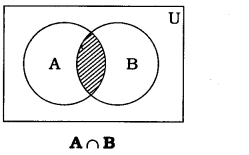
Define intersection of events and draw its Venn diagram.
AnswerThe set of outcomes where both events A and B occur simultaneously is called the intersection of events A and B, denoted by $A \cap B$.
View full question & answer→