Question 13 Marks
One number is randomly selected from the first $50$ natural numbers. Find the sets showing the following events.
$(1)$ The number selected is a multiple. of $5$ or $7.$
$(2)$ The number selected is a multiple of both $5$ and $7.$
$(3)$ The number selected is a multiple of 5 but not a multiple of $7.$
$(4)$ The number selected is only a multiple of $7$ out of $5$ and $7.$
View full question & answer→Question 23 Marks
Two balanced dice are thrown simultaneously. Find the probability that at least one of the two dice shows the number $3 .$
AnswerEvent that the first die shows number $3=A$
Event that the second die shows number $3=B$
Event that at least one die shows number $3=A \cup B$ The number of favourable outcome for event $A$ is $m=1$
Probability of event $A P(A)=\frac{m}{n}$
$=\frac{1}{6}$
The number of favourable outcomes for event $B$ is $m=1$
Probability of event $B P(B)=\frac{m}{n}$
$=\frac{1}{6}$
Since the events $A$ and $B$ are independent, the events $A^{\prime}$ and $B^{\prime}$ are also independent.
Moreover, $P\left(A^{\prime}\right)=1-P(A)=1-\frac{1}{6}=\frac{5}{6}$ and $P\left(B^{\prime}\right)=1-P(B)=1-\frac{1}{6}=\frac{5}{6}$.
Probability of the event that at least one die shows number $3=P(A \cup B)$
$=1-P\left(A^{\prime} \cap B^{\prime}\right)$
$ =1-\left[P\left(A^{\prime}\right) \times P\left(B^{\prime}\right)\right]$
$ =1-\left[\frac{5}{6} \times \frac{5}{6}\right]$
$ =1-\frac{25}{36}$
$ =\frac{11}{36}$
Required probability $=\frac{11}{36}$
View full question & answer→Question 33 Marks
There are $3$ boys and $2$ girls in a friend-circle. Two persons are randomly selected from this friend-circle one by one with replacement to sing a song. Find the probability that the first person is a boy and the second person is a girl in the two persons selected to sing a song.
AnswerThe friend-circle consists of $3$ boys and $2$ girls that is total $5$ persons.
Two persons are selected one by one with replacement. This means that the person selected first is sent back to the group before selecting the second person.
Hence, the events of selecting two persons one by one are independent events.
The total number of mutually exclusive, exhaustive and equi-probable outcomes for selecting the first person is $n={ }^{5} C_{1}=5$.
Event that the first person selected to sing a song is a boy $=A$
The number of favourable outcomes for event $A$ is $m={ }^{3} C_{1}=3$
Probability of event $A P(A)=\frac{m}{n}$
$=\frac{3}{5}$
The selection is with replacement here.
This means that the total number of mutually exclusive, exhaustive and equi-probable outcomes for selecting the second person is $n={ }^{5} C_{1}$.
Event that the second person selected to sing a song is a girl $=B$
The number of favourable outcomes of $B$ is $m={ }^{2} C_{1}=2$
Probability of event $B P(B)=\frac{m}{n}$
$=\frac{2}{5}$
Now, $A \cap B=$ Event that the first boy and the second girl are the two person selected to sing a song.
Since the events $A$ and $B$ are independent,
$P(A \cap B) =P(A) \times P(B)$
$ =\frac{3}{5} \times \frac{2}{5}$
$ =\frac{6}{25}$
Required probability $=\frac{6}{25}$
View full question & answer→Question 43 Marks
There are $12$ screws in a box of which $4$ screws are defective. Two screws are randomly selected one by one without replacement from this box. Find the probability that both the screws selected are defective.
Answer$4$ screws are defective in the box having $12$ screws.
Hence, the number of non-defective screws will be $8 .$
Total number of mutually exclusive, exhaustive and equiprobable outcomes for selecting the first screw are $n={ }^{12} C_{1}=12$.
If $A$ denotes the event that the first screw selected is defective then the number of favourable outcomes of $A$ is $m={ }^{4} C_{1}=4$.
Probability of event $A P(A)=\frac{m}{n}=\frac{4}{12}$
The screws are selected without replacement which means that the first screw is not kept back into the box. Hence, the total number of mutually exclusive, exhaustive and equi-probable outcomes for selecting the second screw is $n={ }^{11} C_{1}=11$.
Let $B$ denote the event that the second screw selected is defective.
The event $B$ occurs under the condition that the event $A$ has occurred. This is the occurrence of event $B / A$.
Since event $A$ has occurred earlier, there are $3$ defective screws in the box.
Hence, the number of favourable outcomes for event $B / A$ is $m={ }^{3} C_{1}=3$.
Probability of $B / A P(B / A)=\frac{m}{n}$
$=\frac{3}{11} $
Now, $A \cap B=$ Event that both the screws are defective From the law of multiplication of probability,
$P(A \cap B) =P(A) \times P(B / A)$
$ =\frac{4}{12} \times \frac{3}{11}$
$ =\frac{1}{11}$
Required probability $=\frac{1}{11}$
View full question & answer→Question 53 Marks
If $P\left(A^{\prime}\right)=\frac{7}{25}, P(B / A)=\frac{5}{12}$ and $P(A / B)=\frac{1}{2}$ for two events $A$ and $B$ in the sample space of a random experiment then find $P(A \cap B)$ and $P(B)$.
AnswerIt is given that $P\left(A^{\prime}\right)=\frac{7}{25}, P(B / A)=\frac{5}{12}$ and $P(A / B)=\frac{1}{2}$.
$ P(A) =1-P\left(A^{\prime}\right)$
$ =1-\frac{7}{25}$
$ =\frac{18}{25}$
We will find $P(A \cap B)$ from the formula of $P(B / A)$.
$P(B / A)=\frac{P(A \cap B)}{P(A)}$
$\therefore \frac{5}{12}=\frac{P(A \cap B)}{\frac{18}{25}}$
$ \therefore \frac{5}{12} \times \frac{18}{25}=P(A \cap B)$
$ \therefore P(A \cap B)=\frac{3}{10}$
Required probability $=\frac{3}{10}$
Now, we will find $P(B)$ by substituting $P(A / B)$ and $P(A \cap B)$ in the formula of $P(A / B)$.
$P(A / B) =\frac{P(A \cap B)}{P(B)}$
$\therefore \frac{1}{2} =\frac{\frac{3}{10}}{P(B)}$
$\therefore P(B) =\frac{\frac{3}{10}}{\frac{1}{2}}$
$ =\frac{3 \times 2}{10 \times 1}$
$ =\frac{3}{5}$
Required probability $=\frac{3}{5}$
View full question & answer→Question 63 Marks
A factory has received an order to prepare $50,000$ units of an item in a certain time period. The probability of completing this work in the given time is $0.75$ and the probability that the workers will not declare strike during that time period is $0.8.$ The probability that this work will be completed during the given period and the workers will not declare strike is $0.7.$ Find the probability that
$(1)$ The work will be completed as per schedule under the condition that the workers have not declared strike.
$(2)$ Find the probability that the workers do not declare strike in the given period knowing that the work is completed as per schedule.
AnswerIf we denote event $A$ that the work will be completed as per schedule and event $B$ that the workers will not declare strike then the given information can be written as follows:
$P(A)=0.75, P(B)=0.8, P(A \cap B)=0.7$
$(1)$ Event that the work will be completed in the given period under the condition that the workers do not declare strike $=A / B$
Probability of $A / B$ from the definition of condition probability,
$P(A / B) =\frac{P(A \cap B)}{P(B)}$
$ =\frac{0.7}{0.8}$
$ =\frac{7}{8} $
Required probability $=\frac{7}{8}$
$(2)$ If it is given that the work is completed as per schedule then the event that the workers do not declare strike $=B / A$
Probability of $B / A$ from the definition of conditional probability,
$P(B / A) =\frac{P(A \cap B)}{P(A)}$
$ =\frac{0.7}{0.75}$
$ =\frac{14}{15}$
Required probability $=\frac{14}{15}$
View full question & answer→Question 73 Marks
For two events $A$ and $B$ in the sample space of a random experiment $P\left(A^{\prime}\right)=0.3, P(B)=0.6$ and $P(A \cup B)=0.83$. Find $P\left(A \cap B^{\prime}\right)$ and $P\left(A^{\prime} \cap B\right)$.
AnswerHere, $P\left(A^{\prime}\right)=0.3 \therefore P(A)=1-P\left(A^{\prime}\right)=1-0.3=0.7$
$P(B)=0.6 \text { and } P(A \cup B)=0.83$
First we will find $P(A \cap B)$.
$P(A \cup B)=P(A)+P(B)-P(A \cap B)$
$ \therefore 0.83=0.7+0.6-P(A \cap B)$
$ \therefore P(A \cap B)=0.7+0.6-0.83$
$ \therefore P(A \cap B)=0.47$
Now,
$P\left(A \cap B^{\prime}\right) =P(A)-P(A \cap B)$
$ =0.7-0.47$
$ =0.23$
Required probability $=0.23$
$P\left(A^{\prime} \cap B\right) =P(B)-P(A \cap B)$
$ =0.6-0.47$
$ =0.13$
Required probability $=0.13$
View full question & answer→Question 83 Marks
The probability that a person from a group reads newspaper $X$ is $0.55$, the probability that he read newspaper $Y$ is $0.69$ and the probability that he reads both the newspaper $X$ and $Y$ is $0.27$. Find the probability that a person selected at random from this group.
$(1)$ reads at least one of the newspapers $X$ and $Y$.
$(2)$ does not read any of the newspapers $X$ and $Y$.
$(3)$ reads only one of the newspapers $X$ and $Y$.
AnswerIf the event that a person from the group reads newspaper $X$ is denoted by event $A$ and reads newspaper $Y$ by event $B$ then the given information can be shown as follows :
$P(A)=0.55, P(B)=0.69, P(A \cap B)=0.27 $
$(1)$ Event that the selected person reads at least one of the newspapers $=A \cup B$
From the law of addition of probability,
$P(A \cup B) =P(A)+P(B)-P(A \cap B)$
$ =0.55+0.69-0.27$
$ =0.97$
Required probability $=0.97$
$(2)$ Event that the selected person does not read newspaper $A=A^{\prime}$
Event that the selected person does not read newspaper $B=B^{\prime}$
Hence, event that the selected person does not read any of the newspaper $X$ and $Y=A^{\prime} \cap B^{\prime}$.
Probability of $A^{\prime} \cap B^{\prime}$
$P\left(A^{\prime} \cap B^{\prime}\right) =P(A \cup B)^{\prime}$
$ =1-P(A \cup B)$
$ =1-0.97$
$ =0.03$
Required probability $=0.03$
$(3)$ If the event that the selected person reads only one of the newspapers $X$ and $Y$ is denoted by $C$ then the event $C$ can occur as follows :
The person reads newspaper $X ($event $A )$ and does not read newspaper $Y ($event $B^{\prime} )$ OR
The person does not read newspaper $X ($event $A^{\prime} )$ and reads newspaper $Y ($event $B )$
Thus $C=\left(A \cap B^{\prime}\right) \cup\left(A^{\prime} \cap B\right)$
Since the events $A \cap B^{\prime}$ and $A^{\prime} \cap B$ are mutually exclusive,
$P(C) =P\left(A \cap B^{\prime}\right)+P\left(A^{\prime} \cap B\right)$
$ =[P(A)-P(A \cap B)]+[P(B)-P(A \cap B)]$
$ =[0.55-0.27]+[0.69-0.27]$
$ =0.28+0.42$
$ =0.7$
Required probability $=0.7$
View full question & answer→Question 93 Marks
$3$ persons from medical profession and $5$ persons from engineering profession offer services at a social organization. $2$ persons are randomly selected from these persons with the purpose of forming a committee. Find the probability that both the persons selected belong to the same profession.
AnswerThere are in all $3+5=8$ persons. Hence, 2 persons can be selected in ${ }^{8} C_{2}=\frac{8 \times 7}{2 \times 1}=28$ ways.
Thus, the total number of mutually exclusive, exhaustive and equi-probable outcomes in the sample space is $n=28.$
Event that both the persons selected belong to medical profession $=A$
Even that both the persons selected belong to the engineering profession $=B$
Event that both the persons selected belong to the same profession $=A \cup B$
The two events $A$ and $B$ can not occur together that is $A \cap B=\phi$
Thus, the events $A$ and $B$ are mutually exclusive.
Hence, from the law of addition of probability, $P(A \cup B)=P(A)+P(B)$
For which we first find $P(A)$ and $P(B)$.
$A=$ Event that both the persons selected belong to medical profession.
The number of favourable outcomes of $A$ is $m={ }^{3} C_{2}=3$.
Probability of event $A \quad P(A)=\frac{m}{n}$
$=\frac{3}{28}$
$B=$ Event that both the persons selected belong to engineering profession.
The number of favourable outcomes of $B$ is $m={ }^{5} C_{2}=10$.
Probability of event $B \quad P(B)=\frac{m}{n}$
$=\frac{10}{28}$
Now,
$P(A \cup B) =P(A)+P(B)$
$ =\frac{3}{28}+\frac{10}{28}$
$ =\frac{3+10}{28}$
$ =\frac{13}{28}$
Required probability $=\frac{13}{28}$
View full question & answer→Question 103 Marks
A box contains $10$ chits of which $3$ chits are eligible for a prize. A boy named Kathan randomly selects two chits from this box. Find the probability that Kathan gets the prize.
AnswerThere are $10$ chits of which $3$ chits are eligible for a prize and $7$ chits are not eligible for prize.
If two chits are randomly selected from these $10$ chits then the number of mutually exclusive,
exhaustive and equiprobable outcomes in the sample space will be $n={ }^{10} C_{2}=\frac{10 \times 9}{2}=45$.
Event of Kathan getting prize $=A$
$\therefore$ Event that Kathan does not get prize $=A^{\prime}$
The outcomes in which Kathan will draw $2$ chits at random from the $7$ chits which are not eligible for prize will be the favourable outcomes of the event $A^{\prime}$.
The number of such outcomes $m={ }^{7} C_{2}=21$.
Probability of $A^{\prime} P\left(A^{\prime}\right)=\frac{m}{n}$
$=\frac{21}{45}$
$ =\frac{7}{15}$
Now $P(A)=1-P\left(A^{\prime}\right)$
$=1-\frac{7}{15}$
$ =\frac{8}{15}$
View full question & answer→Question 113 Marks
Find the probability of having $53$ Thursdays in a leap year.
AnswerThere are $366$ days in a leap year where we have $52$ complete weeks $(52 \times 7=364$ days$)$ and $2$ additional days.
Each day appears once in each week and the each day will appear $52$ times in $52$ weeks.
Now, the additional $2$ days can be as follows which gives the sample space for this experiment.
$U=\{$ Sunday-Monday, Monday-Tuesday, Tuesday-Wednesday, Wednesday-Thursday, Thursday-Friday, Friday-Saturday, Saturday-Sunday$\}$
Thus, total number of outcomes will be $n=7$.
Event $A=$ leap year has $53$ Thursdays.
Wednesday-Thursday and Thursday-Friday are the $2$ favourable outcomes of event $A$ from the above $7$ outcomes.
Thus, $m=2.$ Probability of event $A \quad P(A)=\frac{m}{n}$
$=\frac{2}{7}$
Required probability $=\frac{2}{7}$
View full question & answer→Question 123 Marks
If two balanced coins are tossed, then find the probability of $(1)$ getting one head and one tail and $(2)$ getting at least one head.
View full question & answer→Question 133 Marks
A factory produces screws of different lengths. The length $($in $cm)$ of screw is denoted by $x$. The events $A_{1}$ and $A_{2}$ are defined as follows in the experiment of finding the length of selected screws. Find the events showing union event $A_{1} \cup A_{2}$ and intersection event $A_{1} \cap A_{2}$.
View full question & answer→Question 143 Marks
The genderwise data of a sample of $6000$ employees selected from class $3$ and class $4$ employees in the government jobs of a state are shown in the following table:
One employee is randomly selected from all the class $3$ and class $4$ employees in government jobs of this state.
$(1)$ If the selected employee is a male, find the probability that he belongs to class $3.$
$(2)$ If it is given that the selected employee belongs to class $3,$ find the probability that he is a male.
AnswerSuppose, $A =$ Event that an employee belongs to class $3$
$B =$ Event that an employee belongs to class $4$
$C =$ Event that an employee is a male
$D =$ Event that an employee is a female
$\therefore P(A) = \frac{4500}{6000}, P(B) = \frac{1500}{6000}, P(C) = \frac{4000}{6000}$ and $P(D) = \frac{2000}{6000}$
$(i)\ A|C =$ Event that employee selected is a male, then he belongs to class $3$
$P(A|C) = \frac{P(A \cap C)}{P(C)}$
$= \frac{\frac{3600}{6000}}{\frac{4000}{6000}}$
$= \frac{3600}{4000}$
$= \frac{9}{10}$
$(ii)\ C|A =$ Event that an employee selected belongs to class $3,$ then he is a male.
$P(C|A) = \frac{P(A \cap C)}{P(C)}$
$= \frac{\frac{3600}{6000}}{\frac{4500}{6000}}$
$= \frac{3600}{4500}$
$= \frac{4}{5}$
View full question & answer→Question 153 Marks
The genderwise data of a sample of $6000$ employees selected from class $3$ and class $4$ employees in the government jobs of a state are shown in the following table :
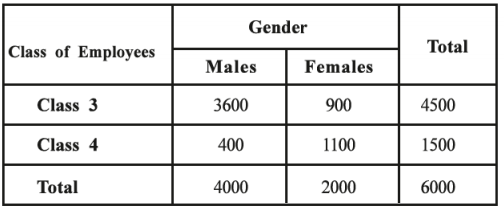
One employee is randomly selected from all the class $3$ and class $4$ employees in government jobs of this state.
$(1)$ If the selected employee is a male, find the probability that he belongs to class $3.$
$(2)$ If it is given that the selected employee belongs to class $3,$ find the probability that he is a male. AnswerSuppose, $\mathrm{A}=$ Event that an employee belongs to class $3$
$B=$ Event that an employee belongs to class $4$
$C=$ Event that an employee is a male
$\mathrm{D}=$ Event that an employee is a female
$ \therefore P(A)=\frac{4500}{6000}, P(B)=\frac{1500}{6000}, P(C)=\frac{4000}{6000} \text { and } P(D)=\frac{2000}{6000} $
$ (i)\ \mathrm{A} \mid \mathrm{C}=$ Event that employee selected is a male, then he belongs to class 3
$ \mathrm{P}(\mathrm{A} \mid \mathrm{C})=\frac{P(A \cap C)}{P(C)}$
$ =\frac{\frac{3600}{6000}}{\frac{4000}{6000}}$
$ =\frac{3600}{4000}$
$ =\frac{9}{10} $
$(ii)\ \mathrm{C|A} =$ Event that an employee selected belongs to class $3 ,$ then he is a male.
$ \mathrm{P}(C \mid \mathrm{A})=\frac{P(A \cap C)}{P(C)}$
$ =\frac{\frac{36000}{6000}}{\frac{4500}{6000}}$
$ =\frac{3600}{4500}$
$ =\frac{4}{5} $$
View full question & answer→Question 163 Marks
If events $A, B$ and $C$ are independent events and $P(A) = P(B) = P(C) = p,$ then find the value of $P(A ∪ B ∪ C)$ in terms of $p.$
AnswerEvents $A, B$ and $C$ are independent events.
$P(A)=P(B)=P(C)=p$
$P(A \cup B \cup C)=P(A)+P(B)+P(C)-P(A \cap B)-P(A \cap C)-P(B \cap C)+P(A \cap B \cap C)$
$=P(A)+P(B)+P(C)-P(A) \cdot P(B)-P(A) \cdot P(C)-P(B) \cdot P(C)+P(A) \cdot P(B) \cdot P(C)$
$=p+p+p-(p \times p)-(p \times p)-(p \times p)+(p \times p \times p)$
$=3 p-p^2-p^2-p^2+p^3$
$=3 p-3 p^2+p^3$
$=p\left(3-3 p+p^2\right)$
View full question & answer→Question 173 Marks
As per the prediction of weather bureau, the probabilities for rains on three days; Thursday, Friday and Saturday in the next week are $0.8, 0.7$ and $0.6$ respectively. Find the probability that it rains on at least one of the three days in the next week.
Answer$A =$ Event that it rains on Thursday
$B =$ Event that it rains on Friday
$C =$ Event that it rains on Saturday
Here, $P(A) = 0.8, P(B) = 0.7$ and $P(C) = 0.6$ are given.
$A, B$ and $C$ are independent events.
$\therefore P(A ∩B) = P(A) ∙ P(B) = 0.8 \times 0.7 = 0.56$
$P(A ∩ C) = P(A) ∙ P(C) = 0.8 \times 0.6 = 0.48$
$P(B ∩ C) = P(B) ∙ P(C) = 0.7 \times 0.6 = 0.42$
$P(A ∩ B ∩ C) = P(A) ∙ P(B) ∙ P(C)$
$= 0.8 \times 0.7 \times 0.6 = 0.336$
Now, $A ∪ B ∪ C =$ Event that it rains on at least one of the three days in the next week
According to the law of addition of probability,
$P(A ∪ B ∪ C) = P(A) + P(B) + P(C) – P(A ∩ B) – P(A ∩ C) – P(B ∩ C) + P(A ∩ B ∩ C)$
$= 0.8 + 0.7 + 0.6 – 0.56 – 0.48 – 0.42 + 0.336$
$= 0.976$
View full question & answer→Question 183 Marks
The probability that the tax-limit for income of males increases in the budget of a year is $0.66$ and the probability that the tax- limit increases for income of females is $0.72.$ The probability that the tax-limit increases for income of both the males and females is $0.47.$ Find the probability that
$(i)$ the tax-limit increases for income of only one of the two, males and females,
$(ii)$ the tax-limit does not increase for income of males as well as females in the budget of that year.
Answer$A =$ Event that the tax-limit for income of males increases.
$B =$ Event that the tax-limit for income of females increases.
$A ∩ B =$ Event that the tax-limit for income of male and female increases.
Here, $P(A) = 0.66, P(B) = 0.72$ and $P(A ∩ B) =0.47$ are given.
$(i)\ C =$ Event that the tax-limit increases only for one of the two male and female.
Event $C$ occurs in following two ways:
$\rightarrow A ∩ B’ =$ Event that the tax-limit increases for the income of male only and not of female OR
$\rightarrow A’ ∩ B =$ Event that the tax-limit increases for the income of female only and not of male Events $A ∩ B’$ and $A’ ∩ B$ are mutually exclusive,
$\therefore P(C) = P(A ∩ B’) + P(A’ ∩ B)$
$= [P(A) – P(A ∩ B)l + (P(B) – P(A ∩ B)]$
$= [0.66 – 0.47] + [0.72 – 0.47]$
$= 0.19 + 0.25 = 0.44$
$(ii)\ A’ ∩ B’ =$ Event that the tax-limit does not increase for income of either male or female.
Now, $P(A ∪ B) = P(A) + P(B) – P(A ∩ B)$
$= 0.66 + 0.72 – 0.47 = 0.91$
$\therefore P(A’ ∩ B’) = P(A ∪ B)’ = 1 – P(A ∪ B)$
$= 1 – 0.91 = 0.09$
View full question & answer→Question 193 Marks
$6$ persons have a passport in’ a group of $10$ persons. If $3$ persons are randomly selected from this group, find the probability that
$(i)$ all the three persons have a passport
$(ii)$ two persons among them do not have a passport.
AnswerOut of $10$ persons, $6$ persons have a passport. So $4$ persons do not have
a passport.
Now, $3$ persons out of $10$ persons are randomly selected.
$\therefore$ Total number of primary outcomes,
$\mathrm{n}={ }^{10} C_3=\frac{10 \times 9 \times 8}{3 \times 2 \times 1}=120$
$(i)\ \mathrm{A}=$ Event that all three persons have a passport
$\therefore$ Favourable outcomes for the event $\mathrm{A}$ is
$m={ }^6 C_3=\frac{6 \times 5 \times 4}{3 \times 2 \times 1}=120$
$ P(A)=\frac{m}{n}=\frac{20}{120}=\frac{1}{6}$
$(ii)\ B=$ Event that two persons among three persons do not have a
passport
$\therefore$ Favourable outcomes for the event $B$ is
$m={ }^6 C_1 \times{ }^4 C_2=6 \times 6=36$
$ \therefore P(B)=\frac{m}{n}=\frac{36}{120}=\frac{3}{10}$
View full question & answer→Question 203 Marks
The probability of occurrence of at least one of the two events $A$ and $B$ is The probability that event $A$ occurs, but event $B$ does not occur is Find the probability of event $B.$
Answer$A \cup B=$ Event that at least one of the two events $A$ and $B$ occurs
$\therefore P(A \cup B)=\frac{1}{4}$
$A^A \mathrm{~B}^{\prime}=$ Event that $A$ occurs, but $B$ does not occur
$\therefore P\left(A \cap B^{\prime}\right)=\frac{1}{5}$
According to the law of addition of probability,
$P(A \cup B)=P(A)+P(B)-P(A \cap B)$
$ \therefore P(A \cup B)=P(A)-P(A \cap B)+P(B)$
$ {\left[P \text { utting, } P\left(A \cap B^{\prime}\right)=P(A)-P(A \cap B)\right]}$
$ \therefore P(A \cup B)=P\left(A \cap B^{\prime}\right)+P(B)$
$ \therefore P(B)=P(A \cup B)-P\left(A \cap B^{\prime}\right)$
$ =\frac{1}{4}-\frac{1}{5}$
$ =\frac{5-4}{20}$
$ =\frac{1}{20}$
View full question & answer→Question 213 Marks
There are $10$ ice cream cones in a box of which $3$ cones weight less than the specification and the rest of the $7$ cones have the specified weight. Two cones are randomly selected one by one with replacement. Find the probability that both the cones selected weigh less than the specified weight.
AnswerThere are $10$ ice cream cones in a box of which $3$ cones weigh less than the specified weight and $7$ cones have the specified weight.
T\vo cones are randomly selected one by one with replacement.
$\therefore $ Total primary outcomes $n =\ ^{10}C_1 = 10$
$A =$ Event that the cone selected in the first trial weigh less than the specified weight.
$\therefore $ Favourable outcomes for the event A is $m = ^3C_1 = 3$.
$\therefore P(A)=\frac{m}{n}=\frac{3}{10}$
Cone is selected with replacement. So in the second trial also $n = ^{10}C_1 = 10$
$B =$ Event that the cone selected in second trial weigh less than the specified weight
$\therefore $ Favourable outcomes for the event $B$ is $m =\ ^3C_1 = 3$
$\therefore P(B)=\frac{m}{n}=\frac{3}{10}$
Now, $A ∩ B =$ Event that both the cones selected weigh less than the specified weight.
Events $A$ and $B$ are independent events.
$\therefore P(A \cap B)=P(A) \cdot P(B)$
$=\frac{3}{10} \times \frac{3}{10}$
$=\frac{9}{100}$
View full question & answer→Question 223 Marks
One joint family has $3$ sons and $2$ daughters whereas the other joint family has $2$ sons and $4$ daughters. One joint family is selected from two joint families and a child is randomly selected from that family. Find the probability that the selected child is a girl.
AnswerIn the first joint family there are total $(3$ sons $+ 2$ daughters$) 5$ children.
In the second joint family there are total $(2$ sons $+ 4$ daughters$) 6$ children.
Suppose, event $F_1 =$ First family is selected and ,
event $F_2 =$ Second family is selected$\therefore P\left(F_1\right)=P\left(F_2\right)=\frac{1}{2}$
$A =$ Event that the child is a girl.
Event A can occur in two different ways :
$\rightarrow$ First family $F_1$ selected and child is a girl.
OR
$\rightarrow$ Second family selected and child is a girl.
$\therefore A = (F_1 ∩ G_1) u (F_2 ∩ G_2)$
According to the law of multiplication of probability,
$P(A) = [P(G_1|F_1) ∙ P(F_1)] + [P(G_2|F_2) ∙ P(F_2)] …………… (1)$
Now, $P(G_1|F_1) =$ Conditional probability of the event that the selected child is a girls knowing that the first family is selected
$=\frac{{ }^2 C_1}{{ }^5 C_1}=\frac{2}{5}$
$P(G_2|F_2) =$ Conditional probability of the event that the selected child is a girl knowing that the
second family is selected.
$=\frac{{ }^4 C _1}{{ }^6 C _1}=\frac{4}{6}=\frac{2}{3}$
Putting the values in the result $(1),$
$P(A)=\left(\frac{2}{5} \times \frac{1}{2}\right)+\left(\frac{2}{3} \times \frac{1}{2}\right)$
$=\frac{1}{5}+\frac{1}{3}=\frac{3+5}{15}=\frac{8}{15}$
View full question & answer→Question 233 Marks
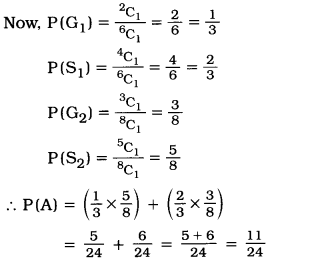
There are $2$ gold coins and $4$ silver coins in a box. The other box contains $3$ gold and $5$ silver coins. One coin is selected from each box. Find the probability that one of the selected coins is a gold coin and the other is a silver coin.
AnswerIn a box there are total $(2$ gold $+\ 4$ silver$) 6$ coins.
In the other box there are total $(3$ gold $+\ 5$ silver$) 8$ coins.
$A =$ Event that a coin selected from each box is a gold coin and a silver coin.
There are two options of occuring the event $A:$
$\rightarrow A$ gold coin $(G_1)$ is selected from the first box and a silver coin $(S_2)$ is selected from the other box.
OR
$\rightarrow A$ silver coin $(S_1)$ is selected from the first box and a gold coin $(G_2)$ is selected from the other box.
$\therefore A = (G_1 ∩ S_2) ∪ (S_1 ∩ G_2)$
$\therefore P(A) = (G_1 ∩ S_2) + (S_1 ∩ G_2)$
$(\because (G_1 ∩ S_2)$ and $(S_1 ∩ G_2)$ are mutually exclusive events.$)$
$= P(G_1) ∙ P(S_2) + P(S_1) ∙ P(G_2)$
$(\because G_1, S_2, S_1, G_2 $ are independent events.$) ………. (1)$
View full question & answer→Question 243 Marks
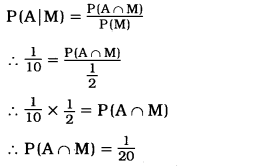
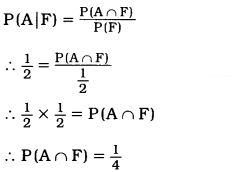
If $P(M)=P(F)=\frac{1}{2}, P(A \mid M)=\frac{1}{10}$ and $P(A \mid F)=\frac{1}{2}$ for events $A, M$ and $F,$ then find $P(A \cap M)$ and $P(A \cap F)$.
AnswerHere, $P(M)=P(F)=\frac{1}{2}$
$P(M)=\frac{1}{2}$ and $P(F)=\frac{1}{2}$ are given.
$P(A ∩ M) :$
$P(A ∩ F) :$
View full question & answer→Question 253 Marks
$80\%$ customers hold saving account and $50\%$ customers hold current account of a nationalised bank. $90\%$ of the customers hold at least one of the saving account and the current account. If one of the account holders randomly selected from this bank holds a current account, find the probability that he holds a saving account.
Answer$A =$ Event that the customers hold the saving account
$\therefore P ( A )=\frac{80}{100}=\frac{4}{5}$
$B=$ Event that the customers hold the current account
$\therefore P(B)=\frac{50}{100}=\frac{1}{2}$
$A \cup B=$ Event that the customers hold at least one of the saving account and the current account
$\therefore P ( A \cup B )=\frac{90}{100}=\frac{9}{10}$
$A \cap B=$ Event that the customers hold both the saving and current accounts
Now, $P(A \cup B)=P(A)+P(B)-P(A \cap B)$
$ \therefore \frac{9}{10}=\frac{4}{5}+\frac{1}{2}-P(A \cap B)$
$\therefore P(A \cap B)=$
$=\frac{8+5-9}{10}=\frac{4}{10}=\frac{2}{5} $
$A \mid B =$ Conditional event $A$ knowing that the customers hold current account.
According to law of conditional probability.
$p ( B \mid A )=\frac{P(A \cap B)}{P(A)}$
$=\frac{\frac{2}{5}}{\frac{1}{2}}=\frac{2}{5} \times \frac{2}{1}=\frac{4}{5} $
View full question & answer→Question 263 Marks
Among the various vehicle owners visiting a petrol pump, $80\%$ vehicle owners visit to fill petrol in their vehicle and $60\%$ vehicle owners visit to fill air in their vehicles. $50 \%$ vehicle owners visit to fill air and petrol in their vehicle. Find the probability for the following events:
$(1)$ If a vehicle owner has come to fill petrol in his vehicle, then that vehicle owner will fill air in his vehicle.
$(2)$ If a vehicle owner has come to fill air in his vehicle, then that vehicle owner will fill petrol in his vehicle.
Answer$A =$ Event that vehicle owners fill petrol in their vehicles
$\therefore P(A)=\frac{80}{100}=\frac{4}{5}$
$B =$ Event that vehicle owners fill air in their vehicles
$\therefore P(B)=\frac{60}{100}=\frac{3}{5}$
$A \cap B =$ Event that vehicle owners fill both petrol and air in their vehicles
$\therefore P(A \cap B)=\frac{50}{100}=\frac{1}{2}$
$(1)\ B|A =$ Conditional event $B$ knowing that vehicle owners visited the petrol pump to fill the petrol in their vehicles According to law of conditional probability,
$P(B \mid A)=\frac{P(A \cap B)}{P(A)}$
$=\frac{\frac{1}{2}}{\frac{4}{5}}=\frac{1}{2} \times \frac{5}{4}=\frac{5}{8}$
$(2)\ A | B =$ Conditional event $A$ knowing that vehicle owners visited the petrol pump to fill air in their vehicle.
According to law of conditional probability,
$P(A \mid B)=\frac{P(A \cap B)}{P(A)}$
$=\frac{\frac{1}{2}}{\frac{3}{5}}=\frac{1}{2} \times \frac{5}{3}=\frac{5}{6}$
View full question & answer→Question 273 Marks
Two six-faced balanced dice are thrown simultaneously. If the sum of numbers on both the dice is more than $7$ then find the probability that both the dice show same numbers.
AnswerTwo six-faced balanced dice are thrown simultaneously.
$\therefore$ Total number of primary outcomes $n = 6^2$
$= 36$
$A =$ Event that the sum of numbers on both the dice is more than $7,$ i.e., $8, 9, 10, 11$ or $12$
$= \{(2, 6), (3, 5), (4, 4), (5, 3), (6, 2), (3, 6), (4, 5), (5, 4), (6, 3), (4, 6), (5, 5), (6, 4), (5, 6), (6, 5), (6, 6)\}$
$\therefore $ Favourable outcomes for the event $A$ is $m = 15.$
$\therefore p ( A )=\frac{m}{n}=\frac{15}{36}$
$B =$ Event that both the dice show same numbers
$= \{(1, 1), (2, 2), (3, 3), (4, 4), (5, 5), (6, 6)\}$
$\therefore $ Favourable outcomes. for the event $B$ is $m = 6.$
$A \cap B =$ Event that the sum of numbers on both the dice is more than $7$ and both the dice show same numbers
$= \{(4, 4), (5, 5), (6, 6)\}$
$\therefore $ Favourable outcomes for the event $A \cap B$ is $m = 3.$
$\therefore P(A \cap B)=\frac{m}{n}=\frac{3}{36}$
Now, $B | A =$ Conditional event $B$ knowing that the sum of numbers on both the dice is more than $7.$
According to law of conditional Probability
$ P ( B \mid A )=\frac{P(A \cap B)}{P(A)}$
$=\frac{\frac{3}{36}}{\frac{15}{36}}=\frac{3}{36} \times \frac{36}{15}=\frac{1}{5}$
View full question & answer→Question 283 Marks
If three events $A, B$ and $C$ of a random experiment are independent events and $P(A) = 0.2, P(B) = 0.3$ and $P(C) = 0.5,$ then find $P(A ∪ B ∪ C).$
AnswerHere, $P(A) = 0.2, P(B) = 0.3$ and $P(C) = 0.5$ are given.
$A, B$ and $C$ are independent events.
$\therefore P(A ∩ B) = P(A) ∙ P(B)$
$= 0.2 \times 0.3$
$= 0.06P(A ∩ C) = P(A) ∙ P(C)$
$= 0.2 \times 0.5$
$= 0.1$
$P(B ∩ C) = P(B) ∙ P(C)$
$= 0.3 \times 0.5 = 0.15$
$P(A ∩ B ∩ C) = P(A) ∙ P(B) ∙ P(C)$
$= 0.2 \times 0.3 \times 0.5$
$= 0.03$
Now, $P(A ∪ B ∪ C)$
$= P(A) + P(B) + P (C) – P (A ∩ B) – P (A ∩ C) -P(B ∩ C) + P(A ∩ B ∩ C)$
$= 0.2 + 0.3 + 0.5 – 0.06 – 0.1 – 0.15 + 0.03 = 0.72$
$= 0.1$
View full question & answer→Question 293 Marks
Person $A$ speaks truth in $90 \%$ cases whereas person $B$ speaks truth in $80 \%$ cases. Find the probability that persons $A$ and $B$ differ in stating the same fact.
Answer$A =$ Event that $A$ speaks truth
$\therefore P(A)=\frac{90}{100}=0.9$
$\therefore P(A)=1-P(A)$
$=1-0.9$
$=0.1$
$B=$ Event that $B$ speaks truth
$\therefore P(B)=\frac{80}{100}=0.9$
$\therefore P(B)=1-P(B)$
$=1-0.8$
$=0.2$
There are two different ways in which persons $A$ and $B$ differ in stating the same fact:
$\rightarrow $ A speaks truth and $B$ does not speak truth, i.e., event $A ∩ B’$
OR
$\rightarrow $ A does not speak truth and $B$ speaks truth, i.e., event $A ∩ B$
Events $A$ and $B$ are independent events. So $A’$ and $B’$ are also independent events.
Hence, the probability that persons $A$ and $B$ differ in stating the same fact
$= P(A ∩ B’) u P(A’ ∩ B)$
$= [P(A) ∙ P(B’)] + [P(A’) ∙ P(B)J$
$= [0.9 \times 0.2] + [0.1 \times 0.8]$
$= 0.18 + 0.08$
$= 0.26$
View full question & answer→Question 303 Marks
Person $A$ can hit the target in $3$ out of $5$ attempts whereas person $B$ can hit the target in $5$ out of $6$ attempts. If both of them attempt simultaneously, find the probability that the target is hit.
Answer$A =$ Event that person $A$ can hit the target
$\therefore P(A)=\frac{3}{5}$
$B=$ Event that person $B$ can hit the target
$\therefore P(B)=\frac{5}{6}$
$A \cap B=$ Event that persons $A$ and $B$ can hit the target
$P(A \cap B)=P(A) \cdot P(B)=\frac{3}{5} \times \frac{5}{6}=\frac{1}{2}$
$( \because A$ and $B$ can hit the target independently.$)$
Now, $A \cup B=$ Event that the target is hit.
According to law of addition of probability,
$P(A \cup B)=P(A)+P(B)-P(A \cap B)$
$=\frac{3}{5}+\frac{5}{6}-\frac{1}{2}$
$=\frac{18+25-15}{30}$
$=\frac{28}{30}$
$=\frac{14}{15}$
View full question & answer→Question 313 Marks
A problem in Mathematics is given to Tania, Kathan and Kirti to solve. The probabilities of them solving the problem correctly are $\frac{2}{3}, \frac{3}{4}$ and $\frac{1}{2}$ respectively. Find the probability that the problem is solved correctly.
Answer$A =$ Event that Tania solves the problem correctly
$ \therefore P(A)=\frac{2}{3}$
$\therefore P\left(A^{\prime}\right)=1-P(A)$
$=1-\frac{2}{3}=\frac{1}{3}$
$B=$ Event that Kathan solves the problem correctly
$ \therefore P (B)=\frac{3}{4}$
$\therefore P \left(B^{\prime}\right)=1- P ( B )$
$=1-\frac{3}{4}=\frac{1}{4} $
$C =$ Event that Kirti solves the problem correctly
$ \therefore P(C)=\frac{1}{2}$
$\therefore P\left(C^{\prime}\right)=1-P(C)$
$=1-\frac{1}{2}=\frac{1}{2} $
Now, $A^{\prime} \cap B^{\prime} \cap C^{\prime}=$ Event that the problem is not solved
$ \therefore P^{\prime}\left(A^{\prime} \cap B^{\prime} \cap C^{\prime}\right)=P\left(A^{\prime}\right) \times P^{\prime}\left(B^{\prime}\right) \times P\left(C^{\prime}\right)$
$=\frac{1}{3} \times \frac{1}{4} \times \frac{1}{2}$
$=\frac{1}{24} $
Hence, the probability that the problem is solved correctly,
$=1-P\left(A^{\prime} \cap B^{\prime} \cap C^{\prime}\right)$
$=1-\frac{1}{24}=\frac{23}{24} $
View full question & answer→Question 323 Marks
If two balanced dice are thrown, then find the probability that
$(1)$ at least one die shows number $5$
$(2)$ the first die shows the number $5$ or $6$ and the other die shows an even number.
AnswerA die is thrown.
$\therefore U =\{1, 2, 3, 4, 5, 6\}\ \therefore n = 6(1) \ A =$ Event that the first die shows number $5$
$\therefore P(A)=\frac{1}{6}$
$B=$ Event that the second die shows number $5$
$\therefore P(B)=\frac{1}{6}$
$A \cap B=$ Event that both dices show number $5$
$\therefore P ( A \cap B )= P ( A ) \cdot( B )=\frac{1}{6} \times \frac{1}{6}=\frac{1}{36}$
Now, $A \cup B=$ Event that at least one die shows number $5$
$ \therefore P(A \cup B)=P(A)+P(B)-P(A \cap B)$
$=\frac{1}{6}+\frac{1}{6}-\frac{1}{36}$
$=\frac{6+6-1}{36}$
$=\frac{11}{36} $
$(2) A=$ Event that the first die shows the number $5$ or $6$
$B=$ Event that the second die shows an even number $=\{2,4,6\}$
$\therefore P(A)=\frac{2}{6}=\frac{1}{3}$
$B=$ Event that the second die shows an even number
$ =\{2,4,6\}$
$\therefore P(B)=\frac{3}{6}=\frac{1}{2} $
Now, $A \cap B=$ Event that the first die shows the number $5$ or $6$ and the second die shows an even number.
$ \therefore P(A \cap B)=P(A) \cdot P(B)(\because A \text { and } B \text { are independent events) }$
$=\frac{1}{3} \times \frac{1}{2}$
$=\frac{1}{6} $
View full question & answer→Question 333 Marks
There are $10$ $CDs $ in a $CD$ rack in which $6$ are action film $CDs$ and $4$ are drama film $CDs.$ Two $CDs$ are randomly selected one by one without replacement from this box. Find the probability that the first selected $CD$ is of action film and the second $CD$ is of drama film.
AnswerThere are total $(6$ action film $+\ 4$ drama film$) 10$ $CDs$ in a $CD$ rack.
One $CD$ is selected from the $CD$ rack.
$\therefore $ Total primary outcomes is $n =\ ^{10}C_1 = 10$
$A =$ Event that the $CD$ selected in the first trial is of action film
$\therefore $ Favourable outcomes for the event $A$ is
$m =\ ^6C_1 = 6. p(A)=\frac{m}{n}=\frac{6}{10}$
Now, two $CDs$ are randomly selected one by one without replacement. So there will be $9$ $CD$s of which $5$ are action film $CDs$ and $4 $ are drama film $CDs.$
$\therefore $ In the second trial total primary outcomes is $n =\ ^9C_1 = 9.$
Now, $B|A =$ Event that second $CD$ selected is of drama film knowing that the first $CD$ selected is of action film
$\therefore $ Favourable outcomes for the event $B|A$ is $m =\ ^4C_1 =4.$
$\therefore P(B \mid A)=\frac{m}{n}=\frac{4}{9}$
AnB $=$ Event that the first selected $CD$ is of action film and the second $CD$ is of drama film
According to law of multiplication of probability,
$P(A ∩ B) = P(B|A) ∙ P(A)$
$=\frac{4}{9} \times \frac{6}{10}=\frac{4}{15}$
View full question & answer→Question 343 Marks
There are two children in a family. If the first child is a girl then find the probability that both the children in the family are girls.
AnswerLet, $B =$ Boy and $G =$ Girl.
$\therefore $ The sample space for the family having two children is expressed as follows:
$U = \{BB, BG, GB, GG\}$
$\therefore n = 4$
$A =$ Event that first child is a girl
$= \{GB, GG\}$
$\therefore $ Favourable outcomes for the event $A$ is $m = 2.$
$\therefore P ( A )=\frac{m}{n}=\frac{2}{4}=\frac{1}{2}$
$B =$ Event that both the children are girls $= \{GG\}$
$\therefore $ Favourable outcome for the event $B$ is $m = 1.$
$P(B)=\frac{m}{n}=\frac{1}{4}$
$A ∩ B =$ Event that both children are girls Event $B$
$\therefore P(A \cap B)=P(B)=\frac{1}{4}$
Now, $B|A =$ Conditional event that first child is a girl, then second child is also a girl.
$\therefore P(B \mid A)=\frac{P(A \cap B)}{P(A)}$
$=\frac{\frac{1}{4}}{\frac{1}{2}}=\frac{1}{4} \times \frac{2}{1}=\frac{1}{2}$
View full question & answer→Question 353 Marks
The probability that a teenager coming to a restaurant for dinner orders pizza is $0.63.$ The probability of ordering cold drink is $0.54.$ The probability that the tenager orders at least one out of pizza and cold drink is $0.88.$ Find the probability that the teenager coming for dinner on a certain day orders only one of the two items from pizza and cold drink.
Answer$A =$ Event that a teenager orders pizza
$B =$ Event that a teenager orders cold drink
$A ∪ B =$ Even that a teenager order at least one of the two, pizza or cold drink.
Now, $P(A) = 0.63, P(B) = 0.54$ and
$P(A ∪ B) = 0.88$ are given.
$A ∩ B =$ Event that a teenager orders both pizza and cold drink
Now, $P(A ∪ B) = P(A) + P(B) – P(A ∩ B)$
$P(A ∩ B) = P(A) + P(B)-P(A ∪ B)$
$= 0.63 + 0.54 – 0.88 = 0.29$
$C =$ Event that a teenager orders only one from pizza and cold drink
$A ∩ B’ =$ Event that a teenager orders only for pizza $($Event $A)$ and not for cold drink $($Event $B’)$
OR
$A’ ∩ B =$ Event that a teenager orders only for cold drink $($Event $B)$ and not for pizza $($Event $A’)$
$\therefore C = (A ∩ B’) ∪ (A’ ∩ B) ,$
$(A ∩ B’)$ and $(A’ ∩ B)$ are mutually exclusive.
$\therefore P(C) = P(A ∩ B’) + P(A’ ∩ B)$
$= [P (A) – P(A ∩ B)] + [P(B) – P(A ∩ B)l$
$= [0.63 – 0.29] + [0.54 – 0.29]$
$= 0.34 + 0.25 = 0.59$
View full question & answer→Question 363 Marks
Two balanced dice are thrown simultaneously. Find the probability that the sum of numbers on two dice is a multiple of $2$ or $3.$
AnswerTwo balanced dice are thrown simultaneously.
$\therefore n = 62 = 36$
A = Event that the sum of numbers on two dice is a multiple of $2$ i.e., $2, 4, 6, 8, 10$ or $12.$
$= \{(1, 1), (1, 3), (1, 5), (2, 2), (2, 4), (2, 6), (3, 1), (3, 3), (3, 5), (4, 2), (4, 4), (4, 6), (5, 1), (5, 3), (5, 5), (6, 2), (6, 4), (6, 6)\}$
$\therefore$ Favourable outcomes for the event $A$ is
$m = 18.\therefore P(A)=\frac{m}{n}=\frac{18}{36}$
$B =$ Event that the sum of numbers on the dice is a multiple of $3$ i.e., $3, 6, 9$ or $12.$
$= \{(1, 2), (2, 1), (1, 5), (2, 4), (3, 3), (4, 2), (5, 1), (3, 6), (4, 5), (5, 4), (6, 3), (6, 6)\}$
$\therefore$ Favourable outcomes for the event $B$ is
$m = 12.$
$\therefore p(B)=\frac{m}{n}=\frac{12}{36}$
$A \cap B =$ Event that the sum of the numbers on dice is a multiple of $2$ and $3,$ i.e.,$ 6$ or $12.$
$= \{(1, 5), (2, 4), (3, 3), (4, 2), (5, 1), (6, 6)\}$
$\therefore$ Favourable outcomes for the event $A \cap B$ is $m = 6.$
$\therefore P(A \cap B)=\frac{m}{n}=\frac{6}{36}$
Now, $A \cup B =$ Event that the sum of numbers on dice is a multiple of $2$ or $3.$
$\therefore P(A \cup B)=P(A)+P(B)-P(A \cap B)$
$=\frac{18}{36}+\frac{12}{36}-\frac{6}{36}$
$=\frac{24}{36}=\frac{2}{3}$
View full question & answer→Question 373 Marks
A number is selected from the natural number $1$ to $100 .$ Find the probability of the event that the selected number is a multiple of $3$ or $5 .$
AnswerHere, $U = \{1, 2, 3, ………… 100\}$
A number is selected from $U.$
$\therefore \mathrm{n}={ }^{100} \mathrm{C}_1=100$
$A =$ Event that the number selected is multiple of $3$
$= \{3, 6, 9, 12, …, 96, 99\}$
$\therefore $ Favourable outcomes for the event $A$ is $m = 33.$
$\therefore p(A)=\frac{m}{n}=\frac{33}{100}$
$B =$ Event that the number selected is multiple of $5$
$= \{5, 10, 15, 20, …, 95, 100\}$
$\therefore $ Favourable outcomes for the event $B$ is $m = 20.$
$\therefore p(B)=\frac{m}{n}=\frac{20}{100}$
$A ∩ B =$ Event that the number selected is multiple of $3$ and $5,$ i.e., multiple of $15$
$= \{15, 30,…, 75, 90\}$
$\therefore $ Favourable outcomes for the event $A ∩ B$ is
$m = 6.$
$\therefore P(A \cap B)=\frac{m}{n}=\frac{6}{100}$
Now, $(A ∪ B) =$ Event that the number selected is multiple of $3$ or $5.$
$\therefore P(A \cup B)=P(A)+P(B)-P(A \cap B)$
$=\frac{33}{100}+\frac{20}{100}-\frac{6}{100}$
$=\frac{53-6}{100}=\frac{47}{100}$
View full question & answer→Question 383 Marks
Three events $A, B$ and $C$ in a sample space are mutually exclusive and exhaustive. If $P(C) = 0.8$ and $3P(B) = 2P(A’),$ then find $P(A)$ and vP(B).$
AnswerHere, $P(C’) = 0.8, 3P(B) = 2P(A’)$ are given.
$P(C’) = 0.8 \therefore P(C) = 1 – P(C’) = 1 – 0.8 = 0.2$
$3P(B) = 2P(A)$
$\therefore 3 P(B)=2[1-P(A)]$
$\therefore 3 P(B)=2-2 P(A)$
$\therefore P(B)=\frac{2-2 P(A)}{3}$
$A, B$ and $C$ are mutually exclusive and exhaustive events.
$\therefore P(A \cup B \cup C)=1 .$
$\therefore P(A)+P(B)+P(C)=1$
$\therefore P(A)+\frac{2-2 P(A)}{3}+0.2=1$
$\therefore \frac{3 P(A)+2-2 P(A)}{3}=1-0.2$
$\therefore \frac{P(A)+2}{3}=0.8$
$\therefore P(A)+2=0.8 \times 3=2.4$
$\therefore P(A)=2.4-2=0.4$
Now, putting $P(A)=0.4$ in $P(B)=\frac{2-2 P(A)}{3}$,
$P(B)=\frac{2-2(0.4)}{3}=\frac{2-0.8}{3}=\frac{1.2}{3}=0.4$
View full question & answer→Question 393 Marks
Three events $A, B$ and $C$ in a sample space are mutually exclusive and exhaustive. If $4P (A) = 5P (B) = 3P (C),$ then find $P (A \cup C)$ and $P(B \cup C).$
AnswerTake $4P(A) = 5P(B) = 3P(C) = x.$
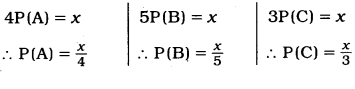
Now, $A, B$ and $C$ are mutually exclusive and exhaustive events,
$\therefore P(A \cup B \cup C)=P(A)+P(B)+P(C)=1$
$\therefore \frac{x}{4}+\frac{x}{5}+\frac{x}{3}=1$
$\therefore \frac{15 x+12 x+20 x}{60}=1$
$\therefore 47 x=60$
$\therefore x=\frac{60}{47}$
$P \text { utting } x=\frac{60}{47},$
$P(A)=\frac{x}{4}=\frac{60}{4 \times 47}=\frac{15}{47}$
$P(B)=\frac{x}{5}=\frac{60}{5 \times 47}=\frac{12}{47}$
$P(C)=\frac{x}{3}=\frac{60}{3 \times 47}=\frac{20}{47}$
$P(A \cup C)=P(A)+P(C)$
$=\frac{15}{47}+\frac{20}{47}$
$=\frac{35}{47}$
$P(B \cup C)=P(B)+P(C)$
$=\frac{12}{47}+\frac{20}{47}$
$=\frac{32}{47}$ View full question & answer→Question 403 Marks
$2$ cards are drawn from a pack of $52$ cards. Find the probability that both the cards drawn are $(1)$ of the same sult, $(2)$ of the same colour.
AnswerTotal number of primary outcomes of drawing $2$ cards from a pack of $52$ cards is
$n={ }^{52} C_2=\frac{52 \times 51}{2 \times 1}=1326$
$(1)\ A =$ Event that the two cards are of the same suit, i.e., two spade cards or two club cards or two heart cards or two diamond cards.
In a pack of $52$ cards each suit has $13$ cards.
$\therefore $ Favourable outcomes for the event A is
$m={ }^{13} C_2+{ }^{13} C_2+{ }^{13} C_2+{ }^{13} C_2$
$=4\left[{ }^{13} C_2\right]=4\left[\frac{13 \times 12}{2 \times 1}\right]$
$=4(78)$
$=312$
Hence, $P(A)=\frac{m}{n}=\frac{312}{1326}=\frac{4}{17}$
$(2)\ B =$ Event that two cards are of the same colour, i.e., two black cards or two red cards.
In a pack of $52$ cards, there are $26$ black cards and $26$ red cards.
$\therefore $ Favourable outcomes for the event $B$ is
$m={ }^{26} C _2+{ }^{26} C _2=2\left[{ }^{26} C _2\right]$
$=\left[\frac{26 \times 25}{2 \times 1}\right]$
$=2[325]$
$=650$
Hence, $P(B)=\frac{m}{n}=\frac{650}{1326}=\frac{25}{51}$
View full question & answer→Question 413 Marks
For two events $A$ and $B$ in the sample space of a random experiment, $P\left(A^{\prime}\right)=$ $2 P\left(B^{\prime}\right)=3 P(A \cap B)=0.6$. Find the probability of difference events $A-B$ and $B$ $- A .$
Answer$P\left(A^{\prime}\right)=2 P\left(B^{\prime}\right)=3 P(A \cap B)=0.6$
$\therefore P\left(A^{\prime}\right)=0.6$
$2 P\left(B^{\prime}\right)=0.6$
$3 P(A \therefore B)=0.6$
$\therefore P\left(B^{\prime}\right)=\frac{0.6}{2}=0.3$
$P(A \cap B)=\frac{0.6}{3}=0.2$
$P(A-B)=P\left(A \cap B^{\prime}\right)$
$=P(A)-P(A \cap B)$
$=\left[1-P\left(A^{\prime}\right)\right]-P(A \cap B)$
$=[1-0.6]-0.2$
$=0.4-0.2$
$=0.2$
$P(B-A)=P\left(A^{\prime} \cap B\right)$
$=P(B)-P(A \cap B)$
$=\left[1-P\left(B^{\prime}\right)\right]-P(A \cap B)$
$=[1-0.3]-0.2$
$=0.7-0.2$
$=0.5$
View full question & answer→Question 423 Marks
For two events $A$ and $B$ in the sample space of a random experiment, $P (A)=0.6, P(B)$ $=0.5$ and $P(A \cap B)=0.15 .$ Find $(1) P\left(A^{\prime}\right)(2) P(B-A)=0.35(3) P\left(A \cap B^{\prime}\right)(4)$ $P\left(A^{\prime} \cap B^{\prime}\right)(5) P\left(A^{\prime} \cup B^{\prime}\right)$
AnswerHere, $P (A) = 0.6, P (B) = 0.5$ and $P(A ∩ B) = 0.15$ are given.
$(1)\ P(A’) = 1 – P(A)$
$= 1 – 0.6$
$= 0.4$
$(2)\ P(B – A) = P(B) – P(A ∩ B)$
$= 0.5 – 0.15$
$= 0.35$
$(3)\ P(A ∩ B’) = P(A) – P(A ∩ B)$
$= 0.6 – 0.15$
$= 0.45$
$(4)$ As per rules of addition of Probability,
$P(A ∪ B) = P(A) + P(B) – P(A ∩ B)$
$= 0.6 + 0.5 – 0.15$
$= 0.95$
$P(A’ ∩ B’) = P(A ∪ B)’ = 1 -P(A ∪ B)$
$= 1 – 0.95$
$= 0.05$
$(5)\ P(A’ ∪ B’) = P(A ∩ B)’= 1 – P(A ∩ B)$
$= 1 – 0.15$
$= 0.85$
View full question & answer→Question 433 Marks
$3$ bulbs are defective in a box of $10$ bulbs. $2$ bulbs are randomly selected from this box. These bulbs are fixed in two bulb-holders Installed in a room. Find the probability that the room will be lighted after starting the electric supply.
Answer$3$ bulbs are defective in a box of $10$ bulbs.
$\therefore 7$ bulbs are non-defective.
Total number of primary outcomes of selecting $2$ bulbs randomly from $10$ bulbs is,
$n ={ }^{10} C_2=\frac{10 \times 9}{2 \times 1}=45$
$A =$ Event that the room will be lighted after starting the electric supply.
There are two options of occurring event $A:$
$\rightarrow $ If $2$ bulbs are non-defective and are fixed in the first bulb holder.
OR
$\rightarrow $ If in $2$ bulbs one bulb is non-defective and one bulb Is defective and are fixed in the second bulb holder.
$\therefore $ Favourable outcomes for event $A$ is,
$ m ={ }^7 C _2+{ }^7 C _1 \times{ }^3 C _1$
$=\frac{7 \times C}{2 \times 1}+(7 \times 3)$
$=21+21=42$
$\therefore p ( A )=\frac{m}{n}=\frac{42}{45}=\frac{14}{15}$
View full question & answer→Question 443 Marks
Two cards are drawn from a well shuffled pace of $52$ cards. Find the probability that $(1)$ both the cards are of different colour $(2)$ both the cards are face cards $(3)$ one of the two cards is a king.
AnswerTotal number of primary outcomes of drawing two cards from a well shuffled pack of $52$ cards is
$n={ }^{52} C_2=\frac{52 \times 51}{2 \times 1}=1326$
$(1)\ A =$ Event that both the cards drawn are of different colours, i.e., one card is of black colour and one is of red colour.
In a pack of $52$ cards, $26$ cards are black and $26$ cards are red.
$\therefore$ Favourable outcomes for the event $A$ is
$m =\ ^{26}C_1 \times\ ^{26}C_1 = 26 \times 26 = 676$
Hence, $P ( A )=\frac{m}{n}=\frac{676}{1326}=\frac{26}{51}$
$(2)\ B =$ Event that both the cards are face cards.
In a pack of $52$ cards, $12$ cards are face cards.
$\therefore$ Favourable outcomes for the event $B$ is
$ m={ }^{12} C_2=\frac{12 \times 11}{2 \times 1}=66 $
Hence, $p ( B )=\frac{m}{n}=\frac{66}{1326}=\frac{11}{221}$
$(3)\ C =$ Event that one of the two cards is a king.
In a pack of $52$ cards, $4$ cards are of king and other cards are $48.$
$\therefore$ Favourable outcomes for the event $C$ is
$m =\ ^4C_1 \times\ ^{48}C_1 = 4 \times 48 = 192$
Hence, $P(C)=\frac{m}{n}=\frac{192}{1326}=\frac{32}{221}$
View full question & answer→Question 453 Marks
$8$ workers are employed in a factory and $3$ of them are excellent in efficiency where as the rest of them are moderate in efficiency. $2$ workers are randomly selected from these $8$ workers. Find the probability that $(1)$ both the workers have excellent efficiency $(2)$ both the workers have moderate efficiency $(3)$ one worker is excellent and one worker is moderate in efficiency.
AnswerFrom $8$ workers $3$ workers are excellent in efficiency.
So the remaining $5$ workers are moderate in efficiency.
Total number of primary outcomes of selecting $2$ workers at random from $8$
workers is $n ={ }^8 C _2=\frac{8 \times 7}{2 \times 1}=28$
$(1)\ A =$ Event that the selected both the workers have excellent efficiency
$\therefore $ Favourable outcomes for the event A is
$m =\ ^3C_2 \times \ ^5C_2 = 3 \times 1 = 3.$
Hence, $P ( A )=\frac{m}{n}=\frac{3}{28}$
$(2)\ B =$ Event that the selected both the workers have moderate efficiency
$\therefore $ Favourable outcomes for the event $B$ is $m =\ ^5C_2 \times \ ^3C_0 = 10 \times 1 = 10.$
Hence, $P(B)=\frac{m}{n}=\frac{10}{28}=\frac{5}{14}$
$(3)\ C =$ Event that in the selected two workers one worker is excellent and ope worker is moderate in efficiency.
$\therefore $ Favourable outcomes for the event $C$ is
$m =\ ^3C_1 \times \ ^5C_1 = 3 \times 5 = 15.$
Hence. $P(C)=\frac{m}{n}=\frac{15}{28}$
View full question & answer→Question 463 Marks
$4$ couples $($husband-wife$)$ attend a party. Two persons are randomly selected from these $8$ persons. Find the probability that the selected persons are $(1)$ husband and wife, $(2)$ one man and one woman, $(3)$ one man and one woman who are not husband and wife.
Answer$4$ couples $($husband-wife$)$ attend a party
$\therefore $ No. of persons attending a party $= 4 \times 2 = 8.$
Now, the number of primary outcomes of the sample space for the random experiment of selecting $2$ persons randomly from $8$ persons
$n ={ }^8 C _2=\frac{8 \times 7}{2 \times 1}=28$
$(1)\ A =$ Event that the selected two persons are husband and wife.
$4$ couples are there.
$\therefore $ Favourable outcomes for the event $A$
is $m = \ ^4C_1 = 4.$
Hence $P(A)=\frac{m}{n}=\frac{4}{28}=\frac{1}{7}$
$(2)\ B =$ Event that in the selected two persons there is one man and one woman.
In $8$ persons, there are $4$ men and $4$ women,
Favourable outcomes for the event $B$ is
$m =\ ^4C_1 \times \ ^4C_1 = 4 \times 4 = 16$
Hence, $P(A)=\frac{m}{n}=\frac{16}{28}=\frac{4}{7}$
$(3)\ C =$ Event that in the selected two persons there is one man and one woman who are not husband and wife.
Let $4$ couples be denoted by $M_1F_1, M_2F_2, M_3F_3, M_4F_4 $ In selected two persons if a man is selected from a couple and a woman is selected from the remaining couples, then they are not husband and wife.
$\therefore C = \{M_1F_2, M_1F_3, M_1F_4, M_2F_1, M_2F_3, M_2F_4, M_3F_1, M_3F_2, M_3F_4, M_4F_1, M_4F_2, M_4F_3\}$
$\therefore $ Favourable outcomes for the event C is m = 12
Hence, $P(C)=\frac{m}{n}=\frac{12}{28}=\frac{3}{7}$
OR
$C=B-A$ and $A \subset B$
$\therefore P(C)=P(B)-P(A)=\frac{4}{7}-\frac{1}{7}=\frac{3}{7}$
View full question & answer→Question 473 Marks
Find the probability of having $5$ Tuesdays in the month of August of any year.
AnswerIn the month of August there are $31$ days.
$4$ weeks a month. So there are $4 \times 7 = 28$ days and $3$ extra days in the month of August.
In a week each day comes only once. So in $4$ weeks each day comes $4$ times.
$\therefore $ The sample space for $3$ extra days is expressed as follows :
$U =\{$(Sunday, Monday, Tuesday$), ($Monday, Tuesday, Wednesday$), ($Tuesday, Wednesday, Thursday$), ($Wednesday, Thursday, Friday$), ($Thursday, Friday, Saturday$), ($Friday, Saturday, Sunday$), ($Saturday, Sunday, Monday$)\}$
$\therefore $ Total number of primary outcomes $n = 7$
$A =$ Event that having $5$ Tuesdays in the month of August of any year.
$= \{($Sunday, Monday, Tuesday$), ($Monday, Tuesday, Wednesday$), ($Tuesday, Wednesday, Thursday$)\}$
$\therefore $ Favourable outcomes for the event $A$ is $m = 3$
Hence, $P(A)=\frac{m}{n}=\frac{3}{7}$
View full question & answer→Question 483 Marks
Two six faced balanced dice are thrown simultaneously. State the sample space of this random experiment and hence write the sets showing the following events :
$(1)$ Event $=$ The sum of numbers on the dice is $7.$
$(2)$ Event $=$ The sum of numbers on the dice is less than $4.$
$(3)$ Event $=$ The sum of numbers on the dice is divisible by $3.$
$(4)$ Event $=$ The sum of numbers on the dice is more than $12.$
Answer
| The sample space for throwing two six faced balanced dice simultaneously is as follows: |
|
| $U = \{(1,1); (1,2); (1,3); (1,4); (1,5); (1,6)$ |
|
| |
$(2,1); (2,2); (2,3); (2,4); (2,5); (2,6)$ |
| |
$(3,1); (3,2); (3,3); (3,4); (3,5); (3,6)$ |
|
| |
$(4,1); (4,2); (4,3); (4,4); (4,5); (4,6)$ |
|
| |
$(5,1); (5,2); (5,3); (5,4); (5,5); (5,6)$ |
|
| |
$(6,1); (6,2); (6,3); (6,4); (6,5); (6,6)\}$ |
|
| $(1)$ Event $=$ The sum of numbers on the dice $=$ is $7.$ |
|
| |
$= \{(1,6), (2,5), (3,4), (4,3), (5,2), (6,1)\}$ |
|
| $(2)$ Event $=$ The sum of numbers on the dice is less than $4.$ |
|
| |
$= \{(1,1), (1,2), (2,1)\}$ |
|
| $(3)$ Event $=$ The sum of numbers on the dice is divisible by $3.$ |
|
| |
$= \{(1,2), (1,5), (2,1), (2,4), (3,3), (3,6), (4,2), (4,5), (5,1), (5,4), (6,3), (6,6)\}$ |
|
| $(4)$ Event $=$ The sum of numbers on the dice is more than $12.$ |
|
| |
$= \{\ \}$ OR |
|
View full question & answer→Question 493 Marks
One card is randomly drawn from a pack of $52$ cards. If drawing a spade card is denoted by event $A$ and drawing a card from ace to ten (non-face card) is denoted by $B$ then write the sets showing the following events :
$(1) U (2) A (3) B (4) A ∪ B (5) A ∩ B (6) B'$
Answer
| If one card is selected out of $52$ cards the total possible outcomes $n = 52\ C1 = 52$ assume $J =$ Jack; $Q =$ Queen; $K =$ King. |
| Let us denote $13$ card of spade by $S_1, S_2, S_3, ……. S_{10} S_J, S_Q S_K.$ |
| $13$ cards of club by $C_1, C_2, C_3, ... C_{10}; C_J; C_Q; C_K.$ |
| $13$ cards of Diamond by $D_1, D_2, D_3, ... D_J; D_Q; D_K.$ |
| $13$ cards of Heart by $H_1, H_2, H_3, ... H_J; H_Q; H_K.$ |
| The sets representing the required events will be as follows : |
| $(1) U$ |
$= \{ S_1, S_2, S_3, ……. S_{10} S_J; S_Q; S_K;$ |
| |
$C_1, C_2, C_3, ... C_{10}; C_J; C_Q; C_K;$ |
| |
$H_1, H_2, H_3, ... H_{10,} H_J; H_Q; H_K;$ |
| |
$D_1, D_2, D_3, ... D_{10}, D_J; D_Q; D_K\}$ |
| $(2)$ Event $A$ |
$=$ The card is of spade |
| |
$= \{S_1, S_2, S_3, ……. S_{10} S_J; S_Q; S_K;\}$ |
| $(3)$ Event $B$ |
$=$ The card is from numbers 1 to 10. |
| |
$= \{S_1, S_2, S_3, ……. S_{10}, C_1, C_2, C_3, ... C_{10}, H_1, H_2, H_3, ... H_{10,} D_1, D_2, D_3, ... D_{10}\}$ |
| $(4)$ Event $A U B$ |
$=$ The card is of spade or the card is from $1$ to $10.$ |
| |
$= \{ S_1, S_2, S_3, ……. S_{10} S_J; S_Q; S_K; C_1, C_2, C_3, ... C_{10}; H_1, H_2, H_3, ... H_{10}; D_1, D_2, D_3, ... D_{10}\}$ |
| $(5)$ Event $AB$ |
$=$ The card is of spade and the card is from $1$ to $10.$ |
| |
$= \{S_1, S_2, S_3, ……. S_{10}\}$ |
| $(6)$ Event $B'$ |
$=$ The card is a face card. |
| |
$= \{ S_J; S_Q; S_K; C_J; C_Q; C_K; H_J; H_Q; H_K; D_J; D_Q; D_K \}$ |
View full question & answer→Question 503 Marks
One number is randomly selected from the natural number 1 to 100. Find the probability that the number selected is either a single digit number or a perfect square.
AnswerLet A = single digit {1,2..9}, $P(A) = \frac{9}{100}$.
Let B = perfect square {1,4,9,16,25,36,49,64,81,100}, $P(B) = \frac{10}{100}$.
$A \cap B$ = {1,4,9}, $P(A \cap B) = \frac{3}{100}$.
$P(A \cup B) = P(A) + P(B) - P(A \cap B) = \frac{9+10-3}{100} = \frac{16}{100} = 0.16$.
View full question & answer→