Questions

4 Marks Each

🎯

Test yourself on this topic

33 questions · timed · auto-graded

Question 14 Marks
The events $A$ and $B$ of a random experiment are as follows $: A=\{1,2,3,4\}, B=\{-1,0,1\}$ If the sample space $U=A \cup B$ then find the sets showing the following events. $(1)\ B^{\prime}\ (2)\  A^{\prime} \cap B\ (3)\  A-B$
Answer
Here, $A=\{1,2,3,4\}$
$B=\{-1,0,1\} $
$U=A \cup B= \{1,2,3,4\} \cup\{-1,0,1\}$
$= \{-1,0,1,2,3,4\}$
$(1)\ B^{\prime}=U-B$
$=\{-1,0,1,2,3,4\}-\{-1,0,1\}$
$ =\{2,3,4\}$
$(2)\ A^{\prime} \cap B=B-(A \cap B)$
First we find $A \cap B$, $A \cap B=\{1,2,3,4\} \cap\{-1,0,1\}=\{1\} \text { Alternate Method : }$
$ A^{\prime}=U-A=\{-1,0,1,2,3,4\}-\{1,2,3,4\}=\{-1,0\}$
$ \therefore A^{\prime} \cap B=\{-1,0\} \cap\{-1,0,1\}=\{-1,0\}$
Now, $A^{\prime} \cap B=B-(A \cap B)$
$=\{-1,0,1\}-\{1\}$
$ =\{-1,0\}$
$(3)\ A-B=\{1,2,3,4\}-\{-1,0,1\}$
$=\{2,3,4\}$
View full question & answer
Question 24 Marks
There are $3$ yellow and $2$ pink flowers in a basket. One flower is randomly selected from this basket. Denote the selection of yellow flower as an event $A$ and the selection of pink flower as the event $B$. Find the sets representing the following events and answer the given questions. $ \text {(1) }U \text { (2) } A \text { (3) } B \text { (4) } A^{\prime} \text { (5) } B^{\prime} \text { (6) } A \cap B\ { (7) }\ A \cup B\ \text { (8) }\ A \cap B^{\prime}\ {(9) }\ A^{\prime} \cap B\ (10)$ State the elementary events of the sample space for this random experiment. $(11)$ Can it be said that the events $A$ and $B$ are mutually exclusive events ? Give reason. $(12)$ Can it be said that the events $A$ and $B$ are exhaustive events ? Give reason.
Answer
$(1)\ U=\left\{Y_{1}, Y_{2}, Y_{3}, P_{1}, P_{2}\right\}$
$(2)\ A=\left\{Y_{1}, Y_{2}, Y_{3}\right\}$
$(3)\ B=\left\{P_{1}, P_{2}\right\}$
$(4)\ A^{\prime}=U-A=\left\{Y_{1}, Y_{2}, Y_{3}, P_{1}, P_{2}\right\}-\left\{Y_{1}, Y_{2}, Y_{3}\right\}$
$=\left\{P_{1}, P_{2}\right\}$
$(5)\ B^{\prime}=U-B=\left\{Y_{1}, Y_{2}, Y_{3}, P_{1}, P_{2}\right\}-\left\{P_{1}, P_{2}\right\}$
$=\left\{Y_{1}, Y_{2}, Y_{3}\right\}$
$(6)\ A \cap B=\left\{Y_{1}, Y_{2}, Y_{3}\right\} \cap\left\{P_{1}, P_{2}\right\}$
$=\phi$
$\text { (7) } A \cup B= \left\{Y_{1}, Y_{2}, Y_{3}\right\} \cup\left\{P_{1}, P_{2}\right\}$
$= \left\{Y_{1}, Y_{2}, Y_{3}, P_{1}, P_{2}\right\}$
$\text { (8) } A \cap B^{\prime}= \left\{Y_{1}, Y_{2}, Y_{3}\right\} \cap\left\{Y_{1}, Y_{2}, Y_{3}\right\}$
$= \left\{Y_{1}, Y_{2}, Y_{3}\right\}$
$ \text { OR }$
$A \cap B^{\prime}= A-(A \cap B)$
$= \left\{Y_{1}, Y_{2}, Y_{3}\right\}-\phi$
$= \left\{Y_{1}, Y_{2}, Y_{3}\right\}$
$\text { (9) } A^{\prime} \cap B= \left\{P_{1}, P_{2}\right\} \cap\left\{P_{1}, P_{2}\right\}$
$= \left\{P_{1}, P_{2}\right\}$
$ \text { OR }$
$A^{\prime} \cap B= B-(A \cap B)$
$= \left\{P_{1}, P_{2}\right\}-\phi$
$= \left\{P_{1}, P_{2}\right\}$
$(10)$ The elementary events are the subsets with one element. If we denote the different elementary events as $E_{1}, E_{2}, E_{3}, \ldots$ then $E_{1}=\left\{Y_{1}\right\}, E_{2}=\left\{Y_{2}\right\}, E_{3}=\left\{Y_{3}\right\}, E_{4}=\left\{P_{1}\right\}, E_{5}=\left\{P_{2}\right\}$
$(11)$ The events $A$ and $B$ can be called mutually exclusive events because according to the definition of mutually exclusive events, the events $A$ and $B$ are called the mutually exclusive events if $A \cap B=\phi$. It can be seen from the answer to the question $6$ that $A \cap B=\phi$.
$(12)$ The events $A$ and $B$ can be called exhaustive events because according to the definition of exhaustive events, the $A$ and $B$ are called the exhaustive events if $A \cup B=U$. It can be seen from the answer to the question $7$ that $A \cup B=U$.
View full question & answer
Question 34 Marks
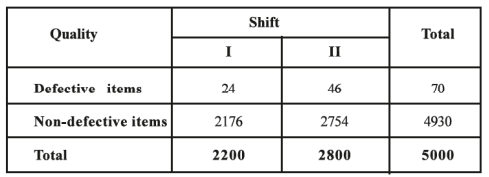
A factory runs in two shifts. The sample data about the quality of items produced in these shifts are shown in the following table :
Image
One item is randomly selected from the production of the factory.
$(1)$ If the item is taken from the production of the first shift then find the probability that it is defective.
$(2)$ If the item is defective then find the probability that it is taken from the production of the first shift.
Answer
The total number of units in the sample $=5000$
We shall define the events as follows :
Event $A=$ The selected item is from the production of first shift
$P(A) =\frac{\text { No. of items produced in the first shift }}{\text { Total number of items in the sample }}=\frac{m}{n}$
$m =\text { No. of items produced in the first shift }$
$ =2200$
Now, $ P(A) =\frac{m}{n}$
$ =\frac{2200}{5000}$
Event $D=$ The selected item is defective
$P(D)=$ relative frequency for defective items
$=\frac{\text { No. of defective items }}{\text { Total number of items in the sample }}=\frac{m}{n}$
$m=$ No, of defective items
$=70$
Now, $P(D)=\frac{m}{n}$
$=\frac{70}{5000}$
Event $A \cap D=$ The selected item is produced in the first shift and it is defective
$P(A \cap D) =\text { relative frequency for event } A \cap D$
$ =\frac{\text { No. of items in event } A \cap D}{\text { Total number of items in the sample }}=\frac{m}{n}$
$m =\text { No. of items in event } A \cap D$
$ =24$
Now, $P(A \cap D)=\frac{m}{n}=\frac{24}{5000}$
$(1)$ The event that the item is defective when it is taken from the first shift $=D / A$ Probability of $D / A$ using the formula of conditional event
$P(D / A) =\frac{P(A \cap D)}{P(A)}$
$ =\frac{\frac{24}{5000}}{5000}$
$ =\frac{24}{2200}$
$ =\frac{3}{275}$
Required probability $=\frac{3}{275}$
$($This probability can be directly obtained as relative frequency $\frac{24}{2200}$ of the event $D / A.)$
$(2)$ The event that the item is taken from the first shift when it is defective $=A / D$ Probability of $A / D$ using the formula of condition probability
$P(A / D) =\frac{P(A \cap D)}{P(D)}$
$ =\frac{\frac{24}{5000}}{5000}$
$ =\frac{24}{70}$
$ =\frac{12}{35}$
Required probability $=\frac{12}{35}$
$($This probability can be directly obtained as relative frequency $\frac{24}{70}$ of the event $A / D.)$
View full question & answer
Question 44 Marks
The sample data obtained about marks scored by a large group of candidates appearing for a public examination of $100$ marks are given in the following table.  $\begin{array}{|c|c|c|c|c|c|} \hline \text{Marks} & 20\ \text{or less} & 21-40 & 41-60 & 61-80 & 81-100 \\ \hline \text{No. of Candidates} & 83 & 162 & 496 & 326 & 124 \\ \hline \end{array}$
One candidate is randomly selected from those appearing for the public examination. Find the probability that this candidate has scored : $(1)$ less than $41$ marks $(2)$ More than $60$ marks $(3)$ Marks from $21$ to $80 .$
Answer
The number of candidates selected in the sample is $n=83+162+496+326+124=1191$.
$(1)$ Event $A=$ The selected candidate scores less than $41$ marks.
$P(A)=$ Relative frequency for the candidates scoring less than $41$ marks.
$=\frac{\text { No. of candidates scoring less than } 41 \text { marks }}{\text { Total number of candidates in the sample }}=\frac{m}{n}$
$m=$ No. of candidates scoring less than $41$ marks
$=83+162$
$ =245$
Now, $P(A)=\frac{m}{n}$
$=\frac{245}{1191}$
Required probability $=\frac{245}{1191}$
$(2)$ Event $B=$ The selected candidate scores more than $60$ marks $P(B)=$ relative frequency for candidates scoring more than $60$ marks.
$=\frac{\text { No. of candidates scoring more than } 60 \text { marks }}{\text { Total number of candidates in the sample }}=\frac{m}{n}$
$m=$ No. of candidates scoring more than $60$ marks $=326+124$
$=450$
Now, $P(B)=\frac{m}{n}$
$ =\frac{450}{1191}$
$=\frac{150}{397}$
Required probability $=\frac{150}{397}$
$(3)$ Event $C=$ The selected candidate scores from $21$ to $80$ marks $P(C)=$ relative frequency for candidates scoring from $21$ to $80$ marks. $=\frac{m}{n}=\frac{\text { No. of candidates scoring from } 21 \text { to } 80 \text { marks }}{\text { Total number of candidates in the sample }}$
$m=$ No. of candidates scoring from $21$ to $80$ marks $=162+496+326$
$=984$
Now, $P(C)=\frac{m}{n}$
$ =\frac{984}{1191}$
$ =\frac{328}{397}$
Required probability $=\frac{328}{397}$
View full question & answer
Question 54 Marks
Two cities $A$ and $B$ of different states have rains on $60 \%$ and $75 \%$ days respectively during the monsoon. For the cities $A$ and $B$, find the probability that on a certain monsoon day,
$(1)$ both the cities have rains
$(2)$ at least one city has rains
$(3)$ only one city has rains.
Note : The events of rains on a day in these two cities are independent.
Answer
Let event $A$ denote that it rains in city $A$ and event $B$ denote that it rains in city $B$. The given information can be stated as follows :
$ P(A)=\frac{60}{100}=\frac{3}{5}$
$\therefore P\left(A^{\prime}\right)=1-P(A)=1-\frac{3}{5}=\frac{2}{5}$
$P(B)=\frac{75}{100}=\frac{3}{4}$
$\therefore P\left(B^{\prime}\right)=1-P(B)=1-\frac{3}{4}=\frac{1}{4} $
$(1)$ Event that both the cities $A$ and $B$ have rains $A \cap B$
Since the events $A$ and $B$ are independent,
$ \text { Probability of event } A \cap B P(A \cap B) =P(A) \times P(B)$
$ =\frac{3}{5} \times \frac{3}{4}$
$ =\frac{9}{20} $
Required probability $=\frac{9}{20}$
$​​​​​​​(2)$ Event that at least one of the cities $A$ and $B$ has rains $=A \cup B$
Probability of $A \cup B\ P(A \cup B)=1-P\left(A^{\prime} \cap B^{\prime}\right)$
$ =1-\left[P\left(A^{\prime}\right) \times P\left(B^{\prime}\right)\right]$
$ =1-\left[\frac{2}{5} \times \frac{1}{4}\right]$
$ =1-\frac{1}{10}$
$ =\frac{9}{10} $
Required probability $=\frac{9}{10}$
$(3)$ Event that only one of cities $A$ and $B$ has rains $=\left(A \cap B^{\prime}\right) \cup\left(A^{\prime} \cap B\right)$
If the events $A$ and $B$ are independent then events $A$ and $B^{\prime}$ as well as $A^{\prime}$ and $B$ are also independent.
$ \text { Probability of }\left(A \cap B^{\prime}\right) \cup\left(A^{\prime} \cap B\right) =P\left(A \cap B^{\prime}\right)+P\left(A^{\prime} \cap B\right)$
$ =\left[P(A) \times P\left(B^{\prime}\right)\right]+\left[P\left(A^{\prime}\right) \times P(B)\right]$
$ =\left[\frac{3}{5} \times \frac{1}{4}\right]+\left[\frac{2}{5} \times \frac{3}{4}\right]$
$ =\frac{3}{20}+\frac{6}{20}$
$ =\frac{9}{20} $
Required probability $=\frac{9}{20}$
View full question & answer
Question 64 Marks
A company produces a certain type of item in its two different factories $A_{1}$ and $A_{2}$ in the proportion $60 \%$ and $40 \%$ respectively. The proportions of defectives in the production of these factories are $2 \%$ and $3 \%$ respectively. One item is randomly selected after mixing the items produced in the two factories. Find the probability that this item is defective.
Answer
Event that the selected item is produced in factory $A_{1}=A_{1}$
$ \therefore P\left(A_{1}\right)=\frac{60}{100} $
$ =\frac{3}{5} $
Event that the selected item is produced in factory $A_{2}=A_{2}$
$ \therefore P\left(A_{2}\right) =\frac{40}{100}$
$ =\frac{2}{5} $
Let $D$ denote the event that the item selected from the total production is defective. Event that the selected item is defective when it is produced in factory $A_{1}=D / A_{1}$
$ \therefore P\left(D / A_{1}\right) =\frac{2}{100}$
$ =\frac{1}{50} $
Event that the selected item is defective when it is produced in factory $A_{2}=D / A_{2}$
$ \therefore P\left(D / A_{2}\right)=\frac{3}{100} $
Event $D$ can occur as follows.
The selected item is produced in factory $A_{1}$ and it is defective.
$ \text { OR } $
The selected item is produced in factory $A_{2}$ and it is defective.
Thus event $ D=\left(A_{1} \cap D\right) \cup\left(A_{2} \cap D\right)$
Since the events $A_{1} \cap D$ and $A_{2} \cap D$ are mutually exclusive,
$ P(D) =P\left(A_{1} \cap D\right)+P\left(A_{2} \cap D\right)$
$ =\left[P\left(A_{1}\right) \times P\left(D / A_{1}\right)\right]+\left[P\left(A_{2}\right) \times P\left(D / A_{2}\right)\right]$
$ =\left[\frac{3}{5} \times \frac{1}{50}\right]+\left[\frac{2}{5} \times \frac{3}{100}\right] $
$ =\frac{3}{250}+\frac{6}{500}$
$ =\frac{12}{500}$
$ =\frac{3}{125} $
Required probability $=\frac{3}{125}$
View full question & answer
Question 74 Marks
A medicine is tested on a group of rabbits and mice to know its effect. It was observed that $7$ rabbits show the effect of medicine in a group of $10$ rabbits who were given the medicine and $5$ mice show the effect of medicine in a group of $9$ mice who were given the medicine. One animal is selected at random from each group. Find the probability that $(1)$ both the selected animals show the effect of medicine and $(2)$ one of the two selected animals shows the effect of medicine and the other animal does not show the effect of medicine.
The given information will be shown as follows : $\begin{array}{|cc|cc|} \hline \text{Animals affected by Medicine} & \text{Animals not affected by Medicine} \\ \hline \text{Rabbits} & 7 & \text{Rabbits} & 3 \\ \hline \text{Mice} & 5 & \text{Mice} & 4 \\ \hline \text{Total} & \mathbf{1 2} & \text{Total} & \mathbf{7} \\ \hline \end{array}$
Answer
$(1)$ Event that a rabbit shows effect of medicine $=A$
Event that a mouse shows effect of medicine $=B$
$\therefore \quad$ Event that both the animals show the effect of medicine $=A \cap B$ The events $A$ and $B$ are independent. Whether the mice show the effect of medicine is not affected by the effect of medicine on rabbits. Hence,
$P(A \cap B)=P(A) \times P(B)$
From the total number of outcomes $n=10, m=7$ outcomes are favourable for event $A$.
$\therefore$ Probability of event $A \quad P(A)=\frac{m}{n}$
$=\frac{7}{10}$
From the total number of outcomes $n=9, m=5$ outcomes are favourable for event $B$.
$\therefore$ Probability of event $B \quad P(B)=\frac{m}{n}$
$\therefore P(A \cap B) =\frac{7}{10} \times \frac{5}{9}$
$ =\frac{7}{18}$
Required probability $=\frac{7}{18}$
$(2)$ Let $C$ denote the event that one animal is affected by the medicine and the other animal is not affected by the medicine.
The event $C$ can occur as follows:
Rabbit is affected by the medicine $($event $A )$ and mouse is not affected by the medicine $($event $B^{\prime} )$ OR
Rabbit is not affected by the medicine $($event $A^{\prime} )$ and mouse is affected by the medicine $($event $B )$
Thus, event $C=\left(A \cap B^{\prime}\right) \cup\left(A^{\prime} \cap B\right)$
Since the events $A \cap B^{\prime}$ and $A^{\prime} \cap B$ are mutually exclusive,
$P(C) =P\left(A \cap B^{\prime}\right)+P\left(A^{\prime} \cap B\right) $
$ =\left[P(A) \times P\left(B^{\prime}\right)\right]+\left[P\left(A^{\prime}\right) \times P(B)\right]  (\because A \text { and } B \text { are independent events) }$
$\text { Here, } P\left(A^{\prime}\right) =1-P(A) P\left(B^{\prime}\right)=1-P(B)$
$ =1-\frac{7}{10} \quad=1-\frac{5}{9}$
$ =\frac{3}{10}$
$\therefore P(C) =\left[\frac{7}{10} \times \frac{4}{9}\right]+\left[\frac{3}{10} \times \frac{5}{9}\right]$
$= \frac{28}{90}+\frac{15}{90}$
$= \frac{43}{90}$
Required probability $=\frac{43}{90}$
View full question & answer
Question 84 Marks
A balanced coin is tossed twice. If the first toss of the coin shows head then find the probability of getting head in both the tosses.
Answer
The sample space of the random experiment of tossing a balanced coin twice is $U=\{H H, H T, T H, T T\}$, where the first symbol shows the outcome of the first toss of the coin and the second symbol shows the outcome of the second toss of the coin. The total number of outcomes in this sample space is $n=4$.
If $A$ denote the event of getting head in the first toss of the coin and $B$ denotes the event that both the tosses result in head then we have to find $P(B / A)$, probability of $B / A$. Event $A=$ First toss shows head
$ =\{H H, H T\} $
Hence, the number of favourable outcomes of $A$ is $m=2$.
Probability of event $A \quad P(A)=\frac{m}{n}$
$ =\frac{2}{4} $
Event $B=$ Head is shown in both the tosses
$ =\{H H\} $
Hence, the number of favourable outcomes of $B$ is $m=1$.
Probability of event $B P(B)=\frac{m}{n}$
$ =\frac{1}{4} $
Event $A \cap B=$ Getting head in the first toss and getting head in both the tosses of the coin $($we have $B \subset A.)$
$ =\{H H\} $
Hence, the number of favourable outcomes of $A \cap B$ is $m=1$.
Probability of $A \cap B \quad P(A \cap B)=\frac{m}{n}$
$ =\frac{1}{4} $
Now,
$ P(B / A) =\frac{P(A \cap B)}{P(A)}$
$ =\frac{\frac{1}{4}}{\frac{2}{4}}$
$ =\frac{1}{2} $
Required probability $=\frac{1}{2}$
View full question & answer
Question 94 Marks
For three mutually exclusive and exhaustive events $A, B$ and $C$ in the sample space of a random experiment $2 P(A)=3 P(B)=4 P(C)$. Find $P(A \cup B)$ and $P(B \cup C) .$
Answer
Taking $2 P(A)=3 P(B)=4 P(C)=x$,
$2 P(A)=x^3\ P(B)=x^4\ P(C)=x$
$\therefore P(A)=\frac{x}{2}$
$\therefore P(B)=\frac{x}{3}$
$\therefore P(C)=\frac{x}{4} $
Since $A, B$ and $C$ are mutually exclusive and exhaustive events,
$ P(A \cup B \cup C)=P(A)+P(B)+P(C)=1$
$ \therefore \frac{x}{2}+\frac{x}{3}+\frac{x}{4}=1$
$ \therefore \frac{6 x+4 x+3 x}{12}=1$
$ \therefore 13 x=12$
$ \therefore x=\frac{12}{13} $
Thus,
$ P(A)=\frac{x}{2}=\frac{\frac{12}{13}}{2}=\frac{6}{13}$
$ P(B)=\frac{x}{3}=\frac{\frac{12}{13}}{3}=\frac{4}{13}$
$ P(C)=\frac{x}{4}=\frac{\frac{12}{13}}{4}=\frac{3}{13} $
Now, the probability of required events,
$ P(A \cup B) =P(A)+P(B)$
$ =\frac{6}{13}+\frac{4}{13}$
$ =\frac{10}{13}$
$\text { Required probability } =\frac{10}{13}$
$P(B \cup C) =P(B)+P(C)$
$ =\frac{4}{13}+\frac{3}{13}$
$ =\frac{7}{13} $
Required probability $=\frac{7}{13}$
View full question & answer
Question 104 Marks
For two events $A$ and $B$ in the sample space of a random experiment $P(A)=2\ P(B)=4\ P(A \cap B)=0.6$. Find the probability of the following events:
$(1)\ A^{\prime} \cap B^{\prime}$
$(2)\ A^{\prime} \cup B^{\prime}$
$(3)\ A-B$
$(4)\ B-A$
Answer
It is given that $P(A)=2 P(B)=4 P(A \cap B)=0.6$. Hence,
$P(A)=0.6$
$2 P(B)=0.6$
$\therefore P(B)=0.3 $
$ 4 P(A \cap B)=0.6 $
$ \therefore P(A \cap B)=0.15 $
$(1)$ Probability of event $A^{\prime} \cap B^{\prime}=P\left(A^{\prime} \cap B^{\prime}\right)$
$ =P(A \cup B)^{\prime}$
$ =1-P(A \cup B)$
$ =1-[P(A)+P(B)-P(A \cap B)]$
$ =1-[0.6+0.3-0.15]$
$ =1-0.75$
$ =0.25 $
Required probability $=0.25$
$(2)$ Probability of event $A^{\prime} \cup B^{\prime}=P\left(A^{\prime} \cup B^{\prime}\right)$
$ =P(A \cap B)^{\prime}$
$ =1-P(A \cap B)$
$ =1-0.15$
$ =0.85 $
Required probability $=0.85$
$(3)$ Probability of event $A-B=P(A-B)$
$ =P(A)-P(A \cap B)$
$ =0.6-0.15$
$ =0.45 $
Required probability $=0.45$
$(4)$ Probability of event $B-A=P(B-A)$
$ =P(B)-P(A \cap B)$
$ =0.3-0.15$
$ =0.15 $
Required probability $=0.15$
View full question & answer
Question 114 Marks
One card is randomly selected from a pack of $52$ cards. Find the probability that the selected card is $(1)$ club or queen card $(2)$ neither a club nor a queen card.
Answer
If one card is randomly selected from a pack of $52$ cards then the number of mutually exclusive, exhaustive and equi-probable outcomes in the sample space of this random experiment $n={ }^{52} C_{1}=52$.
Event that the selected card is a club card $=A$ Event that the selected card is a queen $=B$
$(1)$ Event that the selected card is club or queen card $=A \cup B$ To find the probability of event $A \cup B$ by the law of addition of probability, we will first find $P(A), P(B)$ and $P(A \cap B)$.
$A=$ Event that the selected card is club card. There are $13$ club cards in a pack of $52$ cards. Thus, the number of favourable outcomes of event $A$ is $m=13$.
Probability of event $A P(A)=\frac{m}{n}$ $ =\frac{13}{52} $ $B=$ Event that the selected card is a queen card.
There are 4 queen cards in a pack of $52$ cards.
Thus, the number of favourable outcomes of event $B$ is $m=4$.
Probability of event $B P(B)=\frac{m}{n}$ $ =\frac{4}{52} $ $A \cap B=$ Event that the selected card is club and queen card that is a club queen.
There is only $1$ card in the pack of $52$ cards which is club queen.
Hence, the number of favourable outcomes of $A \cap B$ is $m=1$.
Probability of $A \cap B P(A \cap B)=\frac{m}{n}$ $ =\frac{1}{52} $ From the law of addition of probability, $ P(A \cup B) =P(A)+P(B)-P(A \cap B)$
$ -\frac{13}{52}+\frac{4}{52}-\frac{1}{52}$
$ =\frac{13+4-1}{52}$
$ =\frac{16}{52}$
$ =\frac{4}{13} $ Required probability $=\frac{4}{13}$
View full question & answer
Question 124 Marks
A number is randomly selected from the first $50$ natural numbers. Find the probability that it is a multiple of $2$ or $3 .$
Answer
If one number is randomly selected from the first $50$ natural numbers then the number of mutually exclusive, exhaustive and equi-probable outcomes in the sample space of this random experiment will be $n={ }^{50} C_{1}=50$.
If event $A$ denotes that the number selected is a multiple of $2$ and event $B$ denotes that the number selected is a multiple of $3$ then the event that the selected number is a multiple of $2$ or $3$ will be denoted by $A \cup B. ($This event can also be denoted as $B \cup A$. According to set theory, $A \cup B=B \cup A ).$
To find the probability of $A \cup B$, the union of events $A$ and $B$ by the law of addition of probability, we will first find $P(A), P(B)$ and $P(A \cap B)$.
$A=$ Event that the selected number is a multiple of $2 =\{2,4,6, \ldots, 50\}$
Hence, the number of favourable outcomes of event $A$ will be $m=25$.
Probability of event $A P(A)=\frac{m}{n}$
$ =\frac{25}{50} $
$B=$ Event that the selected number is a multiple of $3 =\{3,6,9, \ldots, 48\}$ IIence,
the number of favourable outcomes of event $B$ will be $m=16$.
Probability of event $B P(B)=\frac{m}{n}$ $ =\frac{16}{50} $
$A \cap B=$ Event that the selected number is a multiple of $2$ and $3$ that is multiple the $LCM$ of $2$ and $3$ which is $6 .$
$=\{6,12,18, \ldots, 48\}$
Hence, the number of favourable outcomes of event $A \cap B$ will be $m=8$.
Probability of event $A \cap B P(A \cap B)=\frac{m}{n}$ $ =\frac{8}{50} $
From the law of addition of probability, $ P(A \cup B) =P(A)+P(B)-P(A \cap B)$
$ =\frac{25}{50}+\frac{16}{50}-\frac{8}{50}$
$ =\frac{25+16-8}{50}$
$ =\frac{33}{50} $
Required probability $=\frac{33}{50}$
View full question & answer
Question 134 Marks
A box contains $20$ items and $10 \%$ of them are defective. Three items are randomly selected from this box. Find the probability that, $(1)$ two items are defective $(2)$ two items are non-defective $(3)$ all three items are non-defective among the three selected items.
Answer
There are $20$ items wherein $10 \%$ that is $20 \times 10 \%=2$ items are defective and the rest $18$ are non-defective.
$3$ items are selected from this box of $20$ items at random.
Hence, the total number of outcomes in the sample space will be $n={ }^{20} C_{3}= 20 \times 19 \times 18 3 \times 2 =1140$.
$(1)$ Event of getting two defective items among three selected items $=A$
Selecting $2$ items from $2$ defective items and selecting $1$ item from the $18$ non-defective items will be the favourable outcomes for the event $A$.
The number of such outcomes $m={ }^{2} C_{2} \times{ }^{18} C_{1}=1 \times 18=18$.
Probability of event $A P(A)=\frac{m}{n}  =\frac{18}{1140}$
$ =\frac{3}{190} $ Required probability $=\frac{3}{190}$
$(2)$ Event of getting two non-defective items among three selected items $=B$
Selecting $2$ items from $18$ non-defective items and selecting one item from $2$ defective items will be the favourable outcomes of the event $B$.
The number of such outcomes $m={ }^{18} C_{2} \times{ }^{2} C_{1}=153 \times 2=306$.
Probability of event $B P(B)=\frac{m}{n}$ $ =\frac{306}{1140}$
$ =\frac{51}{190} $ Required probability $=\frac{51}{190}$
$(3)$ Event of getting all three non-defective items $=C$
Selecting $3$ items from $18$ non-defective items and not selecting any item from the defective items will be the favourable outcomes of event $C$.
The number of such outcomes $m={ }^{18} C_{3} \times{ }^{2} C_{0}=816 \times 1=816$.
Probability of event $C P(C)=\frac{m}{n}$ $ =\frac{816}{1140}$
$ =\frac{68}{95} $ Required probability $=\frac{68}{95}$
View full question & answer
Question 144 Marks
There are $2$ officers, $3$ clerks and $2$ peons among the $7$ employees working in the cash department of a bank. A committee is formed by randomly selecting two employees from the employees of this department. Find the probability that there are
$(1)$ two peons
$(2)$ two clerks
$(3)$ One officer and one clerk among the two employees selected in the committee.
Answer
$(1)$ Event of selecting two peons $=A$
Selecting $2$ peons from the $2$ peons and not selecting any employee from the remaining $5$ employees will be the favourable outcomes of event $A$.
The number of such outcomes will be $m={ }^{2} C_{2} \times{ }^{5} C_{0}=1 \times 1=1$.
Probability of event $A P(A)=\frac{m}{n}$ $ =\frac{1}{21} $
Required probability $=\frac{1}{21}$
$(2)$ Event of selecting two clerks $=B$
Selecting $2$ clerks from the $3$ clerks and not selecting any employee from the remaining four employees will be the favourable outcomes of event $B$.
The number of such outcomes will be $m={ }^{3} C_{2} \times{ }^{4} C_{0}=3 \times 1=3$.
Probability of event $B P(B)=\frac{m}{n}$ $ =\frac{3}{21}$
$ =\frac{1}{7} $ Required probability $=\frac{1}{7}$
$(3)$ Event of selecting one officer and one clerk $=C$
Selecting $1$ officer from $2$ officers, one clerk from three clerks and not selecting any peon from two peons will be the favourable outcomes of event $C$. The number of such outcomes will be $m={ }^{2} C_{1} \times{ }^{3} C_{1} \times{ }^{2} C_{0}=2 \times 3 \times 1=6$.
Probability of event $C P(C)=\frac{m}{n}$ $ =\frac{6}{21}$
$ =\frac{2}{7} $ Required probability $=\frac{2}{7}$
View full question & answer
Question 154 Marks
Four male employees and two female employees working in a government department are sent one by one in turns to the training centre for training. Find the probability that the two female employees go successively for the training.
View full question & answer
Question 164 Marks
Find the probability of getting $R$ in the first place in all possible arrangements of each and every letter of the word $\text{RUTVA.}$
View full question & answer
Question 174 Marks
Two balanced dice marked with numbers $1$ to $6$ are thrown simultaneously. Find the probability that
$(1)$ sum of numbers on both the dice is $7$
$(2)$ sum of numbers on both the dice is more than $10$
$(3)$ sum of number on both the dice is at the most $4$
$(4)$ both the dice show same numbers
$(5)$ sum of numbers on both the dice is $1$
$(6)$ sum of numbers on both the dice is $12$ or less.
Answer
The sample space for throwing two balanced dice simultaneously is as follows : $ U=\{(i, j) ; i, i, j=1,2,3,4,5,6\} $ $\therefore $ Total number of outcomes $n=36$.
$(1)$ If $A_{1}$ denotes that sum of the numbers on the dice is $7$ then there are total $6$ outcomes $(1,6),(2,5),(3,4),(4,3),(5,2),(6,1)$ favourable for this event $A_{1}$.
Thus, the number of favourable outcomes $m=6$ for event $A_{1}$.
Probability of event $A_{1}$ $ P\left(A_{1}\right) =\frac{m}{n}$
$ =\frac{6}{36} =\frac{1}{6} $
$\therefore $ Required probability $=\frac{1}{6}$
$(2)$ If $A_{2}$ denotes the event that the sum of numbers on two dice is more than $10$ then $(5,6),(6,5),(6,6)$ are the favourable outcomes of event $A_{2}$. Thus, the number of favourable outcomes $m=3$ for even $A_{2}$. Probability of $A_{2}$ $ P\left(A_{2}\right) =\frac{m}{n}$
$ =\frac{3}{36}=\frac{1}{12} $
Required probability $=\frac{1}{12}$
$(3)$ If $A_{3}$ denotes the event that the sum of numbers on two dice is at the most $4$ then total $6$ outcomes $(1,1),(1,2),(1,3),(2,1),(2,2),(3,1)$ are favourable outcomes of event $B$.
Thus, the number of favourable outcomes $m=6$ for event $A_{3}$.
Probability of event $A_{3}$ $ P\left(A_{3}\right) =\frac{m}{n}$
$ =\frac{6}{36}=\frac{1}{6} $
Required probability $=\frac{1}{6}$
$(4)$ Event $A_{4}=$ both the dice show the same numbers.
$\therefore $ Total $6$ outcomes $(1,1),(2,2),(3,3),(4,4),(5,5),(6,6)$ are favourable for the event $A_{4}$.
Thus, the number of favourable outcomes $m=6$ for event $A_{4}$.
Probability of event $A_{4}$
$P\left(A_{4}\right)=\frac{m}{n}$ $ =\frac{6}{36}$
$ =\frac{1}{6} $ Required probability $=\frac{1}{6}$
$(5)$ Let $A_{5}$ be the event that the sum of numbers on two dice is $1 .$
It is obvious that not a single outcome in the sample space is favourable for $A_{5}$.
Hence, the number of favourable outcomes $m=0$ for event $A_{5}$.
Probability of event $A_{5}$
$ P\left(A_{5}\right) =\frac{m}{n}=\frac{0}{36}=0 $
Required probability $=0 ($The probahility of impossible event is always $0 )$
$(6)$ Let $A_{6}$ be the event that the sum of numbers on two dice is $12$ or less.
It is obvious that all the outcomes in the sample space are favourable for event $A_{6}$.
Hence, the number of favourable outcomes $m=36$ for the event $A_{6}$.
Probability of event $A_{6}$
$ P\left(A_{6}\right) =\frac{m}{n}$
$ =\frac{36}{36}$
$ =1 $ Required probability $=1 ($The probability of certain event is always $1.)$
View full question & answer
Question 184 Marks
A balanced coin is tossed thrice. If the first two tosses have resulted in tail, find the probability that tall appears on the coin in all the three trials.
Answer
$A=$ Event that in the first trial tall is obtained.
$B=$ Event that in the second trial tail is obtained on the coin.
$\therefore P(A)=\frac{1}{2}, P(B)=\frac{1}{2}$
$\mathrm{C}=$ Event that in the first two trials tail is obtained on the coin.
$\therefore P(C)=P(A) \cdot P(B)$
$ =\frac{1}{2} \times \frac{1}{2}$
$ =\frac{1}{4}$
$\mathrm{D} \mid \mathrm{C}=$ Event that tall appears on the in all three trials if the first two trials resulted in tail
$\therefore \mathrm{P}(\mathrm{D} \mid \mathrm{C})=\frac{P(D \cap C)}{P(C)}$
$\mathrm{D} \cap \mathrm{C}=$ Event that in the first two trails and In the third trial tail is
obtained on the coin
$\therefore P(D \cap C)=P(D) \cdot P(C)$
$ =\frac{1}{2} \times \frac{1}{4}$
$ =\frac{1}{8}$
Now, $\mathrm{P}(\mathrm{D} \mid \mathrm{C})=\frac{P(D \cap C)}{P(C)}=\frac{\frac{1}{8}}{\frac{1}{4}}$
$=\frac{1}{8} \times \frac{4}{1}$
$ =\frac{1}{2}$
View full question & answer
Question 194 Marks
One number is randomly selected from the natural numbers $1$ to $100.$ Find the probability that the number selected is either a single digit number or a perfect square.
Answer
One number is randomly selected from the numbers $1$ to $100.$
$\therefore $ Total number of primary outcomes,
$n =\ ^{100}C_1 = 100$
$A =$ Event that the number selected is a single digit number
$=\{1. 2,3, 4,5,6,78,\}$
$\therefore m = 9$
$\therefore P(A)=\frac{m}{n}=\frac{9}{100}$
$B=$ Event that the number selected is a perfect square
$ =\{1,4,9,16,25,36,49,64,81,100\}$
$ \therefore m=10 $
$ \therefore P(B)=\frac{m}{n}=\frac{10}{100}$
$\mathrm{A} \cap \mathrm{B}=$ Event that the selected number is a single digit number and $\mathrm{a}$ perfect square
$ =\{1,4,9\} $
$ \therefore m=3 $
$ \therefore P(A \cap B)=\frac{m}{n}=\frac{3}{100}$
Now, $A \cup B=$ Event that the number selected is either a single digit number or a perfect square
$ \therefore P(A \cup B)=P(A)+P(B)-P(A \cap B) $
$ =\frac{9}{100}+\frac{10}{100}-\frac{3}{100}$
$ =\frac{16}{100} $
$ =\frac{4}{25}$
View full question & answer
Question 204 Marks
$\text{6 LED}$ televisions and $\text{4 LCD}$ televisions are displayed in digital store $A$ whereas $\text{5 LED}$ televisions and $\text{3 LCD}$ televisions are displayed in digital store $B.$ One of the two stores is randomly selected and one television is selected from that store. Find the probability that it is an $\text{LCD}$ television.
Answer
Digital store $\text{A: 6 LED TV + 4 LCD}$
$\text{TV = 10 TVs}$ are displayedDigital store $\text{A: 6 LED TV + 4 LCD}$
$\text{TV = 10 TVs}$ are displayed
$A_1=$ Event that a store is selected from the store $A$ and $B$
$\therefore \mathrm{p}\left(\mathrm{A}_1\right)=\frac{1}{2}$
$A_2=$ Event that $\text{LCD TV}$ is selected from the store $A$
$\therefore \mathrm{p}\left(\mathrm{A}_2\right)=\frac{{ }^4 C_1}{{ }^{10} C_1}=\frac{4}{10}$
$B_1=$ Event that if store $A$ is selected then $\text{LCD TV}$ is selected.
$\therefore p\left(B_1\right)=p\left(A_1\right) \cdot p\left(A_2\right)=\frac{1}{2} \times \frac{4}{10}=\frac{4}{20}$
$B_2=$ Event that if store $B$ is selected then $\text{LCD TV}$ is selected
$\therefore \mathrm{p}\left(\mathrm{B}_2\right)=\mathrm{p}\left(\mathrm{A}_1\right) \cdot \mathrm{p}\left(\mathrm{A}_3\right)=\frac{1}{2} \times \frac{3}{8}=\frac{3}{16}$
$\mathrm{C} 1=$ Event that if one of the two stores is selected then $\text{LCD TV}$ Is selected
$=B_1 \cup B_2$
$ \therefore P\left(C_1\right)=P\left(B_1\right)+P\left(B_2\right)$
$ =\frac{4}{20}+\frac{3}{16}$
$ =\frac{16+15}{80}$
$ =\frac{31}{80}$
View full question & answer
Question 214 Marks
Define the following events and draw their Venn diagram :
$1.$ Mutually exclusive events
$2.$ Union of events
$3.$ Intersection of events
$4.$ Difference event
$5.$ Exhaustive events
$6.$ Complementary event
Answer
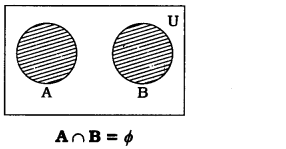
$1.$ Mutually exclusive events: Suppose, $U$ is a finite sample space. $A$ and $B$ are any two events of $U.$ If $A ∩ B = \Phi ,$ then $A$ and $B$ are mutually exclusive events.
Image
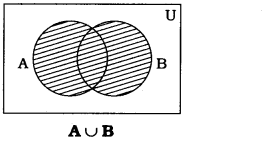
$2.$ Union of events: Suppose, $U$ is a finite sample space. $A$ and $B$ are any two events of $U.$ Event A occurs or event $B$ occurs or events $A$ and $B$ occur togethers, i.e., at least one of the events $A$ and $B$ occurs is called the union of events $A$ and $B.$ It is denoted by $A ∪ B.$ Thus,
$A ∪ B = \{x; x \in A$ or $x \in B$ or $x \in A ∩ B\}$
Image
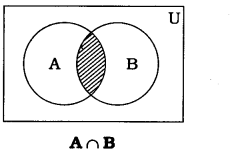
$3.$ Intersection of Events: Suppose, $U$ is a finite sample space. $A$ and $B$ are any two events of $U.$ The event that $A$ and $B$ occur together is called the intersection of events $A$ and $B.$ It is denoted by $A ∩ B.$ Thus,
$A ∩ B = \{x; x \in A$ and $x \in B\}$
Image
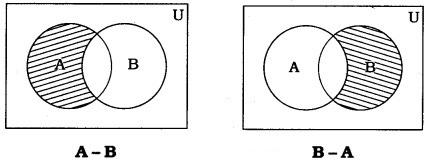
$4.$ Difference event: Suppose, $U$ is a finite sample space. $A$ and $B$ are any two events of $U.$ The event that $A$ occurs but $B$ does not occur is called the difference event of $A$ and $B.$ It is denoted by $A – B$ or $A ∩ B’.$ Similary, the event that $A$ does not occur but $B$ occurs is called the difference event of $B$ and $A.$ It is denoted by $B – A $ or $A’ ∩ B$. Thus,
$A – B = \{x; x \in A$ and $x ∉ B\}$
$B – A = \{x; x \in B$ and $x ∉ A\}$​​​​​​​
Image
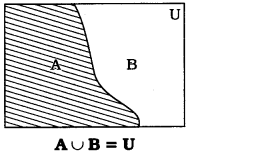
$5.$ Exhaustive events: Suppose, $U$ is a finite sample space. $A$ and $B$ are any two events of $U.$ If $A ∪ B = U,$ then $A$ and $B$ are called exhaustive events.
Image
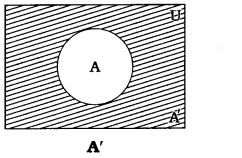
$6.$ Complementary event: Suppose, $A$ is any event of the finite sample space $U.$ The event that A does not occur means the event consists of elements in $U$ but not in $A$ is called the complementary event of $A.$ It is denoted by $A’.$ Thus,
$A’ = \{x; x ∉ A, x \in U\}$​​​​​​​​​​​​​​
Image
View full question & answer
Question 224 Marks
The details of a sample inquiry of $4979$ voters of constituency are as follows:
Year Time t $ŷ = 177.8 + 5.6t$
$2011$ $1$ $177.8 + 5.6 (1) = 183.4$
$2012$ $2$ $177.8 + 5.6(2) = 189.0$
$2013$ $3$ $177.8 + 5.6 (3) = 194.6$
$2014$ $4$ $177.8 + 5.6 (4) = 200.2$
$2015$ $5$ $177.8 + 5.6 (5) = 205.8$
One voter is randomly selected from this constituency.
$(1)$ If this voter is a male, find the probability that he is a supporter of party $A.$
$(2)$ If this voter is a supporter of party $A,$ find the probability that he is a male.
Answer
Here, the total numbers of voters is $n = 4979$
$A =$ Event that the selected voter is a male.
$∴ P(A) =$ Relative frequency of male voters
$=\frac{\text { No. of male voters }}{\text { Total no. of voters }}$
$=\frac{m}{n}$
Putting, $m = 1319 + 1217 = 2536$ and $n = 4979$
$P(A)=\frac{2536}{4979}$
$B =$ Event that the selected voter is supporter of party $A.$
$\therefore P(B)=$ Relative frequency of voters who are supporters of party $A$
$=\frac{\text { No. of voters who are supporters of party A }}{\text { Total no. of voters }}$
$=\frac{2437}{4979}$
Putting, $m=1319+1118=2437$ and $n=4979$
$P(B)=\frac{2437}{4979}$
$A \cap B=$ Event that the selected voter is a male and supporter of party $A$.
$\therefore P(A \cap B)=$ Relative frequency of the event $A \cap B$
No. of voters favourable for
$=\frac{\text { the event } A \cap B}{\text { Total no. of voters }}$
$=\frac{m}{n}$
$=\frac{1319}{4979}$
$(1)\ B \mid A=$ Event that the voter is a male that he is a supporter of party $A$
$\therefore P ( B \mid A )=\frac{P(A \cap B)}{P(A)}$
$=\frac{\frac{1319}{4979}}{\frac{2536}{4979}}$
$=\frac{1319}{2536}$
$(2)\ A \mid B=$ Event that the voter is a supporter of party $A$ that he is a male.
$\therefore P ( A \mid B )=\frac{P(A \cap B)}{P(A)}$
$=\frac{\frac{1319}{4979}}{\frac{2437}{4979}}$
$=\frac{1319}{2437}$
View full question & answer
Question 234 Marks
The sample data about monthly travel expense $($in$?)$ of a large group of travellers of local bus in a megacity are given in the following table:
Answer
Here, the number of travellers selected in the sample is $n = 318 + 432 + 639 + 579 + 174 = 2142$
$(1)\ A =$ Event that the monthly travel expense of the persons is more than $₹ 900.$
$\therefore P(A) =$ Relative frequency of the number of travellers whose monthly travel expense is more than $₹ 900$
$= \frac{\text { No. of travellers whose monthly travel expense is more than } ₹ 900}{\text { Total no. of travellers }}$
$= \frac{m}{n}$ = $\frac{174}{2142}$ = $\frac{29}{357}$
$(2)\ B =$ Event that the monthly travel expense of the persons is at the most $₹ 700.$
$\therefore P(B) =$ Relative frequency of the number of travellers whose monthly travel expense is at the most $₹ 700$
$= \frac{\text { No. of travellers whose monthly travel expense is at the most } ₹ 700}{\text { Total no. of travellers }}$
$= \frac{m}{n}$ = $\frac{318+432}{2142}$ = $\frac{750}{2142}$ = $\frac{125}{357}$
$(3)\ C =$ Event that the monthly travel expense of the persons is $₹ 601$ or more but $₹ 900$ or less.
$\therefore P (C) =$ Relative frequency of the number of travellers whose monthly travel expense is $₹ 601$ or more but $₹ 900$ or less
$= \frac{\text { No. of travellers whose monthly travel expense is } ₹ 601 \text { or more but } ₹ 900 \text { or less }}{\text { Total no. of travellers }}$
$= \frac{m}{n} = \frac{432+639+579}{2142} = \frac{1650}{2142}$ = $\frac{275}{357}$
View full question & answer
Question 244 Marks
Five members of a family, husband, wife and three children are randomly arranged in a row for a family photograph. Find the probability that the husband and wife are seated next to each other.
Answer
Five members of a family can be arranged in,
$n = {}_5P^5 = 5! = 5 \times 4 \times 3 \times 2 \times 1 = 120$ ways.
A = Event that the husband and wife are seated next to each other.
$\therefore m={ }_2 P ^2 \times{ }_4 P ^4 $
$=2 ! \times 4 ! $
$=2 \times 24$
$=48$
Hence, $P(A)=\frac{m}{n}=\frac{48}{120}=\frac{2}{5}$
View full question & answer
Question 254 Marks
Find the probability of getting vowels in the first, third and sixth place when all the letters of the word $\text{ORANGE}$ are arranged in all possible ways.
Answer
Here, there are total $6$ letters $\text{O, R, A, N, G, E}$ in the word $\text{ORANGE.}$
And there are $3$ vovels $\text{O, A, E}$
$\therefore $ The total number of ways of arranging these six letters,
$n = {}_6P^6 = 6! = 6 \times 5 \times 4 \times 3 \times 2 \times 1 = 720$
$A =$ Event of getting vowels in the first, third and sixth place.
$\therefore m={ }_3 P ^3 \times{ }_3 P ^3=3 ! \times 3 ! =6 \times 6=36$
Hence, $P(A)=\frac{m}{n}=\frac{36}{720}=\frac{1}{20}$
View full question & answer
Question 264 Marks
Find the probability of getting $R$ in the first place and $M$ in the last place when all the letters of the word $\text{RANDOM}$ are arranged in all possible ways.
Answer
Here, there are $6$ letters $\text{R, A, N, D, O, M}$ in the word $\text{RANDOM.}$
$\therefore $ The total number of ways of arranging these six letters is,
$n = {}_6P^6 = 6! = 6 \times 5 \times 4 \times 3 \times 2 \times 1 = 720$.
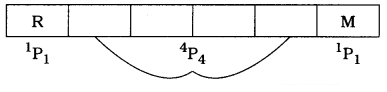
$A =$ Event that getting $R$ in the first place and $M$ in the last place.
Image
$\therefore $ Favourable outcomes for the event $A$ are obtained as follows :
$\therefore m ={ }_1 P ^1 \times{ }_4 P ^4 \times{ }_1 P ^1$
$=1 ! \times 4 ! \times 1 !$
$=1 \times 24 \times 1=24$
Hence $p ( A )=\frac{m}{n}=\frac{24}{720}=\frac{1}{30}$
View full question & answer
Question 274 Marks
The sample space for a random experiment of selecting numbers is $U=\{1,2,3, \ldots$ $120\}$ and all the outcomes in the sample space are equiprobable. Find the probability that the number selected is:
$(1)$ a multiple of $3$
$(2) $ not a multiple of $3$
$(3) $ a multiple of $4$
$(4)$ not a multiple of $4$
$(5)$ a multiple of both $3$ and $4$
Answer
Here,$ U =\{1, 2, 3, …, 120\} ‘$
$A$ number is selected at random.
$\therefore $ Total number of primary outcomes is $n =\ ^{120}C_1 = 120.$
$(1) A =$ Event that the number selected is a multiple of $3.$
$= \{3, 6, 9, 12, …, 117, 120\}$
$\therefore $ Favourable outcomes for the event $A$ is $m = 40.$
Hence, $P(A)=\frac{m}{n}=\frac{40}{120}=\frac{1}{3}$
(2) $A ^{\prime}=$ Event that the number selected is not a multiple of $3$ .
$\therefore P\left(A^{\prime}\right)=1-P(A)$
$=1-\frac{1}{3}=\frac{2}{3}$
(3) $B=$ Event that the number selected is a multiple of $4 .$
$=\{4,8,12,16, \ldots, 116,120\}$
$\therefore$ Favourable outcomes for the event $B$ is $m=30$.
Hence, $P(B)=\frac{m}{n}=\frac{30}{120}=\frac{1}{4}$
$(4) B’ =$ Event that the selected number is not a multiple of $4.$
$\therefore P(B’) = 1 – P(B)$
$=1-\frac{1}{4}=\frac{3}{4}$
$(5) A ∩ B =$ Event that the number selected is a multiple of both $3$ and $4,$ i.e., a multiple of $12.$
$\therefore A ∩ B = \{12, 24, 36, 48, …, 108, 120\}$
$\therefore $ Favourable outcomes for the event $A ∩ B$ is $m = 10.$
Hence, $P(A \cap B)=\frac{m}{n}=\frac{10}{20}=\frac{1}{12}$
View full question & answer
Question 284 Marks
One family is randomly selected from the families having two children. Find the probability that $(1)$ One child Is a girl and one child is a boy.$ (2)$ At least one child is a girl among the two children of the selected family.
Answer
We take, $B=$ Boy, $G=$ Girl
$\therefore$ The sample space for the families having two children is expressed as follows:
$U=\{B B, B G, G B, G G\}$
Now, the total number of primary outcomes of the sample space of selecting a family at random is $n={ }^4 C_1=4$.
(1) $A =$ Event that one child is a girl and one child is a boy.
$=\{B G, G B\}$
$\therefore$ Favourable outcomes for the event A is $m =2$.
Hence, $P(A)=\frac{m}{n}=\frac{2}{4}=\frac{1}{2}$
(2) $B=$ Event that at least one child is a girl among two children of the selected family.
$=\{GB, BG, GG\}$
$\therefore$ Favourable outcomes for the event B is $m =3$.
Hence, $P(B)=\frac{m}{n}=\frac{3}{4}$
View full question & answer
Question 294 Marks
Two balanced dice are thrown simultaneously. Find the probability of the following events :
$(1)$ The sum of numbers on the dice is $6 .$
$(2)$ The sum of numbers on the dice is not more than $10 .$
$(3)$ The sum of numbers on the dice is a multiple of $3 .$
$(4)$ The product of numbers on the dice is $12 .$
Answer
Two balanced dice are thrown simultaneously.
So the sample space for this random experiment Is expressed as follows:
$U \{(1, 1), (1, 2), (1, 3), (1, 4), (1, 5), (1, 6), (2, 1), (2, 2), (2, 3), (2, 4), (2, 5), (2, 6), (3, 1), (3, 2), (3, 3), $
$(3, 4), (3, 5), (3, 6), (4: 1), (4, 2), (4, 3), (4, 4), (4, 5), (4, 6), (5, 1), (5, 2), (5, 3), (5, 4), (5, 5),$
$ (5, 6), (6, 1), (6, 2), (6, 3), (6, 4), (6, 5), (6, 6)\}$
$\therefore $ Total number of primary outcomes of $U$ is
$n = 36$
$(1)\ A =$ Event that the sum of numbers on the dice is $6.$
$A = \{( 1, 5), (2. 4), (3, 3), (4, 2). (5. 1))$
$\therefore $ Favourable outcomes for the event $A$ is $m = 5.$
Hence, $P(A)=\frac{m}{n}=\frac{5}{36}$
$(2)\ B =$ Event that the sum of numbers on the dice is more than $10.$
$\therefore B’ =$ Event that the sum of numbers on the dice is not more than $10.$
$B = \{(5, 6), (6, 5), (6, 6)\}$
$\therefore$ Favourable outcomes for the event $B$ is $m = 3.$
$\text { Hence } P(B)=\frac{m}{n}=\frac{3}{36}=\frac{1}{12}$
$\therefore P\left(B^{\prime}\right)=1-P(B)$
$=1-\frac{1}{12}=\frac{11}{12}$
$(3)\ C =$ Event that the sum of numbers on the dice is a multiple of $3,$ i.e., $3, 6, 9$ or $12$
$C = \{(1, 2), (2, 1), (1, 5), (2, 4), (3, 3), (4, 2), (5, 1), (3, 6), (4, 5), (5, 4), (6, 3), (6, 6)\}$
$\therefore $ Favourable outcomes for the event $C$ is $m = 12$
Hence, $P(C)=\frac{m}{n}=\frac{12}{36}=\frac{1}{3}$
$(4)\ D =$ Event that the product of the numbers on the dice is $12$
$D =\{(2, 6), (3, 4), (4, 3), (6, 2)\}$
$\therefore $ Favourable outcomes for the event $D$ is $m = 4$
Hence, $P(D)=\frac{m}{n}=\frac{4}{36}=\frac{1}{9}$
View full question & answer
Question 304 Marks
There are $3$ roses of different colours and $2$ shoeflowers of the same colour In a basket. $2$  flowers are selected at random from this basket. Write the sample space for this experiment. If $A$ represents the event that the selected flowers are of the same type $( 2$ roses or $2$ shoeflowers$)$ and $B$ represents the event that the selected flowers are of different type, then check the validity of following statements: $(1)\ A \cup B=U$ $(2)\ A \cap B=0$ $(3)\ U-A=U-B$ $(4)\ A^{\prime} \cap B^{\prime} \neq 0$ $(5)\ A^{\prime} \cup B^{\prime}=(A \cap B)^{\prime}$
Answer
$(1)\ A \cup B=U$; True
$(2)\ A \cap B=0$; True
$(3)\ U-A=U-B$; False
$(4)\ A^{\prime} \cap B^{\prime} \neq 0$; False
$(5)\ A^{\prime} \cup B^{\prime}=(A \cap B)$; True
View full question & answer
Question 314 Marks
The weights of five children in a family are $8,12,11,10$ and $9 \ kg$. Two children are selected randomly from this family. Write the sample space of this experiment. If $A$ represents the event that the sum of weight of selected children is less than $20 \ kg$ and $B$ represents the event that the sum of the weights of selected children is greater than $18 \ kg$, obtain the following events:
$(1)$ Event $A^{\prime}$
$(2)$ Event $B^{\prime}$
$(3)$ Event $A \cup B$
$(4)$ Event $A \cap B$
$(5)$ Event $A^{\prime} \cap B$
$(6)$ Event $A^{\prime}-B^{\prime}$
$(7)$ Event $A^{\prime} \cap B^{\prime}$
$(8)$ Event $U-A$
Answer
$(1) A^{\prime}=\{(8,12),(12,11),(12,10),(12,9),(11,10),(11,9)\}$
$(2)\ B^{\prime}=\{(8,10),(8,9)\}$
$(3)\ A \cup B=U$
$(4)\ A \cap B=\{(B, 11),(10,9)\}$
$(5)\ A^{\prime} \cap B=\{(8,12),(12,11),(12,10),(12,9),(11,10),(11,9)\}$
$(6)\ A^{\prime}-B^{\prime}=A^{\prime}$ $(7) A^{\prime} \cap B^{\prime}=0$
$(8)\ \cup-A=\{(8,12),(12,11),(12,10),(12,9),(11,10),(11,9)\}$
View full question & answer
Question 324 Marks
Out of first five even natural numbers, two numbers are selected randomly. Write the sample space of this experiment. If $A$ represents the event that the sum of selected numbers is at least $8$ and $B$ represents the event that the sum of selected numbers is at the most $10 ,$ then answer the following questions: $(1)$ Check whether the events $A$ and $B$ are exhaustive or mutually exclusive or not. $(2)$ List the elementary events of the sample space. $(3)$ Obtain the event $\left(A^{\prime} \cap B\right) \cup\left(A \cap B^{\prime}\right)$ and event $A^{\prime} \cap B^{\prime}$.
Answer
$(1)\ A \cup B=U$. Hence, $A$ and $B$ are exhaustive events.
$A \cap B=\{(2,6),(2.8),(4,6)\}$ $\neq 0 .$
Hence, $A$ and $B$ are not mutually exhaustive events.
$(2)$ Elementary events: $\{(2,4)\},\{(2,6)\},\{(2,8)\}\{(8,10)\}$
$(3)\ \left(A^{\prime} \cap B\right) \cup\left(A \cap B^{\prime}\right)=8$ $A^{\prime} \cap B^{\prime}=0$
View full question & answer
Question 334 Marks
Three unbiased coins are tossed simultaneously. Write the sample space for this experiment. If $A$ denotes the event that maximum two heads occur and $B$ denotes the event that minimum two heads occur, then obtain the following events:
$(1)$ Union of events $A$ and $B$
$(2)$ Intersection of events $A$ and $B$
$(3)$ Event $A'$ and event $B'$
$(4)$ Event $B ^{\prime}- A ^{\prime}$
$(5)$ Event $A \cap B^{\circ}$
Answer
$(1)\ A \cup B=U$
$(2)\ A \cap B=\{ HHT , HTH , THH \}$
$(3)\ A^{\prime}=\{ HHH \}$ and $B^{\prime}=\{TTT HTT, THT, TTH\}$
$(4)\ \left.B^{\prime}-A^{\prime}=\{T T T, H T T, T H T, T T H\}\right)$
$(5)\ A \cap B^{\prime}=\{ TTT , HTT , THT , TTH \}$
View full question & answer
4 Marks Each - Statistics STD 12 Commerce Questions - Vidyadip