Question 12 Marks
For a binomial distribution, mean $= 18$ and variance $= 4.5.$ Determine whether the skewness of this distribution is positive or negative.
View full question & answer→Question 22 Marks
The mean and variance of a binomial distribution are $3.9$ and $2.73$ respectively. Find the number of Bernoulli trials conducted in this distribution and write $p(x).$
View full question & answer→Question 32 Marks
There are $3 \%$ defective items in the items produced by a factory. $4$ items are selected at random from the items produced. What is the probability that there will not be any detective item ?
View full question & answer→Question 42 Marks
Determine whether the values given below are appropriate as the values of a probability distribution of a discrete random variable $X$, which assumes the values $1,2,3$ and $4$ only.
$(i)\ p(1)=0.25, p(2)=0.75, p(3)=0.25, p(4)=-0.25$
$(ii)\ p(1)=0.15, p(2)=0.27, p(3)=0.29, p(4)=0.29$
$(iii)\ p(1)=\frac{1}{19}, p(2)=\frac{9}{19}, p(3)=\frac{3}{19}, p(4)=\frac{4}{19}$
View full question & answer→Question 52 Marks
For a binomial distribution with $n = 10$ and $q - p = 0.6.$ Find mean of this distribution.
Answer$n=10, q-p=0.6 \text { are given, }$
$ q-p=0.6$
$ \therefore 1-p-p=0.6$
$ \therefore 1-2 p=0.6$
$ \therefore 1-0.6=2 p$
$ \therefore 0.4=2 p$
$ \therefore p=\frac{0.4}{2}=0.2$
Mean of the distribution $n p=10 \times 0.2=2$
Hence, mean of the distribution obtained is $2 .$
View full question & answer→Question 62 Marks
Find parameters of the binomial distribution where mean $= 4$ and variance $= 2.$
AnswerHere, mean $n p=4$ and variance $n p q=2$ are given.
Now, $\mathrm{q}=\frac{n p q}{n p}$
$\therefore q=\frac{2}{4}=\frac{1}{2}$
$ \therefore p=1-q=1-\frac{1}{2}=\frac{1}{2}$
Putting, $P=\frac{1}{2}$ in $n p$
$\therefore n \times \frac{1}{2}=4$
$ \therefore n=8$
Hence, the parameters of binomial distribution obtained are $n=8$ and $p=\frac{1}{2}$ respectively.
View full question & answer→Question 72 Marks
Find the standard deviation of the binomial distribution having $n=8$ and probability of failure $\frac{2}{3}$.
Answer$n=8, q=\frac{2}{3}$
$ \therefore p=1-q=1-\frac{2}{3}=\frac{1}{3}$
Standard deviation of the binomial distribution:
$\sqrt{ n p q}=\sqrt{8 \times \frac{1}{3} \times \frac{2}{3}}=\sqrt{\frac{16}{9}}=\frac{4}{3}$
Hence, the standard deviation of the binomial distribution obtained is $\frac{4}{3}$.
View full question & answer→Question 82 Marks
For a binomial distribution, if probability of success is double the probability of failure and $n=4$ then find variance of the distribution.
AnswerProbability of success $= p$ and
Probability of failure $= q$
Probability of success Is twice the probability of failure,
$\therefore p = 2q$
Now, putting $p = 2q$ in $p + q = 1,$
$2p + q = 1$
$\therefore 3q = 1$
$\therefore q =\frac{1}{3}$
$\therefore p = 1 –\frac{1}{3}=\frac{2}{3}$
Variance of distribution :
Putting. $n = 4, p = \frac{2}{3}$ and $q = \frac{1}{3}$ in $npq$
$npq = 4 \times \frac{2}{3}\times \frac{1}{3}=\frac{8}{9}$
Hence, the variance of the distribution obtained is $\frac{8}{9}$.
View full question & answer→Question 92 Marks
Answer
- Suppose dichotomous random experiment has two outcomes Success $(S)$ and Failure $(F).$
- If this experiment is repeated under indentical conditions and the probability $p(0 < p < 1)$ of getting success at each trial of constant then such trials are called Bernoulli Trials.
View full question & answer→Question 102 Marks
If $n=4$ for a symmetrical binomial distribution then find $P (4).$
AnswerHere, $n=4$ and a symmetrical binomial distribution is given.
$
\therefore P=q=\frac{1}{2}
$
$X$ is a binomial variable.
$
\therefore \mathrm{p}(\mathrm{X}=\mathrm{x})=\mathrm{P}(\mathrm{x})={ }^{\mathrm{n}} \mathrm{C}_{\mathrm{x}} \mathrm{P}^{\mathrm{x}} \mathrm{q}^{n-\mathrm{x}}
$
Putting, $n=4, p=\frac{1}{2} \cdot q=\frac{1}{2}$
$
\begin{aligned}
& \mathrm{p}(\mathrm{x})={ }^4 \mathrm{C}_{\mathrm{x}}\left(\frac{1}{2}\right)^x\left(\frac{1}{2}\right)^{4-x} \\
& ={ }^4 \mathrm{C}_{\mathrm{x}}\left(\frac{1}{2}\right)^4 \\
& =\frac{{ }^4 \mathrm{C}_x}{{ }^{16}} \\
& \therefore \mathrm{P}(4)=\frac{{ }^4 \mathrm{C}_4}{16}=\frac{1}{16}
\end{aligned}
$
Hence. $p(4)$ obtained is $\frac{1}{16}$.
View full question & answer→Question 112 Marks
The probability distribution of a random variable is as follows: $p(x)=\frac{x-3}{10}$ $x=-2,-$, Hence, calculate $E\left(X^2\right)$.
AnswerHere, $\mathrm{p}(\mathrm{x})=\frac{x+3}{10}$ is given.
Putting $x=-2,1,2$
$P(-2)=\frac{-2+3}{10}=\frac{1}{10}$
$ P(1)=\frac{1+3}{10}=\frac{4}{10}$
$ P(2)=\frac{2+3}{10}=\frac{5}{10}$
To calculate $E\left(X^2\right)$, the following table is prepared :
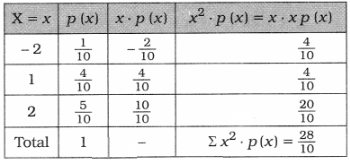
$ E\left(X^2\right)=\Sigma x^2 \cdot p(x)=\frac{28}{10}=2.8 $
Hence, $E\left(x^2\right)$ obtained is $2.8 .$ View full question & answer→Question 122 Marks
Calculate mean of the discrete probability distribution $p(x)\left\{\begin{array}{c}\frac{x-1}{6} ; x=2,3 \\ \frac{1}{2} ;\end{array} x=4\right.$
AnswerHere, $p(x)=\frac{x-1}{6}$ is given.
Putting, $x=2,3$
$\mathrm{p}(2)=\frac{2-1}{6}=\frac{1}{6}$
$ \mathrm{P}(3)=\frac{3-1}{6}$
$=\frac{2}{6}$
$=\frac{1}{3}$
and $P(4)=\frac{1}{2}$
So, the probability distribution of $X$ is obtained as follows :
Mean of the distribution:
$\mu=\Sigma x \cdot p(x)$
$ =2\left(\frac{1}{6}\right)+3\left(\frac{1}{3}\right)+4\left(\frac{1}{2}\right)$
$ =\frac{2}{6}+1+2$
$ =\frac{2+6+12}{6}$
$=\frac{20}{6}$
$=\frac{10}{3}$
Hence, the mean of the distribution obtained is $\frac{10}{3}$.
View full question & answer→Question 132 Marks
For a binomial distribution, standard deviation is $0.8$ and probability of failure is $\frac{2}{3}$. Find the mean of this distribution.
AnswerHere, standard deviation of binomial distribution $=\sqrt{ \mathrm{npq}}$
$\sqrt{n p q}=0.8$
$\therefore \mathrm{npq}=0.64$
Probability 7 of failure $q=\frac{2}{3}$
Mean of the distribution:
Putting, $\mathrm{q}=\frac{2}{3}$ in $n p q=0.64$
$\mathrm{np} \times \frac{2}{3}=0.64$
$\therefore \mathrm{np}=\frac{0.64 \times 3}{2}=096$
Hence, the mean of the distribution obtained is $0.96 .$
View full question & answer→Question 142 Marks
The probability distribution of a random variable $X$ is as follows:
| $X$ |
$2$ |
$3$ |
$4$ |
$5$ |
| $p(x)$ |
$0.2$ |
$0.3$ |
$4C$ |
$C$ |
| Determine the value of constant $C.$ |
AnswerBy condition of probability distribution, we must have
$\Sigma \mathrm{p}(\mathrm{x})=1$
$ \therefore \mathrm{p}(2)+\mathrm{p}(3)+\mathrm{p}(4)+\mathrm{p}(5)=1$
$ \therefore 0.2+0.3+4 C+C=1$
$ \therefore 0.5+5 \mathrm{C}=1$
$ \therefore 5 \mathrm{C}=1-0.5=0.5$
$ \therefore \mathrm{C}=\frac{0.5}{5}=0.1$
Hence, the value of constant $C$ obtained is $0.1 .$
View full question & answer→Question 152 Marks
For a symmetrical binomial distribution with $n=8$, find $P(X \leq 1)$
AnswerHere, it is given that binomial distribution is symmetric.
$\therefore \mathrm{P}=\mathrm{q}=\frac{1}{2}, \mathrm{n}=8$
Putting, $n=8, P=\frac{1}{2}$ and $q=\frac{1}{2}$ in
$p(x)={ }^n C_x p^x q^{n-x}$
$ p(x)={ }^8 C_x\left(\frac{1}{2}\right)^x\left(\frac{1}{2}\right)^{8-x}$
$ P(X \leq 1)=P(X=0,1)$
$ =[p(0)+p(1)]$
$ =\left[{ }^8 C_0\left(\frac{1}{2}\right)^0\left(\frac{1}{2}\right)^8+{ }^8 C_1\left(\frac{1}{2}\right)^1\left(\frac{1}{2}\right)^7\right]$
$ =\left[\left(\frac{1}{2}\right)^8+8\left(\frac{1}{2}\right)^8\right]$
$ =\left[\frac{1}{256}+\frac{8}{256}\right]$
$ =\frac{9}{256}$
Hence, $P[X \leq 1]$ obtained is $\frac{9}{256}$.
View full question & answer→Question 162 Marks
A shopkeeper has 6 tickets in a box. $2$ tickets among them are worth a prize of $Rs.10$ and the remaining tickets are worth a prize of $Rs.5$ . If a ticket is drawn at random from the box, find the expected value of the prize.
AnswerIn a box there are total $6$ tickets of which $2$ tickets are with a prize of ₹ $10$ and $4$ tickets are with a prize of ₹ $5$.
One ticket is drawn at random.
$\therefore $ Total number of primary outcomes $n = { }^6C_1 = 6$
$X =$ The value of prize
$= 5, 10$
The probability distribution of $X$ is obtained as follows :
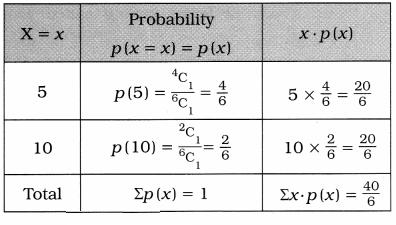
The expected value of the prize:
$E(X)=\Sigma x \cdot P(x)$
$ =\frac{40}{6}$
$ =₹ \frac{20}{3}$
Hence, the expected value of the prize obtained is $₹ \frac{20}{3}$ View full question & answer→Question 172 Marks
For a binomial distribution with $3 n=20 p=15$, find mean and standard deviation of this distribution.
AnswerMean $=\frac{15}{4}$, Standard deviation $=0.97$
View full question & answer→Question 182 Marks
Find parameters of the binomial distribution where mean $=3$ and variance $=2.25$.
Answer$N =12, p =\frac{1}{4}$
View full question & answer→Question 192 Marks
$X$ is a binomial random variable. For its probability distribution If $6 n=105 p=42$, write the probability function of $X$.
Answer$\overline{p(x)}={ }^{7} C_{x}\left(\frac{2}{5}\right)^{x}\left(\frac{3}{5}\right)^{7-x}$
View full question & answer→Question 202 Marks
In a binomial distribution $n=10,3 p+q=1.8$, determine the skewness of the distribution.
Answer$p=0.4$. Hence, positive skewness
View full question & answer→Question 212 Marks
For $n$ Bernoulli trials $2 p-3 q=1.2$, find $p$ and $q$.
View full question & answer→Question 222 Marks
In a binomial distribution $n=12, q-p=0.6$, find its mean and variance.
Answer$p=0.2$, Mean $=2.4$, Variance $=1.92$
View full question & answer→Question 232 Marks
The mean and variance of the distribution of a binomial variate $X$ are $6$ and $3$ respectively, determine the skewness of the distribution.
View full question & answer→Question 242 Marks
The proportion of mean and variance of a binomial distribution is $5: 3$. Find the probability of success p.
View full question & answer→Question 252 Marks
In a binomial distribution if $n=7$ and $p=\frac{5}{7}$ find the mean and variance of the distribution.
AnswerMean $5,$ Variance $=1.43$
View full question & answer→Question 262 Marks
In a survey, it is found that the probability that a person drinks is $\frac{3}{20}$. Obtain the average number of persons who drink and its standard deviation in a group of $300$ persons.
AnswerAverage number $=45$, Standard deviation $=6.18$
View full question & answer→Question 272 Marks
In a box of $1000$ pencils, $20 \%$ pencils are defective, then what is the average number of defective pencils in a box of $120$ pencils$?$
View full question & answer→Question 282 Marks
The probability distribution of a random variable $X$ is as follows:
$P ( x )= \begin{cases}0.16 & x=0 \\ 0.12 & x=1 \\ 0.12(5-x) & x=2,3,4\end{cases}$
Find $E(X)$.
View full question & answer→Question 292 Marks
The probability distribution of a random variable $X$ Is $p(x)=\frac{x+3}{8} x=-2,0,1$. Find mean of $X$.
View full question & answer→Question 302 Marks
The random variable $X$ assume the values $-2,-1,0$ and 1 with respective probability $k, 2 k, 3 k$ and $4 k$, find the value of $k$ and $P[X=0]$.
Answer$K=0.1, P[X=0]=0.3$
View full question & answer→Question 312 Marks
For a random variable $X$, the total probability of its different values is $3 C-1$. Find the value of $C$.
View full question & answer→Question 322 Marks
For a binomial distribution, standard deviation is $0.8$ and probability of failure is $\frac{2}{3}$. find the mean of this distribution.
View full question & answer→Question 332 Marks
For a binomial distribution with $n=10$ and $q-p=0.6$, find mean of this distribution.
View full question & answer→Question 342 Marks
Find parameters of the binomial distribution where mean $=4$ and variance $=2$.
View full question & answer→Question 352 Marks
Find the standard deviation of the binomial distribution having $n=8$ and probability of failure $\frac{2}{3}$
View full question & answer→Question 362 Marks
For a binomial distribution, if probability of success is double the probability of failure and $n=4$, then find variance of the distribution.
View full question & answer→Question 372 Marks
AnswerSuppose, a dichotomous experiment with only two outcomes - Success $(5)$ and Failure $(F)$ - Is repeated n times under Identical conditions and in each trial probability of success $(S)\ p\ (0)$
View full question & answer→Question 382 Marks
If $n=4$ for a symmetrical binomial distribution, then find $p(4)$.
View full question & answer→Question 392 Marks
The probability distribution of a random variable is as follows: $p(x)=\frac{x+3}{10}, x=-2,1,2$, hence the calculate $E\left(X^{2}\right)$.
View full question & answer→Question 402 Marks
State any four properties of binomial distribution.
Answer1. It is a discrete probability distribution.
2. Parameters are n and p.
3. Mean is $np$.
4. Variance is $npq$ and it is always less than the mean.
View full question & answer→Question 412 Marks
For a binomial distribution, if probability of success is double the probability of failure and $n=4$ then find variance of the distribution.
Answer$p = 2q$ and $n = 4$.
We know $p + q = 1$, so $2q + q = 1 \Rightarrow 3q = 1 \Rightarrow q = \frac{1}{3}$.
Then $p = 1 - \frac{1}{3} = \frac{2}{3}$.
Variance = $npq = 4 \cdot \frac{2}{3} \cdot \frac{1}{3} = \frac{8}{9}$.
View full question & answer→Question 422 Marks
Find the standard deviation of the binomial distribution having $ n=8 $ and probability of failure $ \frac{2}{3} $.
Answer$ n=8, q = \frac{2}{3} $. Then $ p = 1 - q = 1 - \frac{2}{3} = \frac{1}{3} $.
Variance $ npq = 8 \cdot \frac{1}{3} \cdot \frac{2}{3} = \frac{16}{9} $.
Standard Deviation $ \sigma = \sqrt{npq} = \sqrt{\frac{16}{9}} = \frac{4}{3} = 1.33 $.
View full question & answer→Question 432 Marks
For a binomial distribution, with $n=10$ and $q-p=0.6$, find mean of this distribution.
AnswerWe know $q + p = 1$ and $q - p = 0.6$.
Adding both : $2q = 1.6 \implies q = 0.8$.
Then $p = 1 - 0.8 = 0.2$.
Mean $np = 10 \times 0.2 = 2$.
View full question & answer→