Question 13 Marks
There are $4$ red and $2$ white balls in a box. $2$ balls are drawn at random from the box with- out replacement. Obtain probability distribution of number of white balls in the selected balls.
View full question & answer→Question 23 Marks
In a factory, packets of produced blades are prepared having $50$ blades in each packet. A quality control engineer randomly selects a packet from these packets and examines all the blades of the selected packet. If $4$ or more defective blades are observed in the selected packet then the packet is rejected. The probability distribution of the defective blades in the packet is given below :

From the given probability distribution,
$(i)$ Find constant $K.$
$(ii)$ Find the probability that the randomly selected packet is accepted by the quality control engineer. View full question & answer→Question 33 Marks
A random variable $X$ denotes the number of accidents per year in a factory and the probability distribution of $X$ is given below :

$(i)$ Find the constant $K$ and rewrite the probability distribution.
$(ii)$ Find the probability of the event that one or two accidents will occur in this factory during the year.
$(iii)$ Find the probability that no accidents will take place during the year in the factory. View full question & answer→Question 43 Marks
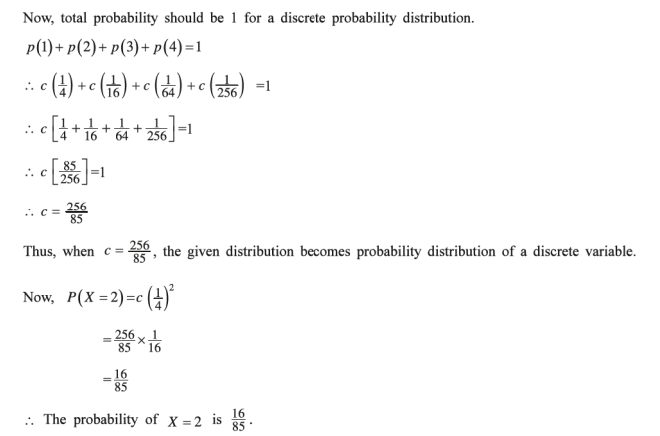
Determine when the following distribution is a probability distribution of discrete variable. Hence obtain the probability for $x =2$
$p(x)=c\left(\frac{1}{4}\right)^{x}, \quad x=1,2,3,4$
AnswerHere, $p(1)=c\left(\frac{1}{4}\right), p(2)=c\left(\frac{1}{4}\right)^{2}=c\left(\frac{1}{16}\right), p(3)=c\left(\frac{1}{4}\right)^{3}=c\left(\frac{1}{64}\right), p(4)=c\left(\frac{1}{4}\right)^{4}=c\left(\frac{1}{256}\right)$
View full question & answer→Question 53 Marks
During a war, on an average one ship out of $9$ got sunk in a certain voyage. Find the probability that exactly $5$ out of a convoy of $6$ ships would arrive safely.
View full question & answer→Question 63 Marks
The probability that a person living in a city is a non-vegetarian is $0.20.$ Find the probability of at the most two persons out of $6$ persons randomly selected from the city is non-vegetarian.
View full question & answer→Question 73 Marks
$10\%$ apples are rotten in a box of apples. Find the probability that half of the $6$ apples selected from the box with replacement will be rotten and find the variance of the number of rotten apples.
AnswerIn a box of apples $10 \%$ apples are rotten.
$\therefore$ Probability that an apple is rotten $p=\frac{10}{100}=\frac{1}{10}$
$\therefore q=1-p=1-\frac{1}{10}=\frac{9}{10}$
Now, $\mathrm{n}=6, \mathrm{X}=$ Number of rotten apples $=3$
$\mathrm{X}$ is binomial random variable.
Putting, $n=6, x=3, P=\frac{1}{10}, q=\frac{9}{10}$ in
$\mathrm{P}(\mathrm{X}=\mathrm{x})=\mathrm{p}(\mathrm{x})={ }^n \mathrm{C}_{\mathrm{x}} \mathrm{p}^{\mathrm{x}} \mathrm{q}^{\mathrm{n}-\mathrm{x}}$
$p(x)={ }^6 \mathrm{C}_x\left(\frac{1}{10}\right)^x\left(\frac{9}{10}\right)^{6-x} \quad$
$ \therefore \mathrm{P}(\mathrm{X}=3)=p(3)={ }^6 \mathrm{C}_3\left(\frac{1}{10}\right)^3\left(\frac{9}{10}\right)^{6-3}$
$ =\frac{6 \times 5 \times 4}{3 \times 2 \times 1} \times \frac{1}{1000}\left(\frac{9}{10}\right)^3$
$ =20 \times \frac{1}{1000} \times \frac{729}{1000}$
$ =0.0146$
Variance:
Putting, $n=6, p=\frac{1}{10}, q=\frac{9}{10}$
$\mathrm{npq}=6 \times \frac{1}{10} \times \frac{9}{10}$
$=0.54$
View full question & answer→Question 83 Marks
The mean and variance of the binomial distribution are $2$ and $\frac{6}{5}$ respectively. Find $p(1)$ and $p(2)$ for this binomial distribution.
AnswerHere, $n p=2$ and $n p q=\frac{6}{5}$
Now, $q=\frac{n p q}{n p}$
$
\begin{aligned}
& \therefore q=\frac{6}{5 \times 2}=\frac{3}{5} \\
& \therefore p=1-q=1-\frac{3}{5}=\frac{2}{5}
\end{aligned}
$
Putting, $p=\frac{2}{5}$ in $n p=2$
$
\begin{aligned}
& \therefore n \times \frac{2}{5}=2 \\
& \therefore n=\frac{2 \times 5}{2}=5 \\
& \therefore n=5
\end{aligned}
$
Putting, $n=5, p=\frac{2}{5}, q=\frac{3}{5}$ in
$
\begin{aligned}
& \mathrm{P}(\mathrm{X}=x)=p(x)={ }^n \mathrm{C}_x p^x q^{n-x} \\
& p(x)={ }^5 \mathrm{C}_x\left(\frac{2}{5}\right)^x\left(\frac{3}{5}\right)^{5-x} \\
& \begin{aligned}
& \therefore p(1)={ }^5 \mathrm{C}_1\left(\frac{2}{5}\right)^1\left(\frac{3}{5}\right)^{5-1} \\
&=5 \times\left(\frac{2}{5}\right) \times\left(\frac{3}{5}\right)^4=5 \times \frac{2}{5} \times \frac{81}{625}=\frac{162}{625} \\
& \text { and } p(2)={ }^5 \mathrm{C}_2\left(\frac{2}{5}\right)^2\left(\frac{3}{5}\right)^{5-2} \\
&= \frac{5 \times 4}{2} \times \frac{4}{25} \times\left(\frac{3}{5}\right)^3 \\
&=10 \times \frac{4}{25} \times \frac{27}{125}=\frac{216}{625}
\end{aligned}
\end{aligned}
$
Hence, $p(1)$ and $p(2)$ obtained are $\frac{162}{625}$ and $\frac{216}{625}$ respectively.
View full question & answer→Question 93 Marks
A person is asked to select a number from positive integers $1$ to $7.$ If the number selected by him is odd then he is entitled to get the prize. If he is asked to take $5$ trials then find the probability of the event that he will be entitled to get a prize in only one trial.
AnswerNumbers are: $1,2,3,4,5,6,7$, of which odd numbers are $1,3,5,7=4$
$\therefore$ Probability of selecting odd number $=\frac{4}{7}$
Now, $\mathrm{n}=$ Number of trials $=5$
$X=\text { Number of trials which is entitled to get the prize }=1$
$ p=\text { Probability of getting prize }=\frac{4}{7}$
$ \therefore q=1-p=1-\frac{4}{7}=\frac{3}{7}$
Putting, $n=5, x=1, P=\frac{4}{7}, q=\frac{3}{7}$ in
$\mathrm{P}(\mathrm{X}=\mathrm{x})=\mathrm{p}(\mathrm{x})={ }^n \mathrm{C}_x \mathrm{p}^{\mathrm{x}} \mathrm{q}^{n-x}$
$ p(x)={ }^5 \mathrm{C}_x\left(\frac{4}{7}\right)^x\left(\frac{3}{7}\right)^{5-x}$
$ \therefore \mathrm{P}(\mathrm{X}=1)=p(1)={ }^5 \mathrm{C}_1\left(\frac{4}{7}\right)^1\left(\frac{3}{7}\right)^{5-1}$
$ =5 \times \frac{4}{7} \times\left(\frac{3}{7}\right)^4$
$ =5 \times \frac{4}{7} \times \frac{81}{2401}$
$ =\frac{1620}{16807}$
Hence, the probability that a person will be entitled to get a prize obtained is $\frac{1620}{16807}$.
View full question & answer→Question 103 Marks
In a game of hitting a target, the probability that Ramesh will fail in hitting the target is $\frac{2}{5}$. If he is given $3$ trials to hit the target, find the probability of the event that he hits the target successfully in $2$ trials. State mean of this distribution.
AnswerHere, $n=3$
$X=$ Number of trials in which the target is successfully hit $=2$.
$p=$ Probability of hitting the target successfully
$=1- ($probabllity of fail in hitting the target$)$
$=1-\frac{2}{5}=\frac{3}{5}$
$\therefore q=1-p=\frac{2}{5}$
$X$ is binomial random variable.
$\therefore \mathrm{P}(X=x)=\mathrm{p}(\mathrm{x})={ }^n C_x \mathrm{p}^x q^{n-x}$
Putting, $n=3, x=2, p=\frac{3}{5}$
$q=1-p=1-\frac{3}{5}=\frac{2}{5}$
$ p(x)={ }^3 \mathrm{C}_x\left(\frac{3}{5}\right)^x\left(\frac{2}{5}\right)^{3-x}$
$ \therefore \mathrm{P}(\mathrm{X}=2)=p(2)={ }^3 \mathrm{C}_2\left(\frac{3}{5}\right)^2\left(\frac{2}{5}\right)^{3-2}$
$ =\frac{3 \times 2}{2} \times \frac{9}{25} \times\left(\frac{2}{5}\right)^1$
$ =3 \times \frac{9}{25} \times \frac{2}{5}$
$ =\frac{54}{125}$
Hence. the probability of hitting the target successfully obtained is $\frac{54}{125}$.
Mean of the distribution:
$n p=3 \times \frac{3}{5}=\frac{9}{5}$
View full question & answer→Question 113 Marks
State properties of binomial distribution.
AnswerProperties of binomial distribution are as follows:
- It is a probability distribution of discrete random variable.
- The parameters of this distribution are $n$ and $p$.
- The mean of the distribution is $\mathrm{np}$, which shows the average number of successes in $\mathrm{n}$ Bernoulli trials.
- In this distribution the value of its variance is always less than its mean. i.e.. $n p q-$ If for any value of $n . p=\frac{1}{2}$, it is symmetric distribution.
- If for any value of $n, p<\frac{1}{2}$, the skewness of the distribution is positive. $(8)$ If for any value of $n$, $p>\frac{1}{2}$, the skewness of the distribution is negative.
View full question & answer→Question 123 Marks
What is discrete probability distribution? State its properties.
Answer
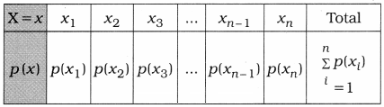
Suppose, probability of a discrete random variable. $X$ is $p\left[X=x_i\right]=p\left(x_i\right)$, where $i=1,2,3, \ldots \ldots, n, p\left(x_i\right)>0$ and
$\sum_{i=1}^n p\left(x_i\right)=1$
then set of real values $\left\{p\left(x_1\right), p\left(x_2\right)\right.$, $\left.\mathrm{p}\left(\mathrm{x}_n\right)\right\}$ is called probability distribution of a discrete random variable $X$.
In tabular form it is written as follows :
Properties of discrete probability distribution :
- For each value $x$ of $X. p(x) > 0.$
- $\sum (x) = 1$
View full question & answer→Question 133 Marks
The distribution of a random variable X is $p (x)=K•^5P_x, x=0, 1, 2, 3, 4, 5$. Find constant K and mean of this distribution.
Answer$p(x)=k \cdot{ }^5 P_x$ is given.
Putting, $x=0,1,2,3,4,5$
$
\begin{aligned}
& p(0)=k \cdot{ }^5 p_0=k\left(\frac{5 !}{5 !}\right)=k \\
& p(1)=k \cdot{ }^5 p_1=k\left(\frac{5 !}{4 !}\right)=5 k \\
& p(2)=k \cdot{ }^5 p_2=k\left(\frac{5 !}{3 !}\right)=20 k \\
& p(3)=k \cdot{ }^5 p_3=k\left(\frac{5 !}{2 !}\right)=60 k \\
& p(4)=k \cdot{ }^5 p_4=k\left(\frac{5 !}{1 !}\right)=120 k \\
& p(5)=k \cdot{ }^5 p_5=k\left(\frac{5 !}{0 !}\right)=120 k
\end{aligned}
$
Now, by condition of probability distribution, we must have
$
\begin{aligned}
& \Sigma \mathrm{p}(\mathrm{x})=1 \\
& \therefore \mathrm{p}(0)+\mathrm{p}(1)+\mathrm{p}(2)+\mathrm{p}(3)+\mathrm{p}(4)+\mathrm{p}(5)=1 \\
& \therefore \mathrm{k}+5 \mathrm{k}+20 \mathrm{k}+60 \mathrm{k}+120 \mathrm{k}+120 \mathrm{k}=1 \\
& \therefore 326 \mathrm{k}=1 \\
& \therefore \mathrm{k}=\frac{1}{326} .
\end{aligned}
$
Now, putting $k=\frac{1}{326}$
$
\begin{aligned}
& P(0)=k=\frac{1}{326} \\
& P(1)=5 k=\frac{5}{326} \\
& P(2)=20 k=\frac{20}{326} \\
& P(3)=60 k=\frac{60}{326} \\
& P(4)=120 k=\frac{120}{326} \\
& P(5)=120 k=\frac{120}{326}
\end{aligned}
$
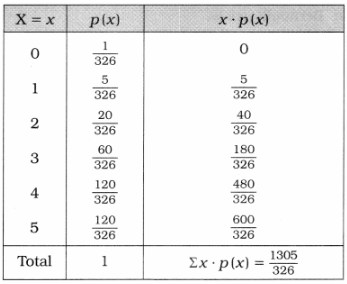
Calculation of mean :
$
\mu=\Sigma x \cdot p(x)=\frac{1305}{326}
$
Hence, the mean of the distribution obtained is $\frac{1305}{326}$. View full question & answer→Question 143 Marks
The probability distribution of a random variable $X$ is as follows:
$P(x)=C\left(x^2+x\right), x=-2,1,2$
Find the value of $C$ and show that $P(2)=3 P(-2)$.
Answer
Here, $p(x)=C\left(x^2+x\right)$
Putting, $x=-2,1,2$
$
\begin{aligned}
& p(-2)=C\left[(-2)^2+(-2)\right]=C(4-2)=2 C \\
& p(1)=C\left[(1)^2+(1)\right]=2 C \\
& p(2)=C\left[(2)^2+(2)\right]=6 C
\end{aligned}
$
By condition of probability distribution, we must have
$
\begin{aligned}
& \Sigma \mathrm{p}(\mathrm{x})=1 \\
& \therefore \mathrm{p}(-2)+\mathrm{p}(1)+\mathrm{p}(2)=1 \\
& \therefore 2 \mathrm{C}+2 \mathrm{C}+6 \mathrm{C}=1 \\
& \therefore 10 \mathrm{C}=1 \\
& \therefore C=\frac{1}{10}
\end{aligned}
$
Now, putting $C=\frac{1}{10}$ in $p(2)=6 \mathrm{C}$
$
p(2)=6 \times \frac{1}{10}=\frac{3}{5}
$
Putting $C=\frac{1}{10}$ in $3 \mathrm{p}(-2)=2 \mathrm{C}$
$
\therefore 3 \mathrm{p}(-2)=3 \times 2 \times \frac{1}{10}=\frac{3}{5}
$
Hence, it is proved that $\mathrm{p}(2)=3 \mathrm{p}(-2)=\frac{3}{5}$.
View full question & answer→Question 153 Marks
The probability distribution of a random variable $X$ is as follows:
$
p(x)=\left\{\begin{array}{ll}
K(x-1) ; & x=2,3 \\
K ; & x=4 \\
K(6-x) ; & x=5
\end{array}\right.
$
Find the value of constant $k$ and the probability of the event that variable $X$ assumes even numbers.
AnswerThe probability distribution of a random variation is given as follows:
$
\begin{aligned}
& p(x)=k(x-1) ; x=2,3 \\
& \therefore p(2)=k(2-1)=k \\
& p(3)=k(3-1)=2 k \\
& p(x)=k ; x=4 \\
& \therefore p(4)=k \\
& p(x)=k(6-x)=k \\
& \therefore p(5)=k(6-5)=k
\end{aligned}
$
By condition of probability distribution, we must have
$
\begin{aligned}
& \Sigma p(x)=1 \\
& \therefore p(2)+p(3)+p(4)+p(5)=1 \\
& \therefore k+2 k+k+k=1 \\
& \therefore 5 k=1 \\
& \therefore k=\frac{1}{5}
\end{aligned}
$
Probability that variable $X$ assumes even numbers :
$
\begin{aligned}
& P[X=2,4] \\
& =p(2)+p(4) \\
& =k+k=2 k \text { (Putting } k=\frac{1}{5} \text { ) } \\
& p(2)+p(4)=2 \times \frac{1}{5}=\frac{2}{5}
\end{aligned}
$
Hence, the probability that the variable $X$ assumes even number obtained is $\frac{2}{5}$.
View full question & answer→Question 163 Marks
An example Is given to $6$ students to solve. The probability of getting correct solution of the problem by any student is $0.6 .$ Students are trying to solve the problem independently. Find the probability of getting the correct solution by only $2$ out of the 6 students.
AnswerHere, $n=6$
$x=$ No. of student getting correct solution of the problem $=2$
$p=$ Probability of getting correct solution of the problem $=0.6$
$\therefore q=1-p=1-0.6=0.4$
Putting, $n=6, x=2, p=0.6$ and $q=0.4$ in
$P(X=X)=p(x)={ }^n C_x p^x q^{n-x}$
$p(x)={ }^6 C_x(0.6)^x(0.4)^{6-x}$
$\therefore P(X=2)=p(2)={ }^6 C_2(0.6)^2(0.4)^{6-2}$
$=15(0.36)(0.4)^4$
$=15(0.36)(0.0256)$
$=0.13824$
Hence, the probability of getting the correct solution of the problem obtained is $0.13824 .$
View full question & answer→Question 173 Marks
There are $200$ farms in a Taluka. Among the bore wells made in these $200$ farms of the Taluka, salted water is found in $20$ farms. Find the probability of the event of not getting salted water in $3$ out of $5$ randomly selected farms from the Taluka.
AnswerAmong the bore wells made in $200$ farms, salted water is found in $20$ farms.
$\therefore$ The probability of getting salted water in the farm is $\mathrm{p}=\frac{20}{200}=\frac{1}{10}$
$\therefore q=1-p=1-\frac{1}{10}=\frac{9}{10}$
Here, $n=5$
$X=3$ farms not getting salted water, i. e., $2$ farms getting salted water
$\therefore x=2$
Putting, $n=5, x=2, p=\frac{1}{10}$ and $q=\frac{9}{10}$ in
$P(X=x)=p(x)={ }^n C_x p^x q^{n-x}$
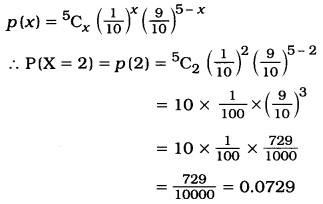
Hence, the probability of not getting salted water in $3$ farms obtained is $0.0729.$ View full question & answer→Question 183 Marks
A person has kept $4$ cars to run on rent. The probability that any car is rented during the day is $0.6$. Find the probability that more than one but less than $4$ cars are rented during a day.
Answer$4$ cars to run for rent. So $n = 4.$
$X =$ No. of cars to run for rent is more than one but less than $4.$
$\therefore X = 2$ or $3$
$p =$ Probability that car is rented during the day $= 0.6$
$\therefore q = 1 – p = 1 – 0.6 = 0.4$
Putting, $n = 4, p = 0.6$ and $q = 0.4$ in
$P(X = x) = p(x) =\ ^nC_x p^x q^{n-x}$
$P(X = x) = p(x) =\ ^4C_x (0.6)^x (0.4)^{4 – x}$
Now, $P(X = 2$ or $X = 3)$
$= p (2) + p(3)$
$=\ ^4C_2 (0.6)^2 (0.4)^{4-2} +\ ^4C_3 (0.6)^3 (0.4)^{4-3}$
$= 6(0.6)^2 (0.4)^2 + 4(0.6)^3 (0.4)^1$
$= 6(0.36) (0.16) + 4(0.216) (0.4)$
$= 0.3456 + 0.3456$
$= 0.6912$
Hence, the probability that more than one but less than $4$ cars rented during a day obtained is $0.6912.$
View full question & answer→Question 193 Marks
Mean of a binomial distribution Is $5$ and its variance is equal to the probability of success. Find the parameters of this distribution and hence find the probability of the event of getting none of the failures for this distribution.
AnswerHere, mean $= np = 5$ and variance $= npq = p$ are given.
Putting, $np = 5$ in
$npq = p,$
$5q = p$
Putting, $q = 1 – p.$
$5(1 – p) = p$
$\therefore 5 – 5p = p$
$\therefore 5 = p + 5p$
$\therefore 5 = 6p$
$\therefore p=\frac{5}{6}$
Putting, $p=\frac{5}{6}$ in
$n p=5$
$ n \times \frac{5}{6}=5$
$ \therefore n=\frac{5 \times 6}{5}=6$
$ \therefore n=6$
So, the parameters of the distribution are
$n=6 \text { and } p=\frac{5}{6} .$
$ q=1-p=1-\frac{5}{6}=\frac{1}{6}$
$X=$ None of the failures. i.e., all successes
$\therefore x=6$
Putting. $n=6, p=\frac{5}{6}$ and $q=\frac{1}{6}$ in
$P(x)={ }^n C_x P^x q^{n-x}$
$ P(x)={ }^6 C_x\left(\frac{5}{6}\right)^x\left(\frac{1}{6}\right)^{6-x}$
$ \therefore P(X=6)=p(6)={ }^6 C_6\left(\frac{5}{6}\right)^6\left(\frac{1}{6}\right)^0$
$ =1 \times \frac{15625}{46656} \times 1$
$ =\frac{15625}{46656}$
Hence, the probability of getting none of the failures for the given distribution obtained is $\frac{15625}{46656}$
View full question & answer→Question 203 Marks
If the following distribution is a probability distribution of variable $X$, then find constant $k . P(x)=\frac{6-|x-7|}{k} ; x=4,5,6,7,8,9,10$
AnswerHere, $\mathrm{P}(\mathrm{x})=\frac{6-|x-7|}{k}$
Putting, $x=4,5,6,7,8,9,10$
$\mathrm{P}(4)=\frac{6-|4-7|}{k}=\frac{3}{k}$
$ \mathrm{P}(5)=\frac{6-|5-7|}{k}=\frac{4}{k}$
$ \mathrm{P}(6)=\frac{6-|6-7|}{k}=\frac{5}{k}$
$ \mathrm{P}(7)=\frac{6-|7-7|}{k}=\frac{6}{k}$
$ \mathrm{P}(8)=\frac{6-|8-7|}{k}=\frac{5}{k}$
$ \mathrm{P}(9)=\frac{6-|9-7|}{k}=\frac{4}{k}$
$ \mathrm{P}(10)=\frac{6-|10-7|}{k}=\frac{3}{k}$
Now, by condition of probability distribution,
we must have
$\sum \mathrm{p}(\mathrm{x})=1$
$ \therefore \mathrm{P}(4)+\mathrm{p}(5)+\mathrm{P}(6)+\mathrm{P}(7)+\mathrm{P}(8)+\mathrm{p}(9)+\mathrm{P}(10)=1$
$ \therefore \frac{3}{k}+\frac{4}{k}+\frac{5}{k}+\frac{6}{k}+\frac{5}{k}+\frac{4}{k}+\frac{3}{k}$
$ \therefore \frac{30}{k}=1$
$ \therefore \mathrm{k}=30$
Hence, the value of $k$ obtained is $30 .$
View full question & answer→Question 213 Marks
Examine whether the following distribution is a probability distribution of a discrete random variable $X$ :$P(x)=\frac{x+2}{25} ; x=1,2,3,4,5$
AnswerHere, $\mathrm{p}(\mathrm{x})=\frac{x+2}{25}$
Putting, $x=1,2,3,4,5$
$P(1)=\frac{1+2}{25}=\frac{3}{25}$
$ P(2)=\frac{2+2}{25}=\frac{4}{25}$
$ P(3)=\frac{3+2}{25}=\frac{5}{25}$
$ P(4)=\frac{4+2}{25}=\frac{6}{25}$
$ P(5)=\frac{5+2}{25}=\frac{7}{25}$
Now, by the definition of discrete probability distribution, we must have
$(1)\ p(x)>0$ and $(2)\ \sum p(x)=1$.
Now, $p\left(x_i\right)>0$ for $(i=1,2,3,4,5)$ and
$\sum p\left(x_i\right)=p(1)+p(2)+p(3)+p(4)+p(5)$
$ =\frac{3}{25}+\frac{4}{25}+\frac{5}{25}+\frac{6}{25}+\frac{7}{25}=1$
Thus, conditions of probability distribution of discrete random variable are satisfied.
So the given distribution is a probability distribution of a discrete random variable $X$.
View full question & answer→Question 223 Marks
For a Binomial distribution, mean $=3$ and standard deviation $=\sqrt{2}$ Find its parameters and $P[X<2]$.
Answer$N =9, p =\frac{1}{3}, P[x<2]=\frac{11}{3}\left(\frac{2}{3}\right)^{8}=\frac{2816}{19683}$
View full question & answer→Question 233 Marks
For a Binomial distribution, mean: variance $=3: 2$. Find the probability of success.
View full question & answer→Question 243 Marks
For the distribution of a Binomial variate $X$, mean $=4.5$ and standard deviation $=1.5$. Obtain $P(3 \leq X \leq 5)$ and $P(X \leq 2)$.
Answer$p=\frac{1}{2}, n=9, P[3 \leq X \leq 5]=\frac{21}{32}, P[X \leq 2]=\frac{23}{256}$
View full question & answer→Question 253 Marks
For a Binomial distribution, mean is $2$ and standard deviation Is $\sqrt{1.6}$ Find its parameters and state its probability function.
Answer$N =10, p =\frac{1}{5}, p(x)={ }^{1} 0 c_{x}\left(\frac{1}{5}\right)^{x}\left(\frac{1}{5}\right)^{10-x}$
View full question & answer→Question 263 Marks
If $9$ ships out of $10$ shlps reach safely to the port, obtain the mean, variance and standard deviation of the number of ships that are reaching safely out of a total of $150$ ships.
AnswerMean $=135$, Variance $=13.5$, Standard deviation $=3.674$
View full question & answer→Question 273 Marks
The probability that a person gets a prize in a certain lottery is $0.003 .1500$ persons have bought the tickets of this lottery. Find the mean and variance of number of persons getting a prize in the lottery
AnswerMean $=4.55$, Variance $4.49$
View full question & answer→Question 283 Marks
In the production of air-coolers, the probability that any air-cooler is defective is $0.2$. For a lot of $200$ air-coolers find the mean. variance and standard deviation of the number o defective aircoolers.
AnswerMean $=40$, Variance $=32$, Standard deviation $=5.666$
View full question & answer→Question 293 Marks
The probability that a person from a group is found to be smoker is $\frac{2}{3}$ For a group of $1200$ persons, find the mean and variance of number of smokers.
AnswerMean $=800$, Variance $=267$
View full question & answer→Question 303 Marks
The probability that a student fails at some examination is $\frac{2}{5}$ Find the mean and variance of the number of students who pass from a group of $300$ students.
AnswerMean $=180$, Variance $72$
View full question & answer→Question 313 Marks
If $P ( X = x )= p ( x )=\frac{x(x+1)(2 x+1)}{120} x =0,1,2,3$ determine whether $p ( x )$ is a probability distribution or not. If it is then find $E \left(X^{2}\right)$
Answer$p(x)$ is a probability distribution. $E(X)=2.65, E\left(X^{2}\right)=7.35$
View full question & answer→Question 323 Marks
If $P(X=x)=p(x)=\frac{x^{2}+1}{18} x=0,1,2,3$ determine whether $p(x)$ is a probability distribution or not. Find the mean and variance of this distribution.
Answer$p(x)$ is a probability distribution. Mean $=2.33$, Variance $=0.24$
View full question & answer→Question 333 Marks
If $p(x)=C .\left(\frac{2 x+1}{x-1}\right) x=2,3,4$, then find the value of constant $C$ such that $p(x)$ becomes a probability distribution.
View full question & answer→Question 343 Marks
If $p(x)=0.2 A .3^{x-1} ; x=1,2,3,4$, then find the value of constant A such that $p(x)$ becomes a probability distribution.
View full question & answer→Question 353 Marks
If the probability distribution of a random variable $X$ is $p(x)=\frac{1}{5} A \cdot\left(x^{3}+1\right) ; x=0,1,2,3$, find the constant $A.$
View full question & answer→Question 363 Marks
If $P(X)=C \cdot{ }_{3} C_{x} \cdot x(x+1) ; x =0,1,2,3$, find the constant $C$.
View full question & answer→Question 373 Marks
Find $(1)$ the constant $C$ and $(2) P[1 \leq X] .$
Answer$C=0.04, p[1 \leq X]=0.6$
View full question & answer→Question 383 Marks
Find the constant ' $a$ ' and the probability that $X$ assumes an odd value.
Answer$a=0.12, P[X=1,3]=0.36$
View full question & answer→Question 393 Marks
The probability distribution of a random variable $X$ is defined as follows:
Answer$P ( X = x )= p ( x )= \begin{cases}0.16 & x=0 \\ a x & x=1 \\ a(5-x) & x=2,3,4\end{cases}$
View full question & answer→Question 403 Marks
The probability distribution of a random variable $X$ is as follows:
Answer$P ( x )= \begin{cases}k(x-1) & x=2,3 \\ k & x=4 \\ k(6-x) & x=5\end{cases}$
View full question & answer→Question 413 Marks
A random variable X denotes the number of accidents per year in a factory and the probability distribution of X is given below :
| X = x | 0 | 1 | 2 | 3 | 4 |
| p(x) | 4K | 15K | 25K | 5K | K |
(i) Find the constant K.
(ii) Find the probability of the event that one or two accidents will occur in this factory during the year.
Answer(i) $\Sigma p(x) = 1 \implies 4K + 15K + 25K + 5K + K = 1 \implies 50K = 1 \implies K = 0.02$.
(ii) $P(X=1 \text{ or } 2) = p(1) + p(2) = 15K + 25K = 40K = 40(0.02) = 0.8$.
View full question & answer→Question 423 Marks
The mean and variance of the binomial distribution are 2 and $\frac{6}{5}$ respectively. Find p(2) for this binomial distribution.
Answer$np = 2, npq = 1.2$.
$q = \frac{1.2}{2} = 0.6 \implies p = 0.4$.
$n(0.4) = 2 \implies n = 5$.
$P(x) = \binom{n}{x} p^x q^{n-x} \implies P(2) = \binom{5}{2} (0.4)^2 (0.6)^3 = 10 \times 0.16 \times 0.216 = 0.3456$.
View full question & answer→Question 433 Marks
State properties of binomial distribution.
Answer1. It is a discrete probability distribution.
2. Parameters are n and p.
3. Mean is np.
4. Variance is npq, and standard deviation is $\sqrt{npq}$.
5. Variance is always less than mean (npq < np).
6. It is symmetric if $p = 0.5$, positively skewed if $p < 0.5$, and negatively skewed if $p > 0.5$.
View full question & answer→Question 443 Marks
The probability distribution of a random variable X is as follows :
$p(x)= C \left(x^2+x\right), x=-2,1,2$
Find the value of C and show that $p(2)=3 p(-2)$
Answer$p(-2) = C(4-2) = 2C$
$p(1) = C(1+1) = 2C$
$p(2) = C(4+2) = 6C$
$\sum p(x) = 1 \Rightarrow 2C+2C+6C = 1 \Rightarrow 10C = 1 \Rightarrow C = \frac{1}{10}$.
To show : $p(2) = 6(\frac{1}{10}) = \frac{6}{10}$.
$3p(-2) = 3(2 \cdot \frac{1}{10}) = \frac{6}{10}$.
Hence, $p(2) = 3p(-2)$.
View full question & answer→Question 453 Marks
The distribution of a random variable X is $p(x)= K ^5 . P _{ x }, x=0,1,2,3,4,5$. Find constant K and mean of this distribution.
AnswerSum of probabilities = 1.
$ K[\binom{5}{0} + \binom{5}{1} + \binom{5}{2} + \binom{5}{3} + \binom{5}{4} + \binom{5}{5}] = 1 $
$ K[2^{5}] = 1 \Rightarrow K = \frac{1}{32} $.
This is a binomial distribution with $ n=5 $ and $ p=0.5 $.
Mean = $ np = 5 \times 0.5 = 2.5 $.
View full question & answer→Question 463 Marks
State properties of binomial distribution.
Answer1. It is a discrete distribution.
2. Parameters are $ n $ and $ p $.
3. Mean = $ np $ and Variance = $ npq $.
4. For $ p < 0.5 $, it is positively skewed; for $ p > 0.5 $, it is negatively skewed; for $ p = 0.5 $, it is symmetric.
View full question & answer→Question 473 Marks
A person has kept 4 cars to run on rent. The probability that any car is rented during the day is $\frac{3}{5}$. Find the probability that more than one but less than 4 cars are rented during a day.
Answer$P(x)=\binom{n}{x} p^x q^{n-x}$
$P(2)=\binom{4}{2}\left(\frac{3}{5}\right)^2\left(\frac{2}{5}\right)^{4-2}$
$=6 \times \frac{9}{25} \times \frac{4}{25}=\frac{216}{625}$
For $x=3$ :
$P(3)=\binom{4}{3}\left(\frac{3}{5}\right)^3\left(\frac{2}{5}\right)^{4-3}$
$=4 \times \frac{27}{125} \times \frac{2}{5}=\frac{216}{625}$
$P(1 < x < 4)=P(2)+P(3)$
$P(1 < x < 4)=\frac{216}{625}+\frac{216}{625}$
$P(1 < x < 4)=\frac{432}{625}$
View full question & answer→Question 483 Marks
State properties of binomial distribution (Any Six points)
AnswerFixed Trials (n) : The experiment consists of a fixed number of independent trials, denoted by n.
Two Outcomes : Each trial results in only two possible outcomes: Success (p) or Failure (q).
Constant Probability : The probability of success (p) remains the same for every trial.
Independent Trials : The outcome of any one trial does not affect the outcome of others.
Discrete Variable : It is a discrete distribution, meaning the number of successes must be a whole number (0, 1, 2...).
Parameters : The distribution is completely defined by two parameters : n (number of trials) and p (probability of success).
View full question & answer→