Question 14 Marks
Let $X$ denote the maximum integer among the outcomes of tossing two dice simultaneously. Obtain the probability distribution of variable $X$ and find its mean and variance.
View full question & answer→Question 24 Marks
A social worker claims that $10 \%$ of the young children in a city have vision problem. A sample survey agency takes a random sample of $10$ young children from the city to test the claim. If at the most one young child is affected by the vision problem, the claim of the social worker is rejected. Find $(i)$ the probability that the claim of the social worker is rejected $(ii)$ the expected number of young children having vision problem in the randomly selected $10$ young children.
View full question & answer→Question 34 Marks
A balacned die is tossed $7$ times. If the event of getting a number $5$ or more is called success and $X$ denotes the number of success in $7$ trials then $(i)$ Write the probability distribution of $X.$ $(ii)$ Find the probability of getting $4$ successes. $(iii)$ Find the probability of getting at the most $6$ successes.
View full question & answer→Question 44 Marks
In a binomial distribution, for $P(X = x) = p(x), n = 8$ and $2 p(4) = 5 p(3) .$ Find the probability of getting success in all the trials for this distribution.
View full question & answer→Question 54 Marks
The parameters of binomial distribution of a random variable $X$ are $n=4$ and $p=\frac{1}{3} .$ State the probability distribution of $X$ in a tabular form and hence find the value of $P(X \leq 2)$.
View full question & answer→Question 64 Marks
It is observed from the life table that the probability that a $40$ years old man will live one more year is $0.95.$ Life insurance company wishes to sell one year life insurance policy of $Rs. 10,000$ to such a man. What should be the minimum premium of the policy so that expected gain of the company would be positive ?
View full question & answer→Question 74 Marks
It is known that $50 \%$ of the students studying in the $10th$ standard have a habit of eating chocolate. To examine the information, $1024$ investigators are appointed. Every investigator randomly selects $10$ students from the population of such students and examines them for the habit of eating chocolate. Find the expected number of investigators who inform that less than $30$ per cent of the students have a habit of eating chocolate.
Answer$50 \%$ of the students have a habit of eating chocolate.
$\therefore$ The probability that a student has habit of eating chocolate is $p=\frac{50}{100}=\frac{1}{2}$.
$\therefore q=1-P=1-\frac{1}{2}=\frac{1}{2}$
Here, $n=10$
$X=$ From the selected 10 students less than $30 \%$ of students, i.e., $\left(\frac{10 \times 30}{100}\right)=3$ students have a habit of eating chocolate.
$=<3$
$X$ is a binomial random variable.
$\therefore P(X=x)=p(x)={ }^n C_x p^x q^{n-x}$
$ \text { Putting, } n=10, p=\frac{1}{2}, q=\frac{1}{2}$
$ P(X=x)=p(x)={ }^{10} C_x\left(\frac{1}{2}\right)^x\left(\frac{1}{2}\right)^{10-x}$
$ ={ }^{10} C_x\left(\frac{1}{2}\right)^{10}$
$ ={ }^{10} C_x\left(\frac{1}{2}\right)^{10}$
$ =\frac{{ }^{10} C_z}{{ }^{1024}}$
Now, $P(X<3)=p(0)+p(1)+p(2)$
$=\frac{{ }^{10} \mathrm{C}_0}{{ }^{1024}}+\frac{{ }^{10} \mathrm{C}_1}{{ }^{1024}}+\frac{{ }^{10} \mathrm{C}_2}{{ }^{1024}}$
$ =\frac{1}{1024}+\frac{10}{1024}+\frac{45}{1024}$
$ =\frac{56}{1024}$
Total number of investigators $\mathrm{N}=1024$
$\therefore$ The expected number of investigators who report that less than $30 \%$ of students have a habit of eating chocolate is
$=\mathrm{N} \times \mathrm{P}(\mathrm{X}<3)$
$ =1024 \times \frac{56}{1024}=56$
View full question & answer→Question 84 Marks
There are one dozen mangoes in a box of which $3$ mangoes are rotten. $3$ mangoes are randomly selected from the box without replacement. If $X$ denotes the number of rotten mangoes in the selected mangoes, obtain the probability distribution of $X$ and hence find expected value and variance of the rotten mangoes in the selected mangoes.
AnswerIn a box there are one dozen, i.e., $12$ mangoes of which $3$ mangoes are rotten.
$3$ mangoes are randomly selected from the box.
$X =$ In selected $3$ mangoes, the number of rotten mangoes.
$\therefore X = 0, 1, 2, 3$
$\text { Now, } P(X=0)=\frac{{ }^3 \mathrm{C}_0 \times{ }^9 \mathrm{C}_3}{{ }^{12} \mathrm{C}_3}=\frac{1 \times 84}{220}=\frac{84}{220}$
$ P(X=1)=\frac{{ }^3 \mathrm{C}_1 \times{ }^9 \mathrm{C}_2}{{ }^{12} \mathrm{C}_3}=\frac{3 \times 36}{220}=\frac{108}{220}$
$ P(X=2)=\frac{{ }^3 \mathrm{C}_2 \times{ }^9 \mathrm{C}_1}{{ }^{12} \mathrm{C}_3}=\frac{3 \times 9}{220}=\frac{27}{220}$
$ P(X=3)=\frac{{ }^3 \mathrm{C}_3 \times{ }^9 \mathrm{C}_0}{{ }^{12} \mathrm{C}_3}=\frac{1 \times 1}{220}=\frac{1}{220}$
The probability distribution of $X$ is obtained as follows :
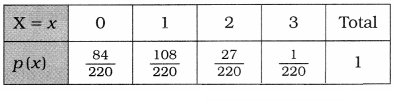
The following table is prepared to find the expected value and variance of rotten mangoes :
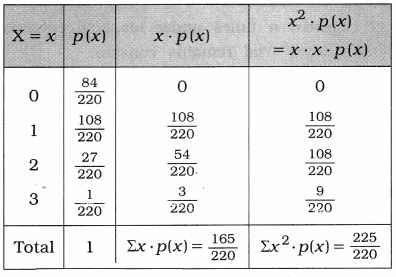
Expected value of rotten mangoes:
$E(X)=\sum x \cdot p(x)$
$ =\frac{165}{220} \text { mangoes }$
Variance of rotten mangoes :
$\sigma^2=V(X)=E\left(X^2\right)-[E(X)]^2$
$ =\sum x^2 p(x)-\left[\sum x p(x)\right]^2$
$ =\frac{225}{220}-\left(\frac{165}{220}\right)^2$
$ =1.0227-(0.75)^2$
$ =1.0227-0.5625$
$ =0.4602$ View full question & answer→Question 94 Marks
There are $3$ red and $4$ white balls in a box. Four balls are selected at random with replacement from the box. Find the probability of the event of getting $(i)\ 2$ red balls and $2$ white balls $(ii)$ all four white balls among the selected balls using binomial distribution.
AnswerIn a box there are total $( 3$ red $+\ 4$ white $= ) 7$ balls.
$4$ balls are selected at random with replacement.
$\therefore n=4$
The probability that a red ball selected is $\mathrm{P}=\frac{3}{7}$ and the probability that a red ball is not selected means a white ball selected is $q=\frac{4}{7}$.
$X$ is binomial random variable.
$\therefore P(X=x)=p(x)={ }^n C_x p^x q^{n-x}$
Putting, $n=4, p=\frac{3}{7}, q=\frac{4}{7}$
$P(X=x)=p(x)={ }^4 C_x\left(\frac{3}{7}\right)^x\left(\frac{4}{7}\right)^{4-x}$
$(i)$ Probability that $2$ red balls and $2$ white balls are selected:
Putting $X=2$,
$P(X=2)=p(2)={ }^4 C_2\left(\frac{3}{7}\right)^2\left(\frac{4}{7}\right)^{4-2}$
$ =6\left(\frac{9}{49}\right)\left(\frac{4}{7}\right)^2$
$ =6 \times \frac{9}{49} \times \frac{16}{49}$
$ =\frac{864}{2401}$
$ =0.3599$
$(ii)$ Probability that all $4$ white balls are selected, i.e., none is red ball.
$\therefore X=0$
$ P(X=0)=\mathrm{P}(0)={ }^4 C_0\left(\frac{3}{7}\right)^0\left(\frac{4}{7}\right)^{4-0}$
$ =1 \times 1 \times\left(\frac{4}{7}\right)^4$
$ =1 \times 1 \times \frac{256}{2401}$
$ =0.1066$
View full question & answer→Question 104 Marks
Normally, $40 \%$ students fail in one examination. Find the probabilities that at least $4$ students in a group of $6$ students pass in this examination.
Answer$40 \%$ student fail in the examination.
$\therefore$ Probability that a student fails $=\frac{40}{100}=0.4$
$p=$ Probability that student passes in the examination
$=1- ($Probability that a student fails$)$
$=1-0.4=0.6$
$q=0.4, n=6$
$X=$ At least $4$ students pass in the examination.
$\therefore X=4,5,6$
$X$ is binomial random variable.
$\therefore P(X=x)=p(x)={ }^n C_x p^x q^{n-x}$
Putting, $n=6, p=0.6, q=0.4$
$P(X=x)=p(x)={ }^6 C_x(0.6)^x(0.4)^{6-x}$
$\therefore \mathrm{p}(4)={ }^6 \mathrm{C}_4(0.6)^4(0.4)^{6-4}$
$=\left(\frac{6 \times 5 \times 4 !}{2 ! \times 4 !}\right)(0.1296)(0.4)^2$
$=(15)(0.1296)(0.16)=0.3110$
$\therefore \mathrm{p}(5)={ }^6 \mathrm{C}_5(0.6)^5(0.4)^{6-5}$
$=\left(\frac{6 \times 5 !}{1 \times 5 !}\right)(0.0778)(0.4)$
$=(6)(0.0778)(0.4)=0.1866$
$p(6)={ }^6 \mathrm{C}_6(0.6)^6(0.4)^{6-6}$
$=(1)(0.0467)(1)$
$=0.0467$
Now, $P(X \geq 4) = p(4) + p(5) + p(6)$
$= 0.3110 + 0.1866 + 0.0467$
$= 0.5443$
Hence, the probability that at least $4$ students pass in the examination obtained is $0.5443.$
View full question & answer→Question 114 Marks
The probability that a bomb dropped from a plane over a bridge will hit the bridge is $\frac{1}{5} .$ Two bombs are enough to destroy the bridge. If $6$ bombs are dropped on the bridge, find the probability that the bridge will be destroyed.
AnswerHere, $n=6$
$p=$ Probability that a bomb dropped over a bridge $=\frac{1}{5}=0.2$
$X$ is binomial random variable.
$\therefore \mathrm{P}(\mathrm{x}=\mathrm{x})=\mathrm{p}(\mathrm{x})={ }^n C_x \mathrm{p}^{\mathrm{x}} \mathrm{q}^{n-x}$
Putting, $n=6, p=\frac{1}{5}=0.2, q=\frac{4}{5}=0.8$
$P(X=x)=p(X)={ }^6 C_x(0.2)^x(0.8)^{6-x}$
Two bombs are enough to destroy the bridge. i.e., $X \geq 2$
$\therefore \mathrm{P}(X \geq 2)=1-\mathrm{p}[\mathrm{X} \leq 1]$
$ =1-[\mathrm{p}(0)+\mathrm{p}(1)] \ldots \ldots \ldots . .$
$ \therefore \mathrm{p}(0)={ }^6 \mathrm{C}_0(0.2)^0(0.8)^6$
$ =1 \times 1 \times 0.2621=0.2621$
$ \therefore \mathrm{p}(1)={ }^6 \mathrm{C}_1(0.2)^1(0.8)^5$
$ =6 \times 0.2 \times 0.32768$
$ =0.3932$
Putting the values of $p(0)$ and $p(1)$ in the result $(1),$
$P[X \geq 2]=1-[0.2621+0.3932]$
$ =1-0.6553$
$ =0.3447$
Hence, the probability that the bridge will be destroyed obtained is $0.3447 .$
View full question & answer→Question 124 Marks
The probability that a student studying in $12th$ standard of science stream will get admission to engineering branch is $0.3. 5$ students are selected from the students who studied in this stream, Find the probability of the event that the number of students admitted to engineering branch is more than the number of students who did not get admission to the engineering branch.
AnswerHere, $n = 5$
$p =$ Probability that a student will get admission to engineering branch $= 0.3$
$\therefore q = 1 – p = 1 – 0.3 = 0.7$
$X$ is binomial random variable.
$\therefore P(X = X) = p(x) = ^nC_xp^xq^{n-x}$
Putting, $n = 5, p = 0.3, q = 0.7$
$P(X = x) = p(x) = ^5C_x(0.3)^x(0.7)^{5-x}$
$X =$ At least three students will get admission in engineering branch
$\therefore X \geq 3$
Now, $P(X \geq 3) = p(3) + p(4) + p(5)$
$= [^5C_3(0.3)^3 (0.7)^{5 – 3}] + [^5C_4(0.3)^4(0.7)^{5 – 4}] + [^5C_5(0.3)^5 (0.7)^{5 – 5}]$
$= [10(0.027) (0.7)^2] + [5(0.0081) (0.7)^1] + [1 (0.00243) (0.7)^0]$
$= [10 \times 0.027 \times 0.49] + [5(0.0081) (0.7)] + [1 \times 0.00243 \times 1]$
$= 0.1323 + 0.02835 + 0.00243$
$= 0.16308$
$= 0.1631$
View full question & answer→Question 134 Marks
If the probability that any $50$ year old person will die within a year is $0.01,$ find the probability that out of a group of $5$ such persons $(i)$ none of them will die within a year $(ii)$ at least one of them will die within a year.
AnswerHere, $n = 5$
$p =$ Probability that any $50$ year old person will die within a year $= 0.01$
$\therefore q = 1 – p = 1 – 0.01 = 0.99$
$X $is binomial random variable.
$\therefore $ Putting, $n = 5, p = 0.01, q = 0.99$ in
$P(X = x) = p(x) =\ ^nC_xp^xq^{n-x}$
$P(X = x) = p(x) =\ ^5C_x(0.01)^x(0.99)^{n-x}$
$(i)$ None of the $50$ year old person will die within a year, i.e.,
$X = 0$
$\therefore P(X = 0) = p(0) = ^5C_0(0.01)^0 (0.99)^{5-0}$
$= 1 \times 1 \times (0.99)^5$
$= 0.9510$
$(ii)$ At least one of them will die within a year, i.e.,$ X ≥ 1$
Now, $P(X \geq 1)$
$= p(1) + p (2) + p(3) + p( 4) + p (5)$
$= 1 – p(0)$
$= 1 – 0.9510$
$= 0.049$
View full question & answer→Question 144 Marks
Two dice are thrown simultaneously once. Obtain the discrete probability distribution of the number of dice for which the number $‘6’$ comes up.
AnswerTwo dice are thrown simultaneously.
$\therefore $ Total primary outcomes of $U$ is $n = 6^2 = 36$
$x$ is to get the number $‘6’$ up.
The following table shows all possible outcomes and their probability.
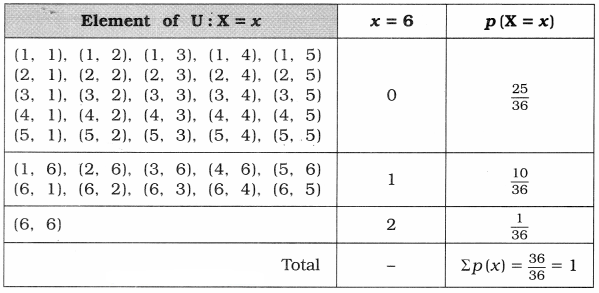
Hence, the probability distribution of getting $x,$ that comes up is obtained as follows : View full question & answer→Question 154 Marks
The probability distribution of the monthly demand of laptop in a store is as follows :

Determine the expected monthly demand of laptop and find variance of the demand.
AnswerExpected monthly demand of laptop :
$E(x) = \sum x ∙ p(x)$
$= 3.62$ laptopVariance of demand of laptop:
$\sigma ^2 = V(X) = E(X^2) – [E(X)]^2$
$= \sum x^2 ∙ p(x) – [\sum x ∙ p(x)]^2$
$= 15.32 – (3.62)^2$
$= 15.32 – 13.1044$
$= 2.2156$
View full question & answer→Question 164 Marks
The probability distribution of a random variable $X$ is as follows :
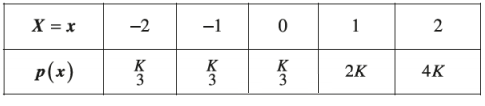
Answer$(i)$ By condition of probability distribution, we must have
$\sum p(x) = 1$
$\therefore \frac{k}{3}+\frac{k}{3}+\frac{k}{3} + 2k + 4k^2 = 1$
$\therefore \frac{k+k+k+6 k+12 k^{2}}{3} = 1$
$\therefore 9k + 12k^2 = 3$
$\therefore 12k^2 + 9k – 3 = 0$
$\therefore 3(4k^2 + 3k – 1) = 0$
$\therefore 4k^2 + 4k – k – 1 = 0$
$\therefore 4k (k+ 1) – 1(k + 1) = 0$
$\therefore (4k- 1) (k + 1) = 0$
$\therefore 4k – 1 = 0$ or $k + 1 = 0$
$\therefore k = \frac{1}{4}$ or $k = – 1$
If $k = – 1,$ then $p(- 2) = – \frac{1}{3}$ which is not possible because $p(x) > 0$.
So $k = – 1$ is not possible.
$\therefore $ Acceptable value is $k = \frac{1}{4}$.
Putting $k =\frac{1}{4}$, the probability distribution of random variable $X$ is written as follows:
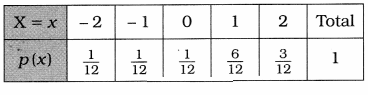
$(ii)$ Mean of the distribution :
$µ = \sum x ∙ p(x)$
$= – 2\left(\frac{1}{12}\right) + – 1 \left(\frac{1}{12}\right) + 0 \left(\frac{1}{12}\right) + 1 \left(\frac{6}{12}\right) + 2 \left(\frac{3}{12}\right)$
$= \frac{-2-1+0+6+6}{12} = \frac{9}{12}$ = $\frac{3}{4}$
Hence, the acceptable value of constant $k$ is $\frac{1}{4}$ and the mean of the distribution obtained is $\frac{3}{4}$. View full question & answer→Question 174 Marks
The probability distribution of a random variable $X$ is defined as follows: $P(x)=\frac{k}{(x+1) !} ; x=1,2,3$ and $k=$ constant Hence, find $(i)$ constant $k \ (ii)\ P(1)$
AnswerHere, $\mathrm{P}(\mathrm{x})=\frac{k}{(x+1) !}$
Putting $x=1,2,3$,
$\mathrm{P}(1)=\frac{k}{(1+1) !}=\frac{k}{2 !}=\frac{k}{2}$
$ \mathrm{P}(2)=\frac{k}{(2+1) !}=\frac{k}{3 !}=\frac{k}{6}$
$ \mathrm{P}(3)=\frac{k}{(3+1) !}=\frac{k}{4 !}=\frac{k}{24}$
$(i)$ Now, by condition of probability distribution.
we must have
$\mathrm{p}(\mathrm{x})=1$
$ \therefore \mathrm{p}(1)+\mathrm{p}(2)+\mathrm{p}(3)=1$
$ \therefore \frac{k}{2}+\frac{k}{6}+\frac{k}{24}=1$
$ \therefore \frac{12 k+4 k+k}{24}=1$
$ \therefore \frac{17 k}{24}=1$
$ \therefore \mathrm{k}=\frac{24}{17}$
$(ii)$ Now, $P(1)=\frac{k}{6}+\frac{k}{24}=\frac{4 k+k}{24}=\frac{5 k}{24}$
Putting, $\mathrm{k}=\frac{24}{17}$
$\mathrm{p}(1<\mathrm{x}<4)=\frac{5 \times 24}{24 \times 17}=\frac{5}{17}$
Hence,$ (i)\ k=\frac{24}{17}$
$(ii)\ \mathrm{P}(1<\mathrm{X}<4)=\frac{5}{17}$
View full question & answer→Question 184 Marks
balanced die is thrown $5$ times. Find the probability of getting number one on the die two times.
View full question & answer→Question 194 Marks
The probability of a child being a boy or a girl is the same. There are $5$ children in each of $800$ families under study. In how many families would there be $2$ or $3$ boys$?$
View full question & answer→Question 204 Marks
is a Binomial variate. For its distribution, the number of trials is $8 .$ If $P(X=4)=$ $0.0520$ and $P(X=5)=0.1560$, find the value of $p$.
Answer$\frac{\overline{15}}{19}$
View full question & answer→Question 214 Marks
For a Binomial distribution, $n=6 .$ If $P(X=3)=0.0625$ and $P(X=4)=0.1250$, find the value of $p$.
View full question & answer→Question 224 Marks
For a Binomial distribution, the number of trials $n=6 .$ If $P(X=2): P(X=3)=4: 3$, find the value of $p$.
View full question & answer→Question 234 Marks
For a Binomial distribution, $n=12$ and $9 P(X=3)=4 P(X=8) .$ Obtain the parameter $p$ of the distribution.
View full question & answer→Question 244 Marks
For a Binomial distribution, $n=6$ and $P(X=3)=P(X=4)$. Obtain the value of $p$.
View full question & answer→Question 254 Marks
For a Binomial distribution, $n =8$ and $5 P ( X =2)=2 P ( X =4)$. Obtain $P(X \leq 3)$.
Answer$P =\frac{1}{2}, p(X \leq 3)=\frac{93}{256}$
View full question & answer→Question 264 Marks
For a Binomial distribution, number of trials $n=7$ and $3 P(X=4)=P(X=3)$. Find the value of $p$ the probability of success.
View full question & answer→Question 274 Marks
An unbiased coin is tossed 5 times. Find the probability to get at least $3$ heads.
View full question & answer→Question 284 Marks
A balanced die is thrown $4$ times. The event that the number on top of the die Is less than or equal to $4$ is called success. Find the probability of getting $(1)$ exactly $3$ successes, $(2)$ at the most $2$ successes.
Answer$P=\frac{2}{3}\ (1)\ \frac{32}{81}\ (2)\ \frac{33}{81}$
View full question & answer→Question 294 Marks
For a Binomial variate $X, n=5$ and $p=0.5$. Find the following probabilities:$(1)\ P(0 \leq X<2)\ (2)\ P(X>3)\ (3)\ P(2 \leq X<4)$
Answer$(1)\ \frac{3}{16}$
$(2)\ \frac{32}{81}$
$(3)\ \frac{33}{81}$
View full question & answer→Question 304 Marks
$X$ is a Binomial variate. If $n=5$ and $p=\frac{1}{3}$, find the Binomial probabilities of possible values of $X$.
AnswerTake $x=0,1,2,3,4,5 .$ $\frac{32}{243}, \frac{80}{243}, \frac{80}{243}, \frac{40}{243}, \frac{10}{243}, \frac{1}{243}$
View full question & answer→Question 314 Marks
An unbiased coin is tossed six times. Find the probability of getting $(1)\ 5$ heads, $(2)$ at the most $3$ heads.
Answer$(1)\ \frac{3}{32}\ (2)\ \frac{21}{32}$
View full question & answer→