Questions

3 Marks Each

🎯

Test yourself on this topic

18 questions · timed · auto-graded

Question 13 Marks
Find the trend using five yearly moving averages for the following data about yearly production $($in tons$)$ of a factory.
Year $2006$ $2007$ $2008$ $2009$ $2010$ $2011$ $2012$ $2013$ $2014$ $2015$ $2016$
Productions(tones) $112$ $106$ $93$ $90$ $114$ $159$ $170$ $130$ $108$ $113$ $115$
View full question & answer
Question 23 Marks
The number of accounts opened in different weeks in a branch of a certain bank are given below. Find the trend using three-weekly moving averages. \begin{array}{|l|c|c|c|c|c|c|c|c|c|c|} \hline Week & 1 & 2 & 3 & 4 & 5 & 6 & 7 & 8 & 9 & 10 \\ \hline No.\ of\ accounts\ opened & 26 & 27 & 26 & 25 & 22 & 24 & 25 & 23 & 22 & 21 \\ \hline \end{array}
View full question & answer
Question 33 Marks
Obtain the linear equation for trend for a time series with $n=8$, $ \Sigma y=344, \Sigma t y=1342 $
Answer
Since $n=8$, we take $t=1,2, \ldots ., 8$
Hence, we get $\Sigma t=1+2+\ldots .+8=36$ and
$ \Sigma t^{2}= 1^{2}+2^{2}+\ldots . .+8^{2}=1+4+\ldots .+64=204 .$
$\bar{t}= \frac{\Sigma t}{n}=\frac{36}{8}=4.5, \bar{y}=\frac{\Sigma y}{n}=\frac{344}{8}=43$
$b =\frac{n \Sigma t y-(\Sigma t)(\Sigma y)}{n \Sigma t^{2}-(\Sigma t)^{2}}$
$ =\frac{8 \times 1342-36 \times 344}{8 \times 204-(36)^{2}}$
$ =\frac{10736-12384}{1632-1296}$
$ =\frac{-1648}{336}$
$ =-4.9048$
$ \simeq-4.9$
$a= \bar{y}-b \bar{t}$
$= 43-(-4.9) \times 4.5$
$= 43+22.05$
$= 65.05 $
Equation for trend $\hat{y}=a+b t$
$ =65.05+(-4.9) t$
$ =65.05-4.9 t $
View full question & answer
Question 43 Marks
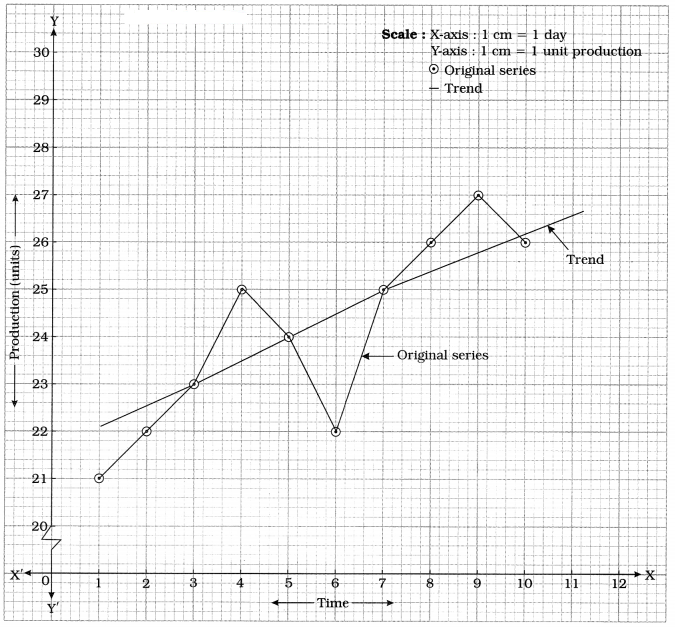
The following time series shows the daily production of a factory. Find the trend using graphical method.
Time $t$ $1$ $2$ $3$ $4$ $5$ $6$ $7$ $8$ $9$ $10$
Production $($units$)$ $21$ $22$ $23$ $25$ $24$ $22$ $25$ $26$ $27$ $26$
Answer
Here, the unit of time is day. So $t = 1, 2, 3, …. 10; y =$ production.
The given time series is written as shown in the following table :
Taking $t$ on $X-$axis and $y$ on $Y-$axis points $(1, 21), (2, 22), …… , (10, 26)$ are plotted on the graph paper. Joining these points serially by lines, the curve of the given series is obtained as follows:
View full question & answer
Question 53 Marks
Discuss the limitations of the method of moving average.
Answer
The limitations of the method of moving average are as follows :
  • The trend obtained by this method is not accurate if the interval for the moving averages is not chosen correctly.
  • The estimates of trend for some initial and last time periods cannot be obtained.
  • A specific mathematical formula is not obtained for future estimates.
  • If time series shows linear trend then only this method is used.
  • If long term moving average taken then curve of trend line vanishes.
View full question & answer
Question 63 Marks
Describe the method of moving average to find trend.
Answer
The method of moving average is very useful to find trend by eliminating the effect of short-term variations.
$\rightarrow$ The period of moving average : The short-term variation are usually regular and have repetition. The period of repetition of these variations can be found by observing the given time series. The average is found from the number of observations corresponding to this period which is known as the period of moving average.
$\rightarrow$ Since the average value lie in the centre, the values obtained by this method show the trend.
$\rightarrow$ Suppose the values of variable are $y_1, y_2, …. y_n$ corresponding to time $t = 1, 2, …, n$ and the period of moving average is $3$ years. Then the mean of first three observations $y_1, y_2, y_3$ is found as $\frac{y_1+y_2+y_3}{3}$ and it is written against the centre of these three observations which is $y_2$. Further, the mean of successive three observation $y_2, y_3, y_4$ is obtained and it written against $y_3$. Similarly, finding successive moving total of three observations, averages are calculated. These average are called three yearly moving averages which indicate trend.
$\rightarrow$ The period of moving average not necessarily every time is year. It may be $5$ days, $4$ weeks, $7$ months, etc.
$\rightarrow$ If time period of moving average is an even number say. $4, 6, …$ etc., then the process of finding moving average is to be done twice.
$\rightarrow$ Suppose, the period of moving average is $4$ years. The four yearly successive averages
$\frac{y_1+y_2+y_3+y_4}{4}, \frac{y_2+y_3+y_4+y_5}{4}, \frac{y_3+y_4+y_5+y_6}{4}$
are written between $y_2$ and $y_3, y_3$ and $y_4, y_4$ and $y_5 ….$ respectively since, these averages are in between two years, the average of each pair of averages is found and written between two moving average. Thus, the average of the first two averages will be written against $y_3$. The averages thus obtained are called as four yearly moving average.
View full question & answer
Question 73 Marks
State the merits and limitations of the method of least squares.
Answer
The merits and limitations of the method least squares are as follows :
  • Merits :
    • This method is absolutely mathematical and hence the future estimates do not change subjectively with the person.
    • The trend estimates can be obtained by this method for each of the given values of t.
    • The trend estimates can also be obtained for intermediate periods as the trend values are obtained using an equation.
  • Limitations :
    • This method required extensive calculations to find trend.
    • The reliability of the estimated values obtained by this method is less if an appropriate type of trend curve and its suitable equation is not fitted.
View full question & answer
Question 83 Marks
Explain the method of fitting a linear equation to the given data using the method of least squares.
Answer
The data available in the form of time series $\{y_t: t = 1, 2, …, n\}$ are the bivariate data, where t is the independent variable and the variable quantity $y$ is the dependent variable. From this data we have to obtain the linear trend that suits to the time series. According to linear regression model, we have to obtain the linear trend model $y_t = \alpha + \beta t + u_t,$ where $t = 1, 2, …, n$ and $u_t$ is an error variable. According to the least squares method, we determine the values of the constants $\alpha$ and $\beta$ in such a manner that the sum of the squares of error variable, i.e., $\sum e^2 = \sum (y_t – \alpha – \beta t)^2$ is minimised. If $‘a’$ and $‘b’$ denote the estimated values of a and p respectively then $‘\alpha ’$ and $‘\beta’$ can be obtained by the following formulae :
$\mathrm{b}=\frac{n \Sigma t y-(\Sigma t)(\Sigma y)}{n \Sigma t^2-(\Sigma t)^2}$ and $\mathrm{a}=\overline{\mathrm{y}}-\mathrm{b} \overline{\mathrm{t}}$
where, $\overline{\mathrm{y}}=\frac{\Sigma y}{n} ; \overline{\mathrm{t}}=\frac{\Sigma t}{n} ; n=$ No. of observations
Thus, the fitting of trend line is given by $ŷ_t = a + bt$. From this trend line we can forecast the variable quantity y of the time series for the values of t following the time duration after $t = n.$ We can obtain the estimates of trend values for all the terms of the time series by this method. If for the given time series there is no linear trend, this method is not useful.
View full question & answer
Question 93 Marks
Write a short note on seasonal component.
Answer
Seasonal component represent the changes taking place in the variable quantity of time Series at fixed period of time like three or four months say winter, summer, monsoon.
  • This fluctuations are short term in nature and its effect is seen according to the seasons.
  • The seasonal component affects the time series as follows :
  • $(1)$ Effect of natural factors :
    • The variations in the values of the time series occur in association With the seasons or weather fluctuations.
    • Such variations occur at almost regular intervals.
    • For example :Increase in demand for woolen clothes in the winter, increase in demand of cold drinks and ice, increase in demand for umbrellas and raincoats in the monsoon.
  • $(2)$ Effect of man-made factors :
    • The variations occurring regularly in less than one year period are caused by the festival customs in the society, habits of people.
    • For example : Increase in the sale of readymade garments and footwears during Diwali, increase in the purchase of ornaments during marriage season, increase customers in movie theater and restaurant.
    • From the study of seasonal fluctuation traders and manufacturers of seasonal goods plan for periodical stocks to take care of the demand of such goods.
View full question & answer
Question 103 Marks
What is meant by trend of a time series ? Explain with an illustration.
Answer
The variation seen in the variable of a time series over a very long period of time, it is called Trend.
  • The variable of a time series is generally found to have a continuous increase or decrease.
  • For example : Increase in the population, decrease in child death rate, temperature of a human body etc.
  • The trend of a time series is experienced after a very long time where ‘Long time’ is a completely relative term.
  • An interval of $10-15$ years is required to know the trend in agricultural yield or industrial production whereas it may be clear with $4-5$ years in the sale of electronic goods.
  • From the study of trend of a time series we can predicate a value of $y_t$ of the time series for some future value of $t$ or we can determine the missing value for some past value of $t.$
  • Also two or more sets of time series data can be compared with the help of their trends.
  • Important decisions concerning economic policy can be taken on the basis of the trend.
  • The estimate of the trend of time series can be obtained by following methods :
  • $(1)$ Graphical method
  • $(2)$ Least squares method
  • $(3)$ Moving average method.
View full question & answer
Question 113 Marks
State the uses of analysis of time series.
Answer
The analysis of time series is useful in trade, science, social and political fields as follows :
  • It is possible to know the past situation and use it to obtain the type and measure of the variation.
  • It is possible to estimate the value of the variable in future using statistical methods.
  • Proper decisions can be taken for the future using the estimated values and activities can be planned accordingly.
  • A comparative study can be carried out for the variations in the given variable at different places or time intervals.
  • The estimates obtained from that past data can be compared with the present values and the reasons for the discrepancies between them can be investigated.
View full question & answer
Question 123 Marks
The data collected about the demand of a commodity from a store are as follows. Find the trend using three monthly moving averages.
Month January February March April May June July
Demand $($Units$)$ $15$ $16$ $18$ $18$ $23$ $23$ $20$
Answer
Calculation for three monthly moving averages :
Month Demand
$($Units$)$
$t$ Three monthly
Moving average
Three monthly
moving average $($Trend$)$
January $15$ $1$ $-$ $-$
February $16$ $2$ $15 + 16 + 18 = 49$ $= 16.33$
March $18$ $3$ $49 – 15 + 18 = 52$ $= 17.33$
April $18$ $4$ $52 – 16 + 23 = 59$ $= 19.67$
May $23$ $5$ $59 – 18 + 23 = 64$ $= 21.33$
June $23$ $6$ $64 – 18 + 20 = 66$ $= 22.00$
July $20$ $7$ $-$ $-$
 
View full question & answer
Question 133 Marks
Fit a linear equation from the following data for variable $(y)$ of a time series: $n = 4, \sum y = 270, \sum ty = 734$
Answer
$\mathrm{n}=4 \text { is given. So } \mathrm{t}=1,2,3,4$
$ \therefore \Sigma \mathrm{t}=1+2+3+4=10 \text { and }$
$ \Sigma \mathrm{t}^2=1+4+9+16=30$
$ \text { Here, } \mathrm{n}=4 ; \Sigma \mathrm{t}=10 ; \Sigma \mathrm{t}^2=30 ; \Sigma \mathrm{y}=270 ; \Sigma \text { ty }=734$
$ \therefore \overline{\mathrm{t}}=\frac{\Sigma t}{n}=\frac{10}{4}=2.5$
$ \overline{\mathrm{y}}=\frac{\Sigma y}{n}=\frac{270}{4}=67.5$
$ \mathrm{~b}=$
Putting $n=4, \Sigma t y=734, \Sigma t=10, \Sigma y=270, \Sigma t^2=30$ in the formula,
$b=\frac{4(734)-(10)(270)}{4(30)-(10)^2}$
$ =\frac{2936-2700}{120-100}$
$ =\frac{236}{20}$
$ =11.8$
$a=\bar{y}-b \bar{t}$
Putting $\bar{y}=67.5, b=11.8$ and $\bar{t}=2.5$, we get
$a=67.5-11.8(2.5)$
$ =67.5-29.5$
$ =38$
Equation of linear trend:
Putting $a=38, b=11.8$ in $\hat{y}=a+b t$, we get $\hat{y}=38+11.8 t$
Hence, the equation of linear trend obtained is $\hat{y}=38+11.8 \mathrm{t}$.
View full question & answer
Question 143 Marks
Explain the importance of time series.
Answer
The important reasons for the study of time series are as follows :
  • The changes occuring in the values of the variable quantity of the time series indicate the situation that prevailed in the past and this knowledge becomes helpful in making decisions for the future.
  • We can predict the future value or values of the variable quantity on the basis of the study of the time series.
  • The policy decisions made on the basis of the study of time series, enable business firms, industrial houses and government organisations to formulate their development plans for future.
  • The study of time series enable business firms, industrial houses and government organisation to compare their present performance of the economic activities with the past and make an assesment of the actual progress achieved.
View full question & answer
Question 153 Marks
State any three merits of graphical method of time series.
Answer
1. It is very simple to understand and easy to draw.
2. No mathematical formula or complex calculations are required.
3. It can be used even if the trend is not linear.
View full question & answer
Question 163 Marks
Obtain the linear equation for trend for a time series with $n=4, \sum y=270, \sum ty=734$.
Answer
t values are 1, 2, 3, 4.
$\sum t = 10, \sum t^{2} = 1 + 4 + 9 + 16 = 30$.
$\overline{t} = 10/4 = 2.5, \overline{y} = 270/4 = 67.5$.
$b = \frac{n\sum ty - (\sum t)(\sum y)}{n\sum t^{2} - (\sum t)^{2}} = \frac{4(734) - (10)(270)}{4(30) - 100} = \frac{2936 - 2700}{120 - 100} = \frac{236}{20} = 11.8$.
$a = \overline{y} - b\overline{t} = 67.5 - 11.8(2.5) = 67.5 - 29.5 = 38$.
Trend line: $\hat{y} = 38 + 11.8t$.
View full question & answer
Question 173 Marks
Fit a linear equation from the following data for variable (y) of a time series $ n=4, \sum y=270, \sum ty=734 $.
Answer
For $ n=4 $, $ t $ values are 1, 2, 3, 4.
$ \sum t = 1+2+3+4 = 10 $
$ \sum t^{2} = 1+4+9+16 = 30 $
$ \overline{t} = 10/4 = 2.5, \overline{y} = 270/4 = 67.5 $
$ b = \frac{n\sum ty - \sum t \sum y}{n\sum t^{2} - (\sum t)^{2}} = \frac{4(734) - (10)(270)}{4(30) - (10)^{2}} = \frac{2936 - 2700}{120 - 100} = \frac{236}{20} = 11.8 $
$ a = \overline{y} - b\overline{t} = 67.5 - 11.8(2.5) = 67.5 - 29.5 = 38 $
Equation: $ \hat{y} = 38 + 11.8t $
View full question & answer
Question 183 Marks
Obtain the linear equation for trend for a time-series with $n=8$, $\Sigma y=344$, $\Sigma ty=1342$.
Answer
For n=8, $\Sigma t = 36$, $\Sigma t^2 = 204$.
$\bar{t} = 36/8 = 4.5$, $\bar{y} = 344/8 = 43$.
$b = \frac{n\Sigma ty - \Sigma t \Sigma y}{n\Sigma t^2 - (\Sigma t)^2} = \frac{8(1342) - 36(344)}{8(204) - 36^2} = \frac{10736 - 12384}{1632 - 1296} = \frac{-1648}{336} \approx -4.9$.
$a = 43 - (-4.9)(4.5) = 43 + 22.05 = 65.05$.
Trend : $\hat{y} = 65.05 - 4.9t$.
View full question & answer
3 Marks Each - Statistics STD 12 Commerce Questions - Vidyadip