Questions

3 Marks Question

Take a timed test

6 questions · self-marked practice — reveal the answer and mark yourself.

Question 13 Marks
Explain with an example, how molecular diagnostic techniques are helpful in early diagnosis of the diseases.
Answer
It is not possible to detect the disease early using traditional methods of treatment (serum and urine analysis etc.). But in the modern medical system, recombinant DNA technology, polymerase chain reaction (PCR), enzyme linked immunosorbent assay (ELISA) etc. are some of the techniques through which the diseases can be identified early.
The disease is not detected in its initial stages, but when the numbers of disease causing agents (bacteria, viruses etc.) increases in the body, then the symptoms of that disease become visible. When there is very less number of pathogens in a person's body, then symptoms of the disease are not visible. But now they can be identified initially by amplification in their nucleic acid by PCR. PCR is also used to detect gene mutations in suspected cancer patients. PCR is a commonly used method for HIV detection in suspected AIDS patients.
View full question & answer
Question 23 Marks
What is the role of transgenic animals in biological product?
Answer
Role of transgenic animals in Biological Products :
Biological Products : There are some human diseases for which medicines made from biological products are required for their treatment. For example, the human protein -1-antitrypsin is used to treat a disease called emphysema. It is being produced through transgenic animals. Transgenic animals have been created by introducing that part of the gene of DNA which works to make protein $\alpha-1$-antitrypsin into the animals. The desired protein $\alpha-1$-antitrypsin is obtained from these transgenic animals.
Similarly, treatment of Phenylketonuria (PKU) and Cystic Fibrosis is also being done successfully by creating transgenic animals. In the year 1977, the first transgenic cow 'Rosie' was invented. It contained milk containing human protein. The desired protein present in the milk of this cow was 2.4 grams per liter. Along with this, alpha-lactalbumin found in its milk is not found in ordinary cow's milk.
View full question & answer
Question 33 Marks
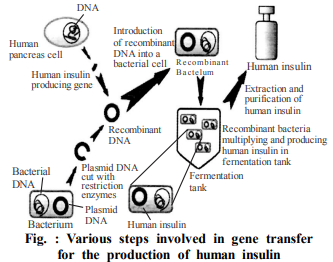
The method developed by Eli Lilly using R-DNA technology has received great support from diabetic patients. Explain, how?
Answer

Image
Eli Lilly prepared two DNA sequences corresponding to the A and B chains of human insulin and introduced them into a plasmid of E. coli for the production of insulin chains A and B. Chains A and B were produced separately, extracted and converted into human insulin. Combined by forming a disulfibond to make insulin. Insulin is synthesized in the human pancreas as a pro-hormone containing a C peptide, which is cleaved into the mature hormone. Insulin synthesized by recombinant DNA technology did not contain the C peptide and was prepared in the mature form.
View full question & answer
Question 43 Marks
What are 'cry-proteins'? Explain with the help of a suitable example how it works as a biopesticide.
Answer
The toxic insecticidal protein produced by Bacillus thuringiensis at a special stage of growth is called cry protein. The gene encoding this protein is called 'Cry'. This protein is in the form of inactive poison and as soon as the insect eats this inactive poison, the particles of this protein become soluble due to alkaline pH in the intestine of the insect and get converted into active form and stick to the lining of the middle intestine. Create holes due to which the cells swell and burst and the insect dies. This property of BT has been used in many crop plants like cotton, maize, paddy etc. in which BT toxin genes get cloned from bacteria and create resistance against insects/pests in these plants. For example :
(i) CryI AC controls cotton bollworm. (ii) CryI ab controls corn borer.
View full question & answer
Question 53 Marks
By which technique are the gene defects identified in a child or fetus treated? Explain with example.
Answer
Gene therapy is used to correct gene defects identified in a child or fetus. In this, genes are introduced into the cells or tissues of a person to treat the disease. To treat cells with genetic defects, normal genes are transferred to the person or embryo, which compensate for the dysfunctional gene and perform its functions.
Gene therapy was first used in 1990 to overcome adenosine deaminase (ADA) deficiency in a four-year-old girl. This enzyme is essential for the functioning of the immune system. This deficiency occurs because the gene responsible for adenosine deaminase disappears. In gene therapy, first of all lymphocytes are extracted from the patient's blood and cultured outside the body. The cDNA of activated ADA is introduced into the lymphocyte (using a post-viral vector) and ultimately returned to the patient's body. These cells are usually dead, hence the genetically engineered lymphocytes need to be removed from the patient's body from time to time. If good genes isolated from bone marrow cells - produced from early embryonic cells - are introduced into ADA, then this could be a permanent treatment.
View full question & answer
Question 63 Marks
Write any four benefits of using GM plants.
Answer
The use of genetically modified crops (GM crops) is beneficial because through genetic modification :
(i) Creation of crops more tolerant to abiotic stresses (cold, drought, salt, heat).
(ii) To reduce dependence on chemical pesticides (pesticide-resistant crops).
(iii) Helpful in reducing post-harvest losses.
(iv) Increase in mineral utilization capacity by plants (it prevents early depletion of soil fertility).
(v) Increase in nutritional level of foods: e.g. Vitamin A rich paddy.
Along with the above uses, the use of GM is helpful in creating suitable plants, from which fats, fuels and pharmaceuticals are supplied to industries as alternative resources.
View full question & answer