Question 15 Marks
(i) Define standing crop.
(ii) Explain important steps in the process of decomposition in a terrestrial ecosystem.
(ii) Explain important steps in the process of decomposition in a terrestrial ecosystem.
Answer
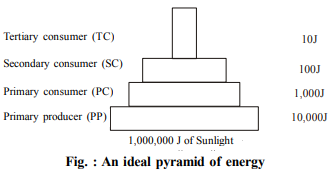
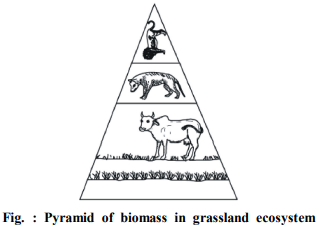
View full question & answer→(i) Standing crop : Each trophic level has a certain mass of living material at a particular time called as the standing crop. The standing crop is measured as the mass of living organisms (biomass) or the number in the unit area.
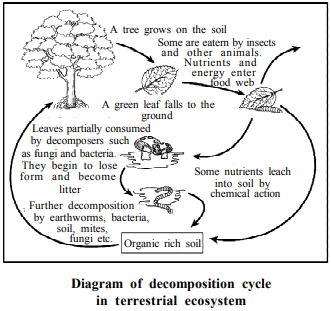
(ii) All living beings existing on earth eventually die. Decomposers breakdown the dead body into its components. Earthworms are being referred to as the farmer's 'friend' because they help in the breakdown of complex organic matter as well as in loosening of the soil. Similarly, decomposers breakdown complex organic matter into inorganic substances like carbon dioxide, water and nutrients and the process is called decomposition. Dead plant remains such as leaves, bark, flowers and dead remains of animals including fecal matter, constitute detritus, which is the raw material for decomposition. The important steps in the process of decomposition are fragmentation, leaching, catabolism, humification and mineralisation.
Detritivores (e.g. earthworm) breakdown detritus into smaller particles. This process is called fragmentation. By the process of leaching, water-soluble inorganic nutrients go down into the soil horizon and get precipitated as unavailable salts. Bacterial and fungal enzymes degrade detritus into simpler inorganic substances. This process is called as catabolism.
It is important to note that all the above steps in decomposition operate simultaneously on the detritus. Humification and mineralisation occur during decomposition in the soil.
Humification leads to accumulation of a dark coloured amorphous substance called humus that is highly resistant to microbial action and undergoes decomposition at an extremely slow rate. Being colloidal in nature it serves as a reservoir of nutrients. The humus is further degraded by some microbes and release of inorganic nutrients occur by the process known as mineralisation.
Decomposition is largely an oxygen-requiring process. The rate of decomposition is controlled by chemical composition of detritus and climatic factors. In a particular climatic condition, decomposition rate is slower if detritus is rich in lignin and chitin, and quicker, if detritus is rich in nitrogen and water soluble substances like sugars. Temperature and soil moisture are the most important climatic factors that regulate decomposition through their effects on the activities of soil microbes. Warm and moist environment favour decomposition whereas low temperature and anaerobiosis inhibit decomposition resulting in build up of organic materials.
(ii) All living beings existing on earth eventually die. Decomposers breakdown the dead body into its components. Earthworms are being referred to as the farmer's 'friend' because they help in the breakdown of complex organic matter as well as in loosening of the soil. Similarly, decomposers breakdown complex organic matter into inorganic substances like carbon dioxide, water and nutrients and the process is called decomposition. Dead plant remains such as leaves, bark, flowers and dead remains of animals including fecal matter, constitute detritus, which is the raw material for decomposition. The important steps in the process of decomposition are fragmentation, leaching, catabolism, humification and mineralisation.
Detritivores (e.g. earthworm) breakdown detritus into smaller particles. This process is called fragmentation. By the process of leaching, water-soluble inorganic nutrients go down into the soil horizon and get precipitated as unavailable salts. Bacterial and fungal enzymes degrade detritus into simpler inorganic substances. This process is called as catabolism.
It is important to note that all the above steps in decomposition operate simultaneously on the detritus. Humification and mineralisation occur during decomposition in the soil.
Humification leads to accumulation of a dark coloured amorphous substance called humus that is highly resistant to microbial action and undergoes decomposition at an extremely slow rate. Being colloidal in nature it serves as a reservoir of nutrients. The humus is further degraded by some microbes and release of inorganic nutrients occur by the process known as mineralisation.
Decomposition is largely an oxygen-requiring process. The rate of decomposition is controlled by chemical composition of detritus and climatic factors. In a particular climatic condition, decomposition rate is slower if detritus is rich in lignin and chitin, and quicker, if detritus is rich in nitrogen and water soluble substances like sugars. Temperature and soil moisture are the most important climatic factors that regulate decomposition through their effects on the activities of soil microbes. Warm and moist environment favour decomposition whereas low temperature and anaerobiosis inhibit decomposition resulting in build up of organic materials.